Regenerative viticulture: what it actually means for your vineyard
TL;DR
- Regenerative viticulture is a soil-first approach to grape growing.
- It combines cover cropping, reduced tillage, compost, integrated pest management, and grazing livestock to rebuild soil organic matter and biodiversity.
- There's no single legal definition, no mandatory federal certification, and no shortcut.
- Measurable agronomic results usually take three to five years to show up in the ground.
What is regenerative viticulture and how is it different from organic or biodynamic?
Regenerative viticulture is a set of farming practices aimed at improving soil health over time, more than holding it steady. That's the cleanest line between it and organic. Organic certification tells you what you can't spray. Regenerative is about what you're actively building. Soil organic matter, microbial diversity, water infiltration, and above-ground biodiversity are the metrics practitioners actually watch.
Organic certification under USDA's National Organic Program [1] is a legal standard with an accredited certifier, annual fees, and an approved materials list. Biodynamic certification (Demeter USA) layers a specific farming calendar and a closed-farm-system philosophy on top of organics [2]. Regenerative has neither of those constraints. You can farm regeneratively without being certified organic, or you can do all three at once.
The Rodale Institute helped popularize the term "regenerative organic" in the 1980s. It later published a framework built around five pillars: soil health, animal welfare, farmer and worker fairness, crop and livestock integration, and progressively reduced external inputs [3]. Viticulture-specific programs like the California Sustainable Winegrowing Alliance (CSWA) and LIVE (Low Input Viticulture and Enology) in Oregon borrow that thinking but lean on practical, measurable on-farm benchmarks instead of philosophy.
Here's the honest version. Regenerative viticulture is not a regulated term. Anyone can paint it on a tasting-room sign. What separates a real practitioner from a marketing line is a documented, multi-year trajectory of improving soil biology, not a list of practices.
What are the core practices of regenerative viticulture?
Six practices show up again and again across university extension guidance, certification programs, and peer-reviewed research. None of them is mandatory in every context. The right mix depends on your soil type, climate, water access, and labor budget.
Cover cropping. Seeding permanent or seasonal cover crops in row middles (and sometimes under the vine canopy) is the most widely adopted regenerative practice in vineyards. UC Davis Cooperative Extension research shows cover crops can increase soil organic carbon by 0.1 to 0.3 percentage points over five years in California wine country soils, depending on species mix and irrigation [4]. Legume mixes fix nitrogen. Brassica mixes can suppress nematodes. Native grass mixes build structure and feed beneficial insects.
Minimal or no-till. Every tillage pass kills fungal networks and releases stored carbon. Cut tillage frequency and mycorrhizal networks re-establish, which improves vine nutrient uptake without a single purchased input. That said, some tillage is a legitimate weed tool, especially in wet climates with heavy weed pressure under the row.
Compost application. Good compost adds living microbiology more than it adds nutrients. Cornell Cooperative Extension guidance notes that finished compost should have a C:N ratio between 10:1 and 20:1 and stable respiration rates before it goes on the field [5]. Applied at 2 to 4 tons per acre a year, compost reliably improves water-holding capacity in sandy or beat-up vineyard soils.
Integrated pest management (IPM). IPM isn't unique to regenerative farming, but it's a cornerstone of it. You monitor pest populations before spraying, set economic thresholds, and reach for the least-disruptive effective tool first. Washington State University Extension runs one of the best regional IPM programs for tree fruit and vineyards in the Pacific Northwest [6].
Sheep or poultry integration. Grazing sheep in dormant-season rows is common in California and Oregon. They eat cover crop biomass, drop manure, and knock back weeds without diesel. The catches: predator pressure, vine damage risk (bad in spring), and the paperwork that comes with running a livestock operation.
Reduced synthetic inputs. Regenerative programs generally move toward dropping synthetic herbicides and synthetic nitrogen, though the pace is gradual. Cut synthetic N cold turkey in a low-organic-matter vineyard and you can stress vines for two to three years before the soil biology catches up.
Does regenerative viticulture actually improve soil health, and what does the research say?
The evidence is real but unevenly spread. Most of the strong data comes from row-crop farming (corn, wheat, soy). Vineyard-specific studies are fewer, smaller, and shorter. That caveat matters.
A 2021 meta-analysis in Nature Plants found that cover cropping across diverse systems increased soil organic matter by a mean of 3.3% and improved aggregate stability by a mean of 12% against bare-soil controls, though high site-to-site variability made specific predictions hard [7]. Vineyard subsets in European studies show the same direction with more scatter, probably because of how vine row management, irrigation, and soil texture pull on each other.
On microbial diversity, UC Davis researchers published findings in 2019 showing that vineyards under reduced tillage and cover crops carried higher fungal-to-bacterial biomass ratios and more diverse arbuscular mycorrhizal fungal communities than conventionally managed blocks in the same region [4]. That diversity matters because it drives nutrient cycling, disease suppression, and drought resilience in ways synthetic fertilizer can't fully copy.
Now water. Cover-cropped vineyard soils in a UC Cooperative Extension trial in Napa and Sonoma counties showed infiltration rates roughly double those of tilled, bare-soil controls after four years. In a drought environment where every inch of rain counts, that's a real agronomic win, not a feel-good number.
The honest caveat: nobody has clean, replicated data on yield and wine quality from regenerative management at scale in U.S. vineyards. The closest thing is Rodale's Farming Systems Trial, running past 40 years, but it covers grain crops, not grapes [3]. Anecdote from growers is everywhere. Controlled trials are not.
Is there a certification for regenerative viticulture in the U.S.?
There are several, and they are not equal.
| Program | Administered by | Requires organic cert first? | Vineyard-specific? | Approximate cost |
|---|---|---|---|---|
| Regenerative Organic Certified (ROC) | Rodale Institute / ROC Alliance | Yes (USDA NOP) | No (all crops) | $1,000 to $3,500/yr by operation size |
| Certified Sustainable (CSWA) | California Sustainable Winegrowing Alliance | No | Yes (wine grapes) | Sliding scale, typically $500 to $2,000/yr |
| LIVE Certification | Low Input Viticulture and Enology | No | Yes (Pacific NW) | ~$400 to $900/yr |
| Demeter Biodynamic | Demeter USA | Requires NOP or equivalent | No (all farms) | $650 to $2,500/yr |
| SIP Certified | Sustainability in Practice | No | Yes (CA wine grapes) | $400 to $1,500/yr |
ROC is the strictest. It stacks three existing certifications (USDA Organic, Animal Welfare Approved or equivalent, and Fair Trade or equivalent) plus soil health improvement benchmarks. If you're not already certified organic, the road to ROC is a multi-year, multi-fee slog.
For most small vineyards, CSWA or LIVE is the practical entry point. Both use third-party audited self-assessment scorecards and require documented improvement over time, which fits regenerative principles without demanding you be 100% organic on day one.
The California Department of Food and Agriculture does not regulate the term "regenerative" as a marketing claim as of 2024. Neither does USDA's Agricultural Marketing Service for wine grapes specifically. So the certification you pick is about market access and your own documentation integrity, not legal compliance.
What does regenerative viticulture cost, and when does it pay back?
This is where the honest answer gets messy, because costs swing hard with starting soil condition, labor rates, water access, and how fast you cut external inputs.
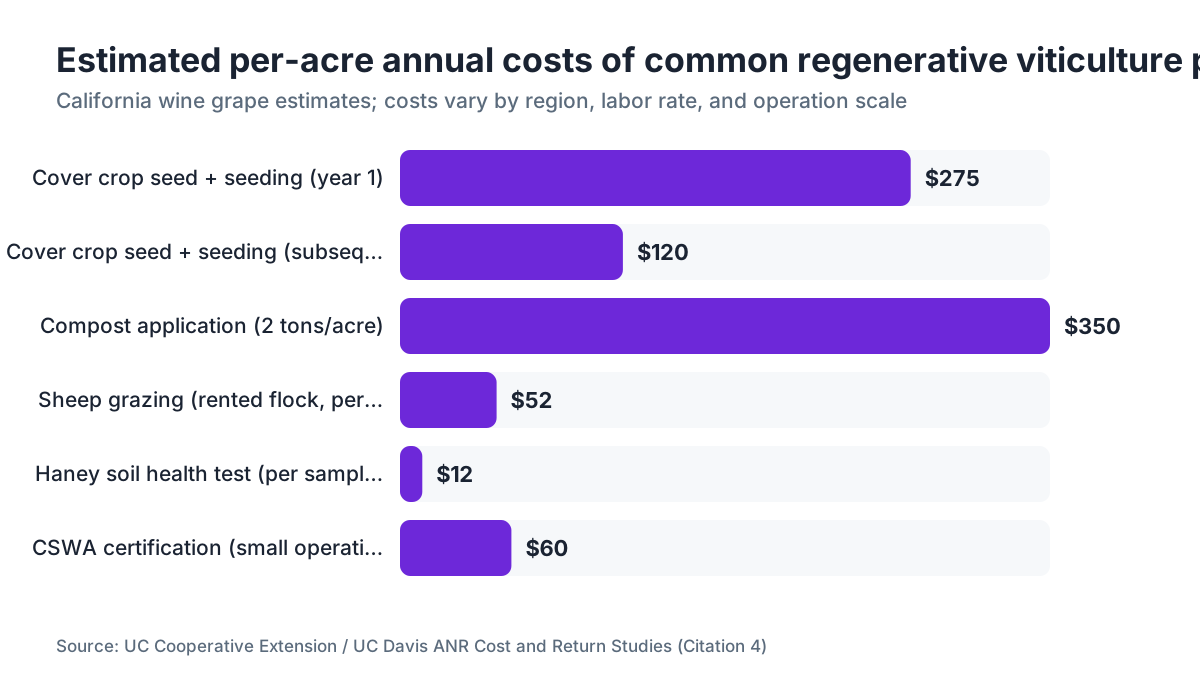
Cover crop establishment runs roughly $150 to $400 per acre in California for seed, seeding equipment, and first-year irrigation (from UC Cooperative Extension's cost-of-production studies for wine grapes) [4]. A custom compost application (2 tons per acre) plus spreading labor runs $200 to $500 per acre on the Central Coast, depending on haul distance. Sheep integration, if you rent a flock, runs roughly $30 to $75 per acre per season across the Pacific Northwest and California, though fencing and predator management add fixed costs.
The savings side is real but delayed. Synthetic nitrogen costs roughly $0.50 to $0.65 per lb of actual N as of 2024 (UAN 32% solution). A mature cover-cropped, composted block with active legume biomass can supply 40 to 80 lbs of plant-available N per acre a year [5], which at those rates is $20 to $52 per acre in fertilizer you didn't buy. Not transformative in year one. After ten years of compounding soil improvement, the math looks very different.
Water is the sleeper benefit. In California's premium appellations, water costs $200 to $800-plus per acre-foot depending on district. A documented gain in soil water-holding capacity of even 0.5 inches per foot of profile across a 30-acre estate block adds up to real avoided irrigation over a dry summer. That math is hard to run precisely without site data, but the effect is real.
Most growers describe a three-to-five year transition window where input costs run higher than a steady-state conventional program (you're adding compost before you've cut fertilizer) before the economics turn. Plan your cash flow around that window.
How do regenerative practices affect spray programs and worker protection compliance?
Regenerative viticulture doesn't wipe out your pesticide program. Most vineyards in transition still use some approved fungicides (copper and sulfur in organic-approved programs, or conventional fungicides in non-certified ones), and every one of those triggers EPA Worker Protection Standard (WPS) requirements no matter your farming philosophy.
The EPA's Worker Protection Standard, revised in 2015 and enforced under 40 CFR Part 170, requires agricultural employers to provide pesticide safety training, post application-specific information at a central location, keep pesticide application records for two years, and supply decontamination materials [8]. These apply whether you spray a synthetic or an OMRI-listed biological. The WPS doesn't care about your certifications.
Where regenerative programs change the compliance picture is frequency and product complexity. A vineyard that drops from 12 to 18 spray passes a season to 6 to 8 targeted passes using IPM thresholds generates fewer records, shorter restricted entry intervals (REIs), and lower aggregate exposure for workers. That's a real safety benefit, and it's simpler to document.
Here's the twist. If you keep spray records by hand or in a spreadsheet, a multi-practice regenerative program actually adds documentation burden, because now you're tracking soil amendments, compost sources, cover crop inputs, and grazing logs alongside pesticide records. A platform like VitiScribe can pull those field operation records into one file so your compliance history is audit-ready whether you're facing a state ag department inspection or a third-party certification audit.
For organic certification specifically, the National Organic Program requires that every material applied to fields be documented with product name, EPA registration number (or OMRI listing), application date, rate, and target pest or purpose. That's 7 CFR Part 205 in the Code of Federal Regulations [1]. Keep those records for five years minimum. NOP auditors typically ask for three to five years of history at renewal.
How do you transition a vineyard to regenerative management without wrecking a vintage?
Transition risk is real, and it's mostly agronomic, not regulatory. The two biggest risks are nitrogen drawdown and weed pressure.
Nitrogen drawdown happens when you stop synthetic N before your soil biology can mineralize enough N from organic matter. Vines show it as pale, slow shoots in spring, weak fruit set, and lower yields. The fix is gradual substitution. Cut synthetic N by 25 to 30% in year one, replace with compost and a legume cover crop, and check petiole nitrate levels at bloom each year to confirm the biology is catching up.
Weed pressure under the vine row jumps the moment you drop synthetic herbicide. The alternatives (cultivation, hand weeding, mulch, flame weeding, undervine cover crops) all cost more and take more labor in the first two years. Organic-approved herbicides like acetic acid (concentrated vinegar) or clove oil formulations exist, but they carry soil pH effects with repeated use.
A practical sequence extension advisors generally recommend:
- Year 1: Establish permanent cover crop in row middles. Hold your existing spray and fertilizer program. Add a soil health baseline (Haney test or biological activity test).
- Year 2: Begin compost applications. Cut synthetic N by 25 to 30%. Pilot undervine mulching in one block.
- Year 3: Put formal IPM thresholds in place. Reduce tillage frequency. Keep monitoring petioles.
- Year 4 and beyond: Weigh inputs against soil biology output. Pursue certification if the market pays for it.
This isn't the only path, but it's conservative enough to protect fruit quality through the transition.
What soil health metrics should you actually track in a regenerative vineyard?
Metric selection matters more than test frequency. You can test soil every year and learn nothing if you're measuring the wrong things.
Conventional soil tests measure pH, CEC, macronutrient concentrations (N, P, K, Ca, Mg), and sometimes micronutrients. Those are still worth running yearly. But they tell you nothing about biological activity, which is exactly the dimension regenerative practices move.
The Haney Soil Health Test (developed by USDA ARS researcher Rick Haney) adds three biological metrics: soil respiration (CO2 burst), water-extractable organic carbon, and water-extractable organic nitrogen. The ratio of these gives a "soil health score" that tracks reasonably well with mineralizable N availability [9]. Commercial labs including A&L Western, Waypoint Analytical, and Ward Laboratories run the Haney test for roughly $45 to $75 per sample.
Other useful metrics: aggregate stability (how well soil holds together when wet), penetration resistance (a proxy for compaction), and earthworm counts (crude but fast). For microbial biomass, PLFA (phospholipid fatty acid) analysis is the gold standard, but it costs $150 to $250 per sample. Most growers run PLFA every two to three years as a trend check, not annually.
Test the same blocks, at the same time of year (late winter or early spring before growth), in the same spots within the block, every year. Soil health metrics vary wildly across a vineyard. Consistency in your sampling protocol matters more than which lab you use.
A simple spreadsheet tracking year-over-year trends in three or four key metrics is enough to show improvement to a certifier or a buyer. You don't need a Ph.D. to see whether your soil respiration is going up.
How does regenerative viticulture interact with water use and irrigation management?
Water is where regenerative viticulture has its clearest, most immediately measurable payoff in dry western wine regions.
Soil organic matter holds roughly 20 times its weight in water. A soil that climbs from 1% to 2% organic matter in the top 12 inches gains about 0.5 to 1.0 inch of extra water storage per foot of profile [4]. Across a 30-acre block, that's a real buffer during a dry stretch between irrigation events.
Cover crops and mulch cut soil surface evaporation. UC Cooperative Extension trials in Paso Robles and Livermore showed 15 to 25% reductions in applied irrigation in cover-cropped blocks versus tilled bare-soil controls over three years, though cover crop competition for water in summer can partly cancel that benefit if the covers aren't mowed or rolled in time.
For regulated deficit irrigation (RDI), which most premium California vineyards practice to control vine vigor and berry size, healthier soil biology means steadier water uptake by vine roots. The mycorrhizal networks that regenerative practices encourage act as an extension of the root system, reaching water and phosphorus in pore spaces roots can't touch directly.
California water rights and metered irrigation records may be required depending on your source (SWRCB surface water rights, groundwater sustainability agency reporting under SGMA). Regenerative practices don't add new water compliance requirements, but they can cut your reportable water use over time, which matters in adjudicated basins.
The Paso Robles wine region, sitting in one of California's most contested groundwater basins, has seen heavy adoption of regenerative practices partly for water-reduction reasons.
How do you document regenerative practices for certification audits and buyers?
Documentation is where a lot of well-meaning regenerative programs fall apart. You can do everything right in the field and still fail a certification audit because the records aren't there.
Most third-party programs (CSWA, LIVE, ROC) require:
- Annual soil health test results with year-over-year comparison.
- Cover crop species and seeding records (date, rate, species mix, location by block).
- All pesticide and fertility inputs with dates, rates, products, and applicators.
- Any livestock integration records, including species, dates, duration, and stocking rate.
- A written farm plan describing your regenerative goals and the practices you're using to hit them.
Buyers, especially in export markets, increasingly ask for a farm sustainability summary. The Wine Institute's California Code of Sustainable Winegrowing, which CSWA administers, provides a standardized self-assessment workbook that maps directly to what most wholesale buyers now request in their supplier ESG questionnaires.
For WPS compliance, your pesticide application records already have to be kept for two years under federal law [8]. Keeping those in the same system as your soil amendment and cover crop records means a single audit-ready file instead of three separate binders.
VitiScribe tracks spray records, field operations, and amendment applications in one place, which earns its keep when a certification auditor or a Tier 1 retail buyer asks for a two-year history across all your blocks.
One practical note: take dated photos. Aerial or ground-level shots of cover crop establishment, sheep grazing, compost spreading, and soil sampling aren't required by most programs, but they're powerful supporting evidence that costs nothing to collect.
What are the marketing and commercial benefits of regenerative viticulture for small wineries?
The honest answer is that the market signal is real but uneven, and it swings hard by sales channel.
Direct-to-consumer (tasting room, wine club, mailing list) is where regenerative messaging delivers the clearest premium. People who visit your vineyard and taste your wines respond to the story of soil health, biodiversity, and long-term stewardship. A two-minute explanation of your cover crop program over a barrel tasting does more for retention than any digital ad.
Wholesale and on-premise accounts are trickier. Most restaurant sommeliers and retail buyers in the $20 to $40 bottle segment treat regenerative as a tiebreaker, not a primary reason to list. They're buying on flavor, value, and relationship. Regenerative certification might get you a meeting with a specialty natural wine buyer you wouldn't otherwise land, but it won't move 200 cases on its own.
Export is the most complicated channel of all. The EU's Farm to Fork strategy and its embedded sustainability requirements for imported agricultural products are tightening, and third-party certified sustainable or regenerative documentation will become a table-stakes requirement for some EU market segments within the next five to ten years. Nobody can give you a precise date. The regulatory direction is clear.
The California Sustainable Winegrowing Alliance reported that 43% of California wine grape growers and 60% of California wine production volume took part in its certified sustainable program as of its 2022 annual report [10]. That penetration means "sustainable" is becoming a floor, not a differentiator, and "regenerative" is where the differentiation is moving.
One thing to be clear about: regenerative certification does not automatically command a price premium at the wholesale level in 2024. It changes conversations. It opens doors. The premium, if it shows up, comes from the relationship and the wine, not the logo on the back label.
Which extension programs and resources are most useful for vineyard managers starting out?
Three university extension programs have published the most practically useful, vineyard-specific guidance on regenerative and sustainable practices in the U.S.
UC Cooperative Extension (UC Davis) produces the California Sustainable Winegrowing Cost of Production Studies [4], the IPM guidelines for wine grapes, and soil health publications tied to the California Department of Food and Agriculture's Healthy Soils Program. Start with the ANR Publication 3520 series on grapevine nutrition and the IPM guidelines at ipm.ucanr.edu.
Cornell Cooperative Extension covers the northeast and Great Lakes wine regions. Their viticulture team publishes the VineBalance sustainability assessment tool and detailed cover crop species recommendations for cold-climate vineyards [5]. Their compost quality guidance is among the best publicly available anywhere.
Washington State University Extension [6] covers the Pacific Northwest and publishes annual spray guides, IPM threshold data for Willamette and Columbia Valley pests, and cover crop trials specific to those climates. Their Pacific Northwest Pest Management Handbooks are co-published with Oregon State University and are searchable online.
Beyond university extension: the Napa Green certification program (napavintners.com) and the CSWA's California Code of Sustainable Winegrowing Workbook are free to download and give you structured self-assessment frameworks even if you never pursue formal certification.
For federal help, the USDA Natural Resources Conservation Service (NRCS) runs the Environmental Quality Incentives Program (EQIP), which offers cost-share payments for cover crop establishment, compost application, and irrigation efficiency on farms including vineyards [11]. EQIP payments for cover cropping in California run roughly $30 to $100 per acre depending on practice code and local office rates. That's real money on a 50-acre estate.
Frequently asked questions
Is regenerative viticulture the same as organic viticulture?
No. Organic certification (USDA National Organic Program) is a legal standard defining prohibited inputs. Regenerative viticulture is a broader soil-and-ecosystem improvement framework with no single legal definition. You can farm regeneratively without organic certification, or you can be certified organic and hit no regenerative benchmarks if you're just swapping in approved inputs without improving soil biology.
How long does it take to see measurable soil health improvements from regenerative practices?
Most research and grower experience puts the visible inflection point at three to five years. Biological activity metrics like soil respiration can improve within one to two seasons after cover crop establishment. Soil organic matter percentage changes slower, typically 0.1 to 0.2 percentage points per year under good management, and needs consistent annual testing at the same time and location to detect reliably.
Can I use the word 'regenerative' on my wine label or tasting room materials without certification?
Yes, as of 2024. The USDA and the TTB do not regulate 'regenerative' as a defined marketing claim for wine or wine grapes. You can use the term without certification. That said, sharp buyers and journalists increasingly ask what it means in practice, and without documentation you're exposed to greenwashing accusations. Third-party certification is the cleanest defense.
What cover crops work best in vineyard row middles in California?
It depends on your goals. For nitrogen fixation, purple vetch (Vicia benghalensis) and bell beans do well in Northern California winters. For weed suppression and fast biomass, a cereal rye or triticale mix works. For pollinator habitat and soil biology, a diverse wildflower and native grass blend is ideal but slower to establish. UC Cooperative Extension's Cover Crop Resource Page lists region-specific species mixes.
Does regenerative viticulture reduce the need for pesticide applications?
Over time, yes, for some pests. Healthier soils and diverse plant communities support predatory insects that suppress mite populations and some sucking pests. But fungal diseases like powdery mildew and botrytis are driven by humidity and canopy density, not soil health, and still need active spray programs even in fully regenerative vineyards. The drop in applications comes from IPM-guided timing, not from biology alone.
What USDA programs offer financial assistance for regenerative vineyard practices?
The NRCS Environmental Quality Incentives Program (EQIP) covers cover crop establishment, nutrient management planning, irrigation efficiency, and compost application, all of which fit regenerative practice. Payment rates vary by state and practice code. Contact your local NRCS service center for current rates. The USDA also offers the Conservation Stewardship Program (CSP) for operations with existing conservation practices that want to layer on more enhancements.
How does the EPA Worker Protection Standard apply to regenerative vineyards that use only OMRI-listed products?
The WPS (40 CFR Part 170) applies to any pesticide covered by FIFRA, including most OMRI-listed products like copper fungicides, sulfur, and biological agents that carry EPA registration numbers. Training, central posting, REI compliance, and two-year recordkeeping are required whether or not the product is organic-approved. Some exemptions exist for very low-toxicity products; check the specific product label.
What is the Haney Soil Health Test and should I use it?
The Haney test, developed by USDA ARS researcher Rick Haney, measures soil respiration, water-extractable organic carbon, and water-extractable organic nitrogen alongside conventional chemistry. The CO2 burst value (1-day respiration) is the most diagnostic single number for biological activity. It costs roughly $45 to $75 at most commercial labs. For regenerative benchmarking, yes, run it annually alongside your standard soil chemistry panel.
Is grazing sheep in vineyards practical for small operations?
It's practical in the dormant season (November through February in most western regions) when vines are dormant and shoot damage risk is low. The main barriers are predator management (livestock guardian dogs or night penning), fencing costs, and the liability and logistics of managing animals you may not own. Many small vineyards rent flocks from local shepherds on a per-acre per-season basis, which sidesteps the fixed-cost problem.
How do regenerative vineyard practices affect irrigation water use over time?
Raising soil organic matter by 1 percentage point in the top 12 inches adds roughly 0.5 to 1.0 inch of available water storage per foot of profile. UC Cooperative Extension trials found 15 to 25% reductions in applied irrigation in cover-cropped versus bare-soil blocks after three or more years. The benefit compounds: better structure, lower evaporation, and more active root-mycorrhizal networks all cut irrigation demand at once.
What's the best way to document regenerative practices for a certification audit?
Annual soil health tests (same blocks, same season, same locations) are the foundation. Layer in dated records for cover crop seeding, compost applications with product documentation, all pesticide and fertility inputs per WPS and NOP requirements, and livestock integration logs if applicable. Dated photographs add context. Keep everything in one organized file, physical or digital, that you can hand to an auditor without scrambling.
Do regenerative vineyard wines command a price premium?
In the direct-to-consumer channel, yes, when the story is told well. In wholesale and on-premise, regenerative certification is more often a tiebreaker than a primary driver in 2024. Export markets, particularly in the EU, are moving toward requiring sustainability documentation, which may make certification more commercially essential within five to ten years. The premium today comes from the relationship and the wine, not the label claim alone.
Can cover crops compete with grapevines for water in dry climates?
Yes. In Mediterranean climates without summer rain, permanent cover crops must be managed carefully to avoid vine water stress. Most California growers mow or roll cover crops in late April or May to terminate active growth before the dry season. Annual covers die back naturally. Undervine covers in dry-farmed blocks need particular attention. UC Davis recommends resident vegetation management and deficit irrigation monitoring to keep vine water status in target range.
Sources
- USDA Agricultural Marketing Service, National Organic Program: NOP certification requirements, approved materials, and recordkeeping rules under 7 CFR Part 205
- Demeter USA, Biodynamic Farm Certification Standards: Biodynamic certification requirements and relationship to organic certification
- Rodale Institute, Regenerative Organic Certification White Paper: Rodale Institute's five-pillar framework for regenerative organic agriculture and long-term Farming Systems Trial
- UC Cooperative Extension / UC Davis ANR, Wine Grape Cost and Return Studies and Soil Health Publications: Cover crop establishment costs, soil organic carbon improvement rates, and irrigation water reduction data in California vineyards
- Cornell Cooperative Extension, Compost and Soil Health Resources: Finished compost C:N ratio standards and N supply estimates from compost and cover crops
- Washington State University Extension, Viticulture and Integrated Pest Management: IPM threshold data and Pacific Northwest pest management guidance for vineyards
- Nature Plants, 2021 meta-analysis on cover cropping effects on soil organic matter: Cover cropping increased soil organic matter by a mean of 3.3% and aggregate stability by 12% relative to bare-soil controls across diverse cropping systems
- EPA, Agricultural Worker Protection Standard (40 CFR Part 170): WPS training, central posting, REI, decontamination, and two-year pesticide application recordkeeping requirements
- USDA Agricultural Research Service, Haney Soil Health Test methodology: Haney test biological metrics including soil respiration CO2 burst, water-extractable organic C and N, and soil health scoring
- California Sustainable Winegrowing Alliance, 2022 Annual Report: 43% of California wine grape growers and 60% of California wine production volume participated in CSWA certified sustainable program as of 2022
Last updated 2026-07-09