Regulated deficit irrigation scheduling for Zinfandel in hot climates
TL;DR
- Regulated deficit irrigation (RDI) for Zinfandel in hot climates puts mild-to-moderate stress on the vine at specific growth stages to control vigor, concentrate berries, and cut sunburn risk.
- Midday stem water potential between -12 and -16 bar during the lag phase is the standard window.
- Miss it and you get raisined berries, uneven ripening, or both.
What is regulated deficit irrigation and why does it matter for Zinfandel?
Regulated deficit irrigation is a managed cut in water supply at defined growth stages, aimed at steering vine physiology toward a production goal instead of maximum canopy growth. You're doing more than saving water. You're using stress as a tool.
Zinfandel is notoriously uneven. The variety ripens asynchronously within a single cluster, a trait so consistent it has its own shorthand: raisining. Some berries reach full sugar while others sit green next to them. In hot climates like the San Joaquin Valley, Paso Robles, or the inland Lodi appellation, high evaporative demand pushes that unevenness harder because the vine fights heat load and drives sugar accumulation at the same time. RDI hands you a lever to slow that runaway process at the moments it matters [1].
The idea behind RDI is that vines tolerate real water deficits during certain phenological windows without losing yield or taking permanent damage, and those same deficits trim excess shoot growth, concentrate berry solutes, and set the canopy you'll manage for the rest of the season. Timing and depth of stress are everything. Get it wrong and you've got raisins in August.
What growth stages should you target for RDI in Zinfandel?
Zinfandel answers to deficit stress differently depending on where the vine sits in its phenological calendar. UC Davis and UC Cooperative Extension work splits the season into four windows, and each one calls for a different play [1][2].
Budbreak through bloom (Stage 1). Not the time for deficit. Vines need full replacement irrigation, or close to it, to build early shoot growth and support even flowering. Stress here sets up uneven fruit set, which amplifies Zinfandel's already erratic cluster development. Replace 100 percent of estimated evapotranspiration (ETc) through bloom.
Fruit set through lag phase (Stage 2, roughly 4 to 10 weeks post-bloom). This is your primary RDI window. Once berry cell division is essentially complete (about 4 weeks after full bloom), you can impose a controlled stress and the vine will take it. The target is midday stem water potential (SWP) of -12 to -14 bar for moderate RDI, or as deep as -16 bar on extremely vigorous vines with a dense canopy [1][3]. Staying above -10 bar here is basically no stress. Dropping below -18 bar risks permanent loss of photosynthetic capacity and jacks up raisin risk later.
Veraison through harvest (Stage 3). This is where most Zinfandel growers get burned. As sugars climb and berries soften, continued hard stress tips some berries into raisining before the rest of the cluster is ready to pick. Most research recommends easing the deficit back toward -10 to -12 bar at veraison for Zinfandel specifically, gentler than you'd run for Cabernet Sauvignon or Syrah [2][4]. In the hottest spots (San Joaquin Valley heat events, triple-digit inland Paso days), some growers back off further to -8 to -10 bar post-veraison to keep turgor in softening berries.
Post-harvest. Recover the vine. Run at or near full ETc replacement until dormancy to rebuild carbohydrate reserves. Zinfandel that's chronically stressed after harvest shows poor budbreak and erratic shoot development the following spring [2].
How do you measure vine water status in the field?
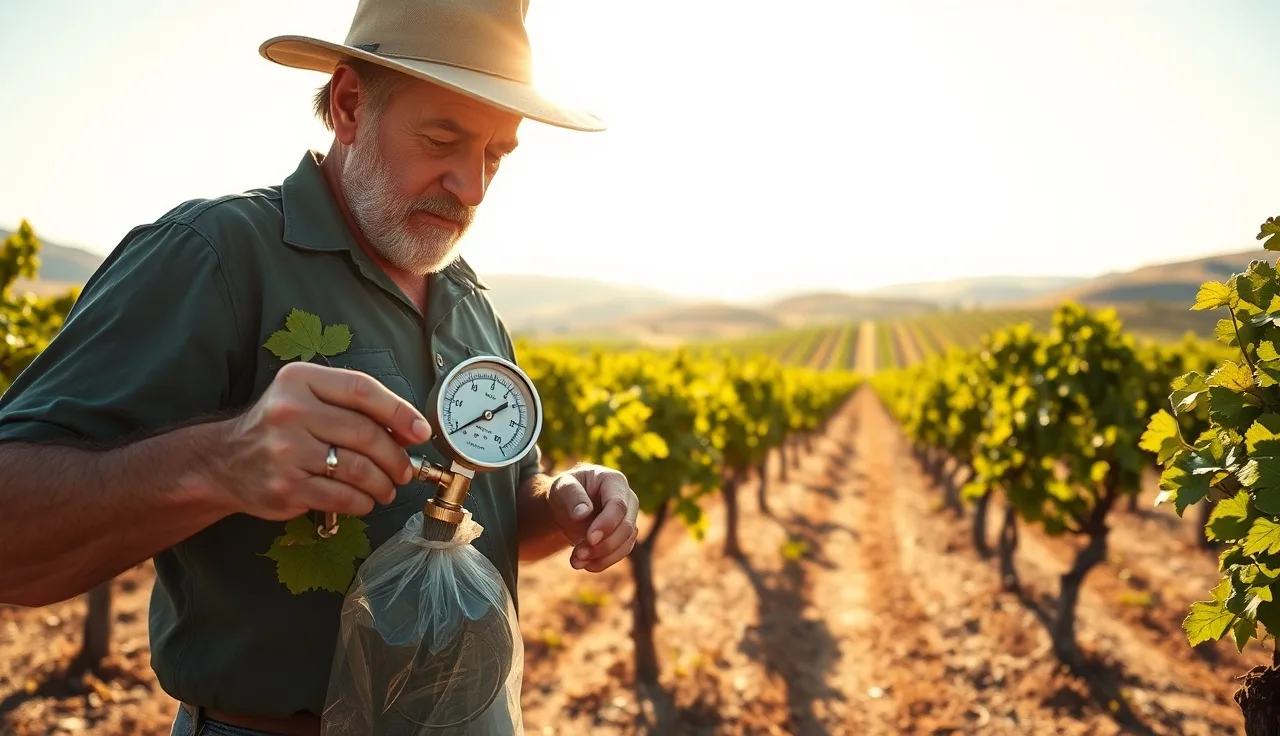
Stem water potential measured with a pressure chamber is the most reliable single field indicator for RDI in California winegrapes. UC Davis Viticulture and Enology, along with UC Cooperative Extension farm advisors in Fresno, Madera, and San Luis Obispo counties, have recommended SWP as the primary scheduling tool for over 20 years [1][3].
To take a proper reading, bag a mature, fully expanded leaf (not a sun-exposed tip leaf) in a reflective plastic bag 30 to 90 minutes before you read, then read at solar noon, roughly 11:30 a.m. to 1:30 p.m. The bag equilibrates the leaf with stem water potential by shutting down transpiration. Readings taken without bagging measure leaf water potential, which swings more with ambient conditions and is harder to read. On a 105 degree F day in Lodi, unbagged leaf readings can run 3 to 5 bar more negative than true SWP [3].
Baseline SWP in a fully irrigated Zinfandel vine on a moderate day (85 to 90 degrees F) often sits around -4 to -7 bar. As ETo climbs into the 8 to 10 mm/day range common in inland California summers, baseline SWP in a well-irrigated vine can naturally land at -8 to -10 bar with no deficit imposed at all. Account for that baseline when you read the numbers. The California Department of Water Resources treats documented water use records as part of Sustainable Groundwater Management Act (SGMA) reporting, and SWP logs support those records [5].
Other tools exist. Predawn leaf water potential (less common in production), dendrometers that track trunk diameter fluctuation, and soil moisture sensors all have a place. Soil sensors (capacitance probes, neutron probes, tensiometers) are genuinely useful for managing irrigation events but don't replace SWP for confirming vine stress level, because the link between soil moisture and vine water status shifts with rootstock, soil texture, and root depth in ways a soil sensor alone can't see [1].
What stem water potential targets should Zinfandel growers use in hot climates?
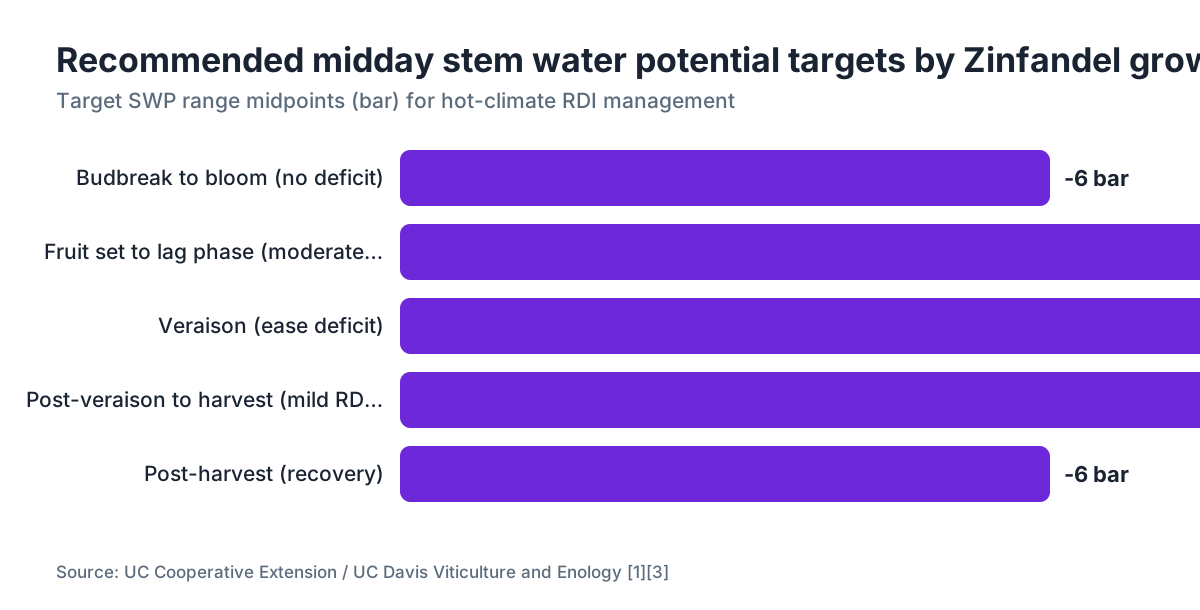
The table below pulls the SWP targets used in UC Cooperative Extension trial work and widely adopted across the San Joaquin Valley and Paso Robles. These are working ranges, not hard rules. A big canopy on deep loam buffers stress differently than a cordon-trained vine on sandy loam with a shallow rootzone.
| Growth Stage | Recommended SWP (bar) | Stress Level |
|---|---|---|
| Budbreak to bloom | -4 to -8 | No deficit (full ETc) |
| Fruit set to lag phase | -12 to -16 | Moderate to mild-severe |
| Veraison | -10 to -14 | Mild to moderate |
| Post-veraison to harvest | -8 to -12 | Mild (Zinfandel-specific) |
| Post-harvest | -4 to -8 | No deficit |
Source: UC Cooperative Extension Fresno / UC Davis Viticulture and Enology [1][3]
One practical warning. In a 100 degree F-plus heat event, even a well-irrigated Zinfandel vine can read -14 to -16 bar at noon with no water deficit in the root zone. If you're chasing a -14 bar target on a heat wave day and the soil is already at field capacity, you don't have a scheduling problem. You have a temporary thermal stress situation. Check predawn SWP, or wait 24 hours after the heat event before making irrigation calls on midday readings alone [1][3].
The most common mistake I see is treating these targets like thermostat settings. Real vineyards have variable soil, variable rootstocks, variable canopy density. Read SWP on at least five to eight representative vines across the block, drop the outliers, and use the block average. A single-vine reading tells you almost nothing.
How do you calculate how much water to actually apply?
The volume calculation starts with reference evapotranspiration (ETo), which the California Irrigation Management Information System (CIMIS) posts daily from weather stations across the state, many within a few miles of production vineyards [6]. From ETo you get ETc by multiplying by a crop coefficient (Kc) that varies with canopy cover and growth stage.
For mature Zinfandel with good canopy cover in a hot interior climate, Kc during the lag phase usually runs 0.45 to 0.65 depending on row spacing, canopy architecture, and whether you're running a mid-row cover crop [2]. A Kc of 0.55 on a 7 mm/day ETo day gives about 3.85 mm/day ETc, or roughly 0.15 acre-inches per acre per day. Over a 7-day interval, that's about 1.05 acre-inches.
To impose a deficit, you apply a fraction of that ETc. A 50 percent ETc replacement during the lag phase is a moderate deficit. Some UC trials have run 25 to 35 percent ETc replacement in the early lag phase for high-vigor Zinfandel blocks, then moved up to 50 to 60 percent later in the lag phase once the stress target is hit and holding [1][2].
Emitter output, system pressure uniformity, and soil infiltration all decide whether the calculated volume actually lands in the root zone at the right rate. A well-kept drip system with distribution uniformity (DU) above 85 percent gives you decent confidence the applied volume is what the vine gets. Below 80 percent DU, your delivery varies enough that SWP readings become your only reliable check [7]. Audit your drip system every year. It's cheap insurance.
How does heat spike risk change your RDI decisions?
Hot climates add a wrinkle that cooler regions rarely face: heat events can cause fast, irreversible berry damage when vines are already stressed. UC Davis research on berry temperature found that berry surface temperatures regularly run 8 to 15 degrees F above ambient air on south- and west-facing clusters with open canopies. That means a 105 degree F day can put berry surfaces at 113 to 120 degrees F [4].
Stack RDI stress (reduced turgor, less evaporative cooling from the canopy) on top of a heat event and you speed up raisining in Zinfandel berries that are already soft. The practical response is to irrigate before a forecast heat event, even if your regular schedule says the next application is 2 to 3 days out. A stress relief irrigation the morning before a spike, sized to bring SWP up 2 to 4 bar, is not abandoning your RDI program. It's running it. You resume the deficit after the event passes.
Some San Joaquin Valley growers use over-vine evaporative cooling (sprinklers or foggers) during extreme heat as an extra buffer. This is an active research area and the data on how well it works for RDI vineyards specifically is limited, but the anecdotal record from Lodi and Madera growers is generally positive for protecting berry integrity during post-veraison heat spikes.
What equipment do you need to run an RDI program reliably?
You don't need much expensive hardware to run RDI well. You do need a few things to run it right.
A calibrated pressure chamber (pressure bomb) is non-negotiable. Basic field units from PMS Instrument Company run $800 to $1,500. Without one you're guessing at vine stress, and guessing wrong with Zinfandel in August is expensive [3]. Budget for annual calibration, especially if the gauge has been dropped or cooked in a truck cab.
Access to CIMIS ETo data for your nearest station costs nothing [6]. Set up a free account, find your closest station, and pull daily ETo every morning through the irrigation season. If you're more than 5 to 7 miles from the nearest station in complex terrain (foothill Paso Robles, Sierra Nevada foothills), consider your own on-farm weather station. Campbell Scientific, Davis Instruments, and Onset HOBO all make units under $2,500 that work with CIMIS-formatted data.
Soil moisture sensors add a useful layer. A capacitance probe installed at two depths (12 inch and 24 inch in most Zinfandel situations) tells you how fast the soil profile draws down between irrigations and helps you catch system failures before they become vine stress events. Sentek, Meter Group (Decagon), and Irrometer all make reliable commercial units.
For field records, a paper log works. But once you're running multiple blocks with different stress targets and irrigation schedules, digital tools pay for themselves fast. Tools like VitiScribe are built around block-by-block irrigation scheduling and SWP logging, with the documentation trail that water reporting and third-party audits demand.
For Paso Robles growers, that documentation trail matters more every year. The Paso Robles Groundwater Basin has been under SGMA planning since 2014, and water use records keep moving further into the regulatory conversation [5].
How does RDI affect Zinfandel wine quality, and what does the research say?
The fruit quality case for RDI in Zinfandel is real, but the research picture has edges. A few things are well-supported by trial data.
Berry weight drops as stress deepens, usually a 10 to 25 percent cut in berry fresh weight at moderate to mild-severe stress during the lag phase [1][2]. Smaller berries mean a higher skin-to-juice ratio, which tends to raise color and tannin extraction potential. For a variety that often turns out jammy, dilute fruit in hot climates under full irrigation, that's usually a win.
Soluble solids at harvest are not reliably different between RDI and full-irrigation treatments in hot climates. The vines tend to hit similar Brix targets, just at different berry weights and earlier on the calendar [1]. The wine quality difference comes from concentration and skin ratio, not from higher sugar.
Anthocyanin and phenolic concentration tends to climb under moderate RDI. A UC Davis trial on San Joaquin Valley Zinfandel found higher total phenolics and anthocyanins in berries from vines held at -14 to -16 bar SWP during the lag phase versus fully irrigated controls, with no significant yield penalty in the moderate stress treatment [1]. Peer-reviewed work in the American Journal of Enology and Viticulture backs the same pattern for red winegrapes in hot climates [12].
Here's where it gets complicated. Severe stress (below -18 bar), or stress applied too late in the season after veraison when berries are soft, sharply raises raisin percentage in Zinfandel clusters. Nobody has perfectly clean published data on exactly where the threshold sits for every combination of clone, rootstock, soil, and climate. The practical consensus among Lodi and Paso growers and UC farm advisors is to start pulling stress back at veraison, and pull harder if daytime temperatures stay above 100 degrees F during berry softening.
What records do you need to keep for RDI compliance and audits?
Irrigation records are more than good farm management now. In California they're a regulatory expectation. SGMA compliance, third-party sustainability audits (Lodi Rules, SIP Certified, California Certified Sustainable Winegrowing), and some buyer contracts require documented water use records that go well past a handwritten note in a field notebook [5][8][11].
At minimum, your record for each irrigation event should capture date, block or zone irrigated, duration, flow rate or total applied volume in acre-inches, and the SWP reading or other vine stress indicator that triggered the event. If you're running a CIMIS-based ETc calculation, log the ETo value and Kc you used. That documentation supports your own scheduling decisions and any third-party review.
The EPA Worker Protection Standard (WPS) is relevant here too. If you apply soil-applied pesticides or fumigants alongside irrigation management (common in nematode programs for drip-irrigated vineyards), your pesticide application records need to be WPS-compliant and kept for two years, accessible to employees and inspectors [9]. The overlap between irrigation scheduling and chemigation is a real compliance area that gets overlooked.
For multi-block operations, block-by-block record-keeping is the only approach that holds up under audit. A spreadsheet with a single "vineyard irrigated" entry does nothing to prove you ran different RDI targets in your high-vigor Zinfandel on the valley floor versus your low-vigor hillside block. VitiScribe keeps records at the block level with time-stamped entries, which lines up with what sustainability certifiers and groundwater agency auditors actually want.
For Paso Robles growers, check the requirements from the Paso Robles Groundwater Sustainability Agency. The region's paso-robles-wineries community has been working through this compliance ground for several years now.
What are the most common RDI mistakes in hot-climate Zinfandel?
Starting the deficit too early is the most damaging mistake. Imposing stress before berry cell division is complete (before about 4 weeks post-bloom) cuts cell number and final berry size in a way that doesn't reliably buy you better quality. You lose yield without the concentration benefit you were after, because the cells simply never divided to their potential. Wait until the lag phase is clearly established [1][2].
Not adjusting for heat events is the second most common error. Growers set an irrigation schedule in June off average ETo, then don't adapt when a 10-day heat event pushes ETo from 6 mm/day to 9 mm/day. Vine stress deepens faster than expected, blows past the target window, and you get raisining before a single picker sets foot in the vineyard.
Ignoring canopy-to-canopy variation within a block causes trouble too. A Zinfandel block head-trained for 40 years with no consistent spur positioning has wildly variable canopy density. The dense-canopy vines need deeper stress to reach the same SWP as the open-canopy vines. Take one or two readings and apply them blockwide and you mask all of that. Sample broadly.
Pushing too hard post-veraison is the Zinfandel-specific mistake that costs the most. Cabernet Sauvignon can hold -16 bar post-veraison without raisining. Zinfandel, with its thin skin and asynchronous ripening, cannot. Ease the deficit at veraison. Full stop.
And not tracking actual water use means you can't learn from one season to the next. The growers who've run successful RDI for 10 or 15 years in Lodi and the Paso Robles foothills are the ones who kept records good enough to know what worked and why.
How do rootstock and soil type affect RDI scheduling for Zinfandel?
Rootstock choice has a real effect on how your SWP targets translate into vine response, but the Zinfandel-specific data is thinner than for Cabernet or Chardonnay. General principles from UC Davis and WSU work on other varieties give you a workable framework [2][10].
Deep-rooted, drought-tolerant rootstocks like 1103 Paulsen, 110 Richter, and 140 Ruggeri hold vine water status better under deficit because they pull soil water from deeper profiles. A vine on 1103P in deep loam may read -10 bar at noon while its neighbor on own-roots in shallow sandy soil reads -16 bar, on identical applied water. This matters because the SWP target is absolute, not relative. If you're chasing -14 bar, the 1103P vine may need a harder deficit to get there.
Own-rooted Zinfandel, still common in older Lodi and Sierra Foothills plantings, is a different animal. Own-rooted vines often carry deeper, more sprawling root systems in soils where phylloxera pressure is low, and their response to deficit can be slower and less predictable than grafted vines.
Soil texture sets water-holding capacity and drainage speed, both of which decide how fast a vine responds to an irrigation event or the lack of one. Sandy soils in parts of Lodi and the San Joaquin Valley drain fast and need more frequent, smaller applications to hold a target SWP band. Clay-loam soils on the Paso Robles west side hold water longer and allow less frequent irrigations. A 10-day interval that works fine on clay loam can let a sandy block blow through -20 bar before you get back to it.
A practical starting point: build your first ETc and Kc estimates from CIMIS data and UC guidelines [6][2], then validate with SWP readings in the first 2 to 3 weeks after you impose the deficit. Adjust applied volume up or down based on where SWP lands against your target. That feedback loop is how you calibrate the system to your own soils and rootstock.
Frequently asked questions
What is the best stem water potential target for Zinfandel during the lag phase?
Most UC Cooperative Extension guidance targets midday stem water potential between -12 and -16 bar during the lag phase for hot-climate Zinfandel. The lower end (-14 to -16 bar) suits high-vigor vines on deep soils. Readings below -18 bar risk permanent photosynthetic damage and sharply raise raisin formation risk later in the season.
When should you stop imposing deficit stress on Zinfandel?
Ease deficit stress at veraison for Zinfandel, targeting -10 to -12 bar rather than the -14 to -16 bar you ran during the lag phase. Post-veraison, thin-skinned Zinfandel berries are far more prone to raisining than most other red varieties. In hot climates with post-veraison temperatures above 100 degrees F, consider managing as mild as -8 to -10 bar to hold berry turgor.
How do you measure stem water potential correctly in the vineyard?
Bag a mature, fully expanded leaf in a reflective plastic bag 30 to 90 minutes before measurement, then read at solar noon (11:30 a.m. to 1:30 p.m.) with a pressure chamber. Bagging equilibrates the leaf with stem water potential. Unbagged readings measure leaf water potential, which on a 105 degree F day can run 3 to 5 bar more negative than true SWP, making them hard to interpret.
How do I calculate irrigation volume under an RDI program?
Start with daily ETo from CIMIS, multiply by your Zinfandel crop coefficient (typically 0.45 to 0.65 during the lag phase in hot climates), then apply the fraction of ETc replacement you're targeting for that growth stage. A 50 percent ETc replacement on a 7 mm/day ETo day with Kc 0.55 gives roughly 1.05 acre-inches per week. Validate with SWP readings every 5 to 7 days.
Should I adjust my RDI schedule before a heat wave?
Yes. Irrigate before a forecast heat spike even if you're not scheduled for an irrigation. A stress relief event sized to raise SWP by 2 to 4 bar protects berry integrity without abandoning the overall RDI program. Resume deficit management after the event. Skipping this in post-veraison Zinfandel during triple-digit heat is a common cause of cluster-level raisining.
What records do I need to keep for RDI irrigation in California?
Document each irrigation event with date, block, applied volume in acre-inches, flow rate, and the SWP reading or ETc calculation that triggered it. Under SGMA and third-party sustainability certification audits (Lodi Rules, SIP Certified), block-level records are required. Keep irrigation records for at least 3 years and pesticide application records for 2 years under EPA Worker Protection Standard rules.
Does RDI actually improve Zinfandel wine quality?
Moderate RDI during the lag phase consistently cuts berry weight (10 to 25 percent) and raises skin-to-juice ratio, anthocyanin concentration, and total phenolics in hot-climate Zinfandel. UC Davis trial work found these gains at -14 to -16 bar SWP with no significant yield penalty. The caveat: severe or mistimed stress increases raisining and can drop overall grape quality below full-irrigation results.
How does rootstock choice affect how I run an RDI program?
Vigorous, deep-rooted rootstocks like 1103 Paulsen or 110 Richter buffer vine water status better than weak-rooted ones, so you may need a harder applied deficit to reach the same SWP target. Own-rooted Zinfandel on deep soils responds slowly and variably. Always validate your target SWP with field measurements in the first weeks after imposing the deficit rather than trusting applied volume alone.
What is the biggest RDI mistake Zinfandel growers make?
Starting the deficit before berry cell division is complete, roughly before 4 weeks post-bloom. Early stress cuts final cell number and berry size without buying the concentration benefit you get from lag-phase stress. You lose yield without gaining quality. The second most common error is not easing the deficit at veraison, which in Zinfandel's thin-skinned, asynchronous clusters triggers raisining faster than in most other red varieties.
How often should I take SWP readings during an RDI program?
Read every 5 to 7 days during active deficit management, and after any significant weather change (heat event, overcast stretch, or unexpected rain). Sample 5 to 8 representative vines per block, drop clear outliers, and use the block average. A single-vine reading on any given day carries too much biological variability to trust for management decisions.
Can I run RDI without drip irrigation?
RDI is possible with micro-sprinkler systems but much harder to manage precisely. Flood or furrow irrigation makes consistent, timely deficit management nearly impossible in a hot climate because application volumes are large, infiltration is uneven, and you can't fine-tune a small stress-relief event before a heat spike. Drip with distribution uniformity above 85 percent is the practical standard for production RDI programs.
How does RDI affect Zinfandel vine longevity?
Properly managed RDI at moderate stress does not shorten vine lifespan. Trimming excess vegetative growth through RDI can improve air circulation and cut disease pressure, which helps long-term vine health. Chronic severe stress (below -18 bar repeatedly across multiple seasons) can drain carbohydrate reserves and leave vines more open to trunk disease pathogens, especially in old-vine blocks already under Botryosphaeria pressure.
What CIMIS stations are most useful for Zinfandel growers in the San Joaquin Valley and Paso Robles?
CIMIS operates over 145 active stations statewide. For San Joaquin Valley Zinfandel, stations in Fresno, Lodi, and Madera provide relevant data. For Paso Robles, the Shandon and Paso Robles area stations are commonly used. If your vineyard sits in complex terrain more than 5 to 7 miles from the nearest station, your local ETo estimates may be meaningfully off.
Does the EPA Worker Protection Standard apply to irrigated vineyards?
WPS applies to any vineyard where agricultural pesticides are applied by or near workers. If you're using chemigation (pesticides applied through the irrigation system), that application is covered by WPS and requires a pesticide application record kept for 2 years and accessible to employees and inspectors. Irrigation records themselves are not WPS records, but the two programs often overlap in fumigation and soil-applied pesticide work.
Sources
- UC Davis Viticulture and Enology, 'Regulated Deficit Irrigation of Grapevines': SWP targets of -12 to -16 bar during lag phase, berry weight reductions of 10-25% under moderate RDI, and phenolic/anthocyanin increases in RDI Zinfandel trials
- UC Agriculture and Natural Resources, 'Irrigation Scheduling for Winegrapes': Crop coefficient (Kc) values for mature winegrapes 0.45-0.65 during lag phase; post-harvest full ETc replacement recommendations; four-stage phenological RDI framework
- UC Agriculture and Natural Resources, 'Using Pressure Chambers in Vineyards': Proper bagging and SWP measurement protocol; unbagged leaf readings can be 3-5 bar more negative than true SWP on hot days; SWP as primary RDI scheduling tool
- UC Davis Department of Viticulture and Enology, berry temperature research: Berry surface temperatures regularly exceed ambient air temperature by 8 to 15°F on exposed clusters; heat event interaction with RDI stress accelerates raisining in Zinfandel
- California Department of Water Resources, Sustainable Groundwater Management Act (SGMA): SGMA compliance in Paso Robles Groundwater Basin requires documented water use records; SWP logs support water use reporting
- California Department of Water Resources, California Irrigation Management Information System (CIMIS): Daily ETo data available free from 145+ active stations statewide; basis for ETc calculation for vineyard irrigation scheduling
- UC Agriculture and Natural Resources, 'Drip Irrigation System Evaluation and Distribution Uniformity': Distribution uniformity above 85% required for confident RDI management; below 80% DU, SWP readings become the only reliable delivery check
- California Sustainable Winegrowing Alliance, SIP Certified Program Standards: Third-party sustainability audits require documented, block-level irrigation records including applied volumes and scheduling basis
- US EPA, Agricultural Worker Protection Standard (WPS): Pesticide application records must be maintained for 2 years and be accessible to employees and inspectors; applies to chemigation in vineyards
- Washington State University Extension, 'Rootstock Effects on Grapevine Water Relations': Deep-rooted rootstocks such as 1103 Paulsen and 110 Richter buffer vine water status under deficit conditions compared to weaker-rooted or own-rooted vines
- Lodi Winegrape Commission, Lodi Rules for Sustainable Winegrowing: Lodi Rules third-party certification requires block-level water use documentation and irrigation record keeping as part of sustainable winegrowing standards
- American Journal of Enology and Viticulture, deficit irrigation and berry quality review: Peer-reviewed research confirms moderate lag-phase deficit increases skin-to-juice ratio, anthocyanins, and total phenolics in red winegrapes grown in hot climates
Last updated 2026-07-11