Scheduling deficit irrigation timing for veraison in red varieties

TL;DR
- For red varieties, aim for moderate vine water stress (stem water potential of -1.0 to -1.4 MPa) heading into veraison, then hold a brief post-veraison deficit through harvest.
- Cut irrigation 2-4 weeks before anticipated veraison.
- Resume at a low rate once berry softening begins.
- Miss the timing in either direction and you lose color, tannin structure, and fruit weight.
What is deficit irrigation and why does veraison timing matter so much?
Deficit irrigation means replacing only a fraction of what the vine actually uses, on purpose. You're not under-watering by accident. You're managing stress as a tool. In red wine production, that stress slows berry expansion, concentrates solutes, and pushes the vine to spend its energy on ripening instead of pushing more canopy.
Veraison is the inflection point. It's when anthocyanin accumulation starts in red varieties, when berries soften, and when the vine's hydraulic architecture changes. Growth shifts from the cell-division phase to a second phase driven by sugar loading. What happens to vine water status in the 2-4 weeks around that transition has an outsized effect on final berry composition.
Research from UC Davis and other institutions has shown, over and over, that water stress applied before veraison limits berry size more effectively than stress applied after [1]. Smaller berries have a higher skin-to-juice ratio, which is what drives color and tannin extraction. Push the stress too hard before veraison, though, and you can hurt berry set in a way that costs yield without buying you proportional quality.
The post-veraison period behaves differently. After softening begins, a continued moderate deficit slows sugar dilution, holds anthocyanins more stable, and in many varieties helps tannin polymerization. The literature is reasonably consistent here: post-veraison deficit in red varieties generally improves color density and phenolic concentration compared to fully irrigated controls [2].
When exactly should you start reducing water before veraison?
The practical window is 2-4 weeks before anticipated veraison. In most California coastal regions, that lands you in late June to mid-July depending on variety and vintage. In Washington's Columbia Valley, figure mid-July to early August. Knowing your variety's typical heat accumulation to veraison is table stakes here.
WSU Extension recommends tracking degree days from April 1 using a 50°F base temperature [3]. Most red varieties in eastern Washington reach veraison at 1,700-2,200 growing degree days (GDD). You can also track berry diameter with a caliper. The slowdown in growth rate that runs ahead of veraison is measurable and reliable. When growth rate starts dropping, you're close.
Start backing off irrigation when shoot growth naturally slows, usually around 12 inches of new growth per shoot tip in the current season. You're not going to zero. The target entering veraison is moderate stress, not severe stress. The difference matters a lot.
Here's an approach a lot of managers use. Cut irrigation to 25-35% of full ETc (crop evapotranspiration) starting 3 weeks before estimated veraison. Watch your pressure bomb readings every 3-5 days. If stem water potential drops below -1.4 MPa at solar noon, back off the deficit slightly. If you're still above -1.0 MPa two weeks out, cut water further. The plant tells you what you need to know, but only if you're actually measuring [4].
What are the right stem water potential targets around veraison?
Stem water potential measured at solar noon with a pressure chamber is the single most reliable number for managing vine water status. Leaf water potential is faster and cheaper to measure but jumpier, because it responds to atmospheric demand as well as soil moisture. Stem water potential is the standard.
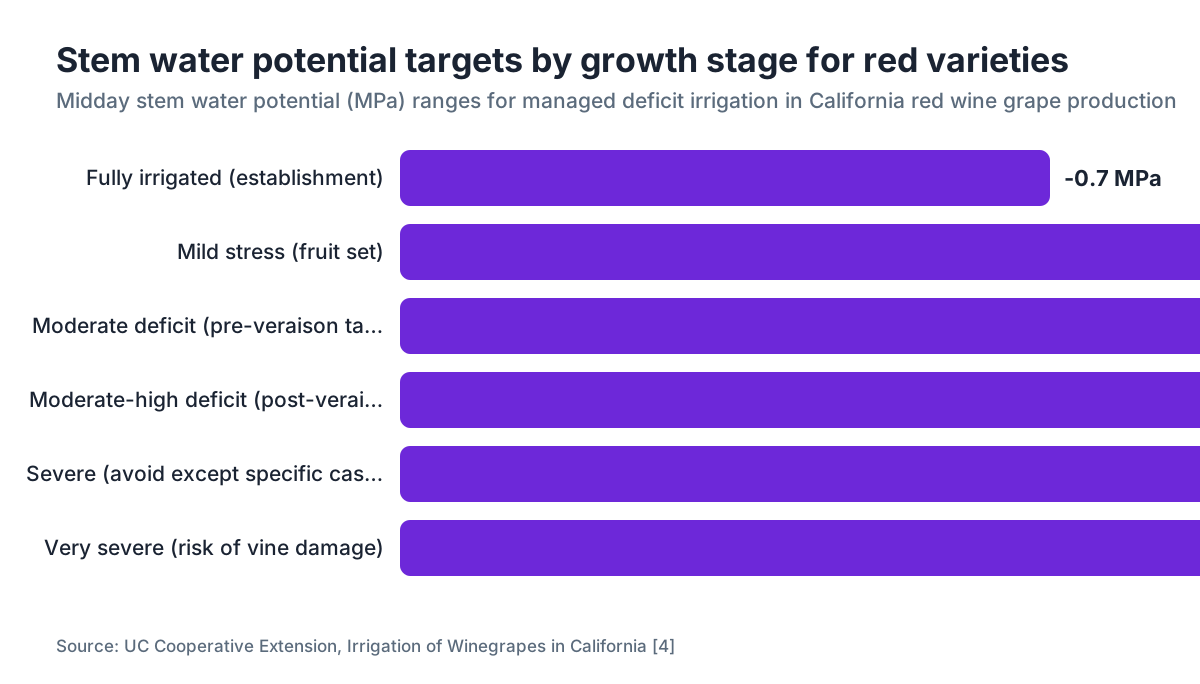
Here's a reference table for red variety stress thresholds used in California and Pacific Northwest research programs:
| Stress Level | Stem Water Potential (MPa) | Growth Stage Context |
|---|---|---|
| None (fully irrigated) | -0.6 to -0.8 | Establishment, first-leaf vines |
| Mild | -0.9 to -1.1 | Pre-bloom, fruit set |
| Moderate (target pre-veraison) | -1.0 to -1.4 | 2-4 weeks before veraison |
| Severe | -1.4 to -1.6 | Avoid in most situations |
| Very severe | Below -1.6 | Risk of irreversible damage |
The -1.0 to -1.4 MPa window pre-veraison comes out of multiple field trials from UC Davis and has become the informal standard across many California premium regions [4]. Post-veraison, you can often hold -1.2 to -1.5 MPa without hurting berry metabolism, and some varieties (Cabernet Sauvignon, Syrah) do fine at the higher end of that range through harvest.
The numbers move with climate. In a hot desert site like the southern San Joaquin Valley, hitting -1.4 MPa midday can mean more real physiological stress than the same reading in a cool coastal block where VPD (vapor pressure deficit) is lower. The number is a proxy, not a guarantee.
How much water should you apply in the weeks leading into veraison?
Target 30-50% ETc replacement in the 3-4 weeks before veraison. That's a wide range, and it should be, because your starting soil moisture, vine age, rootstock, and canopy size all change what the vine actually feels. A 20-year-old own-rooted vine on 101-14 with a full canopy needs more water to reach -1.2 MPa than a younger vine on a drier soil with less leaf area.
Calculate ETc using the CIMIS network (California Irrigation Management Information System) or AgWeatherNet in Washington [3][8]. Multiply reference ET by a crop coefficient (Kc) to get vine ETc. For wine grapes post-fruit-set, Kc runs roughly 0.35-0.65 depending on canopy size. WSU Extension uses a Kc of about 0.40-0.55 for mid-season wine grapes with a moderate canopy in eastern Washington [3].
Running drip? Convert ETc to gallons per vine per day. A 0.30 inch/day reference ET with a Kc of 0.45 gives 0.135 inch ETc. On an 8x6 spacing (48 sq ft per vine), that's about 0.40 gallons per vine per day for full replacement. At 40% replacement, you're at 0.16 gallons per vine per day. Simple math, but it surprises a lot of people how little water that actually is through the emitter.
Calibrate against your pressure bomb. The number you calculate from ET is a starting point. What you read in the vine at noon tells you whether you're hitting your target. Log both, every time. Patterns across the season and across years are where the real learning happens.
What happens if you apply too much stress before veraison?
Severe pre-veraison stress causes problems that don't reverse cleanly. Hit early enough and you'll see reduced berry set. Later on, you get early leaf senescence, more berry shrivel, and a real risk of inhibiting malic acid breakdown, which leaves you with unbalanced fruit at harvest.
In Cabernet Franc and Merlot especially, very severe pre-veraison stress has been linked to elevated herbaceous character in the finished wine, probably because it interrupts normal methoxypyrazine degradation. The evidence is correlative rather than mechanistic, but it's consistent enough across studies to take seriously [2].
Here's the other trap. Over-stress the vine pre-veraison and you're often tempted to rescue it with a pulse of water right at veraison. That rehydration signal can set off a rapid burst of berry expansion just as sugar loading starts, producing the exact large, dilute berries you were trying to avoid. It's a real pattern, and it's maddening when it happens.
The fix isn't decimal-point precision. It's checking stem water potential every few days through this window, not every two weeks. Stress builds faster than most people expect, especially in a late-June heat spike.
What should irrigation look like immediately after veraison starts?
Don't flood the vineyard at veraison. That's the main thing. A lot of the bad outcomes blamed on "post-veraison irrigation" in the literature and in the field are really the result of over-irrigating after under-irrigating, which triggers that rapid berry expansion problem.
If you managed the pre-veraison window right and your vines sit in that -1.0 to -1.4 MPa range, the move at veraison is to hold roughly where you are for 7-14 days while you confirm berry softening is progressing normally across the block. Then decide: maintain the deficit, tighten it slightly, or in a severe drought year, ease off if you're seeing symptoms that say the vines are struggling.
Post-veraison irrigation in most premium red programs runs at 15-35% ETc from veraison through harvest. The exact number depends on your target style. For a lighter-bodied, higher-volume program, 35-45% holds yield better. For a concentration-focused program chasing phenolic ripeness, 15-25% through harvest is common in California's premium regions.
Small operations managing compliance paperwork alongside water: keep a time-stamped log of stem water potential readings, irrigation amounts, and the decisions you made. You'll thank yourself at audit time. Software like VitiScribe can attach pressure bomb readings directly to your block-level water records, which saves real time come reporting season.
Uniform ripening across the block is the goal. If you've got blocks with variable soil depth, the post-veraison stretch is when that soil heterogeneity drives the biggest swings in vine response. Remote sensing (NDVI imagery) flags hot spots, but a pressure bomb on a handful of indicator vines is still the most actionable tool you have.
How do you handle a heat wave during the pre-veraison deficit period?
Heat waves complicate everything. A 108°F day when your vines already sit at -1.3 MPa can shove them into severe stress fast, and severe stress at that point can cause berry abscission, stall ripening, or damage the root system.
The practical rule: if a heat event is forecast to push daytime highs above 105°F for more than two straight days, apply a small rescue irrigation at 20-30% ETc to buffer soil moisture before the event. Aim to enter the heat event at the mild-to-moderate threshold (-1.0 to -1.2 MPa) rather than moderate-to-severe.
Once the heat passes and temperatures normalize, let the deficit rebuild over 7-10 days before returning to your pre-veraison target range. This isn't ideal from a pure wine-quality standpoint. Protecting a vine across a 30-year productive life matters more than optimizing one vintage under extreme conditions.
UC Davis researchers note that vines hit by repeated severe heat stress show cumulative hydraulic damage that carries into later seasons [1]. That's an argument for being conservative during multi-day extreme events, even when your quality goals push toward tighter deficit management.
Does the right deficit irrigation strategy differ by red variety?
Yes, and meaningfully. Varieties differ in drought tolerance, stomatal sensitivity, and how they partition carbon under stress.
Cabernet Sauvignon is relatively drought tolerant and takes to a consistent moderate deficit through harvest. Stem water potential of -1.2 to -1.4 MPa pre-veraison and -1.2 to -1.6 MPa post-veraison is common and generally won't produce off-character fruit in healthy vines [4].
Pinot Noir is more sensitive. Pre-veraison deficits below -1.2 MPa in a warm year can speed up berry shrivel and concentrate volatile acidity. Most Pinot-focused programs in Oregon and on California's Sonoma Coast hold milder pre-veraison stress (-0.9 to -1.2 MPa) and add deficit more gently after veraison.
Merlot sits somewhere between the two, but it's known for throwing stress-related off-characters (pyrazines and greenness in particular) under severe pre-veraison conditions. Manage it more like Pinot: keep pre-veraison stress in the mild-to-moderate range.
Syrah and Grenache, both adapted to Mediterranean conditions, handle the higher end of the stress range without quality loss. In Paso Robles and other warm inland regions, Syrah programs sometimes run at -1.4 to -1.6 MPa through much of the season with no negative outcomes. You can read more about how Paso Robles growers approach water in Paso Robles wineries.
Zinfandel gets its own note. It's notoriously uneven in ripening even in a normal year, and pre-veraison water stress makes that unevenness worse. Managing Zinfandel toward the milder end of the pre-veraison range (staying at -1.0 to -1.2 MPa) tends to produce more even veraison and cuts down on raisining in the earliest clusters.
How does rootstock choice affect your deficit irrigation schedule?
Rootstock multiplies everything else you do. Two blocks with the same scion, the same ETc, and the same drip system will read very differently on the pressure bomb if one sits on 110R and the other on 101-14.
More drought-tolerant rootstocks (140R, 1103P, 110R) hold lower stem water potential longer under deficit. Sounds good, but it also means less visible stress response at the vine, which makes it harder to know when you've crossed from moderate to severe. You lean more on the pressure bomb and less on visual cues.
Higher-vigor rootstocks (5C, 3309C in good soils) pull more water and can give you a false sense of comfort early in a heat event, then crash harder once soil moisture finally runs low. In that situation, any lag in your irrigation timing hurts more.
Know your rootstock's general drought-tolerance category before you set ETc replacement targets. UC Davis Foundation Plant Services keeps variety and rootstock documentation that includes this information [9].
What records do you need to keep for irrigation compliance and traceability?
At minimum, most state water rights programs and some appellation certification programs make you log the date of each irrigation event, the duration or total volume applied, the water source, and the block or zone identifier. California's State Water Resources Control Board extends this through its Agricultural Water Management Plan requirements for operations over certain acreage thresholds, and the details shift with water year designations [5].
Go past the regulatory minimum. There's a real case for logging stem water potential readings, the ETc estimate you used, and your decision rationale (why you reduced on that date, what you saw). That record becomes your institutional knowledge. When a new crew member or a consulting viticulturist looks at your program, those logs tell the story of how you manage the vineyard, more than that you managed it.
EPA's Worker Protection Standard also touches irrigation records when pesticides are involved. If you time an irrigation to move a pesticide through the soil profile after application, document that timing and tie it to your spray records [6]. Field staff who run the irrigation system after certain applications need WPS-compliant training and record access.
For managers who want one place to connect pressure bomb logs, irrigation events, and spray records by block and date, VitiScribe is built for exactly that workflow. The block-level structure keeps your deficit irrigation decisions and your compliance records in the same file.
How do you use soil moisture sensors alongside stem water potential readings?
Soil moisture sensors (capacitance probes, tensiometers, or gypsum blocks) tell you what's happening in the soil. Stem water potential tells you what the vine is actually feeling. You want both.
Tensiometers are cheap and reliable in the 0-75 centibar range, which covers the moderate stress window you're targeting pre-veraison. Above 75 centibars they lose accuracy and often cavitate. Capacitance sensors (Sentek or Decagon probes, for example) give you a profile by depth, which helps a lot in deep-rooted mature vines pulling from a zone your surface tensiometers never reach.
A practical protocol: run soil sensors as a daily trigger for irrigation management, and use the pressure bomb every 3-5 days as a reality check on whether your soil-based thresholds are actually translating to your target vine water status. The two together beat either one alone.
The link between soil moisture depletion and stem water potential varies by soil texture, vine age, and rooting depth. In coarse sand you can go from field capacity to severe vine stress fast. In a clay loam with deep root development, the vine buffers much longer. Don't assume a universal relationship. Calibrate it for each block, which takes at least a season of paired measurements.
What does research actually show about the quality impact of pre- and post-veraison deficit?
The short version: pre-veraison deficit mostly controls berry size, and post-veraison deficit mostly controls berry composition.
A widely cited UC Davis study (Matthews and Anderson, 1989) established that berry size is largely set before veraison, and water stress during that window is the most effective lever for cutting berry weight [11]. Later work by Ojeda et al. (2002) showed that a moderate pre-veraison deficit raised anthocyanin and total phenol concentrations, but a severe pre-veraison deficit actually depressed both [2]. The sweet spot matters.
On the post-veraison side, California trial work found that vines held at mild-to-moderate deficit through harvest carried 15-20% higher anthocyanin concentrations and better color stability than fully irrigated controls, with no significant yield loss in established vineyards [4]. The yield hit gets bigger in young vines and in drought-stressed rootstocks with limited root development.
Cornell's New York State Agricultural Experiment Station has run parallel work in cool-climate varieties. Timing precision matters less in short growing seasons where veraison and harvest are compressed. In Finger Lakes Cabernet Franc, for instance, the window between veraison and harvest may run only 5-7 weeks versus 10-12 weeks in Napa, which changes how aggressively you can manage post-veraison deficit without risking incomplete ripeness.
Nobody has clean data on the variety-by-variety thresholds for Pacific Northwest Syrah or Rhone varieties in desert conditions. The closest sources are WSU Extension trial work and regional research summaries, which give general guidance rather than precise prescriptions [3]. That's an honest limit of what we know right now.
Frequently asked questions
How do I know when veraison is about to start in my block?
Track cumulative heat units from April 1 using a 50°F base temperature. Most red varieties reach veraison at 1,700-2,200 GDD depending on variety and site. Measure berry diameter weekly: when growth rate drops noticeably, veraison is 1-2 weeks away. Walk the block and look for the first color change on individual berries, which usually starts on less-exposed fruit. That's your confirmation.
What equipment do I need to measure stem water potential?
A pressure chamber (pressure bomb) and a nitrogen gas cylinder are the core tools. PMS Instrument Company makes the models most common in viticulture research and production. The instrument costs roughly $1,000-$1,500 new. You also need plastic bags and damp towels to equilibrate leaves before sampling. Take readings at solar noon on sunny days from bagged, shaded leaves. Training on technique matters, because user error is the main source of variability.
Can I schedule deficit irrigation based on visual symptoms alone without a pressure bomb?
You can, but it's rough. Visual symptoms like midday leaf roll, shoot tip drooping, and reduced internode elongation show up at moderate stress, but they can't reliably tell -1.0 MPa from -1.4 MPa. In a window like pre-veraison, that gap matters. If buying a pressure bomb isn't feasible, rent one from a local viticulture consultant or farm advisor. Guessing through the veraison window is a real gamble.
How does drip emitter placement affect deficit irrigation management?
Emitter placement relative to the root zone changes how fast the vine responds to irrigation changes. Emitters over the main root mass give faster, more predictable response. If emitters are offset or you run a single-emitter system on wide spacing, the effective soil moisture coverage is smaller, so deficit builds faster and the vine's buffering capacity drops. Know your emitter layout before setting ETc replacement targets.
Is regulated deficit irrigation different from what's described here?
Regulated deficit irrigation (RDI) is the formal name for what this article describes: intentional, controlled water stress applied at specific growth stages to manage fruit quality. Same principles. RDI in red wine grapes usually targets the pre-veraison window as the main stress period and holds a reduced but non-zero rate post-veraison. The term comes from Australian research in the 1980s and is now standard in extension programs.
How does a hot inland climate change the pre-veraison deficit target?
In high-VPD environments, the same stem water potential reading reflects more physiological stress than in a cool coastal climate. In places like the San Joaquin Valley or eastern Washington in August, many experienced managers hold pre-veraison stem water potential at -0.9 to -1.2 MPa rather than pushing to -1.4 MPa. You can hit the berry-size reduction goal with less apparent stress in a high-evaporative-demand site.
What's the risk of cutting irrigation too late, after veraison has already started?
Post-veraison deficit still works, but it's weaker at controlling berry size, which is mostly set by the time softening begins. You'll still get concentration benefits, particularly for anthocyanins and total phenolics. What you lose by starting late is the skin-to-juice ratio improvement that comes from limiting berry expansion before softening. The quality upside is real. It's just smaller than if you'd started the deficit earlier.
Do organic or biodynamic vineyards handle deficit irrigation differently?
The water management principles are the same. Organic and biodynamic certification doesn't restrict irrigation method or timing. Some biodynamic growers irrigate on a lunar calendar, but there's no peer-reviewed evidence that this affects vine water status or berry composition compared to demand-based scheduling. The pressure bomb is equally valid as a management tool regardless of certification status.
How do I record deficit irrigation decisions to satisfy a winery's grape contract?
Most contracts make you document irrigation volumes, dates, and water source by block. Some premium winery contracts also ask for stem water potential logs to verify RDI protocols were followed. Keep a field log with the date, block ID, pressure bomb reading, irrigation applied (hours and gallons or inches), and a brief rationale note. Digital record systems that time-stamp entries make audits far simpler than paper logs reviewed after the fact.
Can I use NDVI imagery to identify blocks where deficit irrigation is creating uneven stress?
Yes, and it's one of the more useful applications of remote sensing in viticulture. NDVI imagery captured every 2-3 weeks through the season shows within-block variability in canopy density, which correlates with vine water status differences driven by soil heterogeneity. A high-NDVI patch during your deficit period means those vines are getting more water from somewhere, usually a soil texture change or a cracked line. Pressure bomb a few vines in that patch to confirm.
What happens to malic acid levels if I apply too much post-veraison deficit?
Malic acid degradation (malolactic-like respiration in the berry) speeds up under heat and runs somewhat independent of irrigation, but severe post-veraison stress can accelerate berry dehydration in a way that concentrates both sugars and acids unevenly. You can end up with high-Brix berries carrying paradoxically elevated titratable acidity from tartaric acid concentration, plus raisin character. Holding at least 15-20% ETc replacement post-veraison usually avoids this.
Does cover crop management interact with deficit irrigation timing around veraison?
Significantly. A permanent resident cover crop between rows competes for water and speeds soil moisture depletion, which amplifies your deficit. Run a cover crop through the pre-veraison window and your effective ETc is higher than it would be in clean-cultivated rows. Mowing or rolling the cover crop before your pre-veraison deficit period cuts competition and gives you more control over how fast vine stress builds. Many California managers mow to low stubble by late May or early June for exactly this reason.
Is there a difference in deficit irrigation strategy for first-leaf versus mature vines?
Yes. Young vines (years 1-3) should not be managed under significant pre-veraison deficit. Root development is the priority. Stress that's mild for a 15-year-old vine with deep roots can be severe for a first-leaf vine with a shallow, limited root system. Run full ETc replacement or close to it for the first 2-3 seasons, then introduce deficit management gradually as roots develop. Your pressure bomb readings on young vines will show you how quickly stress builds.
Sources
- UC Davis, Department of Viticulture and Enology: Pre-veraison water stress limits berry size more effectively than post-veraison stress; repeated severe heat stress causes cumulative hydraulic damage across seasons
- American Journal of Enology and Viticulture, Ojeda et al. 2002 - Influence of pre- and post-veraison water deficit on synthesis and concentration of skin phenolic compounds: Moderate pre-veraison deficit increased anthocyanin and phenol concentrations; severe pre-veraison deficit depressed both
- Washington State University Extension, Wine Grape Production Guide: Crop coefficient (Kc) estimates for wine grapes in eastern Washington mid-season range 0.40-0.55; GDD tracking from April 1 at 50°F base
- UC Cooperative Extension, Irrigation of Winegrapes in California: Stem water potential targets for California red varieties: -1.0 to -1.4 MPa pre-veraison moderate deficit; post-veraison moderate deficit associated with 15-20% higher anthocyanin concentration
- California State Water Resources Control Board, Agricultural Water Management Plans: State requirements for logging irrigation events, volumes, water source, and block identification for qualifying agricultural operations
- EPA, Worker Protection Standard for Agricultural Pesticides: WPS training and record access requirements for field workers who apply or work near pesticide applications, including post-application irrigation activities
- California Irrigation Management Information System (CIMIS), California Department of Water Resources: Reference evapotranspiration (ETo) data network for California vineyard irrigation scheduling
- UC Davis Foundation Plant Services, Rootstock and Variety Documentation: Rootstock drought tolerance ratings and variety documentation used by growers to select appropriate rootstocks for deficit irrigation programs
- WSU Extension, AgWeatherNet: Pacific Northwest reference ET network for vineyard irrigation management; GDD tracking for veraison timing estimation
- American Journal of Enology and Viticulture, Matthews and Anderson 1989 - Reproductive development in grape: responses to seasonal water deficits: Berry size is largely determined before veraison; water stress during pre-veraison window is the most effective lever for reducing berry weight
- UC Cooperative Extension, Pressure Chamber Use in Vineyard Water Management: Stem water potential measured at solar noon with a pressure chamber is the recommended standard for managing vine water status in production vineyards
Last updated 2026-07-11