Sandy soil vineyards: what actually grows well and why
TL;DR
- Sandy soils drain fast, warm early, and resist phylloxera on their own.
- They push vines into mild water stress that concentrates flavor, but they hold almost no nutrients or water.
- Success comes down to drip irrigation run in short frequent pulses, split fertigation, the right rootstock (or own-rooted planting), and cover crops that add organic matter without stealing moisture.
What makes sandy soil different from other vineyard soils?
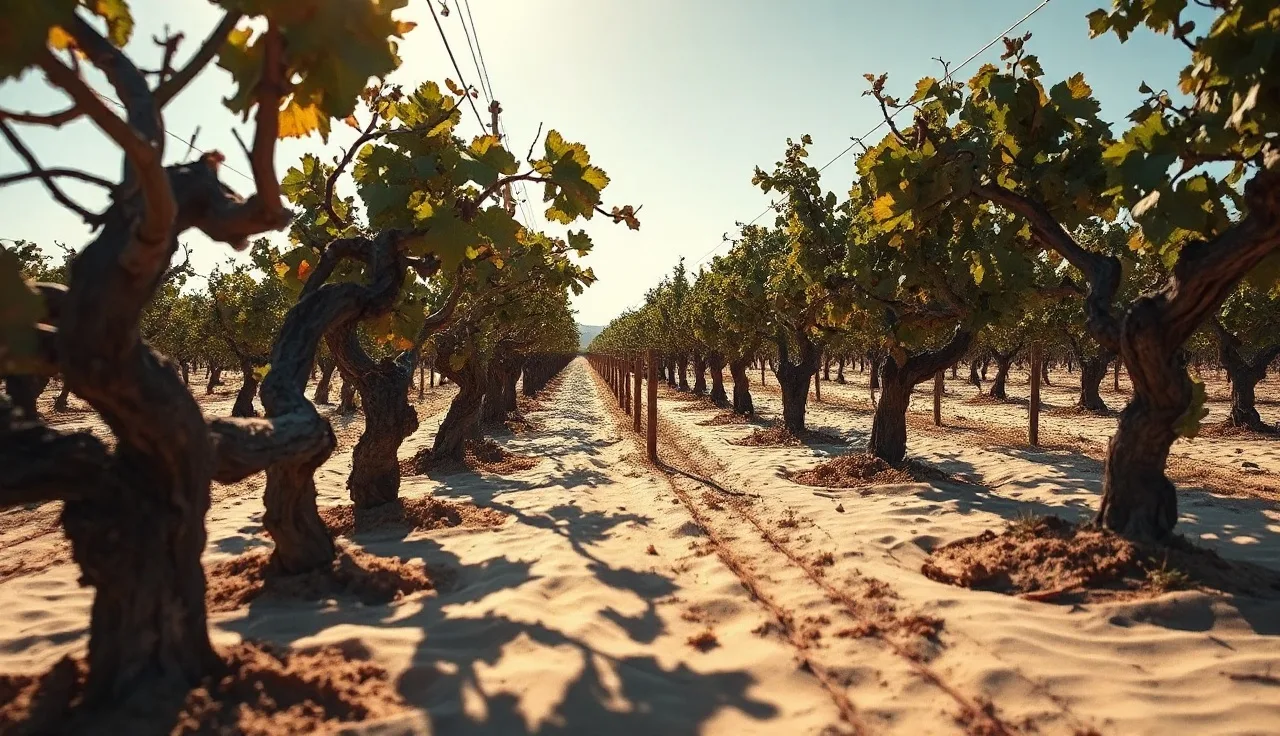
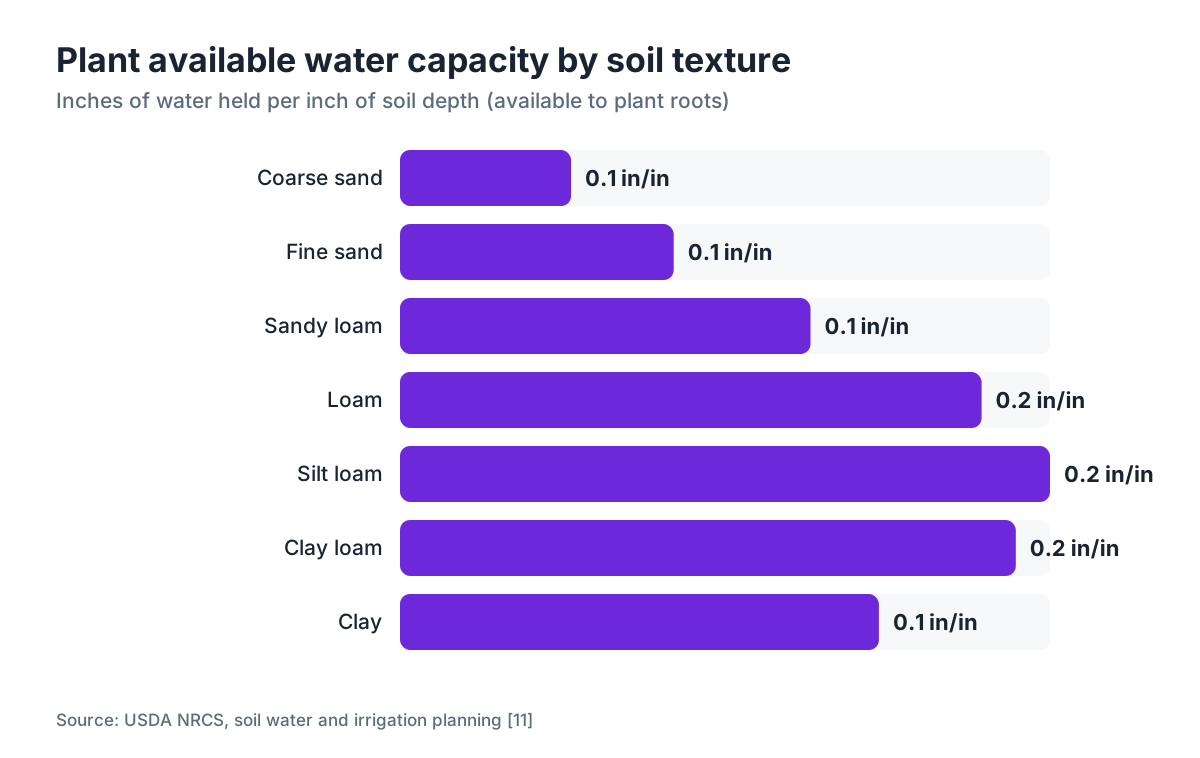
Sand grains are 0.05 to 2 mm across, big enough to leave wide air pores between them [1]. Water runs through fast. Coarse sand can drain 2 to 10 inches per hour where a clay loam moves 0.2 to 0.6 inches per hour [1]. That gap is not a rounding error. It changes almost every management call you make on the block.
Low surface area is the root cause of the rest. Clay particles pack far more surface area per gram, and surface area is where cation exchange happens. Sandy soils usually carry a cation exchange capacity (CEC) of 1 to 5 meq/100g. Clay soils sit at 20 to 50 meq/100g [2]. Low CEC means fertilizer leaches before roots grab it, and pH swings faster than you'd like.
Then there's heat. Sand absorbs it quickly during the day and dumps it at night, so the root zone runs wider diurnal swings than heavier ground. In cool climates that's a feature. Growers in Germany's Mosel and Portugal's Colares district have farmed real sand for centuries partly because that warmth pushes ripening where the season is marginal.
Organic matter is the last piece. A healthy loam holds 3 to 5 percent organic matter. Many vineyard sands run under 1 percent [2]. Organic matter feeds microbes, buffers pH, and holds water. Building it in sand takes years and burns off fast, so you're running to stay in place.
Can vines grow in pure sand, or do you need to amend the soil first?
Vines grow in very high-sand soils without any amendment at all. The Colares DOC in Portugal is the case everyone cites: own-rooted Ramisco planted straight into coastal dunes, some vines over 100 years old [3]. Several top Barolo producers in Serralunga d'Alba farm soils with heavy sand fractions. Rías Baixas Albariño grows on decomposed granitic sand. The vines survive. The real question is whether you want to manage the constraints forever or knock them down before you plant.
Amending pure sand before planting is worth it if you can buy good compost at a fair price and till it in deep. A one-time incorporation of 3 to 5 inches of compost before the vines go in raises organic matter and CEC enough to cut irrigation frequency through the establishment years. UC Davis extension recommends pre-plant incorporation of organic amendments to improve water-holding capacity in coarse-textured soils [2]. Once the vines are in, deep tillage is done. That pre-plant window is the only shot you get.
Here's what you should never do: dump clay or fine soil on top of surface sand hoping to fix the texture. Unless you rip and blend it to depth, you build a layered profile that blocks drainage and sets up a perched water table. Past planting, leave the texture alone.
Amended or not, the framework holds. More frequent irrigation events. Split fertigation. Organic matter in through cover crops and compost top-dressing every season.
Does sandy soil actually protect vines from phylloxera?
Yes, with a catch. Phylloxera (Daktulosphaira vitifoliae) spreads mostly through soil, and its nymphs have to crawl through the profile to reach new roots. Coarse sand blocks that movement because the big air pores don't give the insect the moist, compact paths it needs [3]. More than a century of watching European dune vineyards backs this up: high-sand soils crash phylloxera populations even without grafted rootstock.
UC Davis viticulture researchers note that phylloxera risk in sandy soils runs low enough that some growers plant own-rooted vines [3]. Own-rooted vines can behave differently in the field and in the glass than grafted ones, though the flavor research is genuinely mixed and hard to pull apart from other site effects.
Here's the practical line. If your soil runs above roughly 60 to 70 percent sand through the whole profile, and you're not hauling in soil or equipment from infested blocks, own-rooted planting is a real option worth pricing out. Below that sand fraction, or anywhere with confirmed phylloxera pressure, graft to a proper rootstock no matter the texture. In borderline-sand soils the protection isn't absolute.
Take the Paso Robles wine region, a patchwork of calcareous clay and sandy alluvial fans. Phylloxera pressure swings block by block. A sandy alluvial fan can support own-rooted vines while a clay-dominant block 200 yards away can't. Map your soils block by block before you decide. It's money well spent.
How do you irrigate a sandy soil vineyard without over- or under-watering?
Run drip, and run it in short frequent pulses. Drip is the only system that pencils out agronomically and financially in sand, because overhead and furrow either leach past the roots or wet far more ground than the roots occupy. Drip puts water at the emitter and lets you meter the pulse.
The shift from heavier soils is timing, not total volume. A clay soil might take one 4-hour drip event a week. Sand often does better with two or three 45-to-90-minute events a week at the same total water. You want moisture parked in the top 18 to 24 inches without pushing it below the root zone.
Moisture monitoring earns its keep here. Put capacitance sensors or tensiometers at 12 and 24 inches so you catch leaching before it costs you. Cornell's viticulture extension program recommends monitoring at multiple depths in coarse soils, because the wetting front moves so fast that a single surface reading lies to you [4].
Seasonal water use runs high. Baseline scheduling on sand often lands 20 to 40 percent above the same vine on loam, just to replace what drains past the roots. That's a rough figure. Nobody has clean data on a universal sandy-soil irrigation coefficient, because sand fraction, vine density, climate, and training system all pull on each other. The closest working method is evapotranspiration-based scheduling nudged up by a sandy-soil factor your local extension office can help calibrate.
One field flag worth learning. If you see salt crusting at the surface, or nutrient deficiencies deepening across the season despite steady fertilizing, you're leaching past the roots and your run times are too long. Shorten the events and bump the frequency before you add total volume.
What fertilizer and nutrition program works in low-CEC sandy soils?
Feed small and feed often, through the drip. Sandy soils lose nitrogen, potassium, magnesium, and boron fastest because those move with water. Calcium and phosphorus are steadier, though phosphorus availability drops in very low organic matter soils. Broadcasting a big spring dose on sand is throwing money at the water table.
For nitrogen, inject small amounts weekly or biweekly through mid-season instead of one spring broadcast. UC Cooperative Extension nutrient guidance puts typical wine grape nitrogen needs at 15 to 40 lbs of actual N per acre per year, depending on yield target and how much the soil contributes [9]. Even that modest amount vanishes quickly in sand. Broadcast N on coarse-textured soil can leach below the root zone within a single irrigation cycle, so split injection keeps more of it available.
Potassium deficiency turns up constantly in sandy blocks. Petiole testing at bloom and veraison tells you where you actually stand. If you're seeing marginal leaf scorch or low must potassium at harvest, the soil isn't holding what you apply. Potassium sulfate fertigated in small doses every two weeks through summer is a sound approach.
Magnesium leaches nearly as fast as potassium in sand. Foliar magnesium sulfate (Epsom salt) is a quick fix when interveinal chlorosis shows up on older leaves mid-season. It won't replace a soil program, but it stops the bleeding in-season.
Boron deserves a watch in sandy soils, especially in humid climates where leaching is heavy. Deficiency shows as shot berries and poor set. A small soil or foliar application at or just before bloom (roughly 0.1 to 0.3 lbs actual boron per acre foliar) fixes it if tissue tests confirm the need. Don't apply boron on a hunch. Toxic doses sit closer to deficient levels in grapes than in most crops.
Every application belongs in your records, fertigation events included. VitiScribe's field log ties nutrient applications to block-level petiole data, so you can see which fertigation timing actually moves the needle.
Which rootstocks work best in sandy, low-fertility soil?
Rootstock choice in sand balances drought tolerance, low-nutrient efficiency, and the phylloxera question. The names that come up most for sandy, low-fertility ground are Riparia Gloire, 101-14 Mgt, and 110 Richter, and they don't behave the same.
Riparia Gloire adapts well to poor, dry soils and runs moderate vigor, which is what most quality-focused winemakers want. Its phylloxera resistance is good. The catch is sensitivity to high-pH calcareous soils, so if your sand sits over limestone, test soil pH before you commit.
110 Richter is arguably the most drought-tolerant rootstock in wide wine-grape use [6]. It does well in deep, well-drained sand in warm climates and handles high pH and active limestone reasonably. It pushes more vigor than Riparia Gloire, so match the scion and training system to it.
3309 Couderc is another low-fertility option, though it wants more water than 110 Richter and suits sandy loams better than very coarse sand.
For Zinfandel, Chenin Blanc, Grenache, and other varieties that express something distinct from stressed, warm sand, plenty of producers plant own-rooted where the sand fraction runs high enough to suppress phylloxera. That call is site-specific and carries real risk if the soil read is wrong.
| Rootstock | Drought tolerance | Phylloxera resistance | Suitable soil pH | Vigor imparted |
|---|---|---|---|---|
| Riparia Gloire | Moderate | High | 6.0-7.5 | Low-moderate |
| 110 Richter | Very high | High | 6.0-8.5 | Moderate-high |
| 101-14 Mgt | Moderate | High | 6.0-7.5 | Moderate |
| 3309 Couderc | Low-moderate | High | 6.0-7.5 | Moderate |
| Own-rooted | High (variety dependent) | None | Varies | Variety dependent |
What grape varieties perform best in sandy soils?
No single answer, but the strongest candidates share a trait: lower natural vigor and the ability to ride out mild water stress without shutting down photosynthesis.
Grenache is the obvious place to start. It's drought-tolerant, produces well in poor sand, and its habit of piling on sugar turns useful when sand limits crop load on its own. Mourvèdre and Carignan follow the same logic, both proven in the sandy soils of Spain's coastal plains and southern France.
Tempranillo (Tinta Roriz) does well in sand too, which is part of why Ribera del Duero and the sandy river terraces of Rioja turn out age-worthy versions.
On whites, Albariño, Verdejo, and Chenin Blanc have strong track records on well-drained sandy or sandy-loam ground. The Gervasi Vineyard model in Ohio, where Riesling and other aromatics do well on lighter soils, shows cool-climate whites can thrive with enough irrigation management.
Approach a few with caution on hot sandy sites. Pinot Noir struggles when heat and drought stress stack. Cabernet Sauvignon can work but often needs irrigation support in warm sandy sites, or you get high alcohol and hard concentration without the phenolic development to carry it.
The honest read: sand often gives you lighter body, brighter aromatics, and more delicate tannin than the same variety on clay. Whether that's a win depends entirely on your market.
How do cover crops and organic matter management work in a sandy vineyard?
Building organic matter in sand is slow, and you lose it faster than in heavier ground. Better aeration means faster decomposition, so microbes chew through whatever you add. That's not a reason to skip it. It's a reason to stay consistent.
Legume cover crops do the heavy lifting: crimson clover, vetch, bell beans, or a mix. They fix nitrogen, add biomass when mowed, and don't demand much mid-row water. The risk is real in a dry year, when a deep-rooted cover crop fights the vines for the little water sand holds. WSU Extension recommends watching vine and cover-crop water stress together in coarse-textured dry-farmed vineyards and terminating the cover early in dry years [5].
On very coarse or dry sand, permanent resident vegetation in alternate rows (or keeping one side in bare cultivation) is a fair compromise. The strip right under the canopy usually stays bare or runs a shallow-rooted low grass to cut competition at the root zone.
Compost top-dressing is the most reliable organic matter input. Even 1 to 2 tons per acre a year, spread in the vine row in fall, adds up over time and feeds soil life. Don't till it in on established vines. Let earthworms and rain work it down.
Biochar is getting real research attention for coarse soils specifically, because its porous structure holds water and nutrients that sand can't. The catch is cost, roughly $300 to $800 per ton, and the high rates you need for a measurable effect, 1 to 5 tons per acre. It's not a recommendation for most growers today. It's worth watching.
What are the wind erosion and frost risks specific to sandy vineyards?
Sand moves. On exposed sites with prevailing wind and no cover, you lose topsoil at rates that matter agronomically and cost money to fix. USDA Agricultural Research Service wind erosion work ranks coarse sands among the highest-erodibility classes [7]. Keep the mid-row covered year-round where you can, plant windbreaks on the prevailing-wind face at or before planting, and skip tillage that leaves loose dry sand exposed during windy stretches.
Frost is a separate problem. Sand sheds stored heat fast at night, which raises radiation-frost risk in spring. Clay banks more heat and releases it slowly, acting as a thermal buffer. On a still clear night, sandy sites in frost-prone valleys can read 2 to 5°F colder at the surface than nearby clay-dominant blocks. At budbreak that gap matters.
If you're planting sand in a frost-prone area, a wind machine, overhead sprinklers, or heaters need to sit in your startup budget from the start. Later-budding varieties (Grenache over Pinot Noir, say) or later-ripening clones cut exposure another way.
On compliance, any pesticide application, including materials some growers use during frost events, needs documentation under EPA Worker Protection Standard rules [8]. Keep spray records current no matter the soil type.
How should you track water, fertility, and spray records in a sandy-soil operation?
Sand forces more decisions per acre per season than heavier soil: more irrigation events, more fertigation doses, more scouting, because stressed vines under low nutrients pick up certain diseases more easily. All that volume creates a documentation load that's easy to let slip.
The EPA Worker Protection Standard (WPS) requires pesticide application records kept for two years and worker access to that information [8]. California, Washington, and Oregon layer county agricultural commissioner reporting on top of WPS. Missing records in an audit is expensive and completely avoidable.
VitiScribe is built around this exact kind of block-level record keeping. Log irrigation events, fertigation, and spray applications from a phone in the field, tied to GPS-mapped blocks. If you're running multiple sandy blocks with different soil profiles and irrigation schedules, keeping it in one place with exportable reports for your PCA or county ag commissioner saves real time.
The operational payoff goes past compliance. Records let you see patterns. If one sandy block shows potassium deficiency by August on the same fertigation program as the block next to it, the log tells you whether run times differ, the sand's coarser, or an emitter has drifted. Without records, you're guessing.
What do established sandy-soil wine regions tell us about long-term viability?
Sandy soil viticulture isn't a workaround. Some of the world's most distinctive wines come off sand-dominant sites, and the agronomy reads cleanly: mild water stress at the right growth stages concentrates phenolics and aromatics, thin nutrient supply reins in vigor, and wide diurnal swings (bigger in sand) hold acidity.
Colares, Portugal grows own-rooted Ramisco on ocean dunes, a region that rode out phylloxera untouched since the 1800s [3]. The Maremma coast in Tuscany carries big sandy clay fractions that shape Morellino di Scansano. The Hunter Valley in Australia, famous for Semillon, sits on well-drained sandy loams over red clay subsoil.
In North America, the Paso Robles wineries in the Estrella and El Pomar sub-AVAs run sandy alluvial fans alongside calcareous clay, and many Rhône-focused producers hunt down sandy blocks for Grenache and Mourvèdre. The South Coast Winery region in Southern California includes sandy mesa soils where several varieties show a distinct character.
The lesson from all of them is the same. Plan for higher water and fertilizer inputs than loam would need, build organic matter as a long-game investment, and pick varieties and rootstocks matched to water-stress tolerance. Do that and sand is a feature. Ignore it and you fight the land every season.
If you're weighing a vineyard startup on sand, pull a full soil profile to at least 4 feet before you design the irrigation system. Sand fraction, depth to any restricting layer, and subsoil clay content all move your water-holding capacity and root-zone depth math by a lot.
Frequently asked questions
Can you dry-farm a vineyard in sandy soil?
Dry farming pure sand generally doesn't hold up in climates under 25 to 30 inches of annual rainfall. Low water-holding capacity means roots can't bank enough moisture between rains. Some Mediterranean climates with deep sandy profiles and heavy winter rain can support it, but most growers in drier regions need drip. Portugal's Colares is the exception, not the model.
How deep do vine roots grow in sandy soil?
In loose, uniform sand with no hardpan or restrictive layer, roots reach 6 to 12 feet, deeper than on compacted clay. That depth helps in dry spells because roots tap moisture down low. But nutrient and organic matter content at depth is often near zero, so those deep roots find water, not fertility. Petiole testing reflects what the whole root system pulls up.
Does sandy soil produce lower yields than clay soil?
Usually yes, all else equal. Lower nutrient and water supply caps canopy size and berry development. Sandy blocks often yield 20 to 40 percent below comparable clay-loam blocks of the same variety. Most quality-focused producers count that as a benefit, since lower yields tend to bring better concentration, but it hits the economics for bulk or volume operations.
What pH do sandy vineyard soils typically have?
Sandy soils range widely but tend acidic (5.5 to 6.5) in humid climates, where leaching strips base cations. In arid regions with calcareous parent material they can run alkaline (7.5 to 8.5). Both extremes create nutrient availability problems. Test soil pH annually in sand, because buffering capacity is low and pH shifts faster than in clay-rich soils. Dose lime or sulfur carefully.
Is it worth planting a cover crop in a hot, dry sandy vineyard?
In hot, dry climates on sand, a permanent mid-row cover crop competes directly for water and can stress vines past what you want. A summer-killed annual legume terminated by April or May is a better fit: it fixes nitrogen and adds biomass without transpiring through the dry season. Bare cultivation under the vine row with a terminated cover in the mid-row is common in warm-climate sandy blocks.
How often should you run soil tests in a sandy vineyard?
Annual soil testing is the floor in sand. With low CEC and nutrient levels that shift fast with leaching, an off-cycle test gives you a snapshot that may already be stale. Pair soil tests with petiole tissue tests at bloom and veraison. Together they tell you what the soil holds and what the vine actually takes up, and in low-CEC sand those two often disagree.
What diseases are more common in sandy soil vineyards?
Powdery mildew and spider mites often run worse in sand because dry, warm conditions favor both. Botrytis depends more on canopy management than soil type. Nematodes can do more damage in sand, where root systems are already stressed and nematode mobility is higher. Root-knot and dagger nematodes deserve attention in pre-plant soil testing for sandy sites, since they can hold back vine establishment badly.
Does sandy soil affect wine acidity and pH?
Sandy soil tends to give wines higher natural acidity and lower pH than the same variety on clay-rich ground, though climate and irrigation move it around. The mild water stress and wider diurnal range common on sandy sites slow acid degradation during ripening. Albariño and Riesling off sandy granitic soils are classic cases where high natural tartaric acid retention is part of the varietal signature.
How do you manage salinity in irrigated sandy soils?
Sand is prone to salt buildup from irrigation water when leaching falls short, because every event drops whatever dissolved salts your water carries. The same fast drainage that loses nutrients can work for you: periodic deep irrigation events (leaching fractions) push accumulated salts below the root zone. Test irrigation water for EC and sodium adsorption ratio annually if you're on well or recycled water.
Are there spray timing differences for sandy soil vineyards?
Not fundamentally different from other soils, but the drought stress and heat sand creates can raise plant sensitivity to some fungicide and insecticide applications. Spraying during heat stress (above 90 to 95°F) raises phytotoxicity risk on any soil. Soil-applied pesticides also leach faster in sand, which shortens residual activity and can raise groundwater concerns. Follow label directions and record application conditions per EPA WPS rules.
What trellis and training systems work best in low-vigor sandy soil?
Low-vigor soils call for systems built for smaller canopies. Standard VSP (vertical shoot positioning) with a moderate cordon height works well. High-wire systems made for vigorous growth, like Scott Henry, are often overkill and create canopy problems when vines can't fill the wire. Some sandy-soil growers run bilateral cordon with closer vine spacing to build aggregate leaf area that individual low-vigor vines can't reach alone.
How does frost protection strategy differ in sandy versus clay soils?
Sand releases stored heat faster at night, so radiation-frost temperatures run about 2 to 5°F colder in sandy blocks than adjacent clay on still clear nights. Wind machines often beat heaters on sandy sites because the problem is air stratification, not air temperature. If you were counting on stored soil heat as a passive buffer, sand gives you almost none. Active frost protection is hard to skip on sandy sites in frost-prone valleys.
What does it cost to amend sandy soil before planting a vineyard?
Pre-plant compost incorporation typically runs $800 to $2,500 per acre depending on local compost prices, transport, and tillage cost. At 3 to 5 inches of compost tilled to 18 to 24 inch depth, you need roughly 50 to 80 cubic yards per acre. It's a one-time investment that improves water-holding capacity and CEC through the critical establishment years. Money well spent if you can source quality compost without excess salt.
Can you make premium wines from sandy soil, or is it only good for everyday table wine?
Sandy soils turn out some of the world's most collectible wines. Colares in Portugal, parts of Barolo, Pomerol's iron-pan over sandy subsoil, and several Mosel Grand Cru sites all carry big sand fractions. The common thread is mild stress producing concentration and aromatic lift. Premium results need the right variety-rootstock-management match. Sand doesn't guarantee quality, but it doesn't cap it either.
Sources
- UC Agriculture and Natural Resources, Grape (Viticulture) program: Sandy soils carry CEC of 1 to 5 meq/100g; typical vineyard loams hold 3 to 5 percent organic matter while sands often run below 1 percent; pre-plant organic amendment incorporation recommended for coarse soils
- UC Davis Department of Viticulture and Enology: Phylloxera nymph movement impeded by coarse sandy soils; own-rooted planting viable in high-sand profiles; Colares Portugal own-rooted vines in coastal dunes as historical example
- Cornell College of Agriculture and Life Sciences, Cornell AgriTech: Cornell recommends multi-depth soil moisture monitoring in coarse soils because wetting fronts move quickly and surface measurements alone are misleading
- Washington State University, Viticulture and Enology Program: Nitrogen broadcast to coarse-textured soils can leach below root zone in a single irrigation cycle; cover crop competition with vines in dry years on sandy soils requires early termination
- UC Davis Foundation Plant Services: 110 Richter considered among the most drought-tolerant rootstocks widely used in wine grapes; tolerates high pH and active limestone; imparts moderate to high vigor
- USDA Agricultural Research Service, Soil and Air research: Coarse sands rank among highest erodibility classes in wind erosion models including the Revised Wind Erosion Equation
- EPA Agricultural Worker Protection Standard, 40 CFR Part 170: WPS requires pesticide application records kept for two years and worker access to application information
- UC Agriculture and Natural Resources, vineyard nutrient management: Typical wine grape nitrogen requirement 15 to 40 lbs actual N per acre per year; petiole testing at bloom and veraison recommended for nutrient monitoring
- WSU Extension, cover crop management in Pacific Northwest vineyards: Annual legume cover crops terminated by April-May recommended over permanent swards in coarse-textured or dry vineyard soils to reduce summer water competition
Last updated 2026-07-09