Scott Henry trellis system: how it works and when to use it
TL;DR
- The Scott Henry trellis divides a vine's shoots into two curtains, one trained upward and one downward, on a single cordon wire.
- Scott Henry IV built it at Henry Estate Winery in Oregon in the 1980s.
- It doubles the fruiting surface without doubling row spacing, cuts canopy shading, and suits high-vigor sites where standard VSP produces dense, disease-prone growth.
What is the Scott Henry trellis system?
The Scott Henry system is a divided-canopy trellis where a single vine carries two shoot zones. The top half of the shoots trains upward along wires above the cordon. The bottom half trains downward along wires below it. The result is two vertical shoot-positioned curtains sharing one trunk and one cordon wire, spaced vertically rather than horizontally. Each curtain gets its own pair of foliage wires.
Scott Henry IV developed the system at Henry Estate Winery in the Umpqua Valley of Oregon in the early 1980s [1]. His goal was practical. He had a vigorously growing Pinot Gris block on a fertile river-bottom site, and conventional VSP was giving him a dense, shaded canopy that hurt fruit quality and invited Botrytis. Splitting the shoots into two planes roughly doubled the leaf-wall surface exposed to sun and air, and he did it without adding rows or buying more land.
The system sits in the broader family of divided-canopy designs, alongside the Geneva Double Curtain (GDC) and the Lyre. What sets it apart from GDC is direction. GDC splits the canopy horizontally, pulling two cordons apart at the same height. Scott Henry keeps the cordons in one spot and splits vertically. That distinction matters: Scott Henry works on tighter row spacings where you don't have enough room to pull two cordons far enough apart for GDC to function properly.
How does the Scott Henry trellis work mechanically?
The basic structure uses a standard single-cordon vine, but the post carries more wires than a typical VSP setup. Working from the ground up:
The cordon wire sits at the same height you'd use for VSP, typically around 36 to 42 inches above the soil [2]. Above it, you add two movable foliage catch wires, positioned roughly 12 inches and 24 inches above the cordon, where you tuck the upward-trained shoots each season. Below the cordon, two more wires sit at roughly 12 inches and 24 inches below it, where the downward-trained shoots are tucked.
At the start of the season, all shoots emerge from the cordon heading upward, as normal. Once they're 6 to 10 inches long, alternate shoots are selected for downward training and manually redirected below the lower foliage wires. You're picking every other shoot on the cordon and pushing it down. This takes one to two additional passes compared to a standard VSP shoot-positioning operation, and that labor cost is real. The payoff is that each shoot grows in its own airspace instead of fighting its neighbors in a single dense curtain.
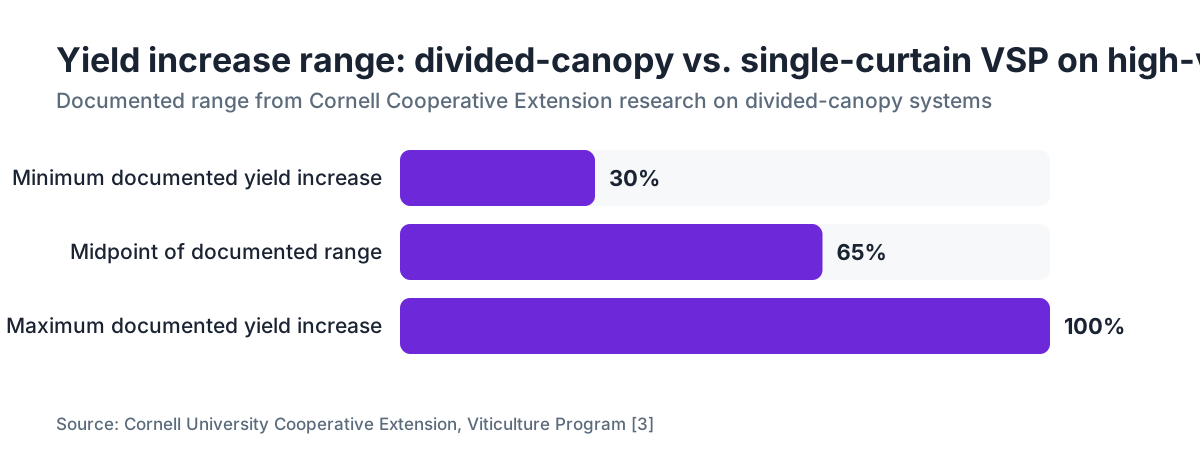
Fruiting occurs on both the upward and downward shoots, which roughly doubles the number of fruit-bearing positions per linear foot of cordon compared to a single VSP curtain. Cornell's viticulture program notes that divided-canopy systems like Scott Henry can increase yield per acre by 30 to 100 percent on high-vigor sites, depending on variety and soil [3].
Post height matters. You need posts tall enough for the full spread. The upward shoot zone runs 18 to 24 inches above the cordon, so your top wire needs to sit around 60 to 66 inches off the ground. Posts typically run 8 feet, set 2 feet in the ground, leaving 6 feet above grade. That's taller than the typical VSP post spec.
What are the canopy and fruit quality benefits compared to VSP?
Canopy shading is the central problem on high-vigor sites, and Scott Henry attacks it directly. In a dense VSP canopy, interior leaves get shaded to the point where they consume more photosynthate than they produce. Shaded fruit clusters ripen unevenly, take on less sugar, hold more malic acid, and pick up more Botrytis because humidity stays high inside the canopy [3].
Spreading the shoots into two planes exposes more leaf area to direct or near-direct sun. Research from the late 1980s and 1990s, summarized by Dr. Richard Smart (the New Zealand viticulturist who helped popularize canopy management science), showed that divided-canopy systems consistently improved the exterior-to-interior leaf ratio, reduced percent shaded leaf area, and improved fruit composition including soluble solids, color, and flavor precursor concentration [4]. Smart's work at Lincoln University in New Zealand gave extension programs much of the science they later drew on.
Botrytis risk drops for two reasons. Better air movement dries clusters faster after rain or irrigation. And the physical gap between shoot zones breaks up the humidity pocket that Botrytis needs to germinate and spread. On Oregon coast-influenced sites where Botrytis is an annual fight, that's no small thing.
There's a real tradeoff on low-vigor sites. If your vines don't have the vegetative energy to fill both curtains, the downward shoots come out weak and poorly fruitful. The system was designed for vigor management, not vigor compensation. On a shallow, well-drained site with naturally balanced vines, plain VSP is simpler and performs just as well.
Which grape varieties and site conditions is Scott Henry best suited for?
Scott Henry was born on Pinot Gris in Oregon, but growers have applied it to many varieties across high-vigor sites. The site conditions that make it worth the extra complexity: deep or fertile soils that drive heavy vegetative growth, moderate to high rainfall or aggressive irrigation, and row spacings of 8 to 10 feet or wider (narrower than GDC needs, but wide enough that the downward foliage sweep clears your equipment).
Varieties that respond well include Pinot Gris, Chardonnay, Riesling, Cabernet Sauvignon on fertile valley-floor sites, and Syrah in irrigated settings. Basically any variety that tends to overcrop its canopy under VSP is a candidate.
Varieties that don't gain much: any thin-shoot, naturally low-vigor variety, and old head-trained vines that aren't set up for bilateral cordon structure. Grenache and Mourvèdre on dry-farmed hillside sites usually lack the vigor to fill two curtains. You'd end up with a sparse, unproductive lower zone.
Washington State University's extension viticulture program has documented Scott Henry use in Washington's Columbia Valley, where deep, irrigated soils push vigorous growth on varieties like Chardonnay and Riesling [2]. The system works there precisely because irrigation is managed to fuel the vegetative growth two curtains require.
The vineyard conditions you're working with matter more than the variety. If your vigor problem is real and stubborn, this system earns its complexity. If you're on a site that would behave with a few more leaves pulled, do that first.
How does Scott Henry compare to Geneva Double Curtain (GDC) and VSP?
| Feature | VSP | Scott Henry | Geneva Double Curtain |
|---|---|---|---|
| Shoot orientation | All upward | Up + down, same cordon | All upward, two separate cordons |
| Cordon count | 1 | 1 | 2 |
| Minimum row spacing | 6 ft | 8 ft | 10 to 12 ft |
| Relative establishment cost | Baseline | Moderate increase | Higher |
| Best vigor range | Low, medium | High | High, very high |
| Mechanization compatibility | High | Moderate | Lower |
| Canopy division | None | Vertical | Horizontal |
VSP is the starting point for most wine grape planting decisions in North America, and for good reason. It's simple to establish, easy to train labor on, and compatible with most mechanical harvesting and leaf-removal equipment. The tradeoff is that it struggles when vigor is high.
GDC was developed by Nelson Shaulis at Cornell in the 1960s. It pulls two cordons apart horizontally, which forces wider row spacing so the two curtains have room to hang without tangling [3]. It mechanizes well and shaped juice grape production in New York, but the row spacing requirement makes it impractical in many existing vineyards.
Scott Henry sits between the two. It works in existing row spacings too tight for GDC. It adds canopy division without a second cordon. And it's friendlier to machines than GDC because the canopy stays centered on a single row. The downside is the extra shoot-positioning labor each season, which is real and should not be underestimated when you're budgeting.
University of California Cooperative Extension viticulture publications describe Scott Henry as particularly practical for retrofitting existing VSP blocks that develop vigor problems as vines mature, rather than as a first-choice system for new plantings on moderate sites [5].
What does it cost to establish or convert to a Scott Henry trellis?
Costs vary by region, by your existing trellis infrastructure, and by whether you're converting an established VSP block or building from scratch.
For a new planting, Scott Henry adds roughly 15 to 25 percent to trellis material costs over VSP. You're running four sets of foliage wires instead of two, and you need taller, heavier end posts to carry the added tension. That premium works out to somewhere around $400 to $700 per acre in extra materials at current wire and post prices, though supply chain swings make any specific figure approximate. Get a local quote.
Converting an established VSP block costs less if your posts are already the right height. Conversion usually means adding two lower foliage wires and retraining alternate shoots downward during the first growing season after conversion. Labor for that initial shoot-positioning change runs 2 to 4 hours per acre more than a standard VSP shoot tuck in the conversion year, then settles into a recurring annual premium of 1 to 2 hours per acre for the ongoing downward positioning.
Mechanical harvest compatibility is a real concern. Continuous-action machines built for VSP can generally harvest the upward curtain, but the downward curtain fights most standard catch-plate configurations. Some growers harvest the two curtains in separate passes with adjusted machine settings. Others hand-harvest the downward zone. If your economics depend on fully mechanical harvest, get equipment specs from your harvester supplier before you commit.
Spray programs through a split canopy also take more attention. Air-blast sprayers need calibration to penetrate both curtains, and coverage verification is worth doing early in the season. The EPA Worker Protection Standard requires that all agricultural workers handling pesticide applications have documented training and that application records be kept for at least two years [6]. Spray record-keeping requirements don't change with trellis system, but the application itself gets more complex.
For teams running multiple blocks across different trellis configurations, field records get complicated fast. Tools like VitiScribe help track spray records and canopy management notes by block, which matters when you're comparing performance across your VSP and Scott Henry blocks over several seasons.
How do you train vines to the Scott Henry system?
Training young vines to Scott Henry takes three to four years, about the same as VSP. The first two years focus on trunk development and establishing the bilateral cordon at the target wire height. Nothing differs from standard cordon training during this phase.
In year three, once the cordon is set and permanent spurs are selected, you start choosing alternate shoots for downward positioning. The easy way to picture it: number your spur positions 1, 2, 3, and so on along the cordon. Odd positions train up. Even positions train down. You want roughly equal shoot counts in each curtain, so spur spacing at establishment should plan for alternating orientations from the start.
Redirect the downward shoots early, while they're still flexible, typically at 4 to 8 inches of shoot length. Wait until shoots hit 12 inches or longer and they turn brittle, and breakage climbs. The first year you do this, count on losing 10 to 20 percent of the shoots you try to redirect while your crew learns the timing.
Foliage wire management during the season matters more than in VSP. The upper foliage wires move upward (or open and re-tuck) as shoots grow, same as standard VSP catch-wire management. The lower wires hold the downward shoots in place and may need adjustment so the curtain doesn't swing into the row middle or drag on the soil. OSU Extension's small farms and viticulture resources describe wire management for divided-canopy systems in the Pacific Northwest [1].
Winter pruning on Scott Henry runs slightly longer than VSP because you're managing two sets of spurs pointed in opposite directions. Budget an additional 15 to 20 percent pruning time per vine over a matched VSP block, at least until your crew knows the system.
What are the yield and quality outcomes supported by research?
The most cited research foundation for Scott Henry comes from Smart and Robinson's 1991 book 'Sunlight into Wine,' which pulled together canopy research from multiple countries and built the framework extension programs have used since [4]. Their core finding: raising the ratio of exterior (sun-exposed) leaf area to interior (shaded) leaf area consistently improves fruit composition, and divided-canopy systems are the most practical way to get there on high-vigor sites without cutting yield.
Cornell's work on divided-canopy systems, first focused on GDC for juice grapes, established that dividing the canopy could raise yield per acre by 30 to 100 percent on high-vigor sites versus single-curtain systems on the same row spacing [3]. Scott Henry's inventor documented similar increases in his original Umpqua Valley block, reporting that his Pinot Gris yields roughly doubled after conversion from a single curtain, while fruit quality held.
A 2003 study published in the American Journal of Enology and Viticulture (AJEV) on Chardonnay grown in Scott Henry versus VSP found that Scott Henry vines produced higher yields with no measurable loss in wine quality scores from a trained sensory panel, provided crop thinning kept per-vine load in an appropriate range [7]. The study's stated conclusion noted that "divided canopy training allowed equivalent or superior wine quality at significantly higher yields compared to VSP on the same high-vigor site."
Nobody has great long-term data on Scott Henry across many climates and varieties in a single controlled study. The research base is scattered across regions and experimental designs. The honest summary: on high-vigor sites, the system reliably cuts shading and usually improves fruit composition, and the yield increases are real but variable.
What are the common problems and failures with Scott Henry?
The most common failure: installing Scott Henry on a low-vigor site because you read it's a good system, then watching the downward curtain throw weak, poorly colored, low-Brix fruit. The system needs a vine with enough vegetative energy to fill two shoot zones well. If your site lacks that energy, you get a top curtain that performs and a bottom curtain that wastes your time.
Inconsistent shoot positioning is the second-most common problem. If your crew is sloppy about redirecting alternate shoots downward early in the season, you get a messy mix of upward and downward shoots that's worse than either a clean VSP or a clean Scott Henry. The system rewards discipline in execution.
The lower curtain runs more Botrytis-prone than the upper curtain in wet seasons because it sits closer to the ground and gets less airflow. The logic of Scott Henry is that the whole canopy is less dense than a packed VSP curtain, and that advantage holds. But the lower zone can still be a Botrytis risk point in high-pressure years, so you may need to time fungicide applications with that in mind.
Tractor operators need training on the row geometry. The downward foliage sweep catches on equipment if operators drive too fast or too close. Post spacing and row orientation matter more here because the lower wires sit closer to tractor paths. WSU Extension has documented equipment management for divided-canopy systems in Washington [2].
And the system is harder to communicate to casual labor. Crew members who have trained VSP blocks their whole careers need specific instruction on which shoots go down and why. Turnover in seasonal vineyard labor makes this a recurring cost.
Is Scott Henry suitable for organic and sustainable wine production?
Yes, and often more suitable than standard VSP on the sites where it fits. Organic and sustainable viticulture programs face extra pressure from fungal disease because conventional synthetic fungicides are restricted or banned. Any system that moves more air through the canopy and cuts the humidity that Botrytis, downy mildew, and powdery mildew need to establish is an asset in an organic program.
The California Certified Organic Farmers (CCOF) and USDA National Organic Program requirements don't address trellis design. They regulate inputs, not canopy architecture [8]. But the canopy improvements from Scott Henry can meaningfully cut the spray frequency needed to protect fruit in organic programs, which lowers cost and reduces the risk of exceeding certification thresholds for even approved materials.
For growers chasing LIVE (Low Input Viticulture and Enology) certification in Oregon and Washington, canopy management practices count as part of the certification criteria. A documented shift to divided-canopy training on a historically problem block would reasonably support your program's case under that framework.
The EPA Worker Protection Standard applies to all pesticide applications regardless of organic status. Biological pesticides covered by WPS include the copper-based fungicides common in organic programs [6]. Spray records (operator, product, rate, and date) must be kept for two years. That requirement doesn't change with trellis type.
For wine regions like Paso Robles where summer heat and low humidity already cut fungal pressure, the organic sustainability argument for Scott Henry is weaker. You'd judge it purely on canopy balance and yield efficiency, not disease reduction.
How do you decide if Scott Henry is the right trellis for your block?
Start with a vine balance assessment. The Ravaz Index, the ratio of crop weight to cane pruning weight, is the standard field diagnostic. A Ravaz Index below 3 to 5 says a vine is pouring too much energy into vegetative growth relative to fruiting. Above 10 says overcropping [9]. If you're consistently seeing values below 3 in a block, you have a vigor problem Scott Henry can address. If your values land in the 5 to 10 range, you probably just need better shoot positioning and canopy management within VSP.
Walk the block mid-season and assess percent shaded leaf area. A rough field method: hold a light meter probe (or even a phone with a lux app) at the center of the canopy versus outside it. More than a 60 to 70 percent drop in light intensity in the interior signals a canopy that's too dense [4]. Smart and Robinson recommend targeting exterior leaf area at 50 percent or more of total leaf area.
Read your spray records. If you're applying fungicides at maximum frequency and still losing fruit to Botrytis in average seasons, canopy management is probably a contributing factor. If your disease pressure tracks rainfall timing more than canopy density, that's a different problem.
Check your row spacing before committing. If your rows are tighter than 7 to 8 feet, the downward curtain creates real equipment clearance problems. GDC is out at that spacing too, so if Scott Henry doesn't fit, look at aggressive hedging and leaf removal within VSP rather than a full system change.
One practical move: convert a single trial block of 1 to 3 acres and run it against a matched VSP block for two to three seasons before you commit the whole vineyard. That kind of per-block record-keeping, tracking spray events, canopy scores, yield, and Brix by block, is exactly where a field operations tool like VitiScribe earns its place in a vineyard management workflow.
Wine regions with a history of divided-canopy adoption, including parts of Oregon's Willamette Valley, Washington's Columbia Valley, and sections of California's south coast winery growing areas, tend to have extension agents and vineyard consultants with hands-on experience. A local consultant who has actually converted blocks in your climate is worth the day rate before you run wire.
Frequently asked questions
Who invented the Scott Henry trellis system and where?
Scott Henry IV developed the system at Henry Estate Winery in the Umpqua Valley of Oregon in the early 1980s. He was managing vigorously growing Pinot Gris on fertile river-bottom soils and needed a way to open the canopy without widening row spacing. New Zealand viticulturist Richard Smart later documented and promoted it, which spread adoption internationally.
What row spacing does Scott Henry require?
Scott Henry generally works in row spacings of 8 feet or wider. You need room for tractor operation alongside the downward foliage curtain without the equipment sweeping the shoots. It works at tighter spacings than the Geneva Double Curtain (which typically needs 10 to 12 feet), but you'll hit equipment clearance issues below about 7 to 8 feet.
Can you convert an existing VSP block to Scott Henry?
Yes, and it's one of the most common reasons growers choose it. If your posts already sit 6 feet above grade, conversion mainly means adding lower foliage wires and retraining alternate shoots downward starting in the next growing season. The conversion-year labor cost runs higher than a normal shoot-positioning operation, and you'll likely lose some shoots to breakage until your crew learns the timing.
Does Scott Henry work with mechanical harvesting?
Partially. The upward curtain is generally compatible with standard harvesting machines. The downward curtain fights most conventional catch-plate configurations. Some operations harvest the two curtains in separate machine passes with adjusted settings. Others hand-harvest the lower zone. If full mechanical harvest is essential to your economics, confirm compatibility with your equipment supplier before converting.
How much more labor does Scott Henry require per acre than VSP?
During shoot positioning, budget 1 to 2 additional hours per acre per season for the ongoing downward shoot redirection over VSP. Winter pruning typically takes 15 to 20 percent longer per vine. The conversion year adds more labor for the initial shoot redirection and likely some breakage recovery. Over time, experienced crews close the gap, but the premium never fully disappears.
What is the Ravaz Index and how does it help decide if Scott Henry is needed?
The Ravaz Index is the ratio of fruit weight (at harvest) to pruning weight (the following dormant season). It measures vine balance. A value below 3 to 5 suggests excessive vegetative vigor relative to fruit production, which is the condition Scott Henry addresses. Values in the 5 to 10 range generally indicate a reasonably balanced vine that may not need a divided-canopy system.
How does Scott Henry affect Botrytis risk?
It reduces Botrytis risk on high-vigor sites by moving more air through the canopy and breaking up the humidity pocket Botrytis needs to germinate. The lower curtain specifically can still be a risk point in wet seasons because it sits closer to the ground. In practice, growers on Botrytis-prone sites often see reduced spray frequency after converting from a dense VSP to Scott Henry.
Is the Scott Henry system the same as the Smart-Dyson trellis?
No, but they're related. The Smart-Dyson trellis is a variant developed by Richard Smart and John Dyson that adapts the divided-canopy vertical concept. It uses bilateral cordons at mid-post height with shoots trained both up and down from the same cordon, similar in principle to Scott Henry. The names get used interchangeably but refer to slightly different configurations of the same general idea.
What wire gauge and post specs are needed for Scott Henry?
Post height above grade is typically 6 feet, requiring 8-foot posts set 2 feet deep. The cordon wire and upper foliage wires follow standard VSP specs, typically 12.5 to 11 gauge high-tensile galvanized wire. The lower foliage wires carry less tension than the upper wires but still resist the weight and movement of a full downward curtain. 12 to 14 gauge smooth wire is commonly used for the lower zone.
Does Scott Henry produce higher yields than VSP?
On high-vigor sites, yes. Cornell research documents yield increases of 30 to 100 percent over single-curtain systems on the same row spacing for divided-canopy designs. Scott Henry's inventor documented roughly double yields in his original Umpqua Valley Pinot Gris block after conversion. On low-to-moderate vigor sites, the yield advantage disappears or reverses because the lower curtain doesn't fill adequately.
Can Scott Henry be used for red wine varieties?
Yes. It's been used successfully on Cabernet Sauvignon, Syrah, Merlot, and other reds on high-vigor sites. The same canopy benefits apply: better light penetration improves color development and phenolic ripeness. The main caveat is that red varieties on low-vigor, dry-farmed hillside sites don't benefit and are better served by a simpler system.
How long does it take to fully train a vine to the Scott Henry system from planting?
Three to four years, the same general timeline as VSP. The first two years focus on trunk and cordon establishment, identical to standard bilateral cordon training. The divided-curtain shoot management begins in year three as permanent spurs are established and alternate shoots are selected for downward training.
Are there extension resources available for learning Scott Henry?
Yes. Oregon State University Extension covers Scott Henry in Pacific Northwest viticulture publications. Cornell Cooperative Extension documents divided-canopy systems including Scott Henry in its vineyard management resources. Washington State University Extension addresses Scott Henry and related systems in the context of Columbia Valley high-vigor sites. UC Cooperative Extension publications reference it as a retrofit option for vigorous California blocks.
Sources
- Oregon State University Extension Service, Viticulture resources: Scott Henry IV developed the system at Henry Estate Winery in the Umpqua Valley of Oregon in the early 1980s to manage high-vigor Pinot Gris on fertile soils.
- Washington State University Viticulture and Enology: Scott Henry is used in Washington's Columbia Valley on deep, irrigated soils that drive vigorous growth on varieties like Chardonnay and Riesling; the cordon wire typically sits around 36 to 42 inches above the soil.
- Cornell University Cooperative Extension, Viticulture Program: Divided-canopy systems can increase yield per acre by 30 to 100 percent on high-vigor sites compared to single-curtain systems; Nelson Shaulis developed GDC at Cornell in the 1960s.
- Smart R. and Robinson M., 'Sunlight into Wine,' 1991, Winetitles, Adelaide: Divided-canopy systems consistently improve exterior-to-interior leaf ratios, reduce percent shaded leaf area, and improve fruit composition metrics including soluble solids and color.
- University of California Cooperative Extension, Viticulture publications: Scott Henry is described as particularly practical for retrofitting existing VSP blocks that have developed vigor problems as vines mature.
- U.S. Environmental Protection Agency, Worker Protection Standard for Agricultural Pesticides: The EPA Worker Protection Standard requires documented worker training for pesticide applications and that application records be maintained for at least two years; biological pesticides including copper-based fungicides are covered.
- American Journal of Enology and Viticulture, Chardonnay Scott Henry vs VSP study, 2003: Divided canopy training allowed equivalent or superior wine quality at significantly higher yields compared to VSP on the same high-vigor site, per a 2003 AJEV Chardonnay study.
- USDA Agricultural Marketing Service, National Organic Program: USDA NOP requirements for organic certification regulate inputs, not canopy architecture or trellis design.
- UC Davis Department of Viticulture and Enology, Vine balance and Ravaz Index: A Ravaz Index below 3 to 5 indicates excessive vegetative vigor; above 10 indicates overcropping; the target range for balanced vines is generally 5 to 10.
- Oregon State University Extension, Winemaking and Viticulture, Umpqua Valley resources: OSU Extension describes wire management details and foliage wire positioning for divided-canopy systems in the Pacific Northwest.
Last updated 2026-07-09