How to set up a soil moisture sensor network in vineyard blocks
TL;DR
- A vineyard soil moisture network needs 2-4 sensor depths per monitoring point and one point per distinct soil type per block, often 1-3 points per acre in variable terrain.
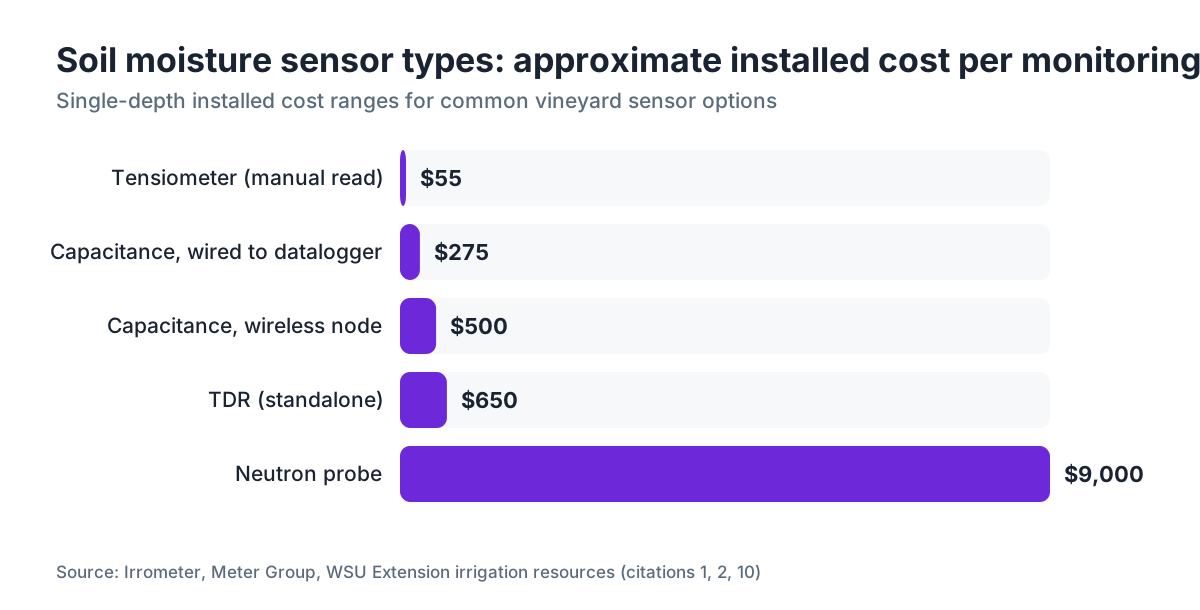
- Tensiometers cost $30-80 each.
- Capacitance-based wireless nodes run $150-700 each.
- Placement by soil type, not row number, is what separates useful data from expensive noise.
Why would you bother putting sensors in the ground at all?
Irrigation by feel, by calendar, or by watching vines wilt has real costs. Under-irrigation stresses the vine at the wrong growth stage. Over-irrigation drives vigor, leaches nitrogen, and in some states now triggers reporting under water-use efficiency programs. Neither mistake is free.
The case for instrumentation is simple: you can't manage what you can't measure. A pressure bomb tells you plant water status at one moment. Soil moisture sensors show you what the reservoir looks like continuously, so you irrigate before stress sets in or hold off when the profile is still full from a rain. WSU Extension's irrigation work found that sensor-guided deficit scheduling produced better fruit quality scores than calendar-based scheduling across Washington wine grape varieties [1].
Sensors are not magic. A sensor buried in an unrepresentative spot gives you false confidence, which is worse than no data at all. Network design matters as much as the hardware you buy.
What types of soil moisture sensors actually work in vineyard conditions?
Four sensor categories cover almost everything you'll see in a vineyard, each with a different working principle, price, and maintenance burden.
Tensiometers measure soil water tension (suction) directly in centibars. They're ceramic-tipped tubes filled with water. As soil dries, it pulls water out through the ceramic and a vacuum gauge reads the tension. They cost $30-80 each, read accurately in the 0-80 centibar range that covers most irrigated vine decisions, and use no electronics. The catch is refilling weekly or every two weeks during dry spells, and they cavitate (lose the vacuum seal) above about 80 cbars. For a vineyard already running a moderate-to-deficit program, they're a reliable workhorse [2].
Electrical resistance blocks (gypsum blocks) are cheap but slow to equilibrate, and they degrade in acidic or saline soils over 2-3 seasons. Most extension programs stopped recommending them as primary sensors years ago. I mention them so you don't buy them by accident.
Capacitance-based sensors (including frequency-domain reflectometry, FDR, and time-domain transmissometry, TDR variants) measure the dielectric permittivity of the soil, which is a proxy for volumetric water content. These run modern wireless networks. Sensors like the Sentek Drill & Drop or the Irrometer Watermark 200SS (resistive, but with digital output) connect to dataloggers and report on 15-60 minute intervals. Accuracy varies by soil. They need calibration in high-clay or high-organic ground, and manufacturers publish soil-specific calibration coefficients. UC ANR irrigation guidance recommends calibrating in place when clay content passes 35% or when checking against gravimetric samples in the first season [3].
Neutron probes are extremely accurate and read multiple depths through one access tube, but they need a radioactive materials license from the NRC and your state radiation program, cost $6,000-12,000 for the probe alone, and are a regulatory headache no vineyard manager wants. Some university extension programs rent them. For a permanent network, skip them.
The table below shows rough cost and fit for common vineyard situations.
| Sensor type | Installed cost per point | Depths per install | Wireless-ready | Maintenance level | Best fit |
|---|---|---|---|---|---|
| Tensiometer | $30-80 | 1 per unit | No | High (weekly fill) | Small blocks, hands-on operators |
| Capacitance (wired) | $150-400 | 2-6 (probe) | Via datalogger | Low | Mid-scale, existing SCADA |
| Capacitance (wireless node) | $300-700 | 2-6 (probe) | Yes (cellular/LoRa) | Low | Multi-block, remote access |
| TDR (standalone) | $400-900 | 1 per rod | Via datalogger | Very low | Research-quality accuracy |
| Neutron probe | $6,000-12,000 | Unlimited | No | High + licensing | Research / large irrigation districts |
How many sensors do you need and where should you put them?
Extension programs answer this question most inconsistently, because it genuinely depends on how variable your soil is. Honest starting point: one monitoring point per distinct soil type per block, with sensors at 2-3 depths per point. That's the floor for actionable data.
A "monitoring point" is one vertical profile. Common depths are 12 inches (shallow root uptake zone), 24 inches (active root zone), and 36-48 inches (drainage check). If you're on drip, the 12-inch sensor sits 6-12 inches laterally from the emitter, not directly under it, to catch the wetting front edge where most active roots live [3].
Soil variability drives sensor count more than block acreage does. A 10-acre block on one uniform loam might need 2 monitoring points. A 5-acre block with a clay lens in the low corner, sandy decomposed granite on the ridge, and a rockier transition in between needs at least 3, one per zone. The right pre-work is an EC (electrical conductivity) survey, or at minimum a careful read of your NRCS Web Soil Survey data, before you buy anything [4].
WSU Extension guidance suggests one well-placed monitoring station per 3-5 acres is enough when soils are uniform, dropping to one per 1-2 acres in highly variable terrain [1]. UC Cooperative Extension recommends backing sensors up with periodic pressure chamber readings to confirm that soil moisture tracks vine water status [3].
Here's the practical rule. Start with fewer points than you think you need. Run one full season. Note where your irrigation calls don't match what you see in the field. Add sensors the next spring. Overbuilding a network before you understand your soil variability is the most common and most expensive mistake I see.
What are the real installation steps for a vineyard sensor network?
Step one is your soil survey, not your hardware order. Pull Web Soil Survey data for your parcels from the NRCS [4], walk the block with a soil probe (a 3-foot push probe runs about $60 and teaches you a lot), and mark the distinct soil zones on a block map. Half a day of this saves you from burying sensors in spots that lie to you.
Step two: decide your data architecture. Are you logging locally to a datalogger you download by USB weekly? Transmitting via cellular modem to a cloud platform? Sending LoRaWAN to a gateway at your equipment shed? Cellular nodes (4G LTE) are the simplest to stand up but carry a SIM data cost of roughly $5-20 per node per month. LoRaWAN gateways cost $200-600 up front, then near-zero per-node transmission cost, and cover 1-3 miles line-of-sight in typical vineyard terrain. If your blocks sit within a half-mile of the shed, LoRa earns the extra setup work.
Step three: install access tubes or drive sensor rods when the soil is at field capacity, ideally 48 hours after irrigation or a soaking rain. Dry, hard soil makes installation harder and opens air gaps around the sensor, which wrecks accuracy. For multi-depth probe systems like the Sentek Drill & Drop, you need a soil auger matched to the probe diameter (usually 1.2 inches), and you backfill the tube with a slurry of native soil and water to close every void. For push-in sensors like the Watermark, follow the manufacturer torque spec. Force one into rocky ground and you crack the ceramic.
Step four: label everything, in the field and in your records. Sensor location (GPS or block map coordinates), depth, serial number, install date, and the soil type at that point. This sounds obvious. It's the step most people skip. Six months later they're staring at one weird reading with no idea which sensor produced it.
Step five: set your alert thresholds before you walk away. Most wireless platforms send email or SMS alerts when tension or volumetric water content crosses a line. Set them. Without alerts, a real-time network is just a historical dataset you check too late.
To keep the sensor metadata, install records, and irrigation event logs in one place, vineyard operations software like VitiScribe can tie sensor data to block records so your irrigation history and crop notes live together instead of across three spreadsheets and a notebook.
What thresholds should you actually irrigate at?
There is no universal threshold. That's the honest answer. The right trigger depends on variety, rootstock, growth stage, crop load, and your quality goals.
General guidance from extension programs still gives you a starting framework. UC ANR irrigation guidance for wine grapes lays out these rough ranges [3]:
- Pre-veraison: irrigate when soil tension at 12 inches hits 50-70 centibars (tensiometer), or when volumetric water content drops to 60-70% of field capacity in the active root zone. Mild stress here is acceptable and helps rein in shoot growth.
- Veraison through harvest: tighter management. Many programs target 40-60 cbars at 12 inches, or 65-75% of field capacity, to avoid berry cracking while holding fruit concentration.
- Post-harvest through dormancy: let the profile dry unless vines show stress. Replenishment irrigation in fall before frost is optional but can improve cold hardiness.
For capacitance sensors reporting volumetric water content, you need your soil's field capacity (FC) and permanent wilting point (PWP) to turn raw VWC numbers into decisions. Most labs run this as part of a standard soil texture and water-holding analysis for $30-80 per sample [5].
Cornell Cooperative Extension's work in New York vineyards suggests many Vitis vinifera varieties do well at a stem water potential of -1.0 to -1.4 MPa during fruit set, which lines up roughly with 50-70 centibars of soil tension in loamy soils [6]. The pressure chamber is your cross-check. Use both the first season, until you learn how your soils and your sensors behave together.
How do you pick a wireless platform and avoid vendor lock-in?
This is where vineyard managers get burned. Plenty of vendors sell hardware that only speaks to their own cloud platform, at a subscription price they can raise after year one. Before you buy anything, ask three things: Can I export raw data as CSV? Does the hardware support open protocols (Modbus, SDI-12, MQTT)? What happens to my data if I cancel?
SDI-12 is the standard you want. It's a simple serial protocol that any modern datalogger (Campbell Scientific, Onset HOBO, Meter Group) can read from most soil moisture sensors. If your sensors speak SDI-12, you aren't chained to one data platform.
LoRaWAN with The Things Network (TTN) or Helium as your network layer is a genuinely open stack. You own the gateway, you own the data, and you can swap your cloud dashboard without pulling a single sensor out of the ground. The tradeoff is more configuration work up front.
For small operations (under 20 acres), Onset HOBO dataloggers downloaded monthly and analyzed in spreadsheets is entirely reasonable and costs far less than a full wireless buildout. The fanciest platform is rarely the most useful one.
If you do go proprietary, get the data export and API access terms in writing before you sign. Extension sensor guides skip this. It's exactly where the long-term cost hides.
What does a vineyard soil moisture sensor network actually cost?
Budget ranges scatter all over the literature because they hinge on hardware choice, block size, and wireless versus wired. Here's an honest breakdown for a 20-acre vineyard with moderate soil variability, running 6 monitoring points at 3 depths each.
| Cost item | Low end | High end | Notes |
|---|---|---|---|
| Sensors (18 total, 3 per point) | $540 | $3,600 | Tensiometer vs. capacitance |
| Wireless nodes / dataloggers | $900 | $4,200 | 6 nodes at $150-700 each |
| LoRaWAN gateway | $0 | $600 | Skip if cellular, or use existing |
| SIM / data plan (annual, 6 nodes) | $360 | $1,440 | $5-20/node/month |
| Installation labor (2 days) | $400 | $800 | More if rocky soil |
| Cloud platform subscription (annual) | $0 | $2,400 | $0 for open-source dashboards |
| Total year 1 | $2,200 | $13,040 | |
| Annual ongoing (years 2+) | $360 | $3,840 | Data plan + platform |
For most 10-30 acre wine grape operations, a realistic wireless network runs $4,000-8,000 installed in year one, then $500-1,500 a year after that. Tensiometer systems with manual reading cost under $1,000 for the same block but demand 30-60 minutes of field time weekly through the irrigation season.
The return on investment question is real and hard to pin down. Nobody has clean controlled-trial data on ROI for small vineyard sensor networks. The closest proxy is water saved. WSU's irrigation efficiency work found sensor-guided scheduling cut applied water by 15-30% against calendar scheduling in Yakima Valley vineyards with no measurable yield penalty [1]. At $50-200 per acre-foot for irrigation water in California, that's a real number for larger operations.
How do soil moisture sensors interact with drip versus overhead irrigation systems?
Drip and overhead irrigation build fundamentally different wetting patterns, and sensor placement has to match.
With drip, the wetting bulb under each emitter is narrow, typically 18-36 inches across in loamy soils and wider in sand. Put your primary sensor 6-12 inches laterally from the emitter at 12 inches deep. A sensor directly under the emitter reads the wettest point and makes the profile look fuller than it is. A sensor halfway between two emitters reads the driest point and triggers irrigation too early. Lateral placement at the expected wetting front edge is the right call [3].
With micro-sprinklers or overhead sprinklers, wetting is broader and more even, so you can place sensors mid-row without the lateral offset. The bigger issue with overhead is that rain and irrigation look similar to the sensor, so correlate your irrigation records against the data carefully.
Subsurface drip (SDI) buries emitters 12-18 inches down, so your shallowest sensor should sit near emitter depth and your deepest should check for downward drainage below 36 inches. SDI is efficient but builds perched wet zones that can fool sensors installed at depths calibrated for surface drip.
If you're running a vineyard with mixed irrigation zones across multiple blocks, keep separate threshold tables for each irrigation type in your records.
What maintenance does a sensor network actually require?
Less than you'd think for electronic sensors. More than you'd think for tensiometers.
Capacitance-based wireless sensors are genuinely low-maintenance. The tasks: check readings at least weekly during the irrigation season to catch drift or failure; verify battery charge on wireless nodes every 60-90 days (most nodes report battery voltage); inspect access tube caps after any equipment passes through, to catch physical damage; and clean the sensor tip with a damp cloth if you pull sensors for the off-season. A calibration check against gravimetric samples once a season in your most variable soil zone is worth the hour.
Tensiometers need more attention. Refill the reservoir as needed, which can mean weekly in hot dry weather. Watch for cavitation above 80 centibars (the gauge drops suddenly to zero tension even as the soil keeps drying). Flush and refill the tube at the start of each season. In cold climates, store them out of the ground over winter so the ceramic cup doesn't freeze and crack.
Wildlife damage is a real problem in a lot of vineyards. Deer and ground squirrels chew through sensor cables. Use conduit or armored cable on exposed runs. Most extension guides skip this. It comes up constantly in practice.
Set a calendar reminder to swap sensor batteries before harvest, when you're too slammed to troubleshoot a node that goes dark mid-August.
Do worker safety or pesticide regulations apply to soil sensor installations?
For installing and maintaining sensors, the EPA Worker Protection Standard (WPS) is the rule most likely to touch your crew [7]. If sensors go into a block during or shortly after a pesticide application, restricted-entry intervals (REIs) apply. Workers installing soil sensors by hand count as agricultural workers under WPS when they do it in a treated area.
WPS requires that workers have received safety training, have access to personal protective equipment, and can see the pesticide application information (product name, REI, active ingredient) for any treated area they enter [7]. Soil sensor installation isn't a "handler" activity unless the worker is also applying or handling pesticide, so full handler PPE usually isn't required. Employer duties for safety training, decontamination supplies, and emergency assistance still apply.
For neutron probe users, NRC regulations under 10 CFR Part 30 govern licensed radioactive materials, and state radiation control programs pile on their own requirements. This is a genuinely complex area and one more strong reason to keep neutron probes out of routine vineyard use [8].
On water-use reporting, several western states (California, Colorado, Arizona) keep expanding irrigation reporting requirements. Sensor data can support water-use efficiency documentation, but check your state's specific program. California's SGMA (Sustainable Groundwater Management Act) compliance can involve documenting irrigation application volumes in some basins, and sensor data supports that [9].
How do you make sense of sensor data and actually change your irrigation decisions?
Raw numbers on a dashboard don't irrigate vines. The translation step is where most operations fall down.
Build a simple decision tree before the season. Something like: if tension at 12 inches exceeds 55 cbars AND tension at 24 inches exceeds 40 cbars AND no rain is forecast in 72 hours, run a 4-hour drip set. Basic, sure. Having it written down and posted at the pump station means whoever makes the call doesn't have to read a graph under time pressure.
Track your decisions against outcomes. After harvest, walk back through your sensor data and irrigation log and ask two questions. Where did I irrigate when the soil was actually fine? Where did I hold off and regret it? Cornell Extension's vineyard irrigation materials suggest a simple season log correlating pressure chamber readings, sensor readings, and vine symptoms, built over 2-3 seasons into a site-specific decision framework [6].
Logging irrigation decisions next to sensor readings is where digital tools earn their keep. VitiScribe ties field observations and irrigation events to block records, so you're building a searchable history instead of a stack of field notebooks. That history pays off in year three when you're trying to figure out why the Cabernet on the lower block needed two extra irrigation events.
Share data with your PCA or crop advisor. A licensed advisor who can see your trends spots calibration drift, flags unusual deep drainage that hints at a pest or disease issue, and helps you refine thresholds. Sensor data locked in a proprietary app your advisor can't open is worth far less than data you can export and email.
Are there extension programs or research resources to help you design the network?
Yes, several good ones.
WSU Extension's irrigation management resources for wine grapes are among the most practical out there, covering sensor placement, threshold recommendations by growth stage, and case studies from Yakima Valley and Columbia Valley blocks [1]. Their Viticulture and Enology program runs workshops and on-farm consultation in Washington.
UC Cooperative Extension has county-level farm advisors who specialize in irrigation management across California wine regions. The UC ANR publication on wine grape irrigation is the most-cited reference in the state and covers both tensiometer and capacitance sensor use in detail [3].
Cornell Cooperative Extension's viticulture program covers the cooler eastern context, with materials for New York, Pennsylvania, and the Great Lakes region [6]. Their irrigation scheduling tools account for shorter, wetter seasons where over-irrigation is as common a problem as under-irrigation.
Meter Group (maker of the TEROS sensor line) publishes a free application guide for vineyard soil moisture monitoring that's technically detailed and not purely promotional. It handles soil-specific calibration and sensor placement in a useful way [10].
The NRCS Web Soil Survey is the right first stop for understanding your soil variability before you spend a dollar on hardware [4]. It's free, covers the entire continental US, and gives you texture, water-holding capacity estimates, and drainage class for every mapped soil unit in your block.
Frequently asked questions
How deep should I install soil moisture sensors in a vineyard?
Three depths cover most situations: 12 inches for the shallow root uptake zone, 24 inches for the main active root zone, and 36-48 inches as a drainage check. If a hardpan or rock layer keeps roots shallower, shift the depths to match. For very deep sandy soils with roots below 48 inches, a fourth sensor at 60 inches catches deep drainage that's wasting water and nitrogen.
Can I use just one sensor per vineyard block?
One sensor beats none, but it only tells you what's happening at one spot. If your block has variable soils, one sensor in the wrong place will mislead you consistently. A single sensor in a verified-uniform soil zone is a reasonable start for a small, even block. Add a second in your most different soil area and compare for one season before deciding you need more.
What's the difference between soil tension and volumetric water content readings?
Soil tension (centibars) measures how hard a root has to pull to extract water, which tracks vine stress more directly. Volumetric water content (VWC, percent) measures how much water is physically present per volume of soil. Both help. Tension is more immediately actionable for irrigation calls, while VWC is better for calculating how much water you've applied or lost. Many modern sensors report both.
Do I need to calibrate soil moisture sensors after installation?
For clay-heavy or high-organic soils, yes. In-situ calibration against gravimetric samples is worth doing in year one. For sandy loams close to the manufacturer's reference soil, factory calibration is often close enough for management decisions. UC ANR guidance recommends calibration checks when clay content passes 35%. For tensiometers, no calibration is needed; they measure tension directly.
What's the best wireless communication technology for remote vineyard blocks?
LoRaWAN fits most multi-block situations best: 1-3 mile range, very low power draw (2-5 year battery life on AA cells), and no per-node data cost after gateway setup. Cellular (4G LTE) is simpler to configure and works anywhere with signal, but costs $5-20 per node monthly. For blocks within 300 feet of a building with WiFi, WiFi nodes are cheap and simple, though battery life is shorter.
How do I know if a soil moisture sensor is failing or drifting?
Compare readings across similar sensors after an irrigation event. All shallow sensors in a uniformly irrigated block should trend alike within a few hours. A sensor that reads consistently wetter or drier than its neighbors, or shows no response after irrigation, is likely failing or has an air gap around the tip. Validate suspect readings with a pressure chamber, or pull the sensor and check it in a bucket of water.
What soil moisture level should trigger irrigation during berry development?
UC ANR guidance targets 65-75% of field capacity in the active root zone from veraison through harvest, roughly 40-60 centibars on a tensiometer in loamy soil. Letting tension exceed 70-80 centibars during this window risks berry shrivel and excess concentration in warm climates. Cross-check with a pressure chamber: target stem water potential of -1.0 to -1.4 MPa as a plant-based confirmation.
Are there any grants or cost-share programs that cover vineyard sensor installation?
USDA NRCS Environmental Quality Incentives Program (EQIP) covers irrigation efficiency practices, including soil moisture monitoring equipment, in most states. Payment rates and practice eligibility vary by state and fiscal year. California's State Water Efficiency and Enhancement Program (SWEEP) has funded sensor networks as part of drip conversion projects. Contact your local NRCS field office for current sign-up windows and payment schedules.
Do soil moisture sensors work in rocky or gravelly vineyard soils?
Yes, with caveats. Rocks displace soil volume, so VWC readings underestimate total water in stony soils unless you apply a rock correction factor. Tensiometers are less affected because they measure tension, not volume. Installation is the main challenge: push-in sensors crack in rocky ground, so pre-drill the access holes. Multi-depth probe systems like the Sentek Drill & Drop handle gravel better than individual push-in sensors.
How does rainfall affect sensor readings and irrigation scheduling?
A rain event that saturates the profile resets your irrigation clock, but readings can lag 6-24 hours behind the full wetting front, especially in clay. Don't irrigate within 48 hours of significant rain without checking sensor trends rather than a single instantaneous reading. Connect a rain gauge to your datalogger or cloud platform so rainfall gets flagged automatically. This prevents the common mistake of irrigating right after a rain that hasn't registered on the dashboard yet.
Can sensor data replace the pressure chamber for vine water status monitoring?
Not entirely. Soil moisture sensors tell you what's available; the pressure chamber tells you what the vine is actually experiencing. Salt accumulation, odd root distribution, or localized compaction can leave a vine stressed even when the profile looks adequate. WSU and UC extension programs both recommend soil sensors as the primary scheduling tool with monthly or bi-weekly pressure chamber readings as a plant-based check, especially during critical growth stages.
What records do I need to keep for a vineyard soil moisture sensor network?
At minimum: sensor location (GPS or block map coordinates), installation depth, sensor type and serial number, install date, soil type at each point, and calibration notes. During the season, log irrigation events with volume applied alongside the readings that triggered the decision. This record set supports water-use reporting under California SGMA and similar state programs, and it's the data your PCA or crop advisor needs to help you refine thresholds over time.
How long do soil moisture sensors last in vineyard conditions?
Capacitance-based sensors typically last 5-10 years if installed without air gaps and kept out of above-ground freeze-thaw. Tensiometer ceramic cups can last 10+ years, but the plastic housing and gauge degrade faster; budget for replacement parts every 3-5 years. Wireless node electronics are the weakest link, often 5-7 years before battery or circuit failure. Manufacturer warranties typically cover 1-2 years.
Sources
- Washington State University Extension, Viticulture and Enology program, irrigation management resources: Sensor-guided deficit irrigation reduced applied water by 15-30% compared to calendar scheduling in Yakima Valley wine grape trials without measurable yield penalty; one monitoring station per 3-5 uniform acres recommended.
- Irrometer Company, tensiometer product documentation and operating range guidance: Tensiometers measure soil water tension accurately from 0 to approximately 80 centibars and require periodic refilling during dry conditions; cavitation occurs above this range.
- University of California Agriculture and Natural Resources (UC ANR), wine grape irrigation guidance: UC ANR irrigation guidance recommends in-situ calibration when clay content exceeds 35%, lateral drip sensor placement 6-12 inches from the emitter, and target ranges of 50-70 cbars pre-veraison and 40-60 cbars veraison through harvest.
- USDA Natural Resources Conservation Service, Web Soil Survey: Web Soil Survey provides soil texture, water-holding capacity, and drainage class for mapped soil units across the continental US, free of charge.
- UC Davis Department of Land, Air and Water Resources, soil water holding capacity analysis: Standard soil texture and water-holding capacity laboratory analysis typically costs $30-80 per sample and provides field capacity and permanent wilting point values needed to interpret VWC sensor readings.
- Cornell Cooperative Extension, viticulture program, irrigation scheduling materials: Cornell Cooperative Extension data indicates many Vitis vinifera varieties perform well at stem water potential of -1.0 to -1.4 MPa during fruit set, correlating roughly to 50-70 centibars of soil tension in loamy soils.
- US EPA, Worker Protection Standard for Agricultural Pesticides (40 CFR Part 170): The EPA Worker Protection Standard requires that workers entering treated agricultural areas observe restricted-entry intervals and that employers provide safety training, PPE, decontamination supplies, and emergency assistance information.
- US Nuclear Regulatory Commission, 10 CFR Part 30, domestic licensing of byproduct material: Neutron moisture probes containing radioactive sources require a radioactive materials license under 10 CFR Part 30 and applicable state radiation control program regulations.
- California Department of Water Resources, Sustainable Groundwater Management Act (SGMA) program: California's SGMA requires groundwater sustainability agencies in critically over-drafted basins to document irrigation application volumes and water use efficiency; sensor data can support this compliance documentation.
- Meter Group, vineyard soil moisture monitoring application guide (TEROS sensor line): Meter Group publishes a free application guide covering soil-specific calibration and sensor placement for vineyard soil moisture monitoring.
Last updated 2026-07-11