Soil microbiome of vineyards: what lives beneath your vines
TL;DR
- Vineyard soil holds hundreds of millions of bacteria, fungi, archaea, and other microbes per gram.
- These communities fix nitrogen, cycle phosphorus, suppress pathogens, and transfer mineral signatures into the grape berry.
- Management choices like tillage, cover crops, compost, and fungicide use can shift the microbiome hard within a single season.
- Protecting this community is one of the highest-return moves a vineyard manager can make.
What exactly is the vineyard soil microbiome?
The soil microbiome is the full community of living microorganisms in your vineyard soil: bacteria, fungi, archaea, protozoa, nematodes, and viruses. When researchers talk about it, they mostly mean the bacteria and fungi, because those two groups do the heavy lifting in nutrient cycling and plant interaction.
A single gram of healthy vineyard soil holds somewhere between 100 million and 1 billion bacterial cells [1]. Fungal biomass is harder to count by cell, but it can represent a bigger share of total soil biomass in drier, lower-nitrogen soils, which describes a lot of wine country west of the Rockies. Archaea, long filed away as exotic extremophiles, show up in nearly every vineyard soil sample. They handle a large part of nitrification, the conversion of ammonium to nitrate that vines actually take up [2].
Think of the microbiome as three zones. Bulk soil has the most diverse and numerous community. The rhizosphere, the thin film of soil sticking directly to roots, is a different world: root exudates (sugars, amino acids, organic acids) feed a concentrated population that runs 10 to 100 times denser than bulk soil [3]. The endosphere is the interior of the root tissue itself, where a selected subset of rhizosphere microbes actually colonize root cells. Mycorrhizal fungi are the most familiar endosphere residents in vineyards.
Here's the practical part. What you do at the soil surface ripples all the way down to the endosphere. Tillage, herbicide use, and synthetic fertilizer inputs change the bulk soil community, which changes the rhizosphere, which changes which organisms the vine pulls into its roots. The vine is not a passive recipient. Research from UC Davis has shown that Vitis vinifera actively shapes its own rhizosphere community, recruiting specific taxa depending on vine stress and phenological stage [3].
What microorganisms matter most to vine health and wine quality?
A handful of functional groups do most of the work vineyard managers actually care about. Not all microbes earn their keep the same way.
Mycorrhizal fungi are the most discussed, and for good reason. Arbuscular mycorrhizal fungi (AMF) form partnerships with the vast majority of cultivated grapevine rootstocks, extending hyphal networks that multiply the root's absorptive surface area by 100 times or more [4]. In exchange for sugars from the vine, AMF supply phosphorus, zinc, copper, and water during dry stretches. California trials by UC Davis extension found that AMF inoculation in fumigated soils reliably improved phosphorus uptake in young vines, though the benefit faded in soils that already had high phosphorus [4].
Nitrogen-fixing bacteria, mainly species in the genera Azospirillum and Gluconacetobacter plus free-living Azotobacter, convert atmospheric nitrogen gas into ammonium plants can use. This isn't the magnitude of fixation you get from legume-Rhizobium symbioses, but the contribution in cover-cropped vineyards is measurable and cuts synthetic nitrogen demand.
Phosphate-solubilizing bacteria (PSB), including many Bacillus and Pseudomonas species, produce organic acids that dissolve mineral-bound phosphate and make it plant-available. That matters a lot in old-vine blocks on weathered, low-phosphorus soils.
Suppressive microbes are the defenders. Bacillus subtilis, Trichoderma harzianum, and certain Pseudomonas fluorescens strains produce antifungal compounds that limit Botrytis cinerea, Phytophthora cinnamomi, and Fusarium populations. Cornell's viticulture extension program has published on using these organisms as biocontrol agents in organic systems [5].
Then there's the winery angle. The microbiome on grape skins and in vineyard soil is the source of indigenous ("wild") yeasts that winemakers use for spontaneous fermentation. Torulaspora, Lachancea, Metschnikowia, and eventually the Saccharomyces cerevisiae strains that finish fermentation all come, at least partly, from the vineyard environment [6]. The terroir sommeliers argue about is partly microbial. Research published in the Proceedings of the National Academy of Sciences found that vineyard-specific fungal communities contributed to regional wine chemical profiles [6].
How does vineyard soil microbiome diversity affect wine terroir?
This is where the science gets genuinely interesting, even when the marketing gets ahead of the data. Microbes are a real layer of terroir, but they are one layer, not the whole story.
The PNAS study by Bokulich and colleagues at UC Davis is the most-cited rigorous work on this question [6]. The researchers sampled soils, grapes, and fermentations across California wine regions and found that the regional pattern of fungal communities on grapes correlated with wine chemical composition, even after controlling for climate and variety. The study's stated conclusion: "Wine metabolites associated with microbial taxa, suggesting a possible microbial aspect to the phenomenon of terroir."
That's meaningful. It is not the same as saying "microbes make terroir." Climate, geology, and winemaking decisions all interact. But the microbial layer is real.
In practice, fumigation history matters. A vineyard replanted after full pre-plant fumigation starts with a near-sterile microbial community that takes years to come back [7]. The dominant colonizers in the early recovery phase are usually generalist, fast-growing bacteria, not the mature community you find under an old-vine block that has never been fumigated. If you're trying to express site character in your wine, that's worth thinking about.
Regional soil type also filters the community. Sandy loam soils typical of parts of the Paso Robles appellation support different fungal communities than the heavy clay common in Carneros. Water activity, pH, and organic matter are the main levers. UC Davis extension data shows that soil pH between 6.0 and 7.0 supports the broadest bacterial diversity, while very acid or alkaline soils tend toward lower diversity and fewer functional groups [3].
What kills the vineyard soil microbiome, and how fast does it recover?
Several management practices hit the microbiome hard. Severity and recovery time vary a lot by practice, and knowing the difference tells you where to be careful.
Pre-plant fumigation with chloropicrin or 1,3-dichloropropene (Telone) is the most complete reset. Fumigated soils can lose 90% or more of their fungal biomass right after treatment [7]. Bacterial populations bounce back faster than fungi because bacteria reproduce quickly and hold resting spore forms. AMF communities, though, can take 3 to 5 years to return to pre-fumigation diversity without active inoculation. Washington State University extension has documented AMF suppression persisting for multiple growing seasons after fumigation in replant situations [7].
Broad-spectrum fungicides are a subtler problem. Copper-based fungicides, widely used in organic viticulture for downy mildew and Botrytis, build up in soil over decades. A 2020 review found that long-term copper accumulation above 100 mg/kg soil significantly reduced AMF colonization rates [8]. The EU caps copper at 28 kg per hectare over 7 years (a 4 kg/ha/year average) partly for this reason. The US has no equivalent federal limit.
Synthetic nitrogen fertilizer, especially ammonium nitrate and urea at high rates, suppresses the diversity of nitrogen-fixing bacteria. The microbes that specialize in fixation gain no competitive edge when mineral nitrogen is already abundant. The effect is dose-dependent and partly reversible if you cut back.
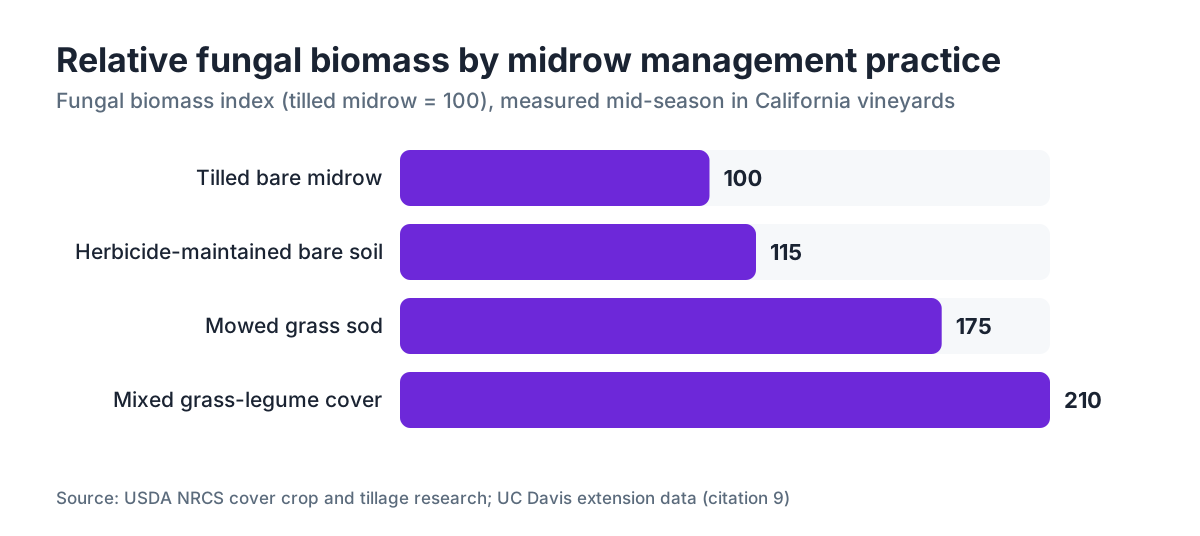
Tillage physically tears apart the hyphal networks that connect fungal communities and breaks up the soil aggregates that shield microbes from drying out and UV. Research comparing tilled midrows to permanent sod in California vineyards found tilled soils had 40 to 60% lower fungal biomass than sod midrows at mid-season [9].
The good news is that recovery is real. A WSU extension trial found that cover cropping with a grass-legume mix for two straight seasons improved AMF spore counts and phosphorus uptake in a replant block to near pre-fumigation levels [7]. Compost at 5 to 10 tons per acre speeds recovery, mostly by adding organic matter that feeds bacterial communities.
How do cover crops and compost change the soil microbiome?
Cover crops are the highest-leverage tool most vineyard managers have, and the microbial research backs it up cleanly. If you change one thing this year, change what grows in your midrows.
Grass species like cereal rye and barley raise the fungal-to-bacterial biomass ratio, which usually goes with slower nutrient cycling and better soil structure. Legumes like vetch or bell beans boost nitrogen-fixing bacteria and, when terminated and incorporated, add an organic nitrogen pulse that helps bacterial diversity broadly. Mixed covers do both [9].
Termination timing matters more than most managers realize. Terminating a cover crop in late February versus late April shifts when the organic nitrogen flush hits the soil, which changes vine nitrogen status at bloom and veraison. That's not purely a microbiome story, but the microbial community is the middleman between organic matter and vine-available nitrogen.
Compost is different from cover crops. It delivers a concentrated dose of organic carbon plus microbial inoculants in one pass. Well-finished compost carries live populations of Bacillus, Pseudomonas, and other beneficial bacteria. High-quality vermicompost tends to have higher microbial activity and diversity than thermophilic (hot) compost [9]. The catch: poorly finished compost can bring in pathogens or weed seeds. Cornell's extension recommends compost that reached 131 degrees F for at least 3 days (for in-vessel or static aerated pile systems) or 15 days with five turnings (for windrow systems) before vineyard application [5].
Don't overlook the row itself as a management zone. The soil directly under the vine, where herbicides often keep bare ground, tends to have lower microbial diversity than the midrow. Narrowing the herbicide strip and letting some understory grow under the trellis can raise the microbially active area of the block by a lot.
What do soil microbiome tests actually measure, and should you get one?
The testing space has moved fast in the past decade. Know what you're actually buying before you spend on it. Some panels tell you how much life is in the soil, others tell you exactly who is there, and they cost very different amounts.
PLFA (phospholipid fatty acid analysis) measures total fungal and bacterial biomass by pulling lipid biomarkers. You get a snapshot of living biomass and a rough fungal-to-bacterial ratio. Cost runs about $50 to $100 per sample through most commercial labs. The limit is that PLFA doesn't tell you which organisms are present, only how much biomass there is.
DNA metabarcoding (amplicon sequencing of 16S for bacteria, ITS for fungi) names the specific taxa and their relative abundances. This is the technology behind studies like the Bokulich PNAS paper. Commercial labs now run it for $150 to $400 per sample [1]. Interpreting the output is the hard part. A list of 2,000 fungal OTUs (operational taxonomic units) isn't actionable without a baseline or a comparison.
Enzyme activity assays (beta-glucosidase, urease, phosphatase) sit in the middle. They measure the functional capacity of the community rather than its composition, they cost $30 to $60 per assay, and they track well with organic matter decomposition and nutrient availability.
My honest take: for most vineyard managers, a PLFA panel or a basic enzyme battery run once in spring and once post-harvest gives you enough trend data to judge management decisions year over year. Full metabarcoding is worth the money for a pre/post fumigation comparison, evaluating a new cover crop program, or documenting terroir character for marketing. Otherwise it's a lot of data with no context.
The real insight lives in tracking what you applied, when, and what the soil test showed afterward. That kind of longitudinal field record is exactly what a system like VitiScribe is built for, connecting spray records, soil amendments, and lab results in one place so the pattern over three or four seasons is actually visible.
Does rootstock choice affect the soil microbiome?
Yes, and it gets skipped in most rootstock selection conversations. Different rootstocks build different microbial neighborhoods around their roots.
Different Vitis rootstocks release different root exudate profiles, and that shapes which microbes colonize the rhizosphere. A study comparing 110R, 3309C, and SO4 found statistically significant differences in rhizosphere bacterial community composition even when the vines were planted in the same block on the same day, with the gap widening over three years [3].
Rootstock drought tolerance interacts with the microbiome in both directions. Deeper-rooting stocks reach different soil horizons with their own microbial communities. Under water stress, vines shift their root exudate chemistry to recruit more stress-tolerant AMF strains [4]. Some rootstocks, notably 1103P and 140Ru, hold higher AMF colonization under drought than shallower-rooted options.
For replants specifically, rootstock choice interacts with fumigation history. Rootstocks with more aggressive root architecture physically reach recovering AMF populations better than finer-rooted stocks in the first two years after replanting.
Nobody has great data on exactly which rootstock maximizes beneficial microbiome outcomes across all soil types. The closest systematic work comes from UC Davis viticulture extension, which runs rootstock trials that include rhizosphere microbiome sampling, but multi-year results from those trials are not fully published as of 2025 [3].
How does irrigation management change soil microbiology?
Water is the single biggest driver of microbial activity in arid and semi-arid wine regions. No water, no activity. But the pattern of delivery matters as much as the total volume.
Drip irrigation concentrates moisture and root activity in a narrow band below each emitter. AMF hyphae multiply in the wet zone and drop off sharply outside it. If you're leaning on AMF for phosphorus uptake but your emitters create a very tight wet front, the mycorrhizal network may not stretch far enough to reach phosphorus-rich zones of the profile [4].
Flood or furrow irrigation, still common in older vine blocks across parts of the California and Washington vineyard landscape, wets the soil more evenly and spreads microbial activity broadly. It also raises disease pressure and can create anaerobic pockets in heavy clay, which push bacterial communities toward anaerobes and denitrifiers.
Pulsed or deficit irrigation, where you cycle between mild stress and water, actually favors diverse AMF communities because it mimics the natural wet-dry cycles that shaped these organisms. Research cited by WSU extension suggests regulated deficit irrigation (RDI) at 50 to 70% ETc during late berry development can raise AMF colonization intensity compared to full replacement irrigation [7].
When you shut off irrigation at season's end also matters. Soils that hold moderate moisture through harvest and into cover crop establishment support higher microbial activity and better breakdown of vine leaf litter going into winter.
What are the EPA and pesticide compliance implications for protecting soil biology?
No federal standard specifically requires protecting soil microbiomes. But pesticide registration rules, the EPA Worker Protection Standard (WPS), and California's Department of Pesticide Regulation (CDPR) create an indirect framework that governs which products reach your soil.
EPA requires pesticide registrants to submit environmental fate data, including soil half-life and soil binding data, as part of registration under the Federal Insecticide, Fungicide, and Rodenticide Act (FIFRA) [10]. That data is on the label or in the full EPA review document. You can look up the soil half-life of any registered pesticide in the EPA's Pesticide Chemical Search. Products with long soil half-lives (some soil fumigants, some soil-applied systemic fungicides) are the ones most likely to leave lasting microbiome effects.
The EPA WPS regulates worker exposure and re-entry intervals and doesn't address microbial protection directly [11]. But the WPS's central documentation requirement, the pesticide application record, is the same record you'd need to line up pesticide timing against any soil biology monitoring you do. Clean, complete application records are both a compliance obligation and a scientific dataset.
In California, CDPR requires restricted materials permits for certain soil fumigants including chloropicrin and Telone, with buffer zones and application windows that carry some incidental soil biology protection. The Sustainable Agriculture Farming Systems (SAFS) project at UC Davis has produced guidelines on minimizing soil biology impacts while keeping disease control [12].
My practical advice: when you evaluate a new soil-applied pesticide or fumigant, pull the EPA environmental fate document and check the soil DT50 (the time for 50% degradation). Anything above 60 days in the soil is worth flagging in your block records right next to your soil biology monitoring data.
How can you build and protect vineyard soil biology over time?
Building a microbiome is a multi-year project. There is no quick fix, and the products that promise one are usually the waste of money.
The most durable gains come from raising soil organic matter. Every 1% increase in soil organic matter in the top 12 inches of a typical vineyard soil corresponds to roughly 1,000 pounds of organic nitrogen per acre in microbially processed form, though release rate depends heavily on microbial activity and temperature [9]. Getting organic matter up usually takes cover crops, compost, and minimal tillage working together for five or more years.
Cut prophylactic soil applications. If you can hit disease control goals with foliar-only copper or sulfur, you're lowering the soil load of those materials. Where soil application is necessary (Phytophthora management, say), pick the shortest effective rate.
AMF inoculants are worth using at planting but are often wasted money in established blocks where native AMF are already present, unless you've recently fumigated. Quality varies wildly between commercial products. Look for independent third-party viability testing, and check that the species on the label are actually there at the claimed spore counts.
Audit your nitrogen program. If you're applying more synthetic nitrogen than tissue tests say the vine needs, you're probably suppressing nitrogen-fixing bacteria you could otherwise rely on. The goal is just enough mineral nitrogen to support your growth targets while leaving room for the biological system to pitch in.
Record everything, and be patient. The payoff from a healthy microbiome, better drought resilience, lower fertilizer spend, and possibly more expressive fruit, shows up over five to ten years, not in one season. Longitudinal records are the only way to see the signal through the year-to-year noise. Tools like VitiScribe let you link soil amendment records and lab results to individual blocks so you can watch the trajectory without digging through three binders of paper at year seven.
And get a baseline soil biology test before you change your program. Without a pre-treatment measurement, you have no way to know whether your cover crop or compost work is actually moving the community where you think it is.
Are there regional differences in vineyard soil microbiomes across US wine regions?
Yes, and the differences are big enough to change management recommendations. A program built for one region can flop in another.
The Bokulich PNAS study found that regional microbial signatures were detectable across multiple vintages, which says climate and soil type create persistent filters on community composition [6]. Pacific Coast regions (Napa, Sonoma, Willamette Valley) tend toward higher fungal diversity in native and minimally disturbed soils, partly because the Mediterranean wet/dry cycle favors fungi over bacteria relative to the continuously moist soils of the northeastern US.
In the Pacific Northwest, WSU extension researchers have documented that volcanic parent material in regions like the Columbia Valley creates soils with high mineral phosphorus but low organic phosphorus, which shifts the relative importance of phosphate-solubilizing bacteria compared to Napa Valley's more developed alluvial soils [7].
Eastern wine regions, including the Finger Lakes in New York (well documented by Cornell viticulture extension), carry higher baseline organic matter from continuous summer moisture, which supports more diverse and active bacterial communities year-round [5]. The trade-off is higher disease pressure and more complex microbial competition that can make biocontrol products less predictable.
Arid regions in southern California and southern Arizona face the opposite challenge: low organic matter, high pH in some blocks, and communities that go dormant for much of the dry season. Thermal swings in desert soils are also more extreme, and many beneficial fungi have narrow temperature tolerance windows.
The takeaway for managers: don't import recommendations wholesale from another region. A biostimulant program built for Oregon's Willamette Valley soils may do nothing for you in a dry-farmed Paso Robles block.
Frequently asked questions
How many microorganisms are in vineyard soil per gram?
Healthy vineyard soil typically holds 100 million to 1 billion bacterial cells per gram, plus substantial fungal biomass measured in meters of hyphae per gram. Exact counts vary by soil type, organic matter level, moisture, and season. Rhizosphere soil directly around roots runs 10 to 100 times denser than bulk soil because root exudates feed it.
Does organic vineyard management produce a different soil microbiome than conventional?
Generally yes. Multiple studies find certified organic vineyards have higher bacterial and fungal diversity, higher AMF colonization, and higher enzyme activity than conventional blocks of equivalent age and soil type. The difference comes mostly from reduced synthetic nitrogen, no broad-spectrum soil fumigants, and steadier organic matter inputs rather than any single practice.
Can the soil microbiome affect wine flavor and aroma?
Research says yes, though the mechanism is indirect. The 2016 PNAS study by Bokulich et al. found regional fungal communities on grapes correlated with wine metabolite profiles. Soil microbes influence mineral uptake, vine stress responses, and which wild yeasts colonize grape skins, all of which affect fermentation chemistry and finished wine composition.
How long after fumigation does the soil microbiome take to recover?
Bacterial populations partly recover within one growing season. Arbuscular mycorrhizal fungi take longer, three to five years to approach pre-fumigation diversity without active inoculation. WSU extension trials found that two seasons of cover cropping plus compost brought AMF spore counts near pre-fumigation levels in replant blocks. Active inoculation at planting speeds recovery.
Is copper fungicide bad for the soil microbiome in vineyards?
Accumulated copper above about 100 mg/kg soil significantly reduces AMF colonization, according to a 2020 review of copper-soil biology interactions. Long-term copper use in organic viticulture is the main source of buildup. The EU caps copper at 4 kg per hectare per year averaged over 7 years. The US has no equivalent federal limit, so testing soil copper in organic blocks every 3 to 5 years is worth doing.
What is the rhizosphere and why does it matter to grapevines?
The rhizosphere is the narrow zone of soil directly surrounding and stuck to roots, usually a few millimeters thick. It has 10 to 100 times more microbial activity than bulk soil because roots release sugars, amino acids, and organic acids that feed the community. Grapevines actively shape their rhizosphere by changing exudate chemistry at different growth stages and under stress, recruiting the microbial functional groups they need.
Should I buy mycorrhizal inoculants for my established vineyard?
Probably not, unless you've recently fumigated or your soil is badly degraded. Established vineyard soils with any history of non-fumigated management almost certainly have native AMF populations that outcompete introduced strains. Inoculants deliver real value at planting in fumigated soils or in potted nursery stock. If you do buy one, look for third-party verified spore counts on the label.
How does tillage affect the vineyard soil microbiome?
Tillage physically breaks fungal hyphal networks and disrupts the soil aggregates that protect microbes. Research comparing tilled midrows to permanent sod found 40 to 60% lower fungal biomass in tilled soils at mid-season. Bacteria recover faster than fungi after tillage. Shifting to under-vine mowing or minimal-disturbance weed management is one of the fastest ways to improve fungal community health in the midrow.
What soil tests tell me about my vineyard's microbial health?
PLFA (phospholipid fatty acid analysis) measures bacterial and fungal biomass and the ratio between them, at about $50 to $100 per sample. Enzyme activity assays (beta-glucosidase, phosphatase, urease) measure functional capacity at $30 to $60 per assay. DNA metabarcoding names specific taxa at $150 to $400 per sample. For most managers, PLFA or enzyme panels run seasonally give better ROI than full sequencing unless you're documenting a major management change.
Does regulated deficit irrigation help or hurt the soil microbiome?
Moderate deficit irrigation, around 50 to 70% ETc during late berry development, tends to raise AMF colonization intensity compared to full replacement irrigation, according to WSU extension research. The wet-dry cycle mimics the natural conditions that favor mycorrhizal fungi. Severe water stress that desiccates the root zone for long stretches does harm the community, especially in shallow soils with low water-holding capacity.
Does the rootstock I choose affect which microbes live in my soil?
Yes. Different rootstocks release different root exudate profiles, which recruit different microbial communities. A study comparing 110R, 3309C, and SO4 found statistically significant rhizosphere bacterial community differences in the same block within three years of planting. Deeper-rooted stocks also reach different soil horizon communities. This rarely comes up in rootstock selection conversations, but it's real.
How does vineyard soil biology relate to EPA pesticide compliance?
No federal standard specifically protects soil microbiomes, but EPA requires soil fate and half-life data for pesticide registration under FIFRA. Long soil half-life products carry the highest microbiome risk. California's CDPR requires restricted materials permits for key fumigants. The EPA Worker Protection Standard mandates application records, which also serve as your data log for correlating pesticide use with any soil biology monitoring you track.
Are there university extension resources on vineyard soil microbiome management?
Yes. UC Davis Cooperative Extension has published extensively on rhizosphere biology, AMF, and cover crop effects. Cornell's viticulture extension covers biocontrol organisms and compost standards for eastern wine regions. Washington State University extension addresses replant disease and AMF recovery after fumigation in the Pacific Northwest. All three programs have free online resources and region-specific recommendations.
What cover crop mix best supports vineyard soil biology?
A grass-legume mix generally beats monocultures for microbial diversity. Grasses like cereal rye raise the fungal-to-bacterial ratio and improve soil structure. Legumes like vetch or bell beans add nitrogen-fixing bacteria and provide an organic nitrogen pulse on termination. WSU and UC Davis extension both recommend mixed species covers for most wine regions, with species adjusted for local climate and termination timing.
Sources
- USDA Agricultural Research Service: Healthy soil contains 100 million to 1 billion bacterial cells per gram of soil
- UC Davis, Department of Viticulture and Enology: Vitis vinifera actively shapes rhizosphere microbial communities; soil pH 6.0-7.0 supports broadest bacterial diversity; rootstock affects rhizosphere community composition
- University of California Agriculture and Natural Resources (UC ANR): AMF extend root absorptive surface area by 100x or more; inoculation improves phosphorus uptake in fumigated soils; drought-tolerant rootstocks maintain higher AMF colonization under water stress
- Cornell University, Grapes and Wine (CALS): Bacillus subtilis, Trichoderma harzianum, and Pseudomonas fluorescens strains act as biocontrol agents in organic vineyard systems; compost temperature and turning standards for pathogen reduction
- Bokulich et al., Proceedings of the National Academy of Sciences, 2016: Regional fungal communities on grapes are regionally differentiated and correlate with wine metabolite profiles; vineyard-specific microbial communities contribute to regional wine chemical profiles
- Washington State University Extension: AMF populations suppressed for multiple seasons after fumigation; two seasons of cover cropping plus compost returned AMF counts to near pre-fumigation levels; RDI at 50-70% ETc increases AMF colonization; volcanic parent material creates high mineral phosphorus soils in Columbia Valley
- Journal of Hazardous Materials, copper accumulation and AMF review, 2020: Long-term copper accumulation above 100 mg/kg soil significantly reduces AMF colonization rates
- US EPA, pesticide registration and FIFRA: EPA requires soil fate and half-life environmental data for pesticide registration under FIFRA
- US EPA, Agricultural Worker Protection Standard (WPS): EPA WPS mandates pesticide application recordkeeping, which supports correlation of pesticide use with soil biology monitoring
- UC Davis, Agricultural Sustainability Institute: UC Davis sustainable farming systems work published guidelines on minimizing soil biology impacts while maintaining disease control in California vineyards
Last updated 2026-07-11