Soil pests in vineyard: identification, damage, and control

TL;DR
- The soil pests that cost vineyards the most are grape phylloxera, plant-parasitic nematodes (especially dagger nematodes that carry fanleaf virus), grape rootworm larvae, and root mealybugs.
- Damage runs from stunted vines to whole-block loss.
- Identify through soil sampling first, then match the tool to the pest: rootstock, fumigation, or biological control.
- Pre-plant prevention costs a fraction of post-establishment remediation.
Which soil pests actually cause economic damage in vineyards?
Four pests drive nearly all soil-related vine decline across North American and European vineyards: grape phylloxera (Daktulosphaira vitifoliae), plant-parasitic nematodes (mainly root-knot, dagger, and ring nematodes), grape rootworm larvae (Fidia viticida and relatives), and root-feeding mealybugs (Pseudococcus spp., Rhizoecus spp.). Each attacks the root system differently. Each needs a different answer.
Phylloxera is the one every grower knows by name. It feeds on root tissue and forms galls that choke off nutrient uptake, killing own-rooted vines over years. The insect spread across Europe in the 1860s and 1870s and wiped out an estimated two-thirds of French vineyards before rootstock grafting solved it [1]. It's still the defining soil pest in California, Oregon, and most of the Old World.
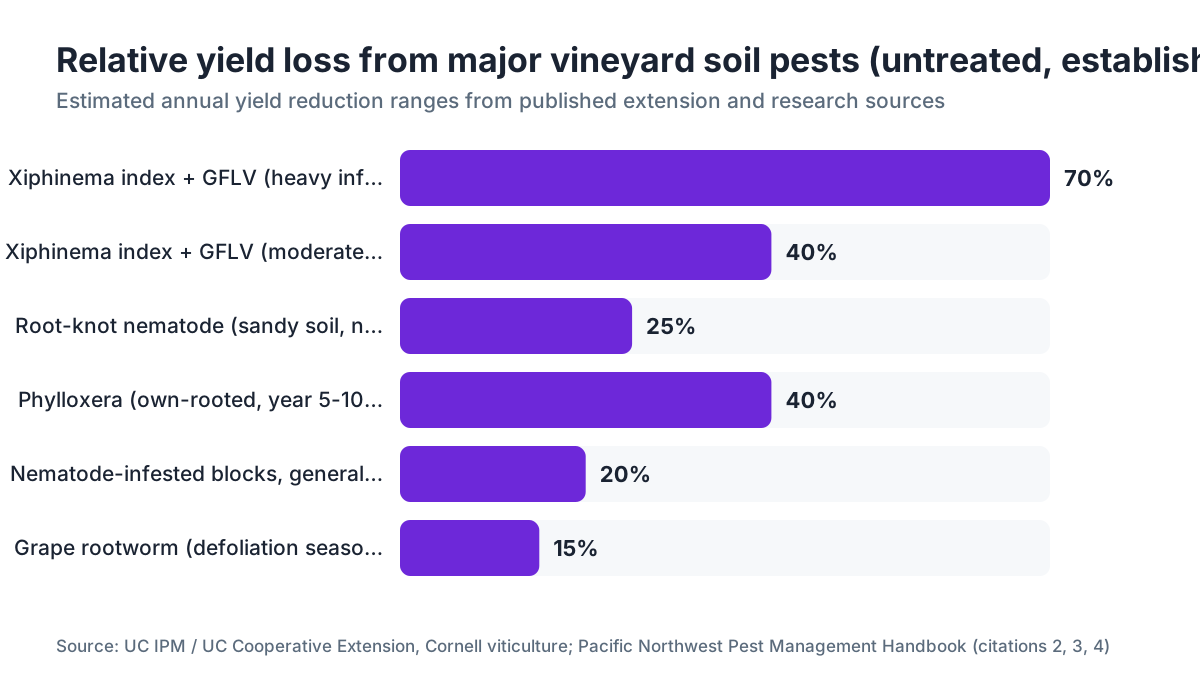
Nematodes get overlooked because the damage mimics nutrient deficiency or drought. Root-knot nematodes (Meloidogyne spp.) form galls on feeder roots. Dagger nematodes (Xiphinema index) are the main vector for Grapevine fanleaf virus, which can cut yields 30 to 80 percent in heavily infested blocks [2].
Grape rootworm larvae chew the root cortex, and the adults skeletonize leaves. They flare in untreated eastern US blocks but stay episodic in most regions. Root mealybugs are the quiet one. Rhizoecus falcifer, the grape root mealybug, feeds on roots all year and you'll almost never find it without going looking.
How do you identify and sample for soil pests before they cause visible damage?
By the time vines look weak in August, the pest population has usually been building for two to five years. Visible decline is a lagging signal. Sampling ahead of the symptoms is the whole game.
For nematodes, pull soil cores from the top 18 to 24 inches, 15 to 20 cores per uniform block, and composite them into one sample. Sample in fall when populations peak near the surface, or in spring before soil temperatures drop below 55°F. Send it to a certified nematology lab. UC IPM guidance recommends a minimum of 500 cc of soil per composite sample for reliable counts [3]. The report gives you species and population density, and you need both to set an action threshold.
For phylloxera, dig at vine drip lines and check roots for the yellow, lemon-shaped insects sitting on galls. Populations are patchy, so walk the whole block and flag weak vines before you dig. PCR-based soil assays through some university labs give species-level confirmation, which matters where D. vitifoliae biotypes overlap.
Nematode thresholds shift by species and soil type. The Pacific Northwest Pest Management Handbook puts the pre-plant threshold for Xiphinema americanum (a fanleaf-family virus vector) at 1 per 250 cc of soil in light sandy soils, lower in heavier ground [4]. Root-knot thresholds generally sit at 1 to 5 per 250 cc, depending on how susceptible your rootstock is.
For mealybugs, peel bark at the trunk base and check soil within six inches of the crown. A 10x hand lens and patience do most of the work. Pheromone-baited sticky traps catch adult males of some species but tell you nothing about population density.
| Pest | Best sampling timing | Sample type | Detection threshold (pre-plant) |
|---|---|---|---|
| Root-knot nematode | Fall or spring | Soil + roots, 18" depth | 1-5 per 250 cc soil |
| Dagger nematode (X. index) | Fall | Soil, 24" depth | 1 per 250 cc |
| Phylloxera | Spring or fall | Root inspection at drip line | Any presence on own-rooted vines |
| Grape rootworm | Spring (soil temps 55°F+) | Soil, 6" depth near crown | Larvae >1 per vine |
| Root mealybug | Year-round | Crown/soil inspection | Any presence warrants monitoring |
Sample before you plant a new block. Every time. Remediation after establishment is slow, expensive, and often only partial. Pre-plant is the one window where you have real control over the outcome.
What does phylloxera damage look like and how fast does it kill a vine?
Phylloxera moves through a block in a pattern you can read. Infested vines form a circular decline zone that widens roughly 1 to 3 rows per year. Vines inside the zone yellow in late summer, set small clusters, and eventually fail to push new growth in spring. From first infestation to death, own-rooted vines usually take 5 to 15 years, depending on soil, climate, and vigor [1].
Galls on the root tips cut off water and nutrient flow. Secondary fungi, mainly Botrytis and Fusarium species, move into the damaged tissue and speed the collapse. That's why phylloxera vines often look like they have Esca or another wood disease at the same time.
In California's North Coast, phylloxera Biotype B tore through plantings on the once-popular AXR#1 rootstock starting in the late 1980s, forcing replanting of tens of thousands of acres [1]. Replant cost per acre ran roughly $15,000 to $40,000 in 1990s dollars, depending on land prep, irrigation, and lost production years. Today's establishment costs push that number higher.
There's no cure for phylloxera in an established vineyard. You slow the spread with sanitation and equipment discipline, and you plan an orderly replant on resistant rootstock.
Which nematode species matter most and why does the virus connection change the math?
Not every nematode is a real threat. Ring nematodes (Mesocriconema xenoplax) and lesion nematodes (Pratylenchus vulnus) chew root tissue but rarely end a vineyard without other stress in play. Root-knot nematodes are worse because they degrade the structural root system over years. Dagger nematodes are a different category entirely.
Xiphinema index, the Italian dagger nematode, is the main vector of Grapevine fanleaf nepovirus (GFLV). It picks up the virus from infected roots, holds it for months, and reinfects new roots as vines regrow after fumigation or even after replanting with clean stock [2]. That's why GFLV sites are the hardest to fix. You can kill the nematodes, plant certified clean material, and still watch reinfection show up within a few seasons from nematodes surviving in deep soil or from infected weed roots.
Cornell viticulture research puts yield loss from GFLV-infected vines at 30 to 80 percent, with the top of that range in heavily infested sites planted to susceptible varieties [2]. Some blocks aren't worth replanting to wine grapes without a long fallow first.
X. americanum, the American dagger nematode, vectors tomato ringspot virus (ToRSV) and tobacco ringspot virus (TRSV), both of which hit grapevines. The Pacific Northwest Pest Management Handbook lists both as real concerns in regional vineyards [4].
Here's the takeaway. When your assay comes back, don't stop at population density. Read the species line. A low count of X. index should worry you more than a high count of ring nematodes on a healthy rootstock.
What rootstocks resist soil pests and are they worth the cost?
Rootstock selection is the most durable and cost-effective tool you have for phylloxera and nematodes both. Grafted vines cost more upfront, usually $2 to $5 more per vine than own-rooted material, and that premium is nothing against a forced replant.
For phylloxera, rootstocks bred from Vitis berlandieri, V. rupestris, and V. riparia crosses hold up well. 110R, 1103P, 140 Ruggeri, and 3309C see wide use across California and Europe. SO4 has moderate resistance. AXR#1, as noted, folded under Biotype B and is off the recommended list in California [12].
Nematode resistance is messier. 1616C and Dog Ridge carry high tolerance to root-knot nematodes but perform poorly in fine-textured soils and drive high vigor, which fights against tight-yield programs. Harmony and Freedom got planted heavily in California on their root-knot ratings, then turned out to be susceptible to X. index, the dagger nematode vector, and helped spread GFLV in the process [8]. Schwarzmann has moderate root-knot resistance and adapts to more soils.
No single rootstock covers everything. The sequence is simple: sample to identify which pests you actually have, pin down the soil type and vigor needs for your variety, then cross-reference. UC IPM and the extension rootstock guides keep updated selection tables for California conditions [3].
For Xiphinema index specifically, no commercial rootstock offers strong resistance. Breeding work continues [9]. For now your tools are fumigation, long fallow, and sometimes giving up on grapevines for that site.
Tracking rootstock choices, graft sources, and the soil data behind them is a records problem as much as a horticultural one. If you're running multiple blocks, VitiScribe ties block-level soil records to planting decisions in a form you can actually read years later when you're chasing a decline or renewing block registrations.
Should you fumigate before planting, and which products are still legal?
Pre-plant fumigation is the strongest nematode tool available, but the rules and the product list have changed a lot in 20 years. Several materials are gone or heavily restricted.
Methyl bromide is essentially phased out for US agricultural use under the Montreal Protocol, with critical-use exemptions that don't reach vineyard establishment [5]. It used to be the standard because one pass handled nematodes, soilborne fungi, and weed seed together. Losing it pushed growers toward alternatives that are either weaker or harder to run.
Telone II (1,3-dichloropropene, 1,3-D) is the main pre-plant nematicide still widely sold. It goes down as a liquid that volatilizes in soil, and it needs the right soil temperature (50 to 85°F at 6 inches), moisture, and organic matter to work. California applications require a site-specific permit from the county agricultural commissioner and a soil suitability assessment [5]. Buffer zones from structures and water bodies apply.
Vapam (metam sodium) is the other option, applied as a soil drench or through drip. It breaks down to methyl isothiocyanate (MITC) and hits nematodes, fungi, and weeds, though most trials rate it weaker on nematodes than 1,3-D at matched rates.
Neither product controls X. index reliably at depth. This species survives at 3 to 4 feet in many soil profiles, below where most fumigants ever reach.
Post-plant options for established vines are thin. Abamectin (Agri-Mek) is registered on established vines in some states and suppresses nematodes through drip application. The efficacy data is uneven. UC IPM trials in the San Joaquin Valley found partial suppression, not the knockdown you get from pre-plant fumigation [3].
My honest read: fumigation earns its keep when X. index or root-knot nematodes come back at threshold in the pre-plant assay. Don't fumigate on a hunch. It costs $1,500 to $4,000 per acre depending on material, method, and local labor and permit fees. A confirmed problem justifies that. A precautionary impulse doesn't.
How do you manage grape rootworm in established vineyards?
Grape rootworm (Fidia viticida in the eastern US; Bromius obscurus, the western grape rootworm, in the Pacific Northwest) mostly hits young plantings, though it can defoliate and feed on roots in any block. Adult beetles skeletonize leaves in a chain-feeding pattern in June and July. Larvae hatch from eggs laid near the crown, drop to the roots, and feed through fall before they overwinter.
For adults, pyrethroid sprays timed to emergence (roughly when soil at 6 inches reaches 55 to 60°F in spring) cut leaf damage and egg laying. Kaolin clay builds a physical barrier that deters egg laying in organic programs, but coverage has to be thorough and repeated.
For larvae, entomopathogenic nematodes (Steinernema carpocapsae, Heterorhabditis bacteriophora) applied to the soil around the crown give biological control of the root-feeding stage. Timing is everything: soil has to be moist and above 55°F for the nematodes to move. Cornell extension work shows S. carpocapsae working against rootworm larvae when applied in late summer after egg hatch [11].
In most commercial vineyards, rootworm isn't the top soil pest. Sort out phylloxera and nematodes first, then worry about this one.
What are the EPA Worker Protection Standard requirements for soil pesticide applications in vineyards?
If you apply any fumigant or registered pesticide in a vineyard, EPA's Worker Protection Standard (WPS) applies. EPA revised the WPS in 2015, and it covers agricultural workers and pesticide handlers on farms, forests, nurseries, and greenhouses [6].
For fumigants specifically, the 2015 revision added handler training on fumigant risks and emergency procedures, plus on-site emergency eyewash and decontamination equipment during application. Application exclusion zones (AEZ) keep workers out of the area around the equipment while it runs.
For vineyard soil applications in general, the core WPS duties are: post field re-entry intervals (REIs) at treated-field access points, train workers before they enter treated areas, keep the label and safety data sheet accessible, and supply the personal protective equipment the label calls for.
REIs for common vineyard soil pesticides run from 12 hours for some granular insecticides to five days for restricted-use fumigants like 1,3-D. The label is the law. The REI and PPE on the current label beat any older record or long-standing habit.
EPA's WPS regulation states that "the agricultural employer must provide, maintain, and ensure use of personal protective equipment (PPE) required by the labeling of each pesticide used" [6]. That's a requirement, not advice.
Keep signed training records for every worker. County agricultural commissioners and state ag departments do ask for them at inspection. A five-year retention period is sound practice even where state law asks for less.
How do soil type and block history affect which pests you're likely to find?
Soil texture isn't only an agronomic detail. It decides which pests thrive and how fast they move.
Sandy soils warm faster in spring, dry out faster, and hold less water. They're the highest-risk ground for nematodes, which travel freely through large pore spaces. Root-knot nematodes do the most harm in sandy, well-drained soils because the vine is fighting moisture stress and root damage at the same time. UC research found nematode damage thresholds in coarse-textured soils can be half the population density that triggers the same damage in loam [3].
Heavy clay isn't immune to nematodes, but it slows them down. Clay is friendlier to phylloxera, though, because the heavier structure gives crawlers better conditions to move between root zones. There's an old French observation that truly sandy soils, like parts of the Camargue, are essentially phylloxera-proof because crawlers can't survive in shifting dry sand. That's the basis for own-rooted vines in a handful of regions worldwide.
Block history matters as much as texture. Ground that grew peaches, cherries, or almonds often carries high Pratylenchus vulnus. Ground after tomatoes or peppers carries root-knot risk. Blocks in continuous grapevine for 30 years or more usually carry high phylloxera and may have picked up Xiphinema index if the old planting ever had GFLV.
Get records from the previous owner when you can. Ask about fumigation history, rootstock identity, and any decline events. That, plus your own pre-plant sampling, tells a fuller story than sampling alone.
What does an integrated pest management (IPM) plan for vineyard soil pests look like?
IPM for soil pests isn't about avoiding chemistry. It's about applying the right tool at the right time based on monitoring data, not a calendar and not precautionary spending.
A workable framework has four stages: monitor, decide, act, evaluate.
Monitor. Pre-plant soil sampling for every new block, every time. Annual visual scouting in established blocks (at least 5 percent of vines per block), with targeted soil sampling anywhere you see unexplained decline. Log where and when you sampled.
Decide. Compare results to established action thresholds. Don't treat below threshold. The Pacific Northwest Pest Management Handbook lists thresholds for several nematode species with soil-type adjustments [4]. Lean on your extension's guidance, not a pesticide rep's pitch.
Act. Match the tool to the pest. Rootstock selection is the move for phylloxera in a replant. Pre-plant fumigation is the move for high nematode counts before establishment. Post-plant biologicals or registered nematicides handle modest populations in established blocks. Sanitation (boot brushes, equipment wash stations) slows phylloxera between blocks. Nothing removes it once it's in.
Evaluate. Resample the treated area 12 to 18 months after you act. Record it. A fumigation that didn't drop counts points to poor soil conditions during application, populations too deep to reach, or reinfection from weed hosts. Knowing which one saves you from repeating a failure.
Recording spray and treatment applications is also a compliance duty in most states. Pesticide application records get kept two to five years depending on the state, and restricted-use records carry federal requirements under FIFRA Section 8 [10]. VitiScribe automates those records and links them to block-level soil history, so you're not rebuilding the chain from memory at audit time.
See also: Vineyard operations and field records for how soil pest work fits into broader block documentation.
What are realistic costs and timelines for managing soil pests?
The numbers below come from published extension budgets and public pesticide cost data. They move with region, labor market, and operation size.
Pre-plant nematode sampling runs $40 to $120 per sample at most commercial nematology labs, species ID included. That's per composite, and a 20-acre block might need three to five samples to cover soil variability. Call it $200 to $600 to sample a new block.
Pre-plant fumigation with 1,3-D (Telone II) runs roughly $1,500 to $3,000 per acre for material and application, with permit fees adding $100 to $500 per application in California. Vapam costs a bit less in material but may need multiple passes. Neither figure counts the wait before planting, which is 21 to 30 days for most fumigants.
Replanting a phylloxera-infested block on resistant rootstock runs $15,000 to $30,000 per acre in established wine regions, covering vine removal, soil ripping, new trellis, irrigation changes, plant material, and labor. Lost production during the non-bearing years (typically years 1 through 3) piles on top.
Entomopathogenic nematode applications for rootworm run $200 to $400 per acre in material and application, repeated annually for a sustained effect.
The pre-plant math is easy. A $600 sampling program plus a $2,000-per-acre fumigation that heads off a $20,000-per-acre replant in year 8 is an obvious call. The harder number to pin down is the lost production and lost market standing in the years between decline and replant.
Nobody has clean data on average career-long yield loss from soil pests across a whole vineyard. The closest figures come from the UC statewide IPM program, which estimates nematode-infested sites without management lose 10 to 30 percent of yield potential annually in affected blocks [3].
What organic and biological options exist for soil pest management in certified organic vineyards?
Certified organic vineyards work with a narrower toolbox for soil pests. Not a complaint, just a constraint to plan around.
For nematodes, the main organic tools are cover crops and soil amendments. Brassica cover crops (mustard, arugula) incorporated as green manure release glucosinolates that break down to isothiocyanates, which suppress nematodes. Field trials show 40 to 70 percent reductions in root-knot populations from Brassica green manure, though the effect swings hard with species, timing, and soil conditions. UC extension has trialed several Brassica species for suppression in California [3]. Sudangrass and sunn hemp (Crotalaria juncea) also show documented suppression.
Compost and organic matter amendments don't kill nematodes directly. They improve soil biology, which builds populations of free-living nematodes and other organisms that prey on the parasitic species. Slow and directional, not a knockdown.
Entomopathogenic nematodes (Steinernema, Heterorhabditis) are OMRI-listed and are the main biological tool for grape rootworm larvae. They do nothing to plant-parasitic nematodes.
For phylloxera in organic vineyards, no approved material gives meaningful control. Resistant rootstocks are the only durable answer, same as conventional.
Kaolin clay (Surround WP) is OMRI-approved and deters adult rootworm when applied before egg-laying, but it doesn't touch soil stages.
Organic certification doesn't exempt you from WPS. Every pesticide application, OMRI-listed materials included, carries the same record-keeping, label compliance, and worker training as conventional products [6].
Frequently asked questions
How do I know if my vineyard has phylloxera?
Look for expanding circular patches of declining vines with yellowing leaves, small clusters, and weak shoots in summer. Dig at the drip line of symptomatic vines and check roots for yellow, lemon-shaped insects on galls. The spread pattern, outward from a center at roughly 1 to 3 rows per year, is diagnostic. Confirm with a lab sample or PCR assay if you want species-level certainty.
Can you treat phylloxera in an established vineyard?
No curative treatment exists for phylloxera in established vineyards. Systemic insecticides don't give reliable control and soil drenches don't work. Management focuses on slowing spread: sanitize equipment between blocks, avoid moving infested soil, and plan an orderly replant on resistant rootstock as the block declines. No chemical reverses phylloxera damage once it starts.
What nematodes are most damaging to grapevines?
Xiphinema index (Italian dagger nematode) is the top priority because it vectors Grapevine fanleaf virus, which cuts yields 30 to 80 percent. Root-knot nematodes (Meloidogyne spp.) cause direct root damage and hit hardest in sandy soils. Ring and lesion nematodes cause moderate damage. Species identification from a soil assay matters more than raw counts when you're making decisions.
How deep should I sample soil for nematodes?
Sample to 18 to 24 inches for most species. Dagger nematodes can sit at 3 to 4 feet, below effective fumigant penetration, so note that on your lab submission if you suspect Xiphinema index. Pull 15 to 20 cores per uniform block and composite them. UC IPM recommends at least 500 cc of composited soil per sample for reliable population counts.
Is fumigation worth it before planting a new vineyard block?
Yes, when sampling confirms nematodes at or above action thresholds, or when the site has a history of Xiphinema index or root-knot nematodes. Pre-plant fumigation with Telone II costs $1,500 to $3,000 per acre but can head off a $15,000 to $30,000 per acre replant later. Don't fumigate speculatively on a clean site. Sample first, then decide. Fumigation without a confirmed problem is a poor return.
Which rootstocks resist nematodes?
Dog Ridge and 1616C carry high tolerance to root-knot nematodes but drive very high vigor and suit only specific situations. Schwarzmann offers moderate resistance with better adaptability. Harmony and Freedom got planted widely for root-knot resistance but proved susceptible to Xiphinema index. No commercial rootstock has strong resistance to X. index. Match rootstock to the specific species confirmed in your assay, not general resistance ratings.
What records do I need to keep for pesticide applications to vineyard soil?
Federal law under FIFRA requires restricted-use pesticide records to be kept two years; many states require two to five. Records must include the pesticide name and EPA registration number, application date, location, rate, target pest, and applicator name and license number. The EPA Worker Protection Standard also requires records of worker safety training and re-entry intervals. Keep application records organized by block for fast retrieval at inspection.
Can cover crops help reduce nematode populations in vineyards?
Yes, with caveats. Brassica cover crops incorporated as green manure release compounds that suppress root-knot and other species in the 40 to 70 percent range across trials, though results vary by species, timing, and soil moisture. Sudangrass and sunn hemp also show suppression. It's a useful IPM tool but not a replacement for fumigation at high population densities.
Do organic vineyards have any options for soil pest control?
The toolbox is narrow. Brassica green manures partly suppress nematodes. Entomopathogenic nematodes (Steinernema, Heterorhabditis, both OMRI-listed) control grape rootworm larvae biologically. Resistant rootstocks are the only effective tool for phylloxera, same as conventional. Compost amendments improve soil biology over time but give no direct knockdown. Organic certification doesn't reduce the need for soil sampling and monitoring.
How does soil texture affect vineyard soil pest risk?
Sandy soils carry the highest nematode risk because nematodes move freely through large pore spaces and vines face moisture and root stress together. Action thresholds in coarse soils can be half those used in loam. Heavy clay limits nematode mobility but can be friendlier to phylloxera spread. Truly sandy soils (under 3 percent silt and clay) are nearly inhospitable to phylloxera crawlers, which is why own-rooted vines persist in some coastal sand-soil regions.
What is the western grape rootworm and where is it a problem?
Bromius obscurus, the western grape rootworm, is the main rootworm species in Pacific Northwest vineyards. Adults skeletonize leaves in a chain-feeding pattern. Larvae feed on roots from late summer through fall. The Pacific Northwest Pest Management Handbook lists it as a periodic economic pest in Washington and Oregon. Adult emergence lines up with soil hitting 55 to 60°F at 6 inches. Pyrethroid sprays and entomopathogenic nematodes are the main tools.
How long does it take to rehab a block infested with Xiphinema index?
Realistically 3 to 6 or more years if GFLV is present. X. index holds the virus for months and survives at depth below fumigant penetration. After removing infested vines you need an extended fallow (at least 2 to 3 years), repeated fumigation or biofumigant cover crops, and weed control to eliminate viral reservoir hosts. Some X. index sites with confirmed GFLV aren't economically viable for grapevine replanting without a decade-long program.
What are the EPA Worker Protection Standard requirements for vineyard fumigant applications?
The 2015 revised WPS requires fumigant-specific handler training, on-site emergency eyewash and decontamination equipment, and application exclusion zones (AEZ) that keep workers out during application. Field re-entry intervals for fumigants like 1,3-D can reach five days. EPA requires that "the agricultural employer must provide, maintain, and ensure use of personal protective equipment required by the labeling of each pesticide used." Signed training records must be retained.
Can I use drip irrigation to apply nematicides in established vineyards?
Yes. Abamectin (Agri-Mek) is registered for drip application on established vines in some states and suppresses nematode populations modestly. Vapam can also go through drip in pre-plant situations. UC IPM trials found partial and inconsistent suppression from post-plant drip abamectin compared to pre-plant fumigation. Drip chemigation works better as a suppressive tool in high-value blocks where you want to extend vine life, not as a replacement for pre-plant management.
Sources
- UC IPM Statewide Integrated Pest Management Program, Grape Phylloxera: Phylloxera Biotype B devastated California plantings on AXR#1 rootstock starting in the late 1980s, requiring replanting of tens of thousands of acres. Original European outbreak destroyed an estimated two-thirds of French vineyards.
- Cornell University College of Agriculture and Life Sciences, Grape Fanleaf and Dagger Nematode research: GFLV vectored by Xiphinema index reduces yields 30 to 80 percent in heavily infested blocks. Steinernema carpocapsae has documented efficacy against grape rootworm larvae.
- UC IPM Statewide Integrated Pest Management Program, Nematodes in Grape: Nematode damage thresholds in coarse-textured soils may be half those for loam. Nematode-infested sites without management lose 10 to 30 percent of yield potential annually. Brassica green manures trialed for nematode suppression. Minimum 500 cc soil sample recommended.
- Pacific Northwest Pest Management Handbooks (Oregon State, WSU, University of Idaho): Pre-plant threshold for Xiphinema americanum is 1 per 250 cc of soil in light sandy soils. ToRSV and TRSV are documented concerns in Pacific Northwest vineyards vectored by X. americanum.
- California Department of Pesticide Regulation, Fumigant Use: 1,3-dichloropropene (Telone II) requires a county agricultural commissioner permit and site-specific soil suitability assessment in California. Methyl bromide is effectively phased out for agricultural use under Montreal Protocol obligations.
- US EPA, Agricultural Worker Protection Standard (40 CFR Part 170): "The agricultural employer must provide, maintain, and ensure use of personal protective equipment (PPE) required by the labeling of each pesticide used." 2015 revision added fumigant-specific handler training requirements and application exclusion zones.
- UC IPM Statewide Integrated Pest Management Program, Grape Rootstock and Nematode Management: Harmony and Freedom rootstocks proved susceptible to Xiphinema index despite their root-knot nematode tolerance ratings, leading to GFLV spread in affected California plantings.
- USDA Agricultural Research Service, Grape Genetics and Rootstock research: Dog Ridge and 1616C offer high root-knot nematode tolerance; Schwarzmann offers moderate resistance with better soil adaptability. No commercial rootstock offers strong resistance to X. index, an active area of breeding research.
- US EPA, Pesticide Registration and FIFRA record-keeping requirements: Restricted-use pesticide application records must be retained for two years under federal law; state requirements may extend this to five years.
- Cornell University College of Agriculture and Life Sciences, Grape Rootworm Management: Entomopathogenic nematodes (Steinernema carpocapsae) show efficacy against grape rootworm larvae when applied in late summer after egg hatch with adequate soil moisture.
- UC IPM Statewide Integrated Pest Management Program, Grape Rootstock Selection: AXR#1 is no longer recommended in California due to susceptibility to phylloxera Biotype B. 110R, 1103P, 140 Ruggeri, and 3309C are widely recommended alternatives.
Last updated 2026-07-09