Spray manual for vineyard oidium: the complete field guide
TL;DR
- Vineyard oidium (powdery mildew, Erysiphe necator) is the most economically damaging fungal disease in most grape regions.
- A working program combines early sulfur or FRAC 3 sprays timed to the 10-day rule or degree-day models, strict rotation of fungicide classes to slow resistance, and complete spray records for compliance.
- Miss the shoot emergence window and you spend the whole season catching up.
What is vineyard oidium and why does it matter so much?
Powdery mildew of grapevines, caused by the obligate biotroph Erysiphe necator (formerly Uncinula necator), is the most economically significant fungal disease in almost every wine grape region on earth. It doesn't need free water to infect, which sets it apart from downy mildew. It thrives in warm, dry weather with moderate humidity, which is exactly the climate many premium winegrowing regions were chosen for. That's the trap.
The fungus overwinters two ways: as dormant mycelium inside infected buds, and as chasmothecia (sexual fruiting bodies) in bark crevices. When spring warms, both release spores. Primary infections from chasmothecia need temperatures above roughly 50°F (10°C) and at least 0.1 inch of rain to discharge ascospores [1]. The bud-overwintering mycelium is arguably the more dangerous route, because it produces infected shoots from day one, before most growers have started spraying.
A single colony can release millions of conidia within days. Under optimal conditions (68 to 77°F, relative humidity above 40%), the latent period from infection to sporulation runs as short as 5 to 7 days [2]. That speed is why a 10-day spray interval is the standard, not the maximum.
The stakes are real. Severe infections reduce berry set, shrivel fruit, lower sugar accumulation, raise volatile acidity in the finished wine, and can take a whole crop on susceptible varieties. UC IPM puts potential crop loss at up to 100% in untreated or poorly timed programs on varieties like Chardonnay and Cabernet Sauvignon [1].
For growers at vineyards in warm inland regions, disease pressure often arrives earlier and climbs faster than coastal operations expect.
Which grapevine varieties are most susceptible to powdery mildew?
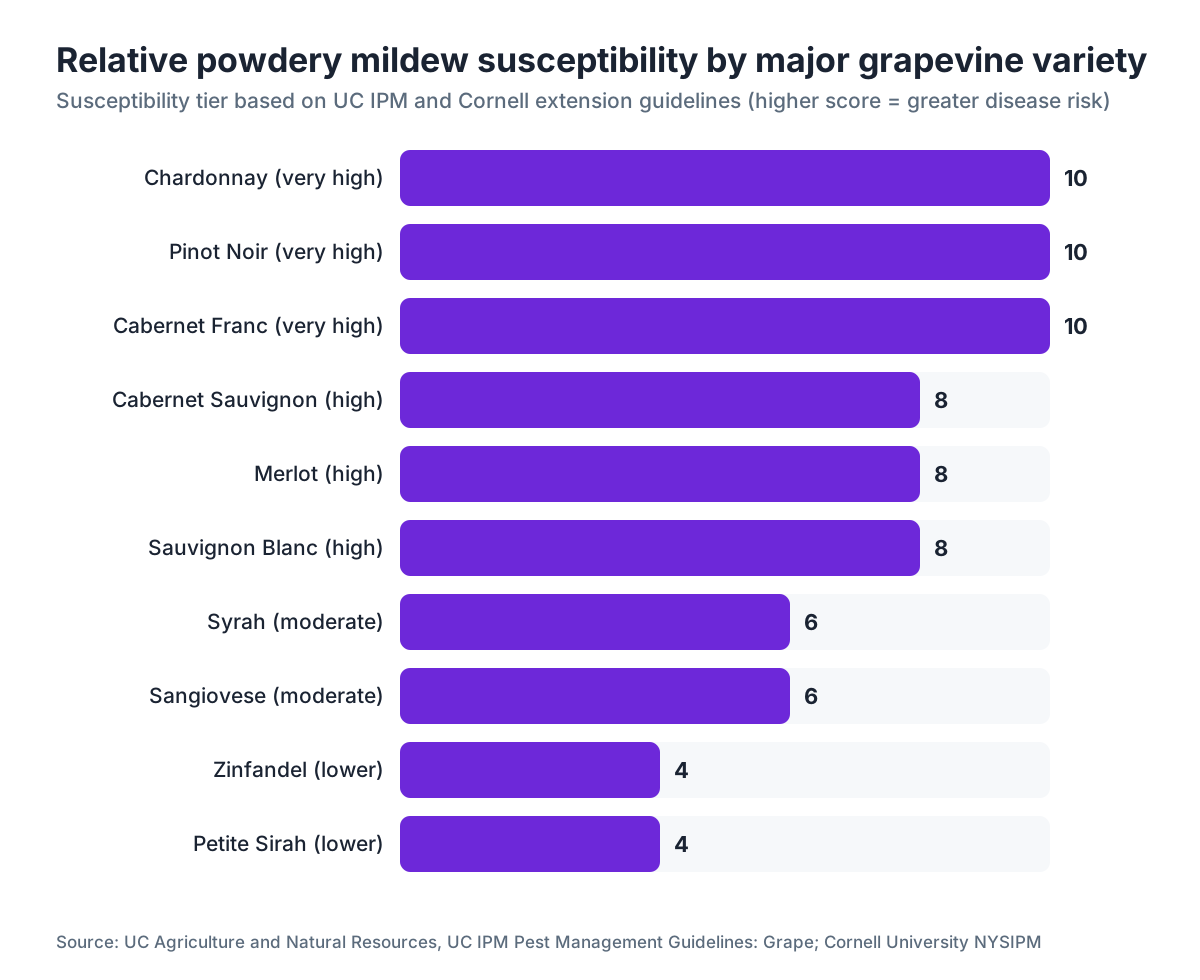
Not every variety is an equal target. Vitis vinifera as a species has essentially no evolved resistance to E. necator, because the pathogen came from North America and vinifera never grew up alongside it. There's still a wide spread within vinifera, though.
| Susceptibility tier | Common varieties |
|---|---|
| Very high | Chardonnay, Cabernet Franc, Pinot Noir, Gewürztraminer, Muscat |
| High | Cabernet Sauvignon, Merlot, Sauvignon Blanc, Riesling |
| Moderate | Syrah, Grenache, Sangiovese, Viognier |
| Lower (still needs management) | Zinfandel, Petite Sirah, Carignan |
Hybrid and interspecific varieties bred with resistance loci from V. rotundifolia or other American Vitis species can cut spray intervals a lot. Cornell's breeding program has released varieties like Arandell and Noiret with partial resistance [3]. Partial resistance means fewer sprays, not zero sprays.
Variety choice doesn't change your spray strategy much in practice. It changes the cost of missing an application. On Chardonnay, missing the pre-bloom window is a season-defining mistake. On Zinfandel in a dry year, a delayed start might not hurt you. Degree-day models help you know which situation you're actually in.
How do you time powdery mildew sprays: the 10-day rule vs. degree-day models
Two timing frameworks run the show. Both work. Using them together beats either alone.
The 10-day rule is exactly what it sounds like: apply a fungicide every 10 days from bud break through roughly 6 to 8 weeks after bloom, shortening to 7 days during the highest-risk stretch (pre-bloom through fruit set) [1]. It's calendar-based and easy to hand to a crew. The weakness is that it ignores the weather. You spray on day 10 whether the past week ran cool and dry (low risk) or warm and humid (high risk).
Degree-day (DD) models read the season better. The UC Powdery Mildew Risk Index tracks cumulative degree-days above 50°F from January 1 to predict key biological events:
- 0 to 20 DD: Begin scouting
- 20 DD: First sprays warranted in high-risk blocks
- 40 DD: Ascospore release begins in earnest
- 180 DD: First flag shoot infection likely if conditions line up [1]
WSU's decision tools and the NEWA network (Cornell) offer free regional weather-based disease forecasting for growers in Washington, New York, and parts of the Midwest [3][4]. Bookmark both.
Here's what a lot of experienced growers actually do: run the degree-day model to set the start date, then default to the 10-day calendar once you're spraying. When a hot, humid stretch hits, tighten to 7 days. After a cool, dry 10 days, you can stretch to 12. That kind of judgment call only holds up if your records are good.
Pre-bloom is the window you don't negotiate. Cornell's IPM program is blunt about it: "The period from immediately before bloom until 3 to 4 weeks after bloom is the most critical time to protect the fruit from infection." Get at least two applications on before bloom opens [3].
What fungicides work best for vineyard powdery mildew?
Fungicides for oidium sort into several FRAC (Fungicide Resistance Action Committee) groups. Rotating groups is the whole game. Staying on one mode of action is how you breed resistant populations, and resistance to DMIs (FRAC 3) and QoIs (FRAC 11) is already documented in California and beyond [5].
| FRAC Group | Mode of Action | Examples | Notes |
|---|---|---|---|
| M2 (inorganic sulfur) | Multi-site | Wettable sulfur, micronized sulfur | Workhorse; phytotoxic above 90°F; cheap |
| 3 (DMI/triazoles) | Sterol biosynthesis inhibitor | Tebuconazole, Myclobutanil (Rally) | Watch label limits; resistance documented |
| 7 (SDHI) | Succinate dehydrogenase inhibitor | Fluxapyroxad (Merivon combo), Fluopyram (Luna combos) | Often premixed with FRAC 11 |
| 11 (QoI/strobilurin) | Complex III inhibitor | Azoxystrobin (Abound), Trifloxystrobin (Flint) | Resistance documented; never use alone |
| 13 (aza-naphthalene) | Signal transduction | Quinoxyfen (Quintec) | Do not exceed 2 apps per year |
| U6 (phenyl-acetamide) | Unknown / novel | Cyflufenamid (Gatten) | Newer chemistry; good resistance profile |
| 19 (polyoxin) | Chitin synthesis | Polyoxin D (OSO, Ph-D) | OMRI-listed; weaker solo; good rotator |
| BM/NC | Multi-site/varied | Potassium bicarbonate, neem oil, Bacillus-based | Low resistance risk; fit organic programs |
Sulfur is still the backbone of most programs, organic and conventional alike. It's cheap (roughly $1.50 to $3.00 per acre per application depending on formulation and rate), it has no documented resistance, and it works. Its limits: phytotoxicity above 90°F, no mixing with oil within 2 weeks, and no systemic movement, so coverage decides everything.
The EPA registers pesticides under FIFRA, and labels are legally binding. The label is the law [9]. If a label caps a FRAC 3 product at 3 applications per season, that number is not a suggestion.
For USDA organic operations, OMRI-listed products (sulfur, potassium bicarbonate, copper, neem) carry the program. Cornell's organic viticulture resources are a solid reference for staying compliant with NOP rules [3].
Keep one table taped in the spray shed: your fungicide rotation by FRAC group, with application dates filled in as you go. Three FRAC 3 entries in a row in your log means stop and switch. Software like VitiScribe flags that automatically as you log sprays, which is one less thing to hold in your head during a busy May.
How do you build a season-long powdery mildew spray program?
A program that works is a schedule with flexibility built into it. Here's a practical framework used across several UC Cooperative Extension regions [1].
Dormant through bud swell (no oidium action needed): Focus dormant copper on black measles and trunk diseases if warranted. Don't burn your FRAC 3 uses this early.
Bud break to 2-inch shoot (earliest start): Wettable sulfur at 3 to 5 lb/acre. Lowest cost, lowest resistance risk. Coverage on new shoots matters more than rate here.
2-inch shoot through pre-bloom (high risk, 7 to 10 day intervals): Rotate sulfur with a systemic, FRAC 3 or FRAC 7. If the block has a history of flag shoots (overwintering bud infections showing as chlorotic, distorted shoots), you need a systemic in this window. Sulfur alone won't reach mycelium inside the tissue.
Pre-bloom through petal fall (most critical window, 7-day intervals): Your best fungicide goes here. Cyflufenamid (Gatten) or a FRAC 7+11 premix. Budget your strongest products for this period. Missing it gets expensive fast.
Fruit set through veraison (10-day intervals, easing off after 6 weeks post-bloom): Rotate back to sulfur as the primary. Spend remaining systemic uses where they count. Six weeks past bloom, berry skin toughens and susceptibility drops hard.
Post-veraison: Risk falls sharply. Most programs stop systemics here. Sulfur alone covers it if pressure is low. Watch pre-harvest intervals; some products carry 7 to 28 day PHIs.
Total applications for a typical vinifera block in a moderate-pressure region: 10 to 16 per season. In a wet, humid year, or a high-pressure region like the Hudson Valley, 18 to 20 is normal [3].
Keep the log current. Record product, FRAC group, rate, water volume, application method, operator, wind speed, temperature, and crop growth stage. That's the legal minimum under most state pesticide rules, and it's the data you'll want if you ever face a crop loss claim or a state inspection.
What spray equipment gives the best coverage for oidium control?
Early on, powdery mildew is a surface pathogen, so coverage drives results more than rate. You can hang the right fungicide at the right time and still lose if deposition is poor.
Air-blast sprayers are the standard in most operations, and calibration is where they live or die. UC Cooperative Extension recommends calibrating for full canopy coverage, targeting 100 to 150 gallons per acre (GPA) in high-density trellis systems and 50 to 75 GPA in lower-density systems with good air penetration [1]. Plenty of growers run 40 GPA with weak air blast and then wonder why interior clusters are covered in white.
Tunnel sprayers (recycling sprayers) cut product use and drift sharply. They cost money (capital of $30,000 to $80,000 depending on configuration) but earn their keep on larger operations worried about neighbor relations and environmental liability. They also improve worker exposure numbers, which matters under the EPA Worker Protection Standard.
The Worker Protection Standard (WPS) at 40 CFR Part 170 requires that workers and handlers be told about pesticide applications, trained annually, and kept out during restricted-entry intervals (REIs) [6]. Sulfur's REI is 24 hours. Many systemic fungicides carry REIs of 12 to 24 hours. Before anyone re-enters a treated area inside the REI, the WPS requires the application information be posted at the central display or communicated directly to workers [6].
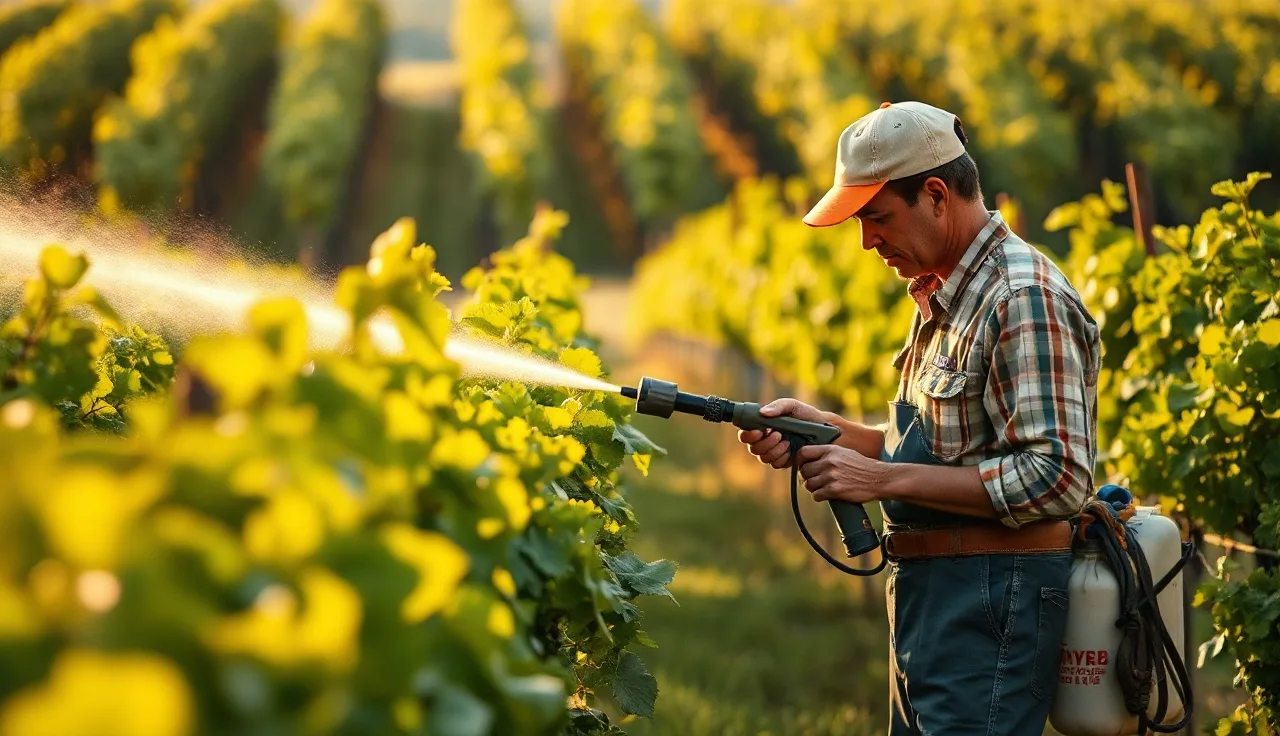
For vineyards under 5 acres, a hand-gun on a PTO pump can work if the canopy is opened up. The catch is consistency. Speed and pressure drift with the operator, coverage goes uneven, and you end up using more product to cover the gaps.
How do you manage fungicide resistance in your oidium spray program?
Resistance is not a hypothetical. E. necator populations with reduced sensitivity to DMI fungicides (FRAC 3) have been documented in California, and QoI resistance is widespread worldwide [5]. It doesn't mean DMIs quit entirely. It means they work less well, which pushes the effective dose up, which speeds resistance along further.
FRAC's core resistance recommendations: alternate modes of action, cap at-risk groups at the label maximum (often 2 to 3 per season), tank-mix at-risk products with multi-site fungicides like sulfur where you can, and never run a solo at-risk product when pressure is already high [7].
Rules worth hardwiring:
- Never apply the same FRAC group back-to-back.
- Never exceed label limits on FRAC 3, 7, 11, or 13 products.
- Use sulfur as the default filler between systemics, not as an afterthought.
- Quinoxyfen (FRAC 13, Quintec) is capped at 2 applications per year on the label for resistance reasons.
- Seeing breakthrough on a product that worked last year? Call your farm advisor and send samples to your state plant diagnostic lab before you assume resistance. Coverage failure looks identical to resistance from the field.
FRAC publishes group classifications and resistance risk ratings for every registered active ingredient. It's free, and it's worth downloading before you build each year's product list [7].
What should a complete powdery mildew spray record include?
Spray records are legally required in every U.S. state for restricted-use pesticides, and in most states for all commercial pesticide applications on farmland. Federal minimums under FIFRA and state programs generally want:
- Date of application
- Product name and EPA registration number
- Active ingredient
- FRAC or mode-of-action group (good practice; not always required by law, but you need it for your own resistance management)
- Rate per acre (amount of concentrate, more useful than diluted volume)
- Total acres treated
- Location of treated area (block ID, GPS if available)
- Application method and equipment
- Applicator name and, if required, license number
- Crop and growth stage
- Wind speed and direction, temperature, and humidity at application
- Pre-harvest interval (PHI) and restricted-entry interval (REI)
- Post-application weather if relevant (rain within 2 hours, say)
Many states require records kept for 2 to 5 years. The California Department of Pesticide Regulation (CDPR) requires pesticide use reports (PURs) submitted monthly to the county agricultural commissioner for all agricultural pesticide applications [8]. That's a legal obligation with fines behind it, not a formality.
Paper records work, but they're vulnerable to water, loss, and arithmetic errors. A spreadsheet beats paper. A dedicated field operations platform beats a spreadsheet for tying records to blocks, generating compliance reports, and warning you when a FRAC limit is close. VitiScribe is built for exactly this: spray logs, PHI tracking, and compliance exports in one place.
Get audited by a state ag commissioner or a food safety body (SQF, PrimusGFS) and the first thing they ask for is your spray records. Complete and legible is the line between passing and a corrective action notice.
Are there organic or low-input options that actually work for oidium?
Yes, but they demand tighter timing and more applications. The honest version: an organic powdery mildew program works well when pressure is moderate and you never miss a spray. It works poorly when pressure is severe and you're already behind.
The tools that genuinely earn their place:
Sulfur (OMRI-listed wettable or micronized): The most effective organic option. 3 to 6 lb/acre every 7 to 10 days during peak pressure. Don't apply within 2 weeks of oil or above 90°F.
Potassium bicarbonate (Kaligreen, MilStop): Works by disrupting the osmotic balance of fungal cells. Good as a protectant with some eradicant activity. Weaker than sulfur solo, but it pairs well.
Copper (OMRI-listed formulations): Mostly a downy mildew and bacterial disease material. It has limited activity against E. necator and isn't a first-choice oidium tool. The NOP allows it, but cumulative soil loading is a real long-term concern.
Neem oil (clarified hydrophobic extract): Some protectant value. Works better with a spreader-sticker.
Biological agents (Bacillus subtilis, Bacillus amyloliquefaciens, Trichoderma): Products like Serenade, Regalia (a plant extract, not strictly a biofungicide), and Timorex Gold carry OMRI listings or low-risk classifications. The evidence is thinner than for sulfur, but WSU field trials show meaningful suppression when biologicals sit inside a rotation rather than carrying the load alone [4].
The University of California's organic viticulture publication is the most practical starting point for building an organic program [10].
How does climate and region affect your oidium spray strategy?
Climate shapes the whole program. A grower in Napa and a grower in the Finger Lakes manage the same pathogen in completely different disease environments.
In warm, dry climates (coastal and central California, parts of Washington's Columbia Valley), the risk period is concentrated and predictable. Ascospore release tracks temperature, the season runs long, and growers can often taper sprays after mid-July as berries harden off. The challenge is heat. Temperatures push past 90°F, sulfur use gets tricky, and product choice during the hot window matters.
In cool, humid climates (Finger Lakes, Willamette Valley, parts of the Okanagan), the season is shorter but pressure can be brutal. Rain during bloom is common, driving mildew and botrytis at once. The interval is almost always 7 days through bloom, and growers often spray even when conditions look marginal by California standards.
In the Southwest and high-altitude regions, afternoon humidity spikes in dry years create localized high-pressure pockets. Paso Robles, for example, has big day-night temperature swings that produce morning dew and humid nights, which surprises growers who assume they're in a low-pressure zone.
If you're sourcing grapes from or working with established operations in a given region, the local UC Cooperative Extension farm advisor is your best resource. Each county advisor publishes region-specific timing guides, and many now tie into real-time weather station networks.
What does a practical spray calendar actually look like, week by week?
This is a condensed example for a Chardonnay block in a moderate-pressure Central Coast California setting. Real timing shifts with your degree-day accumulation and the weather.
| Growth Stage | Approx. Timing | Product / FRAC | Interval |
|---|---|---|---|
| Bud swell (2-inch shoots) | Early March | Wettable sulfur (M2), 4 lb/A | Start of program |
| 4 to 6 inch shoots | Mid March | FRAC 3 (Rally 40WSP, 4 oz/A) | 10 days |
| 8 to 12 inch shoots | Late March | Sulfur (M2), 4 lb/A | 10 days |
| Pre-bloom (cluster visible) | Early April | FRAC 7+11 premix (Merivon, 5.5 oz/A) | 7 days |
| 50% bloom | Mid April | Sulfur + Cyflufenamid (Gatten, 5 oz/A) | 7 days |
| Petal fall / fruit set | Late April | FRAC 13 (Quintec, 6 oz/A) + sulfur | 7 days |
| Berry development (pea size) | Early May | Sulfur (M2), 5 lb/A | 10 days |
| Berry sizing | Mid May | FRAC 3 (rotate back to DMI, 2nd use) | 10 days |
| Pre-veraison | Late May | Sulfur (M2) | 10-14 days |
| Post-veraison | June | Sulfur if needed; evaluate and taper | Monitor |
That totals roughly 9 to 10 applications and moves through FRAC groups M2, 3, 7+11, U6, and 13 across the season. No group shows up more than twice in sequence. Sulfur bookends the whole thing.
Your program will look different. The point is to plan it before the season starts, not improvise week to week. Reactive spraying is how you burn through your best fungicides at the wrong time.
What recordkeeping and compliance pitfalls should growers avoid?
Most compliance failures in spray audits aren't fraud. They're administrative sloppiness that looks bad and opens legal exposure.
Missing EPA registration numbers on spray logs is the most common one. Every label carries an EPA Reg. No. That number has to appear in your records for restricted-use pesticides, and most state programs extend the requirement to all commercial agricultural applications.
Not tracking pre-harvest intervals in real time is second. Spray a material with a 28-day PHI, then harvest 22 days later because a buyer moved up the pick, and you have a pesticide violation. CDPR and other state agencies treat this seriously [8]. Build PHI tracking into your calendar at the moment you spray, not when you plan harvest.
Missing the pesticide use report deadline is a legal violation in states that require reporting. California's PUR system requires monthly submission by the 10th of the following month [8]. Fines of up to $5,000 per violation are possible for late or missing reports.
Worker Protection Standard documentation is a separate track. You have to post application information at the WPS central display (or give it to handlers directly) before the application [6]. The record shows product, active ingredient, REI, location, and date. The WPS revisions that took full effect January 2, 2017 also require annual pesticide safety training for all agricultural workers and handlers [6].
Selling to large retail customers means food safety audits (FSMA, SQF, GlobalG.A.P.) that pull spray records going back 2 to 5 years, organized by block. Build that system in year one, not the year before your first audit.
Frequently asked questions
When should I start spraying for powdery mildew in my vineyard?
Start at bud swell when shoots reach 1 to 2 inches, which lines up with roughly 20 degree-days above 50°F accumulated from January 1. On susceptible varieties like Chardonnay or Pinot Noir, don't wait for visible symptoms. The UC model recommends first application near 20 DD50 as a general trigger, with shorter intervals once clusters are visible.
Can powdery mildew infect dormant vines or only growing tissue?
E. necator overwinters as dormant mycelium inside infected buds and as chasmothecia in bark. The bud-overwintering mycelium produces infected shoots early, called flag shoots, which are a primary inoculum source. Dormant sprays don't control oidium effectively. Your first real chance to manage it is at bud swell, when infected tissue and emerging spores are exposed.
What is the 10-day spray rule for vineyard oidium?
The 10-day rule means applying a fungicide every 10 days from bud break through roughly 6 to 8 weeks after bloom. During the highest-risk window, pre-bloom through fruit set, the interval tightens to 7 days. It's a calendar heuristic, not a model. Pair it with degree-day tracking for better accuracy, especially during hot stretches or odd weather years.
Which FRAC groups have documented resistance in vineyard powdery mildew?
Reduced sensitivity to FRAC group 3 (DMI/triazoles, including myclobutanil and tebuconazole) has been documented in California and in European vineyards. FRAC group 11 (QoI/strobilurins, including azoxystrobin) resistance is widespread globally. Both groups should be rotated strictly, never used consecutively, and held to the maximum applications per season stated on the label.
Is wettable sulfur safe to use all season for grapevine powdery mildew?
Sulfur is safe and effective through most of the season, but it turns phytotoxic to vines above 90°F. Never apply within 14 days of an oil-based product. It has no documented resistance. When temperatures consistently top 90°F, switch to a systemic for that window and return to sulfur once things cool down.
How many powdery mildew sprays do vineyards typically need per season?
Most vinifera blocks in moderate-pressure regions need 10 to 16 applications per season. High-pressure regions (the humid eastern U.S., cool coastal areas with morning fog) can push 18 to 20. The number depends on variety, canopy density, weather, and disease history. Fewer than 8 applications on a susceptible variety in a warm season is generally not enough.
What records am I legally required to keep for vineyard fungicide sprays?
Federal FIFRA requirements cover restricted-use pesticides. Most states extend recordkeeping to all commercial agricultural pesticide use. Required fields typically include date, product name, EPA registration number, active ingredient, rate, acres treated, application method, applicator name, and crop. California requires monthly pesticide use reports submitted to the county agricultural commissioner by the 10th of the following month.
Does rain wash off sulfur and require a reapplication for oidium?
Yes. Rain within 4 to 6 hours of a sulfur application cuts efficacy sharply. The general rule is to reapply if more than 0.5 to 1 inch falls within 24 hours, though the threshold shifts with formulation and growth stage. Check your product label for rainfast guidance. Micronized sulfur tends to adhere better than older wettable formulations.
Can I use biological fungicides as my primary powdery mildew control?
Biologicals like Bacillus subtilis (Serenade) can suppress oidium but perform inconsistently as a primary program on susceptible varieties. WSU field trials show meaningful suppression when biologicals rotate into a sulfur-based program, but not as the sole tool. In conventional programs, use them as rotational partners. In organic, keep sulfur as the backbone and biologicals as supplementary applications.
What is the EPA Worker Protection Standard requirement for vineyard fungicide applications?
The WPS (40 CFR Part 170), revised in 2015 with provisions taking full effect through 2017, requires annual pesticide safety training for all agricultural workers and handlers, posting of application information at a central display before each application, and enforcement of re-entry intervals. Handlers must have access to label information and emergency contacts. Violations can bring fines from the EPA or state equivalents.
How do I identify powdery mildew versus other vineyard diseases?
Powdery mildew shows as white to gray powdery mycelial growth on the surface of green tissue: leaves, shoots, and berries. It doesn't need free water to infect, unlike downy mildew, which produces cottony sporulation on the underside of leaves after wet conditions. Infected berries may split or russet. Flag shoots (chlorotic, distorted young shoots) early in spring point to bud-overwintering infection.
What pre-harvest interval (PHI) restrictions apply to powdery mildew fungicides?
PHIs vary widely. Sulfur is typically 0 to 7 days depending on formulation. Many FRAC 3 products (DMIs) carry PHIs of 7 to 14 days. Some FRAC 7+11 premixes carry short PHIs in certain registrations. Quinoxyfen (Quintec) has a 14-day PHI. Always check the current label, not a third-party source. PHIs are legally binding, and harvest violations are a serious regulatory issue.
What is a flag shoot and what does it mean for my spray program?
A flag shoot is an early-season shoot growing from a bud that got infected with E. necator mycelium the previous year. It looks chlorotic, stunted, and often heavily powdered with white sporulation. Flag shoots signal that overwintering bud infection happened and your block carries significant internal inoculum. Finding them means your early-season program needs systemics, not sulfur alone.
How should I adjust my spray interval during a heat wave?
During sustained temperatures above 90°F, stop sulfur to avoid phytotoxicity. Switch to a heat-tolerant systemic and tighten the interval to 7 days if humidity stays moderate. E. necator's optimum range is 68 to 77°F, and temperatures consistently above 95°F actually cut spore germination, but the moderate windows around heat events are still risky. Resume sulfur once temperatures drop below 90°F.
Sources
- UC Agriculture and Natural Resources, UC IPM Pest Management Guidelines: Grape, Powdery Mildew: UC IPM guidance on degree-day thresholds, spray intervals, and up to 100% crop loss on susceptible varieties
- University of California Cooperative Extension, Erysiphe necator biology and latent period: Latent period from infection to sporulation is 5 to 7 days under optimal conditions (68-77°F)
- Cornell University, New York State Integrated Pest Management Program, Grape Powdery Mildew: Pre-bloom through 3 to 4 weeks post-bloom is the most critical period; Cornell variety breeding program; NEWA weather-based forecasting
- Washington State University Extension, Powdery Mildew of Grapes: WSU decision tools and field trial results showing biological fungicide suppression when rotated into sulfur-based programs
- Fungicide Resistance Action Committee (FRAC), Pathogen Risk List and Resistance Monitoring: Documented reduced sensitivity to FRAC 3 (DMI) fungicides in California E. necator populations and global QoI resistance
- U.S. Environmental Protection Agency, Worker Protection Standard (40 CFR Part 170): WPS requirements for annual training, central display posting, and REI enforcement; provisions effective through January 2, 2017
- Fungicide Resistance Action Committee (FRAC), FRAC Code List: FRAC resistance management recommendations: alternate modes of action, limit at-risk groups to label maximums, mix with multi-site fungicides
- California Department of Pesticide Regulation, Pesticide Use Reporting: California requires monthly pesticide use reports submitted to county agricultural commissioner by the 10th of the following month; fines up to $5,000 per violation
- U.S. Environmental Protection Agency, Pesticide Registration and FIFRA: Pesticide labels are legally binding documents under FIFRA; the label is the law
- UC Cooperative Extension, Organic Viticulture and Wine Production: OMRI-listed products including sulfur, potassium bicarbonate, copper, and neem oil for organic powdery mildew programs; NOP compliance guidance
Last updated 2026-07-09