Spray timing for spider mites in vineyards: when and how to act

TL;DR
- Spray for spider mites when you hit 5-6 motile mites per leaf (Willamette) or 20 per leaf (Pacific spider mite) in pre-bloom scouting, or use a 200-400 degree-day model above 50°F from biofix.
- Act before 30% of leaves show bronzing.
- Delayed timing is the single biggest reason treatments fail.
Why spray timing matters more than which miticide you pick
Spider mites go from nuisance to canopy crisis in ten days. That's not hyperbole. A single female Willamette spider mite (Eotetranychus willamettei) lays 30 to 50 eggs in her lifetime, and generations overlap without a break from late spring through harvest [1]. By the time bronzing covers 40% or more of your leaves, photosynthesis is already hurt enough to cut berry sugar, and no miticide sold reverses that damage.
Timing decides the outcome here. The right product applied two weeks late does less for you than an okay product applied at the right threshold. That's the part most product reps leave out of the pitch.
The economics say the same thing. UC Davis Cooperative Extension data from California North Coast vineyards shows blocks treated at threshold (5-6 motile mites per leaf, pre-bloom) cost growers about one to two miticide applications per season. Blocks that hit economic damage before treatment averaged 2.4 applications and still lost measurable yield from lighter berries [2]. Buying more chemistry to fix a timing mistake is a bad trade.
This guide covers when to start scouting, which thresholds actually trigger action, how to run a degree-day model if you want to stay ahead of the season, and what the spray window looks like once you pull the trigger.
What spider mite species are in your vineyard and why it changes your threshold
Three species drive most North American wine regions, and they don't behave the same way. Know which one you have before you pick a number.
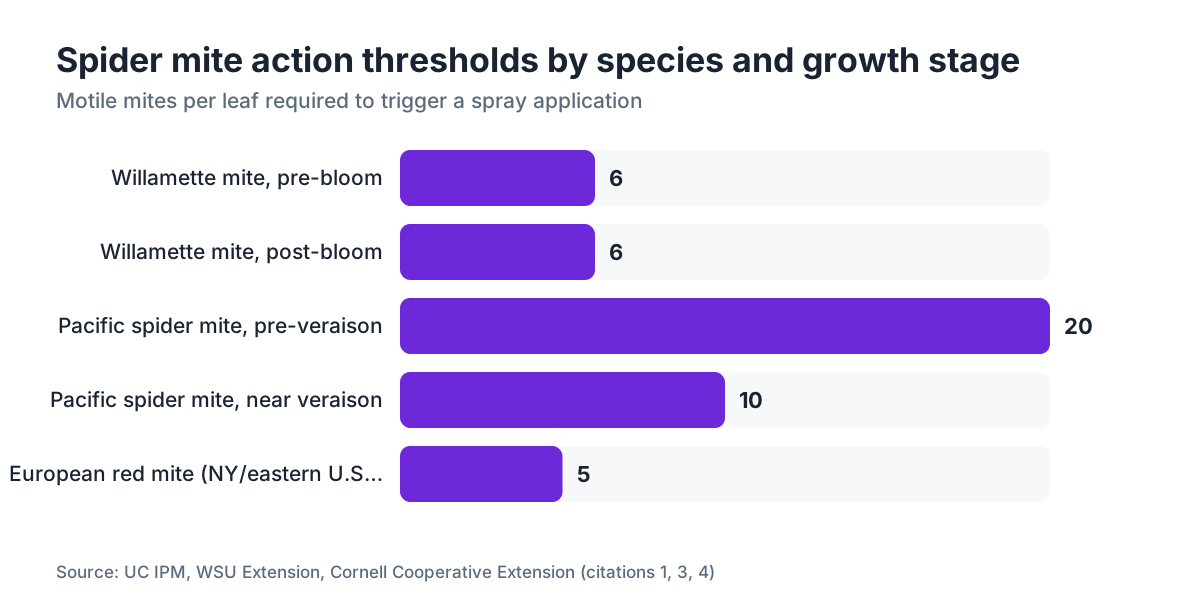
Willamette spider mite runs the show in Oregon, Washington, and cooler California coastal ground. It likes the underside of leaves at moderate temperatures (65-85°F) and turns stippling to bronzing fast. The threshold is conservative: 5-6 motile mites per leaf, or 20% of sampled leaves carrying active colonies, triggers a spray in most Pacific Northwest extension guidance [1].
Pacific spider mite (Tetranychus pacificus) owns the hot interior valleys of California (San Joaquin, Sacramento) and much of the Southwest. It shrugs off heat and can explode above 90°F. Thresholds run higher: 20 motile mites per leaf is the common action number, though WSU and UC guidance both say to drop it closer to 10 once you're within three weeks of veraison [2][3].
European red mite (Panonychus ulmi) is the main pest in eastern U.S. vineyards, especially New York and Pennsylvania. Cornell Cooperative Extension calls for scouting at 200-300 degree-days (base 50°F) after budbreak and spraying when you find 5 or more mites per leaf on 50% of sampled leaves [4].
| Species | Primary Region | Action Threshold (per leaf) | Key Temp Range |
|---|---|---|---|
| Willamette mite | Pacific NW, cool CA | 5-6 motile mites | 65-85°F |
| Pacific spider mite | CA interior, SW | 20 motile mites (10 near veraison) | 90-110°F |
| European red mite | Eastern U.S. | 5+ on 50% of leaves | 60-80°F |
Your species matters because a Pacific spider mite count that looks calm at 15 per leaf in June can triple in a week during a heat run. Willamette mite rarely climbs that fast, but it builds steadily and it wipes out predatory mites if you're careless with your miticide choice.
When should you start scouting for spider mites each season?
Start at budbreak. Not bloom, not veraison. Budbreak.
Overwintering eggs sit on last season's canes, and the first generation hatches within days of bud swell in warm weather. Wait until you see damage and you've already given up several weeks of population growth, and probably most of your predatory mites too.
The scouting protocol from UC IPM and WSU Extension calls for at least 15 leaves per block per round, taken from the middle of the canopy (not the newest growth, not the oldest basal leaves), checking the underside of each leaf [2][3]. Count motile mites (moving adults and nymphs) apart from eggs. Eggs tell you where the population is headed. Motile mites tell you where it is right now.
Frequency matters as much as the count. Before bloom, every two weeks is fine if you're below threshold. Once temperatures hold above 80°F, go weekly. Post-bloom through veraison is your highest-risk stretch in most California and Pacific NW regions. European red mite peaks earlier in New York and Michigan [4].
One number to hang onto: Washington State University found that growers who scouted at least weekly during the post-bloom window treated 40% fewer blocks in a season than growers scouting every two weeks [3]. That's the payoff on 20 minutes of walking a block.
How do degree-day models help you predict spider mite population explosions?
A degree-day (DD) model lets you get in front of population growth instead of chasing it. Mite development runs on temperature, so once you set a biofix (the date you first confirm motile mites or egg hatch in a block), you can track cumulative heat units to predict the next generation and the window where egg hatch makes mites most vulnerable.
For Willamette mite, WSU's Decision Aid System (DAS) uses a base temperature of 50°F. The model puts first-generation egg hatch around 200-250 DD after biofix and population peaks at 400-500 DD [3]. Those windows line up with the best spray timing because young nymphs take a miticide harder than hardened adults, and most contact products barely touch eggs.
Pacific spider mite uses the same 50°F base in UC IPM's Degree-Day Pest Management Calculator. The thresholds look similar, but the clock runs faster in hot interior climates. You can stack 300 DD in under two weeks during a San Joaquin Valley July [2].
You don't need pricey software for this. A $40 min/max thermometer and a spreadsheet do it. Log daily high and low, average them, subtract 50°F, add up the positive values from biofix. Hit 200 DD, go back and scout hard. If you're at threshold, spray before 400 DD and the next generation blows up.
Accurate daily records are exactly where a tool like VitiScribe earns its keep. Logging temperatures and scouting notes next to your spray records in one place means you're not rebuilding the whole picture from memory when mites spike in August.
What time of day should you spray for spider mites?
Spray in the morning. Most growers underthink this and lose coverage because of it.
Mites live on the underside of leaves, so your spray has to reach there. Morning gives you higher canopy humidity and leaves that haven't wilted or curled from heat stress. Curled leaves are a physical wall against underside coverage. Temperatures above 90°F at spray time also flash off water carriers fast, cutting the miticide's contact time.
Morning helps certain chemistries too. Abamectin (Group 6) and spiromesifen (Group 23), two of the more common miticides, both break down under UV. Applying them early gives the product more time to move into leaf tissue before sunlight degrades it [5]. Abamectin needs roughly 4 hours of drying before rain, so read the forecast first.
Late afternoon is a distant second if mornings won't work. Skip midday entirely above 85°F. The EPA Worker Protection Standard (WPS) also sets restricted-entry intervals (REIs) and applicator rules you have to respect no matter what timing you choose [6]. Abamectin's REI is 12 hours for most formulations. Check your product label and the WPS requirements at 40 CFR Part 170 before you schedule crew work behind any application.
Water volume is the other half of coverage. For mites, 30-50 gallons per acre is the floor. 75-100 gallons per acre lifts underleaf coverage a lot, especially in dense mid-season canopies. Running 20 gallons per acre saves you time and throws away the miticide.
Which miticides actually work, and how do you avoid resistance?
Resistance is the biggest problem in vineyard mite management. Mites evolve resistance faster than almost any other vineyard pest, and some California and Oregon populations already carry documented resistance to organophosphates, pyrethroids, and abamectin [7].
The resistance framework from the Mite Resistance Action Committee sorts miticides into numbered modes of action (MOAs). The rule is short: never use the same MOA back to back within a season, and switch MOAs the following year [5].
Common MOA groups in vineyards:
| MOA Group | Active Ingredient | Example Products | Notes |
|---|---|---|---|
| Group 6 | Abamectin | Agri-Mek, Zoro | Strong, resistance in some CA populations |
| Group 10 | Clofentezine | Apollo | Ovicide/larvicide only, no adult activity |
| Group 21 | Pyridaben | Nexter | Knockdown, short residual |
| Group 23 | Spiromesifen | Oberon | Good adult and egg activity |
| Group 25 | Cyflumetofen | Cyflu, Nealta | Newer, strong resistance-management option |
| Group 33 | Etoxazole | Zeal | Ovicide/larvicide only |
Treating a moderate pre-bloom population? An ovicide like etoxazole (Group 33) or clofentezine (Group 10) is the smart play: it kills eggs and larvae, leaves the hatched adults for your predatory mites, and takes selection pressure off your adult-active products. Hold your Group 6 and Group 23 chemistry for a post-bloom outbreak when you need fast adult knockdown.
Sulfur deserves its own paragraph. It kills mites, it's cheap and everywhere, and it has no resistance concerns. The catch is phytotoxicity above 90°F and bad reactions with certain fungicides and oils [8]. In cooler coastal regions, sulfur is a legitimate first move before you reach economic threshold. In hot interior ground it's a gamble above 85°F, and most growers keep it off the vines in July and August.
How does canopy management affect spider mite pressure?
This gets ignored too often. Dense, poorly ventilated canopies build the warm, slightly humid pocket mites love, and they block spray from reaching the middle of the vine no matter how much water you run.
Leaf pulling in the fruit zone (one to two leaves off per shoot on the sun side) improves coverage on a measurable scale. A UC Davis study found fruit zone leaf removal raised miticide coverage on interior leaves by about 35% versus unmanaged canopies [2]. That's not a rounding error.
Shoot crowding above the fruit zone matters too, because it stops spray from reaching the middle canopy where mite populations tend to start. Hedging too hard backfires. Aggressive cuts push out flush growth that mites colonize quickly. Moderate, on-time hedging beats letting the canopy run wild and then whacking it back in August.
Cover crops factor in. Some species, legumes and certain grasses in particular, support alternative mite hosts and give predatory mites a refuge. WSU Extension suggests leaving native vegetation strips between rows if your predatory mite program is active, since predatory mites (mainly Galendromus occidentalis in the West and Neoseiulus fallacis in the East) need other food during low-pressure stretches [3].
Water stress is a well-documented driver of outbreaks. Drought-stressed vines carry higher nitrogen in leaf tissue and weaker chemical defenses, and mites reproduce faster on both. If you run regulated deficit irrigation, scout mite levels more often through your stress periods.
What role do predatory mites play, and can you time sprays to protect them?
Predatory mites are free labor. In vineyards with healthy predator populations, some years you never hit an economic threshold spray at all. The number that matters is the predator-to-prey ratio. A 1:10 ratio of Galendromus occidentalis (western predatory mite) to Pacific or Willamette mite generally holds populations below threshold with no intervention [3].
The trap is broad-spectrum insecticides. Pyrethroids sprayed for leafhoppers or grape berry moth are brutal on predatory mites, and some miticides, pyridaben (Group 21) among them, are moderately toxic to them too [7]. The wrong product at the wrong time can wipe out your biological control for the rest of the season and lock you into multiple miticide passes in August.
Scout and find a 1:10 predator-to-prey ratio or better? Hold off on spraying even if your motile count is creeping toward threshold. Give the predators two weeks to work. If the ratio slips below 1:10 and counts climb, that's your cue to spray, and you reach for a selective miticide (etoxazole, clofentezine, spiromesifen) instead of a broad-spectrum one.
Releases are commercially available and used in some California and Oregon programs. Commercial Galendromus occidentalis runs roughly $15 to $35 per 1,000 mites depending on supplier and volume, and release rates of 10,000 to 50,000 per acre are typical for establishment [9]. That's real money, but it can cover two or three miticide passes across a season.
For anyone tracking predator-prey ratios by scouting date across multiple blocks, this is the kind of field data that VitiScribe holds in one record instead of three different notebooks.
What are the label and WPS compliance requirements for miticide applications?
Label compliance is federal law, not advice. FIFRA Section 12(a)(2)(G) makes it illegal to use a pesticide in a manner inconsistent with its labeling [10]. For vineyards, that means checking every miticide label for:
- Pre-harvest interval (PHI): abamectin has a 28-day PHI in grapes; etoxazole's PHI is 7 days; cyflumetofen's PHI varies by formulation (check the current label). One overlooked PHI can create a tolerance violation that hits your entire lot.
- Restricted-entry interval (REI): the EPA Worker Protection Standard at 40 CFR Part 170 keeps workers out of treated areas until the REI expires and requires the REI posted on the Application Exclusion Zone or field signage [6]. The WPS also requires pesticide safety training for workers before they enter treated ground.
- Applications per season: many miticides cap at 2 applications per season to slow resistance. Going over is a label violation and it breeds resistance.
- Buffer distances: some miticides carry aquatic buffer requirements. Abamectin is highly toxic to aquatic invertebrates, so check for setbacks from waterways and honor them.
Certified organic operations have fewer options. Sulfur is OMRI-listed and widely used. Certain petroleum-based horticultural oils and kaolin clay have documented efficacy at knocking down early-season populations [8]. The National Organic Program (NOP) at 7 CFR Part 205 sets the framework for which materials are allowed [11].
Keep your spray records (product, rate, date, PHI, REI, applicator name, block ID) for at least two years. California requires this under Department of Pesticide Regulation reporting rules, and most other states have their own version [12]. A clean spray record is also your first defense if a worker complaint or a residue test question ever lands on your desk.
How do you build a season-long spider mite management calendar?
The calendar below is built for Pacific Northwest and California conditions. Shift dates 2 to 4 weeks earlier for interior California and the desert Southwest, and 2 to 3 weeks later for New York and Michigan.
Budbreak to woolly bud (March-April in most regions): Pull at least 5 canes per block and check for overwintering eggs under magnification (a 10x hand lens does the job). European red mite eggs are red-orange spheres on the bark. Willamette and Pacific spider mite eggs are pale on leaf tissue. High egg density at budbreak sets your vigilance level for the whole season.
Bloom (May-June): First in-season scout of 15 leaves per block, underside counts. Check predatory mite presence alongside the pest count. A 1:10 predator-to-prey ratio or better means no spray. Pest mites above threshold with predators absent or sparse means you consider an ovicide now rather than waiting for adults to peak.
Post-bloom to bunch closure (June-July): Your highest-risk window for a population blowup in most regions. Weekly scouting. Any pyrethroid or broad-spectrum insecticide sprayed for another pest during this stretch should trigger a mite re-scout within 7 to 10 days, since those products kill predatory mites.
Veraison to harvest (August-September): The PHI clock is now the constraint. If populations sit above threshold inside 28 days of expected harvest and you need abamectin, you have a real problem. That's the whole case for early intervention. Etoxazole (7-day PHI) and cyflumetofen give you later options, but they cost more and hit adults softer than abamectin does.
Post-harvest: Consider a dormant oil pass (1-2% horticultural oil) if European red mite egg counts on canes ran high at harvest. It's your lowest-risk, lowest-cost intervention point, and it's the one most growers skip.
How much does a spider mite outbreak cost, and what does a good spray program cost to prevent it?
The comparison is lopsided, and most growers underrate the damage side.
A full outbreak at veraison, meaning more than 50% of leaves bronzed and counts past 50 mites per leaf, can cut photosynthetic capacity enough to drop berry Brix by 1 to 2 degrees at harvest, according to studies cited by UC Cooperative Extension [2]. For a wine grape operation getting $800 to $1,200 per ton, a Brix hit that drops your contract grade can cost $50 to $80 per acre in grape price alone, before you count the 2 to 3 miticide passes you'll burn trying to knock the population back.
A proactive program, meaning one timely pre-bloom or early post-bloom application at threshold, costs roughly $35 to $80 per acre in chemistry depending on the product, plus application. That's the full preventive spend for most seasons with a healthy predatory mite population [9].
Nobody has clean data on average annual spider mite losses per acre across U.S. wine regions. The closest credible number comes from 2021 USDA National Agricultural Statistics Service data, which puts spider mites and related acarine pests among the top five insect-related grape crop loss categories in California, behind only leafhoppers and grape berry moth [13]. County-level dollar losses swing widely and aren't broken out by species.
The honest answer: a well-timed single application in a normal pressure year saves growers roughly $100 to $200 per acre in downstream costs versus reactive management. That figure grows in a drought year, when pressure is high and you end up making multiple passes.
Frequently asked questions
What is the economic threshold for spider mites in wine grapes?
Thresholds vary by species and growth stage. Willamette mite: 5-6 motile mites per leaf or 20% of leaves with active colonies. Pacific spider mite: 20 per leaf, dropping to 10 near veraison. European red mite: 5 or more on 50% of sampled leaves. These are motile mites (adults and nymphs combined) counted on the underside of 15 leaves per block per scouting round.
How often should I scout for spider mites during the growing season?
Every two weeks from budbreak through bloom is adequate if populations are below threshold. Once temperatures are consistently above 80°F post-bloom, tighten to weekly scouting. During heat events above 90°F, scout every 5-7 days. WSU research found that growers scouting weekly during the post-bloom window treated 40% fewer blocks than those on a biweekly schedule.
Can I spray sulfur for spider mites in the vineyard?
Yes, sulfur is effective on mites and has no resistance concerns. It's OMRI-listed and available for organic programs. The hard limit: phytotoxicity risk is significant above 85-90°F, and sulfur is incompatible with certain fungicides and oils. In cooler coastal regions it's a legitimate first-line treatment. In hot interior valleys during July and August, avoid it. Always check current label directions.
What is the pre-harvest interval (PHI) for abamectin in wine grapes?
Abamectin (sold as Agri-Mek and generics) has a 28-day pre-harvest interval for grapes. This is one of the longest PHIs in the miticide category and is the main reason early-season timing matters so much. If you're within 28 days of expected harvest and still need adult mite knockdown, switch to etoxazole (7-day PHI) or cyflumetofen, and check the current product label since PHIs can change.
Does water stress in the vineyard make spider mite outbreaks worse?
Yes, consistently. Drought-stressed vines have higher amino acid concentrations in leaf tissue and reduced secondary metabolite defenses, both of which accelerate mite reproduction. Regulated deficit irrigation programs, common in premium wine regions, create exactly the stress conditions mites prefer. Scout more frequently during your planned stress periods, especially post-bloom through veraison, and lower your action threshold slightly if vines are visibly under stress.
How do I avoid miticide resistance in my vineyard mite program?
Rotate modes of action (MOA) every application and never use the same MOA twice in the same season. The MRAC group numbering system (Group 6, 10, 21, 23, 25, 33) is on product labels. Using ovicides like etoxazole (Group 33) early in the season preserves adult-active MOAs for later when you need knockdown. Resistance to organophosphates and abamectin is documented in California and Oregon populations.
What time of day is best to spray miticides for spider mites?
Early morning is best. Mites live on leaf undersides, and curled or wilted leaves from afternoon heat reduce coverage significantly. Some miticides including abamectin are photo-degraded by UV, so morning application gives the product more time to penetrate before sunlight breaks it down. Avoid applications above 90°F. Late afternoon is acceptable if mornings are not possible. Midday applications above 85°F waste product and risk phytotoxicity with sulfur.
Should I release predatory mites, and are they cost-effective?
Predatory mite releases make sense if your existing population is depleted from a prior broad-spectrum spray and you have low pest pressure. Commercial Galendromus occidentalis costs roughly $15-$35 per 1,000 mites; typical establishment rates are 10,000-50,000 per acre. In vineyards with intact predatory mite populations, the ratio that holds populations below threshold is about 1 predatory mite per 10 pest mites. At that ratio, skip the miticide application.
What worker protection standard rules apply to miticide applications in vineyards?
The EPA Worker Protection Standard (40 CFR Part 170) requires posting restricted-entry intervals (REIs), providing pesticide safety training to agricultural workers before they enter treated areas, and maintaining required safety information. Abamectin's REI is 12 hours for most formulations. Workers may not enter the Application Exclusion Zone during application. FIFRA Section 12(a)(2)(G) makes any use inconsistent with the product label a federal violation.
Do cover crops affect spider mite populations in vineyards?
They can cut both ways. Some legume and grass cover crop species support alternative hosts for predatory mites, giving beneficial species a food source during low pest-pressure periods. WSU Extension recommends native vegetation strips between vine rows for growers running active predatory mite programs. Conversely, certain cover crop species can harbor pest mites that migrate up into the canopy. Scout the cover crop as well as the vine during your rounds.
What spray volume do I need to get adequate spider mite coverage?
30-50 gallons per acre is the minimum for sparse canopies; 75-100 gallons per acre is better for dense mid-season growth. Mites live on leaf undersides, and low water volumes produce inadequate coverage regardless of nozzle angle. Running 20 gallons per acre to save time is the easiest way to waste an expensive miticide application. Airblast sprayers at proper ground speed with appropriate nozzle configuration outperform most alternatives for mite coverage.
How do I use degree-day models to predict spider mite outbreaks?
Set biofix at first confirmed motile mite or egg hatch sighting in a block. Use a base temperature of 50°F. Sum daily average temperatures minus 50°F from biofix. At 200-250 degree-days, expect first-generation egg hatch, your best spray window for ovicides. At 400-500 DD, population peaks occur and adult-active miticides are needed. WSU's Decision Aid System (DAS) runs this model for Pacific Northwest growers automatically.
Is there a difference in spray timing for organic vineyard spider mite control?
Yes. Organic materials including sulfur and horticultural oils work best at lower populations and earlier in the season before canopies are dense. They have less residual activity than synthetic miticides, so timing precision matters more, not less. Sulfur at 2-3 lb active ingredient per acre works on motile mites but has no residual egg activity. Kaolin clay creates a physical barrier but requires excellent coverage and reapplication after rain. Predatory mite programs become especially important in organic systems.
When is it too late to spray for spider mites before harvest?
That depends on the product's PHI. Abamectin is 28 days before harvest, making it unusable in the final month. Etoxazole is 7 days; cyflumetofen PHI varies by formulation. If you're inside 28 days with a severe outbreak, your options are narrow and expensive. This is exactly the scenario that early-season threshold management is designed to prevent. Check harvest dates against PHIs before every late-season application and confirm with the current label.
Sources
- UC IPM, University of California Agriculture and Natural Resources: Spider Mites (Willamette, Pacific) in Grapes: A single female Willamette spider mite can lay 30-50 eggs in her lifetime; generations overlap continuously from late spring through harvest
- UC Cooperative Extension, Pest Management Guidelines: Grapes, Mites: Populations treated at threshold (5-6 motile mites per leaf) cost roughly one to two miticide applications per season vs 2.4 for delayed treatment; fruit zone leaf removal improved miticide coverage on interior leaves by approximately 35%
- Washington State University Extension: Spider Mite Management in Wine Grapes: Willamette mite action threshold is 5-6 motile mites per leaf; WSU DAS uses 50°F base for degree-day model with population peaks at 400-500 DD; growers scouting weekly treated 40% fewer blocks
- Cornell Cooperative Extension, New York State IPM Program: European Red Mite in Grapes: Cornell recommends scouting at 200-300 DD (base 50°F) after budbreak and spraying when 5 or more mites per leaf are found on 50% of sampled leaves
- Insecticide Resistance Action Committee (IRAC), Mode of Action Classification Scheme: IRAC groups miticides by numbered modes of action; rotation prevents resistance development; abamectin and spiromesifen are photo-degraded by UV, recommending morning application
- EPA Worker Protection Standard, 40 CFR Part 170: WPS requires posting REIs, providing pesticide safety training to agricultural workers before entering treated areas, and restricting entry to Application Exclusion Zones during application
- UC Davis Department of Entomology: Acaricide Resistance in Vineyard Spider Mites: Some California and Oregon spider mite populations have documented resistance to organophosphates, pyrethroids, and abamectin; pyridaben is moderately toxic to predatory mites
- Oregon State University Extension: Organic Management of Spider Mites in Vineyards: Sulfur is effective on mites but causes phytotoxicity above 85-90°F and is incompatible with certain fungicides and oils; kaolin clay has documented efficacy at reducing early-season mite populations
- UC Cooperative Extension, Biological Control in Vineyards: Predatory Mites: Commercial Galendromus occidentalis costs roughly $15-$35 per 1,000 mites; release rates of 10,000-50,000 per acre are typical; a 1:10 predator-to-prey ratio is generally sufficient to hold populations below threshold
- Federal Insecticide, Fungicide, and Rodenticide Act (FIFRA), 7 U.S.C. Section 136j(a)(2)(G): FIFRA Section 12(a)(2)(G) makes it illegal to use a pesticide in a manner inconsistent with its labeling
- USDA Agricultural Marketing Service, National Organic Program, 7 CFR Part 205: NOP at 7 CFR Part 205 sets the framework for which materials are allowed in certified organic vineyard production
- California Department of Pesticide Regulation: Pesticide Use Reporting: California requires spray records including product, rate, date, PHI, REI, applicator, and block identification; most other states have analogous requirements
- USDA National Agricultural Statistics Service: California Grape Acreage and Crop Loss Data, 2021: Spider mites and related acarine pests represent one of the top five insect-related grape crop loss categories in California, behind leafhoppers and grape berry moth
Last updated 2026-07-09