How long do you have to keep spray records? Retention rules for vineyards

TL;DR
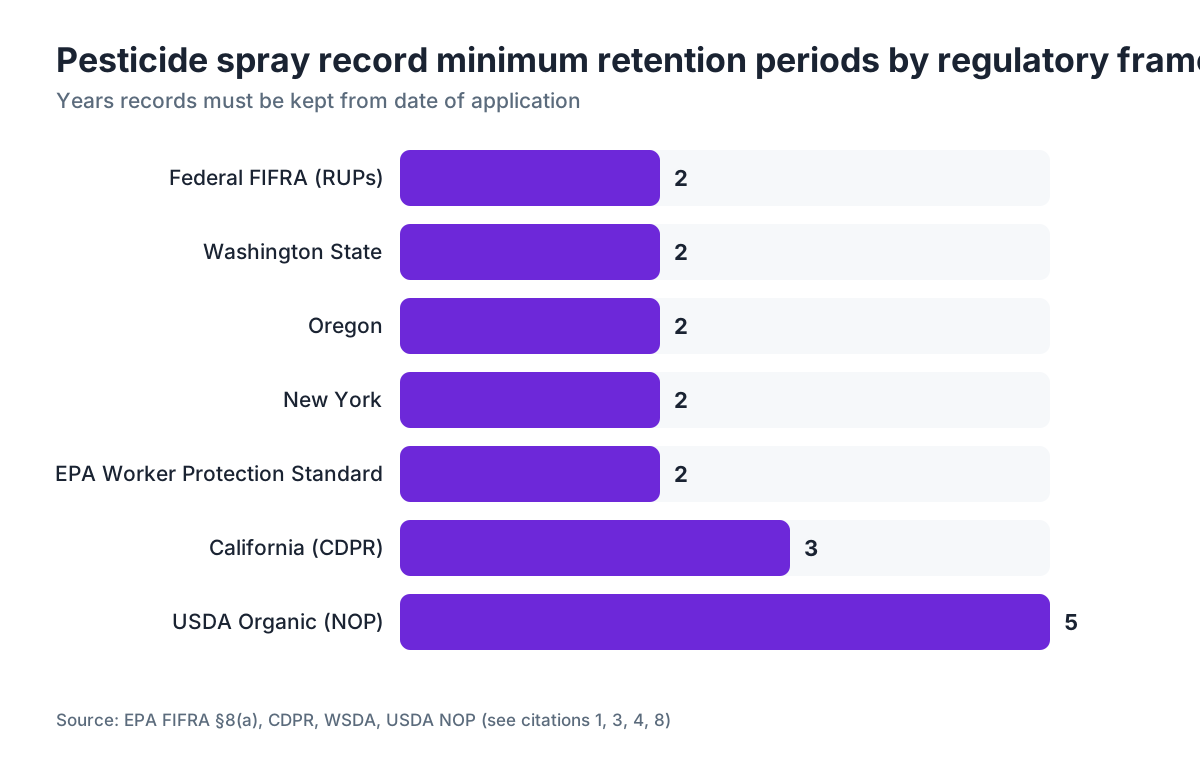
- Federal law under FIFRA requires certified applicators of restricted-use pesticides to keep spray records for at least 2 years from the application date.
- California requires 3 years.
- USDA-certified organic operations must keep records for 5 years.
- A complete record needs the applicator name, EPA registration number, rate, date, location, and crop.
- Store copies with backups, and be ready to produce them within 24 hours of an inspector's request.
What is the federal minimum retention period for pesticide application records?
The federal floor is 2 years. Under the Federal Insecticide, Fungicide, and Rodenticide Act (FIFRA), Section 8(a), certified applicators who apply restricted-use pesticides (RUPs) must keep records for 2 years from the date of application [1]. That's the minimum the federal government requires, and it applies in every state.
For general-use pesticides, FIFRA's federal recordkeeping rule technically only mandates records for RUPs. Don't take that as a free pass. Your state almost certainly has its own rules covering general-use products too, and many of those state rules run longer. EPA's Worker Protection Standard (WPS) adds another layer: records of pesticide applications made to agricultural establishments must be kept and made available to workers and early-entry handlers for set periods as well [2].
Two years sounds manageable. The catch is that inspectors, landlords, and insurance audits don't show up on a convenient schedule, and records past the federal window can still be subpoenaed or demanded under state law if litigation starts. Here's the practical answer: keep everything for at least 3 years, and hold summary logs indefinitely if you have the space.
Do state retention rules differ, and which states require more than 2 years?
Yes, and the gap matters. California is the most demanding state for vineyard operators. Under the California Department of Pesticide Regulation (CDPR), pesticide use reports (PURs) must be kept for 3 years from the date of application, and county agricultural commissioners can audit them on that timeline [3]. California also requires monthly reporting of pesticide use to the county ag commissioner, so there's a parallel paper trail that makes accurate records doubly important.
Washington State requires applicators to keep records for 2 years under state pesticide regulations, matching the federal floor, but the Washington State Department of Agriculture (WSDA) can request records going back further if a complaint is filed [4]. Oregon follows a similar 2-year rule under Oregon Department of Agriculture authority.
The table below covers states with real vineyard acreage:
| State | Minimum retention period | Governing authority |
|---|---|---|
| California | 3 years | CDPR, FAC §12980 |
| Washington | 2 years | WSDA, WAC 16-228 |
| Oregon | 2 years | ODA |
| New York | 2 years | DEC / FIFRA |
| Virginia | 2 years | VDACS / FIFRA |
| Texas | 2 years | TDA / FIFRA |
| Federal (all RUPs) | 2 years | FIFRA §8(a) |
Farming in California? Treat 3 years as your absolute minimum. Everywhere else, build your filing system around 3 years anyway. The marginal cost of an extra year of storage is close to zero, and a missing record during an inspection is a real problem.
What information must be in a completed spray record?
A legally complete spray record isn't a note that says 'sprayed sulfur on block 4.' FIFRA Section 8(a) sets the minimum fields for RUP records: the brand name and EPA registration number of the pesticide, the total amount applied, the location of the application, the size of the area treated, the crop or commodity, the date of application, and the name and certification number of the certified applicator [1].
California's PUR requirements go further. CDPR requires the site ID (township, range, section), the target pest, the unit treated (acres, pounds, square feet), the application method, and the grower or operator information on top of the federal fields [3].
WSU Extension's pesticide recordkeeping guidance recommends also recording the REI (restricted entry interval) end date and the PHI (pre-harvest interval) end date directly on the application record, even where your state doesn't strictly require it [5]. That's good advice. When a harvest crew arrives early or a worker re-enters a treated block, having the REI written on the record that's already posted at the field is the fastest way to dodge a WPS violation.
Keep the pesticide label in the same filing system as the matching spray records, or at least note the label version date on the record. Labels change. If a compliance question comes up two years later, you'll want proof of what the label said on the day you applied.
How should you physically store spray records to survive an inspection?
Storage method matters. An inspector doesn't just want to know the records exist. They want to see them, usually within 24 hours of a request, sometimes right away on-site. Disorganized boxes in a shed that floods in February are not a compliance strategy.
Paper records belong in a dry, lockable location. A fireproof filing cabinet in the shop or office is reasonable. Organize by calendar year, then by block or field unit within each year. Label the outside of each folder or binder with the year and the blocks covered. If you're running 30-plus blocks, a simple spreadsheet index that maps each application record to its physical folder saves real time during an audit.
Digital storage is common now and regulators generally accept it, but stay careful. CDPR has confirmed that electronic records are acceptable as long as they're legible, retrievable on request, and contain all required fields [3]. The EPA WPS doesn't prohibit electronic records. WSDA allows them too. But 'digital' doesn't mean a blurry phone photo of a handwritten log. Records have to be clearly readable.
For digital systems, keep at least two independent copies. A local copy on a farm computer plus a cloud backup is a reasonable minimum. If your spray software exports PDFs, save a static PDF for each season at year-end. Don't rely on a SaaS platform's servers for your only copy. Systems like VitiScribe are built for vineyard compliance records and make it easier to export complete, inspector-ready application logs on demand, but whatever software you use, the backup habit matters more than the software choice.
One more thing. If you have a landlord or a custom crush contract that requires record access, store a copy separate from your operational files so you can respond fast without digging through the main archive.
Can you store spray records digitally or does it have to be paper?
Digital is fine in every major wine-producing state, with a few caveats.
EPA has not issued a blanket federal rule requiring paper. The WPS regulations at 40 CFR Part 170 describe the information that must be kept and made available, not the medium [2]. States have followed EPA's lead. CDPR explicitly allows electronic pesticide use reports submitted through their online system (the CalPEATS/ePUR portal), and stored electronic records are acceptable as long as they can be printed on demand [3].
The practical caveats: whatever system you use has to produce a printed, human-readable record if an inspector asks for one in the field. A laptop that won't start or a cloud system that's down when the inspector arrives is your problem, not the regulator's. Keep a printed copy of at least the current season's records somewhere on-farm, even if your master archive lives on a hard drive.
Cornell Cooperative Extension recommends keeping redundant digital backups for agricultural records and points to the IRS standard of reliable storage with the ability to produce a legible copy as a useful benchmark for farm compliance records generally, even though that's an IRS rule [6]. Borrow the heuristic. It holds up.
What happens if you can't produce spray records during an inspection?
Missing records get treated as missing compliance, full stop. An inspector can't confirm your application was lawful if the record doesn't exist. That turns a paperwork issue into a possible pesticide law violation.
Penalties vary by state. In California, a first-offense failure to maintain pesticide use records can bring civil penalties up to $5,000 per violation under the California Food and Agricultural Code [3]. Repeated violations, or records failures tied to a worker injury or environmental incident, carry higher exposure. Washington State penalties under WSDA can reach $7,500 per violation for willful or repeat offenses [4].
At the federal level, FIFRA Section 14 authorizes civil penalties up to $1,000 per offense for private applicators and up to $5,000 per offense for commercial applicators [9]. EPA rarely leads with the maximum for a first records failure, but they can, and state agencies often do.
Beyond the fine, the real cost is the investigation that follows. Inspectors who find one missing record tend to look harder at everything else. A single gap in a spray log can trigger a full audit of your WPS training records, equipment inspection logs, and label compliance. Keep the records and give no one a reason to dig.
What does the EPA Worker Protection Standard require for spray record access?
The WPS (40 CFR Part 170) requires that specific pesticide application information be available to workers and early-entry handlers during and after an application [2]. This is separate from the FIFRA recordkeeping requirement, though the two overlap a lot.
Under the 2015 revised WPS rule, agricultural employers must keep pesticide application records for 2 years and make them available to workers and handlers within 15 days of a request. The required information includes the product name, EPA registration number, active ingredient(s), location and description of the treated area, date(s) of application, and REI [2].
The WPS also requires posting application information at a central location on the establishment during the REI. That posting is separate from the retained record but must match it. If your posted information says one thing and your spray log says another, you have a problem no matter which one is technically correct.
UC Cooperative Extension has published guidance noting that the 2015 WPS revisions tightened the rules around record accessibility for agricultural workers, and that growers should review their posting and record systems together rather than treating them as separate tasks [7]. Worth internalizing. Your filing system and your field posting system should pull from the same source of truth.
How should spray records be organized so you can actually find them during an audit?
Organization is where most small vineyards fall down. They have the records. They just can't find them.
The most functional filing structure for a vineyard is one binder or folder per calendar year, with records inside organized by date. Within each record, cross-reference the block name or ID to a simple block map stored in the front of the binder. When an inspector asks for all applications to Block 7 in 2023, you find them in under two minutes without pulling every record.
If you manage more than one ranch, or multiple blocks under different ownership or lease arrangements, keep each property's records physically or digitally separate. Co-mingled records from multiple properties create confusion about which applications happened where, and that confusion is hard to un-create during an inspection.
Index every binder. A one-page spreadsheet or table at the front of each annual binder listing application date, product, block, and folder tab number takes about an hour to build at the end of the season and saves hours during an audit. Unglamorous work. Worth doing.
For digital archives, folder naming matters. A structure like /SprayRecords/2024/Block07/2024-05-14_Sulfur_Block07.pdf is findable. A structure like /Misc/spray/scan0047.pdf is not. Pick a convention at the start of the season and apply it every time.
Do you need to keep records for custom application contractors separately?
If you hire a licensed pest control business (PCB) to apply pesticides in your vineyard, the contractor is legally required to keep their own records under FIFRA and state law. That doesn't mean you're off the hook.
As the grower or vineyard operator, you are the agricultural employer under WPS. You're responsible for making application information available to your workers, for meeting posting requirements, and for making sure the REI is observed, no matter who held the spray gun. If the contractor fails to hand you the required information, you're still liable for the WPS compliance gap on your property.
Get a copy of every application record from your contractor on the day of application or within 24 hours. File it exactly as you would a record of your own application. Don't assume the contractor's records stay accessible to you later. Contracted records are the contractor's records, and if they go out of business or lose them, you have nothing.
Some PCBs will hand you electronic spray records through their own software. Fine. Export a copy to your own archive anyway. Relying on a third party's system for your compliance records is a risk you don't need to take.
What's the best practice for backing up spray records before the season ends?
End-of-season record consolidation is one of the highest-return hours you'll spend on compliance. Do it before harvest chaos makes you forget.
For paper systems: pull all application records off the field clipboard or out of the sprayer cab, confirm every required field is filled in, and file them by date in the annual binder. Scan the complete binder and save the PDF to at least two places, one local (a USB drive or a farm computer) and one off-site (a cloud service or a drive kept in a different building).
For digital systems: export the complete season's records as a static file (PDF or CSV) from whatever software you use. Save it with a clear filename and date. Open the export and confirm it's readable before you call the task done.
Check each record against the application calendar before you file. If you see an application date in your calendar with no matching record, track it down now. A missing record is far easier to reconstruct or flag within weeks of the application than two years later when an inspector asks.
WSU Extension recommends a formal end-of-season review of all pesticide records as part of an IPM close-out, including verifying that PHI and REI dates were met based on the harvest dates actually recorded [5]. Build that review into your harvest close-out routine. It's practical, and it puts you ahead of most small vineyard operators.
If you want a system that keeps application records, block maps, and compliance checklists together, VitiScribe is built for exactly this workflow. That said, a well-organized paper system with disciplined scanning keeps you just as compliant.
How do spray record requirements differ for organic vineyards?
Organic certification adds a third layer of recordkeeping on top of FIFRA and state requirements.
The USDA National Organic Program (NOP) at 7 CFR Part 205 requires certified organic operations to maintain records that fully disclose all activities and transactions for at least 5 years beyond their creation [8]. That 5-year window is the longest retention requirement most vineyard operators will hit. It applies to records of any substance applied to the field, whether that substance is NOP-compliant or not, because your certifier needs to verify that prohibited substances were not used.
For organic growers, the spray record needs more than the product name and rate. It needs the NOP-compliant status of the material, usually documented by the OMRI listing or your certifier's approved materials list. Apply an emergency exemption material or a restricted material under the organic regulations, and the documentation trail gets more specific still.
What this means in practice: organic vineyard operators should keep spray records for a minimum of 5 years and should confirm with their certifying agency exactly what additional fields are required. The NOP rule is clear on the retention period, but your certifier may add requirements in your organic system plan.
When should you consult your county agricultural commissioner about spray record requirements?
In California, the county agricultural commissioner (CAC) is your primary compliance contact, not the state CDPR. Each county's CAC office administers pesticide use reporting locally, across 58 counties with their own offices. Rules on how and when to submit monthly PURs, what format is acceptable, and how to handle corrections vary a bit by county.
Contact your CAC when you're starting a new operation, switching from paper to digital records, adding a new block or changing your legal entity, or when you've had a gap in your recordkeeping and want to understand your exposure before a routine inspection finds it. Voluntary disclosure of a records gap is almost always treated better than an inspector discovering it on their own.
Growers in other states: your equivalent contact is your state department of agriculture's pesticide program office. Washington growers reach out to WSDA Pesticides, Oregon growers to ODA, New York growers to the DEC. These agencies publish recordkeeping guides, often in plain English, and most will answer specific questions if you call the right division.
Frequently asked questions
How long do I have to keep spray records for restricted-use pesticides?
Under FIFRA Section 8(a), you must keep restricted-use pesticide application records for at least 2 years from the date of application. California requires 3 years under CDPR rules. Organic operations certified under the USDA NOP must keep all field records for 5 years. In practice, holding every spray record for at least 3 years is the safest approach regardless of your state, because it covers nearly every regulatory window.
Do I have to keep spray records for general-use pesticides, or only restricted-use?
FIFRA's federal recordkeeping mandate specifically covers restricted-use pesticides. Most states, including California, require pesticide use reporting for all pesticides applied commercially, not only RUPs. The EPA Worker Protection Standard requires application information to be available for WPS-covered applications of any pesticide. Don't assume general-use products are exempt. Check your state's pesticide use reporting rules directly with your state ag department.
Can spray records be kept on a phone or tablet instead of paper?
Yes. California, Washington, Oregon, and other major wine states accept electronic records as long as they're legible and can be produced on request. EPA has not prohibited digital recordkeeping under FIFRA or WPS. The practical requirement is that you can print a readable copy when an inspector asks. Keep a backup copy off-device. A cloud backup plus a local export at season-end is a reasonable minimum system.
What fields are legally required on a spray record?
Federal FIFRA requires: pesticide brand name, EPA registration number, total amount applied, location and size of treated area, crop or commodity, date of application, and certified applicator name and number. California adds site ID, target pest, application method, and operator information. WPS requires the REI to be documented. Recording the PHI end date is not federally required but is strongly recommended by WSU and UC extension programs.
What penalty can I face for missing spray records during an inspection?
Federal FIFRA penalties for commercial applicators reach up to $5,000 per offense under Section 14. California penalties for failure to maintain pesticide use records reach $5,000 per violation under the California Food and Agricultural Code. Washington State penalties can reach $7,500 per violation for willful or repeat offenses. Beyond the fine, missing records often trigger a broader audit of all your WPS and pesticide compliance records.
Do I need to keep spray records if I hire a licensed pest control operator to do the spraying?
Yes. The contractor keeps their own records under FIFRA, but as the agricultural employer under WPS, you're responsible for making application information available to your workers and ensuring REIs are observed on your property. Get a copy of every contractor application record on the day of or within 24 hours of application, and file it in your own archive. Don't rely on the contractor's records as your only copy.
How long do organic vineyard spray records need to be kept?
USDA National Organic Program regulations at 7 CFR Part 205 require certified organic operations to maintain records for at least 5 years beyond their creation. This is the longest retention window most vineyard operators face and applies to all substances applied, including NOP-compliant materials. Your certifying agency may add requirements in your organic system plan, so verify the specific fields required with them directly.
Does the EPA Worker Protection Standard require spray records to be accessible to workers?
Yes. The revised 2015 WPS (40 CFR Part 170) requires agricultural employers to keep pesticide application information for 2 years and make it available to workers and handlers within 15 days of a request. Required information includes product name, EPA registration number, active ingredients, treated area description, application date, and REI. This is separate from the FIFRA RUP recordkeeping requirement but overlaps with it significantly.
How soon after an application do I need to complete the spray record?
Federal FIFRA regulations require records to be made as soon as practicable after the application. California requires pesticide use reports to be submitted to the county agricultural commissioner within 30 days of the end of the month in which the application occurred. As a practical matter, completing the record the same day, before the sprayer is cleaned and the tank tag removed, is the most reliable habit and the one extension programs consistently recommend.
What's the best way to organize spray records so I can find them during an audit?
Keep one binder or folder per calendar year, organized by date inside, with records cross-referenced to a block map kept at the front. Add a one-page index listing application date, product, and block. For digital archives, use a consistent naming convention like /Year/Block/Date_Product. Keep paper and digital systems in sync. Disorganized records that technically exist can still cost you time and credibility during an inspection.
Do spray record requirements differ between wine grape vineyards and table grape operations?
The FIFRA and WPS requirements apply to all agricultural pesticide use regardless of the end market for the crop. The rules don't distinguish between wine grapes and table grapes. California's PUR reporting requirements apply equally. Organic certification requirements under USDA NOP apply if the operation is certified. The main difference in practice is that wine grape operations often face extra record demands from distributors, custom crush contracts, and appellations, which may require longer internal retention.
What should I do if I discover a spray record is missing after the season?
Don't fabricate or back-date a record. If you can reconstruct the application from tank tags, purchase receipts, equipment logs, or employee recollections, document the reconstruction process and note that it's a reconstructed record, not a contemporaneous one. Contact your county ag commissioner or state pesticide agency to understand your exposure. Voluntary disclosure of a gap before an inspection is almost always treated better than an inspector finding it independently.
Do I need to keep the pesticide label along with the spray record?
Federal law requires you to have the label at the time of application; there's no explicit requirement to archive the label alongside the record. Still, keeping a copy of the label version in use at the time of application is genuinely useful. Labels change, and if a compliance question arises two years later, you'll want to know what your label said on application day. UC and Cornell extension both recommend including label version dates in application records for this reason.
Sources
- EPA, Recognition and Management of Pesticide Poisonings / FIFRA Section 8(a) and 40 CFR Part 171 recordkeeping requirements (see EPA Pesticides section): Federal minimum 2-year retention period for restricted-use pesticide application records for certified applicators, and required fields including EPA registration number, rate, date, location, and applicator name and certification number
- EPA, Agricultural Worker Protection Standard (WPS), 40 CFR Part 170: WPS requires agricultural employers to keep pesticide application records for 2 years and make them available to workers and handlers within 15 days; required fields include product name, EPA registration number, active ingredients, treated area, application date, and REI
- California Department of Pesticide Regulation, Pesticide Use Reporting: California requires pesticide use reports to be maintained for 3 years; county agricultural commissioners administer reporting; electronic submission is accepted; civil penalties up to $5,000 per violation for recordkeeping failures under the California Food and Agricultural Code
- Washington State Department of Agriculture, Pesticides program: Washington State requires pesticide application records to be kept for 2 years; WSDA can impose civil penalties up to $7,500 per violation for willful or repeat offenses
- Washington State University Extension: WSU Extension recommends recording REI and PHI end dates directly on application records, and conducting a formal end-of-season review of all pesticide records as part of IPM close-out
- Cornell Cooperative Extension, farm records and agricultural compliance guidance: Cornell Cooperative Extension recommends maintaining redundant digital backups for agricultural records and notes that the IRS reliable-storage standard is a useful benchmark for farm compliance records
- University of California Agriculture and Natural Resources (UC Cooperative Extension), Worker Protection Standard guidance for growers: The 2015 WPS revisions tightened rules around record accessibility for agricultural workers; UC Cooperative Extension recommends reviewing posting and record systems together rather than treating them as separate tasks
- USDA Agricultural Marketing Service, National Organic Program, 7 CFR Part 205: USDA NOP regulations require certified organic operations to maintain records for at least 5 years beyond their creation, covering all substances applied to the field
- EPA, Pesticide enforcement under FIFRA Section 14 civil and criminal penalties (see EPA Enforcement section): FIFRA Section 14 authorizes civil penalties up to $1,000 per offense for private applicators and up to $5,000 per offense for commercial applicators
Last updated 2026-07-10