Sulphur vineyard spray: the complete grower's guide

TL;DR
- Sulphur is the oldest and most widely used fungicide in vineyards, applied mainly to stop powdery mildew (Erysiphe necator).
- Rates run 3 to 5 lb of elemental sulphur per acre per pass, with a 24-hour re-entry interval and a preharvest interval as short as zero days on some labels.
- Three things trip growers up: timing, the temperature ceiling, and honest records.
What does sulphur actually do in a vineyard?
Sulphur works by contact. It doesn't move through the plant. A powdery mildew spore lands on a treated leaf, starts to germinate, and the sulphur vapour disrupts respiration in the fungus before it can colonise the tissue. That mode of action, disruption of mitochondrial electron transport, has held up for more than 150 years of commercial use because resistance needs the fungus to rewire several enzymes at once, not flip a single switch [1].
The catch is that sulphur is purely protective. Once mildew has colonised tissue, sulphur does almost nothing to the established infection. So interval discipline matters more than anything else in a sulphur program. UC Davis plant pathologists recommend application intervals no longer than 10 to 14 days during rapid shoot growth in spring, tightening to 7 days when conditions favour mildew, which is roughly 70 to 85 degrees F with humidity above 40 percent [2].
Sulphur has some secondary activity against powdery mildew's overwintering structures, but calling it a cleaner is generous. Treat it as a residual surface barrier. It is not a rescue treatment.
What forms of sulphur are used in vineyard sprays?
You'll run into three main forms: wettable sulphur (WS or WP), sulphur dust, and liquid flowable sulphur (sometimes called a suspension concentrate). Lime sulphur (calcium polysulphide) is a fourth category that behaves differently, and it gets its own note below under dormant applications.
Wettable sulphur is the workhorse. It mixes with water, runs through most sprayers with minimal clogging if your screens are the right size (80 to 100 mesh is typical), and gives even coverage. Most commercial formulations are 80 to 90 percent elemental sulphur by weight. Common products include Thiolux, Microthiol Disperss, and Kumulus DF, though what your distributor stocks varies by state.
Sulphur dust is cheaper per pound and skips water entirely, which helps in dry climates or anywhere water hauling is a pain. The tradeoff is applicator exposure. Dust drifts hard, and a coated tractor cab is miserable. Most large operations have moved to wettable products for ground rig work.
Flowable products suspend fine sulphur particles in water. They're easier to handle than dust and more homogeneous than wettable powders, and they're the gentlest on equipment. They also cost the most per pound of active ingredient, so run the unit-cost math before you switch.
Lime sulphur is its own animal. You apply it dormant or at very early green tissue (before 1-inch shoot growth) as a surface sterilant to knock back overwintering ascospore inoculum. It scorches actively growing tissue, so it must not touch the vine once the season is underway [2].
What are the correct sulphur spray rates for grapevines?
Label rates and the research cluster between 3 and 10 lb of elemental sulphur per acre per pass, depending on formulation concentration, disease pressure, and whether you spray dilute or concentrate [1][3].
For wettable sulphur at 80 percent active ingredient, a common ground rig dilute pass runs 5 to 8 lb of product per acre, so 4 to 6.4 lb of active ingredient per acre. With airblast concentrate applications you apply the same amount of active ingredient in a smaller carrier volume, so the product rate holds but water volume drops to 20 to 50 gallons per acre instead of 100 to 200 for dilute.
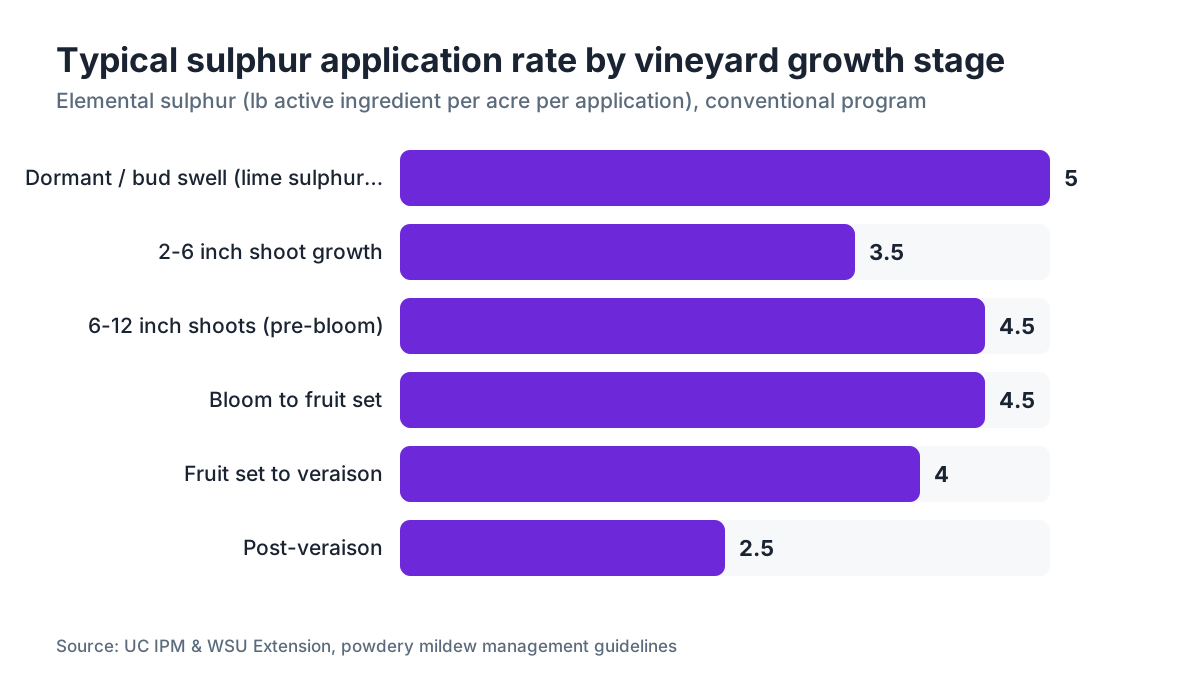
WSU Extension recommends starting at the low end of the rate range in spring, when shoots are small and pressure is light, then moving higher through the critical window from 6-inch shoot growth to cluster closure [3]. That advice holds across most growing regions.
A quick reference table:
| Application Timing | Target Growth Stage | Typical Rate (lb a.i./acre) | Interval |
|---|---|---|---|
| Dormant (lime sulphur) | Dormant, bud swell | 10-20 lb product/100 gal | Once |
| Early season | 2-6 inch shoots | 3-4 lb | 10-14 days |
| Pre-bloom | 6-12 inch shoots | 4-5 lb | 7-10 days |
| Bloom to fruit set | Flowering, berry set | 4-5 lb | 7 days |
| Post-set to veraison | Cluster expansion | 3-5 lb | 10-14 days |
| After veraison | Berry ripening | 2-3 lb or stop | 14+ days |
Mildew pressure usually eases after veraison in most regions, and the only reason to keep spraying is heavy early-season pressure on a susceptible variety. Plenty of growers stop sulphur at veraison and swap to a short-PHI synthetic if they have any residual worry.
At what temperature does sulphur phytotoxicity become a real risk?
This is the question that triggers the most late-season phone calls. The standard threshold across UC Davis, Cornell, and WSU guidance is to skip sulphur when temperatures are forecast to reach or exceed 90 degrees F (32 degrees C) within 24 hours of application [2][3][4].
Above 90 degrees, sulphur vapour pressure climbs enough that it enters leaf tissue faster than the plant can handle. Damage ranges from tip burn on leaf margins to full necrotic spotting on fruit. Berry scarring from sulphur phytotoxicity costs real money, and it's irreversible. You can't spray sulphur on berries and fix the damage after the fact.
The Cornell Pest Management Guidelines put it plainly: "Do not apply sulfur if temperatures are expected to exceed 90 degrees F on the day of application or for the following two days." [4] That two-day window is the part growers miss. You check the day-of forecast, spray at 6 a.m. while it's 75 degrees, and don't clock that the afternoon hits 93 with active residue still sitting on the fruit.
Humidity changes the picture. In humid regions, sulphur activity and its phytotoxicity risk both run a little lower because the vapour-pressure equilibrium shifts. In the arid Central Valley or eastern Washington, treat the threshold as stricter than the label reads, because temperatures there can jump 15 degrees in two hours.
Cultivar sensitivity matters too. Concord and other labrusca types are the most sensitive. Chardonnay and Pinot Noir show moderate sensitivity. Cabernet Sauvignon is generally more tolerant. None of this beats the 90-degree rule, but it's useful when you're triaging a call on a marginal day.
How does sulphur affect yeast and fermentation?
This one matters more than most growers ever hear. Residual sulphur on harvested grapes can slow inoculated fermentations and get reduced to hydrogen sulphide (H2S) during fermentation, which is the rotten-egg off-aroma nobody wants [5].
Here's the mechanism. Saccharomyces cerevisiae has the enzymatic pathway to reduce elemental sulphur all the way to H2S, and it does so most readily under low-nitrogen stress. If the must is also short on yeast assimilable nitrogen (YAN below roughly 140 mg/L is the common warning line), residual sulphur plus nitrogen stress is a reliable recipe for stink.
The fix has three parts. Respect the preharvest interval first. Most sulphur labels list a 0-day PHI, meaning you can legally spray up to harvest, but "can" and "should" are different words. Most winemakers want a 21 to 30 day gap between the last sulphur pass and pick. Second, manage YAN with timely nutrient additions if your must sits borderline. Third, don't harvest into bins or tanks carrying sulphur residue from earlier dusting.
A 2013 study in the American Journal of Enology and Viticulture found that grapes with sulphur applied within two weeks of harvest showed measurably higher H2S at 24 hours post-crush than controls, though the effect largely faded by 48 hours in well-managed, nitrogen-adequate fermentations [5]. That's reassuring. It also means your margin is thin if anything else goes sideways.
If your vineyard sells to multiple wineries, H2S complaints trace straight back to you. Keep your sulphur dates and rates in your spray records so winemakers can size up the risk before fermentation.
What are the worker safety and re-entry requirements for sulphur?
The EPA classifies sulphur as a conventional pesticide with relatively low acute toxicity, but it isn't harmless. Inhaled dust irritates the respiratory tract and direct eye contact stings. The EPA Worker Protection Standard (WPS) applies to every agricultural sulphur application [6].
The restricted-entry interval (REI) for most sulphur products is 24 hours. Some fine-particle products carry a 48-hour REI because those particles stay airborne longer. Read the label instead of trusting the chemical class, because the label is the law.
The WPS requires, at minimum: worker notification about the application (posted signs at field entry points or oral notification), appropriate personal protective equipment, and emergency decontamination supplies. For sulphur, the label-mandated PPE is usually a long-sleeved shirt and long pants, chemical-resistant gloves, shoes and socks, and a NIOSH-approved dust/mist respirator (N95 or better) for the handler [6].
Drift is mostly a neighbour problem rather than a worker one. Sulphur at application strength can burn sensitive vegetable crops and fruit trees. Oregon and California both add state drift rules on top of the federal WPS. In California, the county agricultural commissioner requires a permit for many sulphur products, and a drift complaint can trigger a commissioner inspection [7].
On record-keeping: federal WPS requires application records for two years. State rules vary. California requires three. Washington requires two. Cornell's IPM program notes that solid records protect you legally and help you build a year-over-year picture of what actually worked [4]. A platform like VitiScribe is built for exactly this, tying application dates, rates, REI windows, and worker notification into one auditable log.
How does sulphur fit into an organic vineyard program?
Sulphur is OMRI-listed and approved for certified organic production under the USDA National Organic Program [8]. It's one of the few broadly effective fungicides organic growers can reach for, which makes it load-bearing in any organic mildew program.
Approved doesn't mean unlimited. The NOP requires materials be used in a way that maintains or improves soil health over time. Chronic heavy sulphur can lower surface soil pH, and excess sulphur in decomposing organic matter can create localised sulphide conditions toxic to soil microbes. Most certifiers and extension programs suggest staying at the low end of the label range as a precaution, though the research on soil impacts at normal vineyard rates is genuinely inconclusive [8].
Organic growers have fewer alternative modes of action, so resistance management is close to moot for sulphur itself. Resistance to sulphur in Erysiphe necator remains essentially unreported. But it also means sulphur does the heavy lifting that a synthetic program spreads across several FRAC groups. So organic vineyards tend to run tighter intervals and take more passes per season, often 12 to 18 in a high-pressure year versus 8 to 12 in a conventional rotation.
Kaolin clay and copper fungicides are the usual tank-mix partners in organic programs. Copper handles downy mildew (Plasmopara viticola) while sulphur covers powdery. Copper accumulation in vineyard soils is a rising regulatory concern in the EU and increasingly in California, so track your copper loads even if sulphur is doing most of the work.
What is the preharvest interval (PHI) for sulphur on grapes?
Most registered sulphur products for grapes list a PHI of 0 days, meaning the label allows application right up to harvest [1]. That's a practical edge over many synthetic fungicides carrying 7, 14, or 21-day PHIs.
But 0 days is a regulatory floor, not winemaking advice. As the fermentation section covers, the residue-to-H2S problem pushes most informed programs to a 21 to 30 day practical cutoff before pick. Some premium wineries write it into the contract, often stopping all sulphur by August 1 in early-ripening regions and later in cooler climates.
If you sell fruit and your purchase agreement has a sulphur cutoff clause, that contract date overrides the label PHI. Log it in your records next to the label information so any inspector or buyer can see the basis for your last application date.
If you make your own wine, the call is yours. The PHI is 0. The winemaking risk is real, and it's manageable with good YAN and clean fermentation practices.
How should you calibrate and apply sulphur through an airblast sprayer?
Calibration is where good intentions die. You can have the right product, the right rate, and the right timing and still land 60 percent of what the canopy needs because the sprayer is set up wrong.
WSU Extension recommends the catch-pan calibration method: set pans at several canopy heights on both sides of the row during a test pass and check the distribution [3]. Sulphur, being contact-only, punishes coverage gaps hard because there's no systemic activity to cover a missed spot.
Key airblast settings for sulphur:
- Fan speed: match air volume to canopy density. Overthrowing air through a thin canopy wastes product and feeds drift. Most guidelines put airspeed at the canopy edge around 5 to 10 mph.
- Ground speed: 2 to 3 mph for dense canopies, 3 to 4 mph for open trellis-trained systems. Faster than 4 mph and you're usually giving up coverage.
- Nozzle selection: hollow-cone nozzles suit sulphur suspensions. Check the manufacturer's guidance for the specific product, especially with flowables.
- Water volume: dilute passes at 100 to 150 gallons per acre give the best coverage but take longer. Concentrate passes at 20 to 50 gallons per acre save time and are standard in large operations with properly calibrated rigs.
Spray water pH matters less for sulphur than for some systemic fungicides, but very alkaline water (above pH 8.5) can cause minor formulation instability in some flowable products. Check your water source if you see unusual tank sediment.
One honest note on records: track the actual applied gallons per acre per pass, more than the product rate. That's what lets you reconstruct real coverage when you review a season with disease escapes. A record that only says "applied Microthiol at 5 lb/acre" tells you nothing if the calibration was off.
How do you handle sulphur resistance, and does it exist?
Practical resistance to sulphur in Erysiphe necator, grapevine powdery mildew, has never been documented in the scientific literature [1][2]. That's a genuine edge over the DMI and QoI fungicide classes, where resistance is well established and widespread.
The reason ties back to the mode of action. Disrupting mitochondrial electron transport needs several simultaneous mutations to give meaningful resistance, a far higher evolutionary bar than the single point mutations behind DMI resistance. Not impossible, just that in 150-plus years of commercial use, nobody has reported it at a practical level.
What growers misread as resistance is usually one of three things: application failure (coverage gaps, blown spray intervals), phytotoxicity windows that forced skipped or delayed passes right when mildew pressure peaked, or a highly susceptible variety with mildew so aggressive that even good coverage barely holds.
So you don't need to rotate away from sulphur to manage sulphur resistance. Rotating in other FRAC groups is still smart to protect those synthetics from their own resistance. The Fungicide Resistance Action Committee puts sulphur in FRAC group M2, which reflects its multi-site mode of action and low resistance risk [1].
What does it cost to run a sulphur program, and what's a waste of money?
Wettable sulphur in 50-lb bags runs roughly $0.50 to $0.80 per pound of product at most ag suppliers, so a 5 lb/acre pass costs $2.50 to $4.00 in product per acre. Flowable suspensions cost more per pound of active ingredient, sometimes $1.00 to $1.50 per pound of product, but the handling advantage can justify the premium on large operations where the labour time spent mixing powders adds up.
Run the math on a 100-acre vineyard doing 12 passes a season at 5 lb/acre. Product alone is roughly $1,500 to $4,800, depending on formulation. Application (equipment, labour, fuel) adds a lot more, often $8 to $20 per acre per pass for a well-run ground rig, which puts total sulphur program cost around $10,000 to $25,000 per season for 100 acres.
Where the money leaks, based on spray records from programs that struggle: spraying during high-heat windows that cause phytotoxicity you then have to correct; letting intervals stretch past 14 days during rapid shoot growth so coverage lapses and you tack on emergency synthetic passes to clean up; and buying premium-brand flowable when generic wettable would perform identically at the same active ingredient rate.
Premium copper-sulphur tank mixes sound appealing and can pay off if you truly need both actives, but check label compatibility first. Some copper formulations react with sulphur and cause phytotoxicity or formulation breakdown. The label is not optional reading.
To keep those cost and application records in order, VitiScribe handles spray logs in a format that matches what California DPR, the Oregon Department of Agriculture, and other state agencies actually ask to see, which saves time at audit.
Curious how established regions structure their programs? The Paso Robles wineries area is a useful contrast to coastal California because its extreme temperature swings push the phytotoxicity window hard.
What do spray records for sulphur applications need to include?
Federal WPS requires records kept for two years. California requires three and has the most specific requirements, enforced by county agricultural commissioners [7]. Washington requires two years under WAC 16-228 [9].
At minimum, a defensible sulphur spray record includes:
- Date and time of application
- Product name and EPA registration number
- Rate applied (per acre or per 100 gallons, matching the label)
- Total amount of product used
- Acres treated and location (block or parcel identifier)
- Application method and equipment
- Applicator name and, if your state requires it, license number
- REI posted or communicated to workers
- Weather at application (wind speed, direction, temperature)
- Water source and volume used (useful for calibration audits)
Weather isn't always required federally, but California's pesticide use reporting system requires it and it's good practice everywhere. If a neighbour files a drift complaint and your records show 8 mph gusts blowing from your vineyard toward their property, you're in a much worse spot than if the record shows 3 mph steady wind the other way.
The EPA's Worker Protection Standard [6], codified at 40 CFR Part 170, is the baseline. "Each agricultural employer must maintain a record of each pesticide application made to an agricultural establishment for which the employer is responsible" is the standard's language. That record has to stay at the establishment or be accessible within 24 hours of a regulatory request.
Frequently asked questions
Can I apply sulphur right before it rains?
Rain within 24 hours of application washes sulphur off the leaf surface and cuts residual coverage badly. Most extension programs recommend a rain-free window of at least 24 hours after application. Sulphur is cheap enough that re-applying after a washout won't wreck your budget, but logging both application and rainfall timing helps you understand why a disease escape happened later.
Is sulphur safe to tank-mix with other fungicides?
Sulphur mixes safely with most contact fungicides and many systemics. The main incompatibilities are certain oil-based products (horticultural oils shouldn't be applied within two weeks of sulphur in either direction), captan (which can cause phytotoxicity combined with sulphur), and some copper formulations. Always read each product's label before mixing, and run a small jar test if you're unsure about a new combination.
How close to harvest can I realistically spray sulphur without hurting wine quality?
The label PHI is 0 days for most products, but H2S risk pushes the practical cutoff to 21 to 30 days before harvest for most winemakers. Some winery purchase agreements set an August 1 or earlier cutoff. If your must will be nitrogen-adequate and you ferment with a low-H2S-producing yeast strain, the risk from late passes drops, though it never disappears entirely.
What's the difference between wettable sulphur and flowable sulphur?
Wettable sulphur is a dry powder that disperses in water. Flowable (suspension concentrate) sulphur pre-suspends fine particles in liquid, making it easier to measure and mix with less dust exposure. Both deliver elemental sulphur as the active ingredient, and at the same active ingredient rate their efficacy is equivalent. Flowable costs more per pound of active ingredient but is easier on equipment and cuts applicator dust during mixing.
Does sulphur work against downy mildew in grapes?
No. Sulphur has no meaningful efficacy against downy mildew (Plasmopara viticola). It targets only powdery mildew (Erysiphe necator). Growers in regions where both diseases show up, essentially any humid wine region, need a separate downy mildew program using copper-based products, phosphonate (phosphite) fungicides, or synthetics like mandipropamid or dimethomorph.
How do I know if my vines have powdery mildew versus downy mildew?
Powdery mildew shows as white powdery growth on the upper leaf surface, shoot tips, berries, and cluster stems. Downy mildew shows as yellow-green oil spots on the upper surface with grey-white spore masses on the underside. When in doubt, flip the leaf. Sporulation on the underside means downy. Powdery colonises the top surface. UC Davis has diagnostic photo guides online.
What respirator do I need when applying sulphur dust?
The EPA label for most sulphur dust products requires a NIOSH-approved particulate respirator, minimum N95, for mixers, loaders, and applicators. A standard dust mask isn't enough. For an enclosed tractor cab with a properly maintained HEPA cabin filter, the label usually allows operation without a respirator, but the cab filter must be serviced on the manufacturer's schedule or the exception doesn't apply.
How many sulphur applications per season does a typical vineyard need?
Conventional programs with synthetic fungicides in rotation typically use 4 to 8 sulphur passes per season. Organic programs leaning heavily on sulphur often run 12 to 18, especially in humid regions with high disease pressure. The critical window is bloom through fruit set, when infections on young berries hit quality hardest. Missing that window costs more than missing any other part of the season.
Can sulphur damage equipment or clog sprayer nozzles?
Wettable sulphur can settle in the tank when agitation stops, clogging screens and nozzles. Use 50-mesh or coarser screens for most WP formulations and keep continuous agitation running. Flowable sulphur settles less but still needs agitation during application. Rinse equipment thoroughly after use, because sulphur residue left to dry in stainless tanks is abrasive and much harder to remove than fresh residue.
Is elemental sulphur considered organic and does it affect organic certification?
Yes. Elemental sulphur is approved under the USDA National Organic Program and listed by OMRI (Organic Materials Review Institute) for certified organic production, including grapes. Use a product that is OMRI-listed or specifically approved by your certifier, because some sulphur formulations include inert ingredients that aren't organically acceptable. Confirm with your certifier before switching products.
What records does California require for sulphur applications specifically?
California requires pesticide use reports filed with the county agricultural commissioner within one month of application, per Food and Agriculture Code Section 12979. Records must be kept for three years and include product name, EPA registration number, amount applied, site location, application date, applicator license number, and acres treated. Sulphur, like all California-registered pesticides, falls under this requirement regardless of its low toxicity classification.
How does wind affect sulphur spray drift and what speeds are acceptable?
Most extension programs and labels recommend applying sulphur when wind speeds sit between 3 and 10 mph. Below 3 mph, thermal inversions can cause unpredictable drift as air layers mix. Above 10 mph, drift to adjacent properties and crops becomes a real risk. California's drift rules are among the strictest in the US, and county commissioners can issue stop-use orders after drift complaints. Log wind speed at application time in every record.
What is lime sulphur and when should it be used in a vineyard?
Lime sulphur (calcium polysulphide) is a soluble sulphur compound applied during dormancy or at very early bud swell to reduce overwintering powdery mildew inoculum on bark. It severely burns green tissue and must not be applied once shoots exceed roughly 0.5 to 1 inch. It's one pass per season, at 3 to 5 gallons per 100 gallons of water on most labels. It's not a substitute for the season-long wettable sulphur program.
Sources
- UC ANR Publication 3343, Grape Pest Management (UC Division of Agriculture and Natural Resources): Sulphur is classified in FRAC group M2 (multi-site contact activity), resistance in Erysiphe necator has not been documented, and typical application rates are 3-10 lb elemental sulphur per acre.
- UC IPM (UC Statewide Integrated Pest Management Program), Powdery Mildew of Grape: UC IPM recommends application intervals no longer than 10-14 days during rapid shoot growth, and avoiding sulphur when temperatures exceed 90 degrees F within 24 hours of application.
- Washington State University Extension, Grape Powdery Mildew Management: WSU Extension recommends the catch-pan calibration method for airblast sprayers and rates starting at the lower range in spring, increasing during the critical pre-bloom to fruit set window.
- Cornell University, NYSIPM Integrated Pest Management Guidelines for Grapes: Cornell IPM states: 'Do not apply sulfur if temperatures are expected to exceed 90 degrees F on the day of application or for the following two days.'
- American Journal of Enology and Viticulture (peer-reviewed study on sulphur residue and H2S production during fermentation): Grapes with sulphur applied within 2 weeks of harvest had measurably higher H2S at 24 hours post-crush than controls; effect largely disappeared at 48 hours in nitrogen-adequate musts.
- U.S. EPA, Agricultural Worker Protection Standard (40 CFR Part 170): WPS requires agricultural employers to maintain pesticide application records, post REI information, and provide appropriate PPE; the standard REI for most sulphur products is 24 hours.
- California Department of Pesticide Regulation, Pesticide Use Reporting: California requires pesticide use reports filed with the county agricultural commissioner within one month of application; records must be retained for three years.
- USDA National Organic Program, Allowed and Prohibited Substances (7 CFR Part 205): Elemental sulphur is permitted as a plant disease control material in certified organic crop production under the National Organic Program.
- Washington State Department of Agriculture, Pesticide Regulations (WAC 16-228): Washington State requires pesticide application records to be maintained for two years under WAC 16-228.
- OMRI (Organic Materials Review Institute), Product List for Crop Production: OMRI lists elemental sulphur products approved for use in certified organic production; specific formulations must be individually listed to confirm inert ingredient compliance.
- Fungicide Resistance Action Committee (FRAC), FRAC Code List: FRAC assigns sulphur to group M2 (multi-site activity), reflecting very low resistance risk in field populations of plant pathogens including powdery mildew.
Last updated 2026-07-09