Tatura trellis system: how it works and whether it's worth it
TL;DR
- The tatura trellis is a V-shaped, inclined-panel training system developed in Victoria, Australia in the 1970s.
- Two angled wire planes spread foliage away from the trunk, so more leaf area sees the sky and air moves through the row middle.
- Research shows yield gains of 30 to 60% over central-leader systems in stone fruit and better fruit chemistry in warm-climate wine grapes, though installation runs AU$15,000 to $25,000 per hectare.
What is the tatura trellis system and where did it come from?
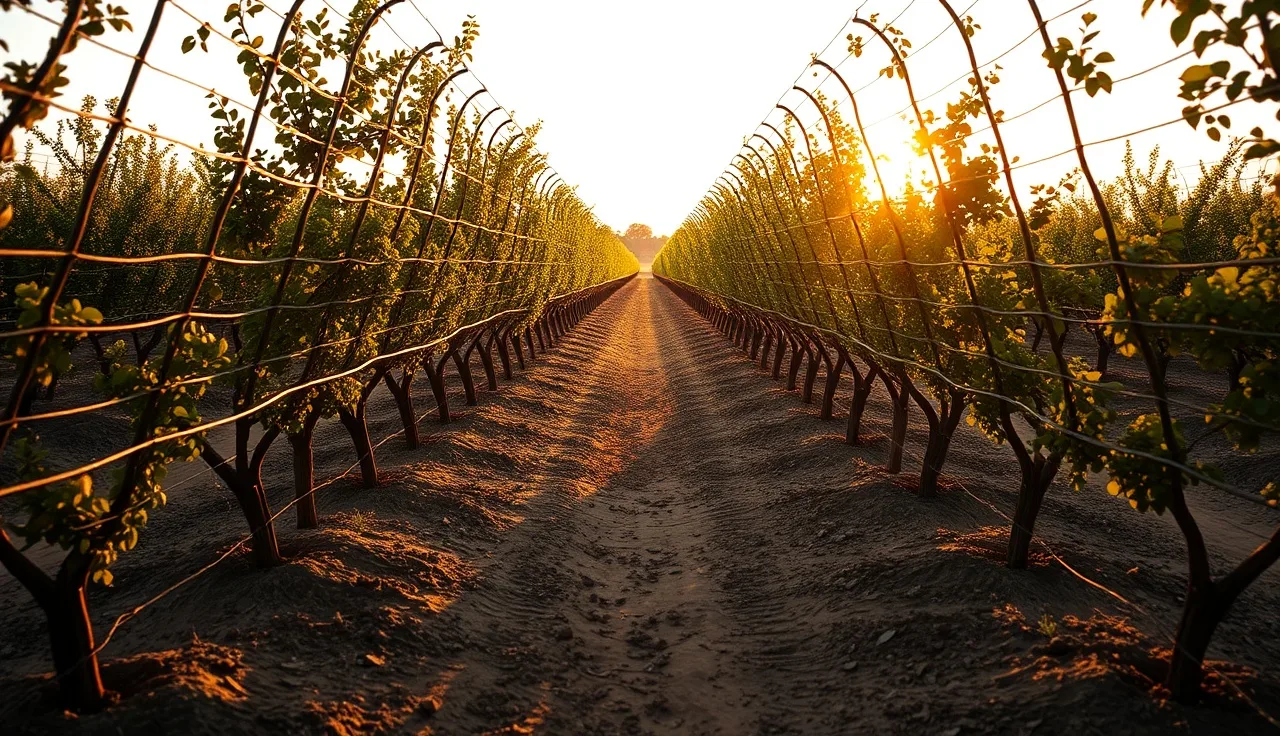
The tatura trellis is a high-density training system built around two inclined wire planes that form a shallow V when you look down the row end-on. Each row has a central post, and wires run outward and upward on both sides at roughly 60 to 70 degrees from vertical, creating two angled canopy panels rather than one flat or upright wall. Fruit hangs inside the V where it stays shaded and reachable. Most of the leaf area faces the sky on the outer surfaces.
The design came out of the Tatura Research Institute in Victoria, Australia, during the late 1960s and 1970s, first for peach and other stone fruit. The scientists there were chasing one specific problem: flat-top hedgerow systems in high-density peach blocks shaded interior wood badly, which knocked down fruit set and quality on everything except the outermost shoots. Tilting the panels toward open sky fixed that. Early trials at Tatura showed the design could push yield per hectare well above what any single-plane system could reach at the same tree spacing [1].
The system spread to apple and pear production in Australia and New Zealand through the 1980s. Winemakers in warm Australian regions started adapting it for Shiraz and Cabernet in the 1990s. In North America, extension programs at UC Davis and Cornell have cited inclined-panel and split-canopy systems as the conceptual family the tatura belongs to, alongside the Scott Henry and the lyre [2][8].
How does the tatura trellis system actually work?
Picture a fence post driven into the ground. From the top, two arms extend outward at opposing angles, like a very flat letter V. Wires are stapled or clipped to those arms at multiple heights, usually three to five wire levels per side. Trees or vines go in a single row down the center, trained so half the fruiting wood climbs one inclined panel and half climbs the other. From above, the finished canopy is a long narrow ribbon. From the end of the row, it is that open V.
The geometry does two things at once. Each panel faces the sun at an angle closer to perpendicular than a vertical cordon wall would, so more photons hit the leaf surface per unit of land, especially in the morning and late afternoon when vertical walls sit nearly edge-on to the sun [1]. Separating the two halves also opens a gap down the center of the row that lets air move and spray get in, which a dense single-plane system chokes off.
In vineyards, shoots get trained onto the inclined wire planes as they grow, and lateral shoots fill the panels. At harvest the fruit zone sits along the inside face of each panel, above the soil and below the heaviest leaf canopy. That keeps it in a moderate microclimate: more heat than deep shade gives, less sunburn risk than full exposure. CSIRO researchers have noted that this positioning matters in warm climates, where direct sun can overcook berry temperature and drop anthocyanin accumulation [9].
What yield and quality results does research actually show?
Results vary a lot by crop, site, and how well the system is managed, but the direction is steady: inclined-panel systems like tatura beat central-leader and flat-top systems in high-density settings when the training is dialed in.
For peaches, the Tatura Research Institute published data showing yield improvements of 30 to 60% over conventional open-vase systems at the same plant population, with most of the gain coming from better light distribution through the canopy rather than tree density alone [1]. That range is wide for a reason. The upper end needs consistently good dormant pruning and summer training. Blocks managed the same way you would manage an open-vase orchard never capture the full benefit.
Wine grapes are more nuanced. Split-canopy systems in general, including the lyre and tatura adaptations, tend to raise yield per vine over a simple VSP (vertical shoot positioning) cordon, but the more useful finding from Australian research is what happens to fruit composition. Work summarized by the Australian Wine Research Institute found that grapes from well-managed divided-canopy systems showed better color, lower pH at the same sugar reading, and more even ripening across the bunch than grapes from overcrowded VSP rows [4]. Whether that makes better wine is harder to prove, but the fruit chemistry data are real.
Here is the number that actually drives photosynthesis efficiency: the ratio of leaf area exposed to direct sun against total leaf area. A single VSP cordon in a vigorous site might have only 40 to 50% of its leaves genuinely exposed. A tatura-style inclined panel in the same block can push that above 80%. Any system that separates two fruiting planes moves that ratio in the right direction [8].
How is the tatura trellis system used in peach and other stone fruit?
Peach is where the tatura trellis started and where it has the most proof behind it. Stone fruit trained to tatura goes in at roughly 1,000 to 2,500 trees per hectare depending on rootstock and vigor, far tighter than traditional orchard spacings but workable because the V-canopy keeps interior light acceptable even at those densities [1].
Training starts in year one. You let a single leader grow to about 60 to 80 cm, then select two scaffold branches and tie them to the outward wires on each inclined panel. From year two on, you renew fruiting wood every year along those panels. The goal is a flat, open surface of one-year-old wood facing the sky. Because peaches fruit on last year's wood, keeping that surface is the whole job. Experienced growers will tell you tatura makes renewal pruning more systematic, because the panel geometry shows you visually where wood is drifting too far from the wire and needs cutting back.
Nectarines, plums, and apricots have all been trialed on tatura frames with results close to peach. Cherries are trickier because of vigor and the longer unproductive juvenile stage, but some Australian and New Zealand growers have made it work. The one requirement for every stone fruit is that you commit to the pruning regime from day one. A tatura block that gets two or three seasons of sloppy training turns into a tangle that is harder to fix than a conventional block.
How do you set up the physical infrastructure for a tatura trellis?
The post and wire infrastructure is heavier than a standard VSP grape trellis, and that is where most of the capital cost sits. End posts are substantial, typically 150 to 200 mm diameter timber or the steel equivalent, because they anchor the tension of multiple angled wire runs on both sides of the row. Intermediate posts go in every 6 to 8 meters and carry the two arm assemblies that splay outward.
The arms, sometimes called crossarms or spreaders, are the defining structural element. They usually span 1.2 to 1.8 meters total and angle upward from horizontal at about 30 to 45 degrees to set the panel inclination. Make them from timber, steel angle, or purpose-built galvanized brackets. The original Tatura design used simple timber arms bolted to the post top. Commercial suppliers in Australia now sell steel assemblies that mount partway up the post rather than at the top, which lowers the center of gravity and cuts wind load.
Wire gauge matters here more than on a vertical trellis. The inclined panels catch more lateral wind load because each panel presents a bigger surface perpendicular to the prevailing wind. Most specifications call for 2.5 mm high-tensile wire on the main fruiting wires and 3.15 mm on the bottom load-bearing wires. Total wire per hectare runs high: budget roughly 1.5 to 2 times the wire cost of a single-plane cordon system [5].
Contract the install to someone who has built inclined-panel trellises before. Getting the arm angle consistent down a long row is harder than it looks. Even a 5-degree wobble between posts changes the panel inclination enough to create uneven canopy development, and fixing that after the vines or trees are in the ground is a miserable job.
What does it cost to install a tatura trellis system?
Tatura-specific cost data is hard to find in North American sources because the system is far more common in Australia. Estimates from Agriculture Victoria put total trellis infrastructure, including posts, arms, wires, anchors, and labor, at roughly AU$15,000 to $25,000 per hectare for new stone fruit blocks. The range comes down mainly to post material and whether the land is already clear [5].
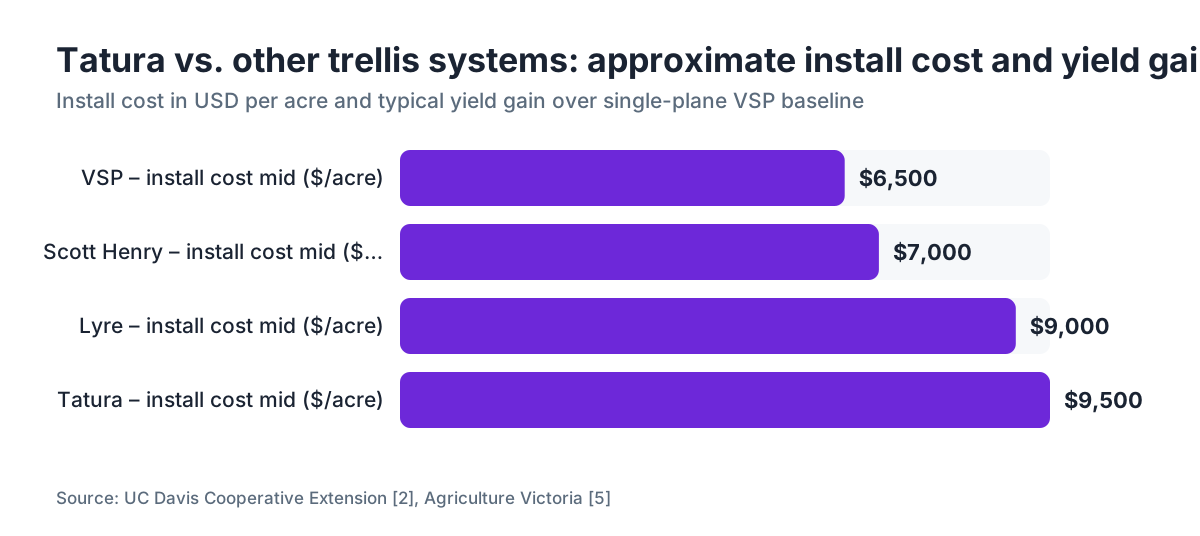
For grape vineyards in North America borrowing the inclined-panel approach, UC Davis Cooperative Extension publishes cost-of-production studies for various trellis systems. Their VSP baseline runs about $5,000 to $8,000 USD per acre for trellis and vine establishment combined, and more complex divided-canopy systems add 30 to 50% to the trellis component alone [2]. A tatura-style system in a California vineyard would likely land at $7,000 to $12,000 USD per acre for infrastructure depending on labor rates and materials.
The payback math turns on whether you can actually capture the yield and quality premium the system offers. A commercial peach grower with access to premium fresh-market channels often justifies the infrastructure cost inside five to eight years of full production. A small winery vineyard already capped by processing capacity is a different story: building tatura infrastructure to grow 40% more fruit you cannot crush is a bad investment. Be honest about your bottleneck before you commit.
| System | Approx. install cost (USD/acre) | Canopy planes | Typical yield gain vs. VSP |
|---|---|---|---|
| VSP (vertical shoot positioning) | $5,000 to $8,000 | 1 vertical | baseline |
| Scott Henry | $5,500 to $8,500 | 2 vertical (split) | 15 to 30% |
| Lyre / U-trellis | $7,000 to $11,000 | 2 inclined | 20 to 40% |
| Tatura | $7,000 to $12,000 | 2 inclined | 30 to 60% |
Sources: UC Davis Cooperative Extension [2], Agriculture Victoria [5]
What are the spray and worker safety implications of a tatura trellis?
The inclined-panel geometry gives you a real spray penetration advantage over a dense vertical hedge. Because the two panels sit physically apart down the center of the row, a sprayer can aim nozzles at each panel face from a closer effective distance, and the open gap lets air-blast sprayers push material through from both directions at once in some configurations.
Worker protection is where growers sometimes overthink it. Under the EPA's Worker Protection Standard (WPS), the compliance obligations do not change with trellis type: restricted-entry intervals, labeling requirements, and PPE apply identically whether you are working a VSP block or a tatura block [6]. What changes is the physical access pattern. Pruning and training crews in a tatura system usually work from a ladder or platform in the row middle, reaching outward to both panels. That affects how you document worker entry timing after an application and how PPE fits the working posture.
Make sure your spray records capture the specific blocks sprayed, product applied, rate, equipment used, and wind conditions. California's Department of Pesticide Regulation requires application records to be kept for a minimum of two years, and some products carry longer retention rules [7]. Washington State has similar retention requirements through its Pesticide Management Division. The shape of your trellis does not change any of that, but a new or unusual system sometimes leads growers to assume different rules apply. They do not. Same rules, different geometry.
Record-keeping software like VitiScribe can log applications per block and flag re-entry intervals automatically, which matters when workers move between conventionally trellised and tatura blocks on the same day.
How does the tatura trellis compare to other split-canopy systems?
The tatura, the lyre, and the Scott Henry are all divided-canopy systems, but they attack the light interception problem in different ways. The Scott Henry splits shoots vertically: half trained up, half trained down, using the same wire infrastructure as VSP plus catch wires for the downward shoots [8]. It is the cheapest split-canopy upgrade because it often only needs added wire on an existing trellis. The penalty is that downward shoots tend to be weaker, and the system demands careful shoot selection every season.
The lyre is the tatura's closest relative. Both use two inclined wire planes forming a V or U. The lyre tends to spread wider at the top, almost a wide U, while tatura panels are narrower and steeper. Alain Carbonneau developed the lyre in France, and it has a strong research base in European wine regions [4]. In high-vigor sites the lyre's wider gap is an advantage. In lower-vigor sites that gap stays too open and you get holes in the canopy instead of useful light interception.
Tatura's edge over the lyre in stone fruit is that the narrower panel angle puts fruit in a very predictable position for mechanical harvesting. Several Australian peach growers have adapted over-the-row harvesting equipment to tatura blocks, which is much harder with the wider lyre geometry.
For grapes, the honest comparison: tatura costs more than Scott Henry and runs about level with lyre, but it gives you a more rigid, defined canopy geometry that is easier to manage consistently once established. Moderate vigor and you want a cheap fix? Scott Henry. High vigor and planting a new block from scratch? Tatura or lyre earns its keep.
What are the main management challenges with the tatura trellis system of training?
The tatura trellis system of training is unforgiving if you skip a season of good pruning. Because the panels are defined geometric planes, any shoot that grows past the wire boundary either collapses the panel geometry or starts shading the interior. In a conventional open-vase or VSP block you can get away with a mediocre year and recover. In tatura, wood that grows out of plane during one season takes two seasons of corrective pruning to bring back into shape.
Labor is the second big challenge. Training crews need to understand the geometry well enough to make real-time calls about which shoots to keep and which to strip. In regions where experienced viticultural labor is hard to find, tatura blocks often drift into inconsistent training that erodes the very benefits the system promises. Cornell's viticulture extension has noted that the biggest predictor of divided-canopy success is not trellis design but training consistency across the workforce [8].
Wind damage is a real risk at establishment. Until the canopy fills in enough for the shoots on both panels to brace each other, a young tatura block is exposed, because the inclined wires and arms present more wind load than a vertical trellis. On exposed sites, hold off positioning young shoots onto the wires until late spring, so they are more lignified when the main wind events hit.
In vineyards especially, shoot positioning eats more time per unit of canopy area than VSP, because you are working two angled planes instead of one vertical one. Budget your labor accordingly. The yield gain rarely comes for free.
Is the tatura trellis right for your vineyard or orchard?
Here is the short version. High inherent vine or tree vigor, a warm climate, and a new block going in? Tatura is worth serious consideration. Retrofitting an existing block? The cost and disruption make it very hard to justify unless the existing trellis is at end of life anyway.
The system was built for conditions where canopy density is your limiting factor for fruit quality and yield. In a low-vigor, cool-climate vineyard where VSP already gives you a thin, well-exposed canopy, adding inclined panels is an expensive answer to a problem you do not have. UC Davis viticulture extension makes this point in their canopy assessment guides: measure your existing canopy density first, using the point-quadrat method or a visual read against the Ravaz index, before you assume a trellis change will help [2].
If you do need the system, the best preparation is standing in an established tatura block in your region before you commit a dollar. Vineyards in warm interior California zones like Paso Robles have experimented with divided-canopy systems that share tatura's geometry, and wine-growing areas in Paso Robles have growers who can speak to real-world performance in a continental-ish climate. Australian extension resources from Victoria are still the most detailed practical guide to the mechanics.
Track everything from the moment the first post goes in: vine or tree performance per block, yields at harvest, fruit quality metrics, spray timing and coverage, and labor hours by operation. You cannot make a rational call on whether the system delivered without those records. A vineyard management platform makes that longitudinal tracking manageable without extra paperwork, and VitiScribe's block-level record structure maps naturally onto multi-trellis operations where you want to compare tatura blocks against VSP controls on the same property.
What do extension programs say about adopting tatura for wine grapes?
Here is the honest summary of where North American extension programs stand: interested, cautiously positive, and short on long-term data from North American sites specifically.
UC Davis, through Foundation Plant Services and the Cooperative Extension viticulture team, has published widely on canopy management and divided-canopy systems, generally framing tatura-style inclined-panel designs as the high-input, high-reward end of the spectrum. Their cost-of-production studies for wine grapes include line items for alternative trellis systems that capture some tatura-like infrastructure costs [2]. What they have not published, as of recent review, is a multi-year trial named as a tatura trial in California wine grapes. The Australian data is what gets cited.
Cornell's viticulture extension, covering the northeast and the Finger Lakes, has detailed publications on Scott Henry and other divided-canopy systems but treats tatura as a related concept rather than a primary recommendation for northeast conditions. Their reasoning is practical: the system was optimized for warm, high-vigor sites, and many northeast vineyards run moderate or even low vigor that does not need the full tatura investment [8].
WSU's Viticulture and Enology program, working with Washington and Oregon conditions, has published canopy management guidelines that discuss inclined-panel systems in the context of managing high-vigor Columbia Valley sites. Their guidance matches the Australian data: in vigorous, warm sites the investment makes agronomic sense, and in moderate sites simpler divided-canopy approaches capture most of the benefit for less money [8].
The collective takeaway from extension sources is not that tatura is unproven. It is that the extension community wants growers to match system intensity to site conditions instead of chasing a headline yield number.
Frequently asked questions
What is the tatura trellis system in simple terms?
The tatura trellis is a V-shaped training frame where two inclined wire panels extend outward from a central post. Trees or vines are trained so half the fruiting wood grows up each angled panel. The geometry increases the proportion of the canopy exposed to direct sunlight compared to a flat or vertical system, which improves both yield and fruit quality in vigorous, high-sunshine growing conditions.
Where was the tatura trellis developed?
It was developed at the Tatura Research Institute in Victoria, Australia, during the late 1960s and 1970s. The institute's focus was high-density stone fruit production, particularly peach. The V-panel design came out of trials aimed at solving the interior shading that plagued conventional flat-top hedgerow systems at the plant densities researchers were targeting.
How much does a tatura trellis cost to install?
Australian estimates from Agriculture Victoria put tatura infrastructure at roughly AU$15,000 to $25,000 per hectare for stone fruit blocks. Adapted for North American wine grape vineyards, using UC Davis cost-of-production benchmarks as a guide, a tatura-style inclined-panel system runs about $7,000 to $12,000 USD per acre, compared to $5,000 to $8,000 for standard VSP. The higher cost comes from heavier posts, crossarms, and more wire per row.
Is the tatura trellis system good for wine grapes?
It works best in high-vigor, warm-climate vineyard blocks where canopy density is limiting fruit quality. The inclined panels improve light interception and air circulation, which Australian research links to better berry color, lower pH at the same sugar level, and more uniform ripening. In low-vigor or cool-climate sites where VSP already produces a thin, well-exposed canopy, tatura adds cost without a meaningful agronomic benefit.
How does the tatura trellis compare to the lyre trellis?
Both use two inclined wire planes in a V or U shape. The lyre, developed in France, tends to be wider at the top and is more common in European wine regions. The tatura has narrower, steeper panels, which positions fruit more precisely and suits mechanical harvesting in stone fruit better. In high-vigor vineyard sites both systems perform comparably; tatura's geometry is slightly more structured and consistent once established.
Can you convert an existing vineyard to tatura?
Technically yes, but it is rarely worth it unless your existing trellis infrastructure is at end of life. Retrofit means removing or replacing posts and adding crossarm assemblies, which brings significant disruption to established vines. The economics only pencil out if the new system will be in place long enough, typically 15-plus years, to recover the installation cost through improved yield and quality premiums.
How many wires does a tatura trellis use?
A typical tatura trellis uses three to five wires per inclined panel, so six to ten wires total per row. The bottom wire on each panel is load-bearing, typically 3.15 mm high-tensile. Upper fruiting and training wires are usually 2.5 mm high-tensile. Total wire per hectare runs roughly 1.5 to 2 times the wire requirement of a single-plane VSP cordon, which is a meaningful material cost difference.
What is spray coverage like in a tatura trellis block?
Spray penetration is generally better in tatura than in a dense vertical hedge because the two separated panels create a center gap that lets air-blast material move through the canopy from both directions. Nozzles can be aimed at each inclined panel face at an angle closer to perpendicular, which improves coverage of the inner surface. Worker Protection Standard re-entry intervals and record-keeping requirements stay identical to any other trellis configuration.
What is the correct panel angle for a tatura trellis?
Most specifications call for each panel to be inclined at roughly 60 to 70 degrees from vertical, or equivalently 20 to 30 degrees from horizontal. The crossarms extend outward at 30 to 45 degrees from horizontal depending on the arm design. Consistent arm angle down a long row matters: even 5-degree variation between posts causes uneven canopy development that compounds as the planting matures and is hard to correct without structural changes.
How long until a tatura trellis block reaches full production?
For peach and stone fruit, a tatura block typically reaches commercial production in years three to four after planting, similar to other high-density systems. For wine grapes, full canopy development and reliable yield data usually show up in years four to five. The first two years are entirely about getting the scaffold established on the panels correctly. Any temptation to rush production at the expense of training quality costs you several years of poor canopy later.
Does the tatura system require special harvesting equipment?
For stone fruit, the tatura system was designed with mechanization in mind. Over-the-row harvesting machines can be adapted to straddle the defined V-panel geometry, and this is one of the system's commercial selling points in Australian peach production. For wine grapes, standard over-the-row mechanical harvesters need some adaptation for the inclined panel width. Hand harvesting works without modification, though workers reaching into the panel from the row center use a slightly different posture than in VSP rows.
What record-keeping do I need for a tatura trellis vineyard?
Record-keeping for tatura blocks is identical to any other vineyard configuration: pesticide applications with product, rate, timing, and equipment; Worker Protection Standard compliance documentation; and harvest records by block. California's Department of Pesticide Regulation requires spray records for a minimum of two years, and Washington's Pesticide Management Division has similar retention rules. Keeping block-level performance records, yield per acre and fruit quality metrics, from establishment helps you judge whether the system is delivering its expected return.
Is tatura used outside Australia?
Yes, though it stays most established in Australian and New Zealand stone fruit and grape production. New Zealand kiwifruit growers have used tatura-derived inclined-panel systems. European wine regions have applied similar geometry under different names, most notably in warm Spanish and Italian growing zones. In North America the system exists as an adaptation used by individual growers in California and the Pacific Northwest, but it has not reached the widespread adoption it has in Australia.
What are the labor requirements for tatura versus VSP?
Tatura needs more pruning and training labor per acre than VSP, mainly because workers manage two inclined panels instead of one vertical plane and because the system is less forgiving of sloppy work. Australian grower surveys have estimated tatura pruning labor at 1.3 to 1.6 times that of conventional systems at comparable vine or tree numbers. Whether that labor premium is justified depends entirely on the yield and quality premium you actually capture.
Sources
- Agriculture Victoria (Department of Energy, Environment and Climate Action), Tatura Research Institute publications on high-density stone fruit: Tatura trellis yield improvements of 30 to 60% over conventional open-vase stone fruit systems; inclined panel geometry developed at Tatura Research Institute in the late 1960s, 1970s
- UC Davis Cooperative Extension, Winegrape Cost and Return Studies and canopy management publications: VSP trellis installation benchmarks of $5,000, $8,000 USD per acre; divided-canopy systems add 30 to 50% to trellis costs; canopy assessment using point-quadrat method and Ravaz index
- Australian Wine Research Institute, Canopy management and divided-canopy research summaries: Grapes from well-managed divided-canopy systems showed improved color, lower pH at equivalent sugar reading, and more uniform ripening compared to overcrowded VSP; Lyre system developed by Alain Carbonneau in France
- Agriculture Victoria, Horticulture industry cost benchmarks for trellis infrastructure: Total tatura trellis infrastructure installation estimated at AU$15,000, $25,000 per hectare for new stone fruit blocks in Victoria
- US EPA, Worker Protection Standard for Agricultural Pesticides: Worker Protection Standard restricted-entry intervals, labeling requirements, and PPE requirements apply uniformly regardless of trellis system or training method
- California Department of Pesticide Regulation, Pesticide use reporting and record-keeping requirements: California requires pesticide application records to be maintained for a minimum of two years; some products require longer retention
- Cornell Cooperative Extension / New York State IPM, Viticulture and canopy management publications for northeast vineyards: Cornell extension treats tatura as a high-input, warm-climate system; Scott Henry and simpler divided-canopy approaches capture most benefit in moderate-vigor northeast sites at lower cost; training consistency predicts divided-canopy success
- CSIRO, Plant Industry research on canopy microclimate and berry temperature in warm-climate vineyards: Inclined-panel canopy microclimate positioning keeps fruit above the soil and below the heaviest leaf canopy, moderating berry temperature and reducing anthocyanin degradation risk in warm climates
Last updated 2026-07-10