Temperature thresholds to record before sulfur application in vineyards
TL;DR
- Do not apply sulfur when air temperature is at or above 90°F (32°C), or when it will reach that within 24 hours of spraying.
- Record ambient air temp at canopy height, canopy surface temp if you have an IR gun, and the forecast high before every application.
- Most extension guidance flags a caution zone starting at 85°F.
- Log date, time, product, rate, and applicator name to meet EPA Worker Protection Standard rules.
Why does temperature matter so much for sulfur applications?
Sulfur is the oldest fungicide in viticulture and one of the easiest to wreck a block with on a hot day. The chemistry is simple. Elemental sulfur volatilizes into sulfur dioxide gas faster as temperature rises, and grapevine tissue takes that gas in through its stomata. Past a certain point the plant can't detoxify it fast enough. You get phytotoxicity: bleached or scorched leaves, defoliation, and in bad cases shoot dieback that sets your crop back weeks.
The number most extension programs put on it is 90°F (32°C). UC Davis and Washington State University Extension both treat 90°F as the hard stop for wettable sulfur and dust on grapevines [1][2]. Some labels drop the caution line to 85°F. That's the number I'd use on young vines or thin-skinned varieties like Chardonnay and Pinot Noir.
Timing changes the math too. Applying at 7 a.m. when it's 72°F feels safe. But if the canopy hits 91°F by 1 p.m. and sulfur residue is still sitting on the leaves, you can still burn. That's why the forecast high matters as much as the reading on your thermometer at spray time.
What specific temperatures should you record before applying sulfur?
Record three numbers before you pull the trigger on any sulfur application. Ambient air temperature at spray time, the forecast high for the day, and the canopy surface temperature if you own an infrared thermometer. Those three cover you agronomically and on compliance.
Here's what each one is:
- Ambient air temperature at the time of application, taken at canopy height, not from your truck cab or a weather station three miles away
- The forecast high for the application day, plus the following 24 hours if residual activity is a concern
- Canopy surface temperature from an IR thermometer, especially on days with strong sun and no wind
Ambient air temperature is the standard compliance record and the first number a PCA or inspector asks for. Canopy temperature can run 5 to 10°F above ambient on a calm, sunny day [3], so an 83°F ambient reading with no wind may already put your leaf surface in the caution zone. That gap is real and it bites people.
To satisfy the EPA Worker Protection Standard (WPS), the minimum logged data per application is date and time, product name and EPA registration number, target pest, application method, rate per acre, total area treated, and the applicator's name [4]. Temperature isn't a WPS-mandated field on its own. It still belongs in your records for liability, label compliance, and your own agronomic review at season's end.
Some state pesticide regulators go further. The California Department of Pesticide Regulation requires licensed applicators to keep use records that include weather conditions at the time of application, and temperature is part of that [5]. Check your state's specific rule, because this varies.
What is the safe temperature range for sulfur use on grapevines?
The consensus safe window is 50°F to 85°F (10°C to 29°C), with the widest agreement on never exceeding 90°F [1][2]. Below 50°F sulfur loses its punch because it won't volatilize fast enough to knock down powdery mildew spores. So the window has a floor and a ceiling.
WSU Extension puts it plainly in its powdery mildew guide: applications made between 60°F and 90°F are most effective and least likely to cause phytotoxicity [2]. Below 60°F you're not hurting the vine. You may just be wasting product.
Here's the practical breakdown:
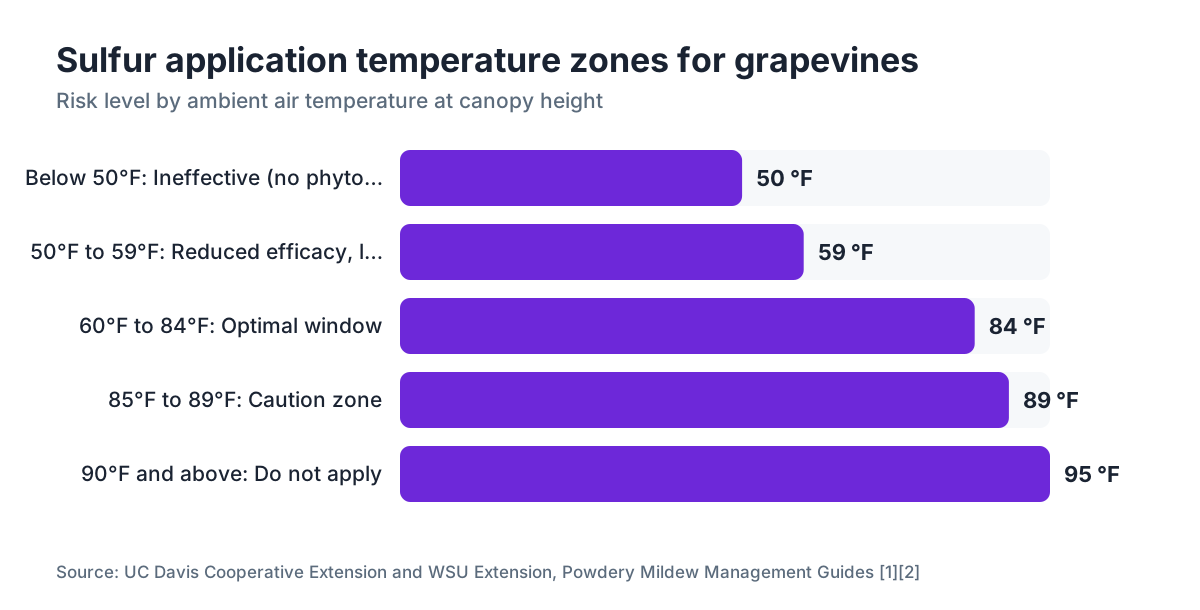
| Air Temperature | Application Status | Notes |
|---|---|---|
| Below 50°F | Not recommended | Sulfur efficacy drops sharply |
| 50°F to 59°F | Use with caution | Reduced efficacy, no phytotoxicity risk |
| 60°F to 84°F | Optimal window | Best efficacy, lowest burn risk |
| 85°F to 89°F | Caution zone | Some labels restrict here, check the forecast |
| 90°F and above | Do not apply | High phytotoxicity risk, label violation on most products |
| Forecast high 90°F+ within 24 hrs | Do not apply | Residual sulfur can still burn at peak heat |
That 85°F to 89°F caution zone is where most real-world burn happens. An applicator sees 82°F in the morning, feels fine, and never checks the afternoon spike. Record the forecast. It's a five-second step that has saved more than a few blocks of Cabernet.
Does the type of sulfur product change the temperature thresholds?
Yes, and a lot of growers get this wrong. Wettable sulfur (WP) and liquid flowable formulations are generally more phytotoxic in heat than dust, because their surfactants and spreader-stickers hold the product tight against leaf tissue and slow the dissipation that would otherwise cut exposure [1]. Micronized wettable sulfur has the finest particle size and can be the most phytotoxic of the wettable powders.
Dust sulfur, applied by air blast or duster, has long been seen as slightly more forgiving at the top of the range because it doesn't cling as hard. Most labels still carry the 90°F restriction regardless of formulation. Read your specific label. If it says 85°F, that's your limit, full stop. FIFRA makes the label the law, and a burn on an 88°F day with a product labeled at 85°F will not go your way in any enforcement or insurance conversation [9].
Organic-certified sulfur carries the same volatilization chemistry and the same burn risk. The organic label changes the approval status, not the physics. Record the same temperature data no matter the certification pathway.
How does the 24-hour forecast rule work in practice?
Most sulfur residues stay active on leaf and berry surfaces for 24 to 48 hours after application, and berry surface temperatures can run well above ambient air during that window [3]. Cornell NEWA data and extension guidance flag this post-application spike as a bigger risk than conditions at spray time itself [10]. That's the whole logic behind the rule.
Here's how to put it in your spray records. Before you spray, pull the forecast high for the application day and the next day. Log both. If either hits 90°F, hold off. If you're in the 85°F to 89°F caution zone, write down that you checked the forecast and the conditions you decided to proceed or delay under. That written note is your protection.
For block-level records I log six things: application start time, end time, ambient temp at start, ambient temp at end (matters if you're covering ground and conditions shift), forecast high for the day, and forecast high for the next day. Thirty seconds. On paper or in a spreadsheet you can build a simple header for it. In spray record software, a tool like VitiScribe prompts you for these fields so nothing gets skipped in the middle of a busy spray morning.
One thing people forget: log wind speed and direction too. Not for the temperature threshold itself, but drift risk and re-entry interval math both use it, and it rounds out your weather record.
What do EPA Worker Protection Standard records require for pesticide applications?
The EPA Worker Protection Standard (40 CFR Part 170) was updated in 2015 and requires agricultural employers to keep specific records for each pesticide application on an establishment [4]. The required fields are:
- Product name, EPA registration number, and active ingredient
- Date and time of application, plus the expected end of any restricted-entry interval
- Location description (the specific area treated)
- Application method
- Total amount of product applied
- Name of the certified applicator or the business that made the application
Weather data, temperature included, is not a WPS-required field in the federal rule. But many product labels require you to apply within specific weather conditions, and a label restriction is legally binding under FIFRA Section 12 [9]. If your label says "do not apply when temperatures exceed 90°F" and you did, you've broken federal law whether or not you wrote anything down. Recording the temperature doesn't erase a violation, but not recording it means you have no defense if one gets alleged.
WPS records must be kept for two years and provided to workers and handlers on request within 15 days [4]. Keep them organized by block and date. If a labor inspector or county ag commissioner shows up, being able to pull a clean, complete record for any block in under two minutes matters a lot.
Are there state-specific temperature recording requirements beyond federal rules?
Several states stack requirements on top of the federal WPS baseline. California is the most detailed. The California Department of Pesticide Regulation requires all licensed pest control operators and farm advisors to record weather conditions, including temperature and wind speed, at the time of any application [5]. California also requires pesticide use reports (PURs) filed monthly with the county agricultural commissioner for any licensed commercial application.
Washington requires licensed applicators to keep records for two years that include weather conditions [7]. Oregon has similar rules for commercial applicators under ORS 634.
Farming in multiple states, or working under contract growing agreements that name a specific standard, means checking each state's department of agriculture rules. The extension programs at UC Davis [1], WSU [2], and Cornell [10] publish state-specific record-keeping guides and are the best starting point for your local requirements.
One practical note. Even where your state doesn't require temperature in spray records, your crop insurance policy, your GAP audit, or your winery contract may. Read those documents. Several large California wineries now require temperature-at-application data in the records their growers submit as part of sustainability and traceability programs.
How do you measure temperature accurately at canopy height in the vineyard?
Measure at canopy height, in shade, with airflow. That sounds basic and it still trips people up. Your truck thermometer, a phone weather app, or the nearest CIMIS or AgWeatherNet station can all hand you a number that's meaningfully off from what your canopy is actually living through.
A sling psychrometer or a calibrated digital thermometer on a 4-foot stake works fine. If you rely on a weather station network, make sure the station sits in your vineyard or at least on the same valley floor or hillside. A valley-floor station can read 5 to 8°F off from a hillside block on a calm night or a hot afternoon [3].
For canopy temperature specifically, point a handheld infrared thermometer at the leaf surface and you get a real reading of what the tissue feels. IR guns run $30 to $80 at most farm supply stores and last for years. On a calm, sunny day in the mid-80s, canopy surface temperatures of 92°F to 95°F are common. Logging ambient air temp and canopy surface temp together gives you the fullest picture.
If you pull from an automated network like WSDA AgWeatherNet in Washington [7] or the California Irrigation Management Information System (CIMIS) [8], log the station ID and the reading time next to the value. That ties your on-farm number to a verified source.
What happens if you apply sulfur above the temperature threshold?
First comes phytotoxicity. Symptoms show up within 24 to 72 hours: interveinal chlorosis, marginal leaf scorch, and on berries a bleached or russeted surface that looks a bit like sunburn but more diffuse. In severe cases you get fast defoliation that exposes the cluster to direct sun, which starts its own problems.
Then comes the compliance side. FIFRA Section 12(a)(2)(G) prohibits using any pesticide "in a manner inconsistent with its labeling" [9]. If the label says not above 90°F, you applied at 93°F, and you have crop loss, you've got a documented violation. That can complicate insurance claims, create liability in a contract-growing setup, and for commercial applicators it can mean license suspension.
The honest truth is that a borderline application at 88°F usually causes no visible damage, especially with a breeze and a moving canopy. But "usually fine" is not a compliance strategy. Log the temperature, check the forecast, and delay a day if you're in the caution zone. Powdery mildew pressure doesn't spike catastrophically in 24 hours. A burned block does.
How should spray record temperature fields be structured for audits?
A spray record that survives a GAP audit, a winery contract review, or a county ag commissioner inspection has a specific shape. Here's what I include for every sulfur application, built around what's legally required plus what's agronomically defensible.
Application header (per event):
- Date
- Block ID and acreage
- Start time, end time
- Product name, EPA registration number
- Active ingredient and formulation type
- Application rate (lbs or oz per acre), total product used
- Application method (air blast, hand gun, drone, etc.)
- Target pest (powdery mildew, specifically Erysiphe necator)
- Applicator name and license number
Weather conditions (per event):
- Ambient air temperature at application start (at canopy height)
- Ambient air temperature at application end
- Wind speed and direction
- Sky conditions (clear, overcast, etc.)
- Relative humidity if available
- Forecast high for application day
- Forecast high for the following day
- Data source (on-site thermometer, weather station ID, phone app name)
This is more than federal WPS demands. It's also the kind of record that closes conversations fast. When someone questions a spray decision, you show exactly what conditions were recorded and how they compared to the label restriction.
For growers running many blocks on tight intervals, spray record software built for vineyards, like VitiScribe, bakes this temperature-logging step into each entry so it's automatic instead of one more thing to remember.
Keep records in a format you can produce quickly. Binder, spreadsheet, or software, the organization matters as much as the completeness.
Which powdery mildew timing models use temperature data that should go into your records?
If a disease model times your sulfur, the model output belongs in your spray records. It's the agronomic reason you sprayed when you did, and it beats "I thought it was time" in any audit.
The UC Davis Powdery Mildew Risk Index, built at UC Davis on Erysiphe necator infection data, tracks conducive nighttime temperatures to predict infection risk [11]. The model uses nighttime temperatures between 50°F and 77°F as its key infection range. Logging that a spray was triggered by a high-risk forecast from a validated model is far stronger documentation than a gut call.
WSU's iPM tools and the Decision Aid System (DAS) used in parts of the Pacific Northwest also run temperature-based disease models [2]. Cornell's NEWA (Network for Environment and Weather Applications) offers the same kind of tool for eastern growers [10]. All are free to access, and the temperature they use is the same temperature you should be logging.
For compliance, the simplest move is to log the model name, the risk output, and the date and time you accessed it next to your spray record. If a high-risk day on the UC index triggered a spray, write it down. It shows a rational, evidence-based decision, which is exactly what a good record is meant to capture.
Frequently asked questions
What is the maximum temperature for applying sulfur to grapevines?
Most extension programs and product labels set the maximum at 90°F (32°C). Some labels restrict use at 85°F. If temperatures will reach 90°F within 24 hours of application, hold off even when it's cooler at spray time, because sulfur residues on leaf and berry surfaces stay phytotoxic during the afternoon spike. UC Davis and WSU Extension both cite 90°F as the hard upper limit.
Does the temperature threshold change for wettable sulfur versus dust sulfur?
The same 90°F ceiling applies to both, but wettable sulfur is generally more phytotoxic in heat because surfactants keep it stuck to leaf tissue longer. Micronized wettable sulfur is the most phytotoxic at high temperatures. Always read your specific label. If it says 85°F, that's your limit regardless of formulation.
Do EPA WPS records require temperature data for pesticide applications?
Federal WPS rules under 40 CFR Part 170 don't explicitly mandate temperature as a required field. But product labels are legally binding under FIFRA, and most sulfur labels restrict applications above 90°F. Several states, including California and Washington, require weather conditions including temperature in licensed applicator records. GAP audits and winery contracts often require temperature documentation too.
How long do you have to keep vineyard spray records?
The federal EPA Worker Protection Standard requires pesticide application records to be kept for two years. California DPR requires pesticide use records retained for two years and filed monthly with the county agricultural commissioner for licensed commercial applications. Some winery contracts or organic certification programs require longer retention, so check your specific agreements.
Can canopy temperature be higher than the air temperature reading I log?
Yes, significantly. On a calm, sunny day, leaf and berry surface temperatures can run 5 to 10°F above ambient air temperature. An ambient reading of 83°F at canopy height could mean leaf surfaces are already at 91°F or higher. That's why recording a forecast high and checking wind matters, and why an IR thermometer aimed at canopy surfaces gives a fuller picture.
What records do I need if I'm applying sulfur as a licensed PCA or commercial applicator in California?
California requires pesticide use reports filed monthly with the county agricultural commissioner, plus on-site records with the date, product, EPA registration number, area treated, amount applied, and weather conditions including temperature and wind. Records must be kept two years. The county ag commissioner can request them at any time. The California DPR website has the current form requirements.
Is there a safe lower temperature limit for sulfur applications?
Yes. Below 50°F (10°C), sulfur's efficacy against powdery mildew drops sharply because it doesn't volatilize fast enough to suppress Erysiphe necator spores. Most extension guidance, including WSU's powdery mildew guide, recommends against applying below 50°F. The optimal efficacy range is 60°F to 85°F. There's no phytotoxicity risk at low temperatures, just poor disease control.
How does the 24-hour temperature forecast affect my spray record?
Log the forecast high for the application day and the following day. If either hits 90°F, delay. Sulfur residues stay active on leaf and berry surfaces for 24 to 48 hours, so a morning application at 78°F followed by a 93°F afternoon can still burn. Cornell NEWA guidance flags this post-application residue risk. Record both forecast numbers in your spray log.
What weather station sources are acceptable for temperature records in vineyard spray logs?
Any calibrated source works if you record the source name or station ID with the reading. Acceptable options include a calibrated on-site thermometer at canopy height, California CIMIS stations, WSDA AgWeatherNet stations in Washington, or NOAA-linked networks. A phone app temperature is generally not preferred for formal records because the source is often unclear. Always note which source you used.
Does sulfur applied during the caution zone (85°F to 89°F) always cause vine damage?
Not always. Whether phytotoxicity happens at 85°F to 89°F depends on wind speed, relative humidity, formulation, canopy age, and variety. Sensitive varieties like Chardonnay, Pinot Noir, and some Riesling clones burn more easily. Young shoot tissue is more vulnerable than mature leaves. The caution zone is real, but an application at 87°F with a 10 mph breeze in a thick-skinned variety often causes no visible damage.
How do I record temperature for drone applications of sulfur in vineyards?
Same fields apply: ambient air temperature at canopy height at start and end, forecast high, and wind speed. Drone applications add the wrinkle of rotor downwash affecting canopy exposure and coverage, but the temperature thresholds and recording requirements match ground rig applications. Log your drone operator's name, license if applicable, and the specific GPS blocks treated.
What temperature data do powdery mildew risk models require that I should be logging?
The UC Davis Powdery Mildew Risk Index uses nighttime temperatures between 50°F and 77°F as its primary infection-risk inputs. WSU's DAS system and Cornell NEWA use similar temperature-based infection period logic. Log the model name, date accessed, risk level output, and the temperature range it reported when you made the spray decision. That output is the agronomic justification for your timing.
Can I use a smartphone thermometer app for the temperature field in my spray records?
Technically yes, but it's weak documentation. Phone apps pull from the nearest NWS station or an interpolated grid, not from your canopy. The reading may be accurate, but if it's ever questioned you can't verify it. A $25 digital thermometer on a stake at canopy height, or a weather station in your vineyard, gives a defensible, traceable measurement. Log the source name either way.
Sources
- UC Davis Cooperative Extension, Grape Pest Management / Powdery Mildew: Optimal sulfur application temperature range of 60°F to 90°F; applications above 90°F risk phytotoxicity on grapevines
- Washington State University Extension, Grape Powdery Mildew Management: Sulfur applications are most effective and least phytotoxic between 60°F and 90°F; WSU recommends not applying above 90°F
- UC Agriculture and Natural Resources, Vineyard Microclimate and Canopy Temperature: Canopy and berry surface temperatures can run 5 to 10°F above ambient air temperature on calm, sunny days
- U.S. EPA, Worker Protection Standard (40 CFR Part 170): WPS requires records of product, EPA reg number, application date and time, location, method, rate, acreage, and applicator name; records kept two years
- California Department of Pesticide Regulation, Pesticide Use Reporting: California DPR requires licensed applicators to record weather conditions including temperature at time of pesticide application
- Washington State Department of Agriculture, Pesticide Records and AgWeatherNet: Washington State requires licensed pesticide applicators to maintain records including weather conditions for two years
- California Irrigation Management Information System (CIMIS), CDFA: CIMIS provides vineyard-zone temperature data used as a verified source for pesticide application weather records
- U.S. EPA, FIFRA Section 12 (Federal Insecticide, Fungicide, and Rodenticide Act): FIFRA Section 12(a)(2)(G) prohibits use of any pesticide in a manner inconsistent with its labeling, making label temperature restrictions legally binding
- Cornell NEWA (Network for Environment and Weather Applications): Cornell NEWA provides temperature-based powdery mildew infection period forecasts used to justify and time sulfur applications
- UC Davis, Erysiphe necator (Grape Powdery Mildew) Infection Period and Risk Index: UC Davis powdery mildew risk model uses nighttime temperatures between 50°F and 77°F as primary inputs for infection period calculation
Last updated 2026-07-11