When to take petiole samples in Chardonnay relative to bloom
TL;DR
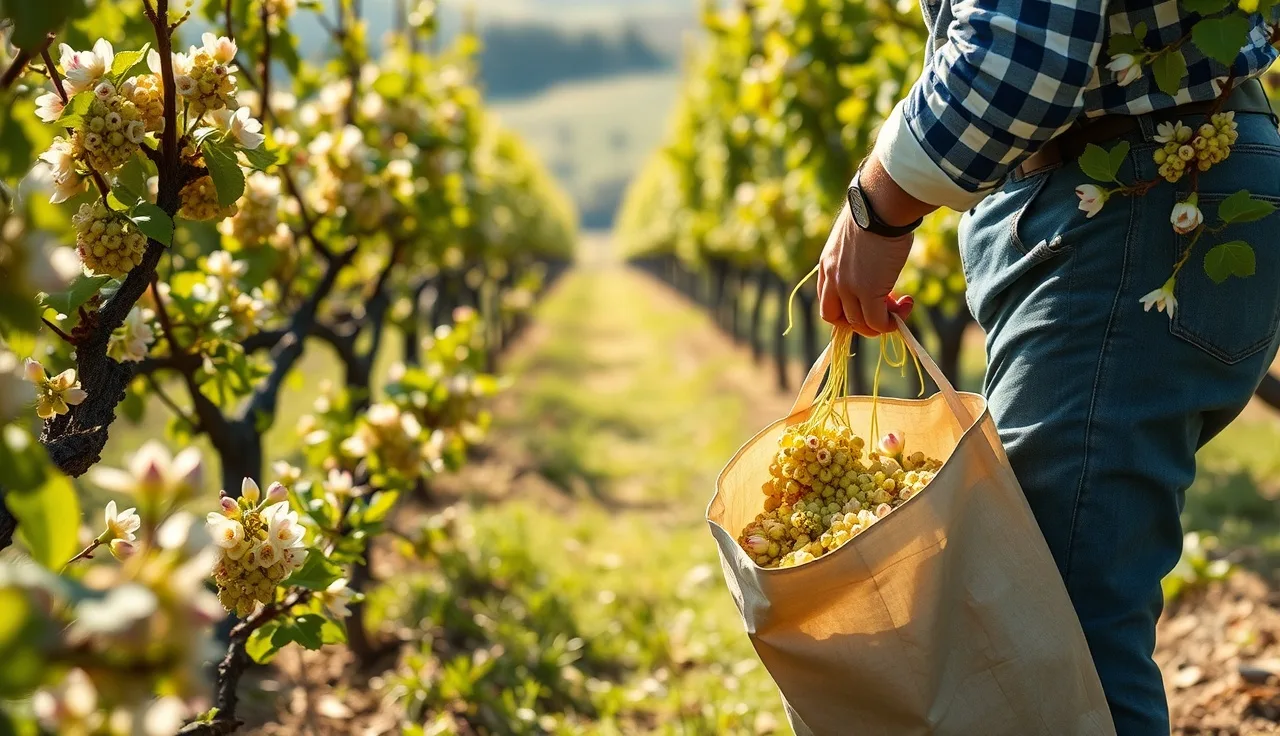
- Take Chardonnay petioles at full bloom, meaning 50 to 80% cap fall on the shoot.
- That stage usually lands 6 to 10 weeks after budbreak, and it's the one moment the numbers actually predict something.
- Sample a week early or a week late and the readings shift enough to make a healthy block look starved or a hungry block look fine.
- Full-bloom petioles give the truest read on vine nitrogen, phosphorus, potassium, and micronutrients for the season.
Why does bloom timing matter so much for petiole sampling?
Petiole sampling is one of the most useful diagnostic tools a grape grower has. The numbers mean almost nothing, though, if the tissue isn't pulled at the right growth stage. Grapevine petioles change their nutrient concentration fast as the season moves. Nitrogen dilutes quickly once vegetative growth takes off after bloom, so a sample taken a week late can read 30 to 40% lower than one taken on time, even though the vine's actual status hasn't budged [1].
Full bloom is the reference point for two reasons, one biological and one practical. At 50 to 80% cap fall, the vine is pulling hard on its reserves to feed fruit set and shoot growth at the same time. That peak-demand moment gives the clearest read on whether soil-available nutrients are truly reaching the tissue. Full-bloom petiole values track end-of-season fruit quality far better than samples taken at early shoot growth or veraison [2].
Chardonnay leaves you a narrow window. It's early-budding and early-blooming, and in a warm, dry spring bloom can come and go in 10 to 14 days. Miss it, and you wait a full year for comparable data.
What exactly is "full bloom" in Chardonnay and how do you identify it in the vineyard?
Full bloom in grapevines is Eichhorn-Lorenz (EL) stage 23, sometimes called stage 65 on the modified BBCH scale. At this point, 50 to 80% of the flower caps (calyptras) have detached from the cluster. Hold a cluster up to the light and it reads plainly: the cluster looks open, the tiny yellow-green caps are dropping or already gone, and the stamens and stigmas are exposed [3].
Chardonnay in California's coastal regions usually hits this from late May into early June. In Oregon's Willamette Valley, full bloom often falls from late June into early July [8]. In New York's Finger Lakes, expect late June. Warmer inland sites like parts of the San Joaquin Valley can bloom as early as mid-May. These are ranges, not promises. A late frost, a cold April, or a heat spike can move everything by two to three weeks.
The move that works is simple. Start walking your Chardonnay blocks weekly once you reach EL stage 19 (flowering visible), and tag a representative set of shoots in each block. When 50% of those tagged clusters show cap fall, you're in the window. Don't try to call this from your desk or from last year's calendar date.
How do you collect petiole samples correctly in Chardonnay at bloom?
The standard protocol, described in UC Cooperative Extension guidelines [1], calls for collecting the petiole (the leaf stem, not the blade) from the leaf directly opposite a flower cluster on the shoot. At bloom, that's the leaf at the same node as the cluster. Snap the petiole off cleanly at the base of the blade, not at the stem end.
Collect 70 to 100 petioles per sample for a valid composite. Go lighter than that and lab variability swamps the real differences between blocks. Sample each block or management zone on its own. Don't mix Chardonnay from your east-facing hillside with your valley-floor block. They may have different soil CEC, irrigation histories, and rootstocks, so a lumped sample describes neither one honestly.
Once collected, put samples in a clean paper bag. Skip plastic, which traps moisture and lets microbes break down nitrogen compounds. Label clearly and get them to a certified agricultural lab within 24 to 48 hours. If a delay is coming, refrigerate but never freeze. Most vineyard labs run a full panel: nitrogen, phosphorus, potassium, calcium, magnesium, sulfur, boron, zinc, iron, manganese, and copper [4].
What are the standard nutrient sufficiency ranges for Chardonnay petioles at bloom?
The table below shows widely cited sufficiency ranges for grapevine petioles sampled at full bloom. These values come from UC Cooperative Extension and are the most-used reference standard in California. Other states use similar or identical ranges [1][2].
| Nutrient | Deficient | Sufficient | Excess |
|---|---|---|---|
| Nitrogen (% dry wt) | < 0.80 | 0.80 to 1.20 | > 1.50 |
| Phosphorus (% dry wt) | < 0.10 | 0.10 to 0.50 | > 0.80 |
| Potassium (% dry wt) | < 1.00 | 1.00 to 2.50 | > 3.50 |
| Calcium (% dry wt) | < 1.20 | 1.20 to 2.50 | n/a |
| Magnesium (% dry wt) | < 0.20 | 0.20 to 0.40 | n/a |
| Boron (ppm) | < 25 | 25 to 60 | > 100 |
| Zinc (ppm) | < 20 | 20 to 50 | n/a |
| Iron (ppm) | < 30 | 30 to 200 | n/a |
These are baseline guides, not law. Chardonnay on different rootstocks takes up potassium at very different rates, so a vine on 110R in high-pH soil may read low-K on this table and genuinely not need more potassium. Read results next to your soil analysis, irrigation log, and what your eyes tell you in the canopy [2].
Nitrogen is the number most growers watch hardest. UC Davis researchers have found that Chardonnay petiole nitrogen at bloom below 0.80% dry weight lines up with reduced fruit set and a higher risk of stuck fermentations from low yeast-assimilable nitrogen (YAN) in the juice [1]. That's a wine quality problem more than an agronomy one.
How does sampling timing shift the nutrient readings, and by how much?
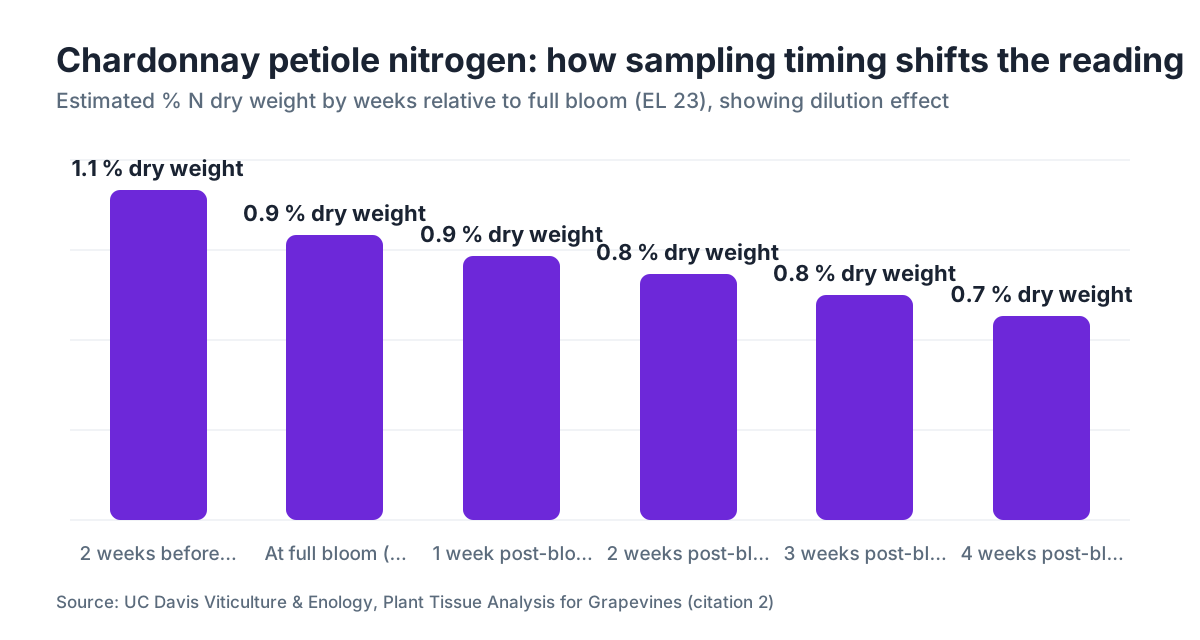
This is where precision earns its keep. A UC Davis study found petiole nitrogen in grapevines drops roughly 0.05 to 0.10 percentage points per week after full bloom as vegetative growth dilutes foliar nitrogen [2]. Chardonnay, vigorous on fertile soils, dilutes faster still. A block reading 0.95% N at full bloom might read 0.78% N just two weeks later, dropping below the deficiency threshold with no real change in the vine or the soil.
Potassium runs the other way. It climbs over the season as the vine stacks K into leaf tissue, so a late sample inflates the reading and can hide a deficiency that was real at bloom. Boron is the most timing-sensitive of all: its petiole concentration can double between bloom and veraison in some soils.
Off-timing doesn't just nudge a number. It can flip the whole interpretation, sufficient to deficient or the reverse. When a lab report fights with what you're seeing in the vineyard, check the collection timing before you blame the lab [2].
WSU Extension says it plainly in its vine nutrition guide: a one-week drift in collection timing can introduce more error than the analytical precision of the lab itself [5].
Can you use leaf blade samples instead of petioles, and when does that make sense?
Yes, and for a couple of nutrients blades are actually better. Leaf blades give steadier readings for calcium and magnesium because those elements park in the blade rather than the petiole. Petioles win for nitrogen, phosphorus, potassium, and most micronutrients, since the petiole works as a vascular highway and concentrates minerals in transit [2].
The catch is that sufficiency standards for blades differ from petiole standards. Compare a blade result against a petiole table and you'll get the wrong answer. Labs know this and should flag which tissue came in, but it's easy to grab blades one year and petioles the next, then wonder why the numbers swing year over year.
For most Chardonnay operations, petioles at bloom is the standard call from UC Davis, Cornell, and WSU Extension, and it's what most commercial labs expect [1][2][5]. If your consultant uses blades, confirm they're applying the right reference ranges and that you stay consistent year to year, or your trend data means nothing.
How many samples per block do you actually need, and how should you map a vineyard for sampling?
There's no single right answer, but Cornell Cooperative Extension recommends a minimum of one composite sample per distinct management unit, defined by the combination of variety, rootstock, soil type, and irrigation zone [4]. A 10-acre Chardonnay block on uniform soil with one rootstock needs one composite of 70 to 100 petioles. Split that same 10 acres across two soil types and two rootstocks and you're looking at four samples.
Some growers sample every other row across the block and composite those. Others walk a diagonal transect. The thing to avoid is cherry-picking. Don't pull only from vines that look great or only from vines that look stressed. The composite should stand in for the average vine in that zone.
Mark your transects with GPS or flag them in your field records so you can repeat the same pattern next year. Year-over-year trends in petiole values often tell you more than any single year's absolute number. A block where nitrogen has drifted down three years running is saying something different than a block that reads low this year after four high ones.
For tracking multi-year, multi-block sampling data cleanly, a field records platform like VitiScribe saves a lot of spreadsheet pain, especially when you're juggling collection dates, lab results, and follow-up fertilizer applications across blocks.
What should you do if you miss the full-bloom window in Chardonnay?
It happens. Bottling ate your week, or a heat event pushed bloom two weeks faster than you planned. Missing the window doesn't mean you skip tissue sampling for the year.
The next-best reference point most extension programs recognize is fruit set, roughly three to four weeks after full bloom, at EL stage 27. Sufficiency ranges for that stage are less well-characterized than full-bloom ranges, but some labs (particularly ones serving California vineyards) have built their own internal benchmarks for fruit-set petioles. Call your lab before submitting and ask which reference ranges they apply to off-standard timing.
Veraison is another secondary window, used more for monitoring potassium and magnesium heading into harvest. UC Cooperative Extension viticulture guidelines include veraison sufficiency ranges, though they're used less for in-season corrective action because the window for any foliar or fertigation response is short [10].
Miss full bloom entirely and the honest move is to document it clearly ("collected at fruit set, 3 weeks post-bloom") so you never compare that year's numbers against bloom-time values from other years. Mixing reference points in one trend dataset is a classic way to draw the wrong conclusion from tissue analysis.
How do petiole sample results connect to fertilizer and foliar spray decisions?
A petiole result is only worth as much as the action it triggers. If nitrogen comes back deficient at full bloom, your realistic options depend on your irrigation system. Fertigating through drip with a soluble nitrogen source (usually calcium nitrate or urea ammonium nitrate) can move the needle within two to three weeks. Foliar urea at 10 to 20 lbs per acre in water, sprayed in the early morning to avoid burn, is another common tool and can raise YAN in the juice, which matters for fermentation management [6].
Potassium deficiency at bloom is harder to fix mid-season because K demand is high and drip correction takes multiple applications over weeks. Some growers reach for potassium sulfate foliar sprays as a stop-gap. Iron chlorosis, if that's what shows up, almost never gets fixed mid-season and usually points to a soil pH problem that needs a longer amendment plan.
Micronutrient shortfalls (boron, zinc) are often corrected with foliar sprays at or just after bloom. Boron at 0.25 to 0.5 lbs per acre as Solubor, applied at 10 to 20% bloom, can improve fruit set when a test confirms deficiency [1]. Never apply boron on a hunch. Excess boron is toxic to grapevines and the gap between sufficient and phytotoxic is thin.
Check pesticide and fertilizer label language before any foliar application near bloom, and mind EPA Worker Protection Standard requirements for restricted-entry intervals if any foliar products go on around the same time your sampling crew is in the vineyard [7].
How does petiole sampling fit into a full-season vineyard nutrition program?
Most well-run programs pull petioles at full bloom and take a soil sample in late fall or winter, before the season starts. Together they give you one picture of what's in the bank (soil) and one of what the vine can actually reach (petiole). Matching those two datasets is where the interpretive skill lives.
Some growers add a veraison petiole pull to watch potassium and catch magnesium issues that could hurt berry quality or next year's reserve carbohydrate loading. It's not universal and it adds cost (commercial petiole panels run roughly $25 to $60 per sample depending on the lab and the panel [4]), but for higher-value Chardonnay blocks it often pays.
Year over year, the trend data becomes your best asset. A block sitting at 0.95% petiole nitrogen for four years, then 0.82% this year, tells you to look at what changed: cover crop competition, a shift in irrigation timing, a new rootstock block coming into production and drawing more nitrogen. The number alone doesn't tell you why. It tells you where to look.
For growers running multiple vineyard blocks across different soils and varieties, tracking all of this across seasons is real work. A digital field records system helps, particularly one that lets you attach lab PDFs to block records and set date-based reminders for sampling windows.
Are there differences between regions in how petiole sampling timing is managed?
The phenological reference point (full bloom, EL stage 23) is the same everywhere. The calendar date and the logistics differ a lot by region.
In California's North Coast (Napa, Sonoma), Chardonnay bloom usually lands between late May and early June, often overlapping with powdery mildew spray programs and creating scheduling pressure. Washington's Columbia Valley Chardonnay usually blooms in late June, buying growers a little calendar room but tightening the run to harvest. Oregon's Willamette Valley, which grows a good deal of Chardonnay, sees bloom from late June into early July most years [8].
Cornell's program at the New York State Agricultural Experiment Station has published bloom timing data for Finger Lakes Chardonnay going back decades, and it shows bloom shifting earlier by roughly one week per decade since the 1980s [9]. If your region's historical bloom dates from the extension service are 10 to 15 years old, they may run systematically too late.
That's why phenological scouting, actually walking blocks weekly and recording bloom stage, beats historical calendar averages. Your own multi-year block records are the most accurate predictor of when your specific vineyard will hit full bloom in any given year.
How do you find a certified lab for petiole analysis and what should you ask them?
Most states with real wine grape acreage have several certified agricultural labs that handle petiole analysis. In California, labs like A&L Western Laboratories, Waypoint Analytical, and the UC Davis Plant & Soil Laboratory get regular use from commercial vineyards. In the Pacific Northwest, Northwest Agricultural Consultants and similar regional services are established. In the East, Cornell's Nutrient Management Spear Program maintains a list of certified labs in the Northeast [4].
Before your first sample, ask the lab three things. Which reference ranges do they apply for grapevine petioles at full bloom (and confirm they distinguish full-bloom from veraison ranges). What's their turnaround, and is it fast enough to act on (standard is 5 to 7 business days, and some offer 2 to 3 day rush processing for a fee). Can they flag samples submitted outside the standard bloom window so the interpretation accounts for timing.
Keep a copy of every lab report, labeled by block, date collected, and phenological stage at collection. That record matters for your own trend analysis and for any third-party audits, like certified sustainable winegrowing programs, that may ask for evidence of your nutrition monitoring [7].
Track your sample submissions alongside your spray records in your field operations log. VitiScribe's record-keeping module holds exactly this kind of dated, block-specific data next to your other compliance records, which pays off when audit season arrives.
Frequently asked questions
What bloom stage is correct for petiole sampling in Chardonnay?
Full bloom, defined as 50 to 80% cap fall on flower clusters, which corresponds to Eichhorn-Lorenz stage 23 (BBCH stage 65). This is the reference point used by UC Cooperative Extension, Cornell, and WSU Extension for grapevine petiole sampling. Sampling outside this window shifts nutrient readings enough to invalidate comparisons against published sufficiency ranges.
How early or late can you collect petioles and still get valid results?
Most extension programs accept samples from 10% cap fall (early bloom) through 80% cap fall. Beyond that, you're in post-bloom territory and the nitrogen and potassium readings start drifting meaningfully. If you're more than a week past full bloom, document the exact phenological stage at collection and tell your lab so they can apply the right context to their interpretation.
How many petioles do you need per sample?
UC Cooperative Extension recommends 70 to 100 petioles per composite sample. Fewer petioles raise the chance that natural within-block variability or lab analytical variability masks real nutrient differences. Each composite should represent one distinct management zone, defined by variety, rootstock, soil type, and irrigation unit.
Which leaf do you pull the petiole from at bloom?
Pull the petiole from the leaf directly opposite a flower cluster on the same shoot, at the same node as the cluster. Remove the petiole by snapping it from the blade at the blade's base, not at the cane. Don't include the leaf blade in a petiole sample; the two tissue types have different nutrient concentrations and different sufficiency benchmarks.
What does a low nitrogen petiole reading at bloom mean for Chardonnay wine quality?
UC Davis research links petiole nitrogen below 0.80% dry weight at full bloom to reduced fruit set and lower yeast-assimilable nitrogen (YAN) in the juice. Low YAN is a primary risk factor for stuck or sluggish fermentations. If you see low petiole N at bloom, a foliar urea application or fertigated nitrogen before veraison can improve both vine performance and fermentation outcomes.
How much does a petiole analysis cost?
Commercial labs generally charge $25 to $60 per sample for a full nutrient panel covering macro and micronutrients. Rush processing typically adds $15 to $25. For a small Chardonnay operation with three or four distinct management zones, annual sampling costs usually stay well under $300. That's modest next to the cost of a mis-applied fertilizer program.
Can you take petiole samples the same day you spray fungicides or foliar fertilizers?
No. Wait at least 7 to 10 days after any foliar application before collecting petioles. Surface residues of fungicides, sulfur, copper, or foliar nutrients can contaminate the tissue sample and produce artificially high readings for copper, sulfur, or applied micronutrients. The goal is to measure what the vine absorbed through the roots and vascular system, not what's sitting on the surface.
Do petiole sufficiency ranges differ for Chardonnay versus other white varieties?
The published UC Cooperative Extension sufficiency ranges for bloom-stage petioles are generally applied across Vitis vinifera white varieties. Chardonnay isn't typically treated separately from Sauvignon Blanc or Pinot Gris in these tables. Rootstock has a larger effect on nutrient uptake than variety, particularly for potassium. Always weigh rootstock when interpreting results, especially in high-pH soils.
How far in advance should you schedule lab submission to get results before bloom ends?
Standard lab turnaround is 5 to 7 business days. If you want results while bloom is still in progress (giving you time to act on anything urgent like a boron spray), schedule your first collection at 10 to 20% cap fall and submit immediately. For most mid-season corrective actions, results delivered within two weeks of full bloom are still actionable.
Should you sample different rootstocks in the same Chardonnay block separately?
Yes. Different rootstocks have substantially different nutrient uptake efficiencies, particularly for potassium. A Chardonnay block split between 110R and SO4 may show very different potassium readings in petioles even if soil K is uniform. Composite samples that mix rootstocks give you an average that describes neither section accurately. Sample them separately and compare.
What is the best way to preserve petiole samples before shipping to the lab?
Use paper bags, not plastic. Paper lets moisture escape, which slows microbial breakdown of nitrogen compounds during transport. Label clearly with block name, collection date, and phenological stage. If you can't ship the same day, refrigerate samples at 35 to 40 degrees F. Don't freeze. Most labs ask that samples arrive within 24 to 48 hours of collection for the best analytical accuracy.
How does climate variability affect when Chardonnay reaches full bloom?
Bloom timing can shift 2 to 4 weeks earlier or later with spring temperatures, particularly heat accumulation between budbreak and bloom. Cornell research documented about one week of calendar advancement per decade in Finger Lakes Chardonnay since the 1980s. Historical average bloom dates may therefore run systematically early relative to current conditions. Weekly phenological scouting beats calendar-based scheduling.
Can you use a refractometer or any field tool to verify bloom stage without counting caps?
Not directly. Bloom stage is confirmed visually by observing cap fall on flower clusters. Some growers use degree-day models (base 10 degrees C) to predict bloom timing, which can narrow your scouting window, but the models give a range, not a precise date. The only reliable confirmation is standing in front of a cluster and observing how many caps have fallen. Mark representative shoots at early flowering so you're watching consistent reference points.
Sources
- UC Cooperative Extension, Grapevine Nutrition and Fertilization: Petiole nitrogen below 0.80% dry weight at full bloom correlates with reduced fruit set and increased stuck fermentation risk; boron at 0.25 to 0.5 lbs/acre at bloom can improve fruit set if deficiency is confirmed; standard bloom-stage petiole sufficiency ranges for N, P, K, Ca, Mg, and micronutrients.
- UC Davis Viticulture & Enology, Plant Tissue Analysis for Grapevines: Full-bloom petiole values correlate better with end-of-season fruit quality metrics than samples from early shoot growth or veraison; petiole nitrogen drops 0.05 to 0.10 percentage points per week after full bloom due to vegetative dilution; petioles are preferred over blades for N, P, K, and micronutrients.
- UC Davis Viticulture & Enology, Grapevine Phenology (Eichhorn-Lorenz Scale): Full bloom in grapevines corresponds to EL stage 23 / BBCH stage 65, defined as 50 to 80% cap fall on flower clusters.
- Cornell Cooperative Extension, Nutrient Management Spear Program, Vineyard Nutrition: Minimum 70 to 100 petioles per composite sample recommended; one composite per distinct management unit; commercial petiole panels cost roughly $25 to $60 per sample.
- Washington State University Extension, Grapevine Nutrition and Vineyard Fertilization: A one-week drift in petiole collection timing can introduce more error than the analytical precision of the laboratory; WSU applies the same full-bloom reference point for Pacific Northwest Chardonnay.
- UC Cooperative Extension, Foliar Nitrogen Applications in Vineyards: Foliar urea at 10 to 20 lbs per acre applied in early morning can raise yeast-assimilable nitrogen (YAN) in juice and improve fermentation outcomes when applied after a low-N petiole reading at bloom.
- EPA Worker Protection Standard for Agricultural Pesticides (40 CFR Part 170): EPA Worker Protection Standard requires compliance with restricted-entry intervals for any pesticide or foliar application; documentation of spray and tissue sampling records may be reviewed during certified sustainable winegrowing audits.
- Oregon State University Extension Service, Grapevine Nutrition in Oregon Vineyards: Willamette Valley Chardonnay typically reaches full bloom from late June into early July in most years.
- New York State Agricultural Experiment Station (Cornell), Long-term Phenological Records, Finger Lakes Viticulture: Finger Lakes Chardonnay bloom timing data collected over decades shows a measurable earlier-shift trend of roughly one week per decade since the 1980s.
- UC Cooperative Extension, Veraison and Bloom Petiole Sampling Protocols: UC Cooperative Extension publishes veraison sufficiency ranges as a secondary sampling window, primarily for monitoring potassium and magnesium, distinct from the full-bloom primary window.
Last updated 2026-07-11