Triple rinse procedure for pesticide containers: how to do it right and what records you need
TL;DR
- Triple rinsing a pesticide container means filling it about a quarter full with water, shaking hard for 30 seconds, draining the rinsate into your spray tank, and repeating for three cycles total.
- Done right, it removes more than 99.9% of the residue.
- Federal and state law require you to document each rinse event: the product, container count, date, and where the rinsate went.
What is the triple rinse procedure and why does it matter?
Triple rinsing is the federally recognized way to decontaminate an empty pesticide container before you recycle or throw it out. The EPA defines an empty nonrefillable container as one that's been triple rinsed or pressure rinsed and drained, per 40 CFR Part 165 [1]. Skip it, and the container still legally holds pesticide. Toss it in with ordinary trash and you can trigger a RCRA violation.
For a vineyard, the reason is practical before it's legal. A one-gallon jug of a concentrated fungicide like mancozeb still holds roughly 3 to 6 mL of product after you pour it out. Run that across a season of 50 or 100 jugs and you've got a real amount of active ingredient heading for your dumpster or recycle bin. Triple rinsing pulls that residue back into your mix tank, cuts your disposal liability, and in most states is the minimum step before a container qualifies for an agricultural container recycling program.
The procedure is fast. Once you know it, figure about two minutes per container. The record takes another 60 seconds. There's no good reason to skip either one.
What are the exact steps for triple rinsing a pesticide container?
The EPA and most state lead agencies recognize this sequence, which also matches the guidance from the Pesticide Educational Resources Collaborative (PERC) [2]:
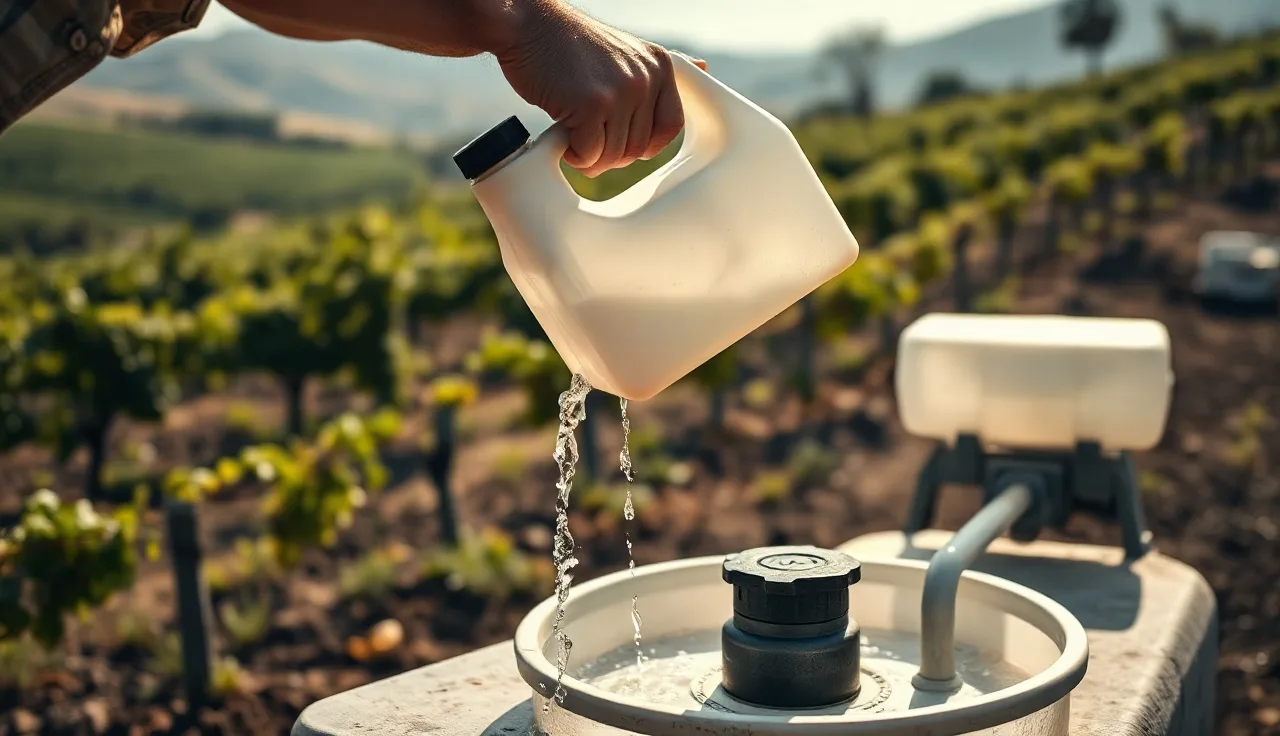
- After pouring out the last of the concentrate, add clean water equal to about 10 to 25 percent of the container's volume. UC Cooperative Extension recommends roughly one-quarter full as a working target [3].
- Cap the container and shake or roll it hard for at least 30 seconds so the water touches every interior surface.
- Pour the rinsate into the spray tank you're already filling. This is legal and encouraged, because it uses up the diluted residue on a registered use site.
- Let the container drain fully, spout down, for at least 30 seconds.
- Repeat steps 1 through 4 two more times, for three cycles total.
- After the third drain, mark the container as triple rinsed (many recycling programs hand out stickers or want a hole punched in the bottom) and set it aside for collection.
A few field notes. Cold water works fine; use whatever's on hand. Don't rinse over your mixing pad drain unless that drain runs to a contained area, because even one cycle's worth of rinsate can turn into a runoff problem. If a product is registered for fertigation or chemigation, confirm the label allows rinsate in the tank. Most do. The label governs.
Pressure rinsing with a built-in nozzle (typically 40 PSI for at least 30 seconds while you rotate the container) is an accepted alternative and is generally more thorough [2]. If your sprayer has a built-in rinsing probe, use it.
Does triple rinsing actually remove enough pesticide residue?
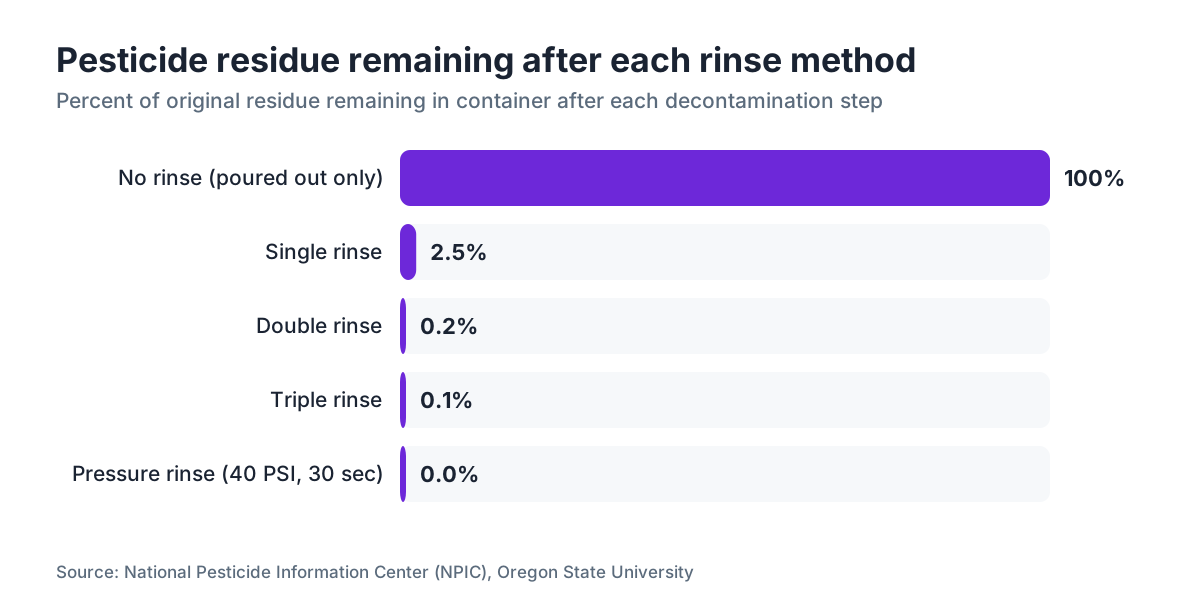
Yes, and the numbers back it up. Research cited by the National Pesticide Information Center found triple rinsing cuts container residue by 99.9 percent or more compared with containers that are just poured out and tossed [4]. A single rinse gets you to roughly 97 to 98 percent removal. The second and third rinses each drop the remaining fraction by about another order of magnitude.
Pressure rinsing edges out triple rinsing by a small margin in lab conditions. For field compliance, that difference is too small to matter. Both methods are listed as equivalent in 40 CFR 165.3 [1].
Where the method fails is technique, not chemistry. The three usual mistakes: not letting the container drain long enough between cycles, using too little rinse water (a splash is nowhere near 10 to 25 percent of volume), and cutting the shake short. Thirty seconds sounds trivial. In practice it feels long. Time it once with your phone and you'll see why people rush it.
What records are legally required for pesticide container rinsing and disposal?
Federal rules come from two directions: the Federal Insecticide, Fungicide, and Rodenticide Act (FIFRA) and, for commercial applicators, the EPA Worker Protection Standard. Most states add their own layer on top.
Under FIFRA and 40 CFR Part 165, container disposal records are required for containers of 5 gallons or larger that held a pesticide classified as a hazardous waste under RCRA [1]. For smaller containers, federal law doesn't mandate a formal disposal log, but it does require the container be rendered empty (triple rinsed or pressure rinsed) before disposal.
Commercial applicators have more to track. The EPA requires private and commercial applicators to keep application records for Restricted Use Pesticides (RUPs) for two years under 40 CFR 171 and state law [5]. Those records must include the EPA registration number, total amount applied, date, location, and certified applicator name. Several states, California among them, require RUP application records for three years [6]. Because the container disposal and the application are the same transaction, your application record doubles as your primary proof the container was properly emptied.
Some state programs and recycling programs (like those run by state ag departments or contracted disposal firms) want a separate container disposal manifest or collection receipt. In California, the Department of Pesticide Regulation (CDPR) requires container disposal records be kept and available for inspection [6]. Washington's WSDA has similar retention rules [7].
The record you actually need, at minimum, covers these fields:
| Field | What to record |
|---|---|
| Date | Date containers were rinsed and set aside |
| Product name | Full label name and EPA Reg. No. |
| Container size | Gallons or liters |
| Number of containers | Count for that product and date |
| Rinse method | Triple rinse or pressure rinse |
| Rinsate disposition | Added to spray tank, contained waste, etc. |
| Disposal method | Recycling program name, landfill receipt, etc. |
| Applicator/operator | Name of person who performed the rinse |
Keep those records for at least three years as a safe baseline regardless of state. Some federal audits look back that far, and several states now match that window.
Where can empty triple-rinsed pesticide containers be legally disposed of?
Once properly triple rinsed, a nonrefillable pesticide container is no longer regulated as a hazardous waste under federal law, per 40 CFR 261.7 [1]. That opens up a few channels.
Agricultural container recycling programs are the cleanest option. The Agricultural Container Recycling Council (ACRC) coordinates a national network of collection events and year-round drop sites [8]. Most programs take containers from 1 quart to 265 gallons. You'll need to show the container is triple rinsed (hole punched in the bottom in many programs), and some want the original label intact.
Sanitary landfill disposal is allowed in most states for triple-rinsed containers under a size threshold, typically under 5 gallons for non-RCRA-regulated pesticides. Check with your county waste authority. Some flatly prohibit pesticide containers even when empty.
Refillable or returnable containers are a separate category. Those go back to the dealer or registrant. They aren't yours to rinse and discard.
Never burn a pesticide container. FIFRA prohibits it regardless of rinse status, and burning creates dioxin and other combustion byproducts depending on the formulation [2].
How does California's triple rinse rule differ from federal requirements?
California builds on the federal baseline in a few real ways. CDPR requires that all pesticide containers, including general use pesticide containers, be triple rinsed or pressure rinsed before disposal [6]. The federal rule carves out exemptions below certain thresholds. California's rule is broader.
CDPR also requires county agricultural commissioner reports for every pesticide application on any commercial agricultural operation, RUP or not [6]. Those monthly use reports function as your primary disposal documentation, because they capture the amount used, which maps to your container count. Keep them three years.
The California program treats containers returned to dealers differently from those dropped at county collection events. Either way, records of the transfer, including a receipt from the collection point, satisfy the disposal documentation requirement.
Running a vineyard in California? The simplest system is to log container counts on your spray record the same day you mix the tank, note that you triple rinsed, then batch your containers to the county collection event and keep the receipt.
What records does the EPA Worker Protection Standard require related to pesticides and containers?
The Worker Protection Standard (40 CFR Part 170) governs worker safety around applications on agricultural establishments, and it touches container management indirectly [9]. WPS requires pesticide safety information, including product labels, be available to workers and handlers. That obligation runs as long as the pesticide is on the establishment, which ends once containers are properly disposed of.
More directly, WPS requires application records be kept for two years, covering the product, date, time, location, and re-entry interval (REI) [9]. Those records implicitly document when containers were used and therefore when they needed rinsing. A WPS inspector will cross-check application records against container disposal records if both get requested.
EPA compliance data shows container disposal is one of the more common technical violations found during WPS inspections. Usually it isn't because people are dumping improperly. It's because the rinsate destination never got documented [9]. Writing "rinsate added to spray tank" on your spray record takes five seconds and closes that gap.
What records does Cornell or WSU extension recommend for small vineyard operations?
Cornell Cooperative Extension and Washington State University Extension have both published pesticide record-keeping guides, and their advice runs more practical than the regulatory minimum.
Cornell's Pesticide Management Education Program recommends a single-page application log that captures product name, EPA Reg. No., application date, target pest, acres treated, rate, total product used, REI, and applicator signature [10]. Cornell specifically suggests adding a "container disposition" column to that same log, so rinsing gets documented as part of the application workflow instead of a separate task that gets forgotten.
WSU Extension advises vineyard managers to track container count alongside product volume, because an auditor can verify your records by matching volume purchased (dealer invoices) against volume used (application logs) against container count [12]. Use 3 gallons of product A, show 3 one-gallon containers rinsed and recycled, and the math closes. When the numbers don't match, that's a red flag in an inspection.
If you're running more than a handful of products across a season, a digital spray log that auto-calculates container counts by product saves real time. Software like VitiScribe is built around this kind of linked record, tying the spray event to the container count, rinse notation, and disposal method in one entry. A paper log works too. The format matters less than filling it out on the day you spray.
What are the penalties for improper pesticide container disposal or missing records?
Penalties vary by state and by whether the violation is administrative or criminal. Under FIFRA, civil penalties for record-keeping violations can reach $5,500 per violation per day under Section 14(a)(1), with criminal penalties for knowing violations up to $25,000 and one year in prison [11]. States can add their own penalties under their pesticide control laws.
In practice, a first-offense administrative violation for record-keeping gaps (incomplete or improperly retained records, not missing ones) often ends in a warning and a corrective action order rather than a fine, especially for small operations. Improper disposal of containers that still hold residue is treated more seriously and can bring RCRA enforcement alongside FIFRA.
CDPR has assessed fines from a few hundred dollars for minor record-keeping lapses to tens of thousands for improper disposal of containers with real residue [6]. Washington's WSDA runs a similar tiered structure [7].
The risk for a typical vineyard isn't catastrophic. The real cost of poor records shows up in inspection delays, reconstructing records from dealer invoices, and the occasional fine. The cost of good records is close to zero once the habit sticks.
How should you store and organize pesticide container records?
Keep your container disposal records with your application records. They're the same transaction, and auditors expect to find them together. Binder, cloud folder, or field operations software, the structure is the same: spray event, then within that record the product used, containers generated, rinse method, and disposal.
Three years is the safe retention window. Some states require two years. A few require four for RUPs. Nobody requires less than two. Store records so you can pull them by date and by product name, because inspections often open with "show me all your applications of product X in the last 24 months."
Receipts from container recycling or collection programs are your proof of proper disposal. Scan or photograph them the day of the event. They're paper, they fade, and collection events happen once or twice a year, so the gap between the event and a possible inspection can run into years.
Managing records across multiple vineyard blocks or ranch parcels? Tag each spray record with the block or parcel ID. This is the single most common gap WSU Extension reports finding: records exist but can't be matched to a specific field location [12].
For cutting the administrative load across a full season, the VitiScribe platform links container counts directly to spray event records, so the rinse notation and disposal method live in the same entry as the application rate and REI.
Can you recycle pesticide containers and what programs exist for vineyards?
Yes. The Agricultural Container Recycling Council runs the largest network of agricultural container recycling programs in the United States [8]. ACRC member programs operate in most major wine grape states, including California, Washington, Oregon, New York, and Texas.
The typical ACRC-affiliated program accepts:
- Plastic containers from 1 quart to 265 gallons (no bags, box liners, or aerosol cans)
- Containers that have been triple rinsed or pressure rinsed
- Containers with the original label still attached
- Containers with the cap removed and a hole punched in the bottom (proof they've been drained)
Some programs are free. Some charge a small per-container fee. Most run as annual or semi-annual collection events coordinated through county farm bureaus or agricultural commissioners. The ACRC website has a program finder by state [8].
In California, contracted disposal firms run container collection events in many agricultural counties in partnership with CDPR. In Washington, the WSDA coordinates events through county conservation districts [7]. Cornell's guidelines note that New York's agricultural container program handles millions of containers a year through a similar county-level structure [10].
Miss a collection event, and most states have year-round drop-off sites at ag retailers or co-ops. Ask your pest control adviser (PCA) or county ag commissioner's office for the nearest one.
Frequently asked questions
How long do you have to shake a container during triple rinsing?
At least 30 seconds of hard shaking per rinse cycle. That's longer than it sounds. The point is to get water onto every interior surface, including corners, seams, and the area around the bung. Time it once with a phone if you're unsure. After draining, hold the container spout-down for another 30 seconds so residual liquid runs out before the next cycle.
Does triple rinsing apply to pesticide bags, boxes, and water-soluble packets?
No. Triple rinsing applies to rigid plastic and metal containers. Bags, fiber drums, cardboard boxes, and water-soluble packaging follow different disposal rules. Water-soluble packets dissolve in the tank and leave no container residue. Bags and fiber containers may be shaken out and disposed of as solid waste per the label, but they aren't triple rinsed the way jugs and drums are.
Can I pour pesticide rinsate down a drain or into a field furrow?
No. Rinsate goes into your spray tank to be applied as part of a registered use. Pouring it down a drain can trigger Clean Water Act violations. Discharging it to a field outside a registered application is also illegal. If you can't add rinsate to a tank (say the application is finished), store it in a labeled container until it can be used or taken to a hazardous waste facility.
Do triple rinse records need to include the applicator's certification number?
For Restricted Use Pesticides, yes. Federal and most state RUP records must include the certified applicator's name and certification number. For general use pesticides, most states require the applicator's name but not necessarily the certification number. California and Washington require the PCA's name and license number on commercial agricultural application records regardless of RUP status. Check your state's specific rule.
How many times do you actually need to rinse? Can two rinses be enough?
Three is the legal minimum for the container to count as "empty" under 40 CFR 165. Two rinses remove roughly 98 to 99 percent of residue, which sounds sufficient but doesn't meet the regulatory definition. Do two rinses, and if an inspector asks for your disposal records you've got a compliance gap regardless of the residue percentage. Three rinses take about 60 extra seconds. Do three.
What happens if I accidentally disposed of a container without triple rinsing it?
Stop the practice and document what happened. If the container went to an agricultural recycling program, contact the program to see if it's retrievable. If it went to a landfill, document the error and your corrective actions. For RCRA-regulated pesticides the exposure is greater, so consult your state ag commissioner or a licensed environmental consultant. For most general use pesticide containers, a documented corrective action and a change in practice is the typical resolution.
Are 55-gallon drums handled differently than smaller containers for triple rinsing?
The same three-cycle requirement applies, but the mechanics differ. Large drums are usually rinsed with a drum-rinsing wand or pressure rinser rather than shaking. Rinse water still needs to be 10 to 25 percent of container volume, so a 55-gallon drum needs 5 to 14 gallons per cycle. Many agricultural recycling programs handle drums but want pre-scheduling because of transport logistics.
How long do I need to keep pesticide application and container disposal records?
At minimum, two years under federal FIFRA requirements. Several states, California included, require three years. Washington requires two years for most records and longer for certain RUP categories. Using three years as your standard window covers all state requirements and most federal audit lookback periods. Records for containers tied to RCRA-regulated pesticides may need to be kept longer, up to five years in some states.
What is the difference between triple rinsing and pressure rinsing for pesticide containers?
Both are legally equivalent methods for rendering a container empty under 40 CFR 165. Triple rinsing is done manually with water and shaking. Pressure rinsing uses a built-in nozzle probe at 40 PSI for at least 30 seconds while rotating the container over the tank opening. Pressure rinsing is faster for high-volume operations and marginally more thorough by some studies, but either method meets the regulatory standard.
Do I need to keep records of container disposal if I use only general use pesticides?
Federal law doesn't explicitly require a formal container disposal log for general use pesticide containers that aren't RCRA-hazardous. But many states do require it, and your application record (which you should keep anyway) is the practical equivalent. California requires container disposal records for all commercial agricultural pesticide containers regardless of classification. When in doubt, keep the record. It costs almost nothing and closes compliance gaps.
Can triple-rinsed containers go into regular recycling or curbside bins?
Generally no. Even triple-rinsed pesticide containers aren't accepted in most municipal curbside recycling programs because of contamination concerns at the sorting facility. They belong in agricultural container recycling programs, not general recycling streams. Some rural solid waste authorities make exceptions for very small containers (under one quart) of certain low-toxicity pesticides, but confirm with your county waste authority before putting them in a blue bin.
What should a pesticide spray log entry look like to satisfy container disposal requirements?
A compliant entry includes: date, block or field location, product name and EPA registration number, formulation and rate, total volume applied, total volume of product used (which tells you how many containers were emptied), number of containers rinsed, rinse method (triple or pressure), rinsate destination (added to spray tank, for example), disposal method (county collection event, receipt number), REI, and applicator name. One line per product per application event is the standard format.
Where can I find agricultural container recycling collection events near my vineyard?
The Agricultural Container Recycling Council (acrecycle.org) has a program locator by state. Your county agricultural commissioner's office usually has a list of local collection dates. In California, CDPR maintains a list of collection events by county on its website. In Washington, the WSDA coordinates events through county conservation districts. Your pest control adviser or ag retailer is often the fastest source of local event dates.
Does the EPA Worker Protection Standard say anything about pesticide container handling?
WPS (40 CFR Part 170) requires application records be kept for two years and pesticide safety information be available to workers and handlers. It doesn't include detailed container rinsing requirements, but it does require pesticide labels be followed, and labels almost universally specify triple rinsing. Failure to triple rinse is therefore a label violation, which is a FIFRA violation, and can be cited during a WPS inspection if container disposal practices are reviewed.
Sources
- EPA, 40 CFR Part 165 (Pesticide Management and Disposal): A container is considered empty under federal law only after triple rinsing or pressure rinsing; 40 CFR 261.7 exempts triple-rinsed containers from hazardous waste regulations.
- Pesticide Educational Resources Collaborative (PERC), Container Disposal Guidance: Triple rinsing procedure: add 10-25% water, shake 30 seconds, drain into spray tank, repeat three times; pressure rinsing at 40 PSI for 30 seconds is an accepted equivalent.
- University of California Cooperative Extension, Pesticide Application and Safety: UC Cooperative Extension recommends filling containers approximately one-quarter full with water for each triple rinse cycle.
- National Pesticide Information Center (NPIC), Oregon State University: Triple rinsing reduces pesticide container residue by 99.9 percent or more compared to containers that are simply poured out.
- EPA, 40 CFR Part 171 (Certification of Pesticide Applicators) and Pesticide Recordkeeping: The EPA requires private and commercial applicators to keep application records for Restricted Use Pesticides for two years, including EPA registration number, total amount applied, date, location, and certified applicator name.
- California Department of Pesticide Regulation (CDPR), Pesticide Use Reporting: California requires that all commercial agricultural pesticide containers be triple rinsed before disposal and that pesticide container disposal records be retained for three years and available for inspection.
- Washington State Department of Agriculture (WSDA), Pesticide Management: WSDA requires pesticide application records for commercial agricultural operations to be retained for two years; container recycling events are coordinated through county conservation districts.
- EPA, 40 CFR Part 170 (Worker Protection Standard): WPS requires pesticide application records to be kept for two years and mandates that pesticide labels, which specify triple rinsing, be followed by all agricultural handlers.
- Cornell University Cooperative Extension, Pesticide Management Education Program: Cornell recommends including a container disposition column in pesticide application logs and tracking container count alongside product volume to allow record verification against dealer invoices.
- EPA, FIFRA Section 14 (Civil and Criminal Penalties): FIFRA Section 14(a)(1) allows civil penalties up to $5,500 per violation per day for record-keeping violations; criminal penalties for knowing violations reach $25,000 and one year imprisonment.
- Washington State University Extension, Small Farm Pesticide Record Keeping: WSU Extension advises matching container count against product volume used and dealer invoices as a cross-check; missing field location tags are the most common gap found during record inspections.
Last updated 2026-07-09