UAV vineyard spraying: what actually works in the field
TL;DR
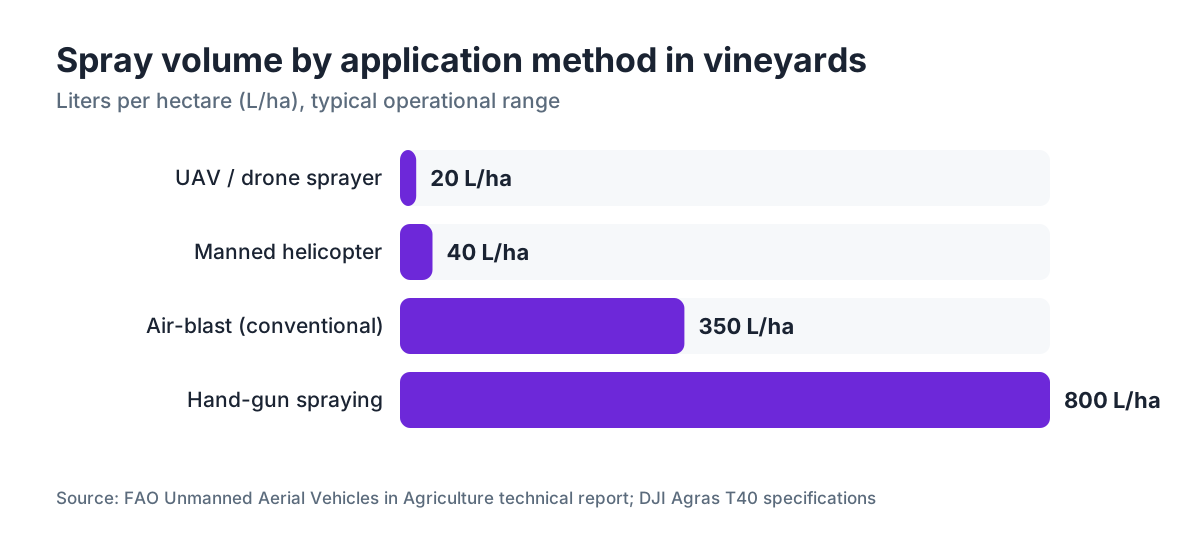
- UAV spraying uses agricultural drones to apply pesticides, fungicides, and foliar nutrients at 10 to 30 liters per hectare, against 200 to 600 liters for a tractor rig.
- Field trials show 30 to 90% less water and comparable coverage in moderate canopy.
- Steep terrain and narrow rows are where drones earn their keep.
- You need an FAA Part 107 certificate, pesticide applicator licensing, and EPA WPS compliance no matter who flies.
What is UAV vineyard spraying and how does it actually work?
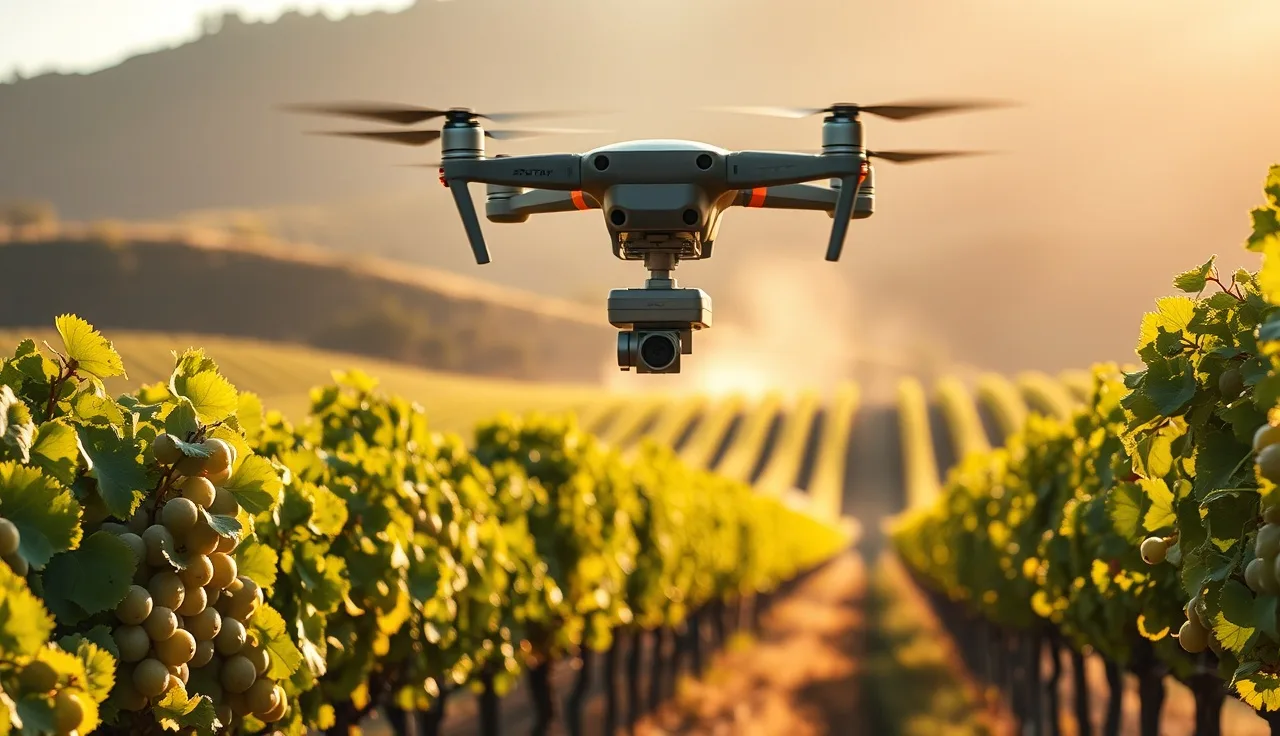
A UAV sprayer is a multirotor drone carrying a 10 to 40 liter tank. It flies 2 to 5 meters above the canopy and pushes spray down through the rotor wash. That downdraft is the reason the physics differs from a boom sprayer or an air-blast unit. Rotor turbulence drives droplets into the canopy and onto the underside of leaves, where Botrytis and powdery mildew pressure starts. Does that penetration match a well-calibrated air-blast rig? The literature still argues about it, and any honest consultant will tell you the answer swings with canopy density.
The workflow is simple. You import a field boundary or fly a mapping pass, the mission software calculates flight lines at a set overlap and altitude, and the drone runs the block automatically while you watch from the edge. Most commercial platforms throttle the application rate to match ground speed, so when the drone slows around a headland the nozzles slow with it. Rates run 10 to 30 L/ha on most platforms. A conventional air-blast sprayer runs 200 to 600 L/ha. [1]
DGPS-guided flight gives 10 to 30 cm positioning accuracy. That matters in narrow-row Pinot Noir or vertical shoot positioned Chardonnay, where boom clearance is genuinely tight. Wide rows with bilateral cordons cover easily. Tight, high-trained VSP canopies are harder and often need a second pass or a different nozzle setup.
Two platform families dominate North American vineyards right now: the DJI Agras series (the T40 and T50 are the current flagships) and the XAG P series. Smaller U.S.-built options exist, but they hold a tiny slice of the commercial market today. Payload, battery endurance, and swath width vary enough between models that you should run a side-by-side efficacy trial in your own blocks before you sign a platform purchase or a service contract.
Where do drones outperform traditional sprayers in vineyards?
Steep hillside blocks are the clearest win. Tractor access on slopes above roughly 30 percent grade is dangerous, and many California and Oregon AVAs post blocks off-limits to wheeled equipment above 15 to 20 degrees. A drone doesn't care. You stand at the road, the machine works the hillside, and your own exposure to drift drops compared to running an air-blast rig upslope from yourself.
Narrow inter-row spacing is the second strong case. Some older European-style plantings in California and the Pacific Northwest have rows under 1.5 meters apart. No conventional sprayer gets in there without canopy damage or soil compaction on wet ground. A small multirotor with a 1.2-meter frame flies those corridors, though coverage uniformity suffers and you may need to drop altitude and speed to hold it.
The third case is speed on large, flat, open blocks. A single high-payload drone (the DJI T40 at a 40 kg tank) covers roughly 40 to 80 acres per day depending on field shape, obstacle density, and application volume. [2] That's competitive with a two-person tractor crew. Zero soil compaction between passes. No risk of tracking disease through the block on wet-weather entry.
Where drones struggle: dense bilateral cordons above 1.2 meters canopy height, blocks with tall windbreaks or power lines that force manual flight overrides, and any program that demands high water volumes. Some copper and kaolin clay applications run 400+ L/ha, and a drone simply can't carry enough to make refill logistics work.
What do the university trials actually show about spray coverage and efficacy?
The short version: drones cover the upper and mid canopy well, but they lose to a tuned air-blast unit on inner-canopy penetration. UC Davis researchers and cooperators in Napa and Sonoma have published comparative work on UAV versus air-blast coverage using water-sensitive paper and fluorescent tracers. Drones hit adequate coverage (defined as more than 30% stain coverage on water-sensitive paper) across the upper and mid canopy consistently. The understory and inner leaf layers come in lower than an air-blast unit run at moderate forward speed. [3]
A 2021 WSU Extension summary on precision spraying found that rotor-wash penetration depth into a vertical canopy depends heavily on travel speed and altitude. It recommended operators slow below 5 m/s and drop to 1.5 to 2 m above the canopy top for dense VSP blocks. [4] Coverage improved a lot at those settings, but acres per hour fell by roughly 35 percent. That trade drives your cost math.
Cornell's viticulture extension has been more cautious. Its recent bulletins treat UAV sprayers as a useful tool for preventive fungicide passes in moderate-to-low disease pressure, but flag curative applications against established powdery or downy mildew as risky. Those need verified canopy penetration, which drones haven't consistently shown in trials on dense Geneva Double Curtain or Scott Henry vines. [5]
Nobody has great long-season efficacy data yet. The closest multi-year trial comparing disease outcomes (more than deposition) in commercial vineyards was still running in Australia as of early 2025. Preliminary published data show comparable disease ratings between UAV and air-blast treatments at 7 of 10 sites. The three exceptions were all high-vigor sites with canopy closure above 85 percent. That's a real signal worth watching.
What does UAV vineyard spraying cost per acre and how does that compare to conventional methods?
The spread is wide, and it turns on one question: do you own the equipment or hire an applicator?
Owning a DJI Agras T40 runs roughly $22,000 to $26,000 USD for the drone, two smart batteries, a charging hub, and the Agras-compatible controller. Add a charging generator or mobile power station ($3,000 to $8,000), backup batteries ($1,200 to $1,800 each for the T40), and an FAA-compliant operations setup. Realistic startup for a single-drone owner-operator lands at $30,000 to $40,000 before you count pesticide applicator licensing, insurance (commercial UAV agricultural liability runs $2,000 to $5,000 a year depending on acreage and carrier), and Part 107 exam prep. [6]
Hired commercial drone applicators in California, Washington, and Oregon quoted $18 to $35 per acre for a basic fungicide pass as of 2024. Custom-hired air-blast ran $12 to $22 per acre in the same regions. The drone premium shrinks on steep or inaccessible ground, because the conventional option can't get there at all. There you're comparing the drone against hand-gun spraying or no treatment, which flips the math.
| Method | Typical water vol (L/ha) | Speed (acres/day) | Est. cost/acre (hired) | Soil compaction risk |
|---|---|---|---|---|
| Air-blast sprayer | 200 to 500 | 40 to 120 | $12 to $22 | Moderate to high |
| UAV (drone) | 10 to 30 | 40 to 80 | $18 to $35 | None |
| Hand-gun spraying | 600 to 1,000 | 2 to 8 | $80 to $150+ | Low |
| Manned helicopter | 20 to 60 | 100 to 300 | $40 to $70 | None |
Breakeven on ownership is hard to pin down. It depends on your total acreage, your spray windows, and what you'd otherwise pay. Here's a back-of-envelope version: spray 200+ acres a season across 8 to 12 events, with hired air-blast at $18/acre as your alternative, and ownership starts to pencil out around year 3 for one drone. That falls apart fast with downtime from battery failure, weather days, or FAA maintenance obligations. Budget 15 percent a year for parts, batteries, and repair. Drone ag hardware takes a beating.
What FAA regulations apply to agricultural drone spraying in vineyards?
The FAA requires a Part 107 Remote Pilot Certificate for any commercial UAV operation, agricultural spraying included. [6] You pass a 60-question knowledge test at an FAA-approved testing center (the fee is $175 as of 2024), then renew every 24 months through an online recurrent training course.
Agricultural spraying carries a few extra constraints under Part 107. You operate within visual line of sight unless you hold a waiver. You cannot fly over moving vehicles or non-participating people. You cannot fly in controlled airspace without authorization through the FAA DroneZone or the LAANC system. Many rural vineyard blocks sit under Class G or Class E airspace and need no LAANC authorization, but check every block. Class D and Class C surface areas extend over farmland near airports in Napa, Santa Barbara, and the Willamette Valley.
Drone pesticide application also falls under FIFRA (the Federal Insecticide, Fungicide, and Rodenticide Act) and state pesticide law. EPA treats the drone airframe as an application device, not the registrant. You must still apply only pesticides registered for aerial application, or in states that allow it, products with a general-use label that doesn't explicitly prohibit aerial use. [7]
In California, the Department of Pesticide Regulation requires a licensed pest control adviser to recommend, and a licensed pest control operator or qualified applicator to apply, any restricted-use pesticide, drone or not. Washington requires a Commercial Pesticide Applicator License (category 7 for agricultural pesticides). Oregon's Department of Agriculture has similar rules. Check your state before you fly a single drop.
How do EPA Worker Protection Standard rules apply to drone spraying in vineyards?
The EPA Worker Protection Standard (WPS), 40 CFR Part 170, applies any time you apply pesticides in an agricultural setting, and flying a drone exempts you from none of it. [8]
Two WPS provisions drive day-to-day drone operations: the restricted-entry interval (REI) and the application exclusion zone (AEZ). The AEZ keeps every worker and handler out of the application block and out of a 100-foot radius around the application equipment during the pass, tractor or drone alike. That zone expands to a quarter mile downwind for pesticides with a fumigant or inhalation hazard statement. Because a drone hovers and the pilot usually stands at the field boundary, your AEZ layout looks different from a tractor job, but the legal obligation is identical.
The REI on the label starts when the application ends, not when the drone lands. Apply a fungicide with a 4-hour REI, finish the block at 10 AM, and no worker enters before 2 PM. Post the field. Record the application time, applicator name, pesticide EPA registration number, rate, and REI. WPS says you keep those records for two years and make them available to employees and their designated representatives on request. [8]
PPE for the pilot comes from the pesticide label, not from the fact that you're flying remotely. If the label calls for a respirator and chemical-resistant gloves during mixing and loading, you wear them during mixing and loading. In flight you may stand several hundred feet from the drone, but tank filling and nozzle maintenance demand full label PPE. This is the point that trips up new drone applicators more than any other.
What pesticides are approved for aerial UAV application in vineyards?
Read the labels carefully, because the regulatory picture is genuinely messy. FIFRA requires that a label permit the use you're making of it. The label is the law. Most fungicide and insecticide labels registered before roughly 2015 say nothing about UAV or drone application, because the technology wasn't relevant when they were written. EPA's general reading: if a label permits aerial application (usually written as "aerial application: apply by fixed-wing or helicopter"), then UAV application is allowed, because the drone is another type of aircraft. If the label says "do not apply by air" or "ground application only," you're stopped cold. [7]
Some newer registrations and supplemental labels name drone application directly. Bayer has filed supplemental labels for several fungicides that cover UAV application, and drone-specific label language is showing up more often.
Common vineyard fungicide active ingredients with aerial-permissive labels in most states include mancozeb (label varies by formulation), myclobutanil, trifloxystrobin, azoxystrobin, and copper hydroxide. Sulfur, one of the most-used organic-approved vineyard fungicides, is generally allowed by air but carries real phytotoxicity risk at the ultra-low water volumes drones use once ambient temperature clears 90 degrees F. Cut sulfur rates by at least 25 percent on drone passes, or switch to a wettable formulation and add an adjuvant to hold coverage at low volume. That's standard field practice, not formal guidance from any extension program.
For California, CDPR keeps a database of registered products by site and application method at cdpr.ca.gov. Confirm before you load the tank. [11]
What spray records do you need to keep for drone vineyard applications?
Your recordkeeping comes from three overlapping sources: EPA WPS, your state pesticide law, and (if you're certified organic) your organic system plan.
At minimum, every drone application record needs the date and time, the applicator name and license number, the pesticide product name and EPA registration number, the crop and field identifier, the total area treated, the application rate and total volume applied, and the REI. California DPR requires more fields, including adjacent land use, wind speed and direction, and temperature at the time of application. [11] Most states with major viticulture ask for similar data.
The organic layer adds lot numbers for approved inputs, confirmation that the label complies with your certifier's approved materials list, and a notation in your Organic System Plan if a material needs pre-approval. An OMRI listing doesn't automatically mean your certifier signs off on the specific product.
This is where a real field record system earns its keep. Paper spray logs are legal but painful at audit time, especially when your pest control adviser, your state ag department, and your organic certifier each want records in a different format. VitiScribe logs drone application events by block alongside your conventional spray records, exports WPS-compliant formats, and attaches field maps pulled from your drone's mission log. It doesn't replace your applicator license or your adviser. It cuts the transcription work on audit-heavy operations.
For non-organic operations, the two-year WPS retention rule is the federal floor. Several states want three to five years. California requires three years for restricted-use pesticide records under Food and Ag Code Section 12981.
What equipment setup and calibration steps matter most before your first drone spray pass?
Calibration is not optional. An uncalibrated drone sprayer is either over-applying (a risk to your vines, an off-label rate, a label violation) or under-applying (wasted money, thin coverage, possible crop loss). Both failures are real, and both cost you.
Start with flow rate verification. Fill the tank with clean water, set your target rate in the mission software (say 20 L/ha), fly a test pass over a known distance at operational speed, then collect and measure what came out. Compare against theoretical output. Most platforms adjust nozzle flow through pump speed. Calibrate to within 5 percent of target.
Nozzle selection matters more than most new operators expect. Standard flat-fan nozzles make fine droplets (100 to 200 microns VMD) that improve coverage but raise drift risk. Hollow-cone and air-induction nozzles make coarser droplets (300 to 400+ microns) that cut drift but give up penetration on dense canopy. NAAA (the National Agricultural Aviation Association) publishes droplet-size guidance that applies to manned and unmanned aerial work alike. For vineyard disease pressure, most practitioners settle on 150 to 250 micron VMD as a workable middle ground. [12]
Check GPS signal quality before every flight. Lose a GPS fix mid-pass and the drone hovers or drifts while still spraying, which dumps a localized over-application. Run a GPS quality check in the ground station and abort if HDOP climbs above 1.5.
Battery management gets less attention than it deserves. Lithium polymer packs in drone ag platforms degrade measurably after 200 to 300 charge cycles. A battery at 70 percent health can cut flight time by 25 to 30 percent mid-season, which multiplies your abort-and-refuel events and drags down effective acres per day. Most platforms log cycle counts. Track them, and buy replacements before you need them.
How does drone spraying affect pesticide drift, and what do label buffer zones require?
Drift is the central environmental worry with any aerial application, and a drone is not automatically lower-drift than an air-blast rig just because the aircraft is smaller. At higher flight altitudes, or with fine nozzles in a crosswind, drone sprayers can throw meaningful off-target deposition.
A 2022 study in Science of the Total Environment measured drift from multirotor drone sprayers. At 3 m flight altitude with a 3 m/s crosswind, off-target deposition 5 meters from the flight path averaged 8.4 percent of the applied dose, dropping to about 1.2 percent at 15 meters. [9] Those numbers beat a poorly calibrated boom sprayer but sit above ideal. The authors recommended flying below 2 m above the canopy top and holding operations to wind speeds under 3 m/s (about 7 mph) as practical mitigation.
Labels often set buffer zones from water, homes, or non-target crops. Those buffers are written for the application method on the label, ground or aerial. Apply by drone under an aerial-permissive label, and the aerial buffers apply. Some labels set larger buffers for aerial than for ground. Read the label every time. This is a source of real liability the moment you overspray a creek or a neighboring organic block.
The National Pesticide Information Center at Oregon State keeps a useful resource on drift and label interpretation. [10] Wind speed at application should sit between 3 and 10 mph for most aerial work. Stop below 3 mph (inversions trap spray near the ground) and above 10 mph (excessive drift). Log the conditions at application. It protects you when a neighbor complaint lands.
What licensing, insurance, and operational requirements does a vineyard owner-operator need?
Here's the short version. You need an FAA Part 107 certificate to fly commercially. You need a state pesticide applicator license to apply pesticides, or a licensed applicator has to do the application. You need liability insurance heavy enough to cover crop damage and off-target drift claims. And you must comply with WPS on your own operation even when you own the drone.
Part 107 is the starting point. The test covers airspace classification, weather, regulations, and aircraft performance. Study materials are free on the FAA website and through the FAA Safety Team. [6] The exam costs $175, takes about 90 minutes, and most people who put in a week of focused prep pass on the first try.
State pesticide licensing varies. In California you hold a Qualified Applicator License (QAL) or work under one. In Washington you need a Commercial Pesticide Applicator License, or a Private Applicator License for your own operation. Oregon looks like Washington. Exam prep comes from your state department of agriculture. In many states you can hire a licensed pest control company that flies drones, meaning you use their licensed applicators and skip your own pesticide license. You still carry WPS compliance as the agricultural employer.
Insurance: commercial agricultural drone liability policies run roughly $2,000 to $5,000 a year for a single-drone operation covering $1 to 2 million per occurrence. Don't skip this number. One off-target drift event onto an adjacent organic vineyard, or a neighbor's backyard vegetable garden, can produce a claim that dwarfs the value of your drone.
The vineyard operations reality: most owners under 100 acres either hire a commercial drone service or stay with conventional equipment. Ownership makes the most sense at 150+ acres with complex terrain.
What are the practical limits and honest downsides of drone spraying in vineyards?
Low water volumes are a real agronomic constraint. Ultra-low volume (ULV) application works well for contact and systemic fungicides at preventive timing, but some products demand minimum water volumes for coverage and phytosafety. Copper programs often want 50+ gallons per acre of carrier for good distribution. Run copper at drone-compatible volumes and you concentrate the active ingredient and raise phytotoxicity risk, worst in cool, humid conditions. Check the label for minimum water volume statements before you assume any product works at drone rates.
Battery logistics on large continuous blocks get painful. A DJI T40 at a 40-liter tank and 20 L/ha covers about 2 hectares per tank, then needs a 10 to 12 minute charge or a battery swap. Run a 50-hectare block in one day and you're doing 25 tank fills and roughly the same number of battery swaps. That takes an organized ground crew, a reliable power source, and a practiced workflow. On a windy day with a narrow spray window, a logistics failure translates straight into missed timing.
Payload limits constrain your chemical options. Load a dense material like wettable sulfur at 8 lbs/acre and the weight in a 40-liter tank at 20 L/ha is a small fraction of tank capacity, but you're still refilling constantly. Heavier active ingredients in higher-rate programs just mean more trips.
Repair parts and field support are better than three years ago, still not at tractor-dealership levels. DJI and XAG both run regional service partners in the major wine regions. But if your drone takes a hard landing in a Paso Robles block on a Thursday in June, right in the powdery mildew window, getting a replacement nozzle or an ESC repair inside 48 hours may not happen. Keep common wear parts on hand: nozzle tips, O-rings, and at least one spare pump.
Local restrictions exist too. Some counties and municipalities carry their own UAV rules beyond the FAA, including notice requirements to adjacent landowners before an aerial pesticide application. California DPR has a public-notice framework for aerial applications in some counties that predates drone agriculture and technically applies. Know your county rules.
Frequently asked questions
Do I need an FAA Part 107 certificate to spray my own vineyard with a drone?
Yes, if you're using the drone for commercial purposes, which includes farm operations that generate income. The FAA treats any drone used in a business context as a commercial operation requiring a Part 107 Remote Pilot Certificate. The exam costs $175 and requires passing a 60-question knowledge test at an FAA-approved testing center. Recreational exemptions do not cover spraying operations.
Are there pesticides that cannot be applied by drone in a vineyard?
Yes. If a label says 'do not apply by air' or 'ground application only,' you cannot legally apply it by drone. Sulfur applied at drone-compatible ultra-low volumes carries phytotoxicity risk above 90 degrees F and should have rates cut by at least 25 percent. High-water-volume programs using kaolin clay or some copper formulations are practically incompatible with drone delivery because of payload limits. Read the current label before loading.
How many acres per day can a drone sprayer realistically cover in a vineyard?
With a high-payload platform like a DJI Agras T40 at 20 L/ha and a competent two-person ground crew, 40 to 80 acres per day is realistic on open terrain. Complex block shapes, steep ground, tall obstacles, and high application volumes all cut output. Dense VSP blocks flown at low altitude and slow speed can fall below 30 acres per day. Budget conservatively when you plan spray windows.
What does EPA Worker Protection Standard require specifically for drone pesticide applications?
WPS requirements are identical for drone and tractor. You maintain an Application Exclusion Zone (100 feet from application equipment during the pass, or a quarter mile downwind for certain products), post restricted-entry intervals, provide handler training and PPE, and keep records for two years. The drone pilot is a pesticide handler under WPS and must have completed WPS handler training before operating.
Can I spray organic-approved inputs like copper and sulfur by drone?
Generally yes, if the label permits aerial application and your organic certifier approves the specific product. Sulfur at drone-compatible ultra-low volumes poses phytotoxicity risk in warm weather, so work with your adviser on rate adjustments. Copper hydroxide at low water volumes raises localized concentration. Confirm every input with your certifier before application, and record the lot number and label version in your organic system plan.
How does UAV spray drift compare to conventional air-blast sprayers in vineyards?
It depends heavily on flight altitude, nozzle type, droplet size, and wind speed. A 2022 Science of the Total Environment study measured 8.4 percent off-target deposition at 5 meters from a multirotor drone in a 3 m/s crosswind. Flying below 2 m above canopy and holding operations under 3 m/s wind cut drift substantially. Air-blast sprayers throw significant drift too, especially at high air volumes. Neither is inherently safer without proper calibration and conditions.
What insurance do I need to operate a drone sprayer in my vineyard?
You need commercial agricultural UAV liability insurance, not standard homeowner or farm property coverage. Policies covering $1 to 2 million per occurrence for a single-drone operation typically run $2,000 to $5,000 a year depending on acreage, state, and carrier. Coverage should include off-target drift damage to neighboring crops, which is the most common and most expensive claim type in agricultural drone work. Get quotes from specialty agricultural insurers.
How do I verify spray coverage and canopy penetration from a drone application?
Place water-sensitive paper cards at multiple canopy positions (upper, mid, and inner canopy, both outer and inner row faces) during a calibration pass, then photograph and evaluate the stain pattern. Fluorescent tracer dye in the tank lets you map deposits under a UV lamp at night. Run these checks before your first commercial season and whenever you change nozzles, flight altitude, or application volume. Extension offices sometimes help with formal deposition trials.
Is drone spraying cost-effective for a small vineyard under 50 acres?
Probably not for ownership. Startup runs $30,000 to $40,000, and at 50 acres with 10 spray events a year you'd need about six seasons at zero breakdowns to recoup against hired air-blast. Hiring a commercial drone applicator at $18 to $35 per acre makes more sense at that scale. The math changes when you have inaccessible terrain where the drone replaces hand-gun spraying at $80 to $150+ per acre. That's where smaller operations see real payback.
What wind speed is safe for drone vineyard spraying?
Most practitioners and the available drift research point to 3 to 10 mph as the operational window. Below 3 mph, temperature inversions trap fine droplets near the ground and cause localized over-deposition. Above 10 mph, drift risk climbs sharply, worst with fine nozzles. Log wind speed at application using a handheld anemometer or data from a nearby CIMIS or AgWeatherNet station. That documentation protects you in a neighbor complaint or a regulatory inquiry.
How do I log drone spray applications to stay WPS and state-compliant?
At minimum your records need the date and time, applicator name and license number, EPA registration number of each product, field identifier, total area treated, application rate, total volume applied, and REI. California DPR requires more fields, including wind speed, temperature, and adjacent land use. Keep records at least two years federally, three years in California. VitiScribe generates WPS-compatible spray records from block data and attaches drone mission files for audit documentation.
What canopy conditions make drone spraying less effective in vineyards?
Dense, closed bilateral canopies above 1.2 meters, high-vigor sites with lateral growth closing the mid-row, and any training system where the inner leaf layer is heavily shaded and folded all cut drone penetration noticeably. Cornell extension work on Geneva Double Curtain and Scott Henry systems found UAV penetration less reliable than air-blast at the inner canopy. Preventive applications on open, well-managed canopies work well. Curative applications on dense canopy at high disease pressure are risky without verification.
Do drone sprayers cause less soil compaction than tractor rigs?
Yes, unambiguously. A tractor with an air-blast sprayer can weigh 8,000 to 15,000 pounds with a full tank. Repeated passes during wet spring conditions in the fungicide window cause measurable compaction, worst in clay-heavy soils. A drone at 50 to 70 kg max payload has zero ground contact during operation. For vineyards with poorly drained soils, or where wet-season timing drives disease control, this is a genuine agronomic argument for drones, more than a marketing point.
What is the best nozzle size for UAV fungicide spraying in vineyards?
There's no universal answer, but most practitioners in moderate-density vineyards run nozzles producing 150 to 250 micron volume median diameter (VMD). Finer droplets improve penetration but raise drift. Coarser droplets cut drift but can miss understory surfaces in dense canopy. Hollow-cone nozzles are common on DJI Agras platforms for vineyard work. Run water-sensitive paper trials at your specific altitude and speed before you commit to a nozzle for the season.
Sources
- FAO, 'Unmanned Aerial Vehicles in Agriculture' technical report: UAV sprayers apply 10 to 30 L/ha versus 200 to 600 L/ha for conventional air-blast sprayers in vineyard settings
- DJI Agriculture, Agras T40 product specifications: DJI Agras T40 carries a 40 kg payload and can cover approximately 40 to 80 acres per day depending on terrain and application volume
- UC Davis Viticulture and Enology, precision spray technology research: UC Davis trials found drone sprayers achieved adequate upper and mid canopy coverage but reduced inner canopy penetration compared to calibrated air-blast units
- Washington State University Extension, precision spraying in specialty crops: WSU Extension recommended UAV flight speed below 5 m/s and altitude 1.5 to 2 m above canopy top for dense VSP vineyard blocks to improve penetration
- Cornell Cooperative Extension, viticulture spray technology guidance: Cornell extension advised caution on curative applications using UAV sprayers in dense Geneva Double Curtain or Scott Henry trained vines due to unverified canopy penetration
- FAA, Part 107 Small Unmanned Aircraft Systems regulations: FAA Part 107 requires a Remote Pilot Certificate for any commercial UAV operation including agricultural spraying; exam fee is $175 with 24-month renewal cycle
- EPA, Federal Insecticide Fungicide and Rodenticide Act (FIFRA) pesticide label requirements: Under FIFRA, the pesticide label is the law; aerial-permissive labels allow UAV application while 'ground application only' labels prohibit it
- EPA, Worker Protection Standard 40 CFR Part 170: WPS requires application exclusion zones, restricted-entry interval posting, handler PPE, and two-year record retention for all agricultural pesticide applications including drone operations
- Science of the Total Environment, spray drift from multirotor UAVs in vineyard and orchard applications (2022): At 3 m flight altitude and 3 m/s crosswind, off-target deposition at 5 meters from the flight path averaged 8.4 percent of applied dose, declining to 1.2 percent at 15 meters
- National Pesticide Information Center, Oregon State University, pesticide drift and label interpretation: NPIC guidance on pesticide application drift and label interpretation for aerial and ground application methods
- California Department of Pesticide Regulation, pesticide use reporting and restricted materials requirements: California DPR requires three-year record retention for restricted-use pesticide applications and additional data fields including wind speed, temperature, and adjacent land use
- USDA Agricultural Research Service, ultra-low volume spray technology for specialty crops: USDA ARS research on ultra-low volume aerial application droplet size and canopy penetration in specialty crop systems
Last updated 2026-07-10