Vineyard air blast sprayer: how to choose, calibrate, and use one right
TL;DR
- An air blast sprayer uses a high-velocity airstream to carry pesticide droplets into the vine canopy.
- For most vineyards, a properly calibrated tower or cross-flow unit running 20-50 gallons per acre (GPA) is the baseline.
- Calibration errors of 20-30% are common, and they cause resistance, residue violations, and wasted chemical cost.
What does a vineyard air blast sprayer actually do?
It coats the vine's leaf surface with a pesticide film by blowing treated air into the canopy at outlet velocities of roughly 100 to 200 mph. That airstream does two jobs at once. It shoves leaves aside so droplets reach the abaxial (underside) surface, where most fungal infections and mite colonies start, and it carries droplets deep enough into the row that one pass covers both sides without you driving a second lane.
The axial-fan air blast design, an orchard sprayer adapted for vines, has been the workhorse since the 1950s. The fan runs off the tractor PTO and pushes radial or axial airflow through a shroud. Nozzles sit in the shroud opening, and you dial in nozzle selection, pressure, and ground speed to deliver the right volume per unit of canopy. The basic physics hasn't changed. What has changed is how precisely you can aim that airflow, which is why tower and tunnel sprayers now take most of the new-purchase money in high-value wine grape blocks [1].
The EPA Worker Protection Standard (WPS) at 40 CFR Part 170 governs re-entry intervals and handler training for anyone running this equipment. The label is still the law. Say that part plainly, because growers sometimes think the sprayer choice affects label compliance. It doesn't. You apply the registered rate no matter which machine you use [2].
What are the main types of air blast sprayers used in vineyards?
Four designs show up in commercial wine grape production. They differ mostly in how the airstream is shaped and where it goes.
Radial (conventional) air blast. The classic round-shroud machine. Cheap, simple, parts everywhere. Air exits in a roughly circular pattern from one central fan. The catch is that the top and bottom of the canopy get about the same air volume, so the outer cordon arms and clusters get hit hard while the interior fruiting zone goes light. On a dense VSP trellis that gap costs you.
Tower (vertical) sprayer. The fan sits at the base and air travels up a vertical duct, with nozzles arranged at multiple heights along both sides of the tower. You can shut off individual nozzle sections electronically to match canopy height. UC Davis research on Napa Valley vineyards found tower sprayers cut spray volume by 25-50% while holding equivalent canopy coverage against conventional air blast, mostly because you stop blowing volume at empty air [1].
Cross-flow (axial-fan, horizontal duct) sprayer. Air exits through a long horizontal outlet spanning most of the row height. Coverage across canopy height reads more even than a radial unit. Common in cooler regions with smaller trellises.
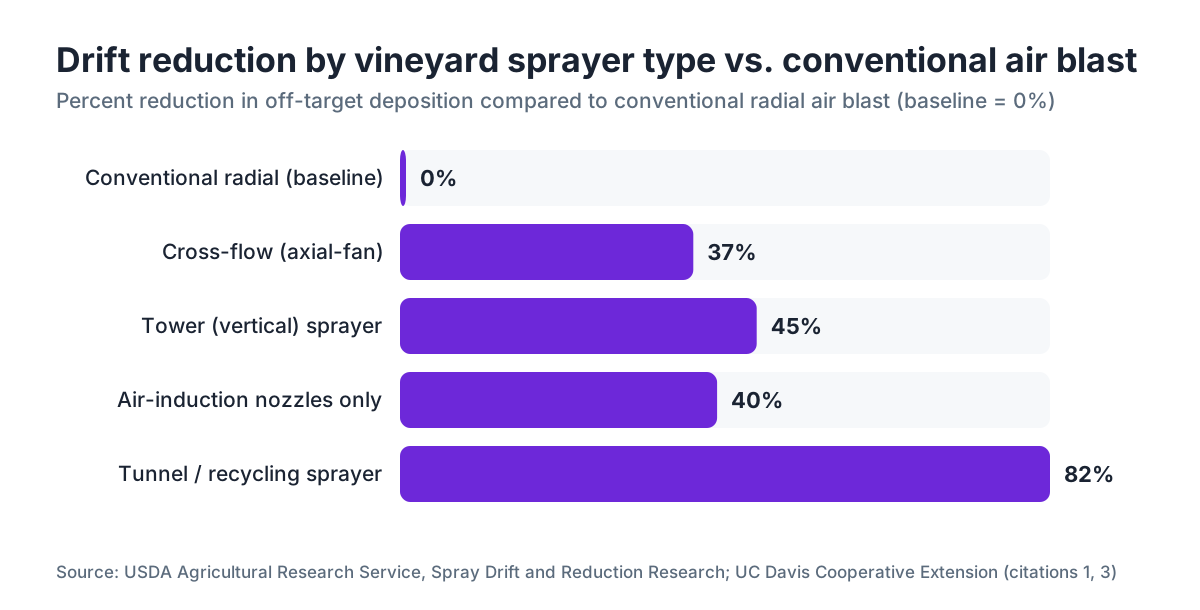
Tunnel (recycling) sprayer. The machine partly wraps the row. Droplets that miss the canopy hit collection panels and get recirculated. Drift reduction is big (some studies show 75-90%) and chemical savings reach 30-40% [3]. New units run high, typically $40,000-$80,000, and they crawl, but for growers in air quality management districts with drift restrictions or near sensitive sites, they're often the only defensible choice.
| Sprayer type | Approx. new cost | Drift reduction vs. conventional | Best fit |
|---|---|---|---|
| Conventional radial | $8,000-$20,000 | Baseline | Low-value blocks, simple canopies |
| Tower (vertical) | $18,000-$40,000 | 30-60% | VSP, mixed canopy heights |
| Cross-flow | $12,000-$30,000 | 25-50% | Uniform mid-height canopies |
| Tunnel/recycling | $40,000-$80,000 | 75-90% | High-value blocks, drift-sensitive sites |
Cost ranges are approximate and swing with manufacturer, tank size, and nozzle setup. Used equipment runs 40-60% less, but check fan bearing condition hard before you buy.
How do you calibrate a vineyard air blast sprayer?
Calibration is where most growers lose money and most compliance violations begin. The goal is simple: deliver a known volume of spray solution per acre of canopy, so you can calculate the actual pesticide rate applied and hold it against the label requirement.
Start by measuring your actual nozzle output at your operating pressure. Catch spray from each nozzle for 30 seconds, measure in ounces, and multiply by 2 to get ounces per minute. Record every nozzle. Any nozzle running more than 10% above or below the set mean gets replaced. Flat-fan and hollow-cone nozzles both wear, and a worn one can be 20-30% off with no visible tell [4].
Next, add up your sprayer output in gallons per minute (GPM) across all active nozzles. Drive a measured 100-foot course at the ground speed and gear you'll actually spray in, with a loaded tank in field conditions. Time the run. Then: GPA = (GPM x 5,940) divided by (mph x row spacing in feet). That's the standard Purdue and extension formula in every state calibration guide [4].
Most wine grape disease programs target 20-50 GPA depending on canopy density. UC Davis extension work suggests a leaf wall area (LWA) approach, measuring actual canopy surface per acre, beats GPA alone for precision. Dense Chardonnay VSP in Carneros needs more volume per acre than an open-lyre Zinfandel in Lodi, even at the same row spacing [1].
Calibrate at the start of each season and again after any nozzle change or tank modification. A written calibration record isn't optional if you're a commercial applicator in most states. California's licensed PCAs and QPAs require it. Cornell's pest management guidelines say re-calibrate whenever output looks inconsistent, or after 25-30 hours of field operation [5].
What gallons per acre should a vineyard sprayer apply?
There's no single right number, and any source that hands you one without qualification is oversimplifying. The variables are canopy density, vine architecture, growth stage, and the specific pesticide.
Most fungicide programs in high-density VSP vineyards run 30-50 GPA with conventional or tower sprayers. Dormant applications (copper, lime sulfur) often go on at higher volumes because you're coating wood, not pushing through a leaf canopy. Foliar insecticides aimed at leafrollers or leafhoppers on thin canopies can run 15-25 GPA. Tunnel sprayers with recirculation reach equivalent effective coverage at 12-20 GPA because the system wastes so little.
WSU Extension's Pacific Northwest handbook recommends a minimum of 25 GPA for foliar fungicides during rapid shoot growth (pre-bloom through fruit set), noting that under-application in this window is the most common cause of Botrytis and powdery mildew escapes [6].
The leaf wall area method is worth learning. Work out of University of California Cooperative Extension frames target volume as a function of canopy surface rather than land area. Measure your row height and canopy width, calculate LWA per acre, and derive an adjusted GPA target from that. For most California VSP blocks this method pushes recommended volumes into the 30-45 GPA range, sometimes higher in very dense canopies at fruit set [1].
How does air blast sprayer speed affect coverage and drift?
Ground speed is one of the biggest levers you have, and one of the easiest to get wrong. Slow down and you put on more volume per acre, but you also keep droplets airborne longer in any one spot. Speed up and you apply less, which can leave coverage gaps, but you shrink the drift window.
Most wine grape programs run 2.5-4.5 mph. Below 2 mph you almost always over-apply, which invites runoff and phytotoxicity on young tissue. Above 5 mph with a conventional radial unit, the canopy doesn't stay open long enough for interior penetration.
Airstream velocity matters here too. You need enough air to move leaves, but too much creates turbulence that carries fine droplets off target. WSU research found that dropping fan speed (and airstream velocity) at row ends, where the canopy thins, cuts off-target deposition a lot with little coverage loss [6]. Some newer sprayer controllers allow PTO-independent fan speed adjustment for exactly this.
Drift is a regulatory and neighbor problem more than an efficiency one. California's Department of Pesticide Regulation (CDPR) tracks drift complaints through the pesticide use reporting system, and one documented drift incident can trigger an investigation of your whole application program [7]. Many California counties require spray notification to nearby sensitive sites. EPA drift label language, required on all labels since 2011, uses phrasing like "do not apply when wind speeds exceed 10 mph" or names a maximum droplet classification. If your label says it, it's law [10].
What nozzle types work best for vineyard air blast sprayers?
Nozzle choice matters more than most growers think, and it ties into everything else: pressure, droplet size, coverage, and drift.
Hollow-cone nozzles (disc-core and deflector types) ran air blast sprayers for decades because they throw a wide droplet spectrum that gets into canopy interiors. The downside is a real fraction of very fine droplets (under 150 microns) that drift easily, especially above 100 PSI.
Flat-fan nozzles produce more uniform droplets, usually medium classification (200-300 microns at standard pressures), and resist drift better. They shine on contact fungicides where surface coverage beats penetration.
Air-induction (twin-fluid) nozzles pull in a secondary airstream that builds larger, drift-resistant droplets. At equal volume they drift 30-50% less than standard hollow-cone tips. The trade is weaker canopy penetration, so they fit contact applications or surface-target spraying rather than reaching the interior.
For Botrytis control at fruit set, where you have to get into dense cluster interiors, hollow-cone tips at moderate pressure (60-80 PSI) with careful speed calibration beat air-induction tips. Cornell's integrated pest management resource says to match nozzle type to the application target instead of defaulting to one tip all season [5].
Check nozzle wear at least monthly during peak spray season. A titanium or stainless steel disc outlasts a brass disc 5 to 10 times over, and the price gap ($3-8 per nozzle) is nothing against a crop loss from patchy coverage.
How do you reduce drift from a vineyard air blast sprayer?
Drift control is part equipment, part timing, part technique. The equipment moves with the biggest payoff: tunnel sprayers (75-90% reduction), air-induction nozzles (30-50%), and electronic section control that shuts off nozzles at row ends.
Timing is free. Wind under 5 mph and temperature under 85 degrees F are the baseline for safe application. Early morning or late evening cuts thermal drift because the temperature inversions that trap and carry fine particles are less likely when air is stable. Night spraying works if your lights and terrain make it safe. Many California coastal growers spray at first light on purpose, because afternoon sea breezes push coastal air toward neighborhoods.
Fan speed adjustment is underused. If your tractor has a two-speed PTO or an adjustable fan drive, cutting fan speed 10-15% in open canopy sections drops turbulence-driven drift with no proportional coverage loss. You make up the difference in ground speed.
Buffer distances matter. EPA labels increasingly name buffer distances for certain active ingredients (pyrethroid insecticides and some fungicides especially) from water bodies and non-target areas. Read the label. CDPR drift enforcement actions in the San Joaquin Valley and Salinas Valley from 2018 to 2023 mostly involved growers who ignored label-specified buffers [7].
For growers documenting drift-reduction practices for compliance, tools like VitiScribe log spray conditions (wind speed, temperature, time of day) next to each application record. That gives you a defensible paper trail if a drift complaint lands.
What does it cost to operate a vineyard air blast sprayer per acre?
Operating cost has three parts: equipment depreciation and interest, fuel and maintenance, and chemical cost (which the sprayer drives through calibration accuracy).
Equipment cost per acre rides on your block size and annual spray frequency. A $25,000 tower sprayer depreciated over 10 years costs $2,500 a year in depreciation alone. Spray 50 acres at 8 applications a year and that's $6.25 per acre-application. On a 10-acre block it's $25 per acre-application. That gap is why co-op sprayer sharing and custom application services make sense for small blocks.
Fuel: a 75-100 HP tractor pulling a PTO-driven sprayer at 2,500-3,000 rpm burns roughly 3-5 gallons of diesel an hour. At 3 mph in 8-foot rows you cover about 1.2 acres per hour after turns and fill time. So fuel runs $3-7 per acre depending on diesel price.
Maintenance: budget 3-5% of equipment value a year. Nozzles, pump seals, hose replacements, and bearing service are the repeat costs. The pump is the priciest single repair, often $800-2,000 for a full diaphragm rebuild.
Chemical cost is where calibration shows up in dollars. A 20% over-application on a $60/gallon fungicide program adds $12 per acre per pass. Across a season of 8 applications on 50 acres, that's $4,800 gone. Calibration takes 2-3 hours at season start. The math writes itself.
What are the EPA and state compliance requirements for vineyard sprayer operation?
Federal law sets the floor, and most wine grape states pile on more.
The EPA Worker Protection Standard (40 CFR Part 170) requires that pesticide handlers (anyone mixing, loading, or applying) get annual training, have access to the pesticide label and safety data sheet at the application site, and wear the personal protective equipment (PPE) the label names. Early-entry workers who go into treated areas before the re-entry interval (REI) expires need separate training and extra protection [2].
The label is a federal document. Applying a pesticide in a manner inconsistent with its labeling violates FIFRA (7 U.S.C. Section 136j), which carries civil penalties up to $19,787 per violation for commercial applicators under the 2023 EPA penalty schedule [2].
California requires all commercial agricultural pesticide applications to be reported to the county agricultural commissioner within 30 days under the Pesticide Use Reporting (PUR) system. The report covers the product, rate applied, acreage treated, and application method [7]. Washington State requires a commercial pesticide applicator license and 2-year records retention [8]. Oregon runs similar licensing through the Oregon Department of Agriculture [9].
Some counties and air quality management districts layer on more. Ventura County, Santa Barbara County, and several San Joaquin Valley counties add spray notification rules for certain compounds near schools and sensitive sites. Check with your county agricultural commissioner before your first spray of the season. "I didn't know" is not a defense that works.
As the EPA WPS guidance states: "The agricultural employer must provide handlers with pesticide safety training before they perform any handler task." [2]
How do you maintain a vineyard air blast sprayer between seasons?
End-of-season care is where most sprayers die young. A diaphragm pump that sits wet with sulfur residue for 8 months is a very expensive rebuild come March.
At season end, flush the whole system with clean water until it runs clear. Then run a tank of clean water with a tank cleaner (ammonium sulfate or a commercial rinsate cleaner) to neutralize residual pH-sensitive products. Drain completely. Pull all nozzle tips, screens, and check valves, rinse them in clean water, inspect under light, and store them dry in a labeled bag by nozzle type.
Drain the pump. If you're in a freeze zone, get all water out of the pump head, hoses, and tank. Diaphragm pumps crack below 28 degrees F if water stays in them. Lubricate the pump head on the manufacturer's schedule. Grease all PTO and driveshaft joints. Check fan blades for cracks, which cause dangerous vibration at operating speed. Never field-repair a cracked fan blade. Replace it.
Check every electrical connection on solenoid valves and section controllers for corrosion, which runs severe in sulfur-heavy spray environments. Clean connections with electrical contact cleaner and apply dielectric grease.
Before your first spring application, fill the tank with clean water and run the full system at operating pressure for 5-10 minutes. Catch nozzle output, check for leaks, and verify the pressure gauge against a calibrated one. This pre-season check takes under an hour and catches problems before you're standing mid-block with a full tank of $2,000 fungicide.
What does research say about air blast sprayer canopy coverage accuracy?
The honest answer: coverage accuracy in real vineyards is worse than most growers assume, and the research has said so consistently for 30 years.
Water-sensitive paper (WSP) tests are the standard field check. You clip small paper strips at multiple canopy positions (top, middle, bottom, interior, exterior, both sides of the row) before a spray pass and read the stain pattern after. UC Davis extension work from the Spray Application Research program found that under real farm conditions, interior canopy coverage with conventional air blast averaged 40-60% of exterior coverage, even at recommended ground speeds and volumes [1].
Tunnel sprayer studies from European research showed coverage uniformity gains of 15-25% at interior canopy positions against conventional air blast at equal volumes [3]. That gap matters most for Botrytis, which starts on interior cluster surfaces.
The most common finding across studies: growers systematically under-spray the transition zone between the exterior canopy and the cluster zone. Part physics (the canopy acts as a filter), part nozzle placement. Tower sprayers with individually adjustable sections at cluster height address this more directly than radial units.
Want to test your own coverage? WSP is cheap (about $15-25 for a pack of 100 sheets) and gives you real data in 30 minutes. Run the test at your standard speed and volume, photograph the sheets, and compare the pattern across canopy positions. If interior coverage sits below 30-40% of exterior, you have a problem worth fixing before your next fungicide pass. Cornell's pest management pages carry a practical WSP evaluation guide [5].
Tracking calibration records, spray timing, and coverage data across seasons in one place is exactly what VitiScribe is built for. When you need to pull spray history for a compliance audit or to diagnose a disease escape, timestamped records of GPA, speed, and canopy conditions save hours.
How do air blast sprayers compare to electrostatic and drone sprayers for vineyards?
Electrostatic sprayers charge the droplets so they're pulled toward the plant surface, including leaf undersides. In theory that improves deposition. In practice, the canopy-penetration problem is real: charged droplets go to the first surface they meet, which tends to be the exterior canopy. Interior deposition gains in vineyards stay modest next to row crops with more open architecture. They don't replace air blast in dense VSP systems.
Drone (UAV) sprayers have drawn a lot of attention since 2020. The DJI Agras T30 and similar platforms apply at roughly 1.5-3 acres per hour at 1-3 gallons per acre. That's ultra-low volume (ULV) application, which needs very concentrated formulations and throws a very fine, drift-prone droplet spectrum. For dormant copper or systemic fungicides with broad activity, drones make sense on steep, inaccessible ground where an air blast tractor can't run safely. For contact fungicides like sulfur that need good coverage, 1-3 GPA from a drone just isn't enough volume to compete with 30-40 GPA from a tower sprayer. The EPA has no general label clearance for UAV application of most vineyard pesticides. You need a product label that explicitly permits aerial or UAV application [10].
For 95% of commercial wine grape blocks with tractor access, a well-calibrated tower or cross-flow air blast sprayer stays the most cost-effective and coverage-reliable option. Drones fill a real niche for hard terrain or spot treatments. The math doesn't support swapping air blast equipment for drones in accessible, flat-to-moderate slope blocks at current drone operating costs.
Frequently asked questions
How often should I calibrate my vineyard air blast sprayer?
Calibrate at the start of each spray season, after any nozzle change, and after every 25-30 hours of operation. Cornell's pest management program recommends re-checking output if you notice inconsistent disease control or visible runoff, both signs that actual GPA has drifted from your target. Calibration takes 2-3 hours and catches output errors that reach 20-30% in worn equipment.
What is the right air blast sprayer fan speed for vineyards?
Most conventional units run at 540 or 1,000 rpm PTO, which generates airstream velocities of 100-200 mph at the nozzle outlet. Higher fan speed improves canopy penetration but raises drift risk and fine-droplet generation. WSU research found that cutting fan speed 10-15% in thin-canopy sections reduces drift meaningfully. Match fan speed to canopy density instead of running maximum speed by default.
Can I use an orchard air blast sprayer in a vineyard?
Yes, many conventional radial orchard sprayers work in vineyards, but canopy shape matters. Orchard units are built for taller, rounder targets, so air distribution in VSP trellis systems often runs poor at the cluster zone. You may need to add or redirect nozzles. Tower or cross-flow units designed for vineyard row geometry almost always give better coverage and let you cut volume.
What wind speed is too high to spray with an air blast sprayer?
Most pesticide labels require you to stop above 10 mph, and many name 7-8 mph as the practical limit for drift-prone materials. CDPR enforcement actions often involve applications at 12-15 mph winds. In practice, winds above 5 mph noticeably degrade canopy penetration on top of causing drift, so most experienced applicators stop at 5-7 mph as a field threshold, especially for contact fungicides.
How many acres per hour can an air blast sprayer cover in a vineyard?
At 3 mph in 8-foot row spacing, you cover roughly 1.2-1.5 acres per hour including turns and filling. At 4 mph you approach 1.8-2.0 acres per hour. In 10-foot rows those figures improve about 20%. Actual field rate depends on tank size and fill station distance. A 200-gallon tank at 30 GPA needs refilling every 6-7 acres, a major pacing constraint in remote blocks.
Is a tunnel (recycling) sprayer worth the cost for wine grapes?
For blocks near sensitive receptors, inside air quality management districts with drift restrictions, or in high-value programs where chemical cost runs $400+ per acre per season, tunnel sprayers often pay back their premium ($40,000-$80,000 new) in 5-7 years on chemical savings alone. For blocks without drift constraints and moderate chemical budgets, conventional or tower units are hard to beat on cost per acre. Break-even hinges on block size and spray program intensity.
What PPE is required when operating a vineyard air blast sprayer?
The pesticide label sets handler PPE, which is federally required under FIFRA and the EPA Worker Protection Standard (40 CFR Part 170). Minimum requirements for most fungicide applications include long sleeves, chemical-resistant gloves, and eye protection. Insecticides and fumigants often require respirators. The WPS requires employers to make sure handlers have the required PPE before any application task begins.
How do I use water-sensitive paper to check my sprayer coverage?
Clip WSP strips (yellow paper that turns blue on water contact) at multiple canopy positions: top, middle, bottom on both the near and far sides of the row, and one at the interior cluster zone. Make a normal spray pass, retrieve the paper before it's disturbed, and photograph each strip. Estimate the stained percentage. Interior coverage below 30% of exterior points to a calibration or nozzle placement problem worth correcting.
What is the leaf wall area method for vineyard spray calibration?
Leaf wall area (LWA) calculates actual green canopy surface per acre instead of treating all acres as equal. You measure canopy height and average canopy depth, calculate exposed leaf surface in square feet per linear foot of row, and set a volume target from that. UC Davis Cooperative Extension built this approach for California wine grapes to fix the problem of fixed GPA targets mismatching real canopy size across trellis systems.
Do I need a pesticide applicator license to run an air blast sprayer on my own vineyard?
In most states, applying pesticides on land you own or lease doesn't require a commercial applicator license if you're treating only your own crops. But if you hire out spray services or apply on others' property, a license is required. California, Washington, and Oregon each have specific rules. Calling your county agricultural commissioner is the fastest way to get a definitive answer for your situation.
How does air blast sprayer calibration affect pesticide resistance management?
Under-application drives resistance selection directly. When pathogen or pest populations meet sub-lethal pesticide concentrations, susceptible individuals die but tolerant ones survive and reproduce. Repeat that at sub-label rates and the tolerant population grows. Calibration that consistently delivers the label rate is a basic resistance management practice. Resistance guidelines from EPA and FRAC both name "apply at the full label rate" as a core recommendation.
What spray records do I need to keep after using an air blast sprayer?
Federal law requires licensed applicators to keep restricted-use pesticide (RUP) records for 2 years. California's PUR system requires all agricultural pesticide applications (not only RUPs) to be reported to the county agricultural commissioner monthly. Records must include the product name and EPA registration number, application date, acreage treated, rate applied, target pest, and applicator name. Most states set a 2-year retention minimum.
Sources
- UC Davis Cooperative Extension, Spray Application Research Program: Tower sprayers reduce spray volume by 25-50% while maintaining equivalent canopy coverage compared to conventional air blast in Napa Valley VSP vineyards; interior canopy coverage with conventional air blast averaged 40-60% of exterior coverage under real farm conditions.
- EPA, Worker Protection Standard (40 CFR Part 170) and FIFRA pesticide civil penalty schedule: WPS requires annual pesticide handler training, PPE per label, and access to labeling at application site; FIFRA penalties for label violations reach $19,787 per violation for commercial applicators as of 2023.
- USDA Agricultural Research Service, Spray Drift and Reduction Research: Tunnel (recycling) sprayers show 75-90% drift reduction and 30-40% chemical savings compared to conventional air blast in orchard and vineyard settings.
- Purdue Extension, Pesticide Applicator Training: Calibration of Sprayers: Standard nozzle calibration method: catch 30-second nozzle output, replace nozzles more than 10% above or below mean; GPA formula: (GPM x 5,940) divided by (mph x row spacing in feet).
- Cornell Integrated Pest Management, New York and Pennsylvania Pest Management Guidelines for Grapes: Cornell IPM recommends re-calibration after 25-30 hours of operation or when output looks inconsistent, matching nozzle type to application target, and provides a practical water-sensitive paper evaluation guide.
- Washington State University Extension, Pacific Northwest Pest Management Handbooks, Grape: WSU Extension recommends minimum 25 GPA for foliar fungicides during rapid shoot growth; reducing fan speed 10-15% at row ends significantly cuts off-target deposition.
- California Department of Pesticide Regulation, Pesticide Use Reporting and Enforcement: California requires all agricultural pesticide use to be reported to the county agricultural commissioner within 30 days; CDPR drift enforcement actions 2018-2023 predominantly involved growers who ignored label-specified buffers.
- Washington State Department of Agriculture, Pesticide Management Division: Washington requires a commercial pesticide applicator license for commercial operations and mandates 2-year records retention for all pesticide applications.
- Oregon Department of Agriculture, Pesticides Division: Oregon requires pesticide applicator licensing for commercial agricultural pesticide application, with similar records-retention requirements to Washington State.
- EPA, Pesticide Registration, Label Requirements and Drift Language: EPA pesticide label drift language, required since 2011, specifies maximum wind speed conditions (often 10 mph) and, for UAV applications, requires explicit label authorization for aerial application methods.
Last updated 2026-07-09