Vineyard block planting record template including rootstock-scion combination

TL;DR
- A vineyard block planting record should capture block ID, planting date, variety and clone, rootstock and scion combination, vine spacing, row orientation, plant material source, virus test status, and any phylloxera or nematode site history.
- Most states require this data for wine labeling and nursery compliance.
- A one-page template covers everything; the key fields are listed and explained below.
What fields does a vineyard block planting record actually need?
A block planting record is the permanent birth certificate for a section of your vineyard. Get it right at planting and you'll answer every downstream question, from an AVA audit to a nursery invoice dispute, without digging through old emails.
At minimum, every record needs these fields:
| Field | Why it matters |
|---|---|
| Block ID / block name | Links field maps, spray records, and harvest logs |
| Planting date (and replant date if applicable) | Age drives yield expectations and crop insurance claims |
| Variety (scion) | Required for wine label appellation compliance |
| Clone designation | Affects flavor profile, color, and certified plant material tracking |
| Rootstock | Soil adaptation, phylloxera resistance, vigor management |
| Rootstock-scion combination | Graft compatibility and certified budwood chain-of-custody |
| Row orientation (degrees) | Sunlight management documentation |
| Row spacing (in-row x between-row, in feet or meters) | Vine density calculations, appellation minimums |
| Vine count at planting | Baseline for replant tracking and insurance |
| Current vine count | Running tally post-replant |
| Nursery or plant material source | Required under California nursery law; best practice everywhere |
| Virus/disease test status | Pierce's disease, leafroll, red blotch, fanleaf |
| Soil series or soil type | Background for rootstock selection rationale |
| Irrigation system type | Drip, overhead, dry-farmed |
| Trellis system | VSP, Scott Henry, GDC, head-trained |
| Training system notes | Cordon length, cane vs. spur pruned |
| Block acreage (GPS-measured preferred) | Tonnage yield calculations, permit acreage |
| Notes field | Replant reasons, cover crop, grafting history |
That's 18 fields. Some are a single number; some need a sentence. The whole thing fits on one page per block.
A few of those deserve extra attention. The rootstock-scion combination is more than "Cabernet on 110R." Write it as scion variety, clone number, rootstock variety, rootstock source, and graft type (bench-grafted or field-budded). That level of detail is what a university extension diagnostic lab needs if you ever call with a graft failure question. UC Davis Foundation Plant Services recommends tracking budwood lot numbers alongside clone designations for exactly this reason [1].
Why is the rootstock-scion combination so important to document separately?
The rootstock-scion combination is the single most consequential long-term decision in vineyard design, and it's also the field most often skipped or recorded vaguely. "Own-rooted" is not a rootstock entry. "Unknown" is not a clone entry. Both will cost you later.
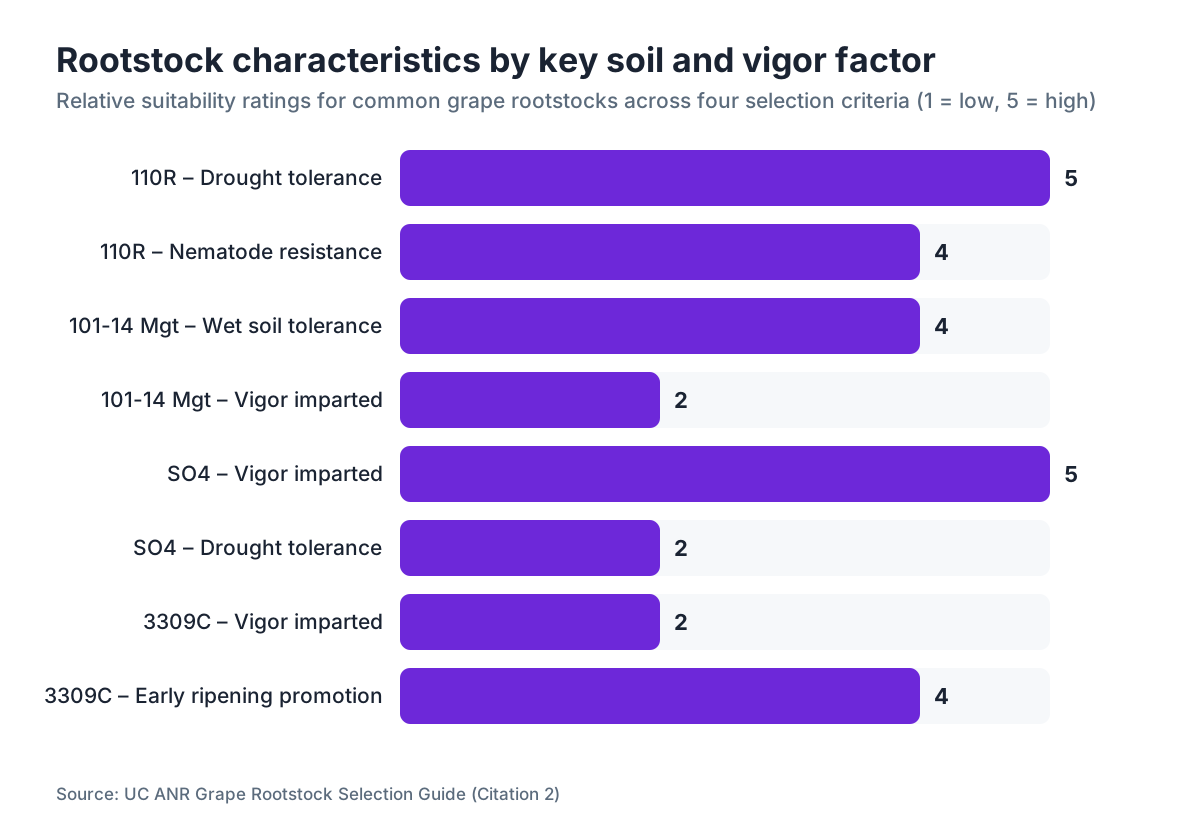
Here's why it gets its own field. Rootstock choice directly affects soil-adapted performance: 101-14 Mgt thrives in heavier, wetter soils with moderate vigor; 110R is drought-adapted and suits coarser, low-fertility sites; SO4 pushes high vigor and is sometimes too much in fertile ground; 3309C keeps vigor low and works well for early-ripening varieties on moderate soils [2]. If you don't record which rootstock is in a block, you can't make a defensible replant decision when a section fails.
Scion clone documentation matters for different reasons. In California, Cabernet Sauvignon has at least 22 registered Foundation Plant Services clones with measurably different cluster weights, berry size, and color density [1]. A winemaker who asks "which block has the small-berry clone?" needs a real answer, not "the one by the road."
Graft compatibility problems don't always show up in year one. Some rootstock-scion combinations develop delayed incompatibility over 5-10 years, showing up as a characteristic union line, leaf chlorosis, or sudden vine collapse. Without a record of the combination, a field diagnosis is guesswork. Cornell's viticulture program has documented graft incompatibility cases where the combination itself was the culprit, and records were needed to confirm it [3].
One more reason, and it's a legal one. Certified plant material programs in most major grape-growing states require nurseries to keep lot-level records, and they strongly encourage growers to retain matching documentation. California's Department of Food and Agriculture Nursery, Seed and Cotton Program inspects nurseries partly on the strength of these records [4]. If your plant material was ever found to carry a regulated pathogen after the fact, your own chain-of-custody record is what connects or disconnects you from a quarantine action.
What does a completed rootstock-scion combination entry look like?
Here's a real example entry for the combination field, written out fully:
"Cabernet Sauvignon, FPS Clone 8 (scion) / 110 Richter (rootstock), bench-grafted, sourced from Sunridge Nurseries lot #SR-2021-CS8-110R, planted April 2021, California DPR Nursery Stock Certificate #[XXXX]."
That's one line. It tells you the variety, the certified clone number, the rootstock, the graft method, the nursery, the lot number, and the phytosanitary documentation number. Any future buyer of your vineyard, any appraiser, any diagnostic lab, and any compliance inspector has everything they need.
If you planted own-rooted vines, say so explicitly: "Own-rooted, Zinfandel, FPS Clone 3, certified budwood source: [nursery], planted March 2019." Own-rooted is a legitimate choice in some soils and for some varieties, but it needs to be documented, not implied.
For a multi-variety mixed block (rare but it happens, especially in old-vine heritage plantings), list each variety separately with its percentage of total vine count. Something like: "Approximately 60% Zinfandel (clone unknown, own-rooted, est. planted 1962), 25% Petite Sirah (clone unknown, own-rooted), 15% Alicante Bouschet." That's honest documentation even when the data is incomplete.
How do block planting records connect to spray records and WPS compliance?
Your block planting record is the anchor document that spray records reference. Every pesticide application log needs a block ID, and that block ID has to resolve back to a defined area with a defined crop. The EPA Worker Protection Standard (WPS), 40 CFR Part 170, requires that agricultural employers post pesticide application information in a central location accessible to workers, including the location of treated areas by field or block [5]. The WPS does not require you to use a specific format for block identification, but it does require that the identification be unambiguous. A block planting record with a clear block ID, GPS boundary, and acreage is the cleanest way to meet that.
Washington State University Extension points out that integrated vineyard record systems, where block maps, planting records, and spray logs all share the same block ID, make both self-auditing and state pesticide inspector audits significantly faster [6]. If your spray log says "Block 4A" and your planting record also says "Block 4A" with a GPS polygon, there's no dispute about what was treated or what crop was present.
California's Department of Pesticide Regulation requires spray records to identify the site of application by township, range, and section or by a farm name and field name [7]. If your block planting record already carries that location data, your spray logs can reference it directly instead of re-entering it each time.
Re-entry intervals (REIs) under WPS are crop-agnostic, they're driven by the pesticide label, but rootstock blocks in a nursery propagation area (if you're doing any own-rooting or bench-grafting on-farm) may fall under different use classifications. Document those areas separately in your planting records.
What format should the template be in: paper, spreadsheet, or farm management software?
Honest answer: any format you'll actually update.
Paper is not wrong. A laminated field card stapled to a block marker post, updated in pencil each time there's a replant, beats a spreadsheet that got last touched in 2018. The problem with paper is searchability. When your accountant needs the total acreage of own-rooted Zinfandel for a crop insurance form, a paper binder takes an hour. A spreadsheet takes ten seconds.
A spreadsheet template (Excel or Google Sheets) is the practical minimum for most operations under about 50 blocks. One row per block, one column per field, a second tab for replant history. Keep it on a shared drive, not a local hard drive. Back it up annually as a PDF with a date stamp. That PDF is your version-controlled record if anything ever changes.
Farm management software adds linked records (so a spray log entry automatically populates with the block's crop and acreage), GPS mapping, and audit trail timestamps. For operations with 50+ blocks, multiple employees entering data, or multi-AVA production, that linkage is genuinely worth the subscription cost. VitiScribe was built specifically for this workflow, connecting block planting records to spray logs, harvest records, and compliance exports in one system.
Regardless of format, the record needs to be legible, dated, and signed or user-attributed for each entry. "Who entered this and when" is the question that comes up in audits, and a spreadsheet with no edit history can't answer it.
How do you record replanting and vine gaps in an existing block?
Replanting is where most planting records fall apart. The original record is clean; then five vines die, get replaced with a different rootstock because the original is backordered, and nobody updates the template. Five years later, you have a block with two rootstocks and you can't remember which rows.
The cleanest solution is a replant log section at the bottom of each block record, or a linked second sheet. Each replant event gets its own row:
| Date | Vine count replaced | Reason for loss | Replacement variety/clone/rootstock | Row(s) affected | Nursery/lot |
|---|---|---|---|---|---|
| 2023-03-15 | 12 | Eutypa dieback | CS Clone 8 / 110R (same as block) | Rows 4, 7, 12 | Sunridge lot SR-2023 |
| 2024-04-02 | 3 | Deer damage | CS Clone 8 / 3309C (110R unavailable) | Row 7 | Sunridge lot SR-2024 |
That second row is the one that saves you. You now have three vines in Row 7 on a different rootstock from the rest of the block. It may never matter. But if Row 7 shows unusual vigor or early senescence in fifteen years, you have a paper trail.
For large-scale replanting events (more than 20% of a block), WSU Extension recommends treating the replanted area as a sub-block with its own block ID suffix, for example Block 4A-R1, rather than just amending the existing record [6]. That way the original planting data stays intact for historical yield modeling.
What virus and disease test fields should the planting record include?
This is the section most template examples online skip entirely, and it matters more than spacing data in most disease-pressure regions.
At minimum, include a "virus/pathogen test status" field with four sub-fields:
- Test date (or "not tested")
- Laboratory name
- Pathogens tested for (Grapevine leafroll-associated viruses 1, 2, 3; Grapevine red blotch virus; Grapevine fanleaf virus; Grapevine rupestris stem pitting; Xylella fastidiosa / Pierce's disease in applicable regions)
- Result (negative, positive, or pending)
California's Certified Planting Stock program through UC Cooperative Extension requires that registered and certified vines carry documentation of virus indexing under the FPS program [1]. If your nursery provided certified stock, attach or reference the nursery certificate number. If you planted from an unverified source, note that explicitly.
Pierce's disease (caused by Xylella fastidiosa) is a regulated pest in California, and planting records that document vector pressure history and nearby infected material can be relevant to a county agricultural commissioner investigation [4]. In the Southeast and Gulf Coast, Pierce's disease pressure is severe enough that UC Davis's Pierce's Disease Research and Outreach Program recommends growers maintain site-specific planting histories tied to disease incidence maps.
Red blotch virus is relatively new (formally described around 2012-2013), and many blocks planted before 2015 were never tested for it. Note that gap honestly: "Pre-2015 planting, no red blotch testing conducted." That's more useful than leaving the field blank.
How does block planting data support wine label compliance and appellation claims?
The connection between a block planting record and the bottle on a retail shelf is more direct than most people realize.
For a wine to carry an AVA designation in the US, at least 85% of the grapes must come from that AVA (75% for a county or state designation) [8]. For a varietal claim, at least 75% of the wine must come from that variety. If you're blending across blocks and want to make an appellation or varietal claim, your block planting records are the source documents that prove which variety came from which location.
The TTB (Alcohol and Tobacco Tax and Trade Bureau) does not require you to submit block planting records with a label application, but it expects them to exist and to be producible in an audit. TTB Circular 2018-1 on recordkeeping for bonded wineries references the need for production records that trace grapes from source to wine lot [9]. Your block planting record is the first link in that chain.
Some AVAs carry stricter rules. Napa Valley AVA compliance under California AB 2084 (the 2000 Napa Valley Appellation Law) requires that 100% of grapes in a Napa Valley-labeled wine come from Napa County [10]. The Napa Valley Vintners association has historically encouraged growers to maintain detailed block records as supporting documentation for appellation compliance, though the legal requirement sits with the winery.
For estate wines, where the winery must own or control the vineyard, the block record with ownership notation or lease documentation is the specific document that establishes "control" under TTB's estate bottling definition.
What soil and site data should go in a block planting record?
Soil data in a planting record is not about generating agronomic reports. It's about explaining why you chose the rootstock you did and creating a reference for future management decisions.
Record these at minimum: USDA soil series name (available from the NRCS Web Soil Survey at no cost [11]), soil texture class (clay loam, sandy loam, etc.), drainage class (well-drained, moderately well-drained, poorly-drained), approximate depth to restrictive layer if known, and pH at planting if you have a soil test.
Then connect it explicitly to your rootstock choice. "SO4 selected for moderate vigor on this clay loam series" is a sentence that will still make sense to someone reading this record in 2045. "Planted 110R, coarse sandy loam over gravel, low water-holding capacity, no irrigation" is even better.
Elevation, aspect (slope direction in degrees), and slope percentage are worth recording even if they feel obvious. Satellite imagery changes, reference points move, and a numeric aspect reading is more useful than "faces southwest-ish."
The NRCS Web Soil Survey lets you draw a polygon around your block and download the dominant soil series data. Do that once at planting and paste the series name and map unit symbol into the record. It takes ten minutes and you'll never have to look it up again [11].
How often should block planting records be reviewed and updated?
Once a year, minimum. After every replanting event, immediately.
The annual review should happen before bud break, when you're already walking the vineyard assessing winter damage and vine health. Count and record any vine losses from the previous season. Update the current vine count. Note any new disease symptoms or observations.
If you made any grafting changes (topworking a block to a different variety, for example), document the grafting date, the new scion, the rootstock that remained, and the nursery source of budwood. Topworking changes the variety but not the rootstock; that nuance matters for variety mapping and for any appellation labeling of transitional harvests.
For compliance purposes, most state pesticide agencies require spray records to be retained for a minimum of two years; California requires three years [7]. Your block planting records should be retained for the life of the planting plus at least five years after removal, because historical records can be needed for replanting decisions, appraisals, and property transactions.
If you use farm management software like VitiScribe, automated audit logs handle the "when was this record last changed and by whom" question without any extra work. That timestamp trail is worth more than people expect when a discrepancy comes up.
Are there university extension templates or government templates you can start from?
A few real resources to know about:
UC Cooperative Extension and UC Davis have published vineyard record-keeping guides as part of their Sustainable Winegrowing program materials. The UC ANR publication catalog (anrcatalog.ucanr.edu) includes farm record-keeping resources, though the specific vineyard block template formats are often embedded in broader sustainable farming guides rather than offered as standalone downloads [12].
WSU Extension's viticulture program has published vineyard establishment and management guides that include recommended record fields. WSU's Viticulture and Enology program page is at viticulture.wsu.edu and includes links to their regional management publications [6].
Cornell Cooperative Extension's viticulture resources, primarily through the Cornell Viticulture and Enology Lab, include establishment-phase records in their New York viticulture production guides [3].
The USDA NRCS offers a Vineyard Conservation Activity Plan template as part of their Environmental Quality Incentives Program (EQIP) documentation. That template is more conservation-focused than compliance-focused, but it includes site and planting data fields that align with what's described here [13].
None of these are a single downloadable "fill in your rootstock here" form. You'll need to assemble one yourself or use farm management software with a built-in template. The field list in the first section of this article is the synthesis of what those extension programs collectively recommend.
What common mistakes make block planting records useless in an audit or property sale?
These are the failure modes that show up repeatedly:
"Unknown rootstock" on anything planted after 1990. By the late 1990s, bare-root phylloxera risk was driving almost universal rootstock documentation in California. If your record says unknown for a post-1990 planting, that's a missing invoice, not a missing field.
Acreage from a tractor odometer estimate instead of GPS. The difference between a 3.2-acre estimate and a 2.9-acre GPS measurement matters for crop insurance, for appellation filings, and for yield-per-acre calculations used in purchase price negotiations.
No nursery source. Without a nursery name and ideally a lot or certificate number, you can't trace the plant material origin. For certified appellation programs in regions like Champagne (AOC) or Napa Valley, traceability of plant material is an expectation even if not a hard legal requirement for every grower.
Conflating block and lot. A block is an agronomically defined unit (same variety, rootstock, trellis, management). A lot is an administrative parcel. They don't have to match, and when they don't, keep them tracked separately.
No replant history. The original planting record exists; the five years of gap-filling do not. The result is a vine count that's wrong and a rootstock inventory that's unknown.
Dates without years. "Planted March 15" has happened in actual records. Always four-digit year.
For anyone exploring how larger operations manage record integration, the vineyard management overview on this site covers the operational context where planting records fit into broader farm documentation systems.
Frequently asked questions
What is the minimum information a vineyard block planting record must contain?
At minimum: block ID, planting date, variety (scion), rootstock, vine spacing, row orientation, vine count, block acreage, and plant material source. For compliance with California pesticide law and TTB appellation records, you also need a GPS-referenced location. Clone designation is technically optional in most states but practically necessary for wine labeling accuracy and future viticultural decisions.
Does the EPA Worker Protection Standard require vineyard block records?
The WPS (40 CFR Part 170) requires that employers post treated area information accessible to workers, referencing specific field or block locations. It does not mandate a specific block record format, but your block planting record supplies the unambiguous location data that spray logs must reference. Without a block ID system tied to a map, WPS location documentation is difficult to satisfy cleanly.
What rootstock data specifically should I record at planting?
Record the rootstock variety name (e.g., 110 Richter, 3309 Couderc, SO4, 101-14 Mgt), the nursery and lot number, the graft type (bench-grafted or field-budded), and whether the rootstock is certified phylloxera-resistant. Also note the soil rationale for the choice. This detail supports both future replanting decisions and any diagnostic work if graft incompatibility or rootstock-related nutrient issues emerge later.
How do I document a block that has multiple varieties or clones planted together?
List each variety and clone separately with an estimated percentage of total vine count. Note the planting year for each if they differ. If the mix is a historic field blend with unknown clone identity, say so explicitly: unknown clone, own-rooted, estimated planting year. That honest documentation is more useful than leaving fields blank or guessing. For wine labeling purposes, mixed blocks require additional harvest tracking by weight per variety.
Can I use a simple spreadsheet instead of farm management software for block planting records?
Yes. A spreadsheet with one row per block, a replant-history tab, and annual backups as dated PDFs meets the practical and legal requirements for most US grape-growing operations. Software becomes worth the cost when you have 50-plus blocks, multiple staff entering data, or need linked spray and harvest records with audit timestamps. Paper alone is risky only because it degrades and isn't searchable.
How long should I keep vineyard block planting records?
Keep them for the life of the planting plus at least five years after block removal. California requires spray records for three years, but the planting record itself has no statutory retention period in most states; the practical standard is permanent retention. Records are needed for property appraisals, replanting decisions, crop insurance claims, and TTB production audits, all of which can arise long after a planting ends.
How does a block planting record support a Napa Valley AVA wine label claim?
California AB 2084 (effective 2001) requires that 100% of grapes in a Napa Valley-appellation wine come from Napa County. TTB appellation records must be producible on audit. Your block planting record, showing the GPS-located block within Napa County, is the source document linking vineyard location to the wine lot. Without it, demonstrating origin compliance depends entirely on third-party invoices.
What virus testing results should I include in a block planting record?
Include the test date, testing laboratory, pathogens tested (at minimum: leafroll viruses 1, 2, and 3; grapevine red blotch virus; fanleaf virus; and Xylella fastidiosa in Pierce's disease regions), and the result. For certified FPS plant material, the nursery certificate number is your virus test record. For pre-2015 plantings, note honestly that red blotch testing was not conducted; that gap is better documented than ignored.
How do I record a block that was topworked to a different variety?
Add a topworking event to the replant log with the grafting date, the new scion variety and clone, the nursery source of budwood, the rows or vine count affected, and the rootstock that remained in place. Create a sub-block ID for the topworked area if more than 20 percent of the block was changed. The original block record stays intact for historical yield records; the topworking entry documents the transition.
What USDA or land grant university resources offer vineyard block record templates?
UC ANR's publication catalog includes vineyard record-keeping materials. WSU Viticulture and Enology publishes vineyard establishment guides with recommended record fields. Cornell Cooperative Extension covers block records in its New York viticulture production guides. USDA NRCS provides vineyard documentation templates through EQIP program materials. None are a single standalone downloadable form; you build from their field recommendations or use farm management software with a built-in template.
Do block planting records affect crop insurance calculations?
Yes. USDA Risk Management Agency Whole-Farm and Actual Production History policies use reported acreage and variety data to establish coverage levels. Block planting records with GPS-measured acreage and variety designations are the source documents for acreage reports filed with the Farm Service Agency. Discrepancies between reported acreage and actual GPS acreage can result in reduced indemnity payments or coverage adjustments.
How should I record soil data in a block planting record?
Record the USDA NRCS soil series name and map unit symbol from Web Soil Survey, plus soil texture class, drainage class, depth to restrictive layer if known, and pre-plant soil pH. Then connect the soil data explicitly to your rootstock choice in a notes field. This takes about ten minutes per block using Web Soil Survey's free polygon tool and creates a permanent agronomic rationale that future managers can follow.
What is the difference between a block ID and a parcel or lot number?
A block is an agronomically defined vineyard unit: same variety, rootstock, trellis system, and management. A parcel or lot is a legal land record defined by county assessor maps. They often don't align. One parcel can contain multiple blocks; one block sometimes spans a parcel boundary. Track both in your records but keep them in separate fields. Conflating them causes confusion in spray records, yield mapping, and property transactions.
Sources
- UC Davis Foundation Plant Services, Grapevine Variety and Rootstock Program: UC Davis FPS recommends tracking budwood lot numbers alongside clone designations; Cabernet Sauvignon has multiple registered clones with measurably different fruit characteristics
- UC ANR, Grape Rootstock Selection Guide: Rootstock selection characteristics: 101-14 for heavier soils, 110R for drought and low fertility, SO4 for high vigor, 3309C for low vigor and early-ripening varieties
- Cornell Cooperative Extension, Viticulture and Enology Program: Cornell viticulture program has documented graft incompatibility cases where records were needed to confirm the combination as the cause
- California Department of Food and Agriculture, Nursery, Seed and Cotton Program: CDFA inspects nurseries on the basis of lot-level plant material records and recommends growers retain matching documentation
- EPA Worker Protection Standard, 40 CFR Part 170: WPS requires agricultural employers to post pesticide application information including treated area location accessible to workers
- California Department of Pesticide Regulation, Pesticide Use Reporting: California requires spray records identifying application site by township/range/section or farm and field name; records retained for three years
- California Legislature, AB 2084 (2000), Napa Valley Appellation Law: California AB 2084 requires 100 percent of grapes in a Napa Valley-labeled wine to originate from Napa County
- USDA NRCS, Web Soil Survey: Web Soil Survey provides free polygon-based soil series name and map unit symbol data for any US vineyard parcel
- UC ANR Publication Catalog, Farm Record-Keeping Resources: UC ANR publication catalog includes vineyard and farm record-keeping guides within Sustainable Winegrowing program materials
Last updated 2026-07-10