Vineyard boom sprayer: how to choose, calibrate, and run one right

TL;DR
- A vineyard boom sprayer applies fungicides, insecticides, and foliar nutrients to vine rows through nozzles mounted along a horizontal frame.
- Your best choice depends on row spacing, canopy shape, and tractor size.
- Calibration keeps you within the label rate, and staying on label is federal law under FIFRA.
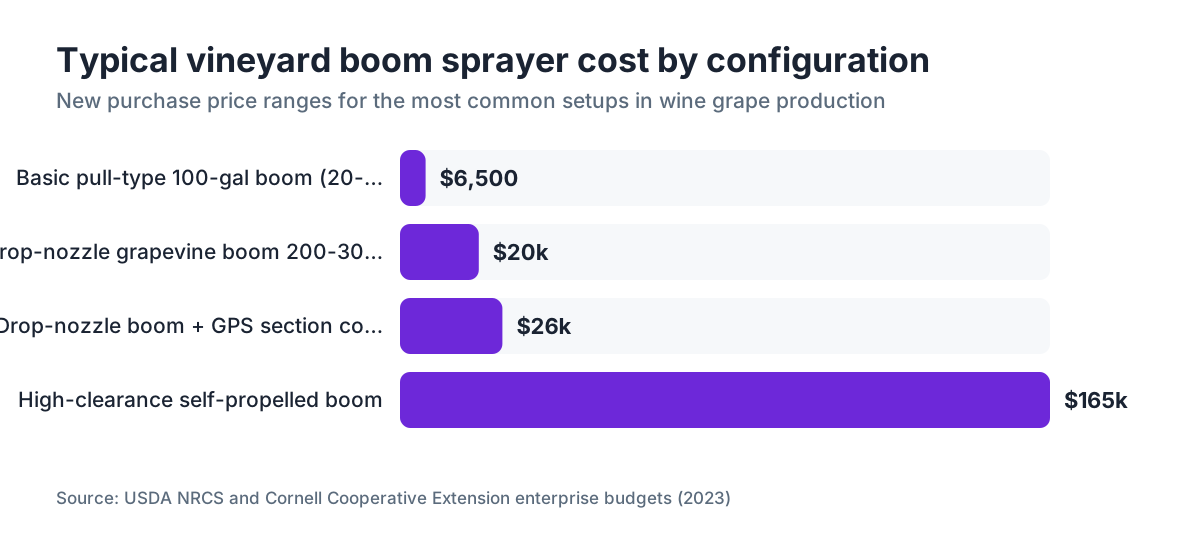
- A decent new unit runs $8,000 to $30,000.
What is a vineyard boom sprayer and how does it differ from an airblast?
A boom sprayer holds a horizontal frame, called the boom, that reaches across one or more vine rows. Nozzles along that boom spray liquid at a set spacing, pressure, and angle. You get a deposit you can measure and predict. That predictability is why boom sprayers have gained ground in wine grape production over the past decade, especially for under-trellis weed control and low-canopy fungicide work.
An airblast sprayer uses a fan to push droplets into the canopy. Airblast machines earn their keep on tall, dense canopies (VSP or sprawl systems) where you need the spray to punch through leaves and reach the fruit. The cost is drift and dose uncertainty. A boom is quieter, uses less chemical per acre in many jobs, and lays down far more even coverage at the target zone [1].
The two are not interchangeable. Most growers running high-value Pinot or Chardonnay blocks reach for an airblast during canopy closure and a boom for pre-emergence herbicide or early-season fungicide passes while vines are still short. Some operations run a grapevine-specific boom with drop nozzles that reach into the fruiting zone. That middle ground is where the equipment has gotten genuinely interesting.
Want the full picture on how sprayer choice fits your vineyard operations? Understand your spray calendar before you lock in equipment.
What types of vineyard boom sprayers are available?
Four practical categories cover almost everything sold to wine grape growers.
Standard horizontal boom. A flat boom reaching left and right of the tractor, usually 20 to 40 feet wide. It fits flat, wide-row vineyards and does most under-trellis herbicide work. Cheapest entry point too, often $3,000 to $8,000 for a pull-type unit with a 100-gallon tank [2].
Grapevine-specific drop-nozzle boom. These rigs add downward-angled drop legs or articulating arms so nozzles reach the fruit zone or work close to the soil under the trellis wire. WSU Extension has documented better fungicide coverage in the cluster zone from drop-nozzle setups than from overhead boom passes alone [3].
High-clearance self-propelled boom. For flat valley-floor sites with wide rows, self-propelled units give you boom heights and span widths a standard tractor can't touch. They cost $80,000 to $250,000 in most builds and rarely pencil out under 200 to 300 acres.
Boomless nozzle systems. A boomless sprayer trades the extended boom for wide-angle nozzles that broadcast over a wider swath. Coverage uniformity drops compared to a real boom, but the rig is compact and nearly impossible to snag on trellis hardware. Growers use it mainly for weed control on steep ground.
A mid-size winery block of 20 to 50 acres usually gets the most out of a pull-type drop-nozzle boom on a 40 to 80 HP tractor. That handles the common spray jobs without the maintenance load of a self-propelled machine.
How do you calibrate a vineyard boom sprayer correctly?
Calibration is the single most important thing you do with a sprayer. Too little product and disease control fails. Too much and you break the pesticide label, a federal offense under FIFRA [4]. Most over- and under-application traces back to one thing: nobody re-checked calibration after a nozzle swap or a pressure change.
The core formula:
Gallons per acre (GPA) = (GPM per nozzle × 5,940) / (nozzle spacing in inches × speed in MPH)
GPM is per-nozzle output in gallons per minute, 5,940 is a unit-conversion constant, nozzle spacing is measured in inches along the boom, and speed is your real field speed in miles per hour [5].
Here's the sequence that works:
- Set your operating pressure (pull the nozzle manufacturer's table for your target GPA and droplet size).
- Catch spray from each nozzle in a container for exactly 30 seconds, then double it for GPM. Compare nozzle to nozzle. Replace any that runs more than 10 percent above or below the average [9].
- Time your actual field speed over a known distance with the sprayer in the row, not on pavement. Field speed usually runs 10 to 15 percent slower than road speed because of row unevenness.
- Run the numbers through the formula and compare calculated GPA to the label target.
- Adjust pressure or speed until you're within 5 percent of target.
UC Davis Cooperative Extension recommends recalibrating at the start of each spray season and again any time you swap nozzle types or the crop stage shifts your target GPA [1]. That's not overkill. Nozzles wear, and a worn nozzle running 15 percent over rate across a 40-acre block is both a compliance risk and a real cost.
One thing almost everybody skips: mark your calibration date on the tank with a paint pen. Ten seconds. It ends arguments later.
What nozzle type should you use on a vineyard boom?
Nozzle choice sets droplet size, and droplet size drives both drift and coverage. Three types dominate vineyard booms: flat fan, hollow cone, and air-induction (sometimes sold as twin-flat-fan or Turbo TeeJet style).
Flat fan nozzles make medium droplets (250 to 350 microns VMD) and spread evenly across the swath. They're the default for under-trellis herbicide. Hollow cone nozzles make finer droplets that wrap around plant surfaces better, which helps early-season fungicide work on young shoot tissue.
Air-induction nozzles make coarse, air-filled droplets that resist drift hard. Reach for them near sensitive areas, waterways, or a neighbor's back fence. UC Davis testing has shown air-induction nozzles cut airborne drift by 50 to 90 percent versus standard flat fans at the same GPA [1]. The catch: those coarse droplets cover waxy leaf surfaces less evenly, so they're a poor match for contact fungicides that need thorough surface coverage.
A working rule for spacing: 20-inch spacing at 20 to 30 inches above the target gives good overlap for flat fan nozzles. Tighten to 15 inches when you're working close to the canopy with drop legs.
| Nozzle Type | Typical VMD (microns) | Drift Risk | Best Use Case |
|---|---|---|---|
| Flat fan | 250-350 | Medium | Herbicide, early fungicide |
| Hollow cone | 100-250 | High | Foliar contact fungicide |
| Air-induction | 400-600 | Low | Near drift-sensitive areas |
| TwinFlat/off-center | 300-450 | Medium-Low | General boom work |
How much does a vineyard boom sprayer cost, new and used?
The range is wide because the category runs from a $2,500 pull-behind herbicide rig to a $250,000 self-propelled precision machine. Here's the honest breakdown for what wine grape operations actually buy.
A basic pull-type boom with a 100-gallon tank and a 20- to 30-foot boom costs $4,000 to $9,000 new from brands like Hardi, Fimco, or John Deere. That's your under-trellis herbicide setup.
A purpose-built grapevine boom with drop arms, stainless fittings, and a 200- to 300-gallon tank runs $12,000 to $28,000 new. Add GPS section control and that's another $3,000 to $8,000 for the controller and valve hardware.
Used units on auction and dealer lots sell for 40 to 60 percent of new price if they're under 10 years old with well-kept pumps and booms. Inspect the pump hard. A worn diaphragm pump that needs replacing adds $800 to $2,500 to your purchase.
Operating cost lands around $4 to $10 per acre per pass once you count fuel, labor at $18 to $25 an hour, and equipment wear (chemical excluded). That figure comes from budgets published by Cornell Cooperative Extension for New York wine grapes, which run similar equipment under comparable conditions [6].
Don't sleep on downtime. A pump seal that fails in the middle of a late-May fungicide window costs you far more in lost efficacy than the seal itself. Keep a spare diaphragm kit on the shelf.
What EPA Worker Protection Standard rules apply to vineyard spraying?
The EPA Worker Protection Standard (WPS), revised in 2015 and codified at 40 CFR Part 170, sets mandatory rules for anyone who mixes, loads, or applies pesticides on an agricultural establishment, vineyards included [7].
The rules that matter most for boom work:
Restricted-entry interval (REI). Every pesticide label carries an REI, the stretch after application when workers can't enter the treated area without personal protective equipment. Common vineyard fungicides run from 4 hours (many sulfurs and coppers) to 48 hours (some SDHIs and DMIs). Your spray records have to document the REI for each product.
Application exclusion zone (AEZ). Since the 2015 revision, applicators must keep all workers and other people out of a 100-foot zone around the equipment during application, unless they're in full PPE [7]. The rule applies to outdoor production, and workers and other persons must not be present in the AEZ while the application is happening.
Posting requirements. After you apply a pesticide with a 48-hour or longer REI, you post warning signs at all usual entry points to the treated area. Signs have to meet set size, symbol, and language requirements.
Training and notification. Workers get WPS safety training every year. For pesticides with a 48-hour or longer REI, you notify workers before the application, either orally, in writing, or by posting.
OSHA's agricultural safety rules under 29 CFR 1928 overlap with WPS on PPE and record retention. California growers face stricter DPR requirements stacked on top of federal WPS [8]. If you're in California, check Cal/OSHA and DPR rules on their own.
WPS-compliant records used to mean a stack of paper forms. Tools like VitiScribe let you log REIs, applicator credentials, and AEZ documentation digitally at the point of application, which makes an audit far less painful.
How do you reduce spray drift in a vineyard?
Drift is a legal problem and a chemistry problem at once. Off-target deposition can damage a neighbor's crop, trigger complaints, and create residue violations on an adjacent organic block. Federal and university sources both flag drift as a leading source of noncompliance in specialty crop production, though honest data on vineyards specifically is thin.
The controls, roughly in order of impact:
Nozzle selection. Switching from standard flat fan to air-induction nozzles is your highest-leverage move. The UC Davis testing cited above showed 50 to 90 percent drift reduction in field conditions [1].
Speed. Every 1 MPH you add lifts the spray plume higher above the target and pushes drift farther downwind. Keep boom speed under 5 MPH any time there's wind.
Boom height. Drop the boom as close to the target as safe operation allows. Each extra foot of height above the target roughly doubles the area exposed to wind shear.
Wind speed and direction. The WPS and most labels prohibit application when wind tops 10 MPH. Practical drift risk climbs sharply above 5 MPH. Spray in the early morning when winds are calm. Within 300 feet of a home or surface water, UC Davis recommends stopping at 3 MPH sustained wind [1].
Buffer zones. Many herbicide labels now carry mandatory buffer distances from aquatic areas. Read the label for the specific product. The label is the law under FIFRA [4].
One underused option: drift-reducing adjuvants. Products like Interlock or Sylgard 309 push droplet size up and cut the fine-droplet fraction without touching your nozzle setup. They add $1.50 to $3.50 per 100 gallons of mix and can make a real difference near sensitive areas.
What records do you need to keep for vineyard boom sprayer applications?
Federal pesticide record-keeping for commercial applicators sits under FIFRA and its regulations at 40 CFR Part 171 [4]. For restricted-use pesticides (RUPs), certified applicators keep records for 2 years. Many states require 3 years, and for all applications rather than just RUPs.
A legally complete boom sprayer record includes:
- Date and time of application
- Location (field or block ID)
- Crop and crop growth stage
- Pesticide product name and EPA registration number
- Amount applied (per acre or per 100 gallons)
- Total area treated in acres
- Application method and equipment type
- Weather at time of application (temperature, wind speed, wind direction)
- Applicator name and certification number
- REI start and end times
- Pre-harvest interval (PHI) information
Cornell Cooperative Extension's Integrated Crop and Pest Management program recommends also logging nozzle type, GPA, and tank mix components, because you'll need that data if an efficacy question or residue issue surfaces later [6]. Good advice. A record that clears only the legal minimum tells you far less than one that captures what actually happened in the field.
Paper records satisfy the law and make audit season miserable. The gap between a WPS inspection request and a complete record set shrinks fast when everything lives in a searchable system. This is where VitiScribe earns its keep: every spray event, REI clock, and applicator certification in one place you can pull up in 30 seconds.
For growers certified under USDA MAEAP or chasing GAP certification, spray records are a primary audit document. Keep them organized.
How do you maintain a vineyard boom sprayer to keep it running?
A sprayer that dies mid-season costs you fungicide timing, which hurts more than the repair bill. The tasks that actually prevent failure are simpler than most people think. They just demand consistency.
End-of-season flush. Run clean water through the whole system until tank, boom, and nozzles are free of chemical residue. Then fill with a tank cleaner (several products are made for sprayer decontamination) and circulate 10 to 15 minutes. Drain it dry. Leftover residue corrodes diaphragms, clogs strainers, and cross-contaminates future loads.
Nozzle replacement. Most nozzles are rated for 40,000 to 50,000 gallons of output before wear pushes flow rate out of spec. Track gallons applied per season and replace the whole set on a schedule instead of swapping worn ones piecemeal. A full set of 20 flat fan nozzles runs $60 to $150. A spray efficacy failure from worn nozzles costs far more.
Pump inspection. Check diaphragms every year. Diaphragm pumps (the most common type on vineyard booms) show wear as pulsation, a pressure drop, or chemical showing up in the oil reservoir. Rebuild kits cost $80 to $200 and take about two hours to install.
Strainer cleaning. Clean boom line strainers every 3 to 5 tank loads. Clogged strainers drop pressure unevenly across the boom and leave spotty coverage you won't catch until disease shows up in the blocks.
Winter storage. After flushing, blow the lines out with compressed air and add RV-grade antifreeze if the sprayer will sit through freezing temperatures. A cracked manifold from one freeze is a $400 to $800 repair.
WSU Extension's spray equipment guides recommend a log card attached to the sprayer that records each calibration, nozzle replacement, and service event [3]. Five minutes per entry. It builds a maintenance history that matters at trade-in time and when you're chasing a recurring problem.
How do row spacing and trellis system affect boom sprayer selection?
This is where one-size-fits-all thinking falls apart. A boom that's perfect for a 12-foot-row Cabernet block on the valley floor is flat wrong for a 6-foot-row Pinot Noir block on a hillside.
Wide-row systems (10 to 14 feet) suit standard pull-type booms. You have clearance on both sides of the tractor and enough row width to swing the boom without clipping trellis stakes. Most of these blocks run VSP or bilateral cordon, with the target canopy concentrated between 24 and 60 inches above the soil.
Narrow-row, high-density blocks (6 to 9 feet) need a boom that fits inside the row. That usually means a shorter boom or a specialized over-row rig that straddles the vine row and sprays down. You see these in cool-climate Pinot Noir plantings across Oregon and California's Sonoma Coast, where spacing echoes Burgundian models.
Slope matters too. Above 15 percent, a pull-type boom can heel to one side as the tractor works across the grade, throwing off pressure and coverage across the boom width. Some hillside growers run self-leveling boom systems or just switch to boomless or airblast rigs on the steep blocks.
The trellis system reshapes the target zone. A Smart-Dyson or Lyre creates a wider, more open canopy that may need drop arms to reach the cluster zone from above. A minimal-pruning system builds a dense mass of canes where boom coverage alone won't penetrate.
Before you buy anything, walk your hardest block with a tape measure. Get row spacing at the narrowest point, measure trellis wire heights, and picture where your disease and weed targets actually sit in space. The sprayer has to physically reach them.
What are GPS and section-control features worth on a vineyard boom sprayer?
GPS section control shuts off individual boom sections automatically when they cross into an already-sprayed area or a no-spray zone like a water buffer. On a straight block, overlap is modest. On an irregular block with angled rows or headland turns, section control routinely saves 5 to 12 percent of chemical per application [2].
Run the math. At 10 passes per season on a 50-acre block, with chemical costing $60 to $120 per acre for the season, an 8 percent savings is $240 to $480 a year. A basic section control system adds $3,000 to $8,000 to the purchase price. That's a 6 to 15 year payback, which makes it hard to justify on smaller blocks unless the same hardware also helps with WPS record-keeping or prescription spraying.
Variable-rate application (VRA) is the next step up. VRA applies higher or lower rates in specific zones from a prescription map, maybe more fungicide in historically high-pressure spots or less herbicide where weed pressure is low. The vineyard research here is still young. Cornell's precision viticulture work has shown real yield and disease variation within single blocks [6], but turning that into reliable spray prescriptions takes more ground-truthing than most small operations can pull off.
For a 20 to 50 acre operation, GPS boom control is probably worth it at the high end of that range. Below 20 acres, the payback rarely works unless you're also mining the GPS data for other record-keeping.
How do you safely store and handle pesticides for boom sprayer use?
Storage and handling are where most small vineyards have compliance gaps. The rules come from several directions at once: EPA under FIFRA [4], OSHA under 29 CFR 1910 for general industry storage, and state ag department rules that vary a lot by state.
The non-negotiables. Pesticides live in a locked, ventilated structure separate from worker break areas and water sources. Products stay in their original labeled containers. Store herbicides and fungicides apart, because herbicide vapors (especially from volatile formulations) can hurt fungicide efficacy when the two share a confined space.
For the mix-and-load area, you need a concrete or impermeable pad with a containment berm so a spill never reaches soil or water. California DPR requires secondary containment able to hold 110 percent of the largest container's volume [8]. Most states follow similar guidance.
PPE during mixing and loading matches what the label requires, not less. If the label calls for chemical-resistant gloves and a face shield during mixing, that's the legal floor. Anyone handling pesticides must be WPS-trained before they mix or load [7].
Keep spill response materials (absorbent, triple-rinse supplies, the right PPE) at the mix-and-load area, not in a shed 200 feet away. A 30-gallon spill won't wait for you to walk back to the storage building.
Frequently asked questions
How many gallons per acre should a vineyard boom sprayer apply?
For under-trellis herbicide, most operations target 15 to 30 GPA. For fungicide passes reaching into the canopy, 50 to 100 GPA is more common because you need enough carrier volume for good surface coverage. The label rate for the specific product sets the legal range. Always calibrate to the label, not to a general habit.
What's the difference between a boom sprayer and a tower sprayer for vineyards?
A boom sprayer uses a horizontal frame with nozzles pointing down or at an angle toward a defined target zone. A tower sprayer is a vertical or angled airblast machine that pushes droplets sideways into the canopy. Booms give better coverage uniformity at the target and less drift. Towers penetrate tall, dense canopies better. Many growers use both, depending on job and growth stage.
How often should you replace nozzles on a vineyard boom sprayer?
Most manufacturers rate nozzles for 40,000 to 50,000 gallons of throughput before wear pushes output past 10 percent above nominal flow. For a 50-acre block with 10 passes at 25 GPA, that's about 12,500 gallons per season, so a set should last 3 to 4 seasons. Check output every year with 30-second timed samples from each nozzle and replace any that deviates more than 10 percent.
Can I use a boom sprayer for under-trellis weed control instead of herbicide?
Some growers run steam weeding or flaming equipment on a boom frame as a herbicide alternative. Vineyard results are mixed: steam handles young annual weeds well but struggles with established perennials, and equipment cost is high at $15,000 to $40,000 per unit. Thermal weeding won't replace a chemical boom in most commercial operations, but it can cut herbicide passes in certified organic blocks.
What pressure should I run a vineyard boom sprayer at?
Pressure depends on nozzle type and target GPA. Most flat fan nozzles for boom work run between 15 and 60 PSI. Going above the manufacturer's range increases fine droplets and drift without improving coverage. Going too low gives irregular distribution. Check the nozzle's technical chart for the pressure-to-GPM relationship and set pressure to hit your target GPA at your actual field speed.
Does a restricted-use pesticide require a special spray record format?
Federal rules under FIFRA require certified applicators using restricted-use pesticides to keep records for 2 years. The data elements sit in 40 CFR Part 171: applicator certification number, EPA product registration number, application date, location, crop, and quantity applied. Most states require 3 years. The format isn't prescribed, so paper logs, spreadsheets, or software all qualify as long as every required element is present.
What is the Worker Protection Standard application exclusion zone for vineyard spraying?
Under the 2015 revised WPS at 40 CFR Part 170, a 100-foot application exclusion zone applies for outdoor applications from most spray equipment. All workers and other persons stay outside that zone during application unless they wear appropriate PPE. Some high-toxicity pesticides carry larger AEZs on the label. The AEZ applies whether the pesticide is restricted use or general use.
How do I calculate boom sprayer speed for calibration?
Measure a known distance in the field (132 feet is handy because it yields a clean calculation). Drive it in the gear and throttle you'll use during spraying, with the tank loaded to simulate real field weight. Time the pass with a stopwatch. Speed in MPH equals 89.4 divided by your time in seconds over 132 feet. Do it three times and average. Pavement speed is no substitute for field speed.
What boom height above target is correct for vineyard applications?
It depends on nozzle type and spacing. For 80-degree flat fan nozzles at 20-inch spacing, correct height for 100 percent overlap (two nozzles hitting each point) is typically 18 to 20 inches above the target. Lower gives less overlap and streaky coverage; higher adds drift exposure. With drop-nozzle arms aimed at the fruiting zone, the tip should sit 12 to 18 inches from the vine wire. Check the manufacturer's spacing-height chart.
Are boom sprayers suitable for steep vineyard terrain?
Standard pull-type booms struggle above 15 to 20 percent slope because the boom tilts across the grade, creating uneven nozzle height and lopsided coverage between the uphill and downhill sides. Self-leveling suspension helps but adds cost. For steep hillside blocks, many growers use boomless broadcast nozzles, airblast machines, or handheld rigs instead. The practical ceiling for standard boom work is about 15 percent slope in most conditions.
How much does it cost to operate a boom sprayer per acre in a vineyard?
Cornell Cooperative Extension enterprise budgets for New York wine grapes put machine operating cost (fuel, repairs, depreciation) for a pull-type boom at roughly $4 to $8 per acre per pass, excluding chemical and labor. Add labor at $18 to $25 per hour, and a 50-acre pass runs 2 to 3 hours, adding $3 to $5 per acre. Total, excluding chemicals: about $7 to $13 per acre per application in most mid-scale operations.
Can a boom sprayer apply foliar nutrition products in vineyards?
Yes. Booms apply foliar calcium, zinc, boron, and other micronutrients routinely. Watch three things: tank mix compatibility (check each label for incompatibilities), carrier volume (most foliar labels set a minimum, often 20 to 50 GPA), and timing relative to other passes. Run a small jar test with all components before loading the full tank. Some foliar products are corrosive to stainless steel or aluminum fittings at concentrated rates.
What certifications does a vineyard boom sprayer operator need?
For general-use pesticides, an agricultural worker on a covered establishment needs WPS safety training but no certification. For restricted-use pesticides, the applicator or a supervising certified applicator must be responsible for the application under FIFRA. State categories vary: California's pest control adviser and operator licenses, New York's commercial applicator certification, and Washington's licensing all differ in requirements and renewal. Check your state department of agriculture for the category covering your crop and application type.
How far in advance should I notify workers before a boom sprayer application with a long REI?
The WPS requires notifying workers before they could be expected to enter the treated area after the REI begins. For pesticides with a 48-hour or longer REI, you post warning signs at all usual entry points. Oral or written notification is also required for any pesticide with an REI over 4 hours if workers could enter during the REI. EPA's WPS guidance requires notification before the application, not after.
Sources
- UC Davis Cooperative Extension, Sprayer Calibration and Pesticide Application Technology: Air-induction nozzles reduce airborne drift by 50 to 90 percent compared to standard flat fan nozzles; boom height and nozzle selection guidance for specialty crops
- Washington State University Extension, Spray Equipment for Vineyards: Drop-nozzle boom configurations improve fungicide coverage in the cluster zone compared to overhead boom alone; maintenance log recommendations
- U.S. EPA, Federal Insecticide Fungicide and Rodenticide Act (FIFRA): Pesticide label is a federal legal document; applying off-label rates is a FIFRA violation; restricted-use pesticide record-keeping required for certified applicators under 40 CFR Part 171
- Purdue Extension, Boom Sprayer Calibration (Publication AY-282): GPA calibration formula: GPA = (GPM × 5940) / (nozzle spacing in inches × speed in MPH); unit-conversion constant 5,940 explained
- Cornell Cooperative Extension, New York Wine Grape Production Enterprise Budget: Boom sprayer operating costs $4 to $10 per acre per pass in New York wine grapes; precision viticulture data showing yield and disease variation within individual blocks
- U.S. EPA, Worker Protection Standard for Agricultural Pesticides (40 CFR Part 170): 100-foot application exclusion zone for outdoor agricultural applications; WPS training, REI posting, and notification requirements; 2015 revision effective date
- California Department of Pesticide Regulation, Pesticide Use and Storage Requirements: California DPR requires secondary containment capable of holding 110 percent of the largest container's volume at mix-and-load areas; stricter state rules supplementing federal WPS
- Oregon State University Extension, Pesticide Applicator Training for Agricultural Spray Equipment: Nozzle output variation exceeding 10 percent above or below the average indicates replacement is needed; narrow-row spray equipment guidance for cool-climate wine grapes
Last updated 2026-07-10