Vineyard discharge prohibition compliance documentation near waterways
TL;DR
- A vineyard within 100 to 300 feet of a waterway falls under Clean Water Act Section 402 NPDES rules, state ag waiver conditions, and sometimes county buffer rules.
- Four documents protect you: a current site map showing drainage paths, a written runoff control plan, dated pesticide and fertilizer records, and storm inspection logs.
- Miss any one and an inspector can write a Notice of Violation.
What discharge prohibitions actually apply to vineyards near water?
Start with the Clean Water Act. Section 301(a) prohibits discharging any pollutant to waters of the United States without a permit, and Section 402 runs the permit program that matters for most vineyard operators. [1] Agricultural stormwater runoff gets a conditional exemption from NPDES permitting under 33 U.S.C. § 1342(l)(1), but that exemption is narrower than most growers think. It covers only stormwater runoff from fields during rain. An irrigation return flow, a point-source discharge from a drain pipe, or a spill of pesticide concentrate is not exempt.
Every major wine-producing state stacks its own rules on top of the federal baseline. California's Central Valley Regional Water Quality Control Board issues General Waste Discharge Requirements for irrigated lands (Order R5-2018-0040 and its updates). [2] Oregon's Agricultural Water Quality Management Program under ORS 568.900 can require farm plans for operations near water. Washington's NPDES general permit for agricultural activities applies to certain dairy and concentrated operations, and it also triggers buffer and reporting expectations for other ag users inside shoreline management areas.
The phrase "discharge prohibition" in these state programs usually means one of three things. A flat ban on direct discharge of tailwater or runoff to a named waterway. A ban during defined rain events or dry-season windows. Or a ban on runoff that crosses a numeric threshold for turbidity, EC, or nitrate.
Knowing which version applies to your property is the prerequisite for knowing what records you need to keep.
Which waterways trigger these rules for my vineyard?
If a stream, wetland, canal, or pond sits within about 300 feet of your vineyard blocks, assume a discharge rule applies until you confirm otherwise. "Waters of the United States" (WOTUS) has been redefined again and again by litigation and rulemaking, and the 2023 Supreme Court decision in Sackett v. EPA (No. 21-454) cut federal jurisdiction hard, dropping most isolated wetlands and ephemeral streams from federal coverage. [3] State jurisdiction often fills the gap. California protects waters of the state under the Porter-Cologne Act, which covers every surface water body regardless of federal WOTUS status.
The features to watch for:
- Perennial or intermittent streams shown on USGS 7.5-minute topographic maps
- Seasonal creeks or blue-line streams on any state resource agency map
- Wetlands, including seasonal wet areas
- Irrigation canals with a downstream public water connection
- Ponds or reservoirs with an outlet to navigable water
Ephemeral channels, the ones that flow only during or right after rain, may or may not be covered depending on your state and county plan. WSU Extension's viticulture and irrigation guidance notes that growers routinely underestimate how many ephemeral features on their land a state agency will treat as jurisdictional. [4]
Call your county farm advisor before the growing season, not during an inspection.
What buffer distances does my vineyard legally need to maintain?
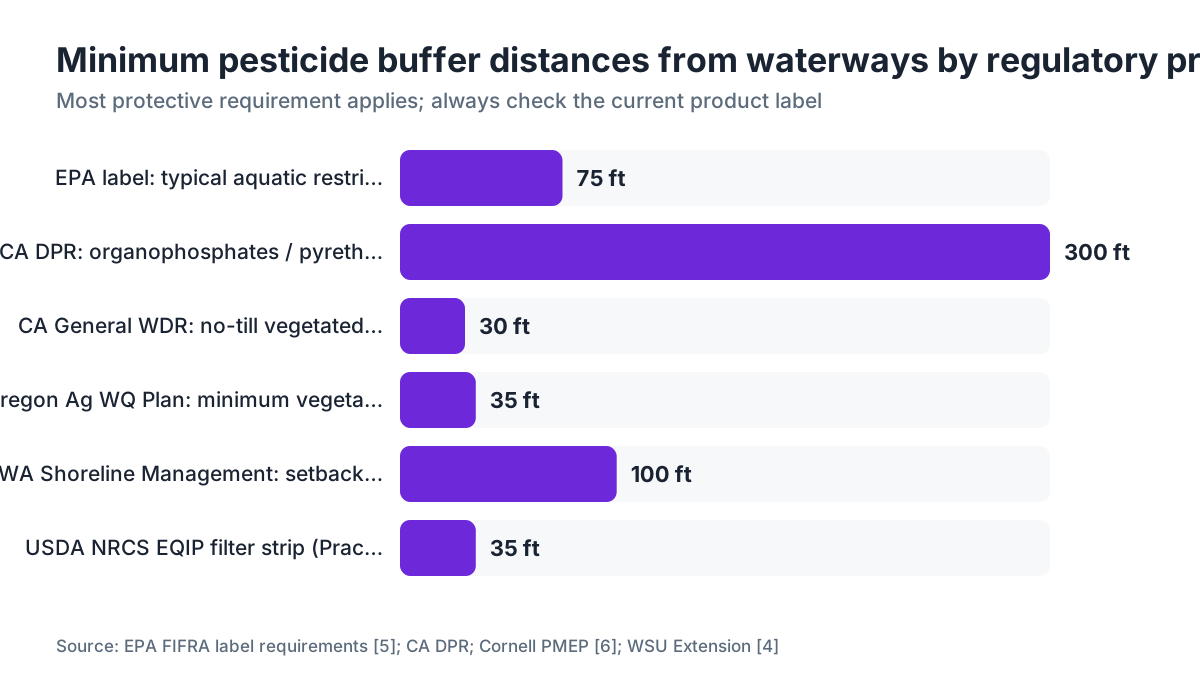
Buffer requirements come from at least four regulatory layers, and they don't always agree. The pesticide label is the hardest of them. Under FIFRA, the label is the law.
| Regulatory Program | Typical Buffer from Water Edge | Notes |
|---|---|---|
| EPA Pesticide Label (federal) | Label-specific; commonly 25-100 ft for aquatic restriction | Overrides all state minimums if label is more protective |
| CA General WDR Order R5-2018-0040 | 30 ft no-till vegetated buffer for erosion | Additional setbacks may apply |
| CA Dept. of Pesticide Regulation | Varies by active ingredient; 50-300 ft for some organophosphates | DPR product database lists product-specific setbacks |
| Oregon Ag Water Quality Plan | 35 ft minimum vegetated buffer in most plans | Can be 50 ft on high-gradient slopes |
| WSU/WA Dept. of Ecology Shoreline Mgmt | 100-200 ft shoreline setback depending on stream class | Applies to new development and major modifications |
| USDA NRCS EQIP practices | 35 ft for practice 393 filter strip cost-share | Voluntary but often tied to payment eligibility |
If a product you spray carries a "do not apply within X feet of water" statement, that distance governs, even when your state program allows a smaller buffer. [5] Cornell's Pesticide Management Education Program puts it plainly: the most protective requirement, whether label, state rule, or local rule, is the one you must follow. [6]
Document the buffer you're keeping. Photograph the vegetated strip. Measure from the ordinary high-water mark, not the top of the bank. Regional water board inspectors routinely check claimed buffer widths against satellite imagery and lidar, so the width on your map and the width in the field have to match.
What documents do inspectors actually look for during a waterway compliance inspection?
The short list is five items: a site map, a runoff control plan, pesticide application records, fertilizer records, and inspection logs. Go through each one.
Site map. You need a current map (no older than three to five years, and updated after any significant grading) that shows block layout, slope direction, drainage paths, culverts, tile drains, swales, detention basins, and every waterway within 300 feet of your operation. It doesn't need CAD-quality drafting. It needs to be legible and accurate. If your drainage paths changed because you built a road or pulled a block, update it.
Runoff control plan. California's General WDR requires a written document describing what you do to prevent or manage runoff to waters. Other states call it a Farm Water Quality Plan or a Riparian Management Plan. The substance is the same: identify your erosion risk areas, list the practices in place (cover crops, straw wattles, check dams, vegetated buffers), and name who is responsible for each. UC Cooperative Extension has a Farm Water Quality Plan workbook that works as a template even outside California. [7]
Pesticide application records. California Food and Agricultural Code Section 12977 requires every application to be recorded within 24 hours and filed with the County Agricultural Commissioner monthly. [8] The record has to list the operator name, property location, pesticide name and EPA registration number, amount applied, application date, target pest, and method. Federal law (FIFRA Section 8) requires commercial applicators to keep records for two years; most state programs want three. Note the distance from the application area to the nearest waterway. That one field note has saved more than a few growers during a discharge investigation.
Fertilizer records. Nitrogen near water draws more scrutiny every year. California's Irrigated Lands Regulatory Program requires nitrogen management reporting in high-priority areas. Keep product, rate (lb N/acre), method, and date. If you fertigate through drip, keep records of system flush volumes and where the flush water drains.
Inspection logs. If your permit or waiver requires self-inspection after storms, log it. Record the date, the person who inspected, weather before and during, what they saw at each drainage outlet, and any corrective action. A blank log for a storm event is evidence of non-compliance. A completed log showing you found minor silt at an outlet and installed a straw wattle the next day is evidence of a system that works.
How do pesticide label aquatic hazard statements change your recordkeeping?
Aquatic hazard language on a label decides what your records have to prove. Labels carry several types of waterway-related language, and each one raises the bar on documentation.
The strongest is a "do not apply directly to water or to areas where surface water is present or to intertidal areas below the mean high water mark" statement. That is a legal prohibition. Your records have to show you did not apply during rain or inside the prohibited zone.
Some labels carry "Runoff Advisory" or "Spray Drift Advisory" language under EPA's Endangered Species Protection framework. Those advisories require specific buffers and, in some counties, county-level mitigation measures administered through the state pesticide use permitting system.
The EPA Worker Protection Standard (40 CFR Part 170) isn't about waterways, but it requires records of restricted-entry intervals and pesticide safety training that inspectors sometimes pull during a combined visit. [9] If you're near water and an inspector is already on site, they may check your WPS records in the same trip.
UC Cooperative Extension's statewide IPM program recommends recording buffer distance and weather (wind speed, temperature, humidity) with every application, even when no rule demands it, because that data is your best defense if a drift or runoff complaint comes in. [10]
What is an NPDES permit and does my vineyard need one?
An NPDES permit (National Pollutant Discharge Elimination System, authorized by Clean Water Act Section 402) is required for any point-source discharge to waters of the United States that isn't exempt. [1] For most vineyards, the question is whether your drainage system creates a point source: a discrete, confined conveyance like a pipe, ditch, or channel.
If your tile drains outlet directly to a creek or irrigation canal, that outlet is likely a point source, and you may need an individual or general NPDES permit. If your surface runoff sheet-flows across a buffer strip and disperses before it reaches water, the agricultural stormwater exemption more likely covers it.
California doesn't issue individual NPDES permits to most irrigated ag operations. The State Water Board administers the Irrigated Lands Regulatory Program (ILRP) instead, and most growers comply by joining a third-party coalition. [2] Coalition membership carries its own reporting and fee requirements, but it satisfies the NPDES obligation in most regions. Farm in a high-priority watershed (the Tulare Lake Basin, parts of the Sacramento Valley) and your coalition adds monitoring and reporting on top.
Washington and Oregon run their own general permit systems for agricultural dischargers. Check with your state Department of Ecology or Department of Agriculture to confirm which general permit, if any, covers your operation.
Managing this across multiple blocks and multiple regulatory calendars is where paper falls apart. VitiScribe centralizes spray records, inspection logs, and compliance documents so nothing slips when a quarterly report comes due.
What happens if my vineyard receives a Notice of Violation near a waterway?
A Notice of Violation isn't a penalty. It's a formal notice that a regulatory agency believes you've broken a permit condition or state water quality law. You get time to respond, and the quality of your records decides what happens next.
Complete application records, a current farm water quality plan, and inspection logs that show good-faith management let your response demonstrate compliance or explain an isolated event. Agencies treat an operator with documentation of a working system very differently from one with none. Civil penalties under California Water Code Section 13385 can reach $10,000 per day per violation for chronic or negligent discharges. [11] First-time NOVs against operations with good records land far lower, often as a Compliance Order rather than a fine.
Federal penalties under Clean Water Act Section 309 run from $25,000 per day for ordinary violations up to $50,000 per day for knowing violations. [1] Those figures rarely hit an individual farmer who made an isolated mistake and can show corrective action.
What to do after an NOV:
- Respond in writing within the deadline in the notice (often 30 days).
- Don't admit liability in your first response; describe your management system instead.
- Pull all relevant records: application records for the date range in question, maps, inspection logs.
- Fix the problem on the ground and document the fix with dated photos.
- Consider hiring an environmental attorney if the NOV cites a violation with significant water quality impact.
Never ignore an NOV. Silence reads as admission.
How should vineyard drainage maps and site plans be structured for compliance?
Your drainage map is usually the first thing a water board inspector or coalition monitor asks to see. Build it right the first time and it takes maybe two hours. After that you're just updating it.
Start with a base layer from Google Earth, your county parcel map, or a USGS topo. Mark every block by name and number. Draw arrows for the dominant slope and drainage direction of each block. Mark every culvert, swale, road ditch, drain pipe, and pump outlet. Circle every waterway within 300 feet of the property edge. Add buffer widths measured from the ordinary high-water mark, and note where you have vegetated filter strips, berms, or other control practices.
Label the map with a date and your name. Every time you change a drainage feature, update the map and re-date it. Inspectors compare your current map to satellite imagery, and if your map shows a grass waterway you graded out two years ago, that gap creates questions you don't want to answer.
Running a tile drainage system? Add a separate diagram of the tile layout, outlet locations, and where any outlets approach water. Tile drain outlets are among the most commonly cited sources of nitrate discharge to waterways in agricultural regions. [12]
For high-priority areas near salmon streams, designated impaired water bodies, or a total maximum daily load study, add GPS coordinates for each drainage outlet. USGS StreamStats confirms which downstream water body your drainage reaches and whether it's on a 303(d) impaired waters list. [13]
What do state ag waiver programs require for annual reporting?
In California, if your vineyard sits in a region covered by the Irrigated Lands Regulatory Program, you almost certainly report through a coalition rather than directly to the Regional Water Board. Every coalition has its own annual reporting form, but the common elements repeat:
- Total acreage farmed near a water body
- List of pesticides applied near the waterway, with dates and rates
- Nitrogen balance or nitrogen management summary
- Description of management practices in place
- Results of any water quality monitoring you conducted
- Confirmation that your farm water quality plan is current
Deadlines vary by coalition and watershed, but annual reports are typically due in the first quarter (January to March) covering the prior calendar year. Miss the deadline and you usually get a late fee. Miss it repeatedly and the coalition may refer you to the Regional Board for individual enforcement.
Oregon's Agricultural Water Quality Management Area Plans under ORS 568.900 work differently. The Oregon Department of Agriculture develops area plans with local advisory committees, and farm operators implement the practices in the applicable plan. There's less formal annual reporting for most vineyard operators, but ODA can conduct site inspections and require corrective action.
WSU Extension's farm water quality planning guidance is worth reading even for California and Oregon growers, because it walks through the plan development logic clearly and maps onto other states' requirements. [4]
What's the minimum documentation a small vineyard should keep year-round?
Small operations often struggle with the paperwork, and there's real risk of over-building a system that never gets maintained. Here's the minimum viable compliance file I'd actually keep.
Always active (update within 24 hours of any event):
- Pesticide application log (date, product, rate, block, applicator, weather, distance to nearest waterway)
- Fertilizer application log (date, product, rate, block, method)
- Equipment maintenance log for any sprayer used near water (calibration date, nozzle type, drift-reduction measures)
After every rain event above 0.5 inches:
- Drainage inspection note (who checked, what they saw at outlets, any corrective action)
Once a year, before peak spray season:
- Review and re-date your site map
- Confirm your farm water quality plan still reflects current practices
- Check every pesticide you plan to use for new label language on aquatic hazard or buffer requirements (labels change)
File and retain at least three years:
- All of the above, plus any coalition correspondence, monitoring results, and NOVs with your response
That's it. It doesn't take elaborate software. A binder and a consistent habit keep you legally protected. If you're managing more than 20 acres near water with multiple blocks and multiple employees, a digital system like VitiScribe can track all of this without the back-filing problem that kills paper systems.
For vineyard managers working near protected waterways, the documentation habit is the compliance.
How do I find out if my waterway is on a 303(d) impaired list, and why does it matter?
Under Clean Water Act Section 303(d), states must identify water bodies that don't meet water quality standards and list them as "impaired." [1] If your vineyard drains to an impaired water body, you face stricter compliance expectations and possibly a Total Maximum Daily Load (TMDL) process that allocates how much of a pollutant each source, ag runoff included, can contribute.
The impairments that hit vineyards most: sediment from erosion, nitrogen and nitrate, pesticides (diazinon and chlorpyrifos impairments are widespread in California wine regions), and temperature from shade loss when riparian cover gets cleared.
To check, go to EPA's ATTAINS database (attains.epa.gov) or your state water board's 303(d) list. Enter your waterway's name or look up your watershed. If it's listed, find out what it's impaired for. That pollutant is exactly what regulators focus on during inspections of nearby operations.
In a watershed with a pesticide TMDL, check whether a Pesticide Management Plan or other response has been adopted. In California, the Department of Pesticide Regulation coordinates with regional water boards on TMDLs for diazinon and chlorpyrifos. Your County Agricultural Commissioner can tell you whether your area carries restrictions tied to a specific TMDL. [8]
What extension resources exist for vineyard discharge compliance planning?
Several university extension programs have done solid work on this, and a few are worth bookmarking before the season starts.
UC Cooperative Extension's Farm Water Quality Planning program, developed with the State Water Board, includes a workbook that walks vineyard operators through site assessment, practice selection, and documentation. It's built for the ILRP compliance structure, but the logic applies broadly. [7]
Cornell Cooperative Extension's Pesticide Management Education Program (PMEP) covers pesticide label interpretation and waterway restrictions in depth, including how to read and apply aquatic protection language. It fits New York and northeast wine regions well. [6]
WSU Extension's viticulture program has produced guidance on irrigation water management and runoff from vineyard operations, with attention to the regulatory context in Washington's major wine appellations. [4]
The National Agricultural Law Center at the University of Arkansas keeps a regularly updated overview of state-by-state water quality requirements for agricultural operations, a useful start if you farm in a state the extension resources above don't cover.
EPA's agricultural compliance resources (epa.gov/agriculture) include a plain-language overview of which Clean Water Act exemptions apply to farming and what triggers NPDES permit requirements. [9] Read it once before anything else, because it sets the federal floor before you layer your state requirements on top.
Frequently asked questions
Do I need an NPDES permit if my vineyard only has stormwater runoff during rain events?
Agricultural stormwater from fields during rain is exempt from NPDES permitting under 33 U.S.C. § 1342(l)(1), but that exemption has real limits. If your drainage includes a pipe, ditch, or confined channel that discharges to a waterway, even during rain, that outlet may be a point source requiring a permit or state waiver enrollment. Check whether your state has a general permit or coalition waiver program that covers you.
How far from a stream do I have to stop spraying pesticides?
The pesticide label governs. Common setbacks run from 25 to 300 feet depending on the active ingredient and application method. Some organophosphates and pyrethroids carry 100-foot or greater aquatic restriction buffers. Read the current label for every product before the season starts, because labels change. Your state's Department of Pesticide Regulation database can also show product-specific setbacks for your region.
What records do I need to prove my vineyard's buffer strip is compliant?
Keep a dated site map showing buffer width measured from the ordinary high-water mark, not the top of the bank. Add annual dated photos of the vegetated strip, with GPS coordinates if possible. If you hold the buffer width by limiting tillage or mowing, note that in your farm water quality plan. Inspectors use satellite imagery to cross-check, so your records and the visible field condition have to match.
How long do I have to keep pesticide application records for waterway compliance?
Federal FIFRA requires commercial applicators to keep records for two years. Most state programs require three. California's Food and Agricultural Code Section 12977 requires records be filed with the County Agricultural Commissioner and retained for three years. If your watershed has a TMDL or you've received an NOV, keep all records for at least five years.
What is the California Irrigated Lands Regulatory Program and who does it cover?
The ILRP is a statewide program administered by the State Water Board's nine Regional Water Quality Control Boards. It regulates discharge from irrigated agricultural lands to California's waters under the Porter-Cologne Act. Most vineyard operators in California comply by enrolling in a third-party coalition. Coalition membership requires annual reporting, fee payment, and adherence to a coalition-specific water quality management plan.
Can my vineyard be cited even if my runoff doesn't visibly reach the stream?
Yes. Regulators can cite you for conditions likely to cause a discharge, not only for observed discharges. If you lack control measures in documented high-risk areas and runoff pathways lead toward a waterway, an inspector can issue a Notice of Violation based on the risk alone. Documented management practices and buffer maintenance are your evidence that you've reduced that risk.
What is a Farm Water Quality Plan and is it legally required?
A Farm Water Quality Plan (FWQP) is a written document describing your site, its drainage risks, and the management practices you've put in place to protect water quality. In California, the ILRP and its coalitions require a current FWQP as a condition of enrollment. Oregon's Ag Water Quality Management Program also requires farm plans in designated management areas. UC Cooperative Extension offers a workbook to help operators build one.
What are the penalties for an unpermitted discharge from a vineyard to a waterway?
Federal penalties under Clean Water Act Section 309 can reach $25,000 per day for ordinary violations and $50,000 per day for knowing violations. California Water Code Section 13385 allows civil penalties up to $10,000 per day per violation. In practice, first-time violations with documented corrective action often result in a Compliance Order rather than maximum fines, but only if you have records showing a functioning management system.
How does the Sackett v. EPA decision affect waterway compliance for vineyards?
The 2023 Supreme Court decision in Sackett v. EPA (No. 21-454) narrowed federal Clean Water Act jurisdiction by removing most isolated wetlands and ephemeral streams that lack a continuous surface connection to navigable water. Many states, California among them, protect these features under state law regardless of federal jurisdiction. Don't assume a seasonal creek or wetland on your property lost its regulatory status after Sackett.
Do cover crops and filter strips count as documentation of discharge prevention?
They count as evidence of a management practice, but only if you document them. Note when the cover crop was seeded, what species, and in which blocks. Photograph the filter strip at least once a year with a visible scale or measurement. Include these practices in your farm water quality plan. Practices that exist on the ground but nowhere in writing give you limited protection during an inspection.
What should I do immediately after a suspected pesticide or sediment discharge to a waterway?
Stop the source if you can do it safely. Document the event with photos and notes: time, location, estimated volume, weather, and what product or material was involved. Check your permit or waiver for mandatory self-reporting timeframes; some require notification to the Regional Water Board within 24 to 48 hours. California's emergency reporting line for spills is the Office of Emergency Services: 1-800-852-7550.
Are there federal cost-share programs that help vineyards build waterway buffers?
Yes. USDA's Environmental Quality Incentives Program (EQIP) provides payments for practices like filter strips (Practice 393), riparian herbaceous cover (Practice 390), and grassed waterways (Practice 412). Payment eligibility typically requires a 35-foot minimum buffer width and a current conservation plan. Contact your local USDA Service Center or NRCS office for current payment schedules, which vary by state and priority watershed.
What's the difference between a Notice of Violation and a Cleanup and Abatement Order?
An NOV is a notification that a violation occurred or may have occurred; it's the agency opening a conversation. A Cleanup and Abatement Order (CAO) under California Water Code Section 13304 is a formal directive requiring you to stop the discharge, contain any pollution, and clean up the affected area. CAOs carry more legal weight and can be enforced through court action. Good documentation and prompt corrective action can keep an NOV from becoming a CAO.
Sources
- EPA, Clean Water Act Sections 301, 302, 402, 309: CWA Section 301(a) prohibits pollutant discharge without a permit; Section 402 establishes NPDES; Section 309 sets civil penalties up to $25,000-$50,000 per day; Section 1342(l)(1) exempts agricultural stormwater from NPDES
- Supreme Court of the United States, Sackett v. EPA, No. 21-454 (2023): Sackett v. EPA (2023) narrowed federal WOTUS jurisdiction by removing isolated wetlands and ephemeral streams without continuous surface connection to navigable waters
- EPA, Federal Insecticide, Fungicide, and Rodenticide Act (FIFRA): Under FIFRA, the pesticide label is the law; label buffer requirements override state minimums when the label is more protective; commercial applicators must retain records for two years
- Cornell University, Pesticide Management Education Program (PMEP): Cornell PMEP states the most protective requirement (label vs. state rule vs. local rule) is always the one the operator must follow for waterway buffer compliance
- California Department of Food and Agriculture, Pesticide Use Reporting under Food and Agricultural Code Section 12977: California Food and Agricultural Code Section 12977 requires pesticide application records within 24 hours, filed monthly with the County Agricultural Commissioner, retained three years
- EPA, Worker Protection Standard, 40 CFR Part 170; EPA Agricultural Compliance Resources: EPA WPS (40 CFR Part 170) requires records of restricted-entry intervals and pesticide safety training; EPA ag compliance page explains which CWA exemptions apply to farming
- UC Statewide Integrated Pest Management Program: UC Statewide IPM recommends recording buffer distance and weather conditions (wind speed, temperature, humidity) in pesticide application records even when not strictly required
- California Water Code Section 13385, Civil Monetary Liability: California Water Code Section 13385 allows civil penalties up to $10,000 per day per violation for discharge violations; Section 13304 authorizes Cleanup and Abatement Orders
- USGS, Water Resources Mission Area, tile drainage and nitrate research: USGS research identifies tile drain outlets as among the most commonly cited sources of nitrate discharge to waterways in agricultural regions
- USGS StreamStats: USGS StreamStats allows users to confirm which downstream water body a given drainage outlet reaches and whether it appears on a 303(d) impaired waters list
- EPA ATTAINS, 303(d) Impaired Waters Database: EPA's ATTAINS database lists state 303(d) impaired water bodies by watershed; operators can search by waterway name to determine impairment status and relevant TMDL programs
Last updated 2026-07-11