Vineyard herbicide sprayer: how to choose, set up, and use one right

TL;DR
- Vineyard herbicide sprayers run from simple boom wands for small blocks to over-the-row machines that shield the canopy while treating both undervine strips in one pass.
- The right pick depends on row spacing, terrain, budget (roughly $800 to $80,000), and your state's record-keeping rules.
- Calibration and Worker Protection Standard training are non-negotiable no matter what you buy.
What types of vineyard herbicide sprayers are there?
Four main categories, each built for a different scale and job.
First, the hand-carried or backpack sprayer. These are fine for spot treatments, resprays around drip emitters, or new plantings where you need tight control. Pressure is manual or battery-powered. Output is low, operator fatigue is real on anything bigger than a quarter acre, and drift control depends almost entirely on the nozzle you mount. For a 200-vine block you just planted, they work. At scale, they don't.
Second is the tractor-mounted boom sprayer with a shielded undervine head. A three-point or toolbar frame carries a horizontal boom that rides below the cordon and lays herbicide on the undervine strip. Shields (usually plastic or stainless skirts) keep spray off the trunk and lower canes. This is the workhorse setup for flat to gently rolling ground with consistent row spacing. Expect $3,000 to $15,000 for a basic shielded undervine boom, depending on tank size and rows treated per pass [1].
Third is the over-the-row vineyard herbicide sprayer, sometimes called an over-vine or straddle sprayer. The machine straddles the vine row and hits both undervine strips at once, so you treat two rows worth of strip in a single pass. The canopy sits inside the machine's arch, which blocks overspray. Output per tractor hour roughly doubles versus treating one strip at a time. Cornell Cooperative Extension notes over-the-row designs help most where row spacing is too tight for a tractor to turn between rows [2].
Fourth is the self-propelled or high-clearance sprayer with herbicide heads. These are usually airblast-style machines fitted with herbicide wands or shielded booms instead of the fan that drives fungicide spray. They run $50,000 to $80,000 or more and pencil out mainly for large commercial operations treating 200 acres or more of uniform plantings.
Then there are rope-wick applicators, which paint herbicide directly onto vegetation with no spray at all. Glyphosate rope-wicks nearly kill off drift and shine on grasses that have shot up past the desired height, but they're slow and they need the target plant to be taller than everything around it. Genuinely useful. Just niche.
How does an over-the-row vineyard herbicide sprayer work?
It solves the oldest problem in vineyard weed control: how do you spray the ground right under the vine without hitting green bark, suckers, or low leaves? The over-the-row machine does it with an arch and shields instead of a steady hand.
The frame forms an inverted U wide enough to clear the trellis posts and low canopy as it straddles the row. Inside the arch, two sets of shielded nozzles point inward and down, one aimed at the strip on each side of the trunk. The shields, usually HDPE or stainless, hang close to soil level and act as physical walls that hold the spray pattern below the canopy. Some designs add rubber flaps or brush contacts to seal the spray zone against upward drift.
Because both strips get treated in one pass, you cut field time nearly in half against single-row gear. That counts in spring, when the window between bud swell and the point where you can no longer safely use contact herbicides near green tissue can shrink to one or two weeks in warm regions [3].
Offset nozzle placement lets the operator dial in spray angle and height for different training systems. VSP-trained vines with low fruiting wires are easy. Head-trained or high-cordon systems may need a custom arch height. Most over-the-row sprayers adjust from about 36 inches to 60-plus inches of clearance.
Pressure and nozzle choice still matter. Flat-fan tips at 15 to 25 PSI with a coarse or ultra-coarse droplet classification cut drift while holding coverage at typical travel speeds of 3 to 5 mph [4]. Run too fast and pattern overlap falls apart. Run too slow at high pressure and you make fine droplets that drift. Calibration isn't optional.
What does a vineyard herbicide sprayer cost?
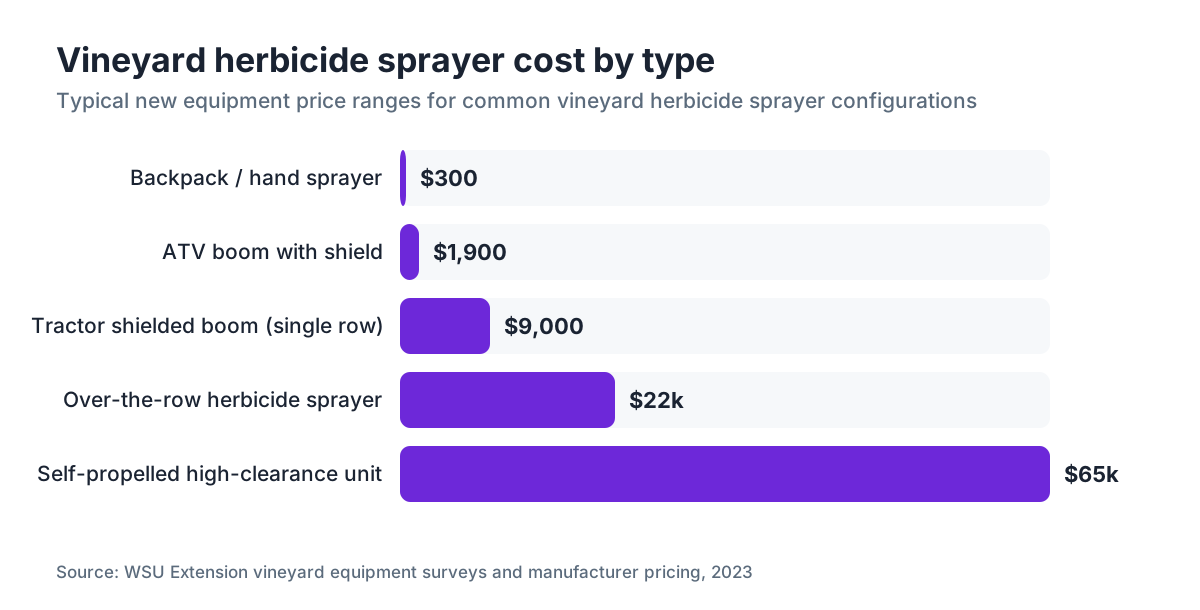
Prices run from genuinely cheap to "I need to call the bank," and no single number covers every situation.
| Sprayer type | Typical price range | Best fit |
|---|---|---|
| Backpack / hand sprayer | $80 - $500 | Spot treatment, small blocks |
| Simple ATV boom with shield | $800 - $3,000 | Under 10 acres, flat ground |
| Tractor-mounted shielded boom (single row) | $3,000 - $15,000 | 10-100 acres, standard rows |
| Over-the-row herbicide sprayer | $8,000 - $35,000 | 30+ acres, tight rows, efficiency priority |
| Self-propelled high-clearance unit | $50,000 - $80,000+ | 200+ acres, commercial scale |
These ranges come from manufacturer price sheets and WSU Extension equipment surveys. Actual dealer quotes swing 15 to 25% by region and options [1][5]. Used units on the big auction sites regularly go for 40 to 60% of new price, but inspect shield integrity, pump seals, and nozzle body threads before you buy anything secondhand.
The "should I buy the over-the-row unit" question usually comes down to labor math. If you're paying $18 to $22 an hour for hand crews doing spot spraying and you farm 50 acres or more, the labor saved on herbicide passes alone can pay off a $20,000 machine in three to five seasons. Run that math honestly before you commit.
Parts are a real ongoing cost. Nozzle tips wear out and should be swapped when output drifts more than 10% off spec, which the manufacturer generally pegs at 25,000 to 50,000 gallons pumped [4]. Budget $150 to $400 a year for nozzles on a mid-sized tractor boom.
How do you calibrate a vineyard herbicide sprayer?
Calibration is where most vineyard herbicide problems start. The operator skips it, or does it once and never repeats it as the nozzles wear, or calibrates at a speed they never actually drive in the field.
Use the catch-and-measure method. Pick a representative nozzle, catch its output in a jar for exactly 30 seconds at your working pressure, then run the formula: GPA equals (output in ounces times 495) divided by (nozzle spacing in inches times travel speed in mph). UC Cooperative Extension publishes this calculator in its Pest Management Guidelines, and it's the same math WSU Extension uses [3][5].
For a shielded undervine boom, nozzle spacing is usually 18 to 24 inches and travel speed 3 to 4 mph. A common target for contact herbicide is 20 to 30 GPA. For systemic herbicides like glyphosate, 15 to 25 GPA is typical. Always verify against the label, because under FIFRA the label is the law.
Check every nozzle, not one. On a five-nozzle boom, two partly plugged tips and one oversized from wear give you uneven coverage and either misses or phytotoxicity hot spots. If variation runs more than 10% between nozzles on the same boom, replace the whole set, more than the outliers.
Recalibrate at the start of each season, after any nozzle swap, and after the sprayer has sat unused more than two months. Takes about 20 minutes. It's the cheapest insurance you have against a failed application or a crop injury event.
Water-sensitive paper laid on the soil in the target zone shows your actual spray pattern before you commit herbicide to the field. A pack of 100 sheets costs about $20. It can save you from learning the hard way that your pattern has a dead zone right under the trunk.
Which herbicides are commonly used in vineyards and what sprayer settings do they need?
The herbicide drives the equipment as much as the equipment drives the application. Glyphosate needs different handling than a soil-applied preemergent or a contact burndown, and each one changes your nozzle and pressure.
Glyphosate (Roundup PowerMAX and generics) is the most widely used under-vine herbicide in California, Washington, and Oregon wine country. It's systemic, so coverage needs to be thorough but not perfect. Coarse droplets at 15 to 20 PSI work fine and cut drift. The real risk is green tissue contact: glyphosate translocates in suckers and young green bark in spring, causing chlorosis or vine death. Shields have to be in good shape. No glyphosate near green shoots. Full stop.
Fluazifop-P-butyl (Fusilade and others) targets grasses and is safe over some broadleaf cover crops. It needs complete coverage of grass foliage, so droplet size matters more here than with glyphosate. Fine to medium droplets at 20 to 30 PSI.
Indaziflam (Alion) is a preemergent soil-barrier herbicide labeled for vineyards. You apply it to bare or lightly vegetated soil and it holds a residual weed control layer for up to 12 months. Flat-fan nozzles, uniform soil coverage, and if you can, incorporation by irrigation. No canopy contact needed because it isn't foliar active.
Oryzalin, simazine, and flumioxazin are other soil-applied options with different residual periods and soil-type rules. Check the label for groundwater protection language. Some carry geographic use restrictions inside California's Groundwater Protection Areas [6].
Contact herbicides like pelargonic acid (Scythe) or acetic acid products are fast burndowns used in organic vineyards. They need fine to medium droplets for good contact but leave almost no residual, so timing against weed growth stage matters a lot. They also demand a shielded sprayer more than systemic products do, because any contact with green vine tissue burns it on the spot.
What are the Worker Protection Standard requirements for vineyard herbicide application?
The EPA's Worker Protection Standard (WPS) under 40 CFR Part 170 covers any agricultural establishment that uses pesticides and has workers or handlers. Herbicide application in a vineyard qualifies. This is federal law, not a suggestion [7].
Handlers (the people mixing, loading, or applying herbicides) must get WPS training before they touch any restricted-use or general-use pesticide in an agricultural setting. Training has to use EPA-approved materials and has to be documented. Records stay on file for two years. The training covers label requirements, PPE, decontamination, emergency procedures, and the right to access safety information.
EPA's WPS guidance states: "Agricultural employers must provide handlers with pesticide safety training before they perform any handler activity." That comes straight from the 40 CFR Part 170 compliance material [7].
During a restricted-entry interval (REI), no worker enters a treated area without full handler PPE. Herbicide REIs vary by product: glyphosate is 4 hours, most preemergent herbicides are 12 hours, and some contact products carry 24 to 48 hours. Read the label.
Post the safety data sheet (SDS) for every herbicide you use somewhere all workers can reach it. Keep a pesticide application record with the product name, EPA registration number, active ingredient, amount applied, location, date, and applicator name. Most states require this by law on their own, apart from WPS. California's rules under Title 3, Division 6 of the California Code of Regulations run stricter than the federal minimum [6].
For small operations that don't want paper records scattered across trucks and binders, a field operations platform like VitiScribe logs spray records digitally and flags REI windows automatically. That earns its keep when a state inspector wants records from three seasons back and you're trying to remember which block got what.
PPE minimums for most herbicide jobs include chemical-resistant gloves, protective eyewear, long sleeves, and closed-toe shoes. Some products call for a respirator. Read the label first. The label sets the floor.
How do you reduce herbicide drift in vineyards?
Drift is the single biggest source of vineyard herbicide problems. It kills neighboring crops, brings regulatory headaches, and can leave you liable for someone else's losses. Four controls do most of the work: nozzle, pressure, weather, and shields.
Nozzle selection is your first control. Coarse or ultra-coarse flat-fan nozzles (ASABE classification) make larger droplets that fall faster and shrug off wind. TeeJet's Extended Range (XR) series or air-induction tips like the Turbo TeeJet Induction sharply cut the fine-droplet fraction versus standard flat-fan tips at the same pressure [4]. If you aren't already on drift-reduction nozzles, switch. They're $3 to $6 each.
Run the lowest pressure that still gives you adequate coverage, usually 15 to 25 PSI for most vineyard herbicide work. Higher pressure shatters the spray into finer droplets.
Don't spray when wind tops 10 mph. Many labels say 15 mph, but 10 mph is a more defensible field threshold if a drift complaint lands on you. Early morning is usually calmer than midday. In many California valleys, a thermal inversion at dawn can trap fine droplets near the surface and carry them farther than midday wind would. Know your local conditions.
Shields are your mechanical backup when the air isn't cooperating. A well-fitted shield on an undervine boom physically stops upward spray movement no matter the nozzle. Keep shields clean, check for cracks, replace worn rubber flaps.
Buffer zones matter next to sensitive crops, especially near other vineyards on different winery contracts or near certified organic ground. Some herbicides carry mandatory buffer distances from water bodies. Check the label and your county ag commissioner's rules.
What maintenance does a vineyard herbicide sprayer need?
End-of-season cleaning is the most neglected job in vineyard spray equipment. Herbicide residue, especially from soil-applied preemergents or glyphosate, sits in a pump and hose all winter, degrades seals, and can contaminate your first fungicide application next season if you share a tank.
Triple-rinse the tank right after each use. Flush the lines all the way through the nozzle bodies. For the end-of-season flush, run a tank of clean water, then a tank with a commercial sprayer cleaner or a 1-ounce-per-gallon ammonia solution (for amine-formulation herbicides), then a final clean water flush. Let everything dry before storage.
Nozzle tips: check for wear with a tester or catch test at the start of each season. Tips flowing more than 10% above their rated output are worn and making finer droplets than the label application assumed. Replace them as a set, not one at a time.
Pump: most diaphragm pumps on vineyard sprayers are rated for 500 to 1,000 hours before a rebuild. Check the spec. Warning signs are pressure fluctuation, loss of prime, or weeping at the diaphragm housing. A rebuild kit for a common Comet or Udor pump runs $60 to $120 and is a two-hour job.
Strainer screens: there are usually three, at the tank outlet, the pump inlet, and the nozzle body. Clean all three after every application. A plugged inlet strainer starves the pump and causes cavitation, which chews up diaphragms fast.
Filter the herbicide as you mix. A cone strainer on the fill hose catches particulate from wettable powders and dry flowables before it ever reaches the pump.
What records do you need to keep for vineyard herbicide applications?
Record-keeping demands come from several directions at once: federal WPS, your state department of agriculture, pesticide use reporting rules, and maybe your winery contract or organic certifier.
At the federal level, restricted-use pesticide (RUP) applications must be recorded if you're a certified private applicator. Records need the product name, EPA registration number, total amount applied, crop treated, size of area, location, date, and applicator name. Keep them two years [7].
California growers face the strictest rules in the country. The state requires a Pesticide Use Report (PUR) for every application, general-use or restricted, filed with the County Agricultural Commissioner within seven days for commercial operations [6]. Washington State requires licensed private applicator records for RUPs [8]. Oregon has similar requirements under ODA rules.
Going past the compliance minimum is genuinely useful agronomically. Knowing which blocks got which herbicide in which year helps you dodge rotation restrictions, track resistance patterns, and answer the winery buyer asking what was sprayed.
A good spray record has the block ID, acres treated, product(s), rate per acre, total product used, water volume, nozzle type and size, pressure, travel speed, wind speed and direction, temperature, applicator name, equipment ID, and any observations. That sounds like a lot. Filling it out takes five minutes at the end of a pass.
If you're keeping spray records on paper and losing them, this is one place a digital system pays off at audit. VitiScribe is built for vineyard field operations: log spray events from a phone in the field, attach photos, generate compliance reports. That's the pitch. The real point is that your records have to be findable two years later, whatever tool you use to keep them.
How do you manage herbicide resistance in vineyards?
Resistance is already here. Glyphosate-resistant horseweed (Conyza canadensis) and glyphosate-resistant annual ryegrass (Lolium rigidum) have both been documented in California vineyard settings [9]. These aren't hypothetical future problems.
The core principle is mode-of-action rotation. Glyphosate is WSSA Group 9. Use it every year in the same block with no rotation and you're selecting for survivors. Rotating to a Group 14 (flumioxazin), Group 1 (clethodim or fluazifop for grasses), or a soil residual in alternating seasons slows selection pressure a lot.
Weed scouting before you spray matters as much as rotation. If you're seeing escapes, survivors that germinated from seed and reached maturity after your program, figure out whether they're resistant or just missed coverage. Send samples to a state diagnostic lab before you assume resistance; the UC Davis Weed Research and Information Center handles this work [10].
The International Survey of Herbicide-Resistant Weeds tracks confirmed cases worldwide. As of 2023 it listed over 260 confirmed resistant biotypes across 70 different herbicide modes of action [9]. That number moves one direction.
Non-chemical methods are part of resistance management, not a soft alternative. Undervine cultivation with rotary tillers, interrow mowing that stops seed set, mulching with wood chips or straw, and cover crop competition in the midrow all cut weed pressure without chemical selection. Many dry-farmed vineyards in the Paso Robles area use undervine cultivation as their main weed tool and spot-spray only where cultivation misses.
Read the resistance management section of every herbicide label. Since the 2012 FIFRA label updates, manufacturers must include resistance management language, and it often sets maximum annual application rates by mode of action [11].
What should you look for when buying a vineyard herbicide sprayer?
Buying a sprayer is one of those purchases where you'll either be glad you did for 15 years or annoyed at it every season. A handful of things actually matter.
Row spacing compatibility first. Measure your actual row spacing, not what you think it is. If you run 8-foot rows in an older block and 10-foot rows in a newer planting, make sure the frame and arch width handle both. Over-the-row units typically adjust from about 6 to 10 feet, but confirm with the dealer.
Tank size against your acreage per fill. A 100-gallon tank at 20 GPA treats 5 acres per fill. If your blocks are 20 acres and it's 30 minutes each way to water, you're spending more time filling than spraying. Bigger tank, less fill time. But a bigger tank means more weight on the tractor, which matters on slopes.
Pump type and flow. Most vineyard herbicide work runs 5 to 15 GPM. A 12-GPM diaphragm pump gives you comfortable headroom. Centrifugal pumps are cheaper but less tolerant of abrasives in herbicide formulations. Diaphragm pumps are the standard for herbicide.
Shield quality. Look at the material (HDPE or stainless), how it attaches, and whether replacement shields are available from the manufacturer. Plastic shields crack. You want the option to buy parts instead of replacing the whole unit.
Parts availability and dealer support. An obscure import at 20% below a known brand isn't a deal if you can't get a pump rebuild kit for six weeks during the spring spray window. Ask which local dealers stock parts before you sign anything.
For used gear, check the pump for even pressure, inspect hoses for cracks near the clamps, and run water through every nozzle body to confirm none are plugged. A $400 used unit with a dead pump and plugged nozzles isn't a deal.
Frequently asked questions
Can I use my airblast sprayer to apply herbicides under the vine?
Technically yes, but it's a bad idea without modification. An airblast sprayer makes a lot of fine droplets and high air velocity that carries spray well past the target zone. Without a shielded undervine head, you'll get heavy canopy contact and drift. Some growers mount a shielded boom wand on the airblast frame and shut off the fan for herbicide passes. That works, but dedicated shielded equipment is safer and more consistent.
What's the best herbicide sprayer for a small vineyard under 5 acres?
A backpack sprayer with a shielded wand handles under 5 acres, though it's slow. A battery-powered unit cuts fatigue. For ATV operations, a 25-to-50-gallon tank with a single shielded undermounted boom runs $1,500 to $3,500 and covers 5 acres in a couple of hours. At that scale the ATV setup is a real time saver over backpacks and pays for itself if you're growing year after year.
How close to the trunk can I spray glyphosate?
It depends on vine age and bark maturity. On vines older than three years with fully corky bark, glyphosate contact with brown bark below the bud union is generally tolerated. Contact with green tissue, suckers, young green bark, or exposed cambium translocates and can cause serious injury or vine death. Most agronomists recommend keeping glyphosate at least 6 inches from any green tissue, and that buffer is hard to hit without proper shields.
How often should vineyard herbicide sprayer nozzles be replaced?
Replace nozzles when output tops 10% above the manufacturer's rated flow. That usually happens after 25,000 to 50,000 gallons pass through them, per nozzle manufacturer guidance. In practice, test nozzles at the start of each season with a catch test and replace the whole set if any tip is out of spec. Worn nozzles make finer droplets that drift more and cover unevenly.
What PPE is required for vineyard herbicide application under WPS?
At minimum, WPS and most herbicide labels require chemical-resistant gloves, protective eyewear, long pants, a long-sleeved shirt, and closed-toe shoes for handlers during mixing and application. Some products call for extra PPE like a chemical-resistant apron or a respirator. The label sets the legal minimum. WPS training must be documented and records kept for two years under 40 CFR Part 170.
Is an over-the-row herbicide sprayer worth the extra cost?
For operations over 30 to 40 acres with consistent row spacing, generally yes. You treat two undervine strips per pass, roughly halving field hours against single-row equipment. Break-even depends on your labor rate, acreage, and passes per season. At $20 an hour and four herbicide passes on 50 acres, labor savings alone can reach $4,000 to $6,000 a season, which offsets a $15,000 to $20,000 machine in three to five years.
What is the restricted-entry interval for glyphosate in vineyards?
Glyphosate carries a 4-hour restricted-entry interval (REI) under its standard agricultural label. No worker enters the treated area during that window without full handler PPE. Confirm the REI on your specific product's label, because formulations vary. California's WPS enforcement requires the REI to be posted at the field entry point and communicated to all workers before they approach the treated block.
How do I prevent herbicide carryover affecting next year's cover crops?
Soil-applied herbicides like indaziflam or simazine can persist 6 to 24 months depending on soil type, organic matter, moisture, and temperature. Before seeding any cover crop, check the replanting or rotation restriction on the label. UC Cooperative Extension's soil bioassay method, planting a fast-germinating indicator seed in treated soil from your block, is a practical field test for carryover before you commit expensive seed.
Can I use a vineyard herbicide sprayer on organic-certified blocks?
Yes, with the right products. Organic certification bans synthetic herbicides, so glyphosate and most synthetic preemergents are out. Approved contact herbicides include acetic acid, citric acid, and pelargonic acid (Scythe). Clove oil and d-limonene products are also approved in many programs. You still need a shielded sprayer, because contact burndowns damage green vine tissue on contact just as fast as synthetic products do.
What California-specific rules apply to vineyard herbicide sprayers?
California requires a Pesticide Use Report filed within seven days for all commercial applications, including general-use herbicides. County Agricultural Commissioners regulate restricted-use pesticide permits. Groundwater Protection Area restrictions apply to some herbicides in specific regions. The Department of Pesticide Regulation maintains active ingredient restrictions by county. California also requires WPS training documentation available for inspection at the worksite during application.
How do I reduce soil compaction from tractor-mounted herbicide sprayer passes?
Run the lightest tractor that safely handles the sprayer weight, especially on slopes. Use flotation tires or drop tire pressure to the manufacturer's recommended minimum for field conditions. Set permanent wheel tracks and stay in them for every tractor pass, which concentrates compaction to known zones instead of spreading it. Avoid spraying right after rain when soil is saturated and compaction risk is highest.
Do I need a pesticide applicator license to spray herbicides in my own vineyard?
For general-use pesticides on your own property in most states, no license is required if you're the landowner or a direct employee applying under the landowner's supervision. Restricted-use pesticides require a certified private applicator license in most states, including California and Washington. If you hire a custom applicator or a PCA (Pest Control Adviser), they must hold the appropriate state licenses. Check your state department of agriculture for current requirements.
How do wind speed and temperature affect vineyard herbicide sprayer performance?
Wind above 10 mph sharply raises drift potential and should be a hard stop for most applications. Temperature affects both efficacy and drift: high heat raises volatility of some amine-formulation herbicides and can evaporate fine droplets before they reach the target. Cold below 50 degrees Fahrenheit slows absorption of systemic herbicides. Early morning at moderate temperature with calm winds is generally ideal in most vineyard regions.
Sources
- WSU Extension, Vineyard Equipment and Mechanization: Price ranges for tractor-mounted shielded undervine sprayers and related equipment in Pacific Northwest vineyard operations.
- Cornell Cooperative Extension, Grapes Program: Over-the-row sprayer designs are especially useful where row spacing is too tight for a tractor to turn efficiently between rows.
- UC Cooperative Extension, UC IPM Pest Management Guidelines: Grape: Calibration formulas and spray timing guidelines for undervine herbicide applications, including catch-and-measure method and GPA calculation.
- TeeJet Technologies, Spray Application Technology: Nozzle tip wear threshold of 10% above rated output; tip replacement recommendation after 25,000 to 50,000 gallons; coarse droplet classification pressure ranges for drift reduction.
- WSU Extension, Vineyard Floor Management: Typical price ranges for over-the-row herbicide sprayers and self-propelled high-clearance units used in Washington State commercial vineyards.
- California Department of Pesticide Regulation, Pesticide Use Reporting: California requires a Pesticide Use Report filed within seven days of application for all commercial pesticide uses; Groundwater Protection Area restrictions apply to certain herbicides.
- U.S. EPA, Worker Protection Standard 40 CFR Part 170: WPS requires handler training before any handler activity, two-year record retention, and REI posting; quote: 'Agricultural employers must provide handlers with pesticide safety training before they perform any handler activity.'
- Washington State Department of Agriculture, Pesticide Management: Washington State restricted-use pesticide record-keeping requirements for licensed private applicators.
- International Survey of Herbicide-Resistant Weeds: Over 260 confirmed herbicide-resistant weed biotypes documented globally across 70 modes of action as of 2023; glyphosate-resistant Conyza canadensis and Lolium rigidum confirmed in California vineyard settings.
- UC Davis Weed Research and Information Center: Glyphosate-resistant weed species confirmed in California agricultural settings including vineyards; diagnostic services for herbicide resistance confirmation.
- U.S. EPA, Pesticide Registration: The pesticide label is legally enforceable under FIFRA; 2012 label updates required resistance management language on all new herbicide registrations.
Last updated 2026-07-10