How to spray a vineyard when bird netting is installed
TL;DR
- Spraying around installed bird netting means adjusting your timing, nozzle angle, water volume, and equipment height.
- The three real risks are poor canopy penetration, nozzle tips snagging the net, and re-entry violations inside enclosed netting.
- The best fix is sequencing: run your full program before netting goes up.
- After that, use low-clearance gear and side-angled nozzles.
Why does bird netting make spraying so much harder?
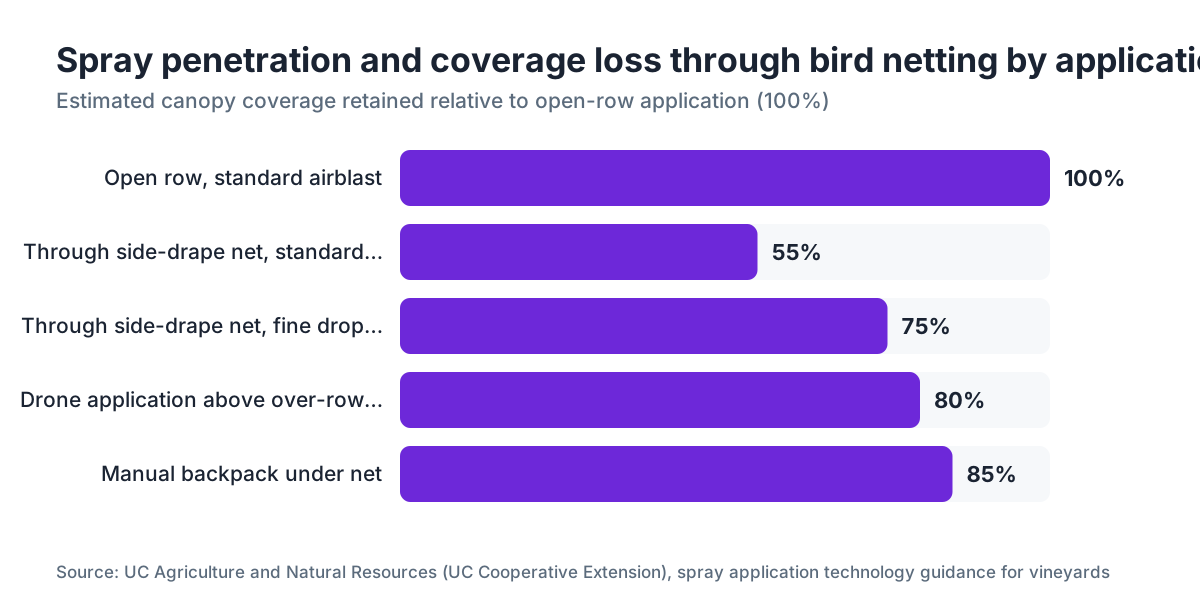
Bird netting creates three real problems for a spray program. First, it blocks the pattern. A solid drape net sitting against the canopy can intercept 30 to 60 percent of droplets before they reach the fruit zone, depending on mesh density and how tight the net is pulled [1]. Second, netting traps humidity inside the canopy by cutting airflow, which feeds the exact disease pressure you're trying to stop. Third, enclosed netting raises real re-entry interval (REI) questions under the EPA Worker Protection Standard: if workers can't freely exit the treated area, the space may function as a closed system for REI purposes [2].
There's an equipment problem nobody talks about too. Nozzle tips catch on loose net material. One snagged tip can rip a 20-foot section of netting, and replacement side-drape nets run $150 to $400 per acre depending on width and material [3]. A single pass gone wrong costs more than the spray itself.
The practical answer is sequencing. A good spray calendar puts your highest-pressure disease windows (Eichhorn-Lorenz stages 12 through 19 for powdery mildew) before netting installation, roughly berry set to early bunch closure [11]. Netting usually goes on at veraison in most regions. In a normal season that gap works fine. In a wet year, when you need to spray at veraison or later, you need a plan.
What spray timing strategy works best before netting goes on?
Front-loading your program is the cleanest answer. UC Cooperative Extension recommends completing your last protective fungicide application no later than early bunch closure (roughly 8 to 10 weeks before harvest in most wine grape varieties), because internal berry infections are largely set by then [4]. Line up your netting installation to go on right after that final bunch-closure spray and you skip most of the access problem.
Building your calendar this way means three things:
- Confirm your netting crew's installation date before the season starts.
- Work backward from that date to schedule your bunch-closure spray 2 to 5 days prior, so the REI clears before netting workers arrive.
- Log that target date in your spray records, so if weather forces a delay you have documented justification.
This is where recordkeeping software earns its keep. VitiScribe lets you attach a crop calendar event directly to a spray record, so the link between "last pre-netting spray" and "netting installation" lives in one place for a compliance audit.
For botrytis specifically, Washington State University Extension identifies bloom and bunch closure as the most effective timing windows, both of which usually come before veraison netting installation [5]. Hit those two windows cleanly and a post-netting botrytis spray becomes a correction, not part of the plan.
How do you actually spray after netting is already installed?
Sometimes the netting is up and you have to spray anyway. Botrytis pressure spikes late. A mildew flare shows up post-veraison. A nutritional deficiency needs a foliar fix. Here's how to work through it.
Lower the boom or riser height. Most over-row sprayers sit 12 to 18 inches above the trellis. With netting on, drop the riser to just above the net surface so air shear from the fan pushes spray downward through the mesh instead of glancing off the sides. You lose some lateral throw. Penetration underneath improves.
Switch to smaller droplets at higher pressure. Finer droplets (100 to 200 micron VMD) push through netting mesh better than coarse ones [1]. This also raises drift risk, so check wind speed before you change nozzles. The EPA's Drift Reduction Technology program recommends staying below 10 mph at application time for fine sprays [6].
Use side-angled nozzles. On a tower or cross-flow sprayer, angling the lower nozzle sets inward and downward at 30 to 45 degrees can drive spray under the net skirt where it isn't staked to the ground. This works best on side-drape netting that leaves a gap at the soil line.
Raise your water volume per acre. Because the net intercepts part of your application, plan to bump water volume 15 to 25 percent above your standard rate, and confirm the label allows it. Some labels give a rate range. Others give a hard maximum. Never exceed the label rate, netting or not.
Walk the pattern before you spray. Run a test pass with water only, then step inside the net and read the canopy. Dry spots on the fruit zone mean you adjust before you load chemistry.
What equipment works best for spraying under or through netting?
Low-clearance airblast sprayers with adjustable fan deflectors are the common choice. Croplands, Munckhof, and Durand-Wayland all build tower configurations that can be lowered mechanically. The spec to ask about is minimum working height. You want a machine that can run with the fan center at canopy height or just above the net.
Under-trellis or inter-row sprayers are a niche tool worth knowing about. They apply systemic fungicides to the trunk and cordon zone after netting goes on. They can't reach the fruit zone, but for powdery mildew on bark or trunk disease materials, they work fine and never touch the net.
Drone application is getting real attention in tight-access blocks. UC Davis field trials as of 2023 showed adequate canopy penetration with DJI Agras T40 units flown 2 to 3 meters above the canopy, with spray volume adjusted upward to make up for shorter dwell time [4]. Drones clear the netting with essentially zero contact risk. The tradeoff is money ($200 to $400 per acre for contract services in California) and the fact that you still need a certified applicator supervising the job in most states.
Manual backpack sprayers are the honest last resort. They're slow. They put workers close to the chemistry. But for a small block with severe pressure and no other access, a trained applicator in proper PPE can treat the fruit zone directly. Match your REI and PPE documentation to the label before you send anyone in.
What are the re-entry interval rules under bird netting?
The EPA Worker Protection Standard (40 CFR Part 170) requires the REI to be posted at the treated area and bars workers from entering until it expires [2]. Under netting, the REI clock starts exactly where it would for any field application: end of application. The complication is that enclosed or semi-enclosed netting can stretch the window during which residues stay at inhalation risk levels, because reduced airflow slows volatilization and settling.
The WPS rule states: "The handler must be sure that no workers enter or remain in the treated area during the application or before the restricted-entry interval has expired" [2]. For netting that workers enter to tuck, thin, or harvest, the practical meaning is plain. Your REI must clear before the next crew entry, and the netting doesn't shorten the REI just because the label reads "restricted entry: 4 hours."
Cornell Cooperative Extension recommends posting REI notices at every access point to a netted block, not only the row ends, because harvesters may enter from several points [7]. If your netting is fully enclosed with zipper or clip openings, treat each opening as an entry point that needs a notice.
For harvest, the pre-harvest interval (PHI) is separate from the REI and comes purely from the product label. PHI doesn't change because netting is present. Log the spray date and the expected PHI expiration in your records so you can confirm clearance before you pick.
How do you document spray applications made around netting for compliance?
California requires pesticide use reports for all restricted-use pesticides within 7 days of application, and the county agricultural commissioner can request records going back three years [8]. Oregon and Washington carry similar retention rules. A spray record under netting needs no special notation in most states, but best practice is to log the netting status at the time of application, because it explains why your spray volume might differ from your standard rate.
At a minimum, each spray record should include:
| Field | What to log |
|---|---|
| Application date and time | Exact start and end time |
| Crop stage | E-L stage or phenological note |
| Product, EPA reg. number | From the label |
| Rate applied (per acre) | Actual, not label target |
| Water volume | Gallons per acre applied |
| Equipment used | Sprayer type, nozzle size |
| Netting status | "Netting installed, side-drape, not fully enclosed" |
| REI and PHI | Date/time of REI expiration and PHI clearance date |
| Applicator name and license number | Required under WPS |
| Wind speed and direction | Good practice, required in some states |
This level of detail matters most when a residue question lands at harvest. If a buyer's third-party lab flags a residue, you need to show exactly what went on, when, at what rate, and that the PHI was respected. A netting note in the record also supports any argument that canopy interception cut effective deposit, if that ever becomes part of a residue defense.
VitiScribe's spray log captures every one of these fields and links them to your block map, so your compliance records and field notes stay together instead of scattered across paper forms and spreadsheets.
Does bird netting change which products you should choose?
Not as a regulatory matter. Practically, yes. A few things to weigh.
Systemic vs. contact chemistry. Contact fungicides like copper and sulfur have to coat the target surface. Netting interception hurts them more than it hurts a systemic like myclobutanil or azoxystrobin, which needs only partial uptake to protect. Post-netting, with real disease pressure, lean toward systemics.
Sulfur and heat. Elemental sulfur burns tissue above 90 degrees F, and netting traps heat. On a warm day a netted block can run 5 to 10 degrees hotter inside than out. Check your thermometer before you apply sulfur under netting. Most labels warn against application when temperatures will top 90 degrees F within 24 hours [9].
Spreader-sticker adjuvants. These improve adhesion on the leaf and help offset the coverage you lose to net interception. They're cheap (add $1 to $3 per acre) and worth it any time your distribution is compromised.
Label restrictions on canopy stage. Some products restrict application after bunch closure because residue in the fruit becomes a concern. Netting doesn't lift those restrictions. Read the label for the crop stage limit, not only the PHI.
How does netting affect powdery mildew and botrytis risk under the net?
This is where the real tension lives. You install netting to protect fruit from birds. The same net reduces airflow by roughly 20 to 40 percent depending on mesh density, according to canopy microclimate research from UC Davis [4]. Less airflow means longer leaf wetness periods, slower drying of berry surfaces after rain or dew, and a warmer, more humid pocket. All of that favors botrytis.
Powdery mildew reads differently. Erysiphe necator (grape powdery mildew) actually prefers lower humidity for spore germination, so the humidity bump under netting may modestly cut infection events. But the reduced light that often comes with over-row netting slows photosynthesis and can limit the new growth that dilutes existing infection.
Here's the upshot. In a region with heavy fall rain (most of the Willamette Valley, the North Fork of Long Island, parts of the Finger Lakes), a late-season botrytis spray under netting is often justified even in a clean year. Plan for it. Price it into the spray budget. And reach for a product with a short PHI if harvest timing is uncertain.
WSU Extension's botrytis guide recommends a maximum of two applications of any single mode of action per season to manage resistance, which means your post-netting spray should use a different FRAC code than your bunch-closure application [5].
What's the safest way to remove netting before a spray, then re-install?
For a large, well-resourced operation, the cleanest answer is blunt: pull the netting back, spray, let the REI clear, then re-install. It sounds like extra labor. On a small block (under 5 acres), a two-person crew can pull back and re-attach side-drape netting in 2 to 4 hours. The spray quality you get with open access beats anything you'll manage through the net.
A few practical notes on doing it safely:
- Don't pull netting when workers are in adjacent blocks already under an REI restriction.
- Netting that touches fresh spray residue transfers those residues to whoever handles it. Let the net dry completely (at minimum, the label REI) before workers handle it for re-installation.
- Fold and stack netting so it doesn't drag across contaminated soil or foliage. A clean tarp or net cart stops cross-contamination.
- Log the removal and re-installation in your field notes with dates and times. That documents the access condition at the time of spray.
For fully enclosed over-row tunnels (common in premium Pinot Noir and Chardonnay blocks in Oregon and California), pulling the netting back gets complicated and often isn't practical mid-season. In those setups, a drone application or a carefully planned pre-netting calendar is really your only good option.
Are there any worker safety risks specific to spraying around bird netting?
Yes, and they're specific enough to brief your crew on before the season starts.
The biggest is re-entry exposure. Netting builds semi-enclosed spaces where residues settle and volatilize more slowly. A worker who enters a netted block to adjust netting or check fruit during an REI faces higher inhalation exposure than the same worker in an open row. The WPS rule (40 CFR 170.309) requires handlers to ensure workers stay out during the REI, which in a netted block means physically securing the entry points [2].
Second risk: netting catches and holds spray mist, creating drip points that workers walk under. Reach up to untangle netting after a spray and you can catch a concentrated drip of pesticide solution on bare skin. Label PPE requirements don't stop at the REI's edge when someone is handling recently treated netting.
Third: heat. Netting raises canopy temperatures, as noted above. Applicators working in or near enclosed netted blocks in summer should follow standard heat illness prevention. California's Heat Illness Prevention Standard (California Code of Regulations Title 8, Section 3395) requires shade, water, and rest periods when temperatures hit 80 degrees F, with heightened requirements above 95 degrees F [10].
Brief the crew annually. Post the label and SDS at the equipment before application. Keep your emergency contact information current on the WPS central posting board.
How do you plan a full-season spray program that accounts for netting installation?
A workable plan runs in three phases.
Phase 1: Pre-netting (budbreak through bunch closure). Run your full program normally. Hit your powdery mildew windows at E-L 12, 14, and 17 to 19. Apply botrytis materials at bloom and bunch closure. Use the products, rates, and volumes your disease pressure demands. Don't shortchange coverage here to "save" a spray for later.
Phase 2: The transition spray. Schedule one application 2 to 5 days before your netting crew arrives, aimed at botrytis with a systemic product. Pick a product with a 4-hour REI so the block clears before netting workers enter. Log this as your "pre-netting protective" application. It does the most work for post-netting disease control.
Phase 3: Post-netting (veraison through harvest). Accept that access is limited and you're in monitoring mode, not preventive-spray mode. Scout twice a week. Active botrytis calls for a short-PHI systemic. Mildew post-veraison can be arrested with a systemic at half-rate plus a spreader-sticker, without full canopy coverage.
The Cornell viticulture team's grape disease management guide recommends driving spray decisions with actual disease models (Gubler-Thomas for mildew, a wetness-based model for botrytis) rather than fixed-interval schedules, and modeling gives you the sharpest signal for when a post-netting spray is truly necessary versus precautionary [7].
Across multiple blocks with different netting dates, a block-level field operations log is genuinely useful. Keep netting status, spray history, and scouting notes in one place, whether that's a spreadsheet or a tool like VitiScribe, and you make better calls under time pressure.
Frequently asked questions
Can I spray fungicide through bird netting without removing it?
Yes, but coverage suffers. Dense mesh can intercept 30 to 60 percent of droplets. You improve penetration with finer droplet sizes (100 to 200 micron VMD), a 15 to 25 percent higher water volume, and nozzles angled downward through the net gap. Systemic fungicides tolerate partial coverage better than contact materials like copper or sulfur. Always run a water-only test pass first to see where spray is landing.
How long after spraying do I have to wait before workers can go back under the netting?
The re-entry interval is set by the product label and doesn't change because netting is present. What changes is that enclosed netting slows residue volatilization, so the WPS requirement to keep workers out until the REI expires matters more in a netted block than an open one. Post REI notices at every access point to the netted block, including any zipper or clip openings, per Cornell Cooperative Extension guidance.
Does bird netting increase botrytis risk in the vineyard?
Yes. Netting reduces airflow by roughly 20 to 40 percent, which extends leaf wetness periods and raises humidity inside the canopy. Both conditions favor Botrytis cinerea. In a wet fall region, plan a post-netting botrytis application with a short PHI as part of your standard program. Use a different FRAC code than your bunch-closure spray to manage resistance, per WSU Extension recommendations.
What's the best time in the season to install bird netting relative to spray timing?
Install netting right after your bunch-closure fungicide spray, once the REI clears. That application is your last high-priority disease window anyway. Netting typically goes on at veraison, which in most wine grape varieties is 8 to 10 weeks before harvest. Front-load your spray program through bunch closure, then schedule netting installation 2 to 5 days after that final spray. That's the cleanest approach.
Can drones spray a vineyard that has bird netting installed?
Yes, and it's one of the better options for post-netting work. UC Davis field trials with the DJI Agras T40 showed adequate canopy penetration flying 2 to 3 meters above the canopy, with volume adjusted upward. Drones clear the netting with no contact risk. Contract drone application services in California run roughly $200 to $400 per acre. You still need a certified applicator supervising the job in most states.
Does spraying under enclosed bird netting change what PPE workers need?
The PPE the label requires applies regardless of netting. What netting changes is the exposure scenario: residues volatilize more slowly in enclosed spaces, and the netting material itself can hold drips. Workers handling netting after a spray should treat it like treated plant material. Wear chemical-resistant gloves and keep it away from the face until the REI has fully cleared and the net has dried.
How do I adjust spray volume when applying through bird netting?
Raise your water volume 15 to 25 percent over your standard rate to offset netting interception, provided the label allows that range. Check the label's minimum and maximum rate and stay inside it. Running a water-only calibration pass through the installed netting before you load chemistry shows you exactly where the coverage gaps are, so you can fix nozzle angle or fan speed before you apply product.
What records do I need to keep when I spray under bird netting?
Log everything you'd record for any spray: date, time, product, EPA reg. number, rate, water volume, equipment, applicator license, wind speed and direction, REI expiration, and PHI clearance date. Add a field noting netting status at the time of application. California requires pesticide use reports within 7 days for restricted-use pesticides, with records retained three years. That netting note protects you if a residue question arises at harvest.
Can I spray sulfur under bird netting?
Be careful. Sulfur phytotoxicity risk climbs above 90 degrees F. Netting raises the canopy temperature 5 to 10 degrees above ambient on warm days. Check the forecast for the 24 hours after application and skip sulfur if temps will top 90 degrees inside the net. Most sulfur labels carry this warning outright. If you need a fungicide in hot conditions, switch to a systemic without a heat-related phytotoxicity risk.
How do I prevent my sprayer from snagging on bird netting?
Lower your boom or riser to just above the net surface before the pass. Inspect the netting for loose edges, broken clips, or sagging sections before you start. Tie back any loose drape on the end posts. Travel at a steady, moderate speed so nozzle tips track consistently. Fold in any horizontal extensions that could catch. A snagged tip can tear 20 feet of netting in one pass, and replacement nets run $150 to $400 per acre.
Does bird netting affect which fungicide modes of action I should use post-veraison?
Netting doesn't change label requirements, but it does favor systemics over contact materials, because systemics tolerate partial coverage better. For botrytis post-netting, use a FRAC code different from your bunch-closure application to manage resistance. WSU Extension recommends no more than two applications per season from any single mode of action. A short PHI matters too if your harvest date is uncertain.
How do I brief my spray crew on working around bird netting?
Cover four things before the season: (1) the REI for each product in use and the specific entry points to posted netted blocks, (2) the heat risk inside enclosed netting in summer, including California's requirements for shade and water above 80 degrees F, (3) the drip hazard from netting holding spray residues after application, and (4) the procedure for re-installing netting safely after it's been pulled back, including the requirement that the net dry completely before handling.
What's the difference between side-drape netting and over-row tunnel netting for spraying?
Side-drape netting lies against the canopy sides and often leaves a small gap at the soil line, which gives you some entry angle for a low-angled nozzle set. Over-row tunnel netting fully encloses the vine top and sides, making a true semi-enclosed space. Tunnels are much harder to spray through and are essentially incompatible with conventional airblast spraying after installation. Drone application or removing net sections are the realistic options for tunnel-netted blocks.
Sources
- UC Agriculture and Natural Resources (UC Cooperative Extension), spray application technology guidance for vineyards: Dense mesh netting can intercept 30 to 60 percent of spray droplets depending on mesh density; finer droplets (100 to 200 micron VMD) penetrate netting better than coarse droplets
- EPA, Agricultural Worker Protection Standard, 40 CFR Part 170: WPS requires REI posting at treated area entry points and prohibits worker entry until REI expires; handler must ensure no workers enter or remain in the treated area during the REI
- UC Agriculture and Natural Resources (UC Cooperative Extension), bird damage management in vineyards: Replacement side-drape vineyard bird netting costs $150 to $400 per acre depending on width and material
- UC Agriculture and Natural Resources (UC Cooperative Extension), vineyard canopy microclimate and application research: Netting reduces canopy airflow by roughly 20 to 40 percent; UC Davis field trials as of 2023 showed adequate canopy penetration with DJI Agras T40 drones flown 2 to 3 meters above the canopy with adjusted volume; last protective fungicide recommended by early bunch closure
- Washington State University Extension, botrytis bunch rot management in wine grapes: Most effective botrytis timing windows are bloom and bunch closure, both typically preceding veraison netting installation; maximum two applications per season from any single FRAC mode of action to manage resistance
- EPA, Pesticide Registration and Drift Reduction Technology program: EPA Drift Reduction Technology program recommends staying below 10 mph at application time when using fine spray droplets
- Cornell Cooperative Extension, grape disease management and worker safety guidance: Post REI notices at every access point to a netted block; drive spray calendar decisions with disease models (Gubler-Thomas for mildew, wetness-based model for botrytis) rather than fixed intervals
- California Department of Pesticide Regulation, pesticide use reporting requirements: California requires pesticide use reports for restricted-use pesticides within 7 days of application, with records retained for three years; county agricultural commissioner can request records
- UC IPM, Pest Management Guidelines: Grape (sulfur application): Elemental sulfur causes phytotoxicity above 90 degrees F; most sulfur labels advise against application when temperatures will exceed 90 degrees F within 24 hours
- WSU Extension, integrated pest management for wine grapes (powdery mildew management): Key powdery mildew spray timing windows correspond to Eichhorn-Lorenz stages 12 through 19, typically occurring before veraison netting installation
Last updated 2026-07-09