Vineyard lease agreement clauses covering pesticide use restrictions

TL;DR
- Vineyard leases should name which pesticides are prohibited or restricted, who holds the applicator license, how spray records get shared, and what happens when a tenant breaks a restriction.
- Skip those clauses and the landlord faces liability under the EPA Worker Protection Standard and state ag codes, while the tenant risks losing certification or a buyer contract.
Why do pesticide clauses matter so much in a vineyard lease?
A vineyard lease is not a standard farm lease. Grapes carry pesticide residues into the winery, onto labels, and into export markets, which means a single misapplied spray can void a buyer's contract, trigger a label audit, or flag a block in a USDA survey. The stakes are higher than in a row-crop situation.
Landlords who lease to a tenant grower stay legally connected to what happens on that land. Under the EPA's Worker Protection Standard (40 CFR Part 170), the agricultural employer, who may be the landowner, the tenant, or both depending on how the lease reads, owes duties to workers including pesticide safety training, posting, decontamination supplies, and access to pesticide application information [1]. If the lease does not clearly assign those duties, both parties can end up in the EPA's crosshairs after an inspection.
On the tenant side, the risk runs the other direction. Organic transition takes three years under the USDA National Organic Program (7 CFR Part 205), and a landlord's residual application of a prohibited substance, or the landlord's neighbor drifting onto the block, can restart that clock [2]. A tenant investing in organic certification needs contractual protection against inputs they don't control.
Neither problem is exotic. They come up in lease disputes all the time. A good pesticide clause does not have to be long, but it has to exist and it has to be specific.
What specific pesticide restrictions should a vineyard lease include?
The clearest leases name substances, not categories. A clause that says "tenant shall follow all applicable laws" is close to useless in a dispute. Here is what should actually appear:
Prohibited materials list. Either attach a schedule or reference a specific list, such as the OMRI list for organic operations, the buyer's approved materials list, or a local groundwater protection area's restricted materials list. California maintains Groundwater Protection Area designations under the DPR's GWPA program, and certain pesticides are prohibited or require a Notice of Intent in those areas [3].
Restricted-use pesticide handling. Who holds the Certified Pesticide Applicator license? Who signs the required purchase record? In most states, restricted-use pesticides (RUPs) can only be bought and used by a certified applicator or someone under their direct supervision. The lease should name the responsible party.
Pre-harvest intervals (PHIs). Some buyers specify that no pesticide with a PHI longer than a certain number of days may be applied after a set date. This is common in wine grape contracts with European buyers. If that's the situation, the lease should either require the tenant to honor the buyer's PHI schedule or prohibit applications that conflict with it.
Drift provisions. The lease should state which party is responsible if pesticide from an adjacent property drifts onto the leased block, and what notification and documentation steps are required within what timeframe. This matters for organic certification and for export tolerance compliance.
Landlord's reserved rights. If the landlord reserves the right to enter and spray (say, because a neighboring block they own also needs coverage), the lease must require advance written notice to the tenant, usually 24 to 48 hours, and limit the landlord's applications to materials approved under the same restrictions that bind the tenant.
Who is responsible for pesticide record-keeping under a vineyard lease?
Federal law and every state with a real wine grape industry require pesticide application records. In California, licensed pest control operators and growers must file pesticide use reports with the county agricultural commissioner within 7 days of an application under Food and Agriculture Code Section 12977 [4]. Oregon and Washington have similar rules under their own department of agriculture regulations.
The lease should spell out three things: who makes the required government filings, who keeps the internal spray log, and how the other party gets access to that log.
For a typical net lease where the tenant manages all farming, the tenant is the applicator of record and files the reports. But the landlord may need copies for their own liability records, for an absentee owner's insurance policy, or to satisfy a buyer's audit. The lease should require the tenant to hand over copies of all pesticide use reports within a set period, 30 days is common, or grant the landlord read access to a shared record system.
For a custom farming arrangement where the landlord contracts the farming work and the tenant is more like a buyer of grapes, the landlord's farm manager or PCA (pest control adviser) is usually the one directing applications. In that case, the lease should require the landlord to keep records in a format the tenant can access and to notify the tenant before any application that could affect harvest timing or organic status.
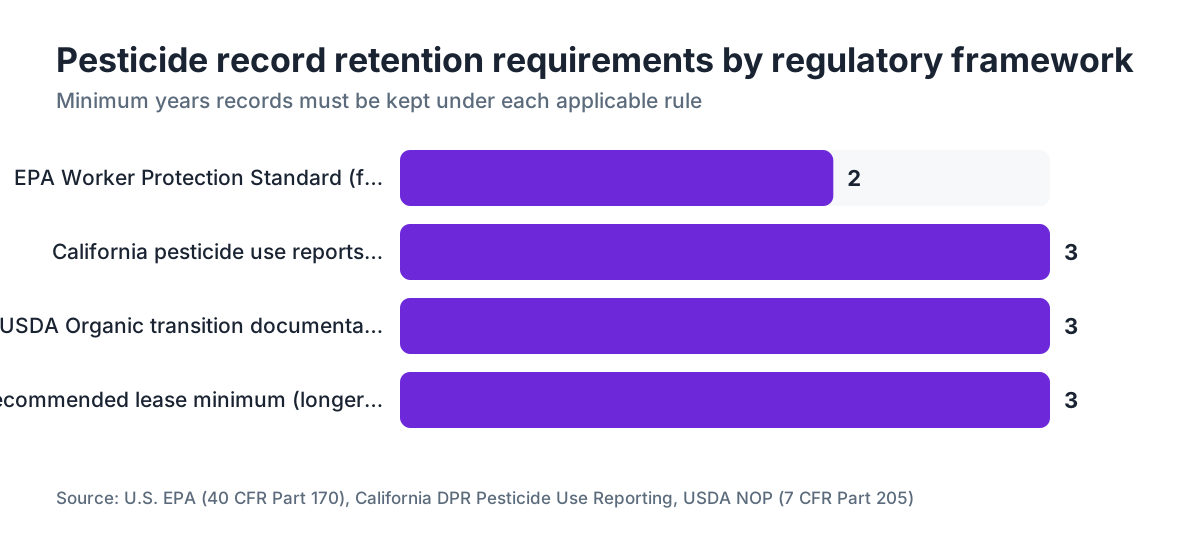
Retention matters too. The EPA Worker Protection Standard requires employers to keep certain application records for 2 years [1]. California requires pesticide use reports be available for 3 years. A good lease sets the longer of the two applicable periods as the minimum.
How does the EPA Worker Protection Standard affect vineyard lease terms?
The EPA Worker Protection Standard (WPS), revised in 2015 and in force at 40 CFR Part 170, is one of the heaviest federal rules for vineyard landlords and tenants because it attaches duties to whoever qualifies as the "agricultural employer" [1]. The EPA defines that as any person who hires or contracts for the services of workers or handlers, or who is a self-employed worker or handler.
In a standard vineyard lease, the tenant usually employs the crew, so the tenant is the agricultural employer for WPS purposes. That means the tenant must provide annual pesticide safety training, maintain a central posting with pesticide application information, keep decontamination supplies available in the field, and give workers access to the safety data sheet (SDS) for any pesticide applied in the last 30 days.
But if the landlord also has employees or contractors on the property, say for irrigation maintenance or harvest, the landlord may carry WPS duties at the same time. The lease should acknowledge both parties' WPS status and state who handles posting, who maintains the decontamination station near the leased block, and who notifies the other party's workers of application-exclusion intervals.
The WPS application-exclusion zone (AEZ) rules, added in the 2015 revision, require that no one other than trained and equipped handlers enters a zone around equipment during outdoor applications. If the landlord's workers are on the property during a tenant's spray event, the AEZ creates a real exposure conflict the lease should handle with a pre-spray notification requirement [1].
The practical fix is a simple clause. Tenant must notify landlord at least 24 hours before any restricted-use pesticide application or any application with a re-entry interval over 24 hours, and landlord must keep landlord's agents out of the leased block during the restricted entry interval.
What does a vineyard lease need to say about organic certification?
Organic wine grapes command premiums, and the three-year transition under the USDA National Organic Program (7 CFR Part 205.202) means a contamination event or a single prohibited-substance application can wipe out years of investment [2]. Leases for organic or transitional blocks need specific language.
First, the lease should state the block's current certification status and name the certifying agent. If the block is in transition, state the transition start date and expected certification date. Both parties should represent and warrant, in the lease, that they have not applied any prohibited substance to the block within the past three years.
Second, the lease should prohibit the landlord from applying anything to the leased block, including through shared equipment or shared irrigation water carrying soluble inputs, without the tenant's prior written consent. Shared water supply is a real issue. If the landlord injects a conventional fertilizer or a synthetic pesticide upstream, that input can reach the leased block.
Third, the lease should address what happens if a prohibited-substance contamination comes from outside the tenant's control, for example drift from a neighbor or from the landlord's adjacent conventional block. The NOP allows organic certification to continue if the farmer can document that they did not apply the substance and took reasonable steps to prevent contamination [2]. The lease should require the landlord to cooperate with any investigation by the certifying agent and to indemnify the tenant for any certification-related loss caused by the landlord's actions or failures.
WSU Extension's organic farming resources and UC ANR's viticulture pages both address transition planning and contamination risk, and either is worth referencing in a lease rider as guidance for reading the organic restrictions clause [5][6].
What happens when a tenant violates pesticide restrictions in the lease?
The consequences split two ways: regulatory and contractual.
On the regulatory side, pesticide misuse can bring civil penalties under the Federal Insecticide, Fungicide, and Rodenticide Act (FIFRA, 7 U.S.C. § 136 et seq.) [7]. FIFRA allows fines up to $1,000 per violation for private applicators and up to $25,000 per violation for commercial applicators. States layer their own penalties on top. California's DPR can revoke a licensed applicator's certificate and impose civil penalties under Food and Agriculture Code Section 12999 [11].
On the contractual side, the lease should spell out remedies that don't require waiting for a regulator to act. A good clause might say: any pesticide application that violates Section X of this lease is a material breach; landlord may terminate the lease on 30 days written notice if the breach is not cured; tenant is liable for documented economic loss including lost organic premium, crop rejection costs, and remediation expenses.
Cure provisions matter. If the violation is something like late record filing rather than an actual prohibited-substance application, a reasonable cure window of 10 to 15 days keeps outcomes proportionate. If the violation is applying a prohibited substance to an organic block, a longer cure period makes no sense because the damage is already done. Some leases separate curable and non-curable breaches for exactly this reason.
Indemnification should run both directions. Tenant indemnifies landlord for regulatory penalties arising from tenant's pesticide use. Landlord indemnifies tenant for penalties arising from the landlord's interference with, or contribution to, a violation.
How should a vineyard lease handle neighboring property drift and off-target applications?
Pesticide drift is genuinely hard to pin liability on, because the applicator is usually a third party, the neighbor, who is not party to the lease. But the lease can still structure how the landlord and tenant respond.
The clause should require whoever first spots evidence of drift, whether by observation, odor, or tissue testing, to notify the other party in writing within 48 hours. It should also require both parties to document the event: photographs, GPS coordinates, wind log if available, and a sample sent to a certified laboratory if the suspected material could affect organic status or export tolerance compliance.
California's DPR and county agricultural commissioners investigate pesticide drift complaints, and the affected party can file a complaint that may bring penalties against the neighboring applicator [3]. The lease clause should require both landlord and tenant to cooperate in any such investigation and to preserve evidence.
For organic blocks, the clause should specify that in the event of confirmed drift from a prohibited substance, the landlord and tenant will jointly notify the certifying agent within a defined period, usually 5 to 10 days. Prompt notification is the NOP's preferred practice and may affect whether the block keeps certification [2].
If the landlord's own adjacent conventional block is a realistic drift source, the lease should include a buffer requirement: no application of restricted materials within a defined distance, commonly 30 to 50 feet, from the lease boundary without prior tenant approval and wind-direction monitoring.
Should the lease address pesticide equipment, calibration, and application timing?
This gets into farming practice territory, and some landlords prefer not to over-specify. But at minimum, if shared equipment is involved, the lease needs to address it.
Shared sprayers create cross-contamination risk. If the landlord's sprayer runs on a conventional block and then on the tenant's organic block without proper cleaning, the NOP treats that as a prohibited-substance application. The lease should either ban shared equipment entirely or require a documented cleaning protocol before any shared-equipment use on the leased block, with records kept by whoever does the cleaning.
Application timing restrictions may come from the lease's own buyer-driven PHI requirements, county or state time-of-day spray restrictions (some California counties limit applications during certain wind conditions or times of day under their county ag commissioner's authority), and pesticide label directions, which are federal law under FIFRA Section 12(a)(2)(G) [7]. The lease can incorporate label compliance by reference, but it should make clear that the tenant is solely responsible for reading and following the label on any product they apply.
Calibration is a practical farming issue more than a legal one, but a calibration log is good evidence in a dispute that the tenant applied materials at label rates. Some leases require annual sprayer calibration documentation. It's a reasonable ask if the landlord is covering liability insurance for the operation.
What do university extension programs recommend for pesticide clauses in farm leases?
Cornell's Agricultural Law and Management program has published farm lease guides that address environmental compliance, including pesticide use, as part of standard lease drafting [8]. The guidance recommends that leases specify which party bears responsibility for pesticide record-keeping and environmental compliance costs, and that environmental indemnification run from the party causing the condition to the other party.
UC ANR's viticulture and farm management resources, including materials from the UC Cooperative Extension, address spray record documentation and the point where lease terms meet California pesticide law [6]. UC ANR farm lease guidance recommends that lessors (landowners) require lessees to keep all pesticide records the law requires and provide copies on request, and that leases make EPA WPS compliance a condition of the tenancy.
WSU Extension covers pesticide stewardship in the context of Washington's specific requirements, including the need for a Pesticide Applicator License for certain operations and how lease terms interact with Washington Department of Agriculture enforcement [5]. Their farm lease materials note that lease termination for pesticide law violations is an appropriate remedy.
One thread runs through all three programs: be specific. Generic compliance language does not create enforceable obligations the way named substances, named deadlines, and named record formats do. Extension specialists generally recommend attaching an exhibit to the lease that lists current prohibited materials and updating it annually by addendum rather than trying to draft a lease that covers every future regulatory change.
How do you track and share pesticide records between landlord and tenant?
Spray records in a vineyard need to capture, at minimum: date and time of application, product name and EPA registration number, application rate, total quantity applied, acres or area treated, target pest, application method, operator name and applicator license number, and weather conditions at time of application. California requires all of these under the DPR's pesticide use reporting system [4].
How landlord and tenant share those records is largely a logistics problem, but the lease should resolve it contractually. Three approaches are common:
- Tenant files government records and delivers copies to landlord within 30 days of each application, retained by landlord for the longer of 3 years or the lease term plus 1 year.
- Both parties keep shared access to a digital spray log, updated within 7 days of each application (matching California's statutory reporting window).
- Landlord or their designated PCA receives copies of all Notices of Intent filed with the county ag commissioner, which in California's restricted materials system works as advance notification rather than after-the-fact reporting.
Option 2 is the most practical for operations where both parties are actively involved, and field compliance platforms make it manageable. VitiScribe is one tool vineyard managers use to log spray events, track re-entry intervals, and generate the reports that satisfy both government filing requirements and lease record-sharing obligations.
Whatever system you pick, the lease should name it or describe its format specifically enough that neither party can argue later about what "records" means.
What should the lease say about pesticide storage and disposal on the leased property?
Pesticide storage on leased property creates environmental liability that can outlast the lease term. Federal and state hazardous waste rules, including RCRA for certain pesticide wastes and EPA's pesticide container rules at 40 CFR Part 165, govern storage and disposal [9].
The lease should require all pesticides stored on the property to stay in original, labeled containers; storage in a locked, ventilated, secondary-containment structure that meets state requirements; an inventory available to the landlord on request; and removal of all pesticide stocks from the property within 30 days of lease termination.
Triple-rinsed pesticide containers can be recycled through state programs, and many California counties run container collection events through the county agricultural commissioner's office. The lease can require the tenant to use those programs rather than tossing containers in a way that creates liability.
End-of-lease inspection should include a pesticide storage check. If any contamination turns up, the responsible party should be named in writing before the security deposit (if any) is released. Some landlords include a specific pesticide-contamination indemnification that survives lease termination.
Are there standard lease templates with pesticide clauses already drafted?
There is no single universal template. But several solid starting points exist.
Cornell's agricultural law resources include farm lease guides with environmental compliance sections [8]. The National Agricultural Law Center maintains a state-by-state farm lease resource library at nationalaglawcenter.org [10]. UC Cooperative Extension has county-level farm advisors who can review lease pesticide language for California-specific compliance. Washington State University Extension has published farm lease templates for Pacific Northwest operations [5].
For vineyards specifically, some wine grape purchase agreements come with required farming practice addenda that effectively dictate lease terms. If the tenant has a grower contract with a winery, that contract's pesticide requirements should be incorporated by reference into the lease, or at minimum the lease should require the tenant to comply with the most restrictive of: applicable law, winery contract requirements, and the lease's own restrictions.
One note on templates. An attorney who practices agricultural law in your state should review any lease that involves restricted-use pesticides, organic certification, or property in a groundwater protection area. The exposure is real enough that $500 to $1,500 in legal review is money well spent. Nobody has good data on how often pesticide clauses are the source of vineyard lease disputes versus other issues, but extension specialists who work with growers describe them as a frequent friction point once a compliance problem hits.
For ongoing record management between landlord, tenant, and PCA, VitiScribe's vineyard operations tools can be the shared documentation layer the lease describes, keeping spray records, re-entry intervals, and applicator credentials in one place both parties can access.
Frequently asked questions
Can a landlord prohibit all pesticide use on a leased vineyard?
Yes, a landlord can contractually prohibit any class or list of pesticides as a lease condition, and the tenant accepts those terms by signing. The practical limit is that a total ban may make commercial viticulture impossible in high disease-pressure regions, so most leases prohibit specific materials instead. The lease should also address what happens if a disease outbreak makes a prohibited material the only label-registered option.
Who is liable if a tenant applies a pesticide that contaminates a neighboring organic vineyard?
The applicator, usually the tenant, carries primary liability under FIFRA and state pesticide law. The landlord may face secondary liability if the lease gave the landlord control over application decisions or if the landlord directed the application. A good indemnification clause shifts costs to the tenant for applications the tenant controls. How these disputes actually settle depends on insurance coverage, lease language, and state law.
Does the EPA Worker Protection Standard apply to the landlord or the tenant in a vineyard lease?
It applies to whoever qualifies as the "agricultural employer" under 40 CFR Part 170, generally the party employing workers or handlers on the property. In a standard lease where the tenant farms with their own crew, the tenant carries WPS obligations. If both parties have employees on the property, both may carry concurrent WPS duties. The lease should assign these responsibilities explicitly rather than leaving them to inference.
How long must pesticide application records be kept under a vineyard lease?
The EPA WPS requires records to be kept for at least 2 years. California's pesticide use reporting rules require records to be available for 3 years. The lease should set the longer applicable period as its minimum. For organic operations, certifying agents typically require records covering the full transition period, which can be 3 years or more, so the lease should match that requirement.
What is a pre-harvest interval and why does it belong in a vineyard lease?
A pre-harvest interval (PHI) is the minimum number of days that must pass between a pesticide application and harvest, as stated on the label. PHIs are federally mandated under FIFRA and enforced as label requirements. Wine grape buyers, especially those exporting to the EU, often require shorter PHI schedules than the label minimum. A vineyard lease should specify whether the tenant must comply with any buyer-imposed PHI schedule on top of label requirements.
Can a pesticide violation by a tenant allow a landlord to terminate the lease?
Yes, if the lease makes pesticide compliance a condition of tenancy and provides for termination upon material breach. Without that language, a landlord relying on general breach-of-contract principles faces a longer, more expensive path to termination. The lease should separate curable breaches with a notice-and-cure period, such as late record filing, from non-curable breaches, such as applying a prohibited substance to an organic block.
What pesticide-related representations should each party make at lease signing?
At signing, the landlord should represent that, to their knowledge, no prohibited substances have been applied to the property within the relevant lookback period (3 years for organic transition). The tenant should represent that they hold current applicator licenses for any restricted-use pesticides they intend to apply. Both parties should represent they are not aware of any pending pesticide-related regulatory investigation involving the property.
How should a vineyard lease handle pesticide use during a drought or pest emergency?
The lease should include a force majeure or emergency provision covering the case where a regulated pest or disease outbreak requires a material that would otherwise be prohibited. The clause should require immediate written notice to the other party, documentation of the emergency declaration or extension recommendation, and a limit that the authorization covers only the specific event. Without this, a tenant may face a lease violation during a genuine phytosanitary emergency.
Do vineyard lease pesticide clauses need to be updated annually?
Not necessarily annually, but they should be reviewed whenever the tenant's winery contract changes approved materials, state or county groundwater protection designations change, the organic certifier updates their materials list, or a new restricted-use classification takes effect for a material in regular use. An annual addendum process, short and simple, is the most practical way to keep restrictions current without re-drafting the whole lease.
What is the difference between a restricted-use pesticide clause and a prohibited pesticide clause in a lease?
A restricted-use pesticide clause governs materials the EPA or state classifies as restricted-use, which require a certified applicator for purchase and use. It typically addresses who holds the license and who signs required purchase records. A prohibited pesticide clause bans specific materials entirely, regardless of regulatory classification. A good lease has both: one for how restricted-use materials are handled, and one listing materials that are off-limits regardless of registration status.
How does a vineyard lease address pesticide applications made by a hired pest control operator versus the tenant directly?
The lease should state that any hired pest control operator (PCO) or pest control adviser (PCA) must comply with the same restrictions that bind the tenant, and that the tenant is responsible for ensuring that compliance. The tenant should have to give any PCO or PCA a copy of the relevant lease sections before they apply anything. Many California operations use a licensed PCA to direct applications; the lease should require that PCA's recommendations be documented and retained.
Can a vineyard lease require the tenant to use only IPM-approved practices?
Yes. Integrated Pest Management (IPM) requirements can be written into a lease by reference to a specific standard, such as the CDFA's Healthy Soils Program criteria, the USDA's IPM definition, or a third-party sustainability program like LODI Rules or Napa Green. The lease should name the specific standard and set a monitoring or documentation requirement so IPM compliance is verifiable rather than aspirational.
What happens to pesticide liabilities when a vineyard lease expires or is terminated early?
Liability for pesticide applications made during the lease term generally follows the party who made them, but environmental contamination liability can run with the land and attach to the current property owner. The lease should include a survival clause stating that indemnification obligations for pesticide violations survive termination. An end-of-lease property inspection covering storage areas and any known contamination points is standard practice.
Are there model vineyard lease clauses published by any government or university source?
Cornell's agricultural law program, UC Cooperative Extension, and WSU Extension all publish farm lease guides with environmental and pesticide compliance sections, though none publish vineyard-specific model clauses. The National Agricultural Law Center maintains a state-by-state farm lease resource library. For California operations, county UC Cooperative Extension farm advisors can often review draft language. State-specific review by an agricultural attorney is the most reliable path for compliance-critical clauses.
Sources
- U.S. EPA, Worker Protection Standard (40 CFR Part 170): The WPS defines agricultural employer duties including pesticide safety training, posting, decontamination, and application-exclusion zones; records must be retained for 2 years.
- USDA National Organic Program, 7 CFR Part 205: Organic certification requires a 3-year transition period with no prohibited substances applied; contamination from an uncontrolled source does not automatically decertify a field if the farmer can document prevention efforts.
- California Department of Pesticide Regulation, Groundwater Protection Areas: California DPR designates Groundwater Protection Areas where certain pesticides are prohibited or require a Notice of Intent before application.
- California Department of Pesticide Regulation, Pesticide Use Reporting: California Food and Agriculture Code Section 12977 requires pesticide use reports to be filed with the county agricultural commissioner within 7 days of application.
- Washington State University Extension, Pesticide Applicator Training and Farm Resources: WSU Extension covers Washington State pesticide applicator licensing requirements and how they interact with farm lease obligations.
- UC Agriculture and Natural Resources (UC ANR): UC ANR farm lease guidance recommends lessors require lessees to maintain all legally required pesticide records and provide copies on request, and include EPA WPS compliance as a lease condition.
- Federal Insecticide, Fungicide, and Rodenticide Act (FIFRA), 7 U.S.C. § 136 et seq.: FIFRA allows civil penalties up to $1,000 per violation for private applicators and up to $25,000 per violation for commercial applicators; using a pesticide inconsistent with its label is a federal violation under Section 12(a)(2)(G).
- Cornell University, Agricultural Law and Management (Cornell CALS): Cornell's farm lease guides address environmental compliance including pesticide use, and recommend environmental indemnification run from the party causing the condition to the other party.
- U.S. EPA, Pesticide Containers and Container Management (40 CFR Part 165): Federal rules including RCRA and EPA's pesticide container regulations at 40 CFR Part 165 govern pesticide storage and disposal.
- National Agricultural Law Center, Farm Lease Resources: The National Agricultural Law Center maintains a state-by-state farm lease resource library covering environmental compliance provisions.
- California Department of Pesticide Regulation, Pesticide Enforcement: California DPR can revoke a licensed applicator's certificate and impose civil penalties under Food and Agriculture Code Section 12999 for pesticide law violations.
Last updated 2026-07-10