Vineyard soil preparation: a complete field guide
TL;DR
- Vineyard soil preparation starts one to two years before planting.
- It covers soil testing at multiple depths, pH correction (target 6.0 to 6.5 for most vinifera), deep tillage to 24 to 36 inches, organic matter, drainage, and cover crops.
- Fixing these after planting costs far more than doing them right the first time.
Why does soil preparation matter so much before planting a vineyard?
Grapevine roots can live 50 years or more in the same ground. You get one real window to fix what's underneath, and it closes the moment you drop a vine in the hole. Once the trellis is up and the canopy is set, you can't run a subsoiler through the block, you can't lime four feet down, and you can't undo a hardpan without tearing the whole thing out.
The money makes the case on its own. University of California Cooperative Extension puts establishment costs for a new vineyard at $15,000 to $50,000 per acre depending on region, trellis system, and land cost [1]. A soil test and a pre-plant lime application might run $200 to $600 per acre. Patching pH after the vines are in, through foliar sprays and surface amendments, is slower, weaker, and it drags across every season the block underperforms.
Pre-plant is also your best shot, sometimes your only shot, at handling nematodes, perennial weeds, compaction, and drainage at the same time. WSU Extension treats pre-plant fumigation, cover crop choice, and deep tillage as one system rather than separate chores, because the order and timing of each step changes what the next one can do [2].
Get this right and your vines hit yield targets two to three years in. Get it wrong and you farm around the problem for the life of the block.
What soil tests should you run before establishing a vineyard?
A standard agronomic panel is not enough. You want a full pre-plant profile: pH, buffer pH (for the lime rate), organic matter percentage, cation exchange capacity, the macros and micros (P, K, Ca, Mg, S, B, Mn, Zn, Fe, Cu), and texture by horizon. That means sampling at multiple depths, 0 to 12 inches, 12 to 24 inches, and ideally 24 to 36 inches. Most labs charge $30 to $80 per sample for a full panel. Running three depths per management zone is worth every dollar.
Add a nematode assay. It costs about $40 to $80 per sample through UC Davis or a private lab, and it checks for Xiphinema index, the vector of Grapevine fanleaf virus, plus root-knot and dagger nematodes that colonize young roots fast. On any ground with prior orchard or vineyard use, this is not optional. UC Davis recommends testing for nematodes before you commit to a fumigation plan, because the treatment depends entirely on which species you have and at what density [3].
A texture analysis tells you whether a drainage problem is structural. Clay-heavy soils (more than 35% clay) may need tile drainage or raised rows. Sandy soils need a completely different fertility approach than a loam.
Sample in a grid or by management zone. Vineyard sites are rarely uniform. One composite sample from a 10-acre block averages out the variation and can hand you a pH reading that's flat wrong for half the ground. Two-acre zones or finer is a reasonable pre-plant target, and it matters most on hillsides where soil depth and parent material shift over a few feet.
What pH should vineyard soil be, and how do you adjust it?
Most Vitis vinifera varieties do best at a soil pH of 6.0 to 6.5. Below 5.5, aluminum and manganese turn soluble at levels toxic to roots, and phosphorus availability drops sharply. Cornell's Finger Lakes Grape Program states the same threshold: "below 5.5, aluminum and manganese become soluble at phytotoxic levels" [11]. Above 7.0, iron, zinc, manganese, and boron get locked up, so you see chlorosis and weak shoots even with the nutrients sitting right there in the soil [4].
Cornell Cooperative Extension notes that many northeastern soils need lime before planting, and that surface-applied lime crawls through the profile, so pre-plant incorporation to 12 inches or deeper beats post-plant surface spreading by a wide margin [4]. Calcitic lime (calcium carbonate) raises pH and supplies calcium. Dolomitic lime raises pH and adds magnesium too. Which one you pick comes off your Ca:Mg ratio. If magnesium is already high relative to calcium (common in some Pacific Coast soils), dolomitic lime makes it worse.
Lime rates run off buffer pH, not water pH. Your lab report should give a rate in tons per acre. Follow that number. Don't eyeball it. Apply lime at least six months before planting, a full year if you have it, so the shift finishes before roots go in.
If pH is too high (alkaline soils, common in parts of Paso Robles and the Yakima Valley), elemental sulfur is the standard fix. Soil bacteria oxidize it to sulfuric acid over weeks to months. The rate depends on soil buffering and how far you need to move. A one-unit drop in sandy soil often takes 200 to 500 lbs per acre of elemental sulfur; heavy clay takes more. This one is slow, so it belongs in year one of a two-year plan.
| Soil pH | Primary issue | Amendment | Timing before planting |
|---|---|---|---|
| Below 5.5 | Al/Mn toxicity, low P availability | Calcitic or dolomitic lime | 12 months minimum |
| 5.5 to 6.0 | Moderate acidity | Lime at moderate rates | 6-12 months |
| 6.0 to 6.5 | Target range | None needed | N/A |
| 6.5 to 7.5 | Borderline alkaline | Monitor; possible sulfur | 6-12 months |
| Above 7.5 | Micronutrient deficiencies | Elemental sulfur | 12+ months |
How deep should you till or rip vineyard soil before planting?
Deep tillage exists to fracture compaction and any restrictive subsoil so roots build a deep, spread-out system in the first few years. Shallow roots leave the vine at the mercy of the weather. A dry July hits a lot harder when roots stop at 18 inches instead of four feet.
WSU Extension recommends deep ripping to at least 24 inches, and 36 inches or more where there's known hardpan or a fragipan [2]. A single-shank subsoiler at 36 inches is the standard tool. On tough sites some growers make two passes at different angles to break the layer more fully. Timing is everything: rip when the soil is dry enough to fracture, not smear. Wet clay that gets ripped just leaves vertical slick planes instead of the shattered structure you want.
On hillsides, most growers rip along the future vine row while the slope is still open ground. A cross-slope rip before row construction can improve infiltration across the block. On flat sites, a full-coverage rip in two directions followed by amendment incorporation is common.
After the deep rip, you usually want a chisel plow or disc pass to work lime, sulfur, or other amendments into the top 12 inches. The rip shatters the hard stuff below. The surface tillage mixes what you're adding into the root-active zone. Don't skip that surface step because you already did the deep work. Two different jobs.
How do you manage drainage and water in vineyard soil prep?
Standing water kills grapevines. A few days of saturated root zone in the growing season starves the roots of oxygen and opens the door to Phytophthora and other water molds. Pre-plant is the time to fix it, because installing tile drainage later means tearing up rows.
Start with a percolation test or a simple pit. Dig down 24 to 36 inches after a rain and check whether free water is still sitting there 24 hours later. If it is, you have a drainage problem. Percolation slower than about 0.5 inches per hour through the subsoil is generally restrictive for vineyards, though the exact threshold shifts with variety and rootstock.
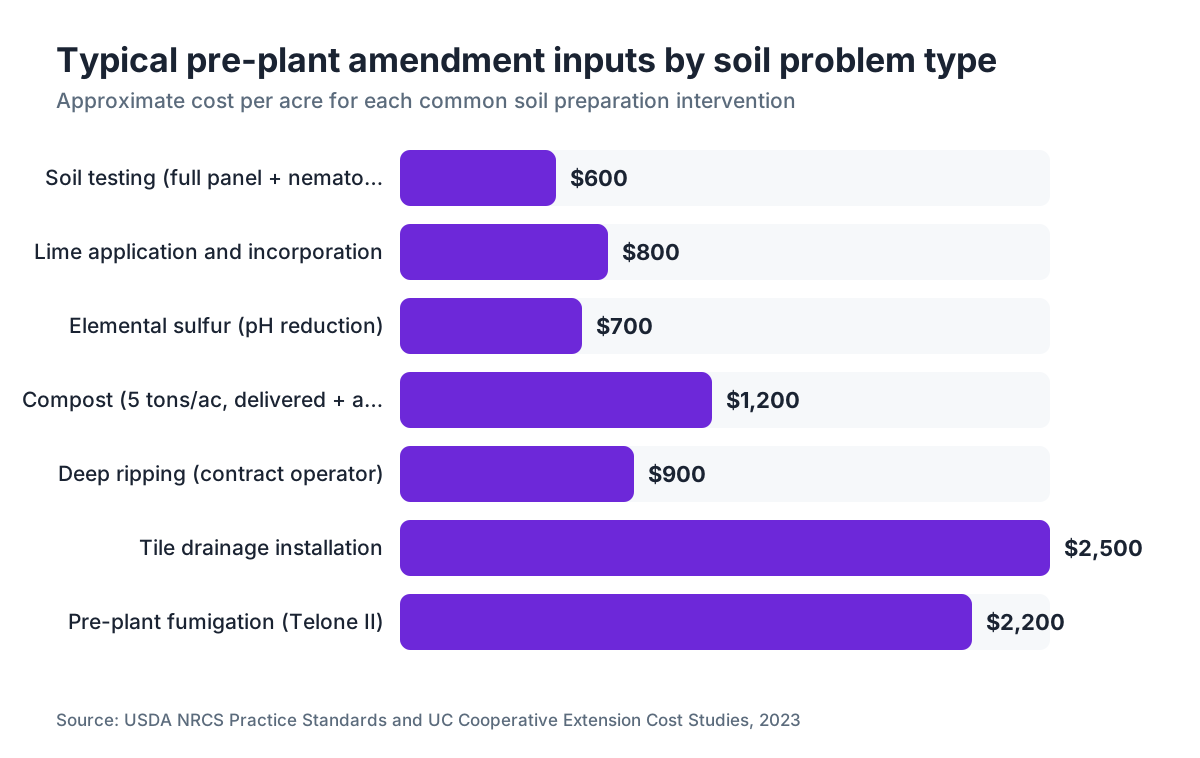
Tile drainage (perforated plastic pipe buried at 36 to 48 inches) is the standard fix for flat sites with slow subsoil. Tile runs along each vine row or every other row at 20 to 40 foot spacing depending on texture. Installation runs roughly $1,500 to $4,000 per acre depending on site complexity and local rates. That range comes off NRCS practice standards and varies a lot by region [5].
On slopes, drainage is usually handled through row orientation (running rows up-and-down to shed water), raised planting berms (mounding soil 8 to 12 inches above grade to keep the graft union and upper roots out of the wet zone), and surface diversion berms or waterways upslope of the block.
Cover crops in the row middles help with surface water and infiltration once they're established. They're no replacement for drainage infrastructure when the problem is structural.
What organic matter and nutrient amendments should you add before planting?
Most farmed soils in the western US carry 1 to 3% organic matter, and many vineyard sites sit lower after erosion, row cropping, or sandy parent material. Aim for 2 to 4% in the top 12 inches going into planting. Higher is better, but you rarely get there pre-plant without years of cover cropping.
Compost is the main lever. A one-time application of 5 to 10 tons per acre of finished compost, incorporated to 12 inches, lifts organic matter and improves structure, water-holding, and microbial life. UC Cooperative Extension warns that compost quality swings hard, and recommends a compost analysis (N-P-K, salt levels, maturity index) before you spread large quantities, especially near young vines where root salt damage is a real risk [1].
Phosphorus barely moves once it's in the soil, so if your test shows low P (below 15 to 20 ppm Bray-1, or the Mehlich-3 equivalent), incorporate it pre-plant. Banding down the row or deep incorporation before final tillage puts P where roots will find it. Loading up on P has diminishing returns and can block zinc and iron uptake, so don't overdo it.
Potassium moves more freely than P and can wait for post-plant in most cases. But if you're badly deficient (below 100 ppm or the CEC-adjusted equivalent), incorporate it before planting. Potassium sulfate beats potassium chloride for grapes, because excess chloride reaches phytotoxic levels in some soils.
Boron, zinc, and manganese belong on a soil-and-tissue-test basis, not a blanket spread. Add boron to a soil that doesn't need it and you hit toxic levels fast. The boron toxicity threshold in soil is only about 2 to 5 ppm available B, depending on the assay.
Should you fumigate vineyard soil before planting, and what are the alternatives?
Pre-plant fumigation is one of the biggest calls in vineyard establishment. The main targets are Xiphinema index (dagger nematode, the fanleaf vector), root-knot nematodes (Meloidogyne spp.), and perennial weed propagules. On replant sites, fumigation is often strongly recommended. On virgin ground with no nematode pressure confirmed by assay, you may not need it at all.
Methyl bromide, the old workhorse, is essentially gone for pre-plant vineyard use in the US. EPA classifies it as an ozone-depleting substance under the Montreal Protocol, with only limited critical-use exemptions left [6]. What's left includes chloropicrin, 1,3-dichloropropene (Telone II), combinations of the two, and metam sodium or potassium applied as a drench or through drip.
Fumigant efficacy leans on soil temperature (above 50 degrees F at 12 inches), soil moisture (field capacity is ideal), and seal quality. Virtually tarped plastic film holds the fumigant in the profile long enough to work. Without good tarp management, a large fraction escapes to volatilization.
All fumigants are registered pesticides under EPA's Worker Protection Standard [7]. The WPS requires specific PPE (respirator, chemical-resistant gloves, coveralls), restricted-entry intervals that vary by product (Telone II carries a 5-day REI), and training for anyone entering treated ground. Many states also require a licensed Pest Control Adviser or Certified Crop Adviser recommendation. California adds its own layer: DPR permits, county agricultural commissioner notification, and buffer zone posting [10].
The alternatives include heat solarization (clear plastic over moist soil in summer), biofumigation cover crops (high-glucosinolate brassicas like mustard, incorporated before flowering), and resistant or tolerant rootstocks. Rootstocks like 3309 C and 101-14 carry moderate nematode tolerance; Freedom resists root-knot nematodes. None of these wipe out nematodes the way a fumigant can, but they can knock populations down enough for a successful start when fumigation isn't practical or available [3].
How do cover crops fit into vineyard soil preparation?
A cover crop in the season before planting does several jobs at once: it builds organic matter, improves structure through root activity, holds down weeds, cuts erosion, and adds biologically available nitrogen if you work in legumes. Some growers run a full dedicated cover crop year as part of a two-year plan, then mow and incorporate the biomass before final tillage and planting.
Selection follows your goals. A winter mix of cereal rye and hairy vetch is common in the Northeast and Pacific Northwest: rye brings biomass and erosion control, vetch fixes nitrogen. Mustard species work as biofumigants, but only if you incorporate them at the right stage, before flowers open, when glucosinolate content peaks. Sudangrass and sorghum-sudangrass hybrids in summer suppress nematodes through allelopathic root exudates, and some growers use them as a fumigation alternative on low-pressure sites.
After planting, cover crops belong in the row middles, never the vine row itself. That's ongoing management, not site prep. The pre-plant cover crop is a one-time deposit into the soil system.
What is the timeline for a proper vineyard soil preparation program?
Two years is ideal. One year works. Under six months and you're cutting corners you'll pay for over decades.
Here's a realistic two-year timeline:
Year 1, Spring: Pull soil samples at multiple depths and zones. Submit for a full nutrient panel plus nematode assay. Establish a biofumigant or biomass cover crop.
Year 1, Summer/Fall: Results come back. Calculate lime, sulfur, and amendment rates. Order materials. Deep rip if the soil is dry enough. Incorporate lime and phosphorus. Seed a winter cover crop if the spring cover was terminated.
Year 1-2, Winter: pH adjustment does its work. Winter cover crop grows.
Year 2, Spring: Terminate and incorporate the winter cover crop. Let the soil settle. Take follow-up samples to confirm pH moved to target.
Year 2, Summer: Fumigate if the assay calls for it (needs dry, warm soil). Install tile drainage if needed. Fine-grade the rows.
Year 2, Fall / Year 3, Spring: Plant dormant vines.
On a one-year timeline the sequence compresses. You lime in spring, rip and incorporate in summer, fumigate if needed in late summer, and plant the following spring. You lose the cover crop year and some pH adjustment time, but you can still do the structural and chemical work that counts.
This is exactly the kind of multi-year sequence that falls apart on memory alone. VitiScribe's field operations tools let you attach soil test PDFs, log amendment applications with rates and dates, and set reminders for follow-up sampling, so nothing slips through across a two-year prep window.
Are there soil preparation differences between new vineyard sites and replant situations?
Yes, and replant is harder. A virgin agricultural site or ground converted from dryland grain carries none of the pest and disease history of a former vineyard. You start clean. The jobs are structural (compaction, drainage), chemical (pH, nutrients), and nematode prevention if the assay flags pressure from neighboring ground.
Replanting into an old vineyard block brings real complications. Grapevine replant disease, sometimes called specific replant disorder, is a documented phenomenon. It ties to a complex of soil fungi including Ilyonectria and Cylindrocarpon species (now reclassified under Dactylonectria and related genera) that build up in old root debris and suppress young vine establishment [8]. Fumigation gets recommended more often on replant sites partly to hit this fungal complex, more than nematodes.
Old root removal matters more here. Grinding old stumps and leaving chips in the ground creates a food source for these fungi. Pulling stumps whole and hauling them off beats in-ground grinding, though it costs more in equipment and labor. Some growers grind and then fumigate; others pull stumps, wait a year under a cover crop, then fumigate. Both are defensible.
Phylloxera-infested replant sites hinge on rootstock selection, because no chemical or biological treatment clears phylloxera from a site. The rootstock choice (St. George, 1103 Paulsen, 110 Richter, and others with phylloxera resistance) becomes the central decision, and the rest of the prep proceeds as normal around it [1].
What equipment do you actually need for vineyard soil preparation?
The list depends on your site and what you contract versus own. Most small vineyard operators contract the heavy iron.
For a typical new planting on farmed ground:
A bulldozer or motor grader handles clearing, stump removal, and initial drainage grading. Rental or contract rates run $150 to $300 per hour depending on machine size and region. This is not a DIY job unless you own the machine.
A subsoiler or deep ripper (single or multi-shank) on a 150-plus horsepower tractor is the deep tillage tool. Equipment dealers often rent these by the day, and many growers hire a custom operator. Shanks need to reach 30 to 36 inches effectively, which takes enough horsepower to pull them at depth without stalling.
A chisel plow or disc handles the surface amendment work. Most operators already own something in this class. Three to five passes may be needed to work lime in thoroughly.
GPS grid sampling or an RTK system for accurate management zones is worth renting or contracting through an ag consultant on larger blocks (over 10 acres). On small blocks, a measured grid and a soil probe do the job.
For fumigation, contracted licensed applicators are the practical route for most growers. The injection rigs and tarping gear are specialized, and the regulatory load (applicator licensing, permits, buffer zones) makes DIY fumigation both impractical and legally risky in most states [7].
Irrigation infrastructure overlaps with soil prep on many sites, because trenching for mainlines is far easier before the vine row mounds are shaped. Plan the irrigation layout before final land prep and trench mainlines at the same time as drainage tile.
How do soil preparation needs differ by region and soil type?
Soil prep is not one recipe. What matters in the Willamette Valley is not what matters in the San Joaquin Valley or the Finger Lakes.
In the Pacific Northwest, volcanic and marine sedimentary parent materials produce everything from silty clay loams in the Willamette Valley (Jory and Nekia series) to silt loam and sandy loam in eastern Washington's Yakima and Walla Walla valleys. Western Oregon pH often sits at 5.5 to 6.0 and needs lime. Eastern Washington soils frequently run alkaline (pH 7.5 to 8.0) from calcium carbonate accumulation (caliche) and may need sulfur. Nematode pressure is significant across the Columbia Valley. WSU Extension covers these regional specifics in its vineyard soil management guides [9].
In California, the Coast Ranges run wildly variable, from ultrabasic serpentine to well-drained clay loams. The Central Valley has deep alluvial soils that are often excellent structurally but can be alkaline and short on micronutrients. Paso Robles soils (covered more in Paso Robles wineries) include calcareous clay and sandy loam types that behave nothing alike. Phylloxera history means rootstock selection dominates the prep conversation across much of California [1].
In the Northeast (New York, Virginia, Pennsylvania), high rainfall, heavier soils, and lower pH from leaching are the pattern. Drainage infrastructure comes up more often. Cornell Cooperative Extension publishes soil management guides specific to the Finger Lakes and Hudson Valley AVAs, with liming rates calibrated to New York soils [4].
Arid western regions (Arizona, New Mexico, parts of Texas) face the opposite set: alkaline soils, salt accumulation, and irrigation water quality that raises soil sodium over time. Gypsum (calcium sulfate) to displace sodium off the exchange complex is a pre-plant step that sodic soils sometimes need.
Mountain sites, like those around mountain wineries, change the tillage picture entirely. Thin rocky soils over fractured parent material may not deep-rip at all, and shallow-rooted vines on poor soils can actually produce better fruit quality while demanding more careful water management.
Frequently asked questions
How long before planting should you prepare vineyard soil?
One to two years is the realistic target. That gives lime time to move pH (6 to 12 months), a cover crop cycle time to build organic matter, and any fumigation time to clear its restricted-entry interval and dissipate. Compressing everything into six months is possible, but you'll be planting before you can confirm pH actually shifted to target.
What pH is best for growing grapes?
Most Vitis vinifera varieties do best at 6.0 to 6.5. Below 5.5, aluminum and manganese turn toxic to roots. Above 7.0, iron and zinc deficiencies get common. Some American hybrids tolerate a wider range. Test at multiple depths, more than the surface, because subsoil pH drives the deep roots just as surface pH drives the shallow zone.
How deep should vineyard soil be ripped before planting?
A minimum of 24 inches, and 36 inches is better on sites with hard subsoil layers or fragipans. WSU Extension recommends deep ripping to at least 24 inches. The goal is fracturing compaction so roots reach 3 to 4 feet deep in the first few years. Ripping at 12 inches is mostly cosmetic. Time it when the soil is dry enough to crack and shatter, not smear.
Do I need to fumigate before planting a new vineyard?
Not automatically. Fumigate if a pre-plant nematode assay confirms Xiphinema index (the fanleaf virus vector) or root-knot nematodes at problem densities, or if you're replanting into ground with prior grapevine history (replant disease risk). On virgin sites with no nematode history, resistant rootstocks plus biofumigation cover crops may be enough. Always test first. Fumigation is expensive and comes with heavy regulation.
How much does vineyard soil preparation cost per acre?
Budget $2,000 to $8,000 per acre for testing, amendments, deep ripping, and drainage work, depending heavily on site complexity and whether you fumigate. Fumigation alone can run $1,500 to $3,500 per acre. These figures come off NRCS practice cost data and UC Cooperative Extension establishment budgets. Tile drainage, land clearing, and terracing push the total higher on tough sites.
What cover crops should I plant before establishing a vineyard?
For organic matter and nitrogen, a winter mix of cereal rye and hairy vetch is well proven. For nematode suppression or biofumigation, high-glucosinolate mustard species (Pacific Gold, Caliente 199) must be incorporated before flowering. Sorghum-sudangrass hybrids in summer also cut nematode populations. Choose based on what your soil test and nematode assay actually show, not a generic prescription.
How do I fix compacted soil in a vineyard that's already planted?
Options are limited. Shallow aeration (subsoiling between rows to 18 to 24 inches) helps if rows are wide enough and you stay 18 inches off the trunks. Deep-rooted cover crops like tillage radish in the row middles break up moderate compaction biologically over several seasons. Severe hardpan under an established block is basically unfixable without pulling the block. That's the core reason pre-plant deep ripping matters.
What nutrients are most commonly deficient in vineyard soils before planting?
Boron deficiency is common in high-rainfall leached soils. Zinc deficiency is widespread in high-pH western soils and sandy profiles. Phosphorus runs low in many virgin agricultural soils and needs pre-plant incorporation since it moves so slowly. Potassium can be low in light soils. Magnesium deficiency shows in coarse sands and in soils where calcitic lime got over-applied without checking the Ca:Mg ratio.
Can I use organic matter amendments like compost instead of fumigation?
Compost and organic matter shift the microbial balance toward suppressive organisms, which reduces (but doesn't eliminate) replant disease risk. They're no substitute for fumigation when Xiphinema index or high root-knot populations are confirmed. Treat compost as a long-term soil health investment and fumigation as a targeted pest decision. They solve different problems.
What worker safety rules apply to pre-plant fumigation in vineyards?
The EPA Worker Protection Standard covers fumigant applications. Workers entering treated areas must be trained, properly equipped (respirator, chemical-resistant gloves and coveralls), and must respect the restricted-entry interval for the specific product. Telone II carries a 5-day REI. California adds DPR permits, county agricultural commissioner notification, and buffer zone posting. The application must run under a licensed applicator in most states.
How do I know if my vineyard site has a drainage problem before planting?
Dig a pit 24 to 36 inches deep after a significant rain and check for free-standing water 24 hours later. Watch the site during wet periods for surface ponding. A percolation rate below about 0.5 inches per hour through the subsoil is generally restrictive. Texture showing more than 35 to 40% clay, especially in the subsoil, is a flag. If in doubt, install tile before planting. It's far cheaper than losing a block.
Does grape variety or rootstock affect soil preparation decisions?
Rootstock choice drives nematode and phylloxera management and changes how aggressively you prep. Freedom resists root-knot nematodes; own-rooted vines have no phylloxera protection at all. High-vigor rootstocks like 1103 Paulsen do better in dry alkaline soils. Variety influences canopy and water demand, which feeds back into spacing and irrigation design, but doesn't change the core pH, drainage, and compaction work.
Should I test water quality before setting up vineyard irrigation?
Yes, especially in arid regions. Irrigation water high in sodium, bicarbonate, or total dissolved solids builds soil salinity and sodicity over time even in well-prepared ground. A water quality test (EC, SAR, bicarbonate, pH, major ions) is a $50 to $100 investment that can change your emitter choice, fertigation program, and whether you need gypsum pre-plant to hold soil permeability under long-term irrigation.
How do you prepare sloped or hillside vineyard ground differently from flat sites?
On slopes, erosion control during prep comes first. Keep existing ground cover until the last possible moment before final tillage. Deep rip along the future vine row contour, not up-and-down slope, so you don't cut erosion channels. Terracing buries topsoil and reworks the profile, so terrace faces need cover crop established right after shaping. Drainage runs off row orientation and upslope diversion berms rather than tile.
Sources
- UC Cooperative Extension, Vineyard Establishment Costs and Returns: UC Cooperative Extension estimates vineyard establishment costs at $15,000-$50,000 per acre and addresses compost quality and rootstock selection for phylloxera-infested sites
- Washington State University Extension, Vineyard Establishment in the Pacific Northwest: WSU Extension recommends deep ripping to at least 24 inches and describes pre-plant fumigation, cover crop choices, and deep tillage as an integrated system
- UC Davis Viticulture and Enology, Nematodes and Grapevines: UC Davis recommends nematode assay before pre-plant fumigation decisions and notes rootstock resistance options for root-knot nematode management
- Cornell Cooperative Extension, Nutrient Management Guidelines for New York Vineyards: Cornell Cooperative Extension notes that pre-plant lime incorporation to 12 inches or more is far more effective than post-plant surface spreading for pH adjustment in northeastern soils
- EPA, Methyl Bromide and the Montreal Protocol: Methyl bromide is classified as an ozone-depleting substance under the Montreal Protocol and is essentially unavailable for pre-plant vineyard use in the US except under critical-use exemptions
- EPA Worker Protection Standard (WPS) for Agricultural Pesticides: The EPA Worker Protection Standard requires specific PPE, training, and restricted-entry intervals for workers entering fumigant-treated areas
- UC Agriculture and Natural Resources, Grapevine Replant Disease: Grapevine replant disease is associated with Ilyonectria and Cylindrocarpon-related fungi that build up in old root debris and suppress young vine establishment on replant sites
- WSU Extension, Soil Management in Pacific Northwest Vineyards: Eastern Washington soils frequently have pH 7.5-8.0 from caliche accumulation; western Oregon soils are often 5.5-6.0 and require lime for grapevine production
- California Department of Pesticide Regulation, Pesticide Use Reporting: California requires DPR permit, county agricultural commissioner notification, and buffer zone management for fumigant applications beyond federal WPS requirements
- Cornell University, Finger Lakes Grape Program, Soil pH Management: Most Vitis vinifera varieties perform best at soil pH 6.0-6.5; below 5.5, aluminum and manganese become soluble at phytotoxic levels and phosphorus availability drops sharply
- USDA NRCS, Web Soil Survey: NRCS Web Soil Survey provides soil series, texture, and drainage class data by location used for site-specific soil preparation planning
Last updated 2026-07-09