Vineyard soil requirements: what your vines actually need
TL;DR
- Grapevines tolerate a lot of soils, but two needs are non-negotiable: drainage and rooting depth.
- Ideal pH runs 5.5 to 7.0, organic matter stays low (1 to 3%), and the profile should be at least 3 feet deep and free of restrictive hardpan.
- Sandy loams through clay loams all work if water moves through.
- High fertility actually hurts wine quality.
What soil do grapevines actually need to thrive?
Grapevines are not picky the way vegetable crops are. They grow in decomposed granite in the Sierra Foothills, shallow chalk in Champagne, and heavy clay in Bordeaux. What ties those soils together is not texture or chemistry. It's drainage and the ability to push roots deep.
One rule holds everywhere. Water cannot sit around the root zone. Phytophthora and other root-rot pathogens move in fast when soil stays saturated, and vines planted in poorly drained sites tend to underperform or die within five years no matter how well everything else is managed [1].
Beyond drainage, vines want a deep profile, ideally 3 feet or more of penetrable soil, so roots can chase water and nutrients downward instead of staying shallow and vulnerable to surface stress. Shallow soils over hardpan or cemented layers (called duripans in California) cap root depth and force you into irrigation-dependent viticulture whether you planned for it or not [2].
Soil fertility is one case where more is genuinely worse. Rich, high-organic soils push excessive vegetative growth, which brings dense canopies, poor fruit exposure, disease pressure, and diluted flavors. The old European idea that vines must suffer a little to make good wine is exaggerated, but the point about low fertility being desirable is real and backed by decades of research at UC Davis and elsewhere [3].
What is the ideal soil pH range for a vineyard?
Most viticulture literature and university extension programs land on pH 5.5 to 7.0 as workable for grapevines, with 6.0 to 6.5 as the sweet spot for nutrient availability [3]. WSU Extension notes that "grapevines grow best in soils with a pH between 5.5 and 7.0" and that outside this range, nutrient tie-up or toxicity turns into a real management problem [4].
Below pH 5.5, aluminum and manganese become soluble at levels toxic to roots. Phosphorus locks up too, and beneficial soil bacteria decline. If your soil tests below 5.5, agricultural lime (calcium carbonate) is the standard correction. Rates depend on your buffer pH reading and your soil's cation exchange capacity (CEC) more than on the active pH number. Expect 1 to 4 tons per acre to raise pH by one unit in a sandy loam, more in heavier soils [3].
Above pH 7.5 or so, iron, manganese, zinc, and boron all become less available. The classic symptom is interveinal chlorosis (leaves yellowing between the veins while the veins stay green), caused by iron deficiency even when the soil has plenty of iron sitting in it. This is common in calcareous soils across parts of California, Texas, and the Southwest. Rootstock selection is your best tool here, since varieties like 1103 Paulsen, 140 Ruggeri, and some St. George selections tolerate high pH and active lime better than AxR1 or Riparia Gloire [5].
One practical note. Field pH meters drift and read inconsistently if they aren't calibrated daily. Send samples to a certified lab. The difference between a reading of 6.4 and 7.0 changes your lime or sulfur recommendation a lot.
How deep does vineyard soil need to be for healthy root development?
Three feet is the practical minimum for dryland or low-irrigation viticulture. In irrigated systems you can manage with less, but the vines become entirely dependent on you for water, which adds risk and cost every season.
Cornell's viticulture resources for the Northeast note that restrictive layers (hardpan, fragipan, or a high water table) shallower than 24 inches create chronic problems: poor drainage in wet years, drought stress in dry years, and roots forced into anaerobic zones [6]. Grapevine roots have been measured penetrating 15 feet or more in deep soils with no restrictive layers. You won't always get that, but 5 to 7 feet of open profile gives you genuine drought buffering.
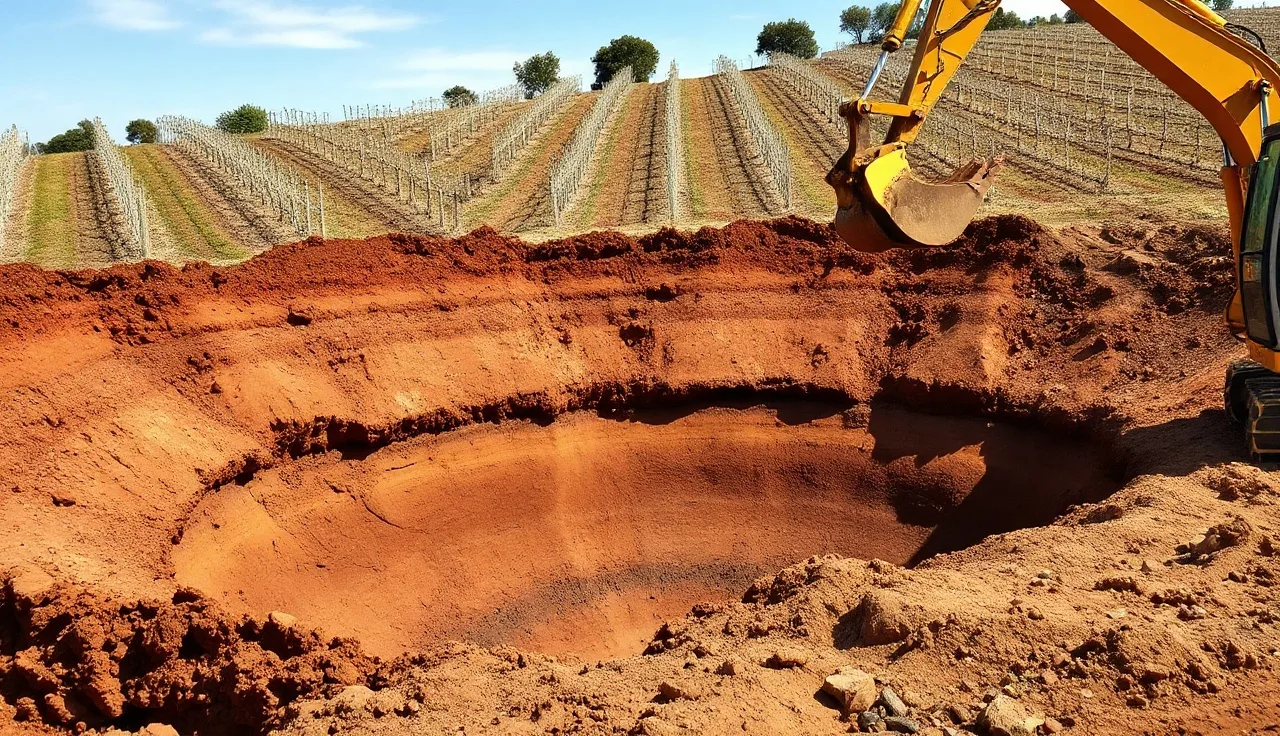
Before planting, dig backhoe pits rather than hand augers, at several spots across the block. You want to see the actual horizons. Look for:
- Mottling (orange or gray splotches that indicate seasonal saturation)
- Cemented or very dense layers that resist penetration
- Abrupt textural changes that perch water (a sandy layer under clay can act like a bathtub)
- Depth to water table in winter, when it's typically at its highest
If you find a hardpan within 3 feet, deep ripping before planting can sometimes fracture it enough to open the profile. Ripping to 4 to 5 feet with a single-shank ripper works in some soils. In cemented calcium carbonate (caliche) layers common in arid regions, it's often futile, and you'd be better off picking a different site or a different rootstock [2].
What soil drainage requirements must a vineyard site meet?
Good drainage has two parts. Surface drainage moves water off the soil after rain. Internal drainage percolates water through the profile without letting it sit. You need both.
A percolation test gives you a rough read on internal drainage. Dig a hole 12 to 18 inches deep, saturate it, and time how fast the water drops the next day. UC Davis extension guidelines suggest that sites draining slower than 1 inch per hour deserve serious scrutiny before you plant [1]. Some clay soils drain at 0.1 to 0.2 inches per hour and need subsurface tile drainage, which runs $3,000 to $8,000 per acre to install depending on layout, depth, and local contractor rates.
Slope helps surface drainage but creates its own problems: erosion, equipment access, frost risk that varies across a block, and harder irrigation design. Gentle slopes of 2 to 10 percent get cited as ideal in extension literature because they shed water without eroding badly [1].
Raised beds or mounds show up more often now on flat sites with marginal drainage, especially in the Southeast and mid-Atlantic. They add 12 to 24 inches of effective rooting depth above the water table. The tradeoff is cost, plus the work of keeping the raised surface from eroding. Some growers in the Willamette Valley and Virginia have had real success with the approach. Others found it added irrigation demand they hadn't planned for.
What soil organic matter level is right for a vineyard?
Low. That reads backward to anyone coming from vegetables or row crops, but high organic matter in vineyard soils drives excessive vine vigor, one of the most common quality-limiting problems in New World viticulture.
1 to 3 percent organic matter is the target range most university extension programs cite. UC Davis viticulture resources note that soils above 3 to 4 percent organic matter tend to release too much nitrogen through mineralization, pushing shoot growth well past what fruit development needs [3]. The result is the classic overcropped, dense-canopy vine that makes green, vegetal wine.
This doesn't mean you ignore organic matter. In very low soils (under 0.5 percent), structure gets so poor that compaction and erosion turn serious. Cover crops help. The goal is a soil with enough structure to carry equipment traffic and biological activity, but not so much fertility that the vine forgets it's supposed to make fruit.
Cover crops between rows are the main management tool for organic matter in established vineyards. Small grains, legumes, or grass mixes all get used, and the choice depends on your rainfall, your tillage philosophy, and whether you want the nitrogen a legume contributes (sometimes you don't). The in-row strip under the trellis is typically kept vegetation-free, especially in the first few years, to reduce competition with young vines [7].
Which soil nutrients matter most in vineyard establishment and management?
| Nutrient | Role in vines | Deficiency symptom | Target soil level (typical) |
|---|---|---|---|
| Nitrogen (N) | Shoot growth, leaf area | Pale leaves, weak growth | Aim LOW; monitor via petiole analysis |
| Potassium (K) | Berry development, acid balance | Marginal leaf scorch, low acid | 150 to 250 ppm exchangeable K |
| Phosphorus (P) | Root development | Rare in established vines | 30 to 50 ppm Bray/Mehlich |
| Calcium (Ca) | Cell wall integrity | Rare; indicates pH problem | >1,500 ppm |
| Magnesium (Mg) | Chlorophyll, photosynthesis | Interveinal chlorosis | 50 to 150 ppm; Ca:Mg ratio 4:1 to 6:1 |
| Boron (B) | Pollination, berry set | Poor fruit set, shatter | 0.5 to 1.5 ppm |
| Zinc (Zn) | Enzyme function | Small, mottled leaves | 1 to 3 ppm DTPA |
Pre-plant soil testing should cover at minimum: pH, buffer pH, organic matter, CEC, and the macronutrients and micronutrients in the table above. Most land-grant university labs (Cornell, UC Davis, WSU) offer soil test panels built for vineyards, and their interpretive guidelines are calibrated for regional soil types. That matters a lot when you're reading potassium numbers in a Pacific Northwest basalt-derived soil versus a Virginia piedmont clay [4][6].
Once vines are established, petiole analysis (tissue testing at bloom and veraison) beats soil tests alone as a guide to vine nutrition. Soil tests tell you what's available. Petiole tests tell you what the vine is actually taking up. Run both together for the first several years and you'll learn how your specific site turns soil chemistry into vine nutrition.
How do you test and evaluate soil before planting a vineyard?
Start with a soil survey. The USDA Web Soil Survey (websoilsurvey.sc.egov.usda.gov) covers most of the US and gives you mapped soil series, drainage class, depth to restrictive layers, and available water capacity before you ever put a shovel in the ground [8]. It's not perfect, but it flags problems and saves you from expensive surprises. Any site that looks marginal on the survey earns a ground-truth dig.
Next, dig backhoe pits. Augers miss layers and can't show you mottling or soil structure the way a pit wall does. Dig at least 3 to 5 pits per 5-acre block you plan to plant, more if the site is variable. Photograph each pit wall with a ruler in frame. Note depth and character of each horizon, evidence of mottling, and the depth of any restrictive layers.
Then pull soil samples for lab analysis. UC Davis recommends sampling by distinct management zones, ideally by soil series if you've done your survey work, rather than one composite sample for a whole vineyard [3]. Pull separate samples for 0 to 12 inches, 12 to 24 inches, and 24 to 36 inches. Subsoil chemistry matters. Subsoil potassium in some California and Pacific Northwest soils runs high enough that pre-plant potassium application isn't just unnecessary, it's actively harmful.
For sites with drainage concerns, hire someone to install a monitoring well or piezometer and check winter water table depth over one full season before you commit. One wet winter's worth of data beats a decade of guessing.
What soil amendments should you apply before planting a vineyard?
Pre-plant is your one chance to work materials into the subsoil before trellis wire, vine rows, and perennial roots are in the way. Most top-dress applications to established vineyards barely move past the first few inches of soil. Use the window.
Lime if pH is below 5.5. Agricultural lime takes 6 to 12 months to fully react in soil, which is why most extension programs say to apply it at least one full season before planting [3]. Dolomitic lime adds magnesium along with calcium, useful if your Ca:Mg ratio is out of range. Sulfur if pH is above 7.5 and rootstock selection can't solve the problem. Expect rates of 200 to 1,000 pounds per acre depending on how far the pH needs to move and your soil's buffering capacity.
Gypsum (calcium sulfate) improves structure in sodic or highly dispersive clay soils without changing pH. It's not a fertilizer in the usual sense, but 1 to 2 tons per acre worked in pre-plant can dramatically improve water infiltration in some heavy soils.
Phosphorus and potassium can be banded deep if subsoil levels are deficient. Nitrogen should essentially never go in pre-plant in large quantities. The vine doesn't need it, and you're just loading your soil ahead of a problem you'll spend years trying to manage back down.
Skip composting or incorporating large amounts of organic matter unless organic matter is critically low (under 0.5 percent). The nitrogen flush from fresh compost can run new vines hard and delay the canopy balance you're building in years one through three.
How does soil type affect wine style and grape quality?
This is where viticulture gets genuinely interesting, and honestly a bit murky, because the science and the legend are harder to separate than the wine press lets on.
What's clearly established: soil texture affects water holding capacity, which affects vine water status, which directly affects berry size, skin-to-pulp ratio, anthocyanin concentration, and acid retention. Sandy soils drain fast, stress vines earlier in the season, and often produce smaller-berried, more concentrated fruit. Heavy clays retain water, stay cooler, and in wet climates can push vegetative growth. Clay loams and loams sit in the middle and tend to be the most forgiving [5].
The terroir debate, specifically whether minerals in soil end up as flavors in wine, is genuinely contested. A 2021 review in the journal OENO One found that while soil mineral composition correlates with wine composition in some studies, the mechanistic pathway from soil mineral to wine flavor stays unclear [9]. Isotopic studies do show that strontium and other elements from specific soil types appear in wines from those sites, which is interesting. That's a long way from the sommelier's story about "tasting the limestone."
What's practical for vineyard planning: match soil texture to your climate and desired style. In cool, wet climates (Willamette Valley, Finger Lakes, Virginia), well-drained soils that prevent waterlogging and cut disease pressure come first. In hot, arid climates (Paso Robles, Lodi, Walla Walla in dry years), soils with enough water-holding capacity to buffer between irrigations without going waterlogged demand careful irrigation design.
For a look at how different California wine regions handle these trade-offs across varied soil types, the operations at Paso Robles wineries reflect the region's extreme swing in soil management strategy, from the coast to the Eastside.
What are the soil-related compliance and record-keeping requirements for vineyards?
Soil testing and amendment applications may look like purely agronomic work, but they touch compliance in several ways that catch small operators off guard.
If you're USDA Organic certified or working toward certification, your soil amendment inputs (lime sources, fertilizers, composts) must be on the National Organic Program approved materials list and documented thoroughly. The NOP requires records of all inputs for 5 years, and inspectors do ask for them [10].
Fertilizer and pesticide applications near waterways trigger state and sometimes federal water quality requirements. Many states set buffer zone rules for nutrient applications near streams, and if you're in a Total Maximum Daily Load (TMDL) area for nitrogen or phosphorus, your fertilizer timing and rates may be restricted. Check with your state department of agriculture and your local resource conservation district.
The EPA Worker Protection Standard (WPS) applies to pesticide applications in vineyards, including soil fumigants that some operations still use pre-plant. WPS requires training, posting, and re-entry interval compliance [11]. Soil fumigant labels (methyl bromide alternatives like chloropicrin or metam sodium) carry specific soil temperature and moisture requirements for efficacy and safety. The label is the law, and those application conditions are part of the label.
Tracking all of it (soil test dates, amendment applications, fumigant usage, and organic input records) is exactly the kind of record-keeping that field operations software like VitiScribe handles in one place instead of across a filing cabinet and three spreadsheets.
For compliance questions specific to your state, UC Cooperative Extension offices [3] and WSU Extension [4] both run farm advisor networks that can clarify local requirements.
What are common soil problems in vineyards and how do you fix them?
Nematodes are the most underestimated soil problem in viticulture. Root-knot nematodes (Meloidogyne spp.) and dagger nematodes (Xiphinema index, which vectors Grapevine fanleaf virus) can wreck a replanted vineyard within a few years. The only reliable pre-plant tools are fumigation (now heavily regulated), extended fallow with non-host cover crops, or nematode-resistant rootstocks [5]. UC Davis's Foundation Plant Services and rootstock trial data are the best resources for matching rootstock to your nematode pressure and soil type.
Soil compaction from repeated equipment passes on wet soils is chronic in most vineyards. A penetrometer reading above 300 psi indicates root-restricting compaction in the zone you're measuring. Deep tillage, cover crops with tap-rooted species, and traffic management (controlled traffic lanes, staying off wet soil) are the main tools. There's no single right answer here, and honest farm advisors will tell you that.
Salinity is a growing concern in arid western regions, especially where irrigation water quality is marginal. Electrical conductivity (EC) above 1.5 to 2.0 dS/m in the root zone starts to hurt vine performance, and many rootstocks and Vitis vinifera varieties are sensitive. Leaching fractions and drainage management turn critical on affected sites [2].
Phylloxera is technically a soil-borne pest (the root-feeding form lives in soil and moves through it to new roots), not a soil chemistry problem, but your rootstock choice before planting is your only real defense. Own-rooted vinifera in phylloxera-present soils is a time bomb in most regions. Cornell, WSU, and UC Davis all maintain phylloxera distribution maps and rootstock guidance for their regions [4][5][6].
How do soil requirements differ across major US wine regions?
US wine regions span a remarkable spread of soil conditions, and practices that work in one region can actively fail in another. Here's where the differences actually matter.
Pacific Northwest (Washington, Oregon): Many Columbia Valley sites have deep, well-drained sandy loams and loamy sands from Missoula Flood sediments. Low organic matter (often under 1 percent), excellent drainage, and naturally low nitrogen are assets here. Irrigation is universal. The Willamette Valley runs cooler and wetter with Jory clay and Willakenzie silt loam soils that hold more water and need careful drainage management [4].
California (Napa, Sonoma, Central Valley, Sierra Foothills): Extraordinary variation within short distances. Napa Valley alone has over 30 mapped soil series. Rocky, well-drained alluvial fans on the valley floor, shallow Aiken loam over fractured volcanic rock in the mountains, heavy clay in some coastal benchland areas. Salinity and boron toxicity from irrigation water are real concerns in the Central Valley [3].
East Coast (Virginia, New York, Pennsylvania): Higher rainfall, higher humidity, and often heavier soils with more organic matter. Drainage is frequently the limiting factor. Phylloxera pressure is universal, so own-rooted vines aren't viable outside deep sandy soils. Disease pressure from downy mildew, powdery mildew, and bunch rots means canopy management interacts constantly with soil-driven vine vigor [6].
Southeast and Texas: Nematodes, Pierce's disease, and soils that run to extremes, either sandy or heavy clay. Muscadine and hybrid varieties handle these conditions better than pure V. vinifera in many spots. pH management is critical given the swing from acidic Coastal Plain sands to alkaline clay soils in Texas.
If you want to see how site-specific soil work translates to real vineyard development, Gervasi Vineyard in Ohio is a good example of how operators in the eastern Great Lakes region approach heavy soil management.
How should you track and document vineyard soil management over time?
Soil data is only useful if you can see it in context across years. A single soil test is a snapshot. Five years of tests from the same sampling zones show you whether your pH is drifting, whether organic matter is building or declining, and whether your potassium applications are piling up.
Build a consistent sampling protocol and stick to it. Same zones, same time of year (fall after harvest is standard for most regions), same lab if you can (lab methodology varies and changes over time, which can create artificial trends in your data). Keep geo-referenced sampling maps so you're pulling from exactly the same spots each time.
Record every amendment application with product, rate, date, application method, and the soil test result that drove the decision. That documentation pays you back three ways: it shows whether your inputs are working, it satisfies organic certification inspectors and conservation program requirements, and it protects you if a regulatory question ever comes up about nutrient loading near a water feature.
VitiScribe's record-keeping tools are built around exactly this kind of longitudinal field data, letting you link spray and amendment records to specific blocks and pull historical reports without digging through binders.
University extension programs at UC Davis [3], Cornell [6], and WSU [4] all publish soil management guides for their regions with recommended testing schedules, interpretation tables, and amendment rate calculators. These are free, peer-reviewed, and updated more often than most paid resources.
Frequently asked questions
What is the minimum soil depth required before planting a vineyard?
Most viticulture extension programs recommend at least 3 feet (36 inches) of penetrable soil before any restrictive layer. Deeper is better for dryland viticulture. Under 24 inches of workable soil, vines lean heavily on irrigation, and drainage problems become nearly unavoidable. Dig backhoe pits before committing to a site, since hand augers miss restrictive layers and mottling patterns that a pit wall makes obvious.
Can grapevines grow in clay soil?
Yes, but only if the clay drains reasonably well. Heavy clays that hold water through winter and spring create anaerobic conditions that kill roots and invite Phytophthora root rot. Many great wine regions, including parts of Bordeaux and the Willamette Valley, have significant clay content. The difference is adequate drainage, either natural from slope or installed tile systems. Clay's water-holding capacity can actually buffer vines through dry summers once drainage is handled.
What soil pH is too acidic for grapevines?
Below pH 5.5, aluminum and manganese become soluble at toxic concentrations, and phosphorus availability drops sharply. Most extension guidelines treat anything below 5.5 as requiring lime before planting. Buffer pH, not active pH, drives the lime rate calculation, so get a full soil test from a certified lab rather than trusting a field meter. Agricultural lime needs 6 to 12 months to react fully, so apply it well before planting.
Is high organic matter bad for vineyards?
In most situations, yes. Soils above 3 to 4 percent organic matter release too much nitrogen through microbial breakdown, pushing excessive vine vigor. Dense canopies shade fruit, cut air circulation, raise disease pressure, and produce diluted, sometimes herbaceous wines. The target for most vineyard soils is 1 to 3 percent organic matter, enough for good structure and biological activity, not enough to overfeed the vine.
How often should vineyard soil be tested?
Most extension programs recommend a full soil test every 2 to 3 years for established vineyards, with petiole (tissue) testing at bloom and veraison each season. More frequent testing pays off in the first 5 years after planting or after significant pH or nutrient corrections, to confirm the amendments worked and nothing overcorrected. Sample the same zones at the same time of year each cycle to make year-over-year comparison meaningful.
Do I need to fumigate soil before planting a vineyard?
Only if nematode pressure is confirmed by soil sampling. Pre-plant nematode sampling is strongly recommended on any site with a prior vineyard, orchard, or native vegetation that hosts dagger nematodes. If population levels are high, fumigation or extended fallow with non-host crops is the conventional response. Nematode-resistant rootstocks are an alternative where available varieties match your soil and climate. Fumigant use is now heavily regulated; check your state's current registered materials.
What rootstock is best for high-pH or calcareous soils?
Rootstocks with high active lime tolerance include 140 Ruggeri, 1103 Paulsen, and 41B. These are rated for active calcium carbonate content of 20 to 40 percent or more. 110R and SO4 have moderate tolerance. AxR1 and Riparia Gloire perform poorly in high-pH calcareous soils. Rootstock selection charts from UC Davis Foundation Plant Services and ENTAV-INRAE are the best reference, matched to your specific soil lime content from a lab analysis.
What soil nutrients are most commonly deficient in vineyards?
Potassium, zinc, boron, and magnesium are the most commonly diagnosed deficiencies in US vineyards. Potassium deficiency shows as marginal leaf scorch and low fruit acid. Zinc deficiency produces small, mottled leaves and poor shoot growth. Boron deficiency causes poor fruit set and berry shatter. Magnesium deficiency looks like interveinal chlorosis at mid-season. Petiole testing at bloom gives you the most actionable read on where deficiencies exist before they limit yield.
How does soil texture affect irrigation management in a vineyard?
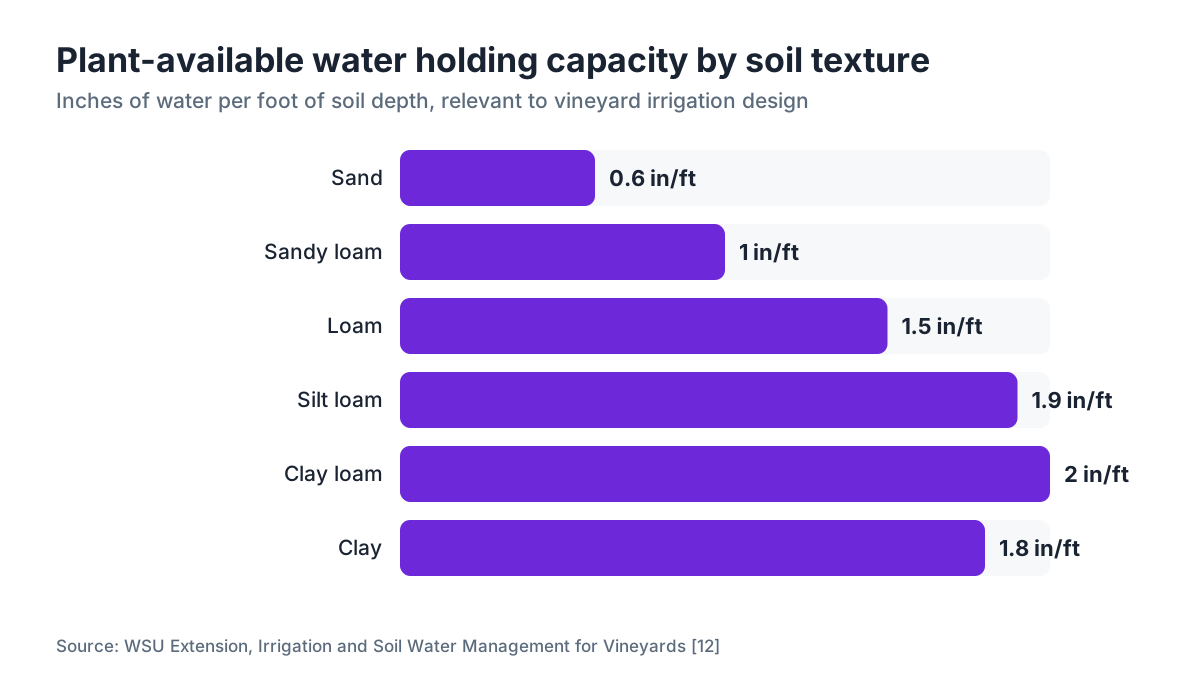
Texture directly controls how fast water drains and how much water the soil holds between irrigations. Sandy soils drain quickly and hold roughly 0.5 to 1 inch of plant-available water per foot of soil. Clay loams hold 1.5 to 2.5 inches per foot but drain slowly. Sandy sites need shorter, more frequent irrigation cycles. Heavy soils need longer dry-down periods to avoid waterlogging. Knowing your soil's field capacity and wilting point, from a lab analysis, is how you set a defensible irrigation schedule.
What are the soil record-keeping requirements for USDA Organic certified vineyards?
The USDA National Organic Program requires certified operations to keep records of all inputs, including soil amendments, for 5 years and to make them available to accredited certifiers during inspections. All inputs must come from the NOP approved materials list. That means documenting product name, source, rate, date, and the field applied to for every lime, compost, or fertilizer application. Certifiers look for traceability from purchase invoice to field application record.
Can you plant a vineyard on a slope, and how steep is too steep?
Slopes up to about 30 to 35 percent get farmed in European appellations with mechanization, and steeper sites are farmed by hand in places like the Mosel and Douro. In the US, most mechanized viticulture operates comfortably on slopes up to 15 to 20 percent. Beyond that, erosion control, equipment safety, and irrigation design become major cost factors. Slopes of 2 to 10 percent are ideal: enough drainage without significant erosion risk under normal cover crop management.
What is the best way to improve drainage on a flat vineyard site?
Subsurface tile drainage is the most effective fix for flat sites with poorly draining soils. Perforated drain lines, typically 4-inch diameter corrugated pipe, are buried 3 to 4 feet deep on a slope toward a collection point. Spacing of 20 to 40 feet between lines is common in vineyards. Installation costs $3,000 to $8,000 per acre depending on site complexity. Raised planting beds are a lower-cost partial solution that adds 12 to 24 inches of effective drainage depth above the natural water table.
How do I know if my vineyard site has a phylloxera problem before I plant?
Soil sampling for phylloxera is possible but not routinely done the way nematode sampling is, because phylloxera distribution in most US wine regions is effectively ubiquitous. In California, the Pacific Northwest, Virginia, and most of the East Coast, the assumption should be that phylloxera is present in any soil that has hosted vinifera roots. The only reliable defense is to plant on a phylloxera-resistant rootstock. Own-rooted vinifera is only viable in regions with confirmed phylloxera absence, typically in sandy soils.
Sources
- UC Davis Cooperative Extension, Soil Management in Vineyards: Internal drainage slower than 1 inch per hour and poor surface drainage are primary site disqualifiers for vineyard establishment
- UC Agriculture and Natural Resources, Rootstock Selection and Soil Considerations: Restrictive caliche layers and hardpan cap root depth and create drought stress; deep ripping is often ineffective in cemented subsoils
- UC Davis Department of Viticulture and Enology, Soil and Vine Nutrition: Optimal vineyard soil pH is 6.0 to 6.5; organic matter target is 1 to 3 percent; high organic matter soils drive excess vigor and reduce wine quality
- Washington State University Extension, Pacific Northwest Viticulture: WSU Extension states grapevines grow best in soils with a pH between 5.5 and 7.0 and that most Columbia Valley vineyard soils have organic matter below 1 percent
- UC Davis Foundation Plant Services, Rootstock Variety Information: Rootstocks 140 Ruggeri and 1103 Paulsen tolerate active lime and high pH; dagger nematode (Xiphinema index) vectors Grapevine fanleaf virus in California soils
- Cornell University Cooperative Extension, Viticulture Resources for the Northeast: Restrictive soil layers shallower than 24 inches create chronic drainage and root development problems in northeast vineyards; phylloxera-resistant rootstocks are necessary in most eastern US sites
- UC Agriculture and Natural Resources, Cover Cropping in Vineyards: Cover crops between rows manage organic matter and soil structure in established vineyards; in-row vegetation-free strips reduce competition with young vines
- USDA Natural Resources Conservation Service, Web Soil Survey: Web Soil Survey provides mapped soil series, drainage class, depth to restrictive layers, and available water capacity for most US land areas
- USDA Agricultural Marketing Service, National Organic Program: The National Organic Program requires certified operations to maintain records of all inputs for 5 years and use only inputs from the approved materials list
- US EPA, Worker Protection Standard for Agricultural Pesticides: The EPA Worker Protection Standard requires training, posting, and re-entry interval compliance for pesticide applications in agricultural settings including soil fumigants used in vineyard establishment
- WSU Extension, Irrigation and Soil Water Management for Vineyards: Sandy soils hold approximately 0.5 to 1 inch of plant-available water per foot; clay loams hold 1.5 to 2.5 inches per foot, requiring different irrigation timing and frequency
Last updated 2026-07-09