Vineyard spray calculator: how to get the right rate every time

TL;DR
- A vineyard spray calculator turns a label rate (fl oz per acre) into the exact amount to add to your tank.
- It accounts for tree row volume (TRV), row spacing, vine height, sprayer output, and water volume.
- Get the math right and you protect your vines, keep your records legal, and stop pouring money onto the ground.
What is a vineyard spray calculator and why does the math matter?
A vineyard spray calculator is any tool, a phone app, a spreadsheet, or pencil math on a clipboard, that converts the label's per-acre rate into the exact amount of product to add to a specific tank volume for a specific block. The output is simple: X ounces of product per Y gallons of water. The inputs are where most applicators go wrong.
Labels assume a conventional ground speed and water volume. Vineyards rarely match those assumptions. Row spacing runs from 8 to 12 feet, canopy volume changes week to week, and concentrate sprayers push 10 to 25 gallons per acre while airblast dilute applications can top 100 gallons per acre. Pour the label rate into the wrong volume of water and you're either underdosing (resistance risk, failed control) or overdosing (residue violations, phytotoxicity, wasted chemistry).
This is not theoretical. The label is a federal document, and the EPA Worker Protection Standard requires applications to follow it. Applying at a rate inconsistent with the label, even by accident, breaks federal pesticide law under FIFRA Section 12 [1]. Getting concentration right is also your first defense against fungicide resistance, which UC Davis plant pathology work has tied to millions of dollars a year in failed spray programs across California wine grapes.
Every calculation below uses the real formula. No dumbed-down approximations.
What inputs do you need before you can calculate spray rates?
You need six numbers before any calculation makes sense. Write them down before you pull into the block.
- Label rate. The rate the manufacturer specifies, usually in fluid ounces, ounces, or pounds per acre. Some labels give a range (say, 4 to 8 fl oz/acre). Pick your rate based on disease or pest pressure.
- Acres in the block. Not total vineyard acres. The block you're treating right now. Irregular blocks need the actual surveyed acreage, not a guess.
- Water volume per acre (gallons per acre, or GPA). This comes from calibrating your sprayer. Cornell Cooperative Extension's sprayer calibration guide recommends calibrating at the start of each season and after any nozzle change [2].
- Tank size. How many gallons does your sprayer hold when full? Use the real working capacity, not the nameplate maximum, because you rarely fill to the brim and spray perfectly to empty.
- Row spacing and vine height or canopy dimensions. These feed the Tree Row Volume (TRV) method if you're going past simple per-acre math.
- Sprayer type. A conventional airblast dilute unit applies differently than a concentrate or speed sprayer. The mode of application changes effective GPA and coverage.
Get any one of these wrong and everything downstream is off. A block that surveys at 4.3 acres is not 4 acres. Those 0.3 acres matter when you're adding a $60-per-liter fungicide.
How do you calculate how much product to put in the tank?
The core formula is short:
Amount of product per tank = (Label rate per acre) x (Tank volume in gallons) / (Gallons per acre)
Say your label rate is 8 fl oz per acre, your sprayer applies 50 GPA, and your tank holds 200 gallons.
- Tanks per acre = 50 GPA / 200 gal tank = 0.25 tanks per acre (the tank covers 4 acres)
- Product per tank = 8 fl oz/acre x 4 acres = 32 fl oz per tank fill
Simple enough. The catch is that most applicators don't know their real GPA, because they've never properly calibrated the sprayer.
To find actual GPA: spray a measured distance at field speed, collect output from all nozzles over that distance, then convert to gallons per acre. WSU Extension's spray calibration fact sheet walks through the procedure and notes that nozzle wear alone can shift output by 10 to 15 percent between seasons [3]. A nozzle that should deliver 1 GPM at 60 PSI can deliver 1.12 GPM after one season of heavy use. That's not trivial.
Once you have confirmed GPA, the formula above is reliable. Plenty of vineyard managers laminate a small card with the formula and their sprayer's confirmed GPA for the season.
What is Tree Row Volume (TRV) and when should you use it?
Tree Row Volume adjusts spray rates to actual canopy size instead of a flat per-acre standard. It was developed for tree fruit and vineyard crops, and it's the most defensible way to set a spray program when your canopy changes hard across a season or across blocks with different training systems.
The TRV formula:
TRV (ft³/acre) = (Row width in ft) x (Canopy height in ft) x (Canopy width in ft) x (43,560 / Row spacing in ft²)
A simplified version used in practice (from UC Cooperative Extension recommendations) [4]:
TRV = Row spacing (ft) x Canopy height (ft) x Canopy width (ft) x 1 (unitless constant)
Compare the result to a reference TRV (often 5,000 ft³/acre for table grapes, or 3,500 to 4,000 for wine grapes on VSP) to get a correction factor:
Rate correction factor = Your TRV / Reference TRV
If your block has a TRV of 2,800 and the reference is 4,000, your correction factor is 0.70. You apply 70 percent of the label rate per acre. That cuts cost and residue load without losing coverage, as long as you measured correctly.
TRV earns its keep mid-season. A VSP-trained Chardonnay block at bloom carries a very different canopy than the same block at veraison. Treat them the same and you waste product at the first timing and underdose at the second.
Not every label allows rate adjustment by TRV. Read the label. Some systemic fungicides set a minimum per-acre rate regardless of canopy size. If the label says "do not apply less than X oz/acre," that's the floor. No exceptions.
How do you convert between dilute and concentrate spray rates?
Most pesticide labels are written for dilute application at 100 GPA or a similar high-volume standard. Concentrate sprayers run at a fraction of that, often 10 to 25 GPA in vineyard work. Dump the same product volume per tank without adjusting for the lower water volume and you over-concentrate the mix badly.
The conversion formula:
Concentrate rate (oz/tank) = Dilute rate (oz/acre) x Dilute GPA / Concentrate GPA
Example: label says 8 fl oz/acre at 100 GPA dilute. Your concentrate sprayer runs at 20 GPA.
- Concentrate rate per acre = 8 fl oz x (20/100) = 1.6 fl oz per acre
- That 1.6 fl oz goes into 20 gallons instead of 100, so the concentration matches the dilute standard while the volume per acre drops.
The label may cap the concentration ratio. Many cap concentrate application at 4x or 8x the dilute rate. Break that cap and you can burn the canopy even when the active ingredient per acre is technically right. Look for "concentration ratio" or "maximum concentrate" language.
Cornell Cooperative Extension points out that many growers moving from dilute to concentrate forget to adjust speed or pressure to hold droplet coverage, which defeats the whole point even when the chemistry math checks out [2].
What is the right water volume (GPA) for vineyards?
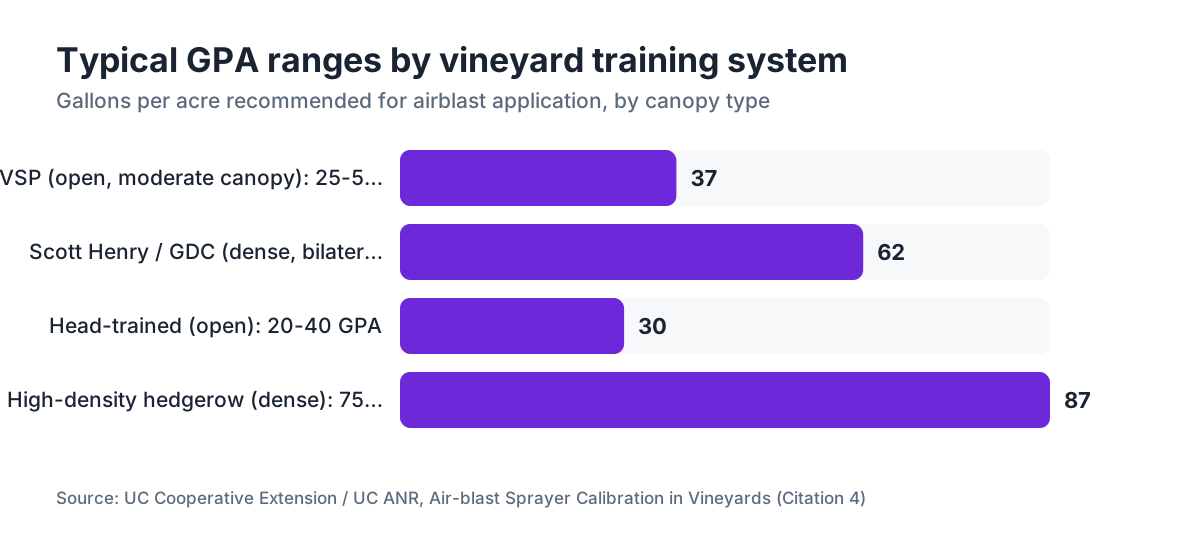
There's no universal right answer, which is inconvenient but true. Appropriate GPA depends on your training system, canopy density, target pest or disease, and sprayer type.
General guidance from UC Cooperative Extension research on airblast sprayers in wine grapes [4]:
| Training system | Canopy type | Typical GPA range |
|---|---|---|
| VSP (vertical shoot position) | Open, moderate | 25 to 50 GPA |
| Scott Henry / GDC | Dense, bilateral | 50 to 75 GPA |
| Head-trained | Open | 20 to 40 GPA |
| High-density, hedgerow | Dense | 75 to 100 GPA |
These are starting points. A dense Pinot Noir canopy in a wet year with high botrytis pressure may need more water to push material into the cluster zone. A well-managed open canopy in a dry year needs less.
Under-watering is the more common mistake. Applicators cut GPA to go faster, droplets stop penetrating the canopy, and you land on the worst outcome: full chemical cost, poor coverage, residue piled on leaf surfaces. WSU Extension research on airblast optimization found coverage in the fruiting zone dropped by up to 40 percent when GPA was cut in half with no matching bump in air volume [3].
Over-watering wastes water, runs off in poorly drained rows, spreads water-mobile pathogens, and burns extra fuel if you're pulling a diesel PTO sprayer. Both directions cost you.
How do you account for row spacing and block shape in your calculations?
Row spacing changes your effective acres per hour and your product per acre. A 10-foot row spacing gives you fewer linear feet of tractor travel per acre than an 8-foot row, and that shifts your calibration.
For irregular blocks, the surveyed acreage from your parcel map is your best number. A rectangular 10-acre block is easy to verify. An L-shaped or hillside block with headlands is not. Many growers I've seen use GPS field mapping to get actual sprayed acreage instead of trusting legal parcel descriptions, which often fold in roads, waterways, and buffer strips.
The acreage formula using row length and spacing:
Acres = (Row length in ft x Number of rows x Row spacing in ft) / 43,560
Eighty rows, each 600 feet long, at 10-foot spacing:
- 80 x 600 x 10 = 480,000 ft²
- 480,000 / 43,560 = 11.02 acres
That's your sprayed acreage, not your parcel acreage. The two numbers are usually different, and the spray record should carry sprayed acreage.
For compliance, the EPA WPS requires records of the site treated and the amount applied. Inflating acreage to justify a lower per-acre rate than you actually applied is a records violation [1]. Use real numbers.
How do you read a pesticide label correctly for spray rate calculations?
The label is the law. FIFRA is blunt: you cannot use a pesticide in a manner inconsistent with its labeling [1]. For spray calculations, the label gives you:
- Rate (minimum, maximum, and often a range tied to pressure or timing)
- Application method restrictions (ground only, airblast only, or unrestricted)
- Maximum seasonal rate per acre (this is where resistance management lives)
- Restricted entry interval (REI), which the EPA WPS requires you to post and enforce [5]
- Pre-harvest interval (PHI), which sets your last allowable application date
- Whether the product can go in tank mixes and what compatibility limits apply
One thing trips people up: some labels express rates in ounces per 100 gallons of water rather than per acre. Those are concentration-based rates, not area-based. You're targeting a percent concentration in the tank, not a rate per acre. You still have to confirm that applying X gallons per acre at that concentration lands within the label's allowable per-acre range.
The National Pesticide Information Center notes that label language has been standardized since the late 1990s, but older registrations may still carry pre-standardization language that reads as ambiguous [6]. When in doubt, call the manufacturer's technical line. They have to answer label interpretation questions, and most keep agronomists on staff.
EPA's label review manual is public and lays out exactly how rate and direction language is structured, which helps when you're staring at an unfamiliar label [7].
How do you calculate a tank mix when you're spraying multiple products at once?
Tank mixing is common in vineyards because you're often fighting powdery mildew, botrytis, leafhopper, and mite pressure at the same time. Each product carries its own label rate, its own GPA assumption, and its own compatibility profile.
The process:
- Choose your GPA for the application. Drive that off the crop and canopy, not off any single product label.
- For each product, calculate the per-acre rate, then scale it to your tank volume using the formula from Section 3.
- Check compatibility. Some combinations precipitate, lose efficacy, or burn the canopy. Mixing guides from UC IPM and the manufacturers list known incompatibilities [8].
- Run a jar test for any combination you haven't used before. Mix small volumes in the same proportions you'd use in a full tank. Flocculation, color change, or heat means do not mix those products.
Fill order matters too. A general rule: fill the tank half full of water, then add wettable powders and water-dispersible granules, then flowables, then emulsifiable concentrates, then surfactants, then top off. Wrong order can cause clumping or reactions that don't surface until the material is already in the canopy.
For record-keeping, each product in a tank mix needs its own line in your spray record. The EPA WPS and most state ag record-keeping rules want each active ingredient logged with its rate and its REI. When REIs differ, the longest one governs when workers can go back in [5].
If you track spray records in software, VitiScribe handles tank mix entries and auto-populates REI and PHI from the product database, which pulls one manual step out of the process.
What does EPA WPS require you to document for every spray application?
The EPA Worker Protection Standard (40 CFR Part 170) covers any agricultural establishment where pesticides go on crops and where workers or handlers may be exposed [5]. For most vineyards with even a single seasonal employee, WPS compliance is not optional.
For each application, WPS and the FIFRA record-keeping rules (40 CFR Part 169.2) require you to keep records for at least two years covering:
- Date of application
- Product name and EPA registration number
- Active ingredient and rate applied
- Total amount applied
- Location treated (block, field ID, or legal description)
- Applicator's name and, if your state requires it, license number
The pesticide record must be available to employees and their designated representatives within 15 days of a request, under WPS rules [5]. A worker who was in a block has the right to see what was sprayed there.
After application, you post WPS warning signs at every entry point to treated blocks during the REI. The sign shows the product name, the REI, and the date and time the REI expires. Miss this and you're looking at state ag department penalties that run from a few hundred to several thousand dollars per violation, depending on the state.
California adds a layer through the Department of Pesticide Regulation: growers file a Pesticide Use Report (PUR) monthly for any pesticide applied to an agricultural commodity, wine grapes included [9]. The PUR wants all the WPS data plus GPS coordinates and weather at time of application.
"The WPS requires agricultural employers to provide specific information and protections to workers and handlers who may be exposed to pesticides," per EPA's WPS guidance [5]. That's the standard your records get measured against.
What are the most common spray calculation mistakes in vineyards?
After reading a lot of spray records, these are the errors that keep showing up.
Wrong GPA from an uncalibrated sprayer. Nozzle wear, pressure swings, and speed changes all drag actual GPA away from the assumed number. If you calibrated in April and it's August, recalibrate. New nozzles are cheap. Overapplication violations are not.
Parcel acres instead of sprayed acres. A 10-acre parcel with a creek, a road, and a 15-foot equipment buffer on all sides might spray at 8.5 acres. Basing product amount on 10 acres looks like underreporting on the PUR and leaves you short on the acres you actually treated.
Ignoring the seasonal maximum. Many fungicide labels cap total applications per season ("do not apply more than 3 times per season," or "do not exceed 24 oz/acre per year"). Lose track of cumulative applications, blow past the max, and you've broken the label even when each single application was fine.
Mixing concentration errors. Pouring product into a partly full tank without accounting for final volume is a classic field mistake. Always calculate product against the full tank volume, not the current fill level.
Rounding too hard. Rounding 7.8 fl oz to "about 8" is fine at small scale. On a 200-gallon tank covering 20 acres, small per-acre rounding errors stack up fast.
For a crew handling records by hand, a single-page laminated calc card, with the block's GPA, row spacing, TRV correction factor, and tank size printed on it, kills most of these before they happen. Five minutes of prep. Real money and real compliance headaches avoided.
Are there free vineyard spray calculator tools available?
Yes, several are free and well-maintained.
UC Cooperative Extension's UC IPM program publishes spray calculation resources and rate-adjustment guidance for California wine grapes, reachable through the UC ANR website [8]. The materials cover TRV adjustment, dilute-to-concentrate conversion, and tank mix planning.
WSU Extension keeps a set of pest management guides with spray calibration procedures and spray efficiency worksheets that adapt well to vineyard use [3]. These are downloadable PDFs, not interactive tools, but the methods are sound.
Cornell Cooperative Extension's NYSAES (New York State Agricultural Experiment Station) has published sprayer calibration guides for wine grape production in the Northeast, which handle the tighter row spacings and higher-density plantings common in New York and Pennsylvania [2].
For interactive math, some PCA (Pest Control Adviser) offices and state extension services have built simple browser-based calculators. Quality varies. Check that any online tool asks for your actual GPA (not an assumed default), accounts for row spacing, and lets you enter label rate and tank size on their own.
VitiScribe includes a built-in spray calculator that ties into your spray log, so calculated rates flow straight into your compliance records without a second data-entry step. If you already keep digital spray records, that link saves real time.
For serious spray program management, a spreadsheet you control often beats a locked app, because you can add TRV columns, seasonal accumulation totals, and block-specific GPA values. Google Sheets or Excel both work. The formulas are plain enough that building your own takes about 30 minutes, and you'll know exactly what it's doing.
How do you handle spray calculations for organic vineyard inputs?
Organic-approved inputs run the same math. Label rate, GPA, tank volume, acreage. The formulas don't change because the product is OMRI-listed.
What does change: the rate tolerance is often tighter. Copper-based fungicides, the main disease tool in organic wine grape production, carry a legal maximum under the National Organic Program. The NOP restricts copper to a cumulative rate that keeps it from building up in soil, and many certifiers set a per-year limit in the range of 3 to 6 pounds of metallic copper equivalent per acre per year [10]. Botch the copper calc and you can hit that ceiling in August with no tool left for late-season bunch rots.
Sulfur is less tightly regulated under NOP but turns phytotoxic above certain concentrations, especially over 90°F or within two weeks of an oil application. The label maximums on sulfur exist for a reason.
For organic inputs without a formal pesticide label (some OMRI-listed biocontrols, kaolin clay, and the like), rate guidance comes from the manufacturer's use directions rather than a federally registered label. You still document what you applied, at what rate, and when, for both your state PUR and your organic certifier's audit trail.
Frequently asked questions
What is the formula for calculating how much pesticide to put in a spray tank?
Amount per tank = (Label rate per acre) x (Tank volume in gallons) / (Gallons per acre). Example: 8 fl oz/acre label rate, 200-gallon tank, 50 GPA sprayer. The tank covers 4 acres, so you add 32 fl oz of product. Always confirm your actual GPA with a sprayer calibration before trusting this formula.
How do I calibrate my vineyard sprayer to find actual gallons per acre?
Mark a 300-foot course in the vineyard. Collect output from all nozzles for the time it takes to travel that distance at field speed. Convert total output to gallons, then use GPA = (gallons collected x 43,560) / (swath width in ft x distance in ft). WSU Extension has a step-by-step worksheet for this. Recalibrate whenever nozzles are replaced or worn.
What is TRV and how does it change my spray rate?
Tree Row Volume measures the actual cubic footage of canopy per acre in your block. You calculate it from row spacing, canopy height, and canopy width, then compare it to a reference TRV (typically 3,500 to 4,000 ft³/acre for VSP wine grapes). If your TRV is lower than the reference, you cut the label rate by that ratio and save product. If higher, you may need more. Not every label allows TRV-based adjustments, so verify first.
How do I convert a label rate from dilute to concentrate for an airblast sprayer?
Multiply the label's per-acre rate by your concentrate GPA divided by the label's assumed dilute GPA (often 100 GPA). Example: 8 fl oz/acre at 100 GPA dilute becomes 1.6 fl oz/acre at 20 GPA concentrate. Check the label for a maximum concentrate ratio (commonly 4x to 8x). Exceeding that ratio risks phytotoxicity even when the per-acre dose is correct.
What records does EPA WPS require me to keep for vineyard pesticide applications?
Under 40 CFR Part 170 and FIFRA record-keeping rules, you keep records for at least two years showing: application date, product name and EPA registration number, active ingredient and rate, total amount applied, site treated, and applicator name. California also requires a monthly Pesticide Use Report filed with the county agricultural commissioner. Workers can request access to these records within 15 days.
How do I calculate the restricted entry interval (REI) for a tank mix with multiple products?
Find the REI for each product on its label. The longest REI governs when workers can re-enter the block. If Product A has a 4-hour REI and Product B has a 24-hour REI, the block is off-limits for 24 hours after the application ends. Post WPS-required warning signs at all entry points showing the longest REI and the time it expires.
How do I calculate the pre-harvest interval to know my last spray date?
Find the PHI on the product label (in days). Count backward from your target harvest date by that many days. That is your last allowable application date. For tank mixes, use the longest PHI among all products. If harvest timing shifts, recalculate. Exceeding PHI residue limits at harvest can mean rejected lots and MRL violations.
How do I figure out how many acres I actually sprayed in an irregular-shaped block?
Use Acres = (Row length in ft x Number of rows x Row spacing in ft) / 43,560. Count only the rows you actually sprayed, measure their length, and use your real row spacing. GPS field mapping apps can also measure sprayed area precisely. Put sprayed acreage on your records, not legal parcel acreage, which often includes roads, waterways, and buffers.
What GPA should I use for a VSP-trained Chardonnay block?
UC Cooperative Extension guidance for VSP canopies typically recommends 25 to 50 gallons per acre with airblast equipment, depending on canopy density. Early season with light canopy, 25 to 35 GPA is often enough. At full canopy or under high disease pressure, 40 to 50 GPA improves penetration into the fruiting zone. Calibrate to confirm actual output at your chosen speed and pressure.
Can I use the same spray calculator for both organic and conventional products?
Yes. The math is identical: label rate per acre, tank volume, confirmed GPA. What differs is that organic programs often set cumulative annual limits (copper is capped at a per-year metallic copper equivalent maximum under NOP) and some organic inputs lack federally registered labels, relying on manufacturer use directions instead. Track seasonal accumulation for copper-based materials to avoid hitting NOP or certifier limits mid-season.
How do I do a jar test before mixing multiple pesticides in a tank?
Fill a clear quart jar with water from your water source. Add each product in the proportions you'd use in a full tank, in your intended fill order (WPs first, then flowables, then ECs, then adjuvants). Stir between additions and watch for flocculation, precipitation, color change, or heat. Any of those signals means the combination is incompatible. Do not scale up an incompatible mixture. Contact the manufacturers for alternatives.
What are the most common vineyard spray record errors that trigger compliance problems?
The usual errors: using estimated rather than calibrated GPA, recording parcel acreage instead of sprayed acreage, missing or wrong EPA registration numbers, failing to log all tank mix products separately, and exceeding seasonal maximum rates by not tracking cumulative applications. California DPR audits Pesticide Use Reports and flags blocks where total applied volume looks inconsistent with reported acreage or product rates.
How often should I recalibrate my vineyard sprayer?
At minimum, calibrate at the start of each season and any time you change nozzles, nozzle types, or operating pressure. WSU Extension research notes that nozzle wear can shift output by 10 to 15 percent over a single season of heavy use. If you notice application inconsistency, check calibration before you blame the chemistry. Mid-season recalibration is worth the 30 to 45 minutes it takes.
What is the maximum number of spray applications allowed per season for most fungicides?
It varies by product and mode of action. SDHI fungicides (like boscalid and fluxapyroxad) commonly carry limits of 2 to 3 applications per season to manage resistance. DMI fungicides (myclobutanil, tebuconazole) often allow 4 to 6 applications but set a per-acre seasonal total. Always check the label's resistance management section for specific limits. Exceeding them is a label violation even if individual application rates were correct.
Sources
- EPA, Federal Insecticide, Fungicide, and Rodenticide Act (FIFRA) overview: Applying pesticides in a manner inconsistent with the label is a federal violation under FIFRA Section 12
- Washington State University Extension, Pesticide Calibration and Spray Coverage: WSU Extension research found coverage in the fruiting zone dropped up to 40 percent when GPA was cut by half without increasing air volume; nozzle wear can change output by 10 to 15 percent per season
- UC Cooperative Extension / UC ANR, Air-blast Sprayer Calibration in Vineyards: UC Cooperative Extension provides TRV calculation methods and GPA recommendations for VSP and other training systems in wine grapes
- EPA, Worker Protection Standard (40 CFR Part 170): WPS requires record-keeping of applications for at least two years, REI posting, and gives workers the right to access records within 15 days
- National Pesticide Information Center, Reading a Pesticide Label: Label language was standardized in the late 1990s; older registrations may carry ambiguous pre-standardization language
- EPA, Label Review Manual: EPA's label review manual explains how rate and direction language is structured on federally registered pesticide labels
- UC ANR UC IPM, Grape Pest Management Guidelines: UC IPM provides tank mix compatibility guidance and rate-adjustment resources for California wine grape production
- California Department of Pesticide Regulation, Pesticide Use Reporting: California requires growers to file a Pesticide Use Report monthly for any pesticide applied to an agricultural commodity including wine grapes
- USDA National Organic Program, Allowed and Prohibited Substances: NOP restricts copper applications to prevent soil accumulation; many certifiers set per-year limits in the range of 3 to 6 pounds of metallic copper equivalent per acre
Last updated 2026-07-09