Vineyard spray equipment: a field guide to choosing and running it right
TL;DR
- Vineyard spray equipment runs from backpack sprayers under $500 to GPS-guided airblast towers over $80,000.
- The right pick depends on your row spacing, canopy density, acreage, and labor.
- Calibration accuracy, EPA Worker Protection Standard compliance, and recordkeeping are non-negotiable at every price tier.
- This guide covers each sprayer type, its cost, how to calibrate it, and the legal duties that come with it.
What types of spray equipment do vineyards actually use?
Vineyard sprayers fall into five families. Knowing which family you're in settles almost every downstream decision about calibration, PPE, and labor cost.
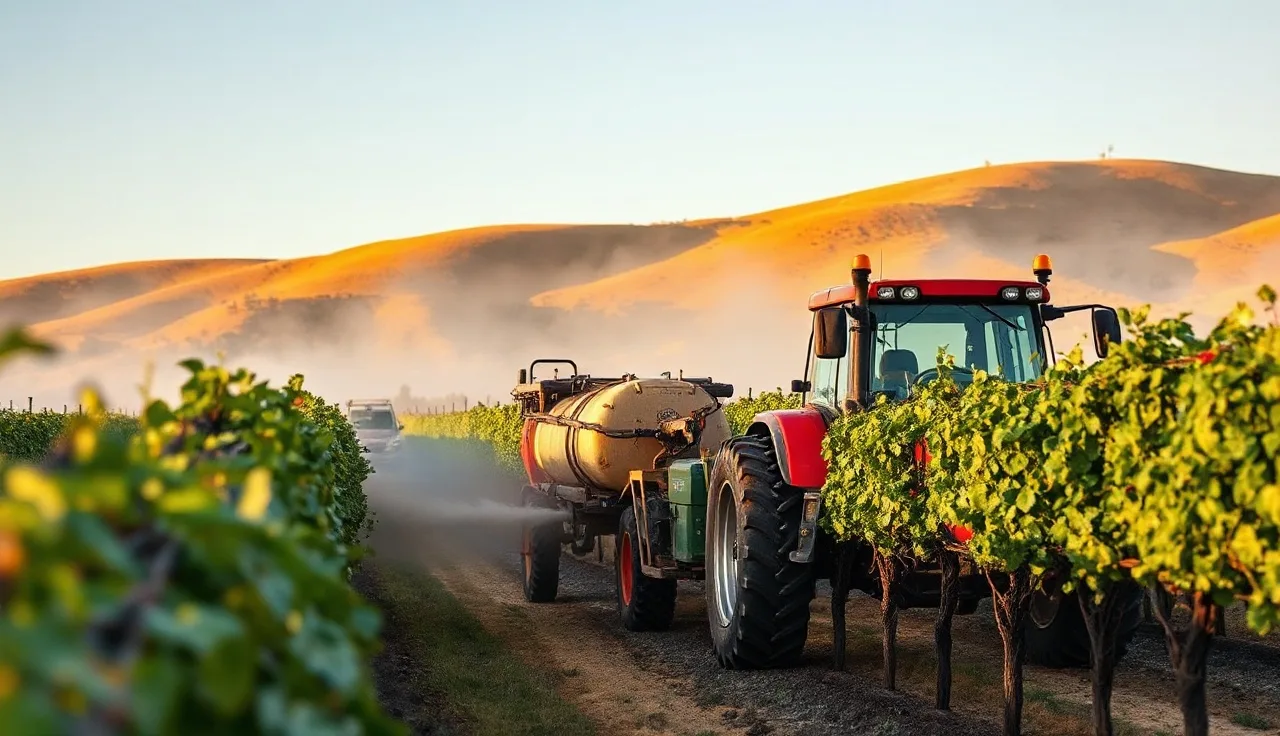
Airblast sprayers are the workhorse of most mid-size and larger vineyards. A fan, usually axial-flow, throws air at 90 to 200 mph through the canopy while nozzles inject pesticide into the airstream. You cover ground fast, and the turbulence deposits material on both leaf surfaces. The tradeoff is drift. An airblast machine running in the wrong wind can push product 50 to 100 feet off-target with ease. UC Davis Cooperative Extension puts airblast as the dominant technology in California wine country, with tower airblast variants gaining share in high-density plantings [1].
Tunnel sprayers capture spray in a hood around the vine row and recirculate overspray back into the tank. Product savings run 25 to 60 percent compared to open airblast, according to trials summarized by Washington State University Extension [2]. That sounds like free money, and it often is. Capital cost is higher, though, and the machines get finicky on uneven terrain.
Handgun and hand-wand rigs handle spot treatments, young vines, and small blocks where running a tractor makes no sense. A 100-gallon nurse tank on a utility vehicle, a diaphragm pump, and a handheld gun cover the job. Cheap and genuinely right for the task.
Backpack and knapsack sprayers matter more than most people admit. They're how small operations handle young block establishment, tight end rows, and organic sulfur in narrow aisles. A decent 4-gallon diaphragm backpack runs $120 to $300.
Drones are the newest entry. Fixed-wing and multirotor UAV sprayers are FAA-regulated, need an applicator certificate in most states, and get real use in steep-terrain Willamette Valley, Finger Lakes, and coastal California blocks where tractor access is dangerous. Coverage quality is improving but still trails airblast in dense canopy. Expect $15,000 to $80,000 for the aircraft alone.
How much does vineyard spray equipment cost?
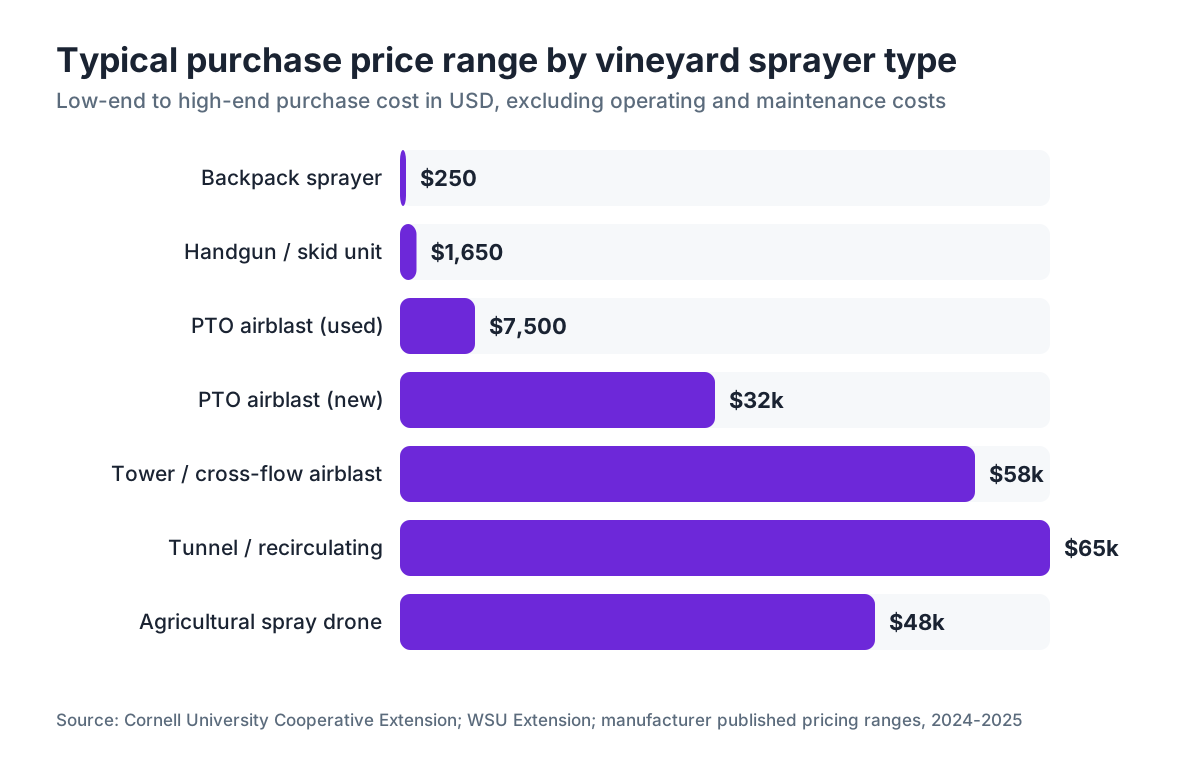
Pricing spans four orders of magnitude, which makes budget talks confusing until you break it down by tier. A backpack sprayer costs $100. A GPS-guided tower rig costs $80,000. Both put pesticide on grapes.
| Equipment type | Typical purchase price | Coverage rate | Best fit |
|---|---|---|---|
| Backpack sprayer | $100 to $400 | 1 to 3 acres/day | Small blocks, spot treatments |
| Handgun / skid unit | $800 to $2,500 | 5 to 15 acres/day | Young vines, small operations |
| PTO airblast (used) | $3,000 to $12,000 | 20 to 60 acres/day | Established vineyards, 20+ acres |
| PTO airblast (new) | $18,000 to $45,000 | 20 to 60 acres/day | Operations wanting warranty, support |
| Tower/cross-flow airblast | $35,000 to $80,000 | 30 to 80 acres/day | High-density, VSP trellised blocks |
| Tunnel/recirculating | $40,000 to $90,000 | 15 to 40 acres/day | Organic programs, buffer-zone sensitive |
| Agricultural spray drone | $15,000 to $80,000 | 5 to 20 acres/hour | Steep slopes, restricted access |
Those are purchase prices. Operating cost adds pump rebuilds, nozzle replacement (every 40,000 to 80,000 gallons through a ceramic nozzle, per manufacturer specs), filter screens, and tractor fuel or drone batteries. Cornell's agricultural engineering group puts a well-maintained airblast sprayer's functional lifespan at 10 to 20 years if you flush it thoroughly after sulfur, which is the most corrosive material most vineyard sprayers ever see [3].
Used equipment deserves a word. A $5,000 used airblast sprayer with a good pump and fan is often a smarter buy than a new bottom-shelf unit. But you need to pressure-test every gasket and replace the full nozzle set before your first spray. Budget $400 to $800 for that refresh no matter what the seller swears about condition.
How do you calibrate a vineyard sprayer correctly?
Calibration is where most spray programs quietly go wrong. Under-application means weak disease control. Over-application means wasted money, residue risk, and possible label violations. Neither is a good place to sit.
For airblast sprayers, the two-step method used by WSU and UC Davis Extension both start with nozzle output. You catch each nozzle's output individually for 30 seconds into a graduated container, work out per-minute flow, then compare across the whole manifold. Any nozzle more than 10 percent off the mean gets replaced, not adjusted. Nozzle wear is never uniform [2][4].
Step two is ground speed. Time the tractor through a measured 300-foot run at your intended field speed, convert to mph, and plug into the formula: gallons per acre equals (nozzle output in gallons per minute x 5,940) divided by (mph x row spacing in feet). Run the math for each block if row spacing varies. A 9-foot row and a 12-foot row at the same speed need different GPA outputs to hit the same rate.
Water-sensitive paper cards are cheap insurance. Tape them to leaves at different canopy positions, inner and outer, upper and lower, make one pass, and count the deposits. You want 20 to 40 droplets per square centimeter on internal leaves. If you're not close, adjust fan angle, speed, or nozzle selection before the season's first fungicide goes out.
USDA recommends recalibrating at least once per season and after any pump repair, nozzle change, or tractor swap [4]. If you run multiple tractors on one sprayer, each tractor's calibration is different, because each tractor's PTO speed under load is different. People ignore this detail constantly.
For air-assisted backpack units, calibration is simpler. Measure a 100-foot row, spray it, note the tank volume you burned, and scale to gallons per acre. Do it twice and average.
What nozzle types work best in vineyard applications?
Nozzle selection changes your droplet spectrum and your drift exposure more than almost any other equipment choice. Get the nozzle right and half your drift problem disappears.
Hollow cone nozzles are the traditional airblast pick because they make fine droplets that get into the canopy. The problem is drift. Fine droplets (under 150 microns volume median diameter) stay airborne long enough to travel well past your target block in any breeze over 5 mph [1].
Air-induction (twin-fluid or Venturi) nozzles make larger droplets by mixing air into the liquid stream. They cut drift hard, sometimes 50 to 75 percent in direct comparisons, but you give up some canopy penetration. For open VSP canopies on flat ground near sensitive buffer areas, that trade is almost always worth it.
Flat-fan nozzles show up on vineyard sprayers less often, mostly in overhead systems and some boom setups for herbicide under the vine row. They don't pair well with airblast.
Ceramic nozzles cost more upfront, roughly $8 to $18 each versus $2 to $5 for polymer, but they last 5 to 10 times longer before wear-driven enlargement throws your output off by more than 10 percent. Over a full season, ceramics are almost always the cheaper choice.
What are the EPA Worker Protection Standard requirements for spray operations?
The EPA's Worker Protection Standard (WPS), last updated in 2015 and enforced under 40 CFR Part 170, sets the legal floor for protecting workers during and after pesticide application in vineyards [5]. Miss the floor and you're exposed to penalties and to injured workers.
The core duties, in plain terms. You must train all agricultural workers and pesticide handlers before they enter treated areas or handle pesticides. The training has to come from an EPA-approved source and be documented, with records kept two years. You must post pesticide application information (product name, active ingredient, EPA registration number, application date, REI, and the treated area) at a central spot every worker can reach.
The Restricted Entry Interval (REI) is not negotiable. Once an REI starts, nobody enters the treated area without a specific WPS exception and the required PPE. Common vineyard fungicides carry REIs from 4 hours (many EBDC fungicides under certain conditions) to 48 hours (some copper products under certain label revisions). Always read the current label. REIs shift between revisions, and the label is the law.
PPE during application depends on the product. Most vineyard labels require long sleeves, chemical-resistant gloves, and eye protection at minimum. Organophosphate applications usually trigger respirator requirements. The WPS makes the employer supply all required PPE and keep it clean.
The 2015 WPS also requires decontamination supplies (soap, water, single-use towels) within a quarter mile of where workers are working, emergency eyewash capability, and transportation to a medical facility if needed. UC Davis runs a well-organized online module that satisfies WPS handler training [6].
One thing small operations overlook: the WPS applies to family members who are employed workers, but there's a narrow immediate-family exemption for farms where the owner's immediate family are the only workers. Confirm your state's reading of that exemption with your state lead agency before you assume it covers you.
How do you keep legally required spray records for vineyard applications?
Most states require a pesticide application record within 24 hours of any restricted-use application, and many require records for every agricultural pesticide application. California, for one, requires a Pesticide Use Report (PUR) filed with the county agricultural commissioner for every commercial application, restricted-use or not [7].
At minimum, your records need the date and time of application, the legal description or APN of the treated property, the product name and EPA registration number, the active ingredient and amount applied per acre, the total area treated, the target pest, the applicator name and license number, and the REI start and end time.
Doing this on paper is legal. It's also miserable when you're trying to reconstruct your spray history for a CCOF organic inspection, a TTB audit of winery inputs, or a neighbor's drift complaint. Field platforms like VitiScribe let you log at the point of application from a phone, sync to your records database, and generate state-required report formats automatically, which cuts the documentation load without adding a separate transcription step.
WPS also requires you to keep application records for two years and to give EPA and state inspectors access to them [5]. If a custom applicator (a licensed PCA or PCO spraying on your behalf) does the work, they must hand you a copy of the application record within 30 days. Plenty of vineyard managers run a binder and a spreadsheet in parallel. The binder covers legal compliance fine. It just won't help you analyze your program year over year.
For vineyard operations at any scale, building the recordkeeping habit from the first application of the season is far easier than piecing together a whole season from tractor GPS tracks and label photos in December.
How do airblast sprayer settings affect canopy coverage and drift?
Most drift incidents that turn into neighbor complaints or regulatory trouble trace to one of three things: the wrong fan speed, the wrong travel speed, or spraying when wind tops 10 mph. Fix those three and you handle most of the risk.
Fan speed controls air volume and velocity. Higher fan speed pushes more air through the canopy but also throws droplets further past the target. WSU Extension's rule of thumb is to use the lowest fan speed that gets adequate canopy penetration, verified by your water-sensitive paper test [2]. Running a 2,000 rpm fan at 2,500 rpm because the tractor happens to sit at a different throttle is a calibration error most operators never notice.
Travel speed drives both coverage rate and spray deposit. Faster means fewer gallons per acre unless you bump nozzle output to compensate. In dense canopies, too fast also cuts the dwell time the air jet needs to open the canopy and lay material inside. Most vineyard airblast runs at 3 to 5 mph. Below 2.5 mph you start piling material on outer foliage and starving the interior, no matter what the fan is doing.
The 10 mph wind rule shows up in most state pesticide laws as a hard cap, and many labels back it. In practice, experienced applicators stop at 8 mph, because wind gusts and a measured 8 mph can spike to 12. A handheld anemometer costs about $30 and belongs in every operator's cab or vest pocket.
Night applications get sold as low-drift, and it's more complicated than that. Temperature inversions at night can trap spray near the ground and carry it horizontally further than daytime thermals would. Night spraying is not automatically safe. UC Davis Extension recommends early morning, roughly 6 to 10 a.m., when wind is lowest and dew on the canopy improves deposit [1].
What maintenance schedule keeps a vineyard sprayer in reliable condition?
Equipment failure mid-spray costs you twice: once for the downtime, once for the disease pressure that builds while the sprayer sits in the shop. A steady maintenance routine heads off most in-season failures.
Before each season, rebuild or replace the pump diaphragms or pistons (typical interval is 200 to 400 hours of operation), replace all nozzle tips if you can't verify output within 10 percent of spec, check every hose connection for cracking or weeping, and grease the fan bearings per the manufacturer schedule. Test the agitation system with clean water before you load any product.
After each application, flush the whole system with clean water until the tank, lines, and pump run clear. After any sulfur application, flush twice and consider a tank-wash additive. Sulfur and copper both speed corrosion of aluminum components and diaphragm materials. This is the step operators abbreviate in busy weeks and then pay for with a dead pump seven days before harvest.
Every 50 hours of operation: check fan belt tension and condition, inspect the manifold and individual nozzle screens for partial blockage (a plugged screen fools you into thinking you applied the right volume when you didn't), and confirm all pressure gauges read consistently across the manifold.
At season end, winterize for your climate. In freeze-prone regions that means a full drain and compressed-air purge of every line segment, or an antifreeze fill. A cracked pump body from a freeze costs $800 to $2,000 to repair. That's a lot of antifreeze.
Keep a maintenance log that travels with the sprayer. If you sell the machine later, documented history holds resale value the same way service records hold value on a used truck.
Are spray drones a realistic option for small vineyards?
Drones are a realistic option for a narrower slice of the vineyard world than the marketing suggests. For the right block they're excellent. For a flat 15-acre VSP block they usually lose to a used airblast rig.
The clear use cases are steep-slope blocks where tractor access is dangerous, blocks with poor row ends that make airblast passes inefficient, and operations that hire a custom drone service instead of buying. In those spots, the case for drones is real and growing.
For a 15-acre flat-ground VSP vineyard in a temperate climate with no buffer-zone constraints, the math gets hard. A drone covering 5 to 20 acres per hour at $15,000 to $80,000 capital cost, FAA Part 137 certification if you apply for hire, and ongoing battery, sensor, and maintenance cost usually doesn't beat a well-calibrated used airblast sprayer at $8,000.
Canopy penetration is the honest limit. A multirotor drone at a standard 10 to 15 feet above canopy makes downwash, but not the lateral air jet of an airblast fan. For open canopy systems with wide rows and early-season low density, coverage is fine. For a mid-summer 60% shoot-count Cabernet block, the spray can't reach interior clusters reliably without multiple passes.
FAA rules require a Part 107 Remote Pilot Certificate for most commercial drone operations, and applying pesticides by drone needs authorization in many states [10]. Check with your state department of agriculture and your state pesticide agency before you assume drone application is legal without extra permits.
Custom application services offering drone spraying are available in most major wine regions now. Contract that service for your difficult blocks while running your own airblast on the easy ground. That's a reasonable middle path.
How do organic vineyard spray programs change equipment requirements?
Organic certification under USDA NOP (7 CFR Part 205) doesn't require different spray equipment mechanically. It changes what runs through the equipment and how you manage contamination between applications [8].
The main equipment concern in organic programs is contamination control. If one sprayer handles both synthetic and organic-approved materials (many operations do during transition), you need documented cleaning procedures between uses, and your certifier will ask for those records. A triple-rinse and tank-wash cycle logged in your spray records is usually enough, but confirm with your specific certifier.
Sulfur is the backbone of most organic fungicide programs in vineyards. Sulfur at high rates in high heat (above 90°F on most copper-sulfur combo labels; verify the specific product) causes phytotoxicity. You need a sprayer that applies accurate low rates, which means good pressure regulation and nozzle consistency. That's one reason organic programs favor tunnel and recirculating sprayers: you hit target dose rates more precisely with less total product.
Copper-based bactericides and fungicides are allowed under NOP with accumulation limits (50 kg per hectare over any 5-year period as an OMRI-listed standard; verify current NOP guidance) [8]. Copper is harder on equipment than most materials. Flush promptly and thoroughly.
Biological products (Bacillus subtilis, Trichoderma, and similar) need no special equipment but often work better with finer droplet spectra. Hollow-cone or air-induction nozzles producing 200 to 400 micron VMD do well here. Some biological organisms are fragile, so minimize recirculation time in the tank and apply soon after mixing.
What should you know about pesticide labels and restricted-use classification?
The pesticide label is a federal legal document. The Federal Insecticide, Fungicide, and Rodenticide Act (FIFRA) at 7 U.S.C. § 136j makes it a federal violation to use a pesticide in a manner inconsistent with its labeling [9]. If the label says "do not apply within 100 feet of a water body" and you apply at 50 feet, you've committed a federal violation whether or not anything got hurt.
Restricted-Use Pesticides (RUPs) require a certified applicator license to buy and apply. Common vineyard RUPs include certain organophosphate insecticides, some soil fumigants used in replant programs, and several rodenticides. Your state lead agency maintains the current list. Unlicensed RUP application, even by the farm owner, is a violation.
The label hierarchy matters. If a state restriction is stricter than the federal label, the state restriction applies. California's requirements are often tighter than federal EPA labels, which is why you confirm the California-specific label for any product you apply in-state [7].
Pre-harvest intervals (PHIs) sit on every label and matter enormously for winery compliance. Many winemaker-grower contracts now require spray records proving PHI compliance before fruit acceptance. A missed PHI can void a purchase contract. Cornell Extension keeps a plain guide to reading pesticide labels for PHI and REI compliance that's worth filing with your spray records [3].
For operations working across states or supplying grapes to federally bonded wineries, TTB doesn't independently regulate pesticide use, but a failed FDA residue test on finished wine can trigger import alerts and market withdrawals. The practical standard stays the same: follow every label restriction, every time.
How can digital recordkeeping improve your vineyard spray program?
Paper spray logs satisfy the law, but they only prove you sprayed. A digital system that captures block-level application data, product lot numbers, and operator names lets you actually analyze the program: which blocks blow past fungicide budget, whose calibration checks drift off spec, which spray intervals run shorter than the disease model says they need.
The data worth capturing at each event goes beyond the regulatory minimum. Weather at application (temperature, humidity, wind speed and direction), canopy growth stage, the exact equipment settings (nozzle type, fan speed, GPA target versus actual), and any problems (plugged nozzles, drift events, skipped rows) tell a story pure compliance records never will.
VitiScribe was built for this kind of field-level capture in vineyard operations, so you log at the point of application and generate both compliance-formatted reports and operational summaries from one entry. If you're managing more than two or three distinct blocks across a season, the time saved and errors avoided are real.
Buyers increasingly want supply chain transparency, too. Retailers and importers requiring Sedex, SCS Global, or similar social and environmental audits will ask for pesticide application data in structured formats. Having that data digital from day one is far easier than converting three years of paper logs the week of an audit.
WSU's integrated pest management resources connect well to your recordkeeping. Their online decision models for fungicide timing in Concord and vinifera grapes tell you whether your spray interval was well-timed against disease pressure, which lets you judge your program's efficiency instead of only its compliance [2].
Frequently asked questions
What size airblast sprayer do I need for a 20-acre vineyard?
For 20 acres, a 100 to 200-gallon PTO airblast sprayer is usually enough, covering the block in two to four tractor passes depending on row length and spray timing. If weather squeezes your spray windows, a larger tank (200 to 300 gallons) cuts refill trips and keeps you moving. Factor in your water source distance too. Hauling water to a remote tank adds time that a bigger onboard tank eliminates.
How often should vineyard spray nozzles be replaced?
Ceramic nozzles hold output within 10 percent of rated flow for 40,000 to 80,000 gallons of throughput. Polymer nozzles wear faster, often showing a 10-plus percent output increase after 15,000 to 25,000 gallons. The practical rule: catch each nozzle's output at the start of every season with a graduated container timed for 30 seconds, and replace any nozzle more than 10 percent off the mean. Don't try to adjust a worn nozzle.
What wind speed is too high for vineyard spraying?
Most state regulations set a 10 mph hard cap for pesticide application. Many operators stop at 8 mph because gusts can spike well above a momentary reading. A handheld anemometer, $25 to $40, is worth carrying at all times. Early morning applications (6 to 10 a.m.) usually give the lowest sustained wind in most wine regions. Record wind speed in your spray log; it shows due diligence if a drift complaint comes up.
Do I need a pesticide applicator license to spray my own vineyard?
For general-use pesticides applied by the farm owner on their own property, most states don't require a license. For Restricted-Use Pesticides (RUPs), a certified applicator license is required in all states. If you hire a worker to apply pesticides for you, they must be a licensed applicator or work under the direct supervision of one. Contact your state department of agriculture for the specific rules, since they vary.
What's the difference between REI and PHI on a pesticide label?
The Restricted Entry Interval (REI) is the time after application that workers can't enter the treated area without specific PPE. It protects worker safety. The Pre-Harvest Interval (PHI) is the minimum number of days between the last application and harvest, protecting the crop's legal residue status. Both appear on every pesticide label. PHI matters enormously for winery contracts; a missed PHI can get your fruit rejected.
How do tunnel sprayers reduce pesticide use in vineyards?
Tunnel sprayers enclose the vine row in a shroud during application and catch overspray droplets that miss the canopy, returning them to the tank. Field trials reviewed by WSU Extension show product savings of 25 to 60 percent versus open airblast, with comparable or better coverage on outer leaf surfaces. The tradeoffs are higher capital cost ($40,000 to $90,000), slower ground speed, and mechanical complexity. They suit organic programs sensitive to copper accumulation limits.
Can I use one sprayer for both herbicide and fungicide applications in the vineyard?
Technically yes, but it's risky. Herbicide residues, especially systemic products like glyphosate or clopyralid, are notoriously hard to remove from tanks and can injure vines at very low concentrations. Most experienced operators dedicate separate equipment for herbicide. If you must use one sprayer, triple-rinse with clean water, follow with an activated charcoal or ammonia tank-wash treatment, and test-spray a small patch of expendable plants before going near vines.
What WPS records do I need to keep on file?
Under 40 CFR Part 170, you must keep worker training records showing who was trained, when, and by what method, for two years. Application records must be kept two years and include product name, EPA registration number, active ingredient, application date, REI, treated area location, and the licensed applicator's name and certification number. These records must be available to EPA and state inspectors on request. Many states add requirements beyond the federal floor.
How do I calibrate a backpack sprayer for vineyard use?
Measure and stake a 100-foot row section. Fill the backpack to a known level. Walk the section at your normal working pace, spraying as you would in the field. Measure how much water you used, scale to a per-acre figure based on row spacing, and compare against the label rate. Do two passes and average. Adjust the nozzle tip or your walking speed as needed. The whole calibration takes under 20 minutes and is worth doing at the start of each season.
What's the best way to clean a sprayer after sulfur applications?
Flush the tank immediately after use with clean water, draining completely. A second flush with water and a tank-cleaning product made for sulfur residue (several commercial options exist; confirm compatibility with your equipment materials) helps neutralize residual acidity. Let the system drain fully before storage. Sulfur is especially corrosive to aluminum pump housings and brass fittings; delayed flushing measurably shortens pump service life. Document the cleaning in your maintenance log.
Are spray drones approved for pesticide application in vineyards?
Yes, in most states, but with conditions. The FAA requires a Part 107 Remote Pilot Certificate for commercial drone operation. Applying pesticides by drone counts as a commercial operation under Part 137 in many interpretations, requiring additional FAA certification. Most states also require a pesticide applicator license. Check with your state department of agriculture and your state aviation authority before operating. Regulations are actively evolving, and several states have added drone-specific application guidance since 2023.
How does row spacing affect airblast sprayer calibration and choice?
Row spacing directly sets gallons per acre output at a given nozzle flow and travel speed. The standard formula: GPA = (nozzle output in GPM x 5,940) divided by (mph x row width in feet). Narrower rows need proportionally higher nozzle output or slower speed to hit the same per-acre rate. High-density plantings under 6-foot row spacing often outrun the effective air-jet reach of standard radial airblast fans, which is part of why tower and cross-flow designs exist for those systems.
What spray records do I need to satisfy an organic certification audit?
Your USDA NOP certifier typically wants application dates, product names with OMRI listing confirmation, rates per acre, block identification, and total seasonal accumulation for regulated materials like copper (50 kg per hectare per 5-year NOP standard). They'll also want cleaning records if you use shared equipment between synthetic and organic-approved applications. Gaps in the record are treated as compliance failures; complete records are your primary evidence of compliance.
Sources
- UC Davis Cooperative Extension, Grape Pest Management Resources: Airblast sprayers are the dominant technology in California wine country; tower airblast variants are gaining share in high-density plantings; early morning application (6-10 a.m.) reduces drift risk.
- Washington State University Extension, Spray Equipment and Calibration for Vineyards: Tunnel sprayers reduce product use 25 to 60 percent compared to open airblast; lowest fan speed that achieves adequate penetration is the recommended setting; WSU IPM resources for fungicide timing in vinifera grapes.
- Cornell Cooperative Extension, agricultural engineering and pesticide label guidance: A well-maintained airblast sprayer has a functional lifespan of 10 to 20 years with thorough post-sulfur flushing; Cornell publishes a guide to reading pesticide labels for PHI and REI compliance.
- USDA Agricultural Research Service, Sprayer Calibration and Management: USDA recommends recalibrating sprayers at least once per season and after any pump repair, nozzle change, or tractor swap.
- U.S. EPA, Worker Protection Standard (40 CFR Part 170): WPS requires safety training documentation retained for two years, application information posted at a central location, REI enforcement, and inspector access to records.
- UC Davis, WPS Pesticide Handler Training Program: UC Davis provides an online WPS handler training module that satisfies EPA training requirements.
- California Department of Pesticide Regulation, Pesticide Use Reporting: California requires a Pesticide Use Report submitted to the county agricultural commissioner for every commercial pesticide application; California label requirements are often more restrictive than federal EPA labels.
- USDA National Organic Program, 7 CFR Part 205: NOP allows copper-based materials with a standard 50 kg per hectare accumulation limit over any 5-year period for OMRI-listed products; certifiers require documentation of cleaning procedures between synthetic and organic applications.
- U.S. EPA, Federal Insecticide, Fungicide, and Rodenticide Act (FIFRA), 7 U.S.C. § 136j: FIFRA makes it a federal violation to use a pesticide in a manner inconsistent with its labeling.
- FAA, Part 107 Remote Pilot Certificate and Part 137 Agricultural Aircraft Operations: FAA Part 107 Remote Pilot Certificate required for commercial drone operations; Part 137 applies to agricultural application by aircraft including drones.
Last updated 2026-07-09