Vineyard frost protection with water sprinklers: the complete field guide
TL;DR
- Overhead sprinkler irrigation protects grapevines by releasing latent heat as water freezes on the shoots, holding tissue temperature near 32°F (0°C).
- It works only with continuous flow, usually 0.10 to 0.15 inches per hour.
- The system saves crops down to roughly 24°F (-4.4°C), but stopping the water mid-freeze does more damage than the frost would have.
How does sprinkler frost protection actually work in a vineyard?
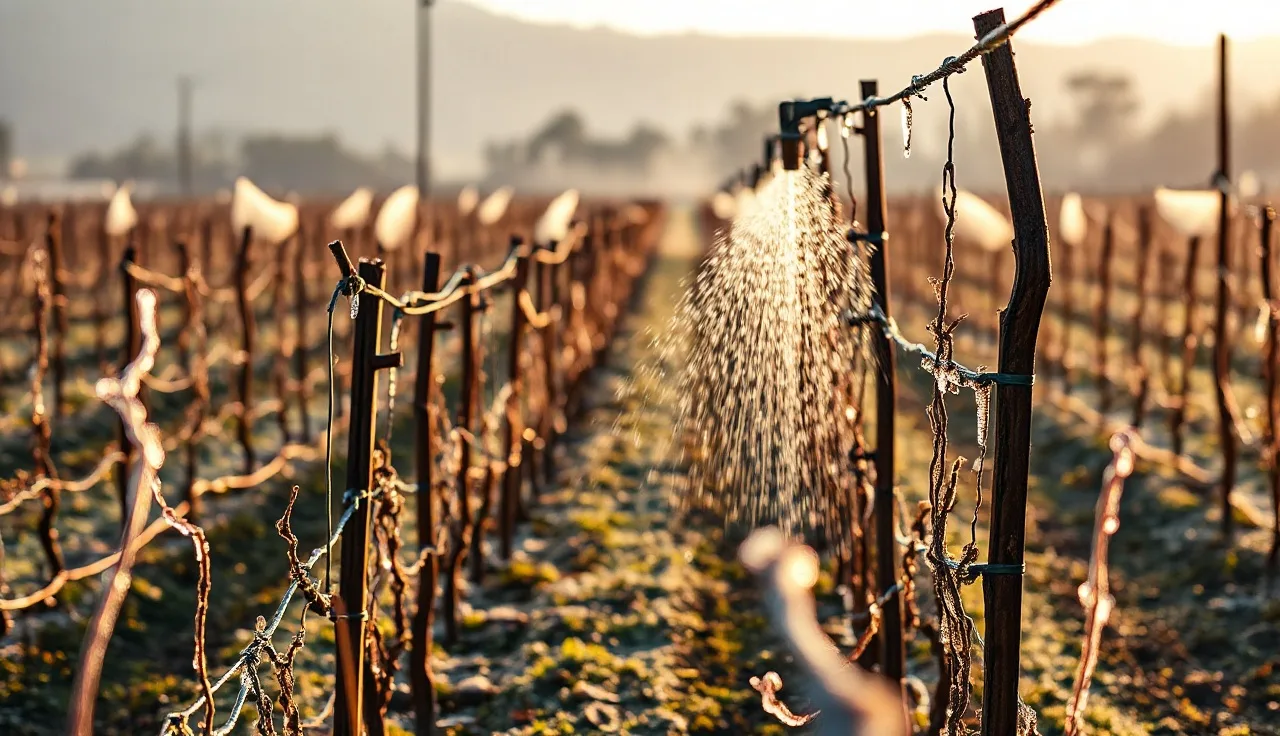
Water gives off 80 calories of latent heat for every gram that freezes. That heat moves straight into the plant tissue under the ice, holding the surface of buds and young shoots near 32°F (0°C) as long as the water keeps flowing and freezing. The ice looks alarming. It's doing its job.
The method has one hard rule: once you start, you cannot stop until the air rises above freezing and the ice melts on its own. Stopping mid-freeze is one of the fastest ways to kill a crop. Wet ice drying in sub-freezing air cools by evaporation and drags tissue temperature several degrees below where you started [1].
Extension programs call this "overhead sprinkler irrigation for frost protection," and the term is worth getting right. Under-vine drip and micro-sprinklers protect soil heat instead, and the physics are different. This guide covers overhead systems, which are the dominant frost-spray method in commercial viticulture.
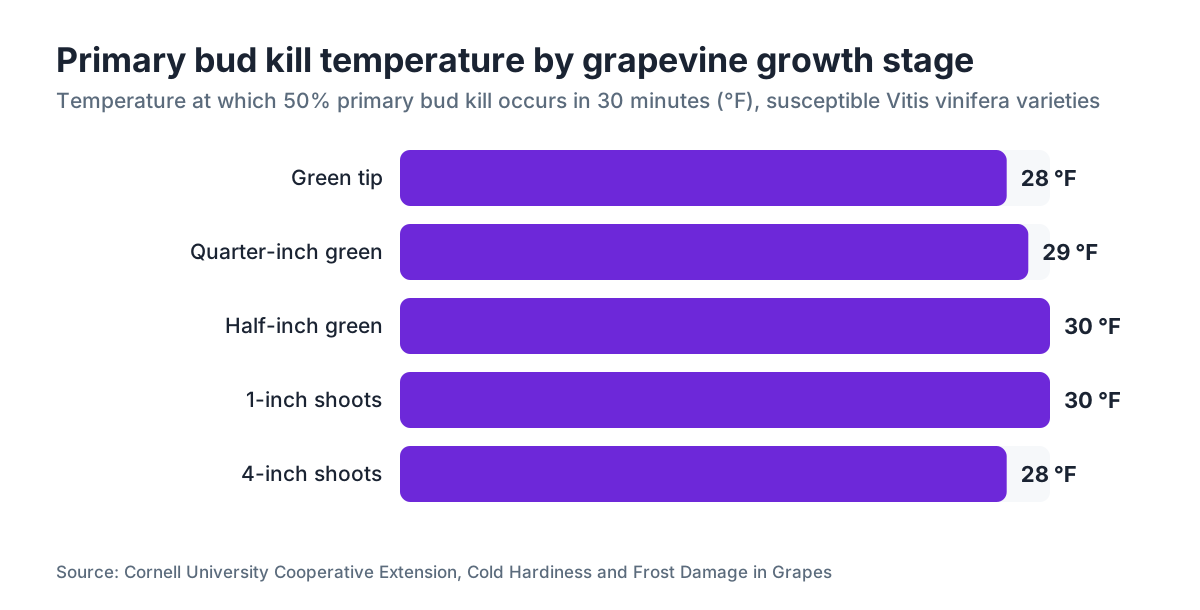
Wine grape buds are most exposed in spring, from green tip through the third or fourth leaf. At green tip, Vitis vinifera varieties usually take primary bud damage at 28°F (-2.2°C). By the time shoots reach 6 inches, 30°F (-1.1°C) for more than 30 minutes kills primary buds in many varieties [2]. Those numbers tell you when to start the pumps.
What water application rate do you need for vineyard frost protection?
Most university extension programs, UC Davis and Washington State University among them, put the target at 0.10 to 0.15 inches of water per hour across the protected block [1][3]. That rate releases enough latent heat to offset what radiation and convection strip away on a typical still frost night.
Rate matters more than coverage pattern. A system rated at 0.08 in/hr on paper often falls short at the edges of the throw once wind picks up or nozzle spacing runs too wide. WSU recommends pushing toward 0.15 in/hr where frost-night winds routinely top 5 mph, because wind pulls heat off the ice faster than calm air does [3].
Nozzle spacing and pressure both drive application rate. Most vineyard overhead systems run rotating impact heads or oscillating mini-sprinklers on risers above the trellis wire. A common layout puts heads 30 to 40 feet apart in the row and 20 to 30 feet between rows, at 25 to 45 PSI depending on the nozzle. Calibrate your real delivery rate with catch cans before the season, not at 2 a.m. on a frost night.
Water supply is the constraint people forget. A 10-acre block at 0.12 in/hr needs about 53,000 gallons an hour. If your pump was sized for summer peak irrigation, check whether it can hold that output all season with reservoir drawdown in the math. Plenty of growers find out the hard way, mid-freeze, that it can't.
At what temperature should you turn on the frost sprinklers?
Start the system when the wetbulb temperature at canopy level reaches 34°F (1.1°C), not when the drybulb air temperature does. The wetbulb threshold buys you the 5 to 10 minutes the system needs to build ice coverage before tissue drops to the damage point [1].
If all you have is a standard thermometer and no wetbulb reading, UC Cooperative Extension gives a working rule: start at a drybulb reading of 35°F to 36°F (1.7°C to 2.2°C) under calm, clear skies. That matches the wetbulb timing in most cases [2].
Wind changes the math. It speeds evaporative cooling and strips latent heat off the ice faster. Oregon State University extension materials suggest raising your start threshold 1°F to 2°F when sustained winds pass 5 mph, so you might start at 37°F drybulb on a breezy night [4].
Sensor placement beats sensor quality. A wireless sensor at canopy height, 3 to 4 feet up in the coldest block, tells you far more than a station bolted to a building or sitting in a Stevenson screen at 5 feet. Cold air pools. The gap between your lowest vineyard floor and the station can run 3°F to 5°F on a calm radiative night. Growers who lost crops often had good thermometers in bad spots.
What are the real limits of sprinkler frost protection, and when does it fail?
Sprinkler protection tops out around 24°F (-4.4°C) for sustained lows under calm conditions. Below that, the system still releases heat but can't keep up with the energy loss, and ice keeps building past what the shoots can carry under its weight [3].
Wind is the other hard limit. Above 10 mph sustained, evaporative cooling off the ice strips heat faster than the water can replace it. The USDA Agricultural Research Service has documented crop failures from systems running correctly at rates that would have held up in calm air, lost solely to 12 to 15 mph winds [5]. Know your frost climatology. If your frost events tend to arrive with wind, overhead sprinklers fit worse than you'd hope.
Equipment fails mid-event too. Pump breakdowns, power cuts, and pipes freezing at fittings have wiped out crops on vineyards that owned working frost gear. WSU recommends a generator and a manual override at every pump station [3].
Ice weight gets underestimated. A thick buildup over a long event snaps trellis wires, breaks young shoots even without cold damage, and can bend older trunk wood. If the system runs 10 to 12 hours below freezing, walk the rows at dawn and assess the structure before the ice melts and the evidence is gone.
How does sprinkler frost protection compare to other vineyard frost methods?
| Method | Effective temp range | Capital cost (per acre, rough) | Operating cost | Wind sensitivity |
|---|---|---|---|---|
| Overhead sprinklers | Down to ~24°F | $800 to $2,500 | High (water + pump) | High |
| Wind machines | Down to ~26°F | $15,000 to $25,000 per unit | Low | Works best in inversion frosts |
| Heaters (propane/smudge) | Down to ~20°F | $300 to $600 | Very high (fuel) | Low |
| Frost cloth/row covers | Down to ~26°F | $500 to $1,200 | Labor-heavy | Low |
| Under-vine micro-sprinkler | Down to ~28°F | $400 to $800 | Moderate | Moderate |
Capital cost for sprinklers swings hard depending on the irrigation you already own. Managers who inherit a drip system and bolt on overhead frost protection usually spend $1,200 to $2,000 per acre for risers, heads, and extra lateral lines [2].
Wind machines cover roughly 10 to 15 acres each. They pull the warmer air above the temperature inversion down to canopy level, which makes them strong on radiation frost nights where an inversion exists. Napa and Willamette Valley growers with machines report a 4°F to 6°F lift in the protected zone [4]. On an advection frost night, though, a machine alone adds nothing and can speed cooling by dragging cold air sideways.
Serious frost-risk vineyards in California and Washington often run both: wind machines as the first line with a start threshold around 34°F, then sprinklers as backup if the temperature keeps sliding. The pair covers both frost types and stretches the effective protection range.
What compliance and record-keeping requirements apply to frost spray applications?
Here's where growers slip. Add any material other than plain water to the frost system, even a foliar fertilizer or a plant protectant, and the application likely triggers pesticide record-keeping under state rules and the EPA Worker Protection Standard [6].
Pure water for frost protection is not a pesticide application and needs no Pesticide Use Report (PUR) in California or equivalent records elsewhere. But several products marketed for frost, including some plant growth regulator formulations and foliar sprays claiming to build cold tolerance, are registered pesticides. Read the label. If it's a registered pesticide, record the application.
The EPA Worker Protection Standard (40 CFR Part 170) requires workers be told about pesticide applications in the area and that restricted-entry intervals be honored. For frost spraying at night with no workers present, the practical WPS burden is low, but you still post the treated-area information if a pesticide went out [6].
California's Department of Pesticide Regulation requires a PUR for any registered pesticide on an agricultural site, covering method, product name, EPA registration number, rate, and acreage. You have until the end of the month following application to file [7]. Keep the record current even when the spray happens at 3 a.m. in the middle of a stressful night.
Good record software earns its keep here. VitiScribe lets you log a frost application on your phone in the vineyard, capturing timestamp, block, product (if any), and temperature readings, so the record is done before your first coffee. A searchable frost log also helps when an insurance claim or a PCA audit surfaces later.
How do you set up and test a vineyard frost sprinkler system before the season?
Pre-season testing is not optional. Run the full system four to six weeks before your first expected frost date, which for most California and Pacific Northwest wine regions means February testing to be ready for March activation [2].
Start with a pressure check across the whole system. Low pressure at the end of a lateral means a pump issue, a partly closed valve, or a leak. Flag every nozzle delivering off-spec and swap it. Rotating impact heads wear out; a head that put down 0.12 in/hr three years ago might be at 0.09 in/hr now.
Catch cans are the only honest measure of your real rate. Set cans on a grid across one representative block, run the system for exactly 30 minutes, and measure the depth in each. Average them, multiply by 2, and that's your hourly rate for that block. If you're under 0.10 in/hr, go up a nozzle size or tighten spacing before frost season.
Check the water source hard. On a reservoir or pond, confirm the starting volume and figure out how many hours you can run before the pump sucks air. In a multi-day event, running dry with four hours of night left is a total loss.
Log the test date, the pressure at the pump and at each lateral end, and the catch can numbers. That data is your baseline when something goes wrong in a live event.
What do temperature inversions have to do with vineyard frost and sprinklers?
Radiation frost, the most common type in vineyards, hits on still, clear nights when the ground and low canopy radiate heat to the sky. Air near the ground cools faster than air 50 to 100 feet up, creating a temperature inversion where it's warmer aloft than at vine height. That's why hilltop blocks in Napa and the Willamette Valley often dodge frosts that hammer the valley floor [4].
Sprinklers work in radiation frost because you're fighting a specific, local pool of cold air. The physics stay manageable: low wind, a defined cold zone, a steady drop over several hours.
Advection frost is a different animal. A cold air mass moves in horizontally, usually with wind, and the whole region chills evenly. There's no inversion to exploit. Minimum temperatures run lower and the cold lasts longer. Sprinklers lose ground here, both because wind strips heat off the ice and because the floor often sits below 24°F in a bad advection event.
Knowing which frost type dominates your site is genuinely useful when you decide how much to spend on which method. Your local NWS office and NOAA historical climate data can tell you the ratio of radiation to advection events in your county. Nobody has clean data for every sub-AVA, but the nearest NOAA airport or cooperative observer station usually tells a useful story [8].
What grape varieties and growth stages are most vulnerable to frost damage?
Varieties are not equally exposed, and the gap is big enough to change your strategy. Early-budding varieties like Chardonnay and Pinot Noir push green tissue one to two weeks ahead of later types like Cabernet Sauvignon and Zinfandel. In a region with a typical last frost in late March or early April, that gap is the line between heavy crop loss and none [2].
The numbers are well established. Cornell's viticulture extension puts primary bud kill (30 minutes at the stated temperature) at roughly: green tip 28°F (-2.2°C), quarter-inch green 29°F (-1.7°C), half-inch green 30°F (-1.1°C), 1-inch shoots 30°F (-1.1°C), and 4-inch shoots 28°F (-2.2°C). Those figures reflect 50% primary bud kill in susceptible varieties [9].
Secondary and tertiary buds are hardier than primary buds. That's why some growers on frost-prone sites deliberately delay pruning to stretch dormancy and cut the total exposed shoot days before the last frost. It's called delayed or late pruning, and it can push effective bud break back 10 to 14 days in some varieties with little yield penalty, though it takes labor.
After the 4-leaf stage, vines harden off and gain some tolerance, but shoot tips can still burn above 30°F in a long frost. The upside is that loss is less total by then, because secondary buds have mostly broken and will carry the season.
How do you manage frost risk on a limited budget in a small vineyard?
On 2 to 5 acres where a full overhead system makes no financial sense, a few options are worth real consideration. Frost cloth is labor-heavy but genuinely works on small blocks. A single-layer polypropylene blanket at 1.25 oz/sq yd or heavier gives 4°F to 6°F of protection, and two people can deploy and pull it in an hour on a small block [4].
A portable frost fan or small wind machine works for 5 to 15 acres and rents in some regions. Ask your farm bureau or grower cooperative; rentals exist around Lodi, Paso Robles, and parts of the Willamette Valley.
For blocks that are structurally frost-prone, the best long-term money often goes into site work: pulling trees or hedgerows that trap cold air, cutting drainage channels to move cold air off the vines, or managing cover crop to slow ground-level cooling overnight. This sounds dull next to buying gear, but it can cut your frost events 30% to 50% in mild years.
For a small grower who wants a bare-minimum viable setup, WSU recommends at least this: calibrated canopy-level temperature monitoring, a clear startup plan built on wetbulb or corrected drybulb thresholds, and a tested response time so you know exactly how many minutes it takes from alert to full coverage [3]. Improvising at 2 a.m. is where crops die.
How do you keep frost event records for insurance and compliance purposes?
After a frost event, your records do three jobs: crop insurance claims, compliance audits if any registered product went out, and your own calibration data for next year.
For insurance, the California Department of Food and Agriculture and most crop insurance programs want documentation of the event temperature, the time spent below threshold, the protection measures taken, and the affected acreage with an estimated loss. The USDA Risk Management Agency (RMA) covers frost under standard multi-peril crop insurance (MPCI) policies, and adjusters will ask for temperature logs [10]. A sensor that timestamps a reading every 5 to 15 minutes is worth far more than a manual thermometer glance.
Log at minimum: the date, each block's low and how long it held below threshold, when you started and stopped the sprinklers, the application rate from your pre-season catch can data, and any product name and rate if you added something to the water. In California, that last item can trigger a PUR.
VitiScribe's block-level field log captures exactly these points, with geo-tagged block records and timestamped entries already formatted for California PUR submission. It's not the only way to do this, but a paper log in a wet, cold vineyard at 4 a.m. has an obvious reliability problem.
Hold records at least three years, which covers most state pesticide record-keeping rules and the usual crop insurance audit window [7].
Frequently asked questions
Can you run frost sprinklers all night as a precaution even if temperatures stay above 34°F?
Running water you don't need drains the reservoir, stresses the pump, and soaks the soil in ways that cause their own problems heading into the season. Run the system only when your wetbulb threshold is hit or a confirmed forecast dip is coming. A false start is expensive. Doing it every night becomes a budget problem by mid-season.
What happens if the power goes out while frost sprinklers are running?
This is the scenario that kills crops. When water stops mid-freeze, the wet ice on the vines evaporates in sub-freezing air and drives tissue temperature 2°F to 4°F below where you started. A generator wired to the pump is the standard fix. Size it for full pump load, not near-full. Test the auto-start at least once before frost season.
How long does it take for overhead sprinklers to build protective ice coverage?
Under calm conditions, rotating impact heads at 0.12 in/hr usually show visible ice on buds within 8 to 12 minutes of starting. Full shoot coverage takes 15 to 20 minutes. That lead time is why the start threshold sits at 34°F to 35°F drybulb rather than 32°F. You need the ice built before tissue hits the damage point.
Do frost sprinklers damage young vine trunks or rootstocks?
Healthy wood handles the ice shell fine. The real risk to trunks comes from ice weight on the trellis bending young vines that aren't well staked, or occasionally from ice on grafted bench-graft unions in the first establishment year. Stake young vines firmly and keep an eye on graft unions during long frost events.
What is the difference between a radiation frost and an advection frost in a vineyard context?
Radiation frost happens on still, clear nights when vines and soil radiate heat to the sky, pooling cold air near the ground. Advection frost is a regional cold air mass moving in, usually with wind. Sprinklers and wind machines work best on radiation events. Advection frosts are harder to fight because of the wind and lower temperatures, and may need heaters or frost cloth on top.
Does adding any product to the frost spray water require a Pesticide Use Report in California?
Yes, if the product is a registered pesticide. Plain water needs no PUR. Some frost-protection products, including certain biostimulants and growth regulator formulations, carry EPA registration numbers. If the label shows an EPA Reg. No., the application is a pesticide application and needs a PUR filed by the end of the month following application under California DPR rules.
How many gallons per hour does a 10-acre frost sprinkler system need?
At 0.12 inches per hour, one acre needs about 5,250 gallons per hour (43,560 sq ft x 0.12/12 ft x 7.48 gal/cu ft). A 10-acre block needs roughly 52,500 gallons per hour. Verify your pump output and reservoir capacity before frost season so you know exactly how many hours you can run without running dry.
At what bud stage is Chardonnay most vulnerable to frost damage?
Cornell viticulture extension puts Chardonnay primary bud kill starting at 28°F at green tip, rising to 30°F at half-inch green for 50% kill in 30 minutes. Chardonnay is one of the earliest-budding wine varieties, so its window of maximum vulnerability often overlaps with the last frost date in marginal regions.
Do frost sprinklers require any permits or water rights documentation?
In most western states, yes. Large overnight water diversions can trigger reporting under your water rights permit. In California, if you pump from surface water, frost use may count against your annual diversion amount and may need reporting to the State Water Board. Check with your local water district and review your water rights permit before your first season.
How does the EPA Worker Protection Standard apply to nighttime frost spray operations?
The WPS (40 CFR Part 170) applies whenever a registered pesticide is applied, no matter the hour. If your frost spray is only water, WPS does not apply. If a registered product goes in, the treated area must be posted with the required information before workers re-enter. Nighttime applications with no workers present lower the practical burden, but posting still stands if a pesticide was used.
Can drip irrigation substitute for overhead sprinklers as frost protection?
Not directly. Drip delivers water at soil level and can slow overnight radiative cooling by storing heat in moist soil and releasing it, worth maybe 1°F to 2°F in some conditions. That's not enough in a serious frost. Under-vine micro-sprinklers on risers help more, but neither replaces overhead coverage at standard frost-protection rates.
What records do USDA crop insurance adjusters look for after a frost event?
USDA RMA adjusters typically want timestamped canopy-level temperature logs showing the event temperature and duration, the protection measures deployed with start and stop times, and block-level acreage. They may also check your pre-season system test records and prior year yield history. Gaps in temperature records are the most common documentation problem in frost loss claims.
Is late pruning a viable frost risk reduction strategy, and does it hurt yield?
Late pruning to delay bud break is viable and practiced in regions like the Willamette Valley and parts of New York. It can push effective bud break back 10 to 14 days in responsive varieties like Chardonnay and Pinot Noir. Yield penalty is usually minimal if pruning wraps up before bud swell, though in some years the delayed season pushes harvest into wetter fall weather.
Sources
- UC Cooperative Extension, Frost Protection for Vineyards: Application rate of 0.10 to 0.15 inches per hour required for overhead sprinkler frost protection; stopping water flow mid-freeze causes additional damage through evaporative cooling
- UC Davis Viticulture and Enology, Frost and Freeze Protection: Vitis vinifera primary bud damage thresholds by growth stage; capital cost estimates for overhead frost sprinkler installation; pre-season testing timing recommendation
- Washington State University Extension, Frost Protection in Washington Vineyards: 0.15 in/hr recommendation in windy conditions; wind machine performance data; generator backup recommendation; minimum viable frost monitoring recommendations
- Oregon State University Extension Service, Frost Protection for Horticultural Crops: Start threshold adjustment of 1°F to 2°F for winds above 5 mph; wind machine temperature lift of 4°F to 6°F; frost cloth protection range of 4°F to 6°F; hilltop versus valley floor temperature differentials
- USDA Agricultural Research Service, Frost Protection Research: Documented crop failures from overhead sprinkler systems at correct application rates when sustained winds exceeded 12 to 15 mph during frost events
- EPA Worker Protection Standard, 40 CFR Part 170: WPS posting and restricted-entry requirements apply when registered pesticides are applied regardless of time of day; pure water applications are not covered
- California Department of Pesticide Regulation, Pesticide Use Reporting: PUR required for all registered pesticide applications to agricultural sites in California; filing deadline is end of month following application; records must be retained for three years
- NOAA National Centers for Environmental Information, Climate Data: Historical frost event frequency, radiation versus advection frost ratios by region, cooperative weather observer station data
- Cornell University Cooperative Extension, Cold Hardiness and Frost Damage in Grapes: Primary bud kill temperature thresholds (50% kill in 30 minutes) by phenological stage for susceptible Vitis vinifera varieties including Chardonnay and Pinot Noir
- USDA Risk Management Agency, Multi-Peril Crop Insurance for Grapes: MPCI policies cover frost damage; adjusters require timestamped temperature logs, protection measure documentation, and affected acreage records
Last updated 2026-07-09