Vineyard spray record retention requirements by state

TL;DR
- Federal EPA rules under the Worker Protection Standard require pesticide application records to be kept for at least 2 years.
- Most states match that floor, but California requires 3 years for growers, and several states extend to 5 years for commercial applicators.
- Your records must include the product name, EPA registration number, rate, date, and treated area at minimum.
What federal law requires for pesticide record-keeping
The EPA's Worker Protection Standard (WPS), codified at 40 CFR Part 170, is the federal floor for pesticide records on farms. Under WPS, agricultural employers must keep records of pesticide applications for at least 30 days after any restricted-entry interval (REI) expires, but those records must also be available for the most recent year to workers and their designated representatives upon request. [1]
That's the WPS piece. The record-retention floor that actually matters for vineyard owners comes from FIFRA, the Federal Insecticide, Fungicide, and Rodenticide Act, and its implementing regulations at 40 CFR Part 171. Commercial and private pesticide applicators who use restricted-use pesticides (RUPs) must retain application records for a minimum of 2 years from the date of application, and those records must be available to state or federal inspectors. [2]
Note the word "minimum." States are free to be stricter, and most are. If your state says 3 years, 3 years is what you follow, federal minimums notwithstanding.
The required data elements under FIFRA for RUP records are: the product name and EPA registration number, the total amount applied, the location and size of the treated area, the date and time of application, the method of application, and the name and certification number of the applicator. [2] Some states tack on additional fields like wind speed, temperature, target pest, and adjacent crop notation.
How long do you actually have to keep spray records in each state?
Here's the honest answer: there is no single federal mandate that says "3 years for everyone." Retention periods are a patchwork set by each state department of agriculture, and they differ depending on your role. A licensed commercial applicator, a private applicator, and the grower of record can each face different rules on the same block.
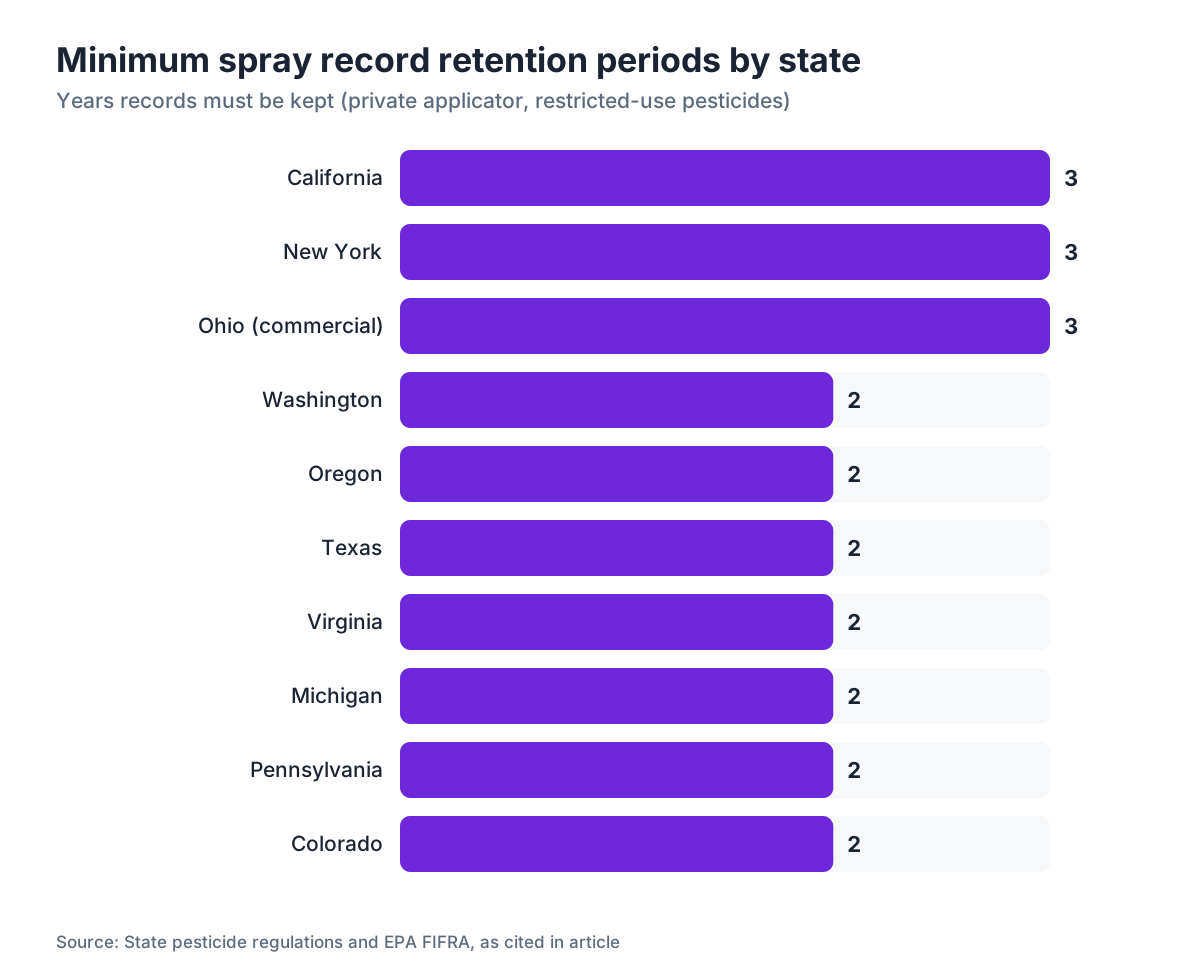
The table below covers the major wine-producing states and a selection of others. Where a state has different rules for restricted-use versus general-use pesticides, that's noted. "Private applicator" in most states means you're applying pesticides on land you own or lease for production of an agricultural commodity. That's where most vineyard operators fall.
| State | Private Applicator Retention | Commercial Applicator Retention | Notes |
|---|---|---|---|
| California | 3 years | 3 years | Regulated under Food & Ag Code §12982 and 3 CCR §6628. County ag commissioner may inspect. [3] |
| Washington | 2 years (RUP) | 2 years | WSU Extension notes 2 years under WAC 16-228. General-use records not mandated at state level. [4] |
| Oregon | 2 years | 2 years | OAR 603-057-0400. Records must be produced within 72 hours of request. |
| New York | 3 years | 3 years | ECL §33-1005 and 6 NYCRR Part 325. Includes general-use records for commercial applicators. [5] |
| Texas | 2 years | 2 years | Texas Ag Code §76.145. Private applicators only required to keep RUP records. |
| Virginia | 2 years | 2 years | Virginia Pesticide Control Act, Title 3.2, Chapter 39. |
| Michigan | 2 years | 2 years | Michigan FIFRA-based rules; state defers to federal minimum for private applicators. |
| Ohio | 2 years | 3 years | OAC 901:5-11-16. Commercial applicators get an extra year. |
| Pennsylvania | 2 years | 2 years | Pennsylvania Pesticide Control Act of 1973, as amended. |
| Colorado | 2 years | 2 years | 8 CCR 1203-2. |
| Missouri | 2 years | 2 years | Follows federal FIFRA minimums. |
| North Carolina | 2 years | 2 years | NCGS §143-469 and 2 NCAC 09L .0601. |
This table reflects general requirements as of mid-2025. State regulations change, and your county or state department of agriculture is the authoritative source before you set your document-retention policy. Using a contract spray service doesn't erase your obligation. Their commercial applicator record-keeping duty runs alongside yours as the grower, not instead of it. Keep your own copies.
California enforces its 3-year rule harder than most. County agricultural commissioners run field inspections, and Cal/DPR reported more than 1,500 pesticide use enforcement cases in a recent annual report. [3]
What information must be on every spray record?
Getting the retention period right doesn't help much if the records themselves are incomplete. An inspector who finds a log missing the EPA registration number or the treated acreage can still cite you, even if you kept it for five years.
Federal minimums for RUP records require these fields [2]:
- Product brand name
- EPA registration number
- Total amount of product applied
- Location and size (in acres) of treated area
- Date of application
- Method of application
- Name and address of the certified applicator
- Certification/license number of the applicator
California adds mandatory fields under 3 CCR §6628 [3]:
- Operator of property (if different from applicator)
- County where applied
- Target pest
- Commodity and crop stage
- Equipment used
- If aerial, the aircraft registration number
New York under 6 NYCRR Part 325 also requires the time of application and, for commercial applicators, weather conditions at the time of application. [5]
Record wind speed and direction, temperature, and relative humidity at every application, whether your state mandates it or not. If a neighbor files a drift complaint or a worker files a WPS violation, those weather notes are the fastest way to reconstruct what actually happened. Cornell's integrated pest management program recommends this for liability reasons, even where no law requires it. [6]
One more thing: re-entry interval postings and records are separate from application records under WPS. WPS requires that the application record be posted or accessible at a central location on the farm until 30 days after the REI expires. That's a display requirement more than a retention requirement. [1]
Does the EPA Worker Protection Standard require separate spray records from FIFRA?
Yes, and that trips up more vineyard operators than you'd think.
FIFRA-mandated records focus on RUP applications and are driven by applicator accountability. WPS records are worker safety records, and the obligation falls on the agricultural employer to make pesticide application information available to workers who were, or may have been, exposed. [1]
The 2015 WPS revision strengthened these requirements. Agricultural employers must now keep records that include the product name, EPA registration number, active ingredient(s), REI, and the date, time, and location of each application. These records must be accessible to workers and their designated representatives for at least 30 days after the REI expires. [1]
The EPA's WPS guidance states: "Agricultural employers must keep a copy of the labeling and safety data sheet for each pesticide product used in production of agricultural plants on the establishment." [1] That's a separate retention obligation from the application record.
A vineyard operator runs three overlapping systems. FIFRA RUP records last 2 or more years and cover restricted-use products. WPS application information lasts 30 days past the REI and exists for worker access. State pesticide use reporting varies by state and often covers every pesticide, not only RUPs. Treat these as one thing and you'll get burned.
Washington State University Extension has a useful breakdown of how these layers interact for tree fruit and grape growers in the Pacific Northwest. [4] The structure is the same in most states.
Which states require pesticide use reporting in addition to record-keeping?
Record-keeping is about what you keep on file. Pesticide use reporting is about what you file with the state. They're different, and some states require both.
California is the most aggressive on this front. Under the Department of Pesticide Regulation's mandatory reporting system, every agricultural pesticide application must be reported to the county agricultural commissioner by the applicator, typically on a monthly basis. [3] This covers general-use pesticides, not only restricted-use. California is essentially the only state with this breadth of mandatory reporting, and it's the reason California DPR holds the most detailed pesticide use data in the country.
Washington requires reports for restricted-use pesticides from commercial applicators but not from private applicators applying on their own land. [4]
New York requires commercial applicators to maintain records that the Department of Environmental Conservation can request, but doesn't require proactive monthly filing for most agricultural applications. [5]
Oregon, Texas, and most other wine states do not require proactive pesticide use reporting from private applicators. You keep the records and produce them if inspected.
Operate in California and your compliance burden is meaningfully higher than it is in Oregon or Washington. The county ag commissioner submission deadline in California is the 10th of the month following the application month, and late or inaccurate reports draw fines. Grow grapes across multiple counties in the same season and each county commissioner gets its own report.
What happens if your spray records are incomplete or missing?
The realistic answer is: it depends on who's asking and why.
For routine state inspections, first-time violations for missing or incomplete records typically draw a written warning or a notice to comply, especially for private applicators with no prior history. Civil penalties vary widely. In California, fines under the Food & Agricultural Code can reach $5,000 per violation per day, though enforcement at that level is generally reserved for repeat violations or cases involving worker harm. [3]
For EPA inspections tied to a WPS complaint, the consequences can hit faster. FIFRA Section 9(a) authorizes EPA inspectors to inspect premises and records without advance notice. Failure to maintain required records is a violation of FIFRA Section 12, which carries civil penalties up to $5,000 per violation for private applicators and up to $25,000 per violation for commercial applicators. [2]
Where records really matter is civil litigation. A drift complaint from a neighbor, a farm worker injury claim, or a food safety investigation goes much better for you when you have complete, dated records showing exactly what you applied, when, and at what rate. Lawyers working pesticide injury claims hunt for gaps in application logs. Missing records create the impression that something got applied without documentation.
The other practical issue is crop certification. If you're applying for organic transition, USDA NOP requires that you document all inputs applied to a field for 5 years prior to certification. Spray records are how you prove no prohibited substances were used. [7] That 5-year lookback can push your effective retention need well past the 2- or 3-year state minimum.
How should vineyard managers actually store and organize spray records?
Paper spray logs kept in a binder in the equipment shed are legal in every state. They're also fragile. A fire, a flood, or a decade of UV exposure will destroy them, and the inspector arriving three years from now won't accept "we lost it" as a defense.
Here's what actually works:
For small operations (under 50 acres), a simple spreadsheet synced to cloud storage is enough. Each row is one application, columns map to the required fields, and you export to PDF at the end of each spray day. Attach the product label as a scanned PDF to each record. You don't need much more than that.
For larger operations, digital record-keeping tools built for pesticide compliance save real time. Tools like VitiScribe let you log applications in the field with a phone and automatically track RUP requirements, REI windows, and required data fields for each product. The payoff isn't just organization. The system can flag missing fields before you save, which is where paper logs fail most often.
Regardless of format, keep at least one off-site backup. If your state requires 3 years of records and a fire destroys your only copies at year two, you have a compliance problem even though the records once existed. Cloud sync handles this automatically.
Washington State University Extension recommends that growers build a filing system that separates records by year and by field or block, which makes responding to inspector requests much faster. [4] Cornell's pesticide management program says the same and adds that records should be filed close to the time of application, not reconstructed later from memory. [6]
Also worth knowing: you don't have to hand an inspector your records on the spot if they arrive unannounced. Most state regulations give you 72 hours to produce records when requested in writing. Oregon's rule at OAR 603-057-0400 is one example. Check your state's specific language, but don't feel pressured to improvise under time pressure.
Do spray records requirements differ for organic vineyards?
Organic certification adds a separate layer of record-keeping on top of state pesticide rules, and the two don't fully overlap.
USDA NOP-certified operations must maintain records that fully disclose all activities and transactions in sufficient detail to be readily understood and audited. The NOP requires that organic system plan records, input purchase records, and field activity records be retained for 5 years. [7] That 5-year standard exceeds California's 3-year state minimum and doubles the federal FIFRA minimum.
For an organic vineyard, every material applied to a block, sulfur, copper, neem oil, or a biological product, needs to be logged with the same rigor you'd apply to a synthetic pesticide. The certifier will ask to see these records at your annual inspection. If you can't show consistent documentation, you risk losing certification for that block.
Organic growers sometimes assume they don't need spray records because they're "not using pesticides." Sulfur and copper are both classified as pesticides under FIFRA. If you use copper fungicides in your organic program (and most do), you're applying a restricted-use pesticide in some formulations, which triggers FIFRA record-keeping on top of NOP records.
The practical implication: organic vineyard operators should plan for 5-year retention as a minimum, even in states where the pesticide rule only requires 2.
Are spray records part of a GAP audit or food safety certification?
Yes. Sell grapes to a winery that participates in GFSI-recognized food safety schemes (SQF, GLOBALG.A.P., Primus GFS) and you'll be asked to produce pesticide application records as part of the audit.
GLOBALG.A.P. Integrated Farm Assurance standard requires that all plant protection product applications be recorded and traceable to a specific crop, field, and date. The standard specifies that records must be retained for a minimum of 2 years, though many auditors request 3 years of historical records to demonstrate ongoing compliance. [8]
Primus GFS, common in California and used by several large grape buyers, requires that pesticide records be complete, accurate, and available for inspection. Pre-harvest intervals (PHIs) must be documented and demonstrably observed.
Some wineries handling estate or contract fruit require their growers to submit spray logs alongside each load ticket during harvest. That's a buyer requirement, not a legal one, but ignoring it risks losing the contract. Grow for a certified-sustainable program like SIP (Sustainability in Practice) in California and spray records become part of the annual third-party audit, where auditors check for completeness, more than existence.
For growers considering operation in the Paso Robles wine region, where many wineries have adopted sustainability certifications, vineyard compliance documentation is a commercial necessity at this point more than a regulatory one.
How do spray record requirements apply to custom crush or leased vineyard operations?
This is where the paperwork gets genuinely confusing, and most operators don't think it through until there's a problem.
If you own the land and lease it to another party who farms it, your obligations depend on who is named as the operator of record and who holds the pesticide applicator license. In most states, the person who physically makes the pesticide application is the applicator for record-keeping purposes. But WPS compliance obligations fall on the "agricultural employer," which may be the landowner if the landowner directs farming activities. [1]
If a custom vineyard management company is farming your land, get it in writing who maintains spray records and for how long. A vague contract that says "farming operations" will be maintained by the management company is not a defense when the state cites you as the property owner.
City wineries and custom crush facilities that source fruit from multiple independent growers (a common model for urban winery operations) are generally not the applicator of record and don't bear the primary record-keeping obligation for field applications. But the winery does need to keep records of pesticide residue testing and pre-harvest interval compliance for traceability, particularly if it's certified under any food safety scheme.
If you're on the grower side of a custom crush arrangement, don't assume the winery is keeping your spray records for you. They're almost certainly not.
What's the simplest compliant spray record system you can set up today?
You don't need software to comply. You need a consistent process.
Build a spray log template, either in a spreadsheet or on paper, that includes every field required by your state plus the federal FIFRA fields. Print or export a new sheet at the start of each season. Fill it in at the time of application, not at the end of the week. Attach the product label for each new product you use, scanned and stored alongside the log. At the end of the calendar year, export or print the full log, label it with the year and property name, and store it somewhere dry and accessible.
Set a calendar reminder for the retention cutoff date. If your state requires 3 years, your 2022 records become eligible for destruction in early 2026. Don't destroy them the day after the cutoff, though. If a civil suit is filed related to a 2022 application, records shredded the day the legal obligation expired can still look bad in litigation.
For operations above about 50 acres, or any operation managing multiple blocks with different pesticide programs, the overhead of manual tracking grows fast. That's where purpose-built tools like VitiScribe cut error rates meaningfully, mostly by ensuring every required field gets captured before the record is finalized.
UC Davis's Integrated Pest Management program has a free printable pesticide application record form on its website that meets California's requirements and adapts easily to other states. [9] Start there if you're building a paper system from scratch.
Frequently asked questions
How long do I have to keep spray records in California?
California requires pesticide application records to be kept for 3 years from the date of application, under Food & Agricultural Code §12982 and 3 CCR §6628. This applies to all agricultural pesticide applications, not only restricted-use products. Your county agricultural commissioner can inspect these records, and California runs one of the most active pesticide enforcement programs in the country.
Do federal rules require spray records for general-use pesticides or only restricted-use?
Federal FIFRA record-keeping requirements apply specifically to restricted-use pesticides (RUPs). General-use pesticide records are not federally mandated at the farm level, but several states, most notably California, require records for all agricultural pesticide applications regardless of restricted or general-use classification. Check your state's rules, more than the federal ones.
What is the EPA Worker Protection Standard requirement for spray record access?
Under 40 CFR Part 170, agricultural employers must make pesticide application information available to workers and their designated representatives for at least 30 days after the restricted-entry interval expires. This is a worker access requirement, separate from the record-retention requirement under FIFRA. Both obligations apply simultaneously and independently.
Can spray records be kept digitally, or do they have to be paper?
Most states accept electronic records as long as they can be produced for inspection when requested. California, Washington, New York, and Oregon all allow digital formats. The practical requirement is that records are legible, complete, and retrievable. A PDF or spreadsheet stored in cloud backup is acceptable; an undated photo of a Post-it note is not.
What fields are required on a vineyard spray record to satisfy federal rules?
Federal FIFRA rules require: the pesticide brand name and EPA registration number, total amount applied, location and size of the treated area, date of application, application method, and the certified applicator's name and certification number. States may require additional fields such as weather conditions, target pest, and crop growth stage. Always check your state's regulations for the full list.
Does organic certification change how long I have to keep spray records?
Yes. USDA NOP-certified operations must keep all farm records for a minimum of 5 years, which exceeds the 2- or 3-year minimums in most state pesticide rules. If you're in organic transition or certified organic, plan your record retention around the 5-year NOP requirement, since it's the longest obligation you face and covers the others.
Who is responsible for spray records if I hire a vineyard management company?
The licensed applicator who makes the application is typically responsible for maintaining application records under FIFRA. WPS obligations fall on the agricultural employer, which may be the landowner. If you use a vineyard management company, your contract should explicitly state who maintains records and for how long. Don't assume the management company's records satisfy your obligations as landowner.
What are the penalties for missing or incomplete spray records?
Federal FIFRA penalties for failing to maintain required records reach up to $5,000 per violation for private applicators and $25,000 per violation for commercial applicators. California state penalties under the Food & Agricultural Code can reach $5,000 per violation per day for repeated violations. First-time administrative violations often result in warnings, but enforcement escalates with repeat non-compliance.
Does New York require spray records for general-use pesticides?
New York's 6 NYCRR Part 325 requires commercial pesticide applicators to keep records of all applications, including general-use products, for 3 years. Private applicators in New York must keep records of restricted-use pesticide applications for 3 years. The New York ECL §33-1005 grants DEC authority to inspect these records.
How do spray record requirements affect a winery buying fruit from outside growers?
The winery is generally not the applicator of record and doesn't carry the primary FIFRA record-keeping obligation for field applications. However, wineries operating under food safety certifications like GLOBALG.A.P. or Primus GFS must verify pre-harvest interval compliance and may require growers to submit spray logs with deliveries. The grower remains responsible for maintaining their own records.
Does Washington state require spray records from private vineyard applicators?
Washington requires private applicators who use restricted-use pesticides to keep records for 2 years, consistent with the federal FIFRA minimum, under WAC 16-228. General-use pesticide records are not state-mandated for private applicators in Washington. Commercial applicators in Washington have the same 2-year obligation. WSU Extension has additional guidance specific to wine grape operations in the state.
What records does a vineyard need for a GAP or GLOBALG.A.P. audit?
GLOBALG.A.P. Integrated Farm Assurance requires documented records of all plant protection product applications traceable to specific crops, fields, and dates, retained for a minimum of 2 years with most auditors expecting 3 years of history. Records must show product name, rate, date, and observed pre-harvest intervals. Incomplete records are a common minor non-conformance and can escalate to major non-conformance on repeat audits.
Can a county agricultural commissioner inspect my spray records without advance notice in California?
Yes. California county agricultural commissioners have statutory authority to inspect pesticide application records during normal business hours, and California law does not require advance notice for routine compliance inspections. In practice, many inspections are announced, but unannounced inspections occur, particularly following complaints. Your records should be organized and accessible at all times, more than before a scheduled audit.
How do spray record retention rules interact with USDA organic certification?
USDA NOP requires organic operations to retain all records verifying compliance, including pesticide application records, for 5 years. Certifiers review these records at annual inspections and can conduct unannounced inspections at any time. Because organic growers may apply approved pesticides like sulfur or copper, FIFRA record-keeping obligations still apply alongside NOP requirements. The 5-year NOP standard is the binding one since it's longer.
Sources
- EPA, Worker Protection Standard (40 CFR Part 170): Agricultural employers must keep pesticide application information accessible to workers for 30 days after the REI expires; EPA states 'Agricultural employers must keep a copy of the labeling and safety data sheet for each pesticide product used in production of agricultural plants on the establishment.'
- EPA, FIFRA Section 12 and 40 CFR Part 171, Pesticide Application Record-Keeping: Commercial and private applicators of restricted-use pesticides must retain records for a minimum of 2 years; civil penalties for FIFRA record-keeping violations reach $5,000 per violation for private applicators and $25,000 for commercial applicators
- California Department of Pesticide Regulation, Pesticide Use Reporting: California requires all agricultural pesticide applications to be reported monthly to county agricultural commissioners and records retained for 3 years under Food & Agricultural Code §12982 and 3 CCR §6628
- Washington State University Tree Fruit and Extension pesticide guidance: WSU Extension notes 2-year retention under WAC 16-228 and provides breakdowns of how FIFRA, WPS, and state reporting layers interact for tree fruit and grape growers
- New York State DEC, Pesticide Recordkeeping Requirements (6 NYCRR Part 325): New York requires commercial and private pesticide applicators to retain records for 3 years under ECL §33-1005 and 6 NYCRR Part 325, including general-use pesticides for commercial applicators
- Cornell University Integrated Pest Management Program: Cornell IPM recommends recording weather conditions at time of application even where not legally required, for liability protection in drift complaints and WPS investigations
- USDA Agricultural Marketing Service, National Organic Program Regulations (7 CFR Part 205): USDA NOP requires certified organic operations to retain all compliance records including pesticide application logs for a minimum of 5 years
- GLOBALG.A.P. Integrated Farm Assurance Standard: GLOBALG.A.P. IFA requires plant protection product applications to be recorded and traceable to a specific crop, field, and date, with records retained for a minimum of 2 years
- UC Davis Integrated Pest Management Program, Pesticide Application Record Forms: UC Davis IPM provides free printable pesticide application record forms that meet California regulatory requirements; these forms can be adapted for use in other states
- USDA Economic Research Service, Pesticide Use in U.S. Agriculture: Background reference for agricultural pesticide application trends; ERS publishes periodic estimates of pesticide use by crop type
Last updated 2026-07-11