Vineyard sprayer calibration: how to do it right every time
TL;DR
- Vineyard sprayer calibration confirms your rig delivers the exact gallons per acre your label requires.
- An error as small as 10% puts you out of compliance and wastes chemical.
- The whole job takes under an hour: measure nozzle output, clock your ground speed, run the GPA formula.
- Recalibrate any time you change nozzles, adjust pressure, or switch products.
Why does sprayer calibration matter so much in a vineyard?
Get the rate wrong and you have two problems, not one. Under-apply and the pest or disease you're after gets a sub-lethal dose, resistance pressure builds, and the application still counts against your restricted-use pesticide record. Over-apply and you've broken the label, which is a federal violation under FIFRA, and you've dumped extra chemical onto your fruit and into the soil. Neither mistake comes back once the spray is on the vine.
The EPA is blunt about this. Under FIFRA Section 12(a)(2)(G), using a pesticide in a manner inconsistent with its labeling is a prohibited act [1]. The label is the law, and the label sets a rate. If your sprayer puts out 35 GPA when the label says 25, you're applying inconsistently with the label. Full stop.
For managers running both canopy sprays and vineyard floor herbicide, the stakes shift by application type. Herbicide calibration is less forgiving than fungicide work, because herbicides have tighter injury thresholds on the vines and on the cover crop species you want to keep alive. A boom running 15% hot on a contact herbicide strip can burn vine bases or creep into root zones. Expensive in a crop that lives for decades.
Here's the good news. Calibration isn't hard. It takes 45 minutes the first time and about 20 minutes once you've done it twice. You just have to actually do it.
What equipment do you need before you start calibrating?
You don't need special gear. Pull this together before you head out to the rows.
- A measuring tape or wheel (you want at least 200 feet of row for useful numbers)
- A stopwatch or phone timer
- A catch container for each nozzle, graduated in ounces or milliliters
- A pressure gauge you trust (hang a separate calibration gauge on the line if your tractor gauge is old)
- Water, because you calibrate with water, never chemical
- A notebook or your phone for the numbers
- A calculator
The pressure gauge matters more than people admit. WSU extension research on sprayer calibration notes that gauges on older sprayers drift a lot and should be checked against a calibrated reference gauge at least once a season [2]. A gauge reading 100 PSI while the line actually runs 115 PSI shifts your nozzle output by roughly 7%. That's enough to push you past label tolerance on plenty of products.
For airblast rigs, check fan output and distribution pattern before you touch the rate math. The Sprayer 101 materials from UC Cooperative Extension recommend a string-and-paper collection test across a cross-section of the canopy to see where the airblast actually lands, because airblast calibration means nothing if the pattern is wrong first [3]. Rate accuracy without distribution accuracy doesn't protect your vines.
How do you calculate gallons per acre for a vineyard sprayer?
The core formula is short:
GPA = (GPM × 5,940) / (MPH × W)
GPM is total nozzle output in gallons per minute, MPH is your ground speed, and W is the effective swath width in inches (for a row sprayer, that's usually your row spacing in inches).
Here's how you get each number.
Ground speed: Drive a measured 200-foot course at the gear and throttle you plan to run in the field. Time the pass in seconds. Then MPH = (200 × 0.682) / seconds. Do it three times and average. Never calibrate at a speed you can't hold on the real terrain.
Nozzle output (GPM): Run the sprayer at your working pressure. Hold a catch container under each nozzle for exactly 30 seconds. Measure the output in ounces, then convert to GPM with (ounces per 30 seconds × 2) / 128. For an airblast rig, sum all nozzle outputs, and check each nozzle individually too. The WSU Small Farms program recommends replacing any nozzle more than 10% above or below the mean output across all nozzles [2].
Row spacing (W): Measure your actual row spacing in inches. Most North American vineyards run between 96 and 144 inches (8 to 12 feet).
Run a real example. Say your nozzles total 0.68 GPM, your speed is 3.2 MPH, and your rows sit 120 inches apart:
GPA = (0.68 × 5,940) / (3.2 × 120) = 4,039.2 / 384 = 10.5 GPA
If the label says 15 GPA, you need more nozzle output or a slower speed. If the label says 10 GPA, you're running a touch hot and need to drop the pressure or pick up speed.
Cornell Cooperative Extension's calibration guide for New York vineyards walks the same formula and recommends confirming the result with a field collection test: spray onto a tarp or trough and measure the actual volume caught from a known area [4].
How do you calibrate an airblast sprayer differently than a boom sprayer?
The GPA math is identical. The differences live in how you verify distribution and how you think about canopy volume.
Boom sprayers are geometric. You know your nozzle spacing, you can measure your swath, and coverage is predictable as long as boom height is right. Calibration is mostly arithmetic.
Airblast rigs are trickier because the air volume and direction decide where droplets go. Run too fast through the row and spray blows past the canopy onto the ground or the next row. Run too slow and you drown the outer canopy without reaching the interior. That's why WSU and UC Davis extension both recommend the Tree Row Volume (TRV) approach as a supplement to plain GPA math for airblast work [3][5]. TRV accounts for canopy height, width, and row spacing to reach a volume-adjusted rate:
TRV (L/ha) = (canopy height m × canopy width m) / row spacing m × 10,000
Nozzle setup matters here too. For a two-sided airblast sprayer treating both sides of a row at once, your effective W in the GPA formula is one full row spacing. For a one-sided rig, you make two passes, so W is still one row spacing, but you carry that in your pass count, not in the formula.
After you run the GPA numbers, verify with a physical test. Hang water-sensitive paper at several canopy positions (outside top, outside bottom, interior middle), make one pass, and read the coverage. Aim for 20 to 30 drops per square centimeter for most fungicide applications, per the general guidance from UC Davis Viticulture & Enology extension [3]. If coverage is uneven, fix the distribution before you call the calibration done.
What ground speed should you use when calibrating a vineyard sprayer?
Use the exact speed you'll spray at. Sounds obvious, but people calibrate at a convenient speed on flat ground and then spray at a different speed in undulating rows. The numbers won't match.
Most vineyard airblast applications run between 2.5 and 4 MPH. Most under-vine herbicide booms run between 3 and 5 MPH. Within those ranges, slower is steadier and less prone to boom bounce. Faster saves time but cuts GPA and can wreck distribution.
Pick the gear and throttle you'll actually use, then lock that in as your calibration condition. If your vineyard has slopes that force a different gear on certain blocks, calibrate separately for those spots. A 5% speed change from a grade shift moves your GPA by that same 5%, which may or may not matter depending on how tight your label tolerance runs.
One trick from WSU's sprayer calibration resources [2]: mark your tractor's throttle position with a paint pen or a piece of tape at the calibration RPM. Now you can return to exactly that condition through the season without re-running the whole calibration.
How often should you recalibrate your vineyard sprayer?
At minimum, once per season before your first spray. In practice, recalibrate after any of these:
- Nozzle replacement or addition
- Pressure setting change
- Change in spray water source (high-dissolved-solids water can shift nozzle output at very high concentrations, though that's rarely a real issue in most regions)
- New tractor or a changed ground speed from different tractor weight or tire pressure
- Any pump repair or rebuild
- After hitting an obstruction that could bend a nozzle or knock its angle off
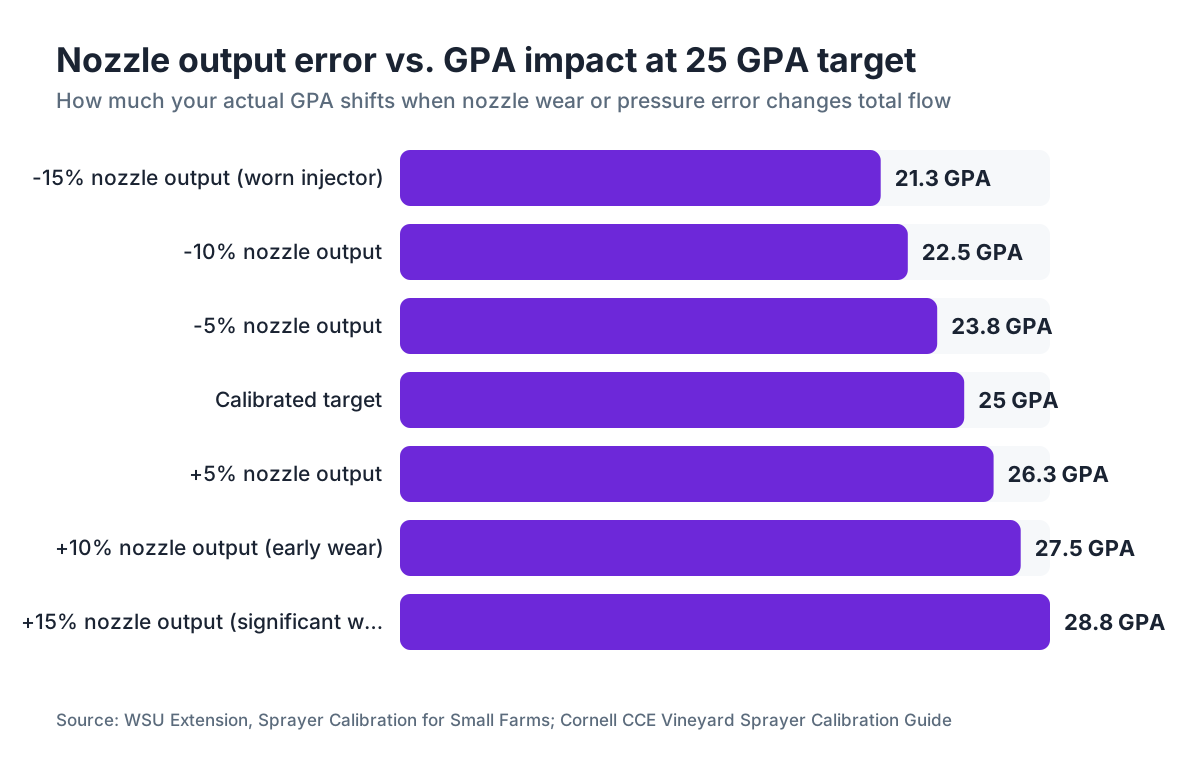
Nozzle wear is the sneaky one. Ceramic and stainless nozzles wear slowly enough that the drift slips past you. Cornell's calibration materials note that a worn nozzle can increase output by 10 to 15% before it looks any different [4]. If you push more than 200 acres a season through the same nozzles, check wear quarterly by catching output and comparing to the manufacturer's rated output at your working pressure.
For compliance, your application records have to reflect the rate you actually applied. Calibrate in April, let the nozzles wear 15% by August, and your records say one thing while your sprayer does another. That's a records problem stacked on an efficacy problem. Keeping calibration logs alongside your application records is the kind of documentation that VitiScribe tracks without a separate spreadsheet for every tractor.
What's the right pressure to run vineyard spray nozzles?
It depends on the nozzle type, and it matters more than most people realize.
Flat-fan boom nozzles run best between 15 and 40 PSI. Below 15 PSI you lose pattern consistency. Above 40 PSI you make fine droplets that drift. For under-vine herbicide, drift is a serious problem, because you're spraying near the vine base and often near susceptible cover crops or the neighbor's block.
Airblast disc-and-core nozzles run between 100 and 200 PSI depending on core size and target droplet spectrum. Too low and you get large, poorly carried droplets that don't penetrate. Too high and you shift the spectrum toward very fine droplets that the airblast throws past the canopy.
Hollow-cone nozzles, common for fungicide work in airblast rigs, perform best between 50 and 150 PSI. Check your nozzle manufacturer's spec sheet (Greenleaf, TeeJet, and Albuz all publish these) for the GPM-versus-pressure tables that tell you exactly what output to expect at each pressure [10].
One field check: if you see fogging or a visible mist cloud trailing the sprayer, your pressure is too high or your fan is too fast. Both push spray out of the canopy target zone and into the air. That's a worker protection issue on top of an efficacy issue.
| Nozzle type | Typical working pressure | Primary use in vineyards |
|---|---|---|
| Flat fan (boom) | 15-40 PSI | Under-vine herbicide, soil-applied products |
| Hollow cone (airblast) | 50-150 PSI | Fungicides, insecticides in canopy |
| Disc and core (airblast) | 100-200 PSI | High-volume canopy coverage |
| Turbo flat fan | 30-60 PSI | Herbicide with drift reduction |
| Air induction flat fan | 30-60 PSI | Herbicide in sensitive areas |
How does EPA Worker Protection Standard affect your spray records and calibration?
The EPA's Worker Protection Standard (WPS), revised in 2015 and enforced under 40 CFR Part 170, requires that agricultural employers keep pesticide application records showing the product name, EPA registration number, total amount applied, location, date, and the name of the applicator [6]. That one item, amount applied, is only accurate if your sprayer is calibrated and you've recorded the calibration data next to the application.
WPS also sets restricted entry intervals (REIs). The REI clock on a product starts when the application ends. If your calibration was off and the spray actually ended 20 minutes later than your records show, because you ran short of product and had to refill, that clock is wrong. Small thing. Real compliance exposure.
WPS training rules affect who can run the equipment. Workers handling pesticide applications must receive WPS pesticide safety training, and that training must be documented. If you delegate sprayer operation to employees, confirm they've finished the required training and that the records are on file [6].
State rules layer on top of WPS. In California, the County Agricultural Commissioner requires Pesticide Use Reports (PURs) within 30 days of each application, and those reports must carry accurate application rates [7]. In Washington, the Department of Agriculture requires similar records under WAC 16-228 [8]. Get the calibration right first, then the records reflect reality.
How do you record sprayer calibration data for a pesticide inspection?
Inspectors from state agriculture departments and county ag commissioners look for a few things: application records that match the label rate, evidence that the sprayer was in the condition those records imply, and training documentation for applicators.
A calibration log that lives with your application records is the cleanest way to cover the first two. At minimum, record:
- Date of calibration
- Sprayer identifier (if you run more than one)
- Nozzle type, size, and age
- Working pressure at calibration
- Ground speed at calibration
- Nozzle output per nozzle (each one, individually)
- Calculated GPA
- Operator name
Keep this with your spray records, not in a separate binder out in the barn. If an inspector pulls a PUR from June and asks how you know the rate was right, you want to hand over the calibration log from the same week, not go hunting for it.
Digital records have a real edge here. VitiScribe links calibration data straight to spray event records, so the paperwork chain is automatic. A well-organized spreadsheet beats nothing, but the paper approach tends to fall apart when you're juggling several applicators across several blocks during peak disease pressure.
For California operators, UC Cooperative Extension Sonoma has published a pesticide record-keeping checklist that maps to PUR requirements and is worth keeping on the desk [9].
What are the most common vineyard sprayer calibration mistakes and how do you fix them?
Calibrating at the wrong speed. The single most common error. If your calibration speed doesn't match your application speed, your GPA is off by exactly the percentage the speeds differ. Fix: calibrate on terrain like what you'll spray, at the actual gear and throttle you use.
Using a worn pressure gauge. Old glycerin-filled gauges stick and read low. You think you're at 120 PSI and you're at 135. Fix: check your onboard gauge against a new calibration gauge once a season. A new one runs about $15.
Not catching all nozzles individually. Averaging a few nozzles and assuming the rest match is optimistic. One partially clogged tip or a weeping fitting can shift your total output enough to matter. Fix: 30-second catch test on every nozzle, every calibration.
Forgetting that row spacing goes in inches. Put feet in the W position instead of inches and your answer is off by a factor of 12. Plenty of textbooks skip past this. Fix: always convert to inches before you plug into the standard formula.
Calibrating with a full tank and spraying to empty. Pump output can drift a little as tank level drops, and some diaphragm pumps show pressure swing near the end of a tank. For most vineyards the effect is small, but if you see inconsistent coverage at the end of loads, check pump output at both full and half-tank.
Not recalibrating after seasonal nozzle wear. Covered above, but it's the mistake that causes the most quiet compliance exposure. Nozzles wear predictably, and a mid-season check takes 15 minutes.
What does a well-calibrated vineyard sprayer look like in the field?
A calibrated sprayer, run evenly across a block, puts even coverage on water-sensitive paper at every canopy position, empties a load in the number of acres you calculated at your GPA, and leaves no dry patches or over-wet foliage at the row ends where turns slow you down.
The tank math is your fastest field check. Say your block is 8 acres, your tank holds 200 gallons, and you're targeting 25 GPA. You should empty all 200 gallons over the block. Finish with 40 gallons left and your actual GPA is closer to 20. Run dry after 6 acres and you're closer to 33 GPA. Either way, stop, find the error, and fix it before the next load.
Coverage on water-sensitive paper shows the distribution picture the math can't. UC Davis Viticulture & Enology extension recommends checking paper at 5 to 8 positions per treatment pass when you're first characterizing a new sprayer or a new nozzle setup [3]. Once distribution checks out, spot checks twice a season are reasonable.
For under-vine herbicide, the visual check is stripe width. If your herbicide strip wanders from 18 to 28 inches across the row at the boom edges, you've got boom height variation, nozzle angle drift, or speed variation. A consistent stripe means the calibration and the mechanics are working together.
Frequently asked questions
How long does it take to calibrate a vineyard sprayer?
The first time, expect 45 to 60 minutes if you do it carefully: speed runs, individual nozzle catches, and the GPA calculation. Once you know the drill, a full recalibration with all nozzle catches takes about 20 to 30 minutes. Skipping steps to save time usually means redoing it after your rates come out wrong, which costs more than the calibration would have.
What is a good target GPA for vineyard fungicide applications?
For dilute airblast fungicide sprays in a mature canopy, most recommendations land between 50 and 150 GPA depending on canopy density and product. Concentrate applications typically run 10 to 30 GPA at a higher active ingredient concentration. Your product label sets the minimum and maximum. Hit the label range, then confirm with water-sensitive paper that the actual coverage in the canopy is adequate.
Do you need to recalibrate after changing nozzle tips?
Yes, always. New tips of the same catalog number usually land close to your old output, but even tips from one batch vary a little. Worn tips can run 10 to 20% above rated output before they look damaged. Swapping in new tips without recalibrating means you're applying at the old calibration number but delivering a different volume. Take 15 minutes and confirm the new output.
Can I calibrate a vineyard sprayer without a specialized kit?
Yes. You need a stopwatch, a tape measure, and graduated containers you can read in ounces or milliliters. That's it. The math is basic arithmetic. Purpose-built kits add convenience but aren't necessary. What causes calibrations to fail isn't the equipment, it's skipping steps like measuring each nozzle individually or running the speed check on real field terrain.
What is the 10% nozzle variation rule?
WSU and Cornell extension both recommend replacing any nozzle whose 30-second output runs more than 10% above or below the mean output across all nozzles on the boom or airblast unit. A nozzle 15% over the mean delivers 15% more chemical to that part of the canopy, which can mean overapplication in a narrow strip and a possible label violation. Replace it. Tips are cheap.
How do I calibrate a vineyard herbicide boom sprayer differently from a canopy sprayer?
The GPA formula is the same. The practical differences: boom height above the target matters much more for flat-fan herbicide nozzles (typical recommendation is 18 to 20 inches above target for 110-degree nozzles at 20-inch spacing), and you have to account for any shielding or hooded equipment in your swath width. Drift control is more critical too, so keep your pressure toward the low end of the nozzle's rated range.
What records do I need to keep about sprayer calibration for a state pesticide inspection?
At minimum: date of calibration, sprayer ID, nozzle type and size, working pressure, ground speed, output per nozzle, calculated GPA, and operator name. Keep this log alongside your pesticide application records. California requires Pesticide Use Reports within 30 days of application, and accurate rates on those PURs are only possible if calibration data backs them up. Washington has similar requirements under WAC 16-228.
How does slope affect vineyard sprayer calibration?
Uphill runs slow your ground speed compared to flat ground, downhill runs speed it up. Since GPA is inversely proportional to speed, a steep grade that drops your MPH by 0.5 can add 15 to 20% to your GPA on uphill passes and cut it on downhill passes. If your blocks vary a lot in slope, do separate calibration runs at the speeds you'll actually hit on those blocks and adjust rate or speed to suit.
Does temperature or humidity affect sprayer calibration in the vineyard?
Not much for the calibration math itself. Water viscosity changes slightly with temperature but not enough to matter for nozzle output at typical working pressures. What temperature and humidity do affect is spray evaporation during application, which matters for fungicides with minimum water volume requirements. Calibrate with water and focus on hitting your GPA, then manage application timing separately for evaporation conditions.
What is Tree Row Volume (TRV) and when should I use it for vineyard calibration?
TRV (Tree Row Volume) adjusts your spray volume based on canopy size rather than just land area. It accounts for canopy height, width, and row spacing to reach a volume per unit of canopy surface. It's most useful for airblast sprayers in high-density or variable-canopy vineyards. UC Davis and WSU extension both describe the calculation. For vineyards with uniform trellis and consistent canopy, standard GPA calibration is enough.
How do I know if my airblast sprayer distribution is off even if the GPA is right?
Place water-sensitive paper at several canopy positions: outside top, outside bottom, inside middle, and inside lower. Make one pass and count coverage. If the outside is saturated and the interior is under-covered, your air volume is too low or your ground speed too fast. If coverage is even but you're getting heavy off-target deposition, your air volume is too high. Fix distribution before you finalize the calibration.
What's the cheapest calibration mistake that costs the most money?
Not recalibrating after nozzle wear. Nozzles that have worn 15% over a season deliver 15% more chemical per acre all year with no visible alert. On a 50-acre block sprayed 12 times a season, a 15% overrun adds up to roughly 1.5 extra full-acre applications of whatever you're spraying. For high-cost fungicides or insecticides, that waste easily runs $500 to $1,500 per season, and you get zero benefit from it.
Sources
- EPA - Federal Insecticide, Fungicide, and Rodenticide Act (FIFRA), Section 12: Using a pesticide in a manner inconsistent with its labeling is a prohibited act under FIFRA Section 12(a)(2)(G)
- Washington State University Extension - Sprayer Calibration for Small Farms: Pressure gauges on older sprayers drift and should be checked against a calibrated reference gauge; nozzles more than 10% above or below mean output should be replaced
- UC Cooperative Extension - Sprayer 101 / UC Davis Viticulture & Enology extension: String-and-paper collection tests verify airblast distribution; aim for 20-30 drops per square centimeter for most fungicide applications; check paper at 5-8 canopy positions when characterizing a sprayer
- Cornell Cooperative Extension - Vineyard Sprayer Calibration Guide: Worn nozzles can increase output by 10-15% before appearing visibly different; field collection tests on tarps can confirm GPA calculations
- WSU Extension - Tree Row Volume approach for airblast sprayer calibration: Tree Row Volume (TRV) supplements GPA calculations for airblast applications by accounting for canopy height, width, and row spacing
- EPA - Worker Protection Standard, 40 CFR Part 170: WPS requires pesticide application records including product name, EPA registration number, total amount applied, location, date, and applicator name; worker safety training must be documented
- California Department of Pesticide Regulation - Pesticide Use Reporting: California County Agricultural Commissioners require Pesticide Use Reports within 30 days of each application, including accurate application rates
- Washington State Department of Agriculture - Pesticide recordkeeping, WAC 16-228: Washington requires pesticide application records under WAC 16-228 similar to federal WPS requirements
- UC Cooperative Extension Sonoma - Pesticide Record-Keeping Checklist: UC Cooperative Extension Sonoma has published a pesticide record-keeping checklist that maps to California PUR requirements
- TeeJet Technologies - Nozzle Selection Guide and Pressure-Output Tables: Nozzle manufacturer pressure-versus-GPM tables allow operators to verify expected output at any working pressure for calibration confirmation
Last updated 2026-07-10