Vineyard sulfur spray: the complete guide for grape growers
TL;DR
- Elemental sulfur is the most widely used fungicide in vineyards, controlling powdery mildew (Erysiphe necator) at roughly 3-6 lb per acre per application.
- It works as a protectant, not a cure.
- Temperature matters enormously: applications above 90°F cause phytotoxicity.
- Minimum 7-10 day pre-harvest interval applies in most states.
- Organic-certified formulations are widely available.
Why do vineyard managers use sulfur spray in the first place?
Powdery mildew is the single most economically damaging disease in wine grape production worldwide. The pathogen, Erysiphe necator, can reduce yield, destroy berry quality, and make fruit unsalable in a bad year. Sulfur has been the primary defense since the mid-1800s, and for good reason: it's cheap, broadly effective at preventive rates, leaves no residue concern at approved intervals, and is allowed under USDA National Organic Program rules.
Sulfur works by disrupting fungal respiration. When spores land on a sulfur-coated surface, the sulfur vapor (higher at warmer temperatures) interferes with electron transport in the pathogen's mitochondria. That mechanism is contact and vapor-based, not systemic, which means sulfur gives you zero curative activity. If you're spraying after you already see colonies, you're mostly wasting product. You need to be on the vine before the spores germinate.
The UC Davis Integrated Pest Management program describes E. necator as 'one of the most destructive pathogens of Vitis vinifera' and notes that 'sulfur-based fungicides remain the backbone of most powdery mildew management programs' in California wine regions [1]. Cornell's extension viticulture program and WSU both echo that framing for their respective climates [2][3].
There's also a practical reason growers keep coming back to sulfur: resistance is not a real concern the way it is with sterol inhibitor fungicides or strobilurins. After 170-plus years of use, E. necator has shown no confirmed field resistance to elemental sulfur. That's a meaningful advantage when you're building a spray program and don't want to rotate a product out every few seasons.
How does elemental sulfur differ from lime sulfur spray in vineyard use?
These are genuinely different products with different jobs, and growers sometimes confuse them.
Elemental sulfur (also called dry flowable sulfur, wettable sulfur, or dust sulfur) is the standard season-long protectant. You apply it at 3-6 lb per acre per application, typically every 10-14 days during susceptible growth stages, starting at budbreak and running through late berry development. It comes as wettable powder, dust, or dispersible granule. Cost runs roughly $1.50-$4.00 per acre per application depending on the formulation, application method, and regional pricing (actual quotes vary; get at least two supplier bids before budgeting).
Lime sulfur (calcium polysulfide) is a different animal. It's a caustic liquid used mainly as a dormant-season spray, applied after harvest and before budbreak to knock down overwintering inoculum and address powdery mildew, bunch rots, and some mite eggs. Lime sulfur is corrosive to equipment and skin, requires more careful PPE, and at full dormant rates can injure green tissue if applied too late. Most labels prohibit application after bud swell. UC Davis IPM notes that lime sulfur at 1-3 gallons per 100 gallons of water is effective for dormant powdery mildew sanitation, though it emphasizes timing as the controlling factor [1].
Here's the practical split: use elemental sulfur as your season-long protectant fungicide, and consider lime sulfur as a winter reset in high-inoculum blocks with a history of severe disease. They're not interchangeable. Lime sulfur applied in-season at wrong rates will defoliate your vines.
| Product | Season | Typical Rate | Primary Use | Organic OK? |
|---|---|---|---|---|
| Elemental sulfur (WP/DF) | Growing season | 3-6 lb/acre | Powdery mildew protection | Yes |
| Elemental sulfur (dust) | Growing season | 4-8 lb/acre | Powdery mildew protection | Yes |
| Lime sulfur (calcium polysulfide) | Dormant only | 1-3 gal/100 gal | Overwintering inoculum, mites | Yes |
| Sulfur-copper combo | Growing season | Varies by label | Mildew + downy mildew | Yes (check label) |
What rates and timing actually work for powdery mildew control?
The window that matters most is early: from budbreak through roughly 6-8 weeks post-bloom. During this period, the vine's most susceptible tissues (young shoots, flower clusters, and newly set berries) are present and unprotected. UC Davis IPM recommends beginning sulfur applications at woolly bud or early shoot growth and holding a 10-14 day interval through berry set in most California climates [1]. Cornell recommends similar timing for the Northeast but notes that cooler springs can compress the early window [2].
For wettable sulfur and dry flowable products, the general effective range is 3-6 lb per acre per application. Several studies have found diminishing returns above 6 lb per acre for mildew control, while rates below 2.5 lb per acre tend to give inadequate coverage in moderate-to-high pressure seasons. Washington State University's viticulture extension recommends 4-5 lb per acre per application as a practical middle ground for humid inland valleys [3].
Interval length matters as much as rate. Every significant rainfall event, heavy dew period, or dense fog effectively dilutes and weathers your sulfur deposit. After any rainfall exceeding about 0.5 inches, check your coverage and consider a reapplication regardless of where you are in the 10-14 day cycle. The sulfur that's been washed off your canopy is not protecting you.
Spray timing within the day is also real. Early morning or evening applications when temperatures are below 85°F reduce phytotoxicity risk and reduce drift. Avoid midday spraying in summer, and check the extended forecast before you load the tank. If a heat event is coming in 48-72 hours, hold off or you'll be looking at burned leaf margins and defoliation.
Copper products are sometimes tank-mixed with sulfur to add downy mildew activity. This is a legitimate practice, but copper has its own rate restrictions and cumulative toxicity concerns for soil. Don't add copper reflexively; add it when downy mildew pressure is actually elevated.
What temperatures cause sulfur phytotoxicity and how do you avoid it?
This is the mistake that costs growers real money every summer. Sulfur phytotoxicity is well-documented and predictable, yet it still happens regularly because heat events develop faster than spray schedules adjust.
The general threshold in extension literature is 90°F (32°C). Above that temperature, sulfur vapor pressure increases enough that contact with leaf tissue causes cellular damage. In practice, most labels say do not apply when temperatures are at or above 90°F, and most experienced growers build in a more conservative margin: they hold applications when a 90°F day is forecast within 24-48 hours after application. The burn shows up as interveinal chlorosis, leaf curl, and in severe cases defoliation, which then exposes fruit to sunburn and creates its own quality problems.
Varietal sensitivity varies. Some thin-skinned varieties and certain rootstocks are more sensitive than others, but the published data on variety-specific thresholds is incomplete. Anecdotally, growers in hot inland valleys (think Lodi, Paso Robles, or eastern Washington) report problems with Pinot Noir and Muscat types at lower temperatures than Cabernet Sauvignon or Zinfandel. Nobody has good systematic data on this across a broad set of varieties; the most relevant summary is still the UC Davis IPM guidelines, which call for caution above 85°F and a firm stop above 90°F [1].
Wettable sulfur formulations tend to be somewhat safer than dust sulfur in high-temperature conditions because the spray carrier helps distribute and dilute the active ingredient. Still, temperature is the controlling variable regardless of formulation.
If you're farming a hot-climate block and your mildew pressure season runs through July and August, you may need to rotate off sulfur during the hottest weeks and use a different mode of action, such as a potassium bicarbonate product or an SI fungicide, to bridge the gap. That's a real trade-off, not a failure. Plan for it.
What is the pre-harvest interval for sulfur on wine grapes?
The pre-harvest interval (PHI) for sulfur on grapes is typically 7 days for most elemental sulfur products registered for use in the U.S., though some labels specify 10 days, and a few specify as few as 1-2 days for very low-rate formulations [4]. Read your actual product label because the label is the law under FIFRA.
For lime sulfur, PHIs are generally much longer or the product is restricted to dormant applications only. Check the specific label for any lime sulfur product you're using because the restrictions vary widely.
Practically, if you're harvesting Pinot Noir in late August in a hot year, your last sulfur application often needs to land around Aug 10-15 to stay within a 7-10 day PHI. That's a window that requires planning, especially if late-season powdery mildew pressure is still high. Some growers extend protection in those final weeks with a potassium bicarbonate application (PHI as short as 0 days on some labels) or accept the disease risk as preferable to a PHI violation.
PHI violations discovered at the winery or during audit are a serious compliance problem. Wineries submitting grapes or bulk wine for export face laboratory testing that can detect sulfur residues above Maximum Residue Levels (MRLs) set by the destination country. The EU MRL for sulfur dioxide and sulfates on grapes is effectively managed through processing, but elemental sulfur residue on fruit is a different issue. If you're selling to an export-focused winery, know their MRL requirements before you finalize your spray program calendar.
What are the EPA Worker Protection Standard requirements for sulfur applications?
The EPA Worker Protection Standard (WPS), found at 40 CFR Part 170, sets requirements for pesticide applications in agricultural settings including vineyards [5]. Sulfur is not an exempt material under WPS just because it's organically approved. If you have a product with an agricultural pesticide label, WPS applies.
Key WPS obligations for vineyard sulfur applications include: posting treated-area warning signs or using equivalent notification for workers, maintaining a pesticide safety information center, providing training for all agricultural workers, and following the restricted-entry interval (REI) on the label. For elemental sulfur, the REI is typically 24 hours. For lime sulfur, it's commonly 48 hours or longer because of the caustic nature of the material.
Personal protective equipment (PPE) requirements are listed on the label. For most wettable sulfur products, the minimum PPE during mixing and loading includes long-sleeved shirt and long pants, chemical-resistant gloves, and protective eyewear. During application, respiratory protection may be required depending on application method (dust applications often require a NIOSH-approved particulate respirator).
The EPA revised the WPS in 2015, with key provisions phased in through 2017 and 2018 [5]. The revised standard requires that applicators provide workers with specific information about pesticides applied in their work area, including the product name, EPA registration number, and active ingredient. Keeping clean, accessible spray records is more than good farming practice; it's a WPS requirement.
For Washington State growers, the Washington State Department of Agriculture administers WPS enforcement and publishes state-specific guidance [6]. California growers operate under the California Department of Pesticide Regulation, which layers additional requirements including county agricultural commissioner reporting for certain materials [7].
How do you keep accurate spray records for sulfur applications?
Spray records are legally required in most states for any pesticide application on a commercial agricultural operation. California requires pesticide use reports filed with the county agricultural commissioner within a specified period after application [7]. Washington requires pesticide application records to be kept for at least two years [6]. Federal WPS recordkeeping rules run independently of state rules and require that you be able to produce specific information about any covered application.
A complete sulfur spray record for a single application needs to capture at minimum: application date and time, product name and EPA registration number, formulation, rate per acre, total volume mixed, target pest, field or block identifier, acreage treated, applicator name (and license number if required by your state), equipment used, and weather conditions at time of application including temperature, wind speed, and wind direction. Some states and most third-party certification audits (organic, sustainable, Certified California Sustainable Winegrowing) require the PHI and REI to be documented on the record as well.
Paper records kept in a binder work legally. They fail practically when you need to pull historical records for an audit three seasons back, when you're trying to track cumulative copper loads across blocks, or when your handwriting in July heat is illegible in January. Digital recordkeeping closes those gaps. VitiScribe was built specifically to handle field-operation records including spray logs, with the block structure and PHI tracking that vineyard managers actually need. That matters most when a winery buyer or a certification auditor calls and wants application records for a specific block going back two years.
Regardless of what system you use, back it up. Spray records have been subpoenaed in pesticide drift litigation. Treat them like financial records.
Is sulfur approved for organic vineyard production?
Yes. Elemental sulfur and lime sulfur are both on the USDA National Organic Program's National List of Allowed and Prohibited Substances, specifically listed in 7 CFR 205.601 as allowed synthetic substances for crop production [8]. This is one of the rare cases where a material on an 'allowed synthetics' list has been in continuous agricultural use long enough that its safety profile and environmental behavior are very well understood.
For organic certification, the product must be an organically approved formulation. This doesn't mean the chemistry differs, but it does mean the inert ingredients in the formulation must also be approved. Some wettable sulfur products contain inert ingredients that are not allowed under NOP rules. Always check that the specific product you're buying carries an OMRI listing (Organic Materials Review Institute) or equivalent certification before applying it to a certified organic block [9].
Application rates and practices under organic certification are otherwise the same as conventional. You're still bound by the label rate, PHI, and WPS requirements. Organic certification doesn't create a more lenient regulatory environment; in some ways it's more strict because you have a certifier reviewing your records annually.
For transitioning blocks (the three-year conventional-to-organic transition required by NOP), sulfur is allowed throughout the transition period. That's one reason many growers make sulfur a core part of their spray program even before they pursue certification: it doesn't create a residue problem later.
How should you calibrate your sprayer for sulfur applications?
Calibration is the step that separates a labeled rate from an actual delivered rate, and the gap between them is often 20-40% in poorly maintained vineyard sprayers. That matters with sulfur because underapplication leaves gaps in coverage and overapplication wastes money and raises phytotoxicity risk.
The basic calibration process for an airblast sprayer: measure your actual ground speed through the vineyard, measure your actual output per nozzle per minute, calculate your gallons per acre delivered, and then adjust your product concentration to hit the labeled rate per acre. UC Davis IPM and the UC Agriculture and Natural Resources program have published sprayer calibration procedures specifically for vineyard airblast equipment [10]. Do this at the start of each season and after any nozzle replacement.
For sulfur specifically, coverage uniformity matters more than total volume in many cases. A well-calibrated sprayer delivering 40 gallons per acre with good penetration beats 80 gallons per acre with poor canopy penetration. As canopy density increases through the season, your air volume and speed settings need to track with it. A setting that gave good coverage at shoot emergence will under-penetrate by veraison.
Nozzle wear is a real issue with sulfur applications, particularly dust formulations. Sulfur is abrasive. Check nozzle outputs with a catch container and stopwatch every few applications during peak-use periods. A nozzle that's worn 15% from nominal is delivering 15% more product than you're recording, which means your block-level records are wrong and your PHI calculation may be off.
Drone application of sulfur is an emerging practice. It's legal in some states under specific conditions and is growing in steep-terrain vineyards where ground equipment access is limited. If you're exploring drone applications, check your state's pesticide application rules and the specific product label; some labels do not include drone as an approved application method.
What are the most common mistakes growers make with vineyard sulfur spray?
Starting too late is probably the most expensive one. E. necator can build significant populations before you see visible symptoms, especially in the early season when temperatures are cool and the mildew is still in its cleistothecial (overwintering) stage transitioning to asci and ascospores. Waiting until you see white powdery colonies means the disease cycle is already running ahead of your program.
Applying during or just before heat events is the second big mistake, covered above. This is avoidable with a decent weather forecast and willingness to shift the spray day by 24-48 hours.
Ignoring canopy density is the third. A spray program calibrated in April doesn't account for a dense July canopy. If your airblast is not penetrating to the interior of the cluster zone by midsummer, you're creating protected pockets where mildew can establish on fruit.
Using sulfur as your only tool through the entire season is also a strategic error in high-pressure years. E. necator doesn't develop resistance to sulfur, but relying on a single mode of action while skipping SI fungicides or strobilurins during the highest-pressure windows means you're not getting the control you could. WSU's powdery mildew management guidelines recommend rotating or tank-mixing modes of action during the 2-4 week post-bloom window, which is the highest-risk period for berry infection [3].
Skipping records or keeping incomplete ones is the last one. Sulfur is considered low-risk, which sometimes makes growers sloppy about documentation. But an incomplete record becomes a compliance problem the moment you're audited, and 'low-risk' doesn't mean no-risk under WPS or state pesticide reporting requirements.
How do sulfur spray costs compare to alternative fungicides?
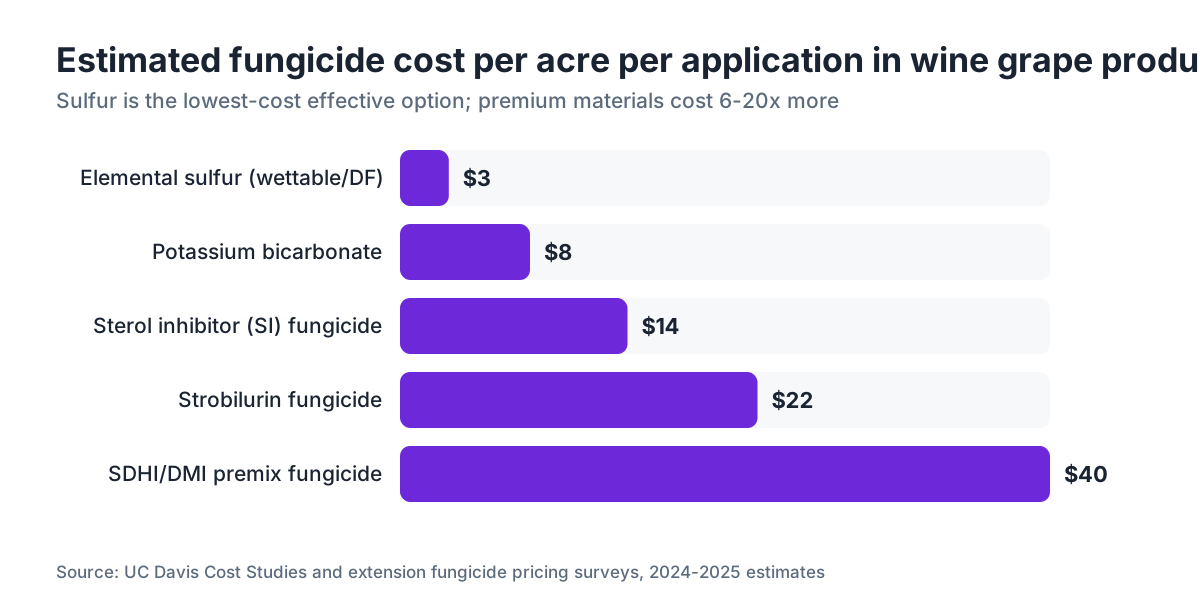
Sulfur is almost always the cheapest effective option on a per-acre basis. That cost advantage is real and significant over a full season's spray program.
For wettable or dry flowable sulfur, expect to pay roughly $1.50-$5.00 per acre per application at commercial rates (2024-2025 pricing; regional and volume variation is substantial, so treat these as ranges not quotes). SI fungicides like myclobutanil, tebuconazole, or triadimefon typically run $8-$20 per acre per application. Strobilurins like azoxystrobin or trifloxystrobin run $15-$30 or more per acre. DMI/SDHI premixes like Miravis Prime (pydiflumetofen + fludioxonil) can run $30-$50 per acre [11].
A typical sulfur-anchored program in California might include 8-12 sulfur applications per season plus 2-4 applications of a more expensive material during the critical post-bloom window. Total fungicide cost per acre for such a program might run $60-$150 per season depending on pressure, region, and which higher-cost materials you choose. A program that tried to replace all sulfur with premium fungicides would cost several times that amount.
Lime sulfur's dormant application is also cost-effective at roughly $15-$35 per acre for the material, though it requires more careful handling and equipment cleanup, which adds labor cost.
The cost comparison table above (under the lime sulfur vs. elemental sulfur section) gives rate and use context. For full-season fungicide budgeting, UC Davis publishes annual cost-of-production studies for wine grapes that include fungicide program assumptions [12].
VitiScribe's spray log tracks per-application and per-season fungicide costs by block, which helps you see where your program costs are actually going rather than estimating at year-end.
What do university extension programs recommend for sulfur timing in different climates?
UC Davis IPM (California): Begin applications at budbreak (woolly bud to early shoot emergence) in all regions with a history of powdery mildew. Hold 10-14 day intervals through bloom and berry set. In hot inland regions, halt sulfur applications when sustained temperatures above 90°F are forecast and substitute with potassium bicarbonate or an SI fungicide. UC Davis's online IPM guidelines for grapes are updated annually and are the most referenced source for California wine regions [1].
Cornell Cooperative Extension (New York): The Cornell Pest Management Guidelines for Grapes (updated annually) recommend starting at 1/2-inch shoot growth and using a disease forecasting model (like the UC Davis powdery mildew risk index or a degree-day model) to time applications rather than strictly fixed intervals. In cool, wet northeastern springs, early infections can be severe and early-season sulfur coverage is especially important. Cornell also specifically recommends against sole reliance on sulfur in high-pressure seasons, given that some NY wine regions have historically high inoculum pressure [2].
WSU Extension (Washington): Inland varieties like Riesling and Chardonnay face significant powdery mildew pressure in the Columbia Valley. WSU recommends a protectant sulfur program from budbreak through berry set, with close attention to rainfall-driven reapplication timing. Their guidelines emphasize that 'effective powdery mildew control requires preventive applications before infection periods' and that sulfur remains the most cost-effective protectant for most Washington growers [3].
All three programs agree on the core logic: sulfur is a protectant, not a curative, and timing relative to vine growth stage and infection risk matters more than rigid calendar intervals. If you farm in a region served by one of these extension programs, their specific guidelines for your climate and cultivar mix are worth bookmarking and reading every spring before you start the season.
Frequently asked questions
How often should I spray sulfur on my vineyard?
Every 10-14 days during the growing season from budbreak through berry set is the standard starting point. After significant rain events (more than 0.5 inches), reapply sooner regardless of where you are in the interval. Interval length matters less than canopy coverage and timing relative to vine growth stage. UC Davis IPM and Cornell both use 10-14 days as their base recommendation but emphasize adjusting for weather.
At what temperature is sulfur unsafe to spray on grapevines?
Most product labels say do not apply at or above 90°F (32°C). In practice, most experienced growers stop at 85°F or hold off when a 90-degree day is forecast within 48 hours of a planned application. Above 90°F, sulfur vapor pressure increases enough to damage leaf tissue, causing interveinal chlorosis and potentially defoliation. The threshold varies slightly by variety, but 90°F is the hard limit on almost all registered sulfur labels.
What is the pre-harvest interval for sulfur on wine grapes?
Most elemental sulfur products registered on grapes carry a 7-day PHI, though some labels specify 10 days and a few low-rate formulations list shorter intervals. Always read your specific product label because the label is the legal document. Lime sulfur products typically restrict use to the dormant season only, which makes PHI a non-issue for those materials. PHI violations can result in MRL exceedances at export destinations.
Can I use sulfur spray in an organic vineyard?
Yes. Elemental sulfur and lime sulfur are both allowed under the USDA National Organic Program's National List (7 CFR 205.601). The product must use only NOP-approved inert ingredients, so look for OMRI-listed formulations before purchasing. Organic certification doesn't change the label rate, PHI, or WPS requirements. Sulfur's long history of use in organic systems makes it one of the most straightforward materials to justify in a certifier review.
What is the difference between wettable sulfur and dust sulfur for vineyards?
Wettable sulfur is mixed with water and applied as a spray, giving better canopy penetration and somewhat less phytotoxicity risk at high temperatures. Dust sulfur is applied dry, typically at 4-8 lb per acre, and is faster to apply on steep terrain without water. Dust has higher drift potential and can be harder on lungs without proper respiratory protection. Most modern vineyard operations use wettable or dry-flowable formulations because of spray equipment compatibility and more precise rate control.
How do I calculate how much sulfur I need for a season?
A rough budget: 8-12 applications per season at 4-5 lb per acre per application equals 32-60 lb of elemental sulfur per acre per year. Multiply by your total acres. Add a 15-20% buffer for reapplications after rain events. For lime sulfur as a dormant spray, budget 1-3 gallons per 100 gallons of water per application. Your actual usage will vary with disease pressure, canopy density, and how many rain-driven reapplications you need in a given vintage.
Does rain wash off sulfur spray and require reapplication?
Yes. Significant rainfall, generally over about 0.5 inches, removes a meaningful portion of your sulfur deposit and should trigger reapplication, especially during high-risk periods like bloom through berry set. Light dew or fog is less of a concern and some research suggests damp conditions actually improve sulfur efficacy slightly at moderate temperatures. The practical rule is: if it rained hard enough to visibly wet the fruit zone, check your program timing and consider moving up the next application.
What PPE do workers need during vineyard sulfur applications?
WPS and product labels typically require long-sleeved shirt, long pants, chemical-resistant gloves, and protective eyewear during mixing and loading. During application, requirements vary by formulation. Dust sulfur often requires a NIOSH-approved particulate respirator (N95 or better). Lime sulfur is caustic and requires face shield and chemical-resistant apron in addition to standard PPE. The specific label governs; check it before every application and train workers on the required PPE for the specific product being used.
Can sulfur be tank-mixed with copper fungicides?
Yes, in many situations. Sulfur-copper tank mixes are common in vineyards where both powdery mildew and downy mildew pressure are present, and the combination is widely used in organic programs. Compatibility varies by specific formulation and water quality. Always do a jar test before loading a full tank. Copper adds phytotoxicity risk in its own right, particularly to young tissue, and has cumulative soil toxicity concerns over many seasons of use. Add it for a reason, not reflexively.
What spray records do I need to keep for vineyard sulfur applications?
State and federal WPS requirements mandate records that include at minimum: application date, product name, EPA registration number, active ingredient, rate, total amount applied, target pest, field identifier, acreage treated, applicator name, and weather conditions. Many states add reporting requirements to county agricultural commissioners within specified timeframes. California and Washington both require multi-year retention. Most third-party audits (CCSW, CCOF, SIP) require the same data plus PHI and REI documentation on each record.
How does lime sulfur spray differ from regular sulfur for vineyard dormant applications?
Lime sulfur (calcium polysulfide) is a caustic liquid applied during dormancy, after harvest and before bud swell, to reduce overwintering powdery mildew inoculum and some mite eggs. It's more hazardous to handle than elemental sulfur and can cause severe burn if applied to green tissue. Elemental sulfur in contrast is used season-long as a protectant. They're not interchangeable. Lime sulfur at 1-3 gallons per 100 gallons water is the typical dormant rate per UC Davis IPM guidance.
What happens if I spray sulfur too close to harvest?
Applying within the stated PHI (commonly 7-10 days for elemental sulfur) means residue on fruit may exceed label-permitted levels or, for export fruit, MRLs set by the importing country. The EU and other major wine import markets test for pesticide residues. A PHI violation discovered at the winery or during export screening can result in rejected loads or loss of certification. It also creates a WPS recordkeeping problem if the application is not documented accurately with the PHI noted.
Are there any grape varieties that are particularly sensitive to sulfur phytotoxicity?
The published data is thin here. Anecdotally, thin-skinned varieties like Pinot Noir, Muscat, and some white varieties are reported more sensitive, particularly in hot inland conditions. No rigorously controlled varietal sensitivity study has been published as of 2025; the UC Davis IPM guidelines acknowledge varietal differences exist but don't provide a ranked list. The conservative approach is to treat 90°F as a hard cutoff for all varieties and watch your specific blocks for any early signs of marginal burn after the first few applications.
How do I know if my sulfur spray program is actually working?
Scout regularly, more than just after you spray. Walk your highest-risk blocks weekly during the susceptible period (shoot growth through berry set), checking shoot tips, young leaves, and cluster stems for early powdery mildew colonies. Track disease incidence by block over multiple seasons. If you're seeing clusters with more than 1-2% infection at harvest in a normal-pressure year on a standard sulfur program, either your timing, rate, or coverage is off. A disease forecasting tool or degree-day model can help you correlate spray timing with actual infection periods.
Sources
- UC Davis IPM Program, Grape Powdery Mildew Management Guidelines: UC Davis IPM describes E. necator as one of the most destructive pathogens of Vitis vinifera and notes that sulfur-based fungicides remain the backbone of most powdery mildew management programs; lime sulfur at 1-3 gallons per 100 gallons water is effective for dormant sanitation
- Cornell Cooperative Extension, New York and Pennsylvania Pest Management Guidelines for Grapes: Cornell recommends starting sulfur at 1/2-inch shoot growth and using disease forecasting models; they specifically recommend against sole reliance on sulfur in high-pressure seasons
- Washington State University Extension, Powdery Mildew Management in Wine Grapes: WSU recommends 4-5 lb per acre per application as a practical middle ground for humid inland valleys and states that effective powdery mildew control requires preventive applications before infection periods
- EPA, Pesticide Label Requirements under FIFRA: The pesticide label is the law under FIFRA; pre-harvest intervals for sulfur on grapes are typically 7-10 days depending on the specific registered product
- EPA, Worker Protection Standard, 40 CFR Part 170: EPA WPS requires posting treated-area warnings, maintaining a pesticide safety information center, providing worker training, and following label REIs; the standard was revised in 2015 with provisions phased in through 2017-2018
- Washington State Department of Agriculture, Pesticide Application Records Requirements: Washington requires pesticide application records to be kept for at least two years
- California Department of Pesticide Regulation, Pesticide Use Reporting: California requires pesticide use reports filed with the county agricultural commissioner; state regulations layer additional requirements beyond federal WPS for certain materials
- USDA National Organic Program, National List of Allowed and Prohibited Substances, 7 CFR 205.601: Elemental sulfur and lime sulfur are both listed in 7 CFR 205.601 as allowed synthetic substances for crop production under the USDA National Organic Program
- Organic Materials Review Institute (OMRI), OMRI Products List: OMRI listing confirms that a specific formulation's inert ingredients are approved for use in certified organic production
- UC Agriculture and Natural Resources, Sprayer Calibration for Vineyards: UC ANR has published sprayer calibration procedures specifically for vineyard airblast equipment, covering ground speed measurement, nozzle output testing, and gallons-per-acre calculation
- UC Davis Cost Studies, Sample Costs to Establish and Produce Wine Grapes: UC Davis publishes annual cost-of-production studies for wine grapes including fungicide program cost assumptions; premium fungicide materials can run $15-50 per acre per application versus $1.50-5 for sulfur
- UC Davis Department of Agricultural and Resource Economics, Wine Grape Cost Studies: UC Davis cost-of-production studies provide annual benchmarks for total fungicide program costs per acre in California wine grape production
Last updated 2026-07-09