Vineyard weed sprayer: how to choose, build, and use one right

TL;DR
- A vineyard weed sprayer applies herbicide in and between vine rows without touching the vines.
- The right setup depends on row spacing, terrain, and weed pressure.
- Options run from a backpack sprayer under $200 to a shielded tractor boom at $3,000 to $15,000 or more.
- Calibration, label PPE, and a complete spray record are non-negotiable no matter what you buy.
What is a vineyard weed sprayer and why does it differ from other farm sprayers?
A vineyard weed sprayer puts herbicide along and between vine rows while keeping it off the vines. That one job, holding chemical away from green tissue, bark, and the rootzone surface, is what separates vineyard weed control gear from ordinary row-crop sprayers.
A field boom broadcasts herbicide evenly across its whole width. Vineyards can't work that way. Grapes are sensitive to plenty of herbicides, glyphosate included, and a young vine can die from a single drift event. So vineyard sprayers use shielded nozzles, directed hoods, or recirculating curtains to pen the spray in. Better designs also let you treat the under-vine strip (the band directly beneath the trellis wire where you can't cultivate) separately from the mid-row.
The under-vine strip is the real headache. It usually runs 18 to 24 inches on each side of the trunk, gets zero tillage, and can hold 60 to 80% of total vineyard weed biomass in some regions [1]. Getting herbicide there without touching the vine is exactly where equipment design earns its keep.
Row spacing complicates everything. California coast vineyards often run 6x8 or 6x10 feet. Washington Riesling blocks can run 9x5. High-density European-style plantings drop to 3x3. No single sprayer geometry covers all of that. That's why most serious operations end up with two spray setups, one for mid-row and one for under-vine work.
What types of vineyard weed sprayers are available?
Five main categories, and each one earns its spot depending on your scale and terrain.
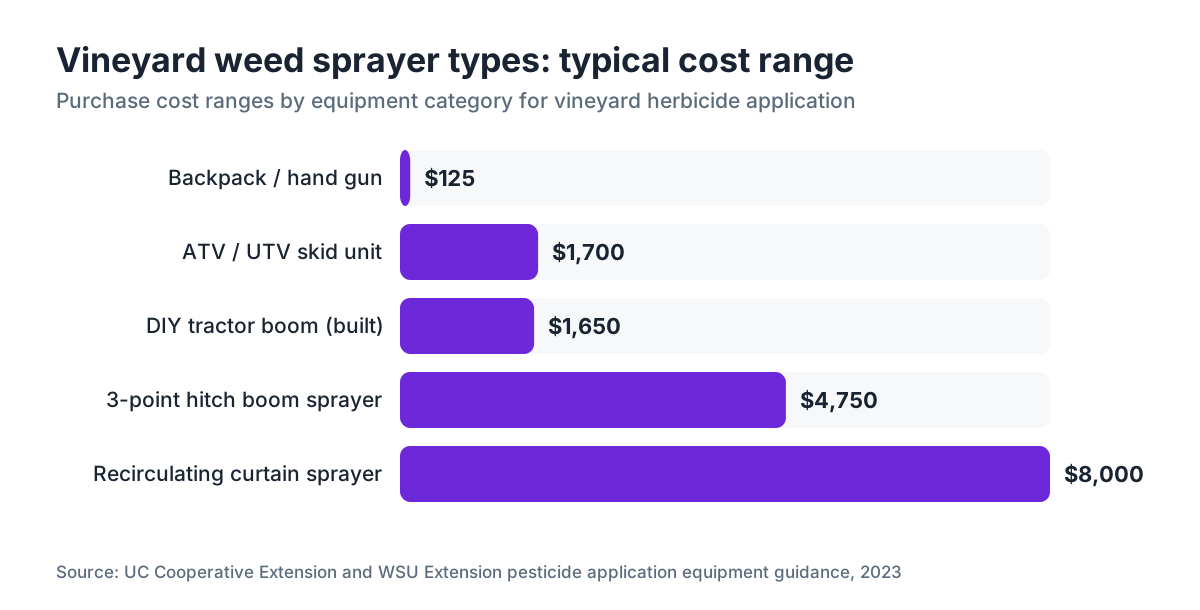
Backpack and hand-gun sprayers. The entry level. A 4-gallon backpack costs $50 to $200. You aim a wand with a shielded hood or a flat-fan nozzle. Fine for spot treatments, small blocks, or rocky ground a tractor can't reach. Labor per acre is high, and operator exposure runs higher than tractor-mounted rigs because you're walking through the spray zone.
3-point hitch mounted boom sprayers. A tank (50 to 300 gallons), a pump, and a boom plumbed to shielded under-vine nozzles plus optional mid-row nozzles. This is the most common vineyard-scale setup. Expect $1,500 to $8,000 depending on tank size and nozzle count. They work well on flat ground and moderate slopes.
Airblast-style under-vine sprayers. Less common for herbicide (airblast is mostly a fungicide tool), but some growers run low-volume recirculating curtain sprayers that direct herbicide under the trellis wire and catch overspray on a back wall. These cut drift and chemical use hard. Units from Silvan or Gearmore run $4,000 to $12,000 [2].
Rope wick and roller applicators. A saturated wick or foam roller touches weeds that grow taller than the vine canopy. Zero drift, tiny herbicide use, no spray in the air at all. Good for tall perennials like bindweed or johnsongrass once they climb above the fruiting zone. Useless on low-growing annuals.
ATV and UTV-mounted sprayers. A compact tank (15 to 55 gallons) on a side-by-side, plumbed to a hand gun or small boom. Good for steep terrain, headlands, and cover-crop intersections where a tractor is too wide or too heavy. Prices run $400 for a basic skid unit up to $3,000 for a purpose-built ATV boom.
| Sprayer type | Typical cost range | Best use case | Operator exposure risk |
|---|---|---|---|
| Backpack / hand gun | $50 to $200 | Spot treatment, small blocks | High |
| 3-point boom (tractor) | $1,500 to $8,000 | Main vineyard blocks, flat to moderate slope | Low to medium |
| Recirculating curtain | $4,000 to $12,000 | High drift-risk situations, organic programs | Low |
| Rope wick / roller | $300 to $1,500 | Tall perennial weeds above vine height | Very low |
| ATV / UTV skid | $400 to $3,000 | Steep terrain, headlands | Medium |
How do you build a vineyard weed sprayer from scratch?
Building your own is worth it when commercial units don't fit your row geometry or your budget is tight. You also end up with a sprayer matched exactly to your trellis height and vine spacing. The core parts stay the same at every scale.
Tank. Poly tanks are standard. A 100-gallon tank is a sensible starting point for a small to mid-size vineyard. Fimco, Norwesco, and similar suppliers sell them for $150 to $400. Size up past 10 acres per fill, or you'll lose more time hauling water than spraying.
Pump. A roller pump (the Hypro D30 is a common pick) or a diaphragm pump. Diaphragm pumps handle wettable powders and abrasive mixes better and cost $200 to $600. Roller pumps run cheaper ($80 to $250) and do fine on solution-only programs. Match pump GPM to your total nozzle flow plus about a 20% margin for pressure management.
Plumbing. Poly or stainless fittings. Skip brass when you're running acidic adjuvants. A simple agitation return line from the pump back to the tank keeps the mix uniform. Put your pressure gauge at the boom, not the pump, because line losses matter.
Nozzles and shields. This is where the build lives or dies for vineyard use. TeeJet flat-fan nozzles (110-degree, AI or TT series for drift reduction) are the standard. Every under-vine nozzle needs a physical shield, either a commercial hood or a fabricated steel or HDPE shroud, so vines never catch overspray. UC Cooperative Extension recommends shielded, directed nozzles for all under-vine herbicide applications to keep spray off the vines [1].
Boom geometry. For under-vine work you need two boom arms that reach out from the tractor and drop down to roughly 8 to 12 inches off the soil, angled inward under the trellis. Parallelogram linkage lets the arms follow uneven ground. Weld it from 2x2 square tube steel or buy adjustable boom arms from a vineyard equipment supplier like Gearmore or Anova.
Controls. At minimum: a section valve per boom arm, a main on/off, and a pressure regulator. A rate controller (Raven, Arag, or similar) lets you hold a steady gallons-per-acre across changing ground speed. That pays off in calibration accuracy and in cleaner spray records.
A well-built tractor-mounted DIY unit runs roughly $800 to $2,500 in parts, depending on pump choice and whether you add a rate controller. WSU Extension's calibration bulletin (EM067E) walks through a worked nozzle-selection and output example that's genuinely useful here [3].
How do you calibrate a vineyard weed sprayer?
Calibration is the most skipped step in small vineyards, and the one that costs the most in wasted chemical and compliance trouble. The point is simple: confirm you're applying the intended gallons per acre (GPA) at your actual field speed.
The catch-and-measure method goes like this. Mark a 100-foot course in the vineyard. Drive it at your normal spray speed and note the time. Then, with the sprayer running at field pressure, catch the output from one nozzle for exactly the number of seconds it took to cover 100 feet. Measure the ounces. Convert to GPA with GPA = (ounces collected x 495) / (nozzle spacing in inches). WSU Extension's Bulletin EM067E has the full walkthrough [3].
For under-vine nozzles in a shielded boom, check spray-pattern uniformity too. A worn or partly clogged nozzle leaves coverage gaps that look like spray failures but are really equipment failures. Replace a nozzle once its output drifts more than 10% off the manufacturer's rated flow at your operating pressure.
Track two numbers in your records: actual GPA and actual field speed. Both drive pesticide rate compliance. If a label reads "apply in 20 to 30 gallons per acre" and you're running 45 GPA because you slowed for a steep section, you're over-label, and that's a violation [4].
Calibrate at the start of each season, after any nozzle swap, and whenever you change herbicide programs. Twenty minutes of calibration work can save a $400 chemical bill and a compliance headache.
What nozzles work best for vineyard herbicide applications?
Nozzle choice drives drift, coverage, and operator safety more than almost any other hardware decision you make.
For flat-ground mid-row work, TeeJet's TT (Turbo TwinJet) or AI (Air Induction) flat-fan nozzles cut drift hard against standard flat fans because they throw larger droplets that resist wind. At 30 PSI a TT11004 nozzle flows about 0.4 GPM and gives good coverage with reduced drift. These cost $3 to $8 each.
For under-vine work, a shielded flat-fan or a recirculating-curtain nozzle is the better pick. TeeJet FloodJet nozzles (TK-SS series) show up often in low-pressure under-vine systems because they throw a wide, flat pattern close to the soil. Operating pressure runs 10 to 20 PSI, which knocks drift down further.
Nozzle spacing on under-vine booms usually runs 20 to 24 inches. You want enough overlap for continuous coverage along the row, but not so much that you double-rate the middle of the strip.
Replace nozzles once they've passed roughly 50,000 gallons of use or when output drifts more than 10% off spec at your calibrated pressure. Plenty of operators just swap the whole boom's nozzles at the start of each season for consistency. At $3 to $8 each, it's cheap insurance.
What are the EPA worker protection standard requirements for vineyard spraying?
The EPA's Worker Protection Standard (WPS), codified at 40 CFR Part 170, covers agricultural workers and pesticide handlers on farms, and vineyards fall squarely under it [4]. If anyone you employ mixes, loads, or applies herbicides, or enters treated areas during the Restricted Entry Interval (REI), you carry WPS obligations.
Here's what matters most for weed sprayer operations.
Handler training. Anyone applying pesticides needs WPS pesticide safety training every year, spray equipment operators included. Training has to come from an EPA-approved source, and you have to keep the records.
PPE per label. The label is a federal legal document, and its PPE requirements are mandatory for handlers. For a contact herbicide like glufosinate, that usually means long sleeves, long pants, chemical-resistant gloves, protective eyewear, and shoes plus socks. Glyphosate labels read similarly. Wearing less than the label requires is a federal violation.
Application exclusion zones (AEZ). Added in the 2015 WPS revision and in force since 2018, the AEZ keeps other people out of the area within 100 feet of most ground applications while spraying is happening. In practice that means your crew can't be working an adjacent row while you spray.
The EPA's WPS guidance for agricultural employers requires that employers give workers and handlers information about each application, including the product name, EPA registration number, active ingredients, and the location and description of the treated area [4].
Post-application REIs vary by product. Glyphosate typically carries a 4-hour REI. Some systemic herbicides run 12 to 24 hours. Your spray records need to log the REI and the date and time of application so supervisors can enforce re-entry timing. This is exactly the record a system like VitiScribe captures and organizes, because one missed REI entry can turn into real liability in an inspection.
How do you manage herbicide drift in a vineyard?
Drift is the number one cause of herbicide injury in vineyards. Grapes are sensitive to several herbicide classes, especially growth regulators (2,4-D, dicamba) and, at certain tissue stages, glyphosate. A drift event that does nothing to a corn field can defoliate a vine or leave it with lasting growth abnormalities.
The practical drift toolkit is short.
Spray only when wind is 3 to 7 mph and steady. Below 3 mph, thermal inversions can carry spray in unpredictable ways. Above 7 mph, even large-droplet nozzles drift. Never spray when the wind is forecast to shift toward sensitive areas during the REI window.
Run low-pressure, large-droplet nozzles. AI and TT designs throw droplets in the 300 to 500 micron range. Standard flat-fan nozzles at the same pressure can throw 150 to 200 micron droplets, which move far more easily. USDA defines "fine" spray as droplets below 145 microns and "very fine" below 75 microns; anything in that range has meaningful drift potential [5].
Physical shields do double duty. A full nozzle hood on under-vine booms doesn't only keep spray off vines. It also blocks crosswind from grabbing the plume before it reaches the soil.
Buffer rows. If you border neighbors with susceptible crops, or if organic blocks sit next to conventional ones, leave a 15 to 25 foot unsprayed buffer at the perimeter, especially on the upwind side.
Log wind speed and direction at application. Many states require it in spray records anyway, and it's your first line of defense if a neighbor claims drift damage.
What herbicides are commonly used with vineyard weed sprayers?
Herbicide selection is its own topic, but it ties back to equipment because some formulations need specific handling.
The widely used vineyard herbicides sort into a few categories.
Glyphosate (non-selective, systemic). The workhorse for most under-vine programs. Applied post-emergence. Vineyard-specific labels (Roundup Pro Concentrate and similar) spell out directions for directed under-vine applications. Standard practice is to apply before vines push in spring, or with full shields to avoid green tissue.
Glufosinate (non-selective, contact). Faster burndown than glyphosate, no soil residual. Useful for late-season passes near harvest, when glyphosate's slower translocation is less welcome. Costs more per acre than glyphosate.
Flumioxazin and indaziflam (pre-emergent, residual). Applied to bare soil to block weed germination. Flumioxazin (Chateau SW) is a common option; indaziflam (Alion) has a longer residual, over 12 months in some studies [6]. These need even coverage on the soil surface, so calibration directly drives how well they work.
2,4-D and other growth regulators. Used in mid-row renovation, but extremely risky in established vineyards. If you use them at all, keep them strictly mid-row with full hoods and only early season, before adjacent vine shoots push.
Cornell's viticulture program publishes weed management guidelines for New York production systems covering product selection, timing windows, and resistance management [7]. UC Davis's IPM program has California-specific guides with efficacy ratings by weed species [1].
One practical note. In California, the Department of Pesticide Regulation requires that pesticide applications be recorded, including product name, EPA registration number, site, acreage, and pounds of active ingredient applied, with use reports filed within seven days [8]. Other states have their own versions. Your record system needs to capture all of this at application time, not reconstruct it later.
How do you handle under-vine weed control on steep vineyard terrain?
Steep terrain is where a lot of standard spray setups fall apart. On slopes above 15 to 20%, a fixed-geometry 3-point boom digs into the ground on downslope passes and lifts clear of the soil on upslope passes.
A few approaches that actually hold up.
Floating boom arms with parallelogram linkage. Each side of the boom rides up and down on its own, following the ground contour. Add ground-following wheels or skids to the nozzle hood and you hold nozzle height steady across terraces and cross-slopes.
ATV/UTV-mounted setups. A narrow ATV gets into slopes and rows a full-size tractor can't. A 25-gallon ATV skid with a single boom arm and a flat-fan hood nozzle covers the under-vine strip well on narrow, steep blocks.
Hand application as a real option. On slopes above 30%, the honest answer is that hand-applied control (backpack sprayer, rope wick, or even manual cultivation) may be safer and more effective than tractor spraying. Slope-related tractor accidents are a genuine hazard; NIOSH agriculture safety literature documents tractor overturns as the leading cause of farm fatalities [9].
Cover crop management as a partial substitute. On steep ground, many operators shift strategy. Aggressive mid-row cover crops with a mowing program drop weed pressure enough that under-vine chemical control becomes the only spray task. That's one pass per cycle instead of three or four.
What spray records do you need to keep, and for how long?
Spray records are both a legal requirement and your best operational tool. Let's be direct about what's required versus what's just useful.
Federal requirements (FIFRA). The Federal Insecticide, Fungicide, and Rodenticide Act requires certified applicators to keep records of restricted-use pesticide (RUP) applications for two years [10]. Each record needs the applicator name and certification number, crop or commodity, product name and EPA registration number, total amount applied, date, and location.
State rules often go further. California's DPR requires pesticide use reporting (PUR) from licensed applicators within seven days for most pesticides, and records kept for three years [8]. Washington State requires private applicators to keep RUP records for two years [11]. Check your state department of agriculture, because state rules almost always sit above the federal floor.
A complete vineyard spray record includes date and time of application, applicator name, target location (block ID, acreage), product name, EPA registration number, active ingredient, application rate (per label and actual), gallons per acre applied, equipment used, wind speed and direction, temperature, REI per label, and the re-entry date and time.
That's a lot of fields. On paper, it takes 5 to 10 minutes per application to fill out correctly under time pressure. Structured digital records, which is what VitiScribe is built for, cut that to under two minutes and keep the data retrievable when a county ag commissioner audit or a PCA program review lands on you.
Keep records accessible for at least three years. If your state requires PUR reporting, file on schedule. A missed PUR filing in California carries fines starting at $500 per violation [8].
How much does a vineyard weed sprayer cost to own and operate per year?
Most operators lowball total cost of ownership because they look at purchase price and ignore maintenance, calibration time, and chemical waste from sloppy application.
Here's a rough breakdown for a 20-acre vineyard.
Equipment purchase (amortized over 10 years). A good tractor-mounted 100-gallon boom sprayer at $4,000 costs $400 a year in amortization. Add a $150 backpack unit for spot work and you're at $415 a year.
Maintenance. Nozzles replaced annually run roughly $40 to $100 depending on count. Pump seals, hose fittings, and filter screens run $50 to $150 a year. Pressure gauge replacement every two to three years. Total: $100 to $250 a year.
Chemical cost. This swings enormously by program. A glyphosate-only under-vine program at 2 lbs ae/acre on 20 acres runs roughly $200 to $400 a year in product. Add a pre-emergent residual like flumioxazin and you're looking at $600 to $1,200 a year for 20 acres.
Labor. At $20 an hour, two operator-hours per acre per pass, three passes a season, you're at 120 hours, or about $2,400 a year in direct labor for a 20-acre block.
Total operating cost for a 20-acre weed program lands roughly in the $3,200 to $4,600 a year range. Sloppy calibration that runs 15% over-application costs you $90 to $180 a year in wasted chemical on those same 20 acres. That's a real number, not a hypothetical.
For a vineyard with complex blocks and multiple herbicide zones, the management overhead of record-keeping and compliance tracking adds real time that operators rarely count in their cost estimates.
Frequently asked questions
What is the best nozzle type for under-vine herbicide application in a vineyard?
Shielded flat-fan nozzles, particularly TeeJet TT or AI series, are the best general choice. They throw larger droplets that resist drift and work well at low pressure (15 to 30 PSI). For very close-to-soil work, TeeJet FloodJet nozzles at 10 to 20 PSI give a wide, flat pattern with minimal drift. Always pair a nozzle with a physical hood or shroud to keep spray off the vine.
How often should I calibrate my vineyard sprayer?
Calibrate at the start of each spray season, after any nozzle replacement, after any pump work, and whenever you change herbicide programs or field speed. A full catch-and-measure calibration takes 20 to 30 minutes. Skipping it risks both over-application (label violation, wasted chemical) and under-application (poor weed control). WSU Extension's Bulletin EM067E gives a step-by-step procedure for boom sprayers.
Can I use a standard agricultural boom sprayer in my vineyard for weed control?
Not without modification. A standard boom broadcasts across its full width, which will hit vine trunks and foliage. You need shielded, directed nozzles that confine spray to the under-vine strip and mid-row. Some operators retrofit a standard boom with hood nozzles on drop hoses. Purpose-built vineyard booms come with this geometry standard. DIY retrofits can work but need careful boom arm positioning.
What PPE is required when spraying herbicides in a vineyard?
PPE requirements come from the pesticide label, which is legally binding under FIFRA. Most contact and systemic herbicides require long sleeves, long pants, chemical-resistant gloves (not cotton or leather), protective eyewear, and closed-toe shoes with socks. Some products require a face shield or respirator for mixing and loading. The EPA Worker Protection Standard at 40 CFR Part 170 requires the employer to provide PPE at no cost to the handler.
How do I prevent herbicide drift from damaging my vines?
Spray when wind is 3 to 7 mph and steady. Run large-droplet nozzles (AI or TT type) at low pressure. Add physical nozzle shields on under-vine booms. Leave a 15 to 25 foot buffer strip on the perimeter when conditions are marginal. Log wind speed and direction for every application. Avoid growth-regulator herbicides (2,4-D, dicamba) entirely if organic or sensitive vine blocks are next door.
What is the restricted entry interval (REI) for common vineyard herbicides?
REI varies by product. Glyphosate (most labels) carries a 4-hour REI. Glufosinate (Rely 280 and similar) is typically 12 hours. Flumioxazin (Chateau SW) is 12 hours. Indaziflam (Alion) is 12 hours. Always verify the REI on the current product label before application. Log the REI and re-entry date and time in your spray record so supervisors can enforce it correctly.
How do I control weeds under vines without using herbicides?
Mechanical cultivation under vines works with inter-row cultivators that use vine-sensing deflectors (brands like Clemens or Landsberg) to swing away from trunks. Mulch (wood chips, straw, or cardboard) suppresses weeds for one to two seasons but needs annual topping up. Rope wick applicators remove spray drift entirely for tall weeds. Most organic programs combine cultivation, mulch, and spot treatment with certified organic herbicides like clove oil or citric acid.
What spray records are legally required for vineyard herbicide applications?
FIFRA requires two-year records of restricted-use pesticide applications for certified applicators, including product name, EPA registration number, amount applied, date, location, and applicator name. California's DPR requires pesticide use reports filed within seven days for licensed applicators and records kept three years. Washington requires private applicators to keep RUP records two years. State requirements typically exceed the federal minimum. Check your state ag department for current rules.
How many gallons per acre should I apply for under-vine herbicide in a vineyard?
Most under-vine directed applications are calibrated at 15 to 40 gallons per acre of treated strip, not total vineyard acreage. The product label sets the acceptable range. Running past 40 GPA wastes product and increases soil loading. Running below the label minimum can cut efficacy. Calibrate actual output against field speed and nozzle flow to confirm you're inside the labeled range before each season.
What is building a vineyard weed sprayer from scratch likely to cost?
A DIY tractor-mounted under-vine boom sprayer typically runs $800 to $2,500 in parts: $150 to $400 for a 100-gallon poly tank, $80 to $600 for a roller or diaphragm pump, $100 to $300 for plumbing and fittings, $150 to $400 for boom arms and brackets, and $80 to $200 for nozzles and shields. A rate controller adds $300 to $800. The result is a sprayer matched to your row spacing and trellis geometry, often more useful than an off-the-shelf unit.
How do I choose between a tractor-mounted sprayer and a backpack sprayer for my vineyard?
Backpack sprayers make sense for blocks under 2 to 3 acres, spot treatments, steep rocky terrain where tractor access is unsafe, and quick early-season passes before equipment is set up. For any block larger than 2 to 3 acres sprayed more than once a season, a tractor-mounted boom pays back in labor savings within the first season. The labor cost gap at $20 an hour is significant across 10-plus acres.
Does the EPA Worker Protection Standard apply to small vineyard operations?
Yes. The WPS at 40 CFR Part 170 applies to agricultural establishments that use pesticides and employ agricultural workers or pesticide handlers. There is no small-farm exemption for the main WPS requirements. Immediate family members working on a family farm have some exemptions, but any non-family employee triggers full WPS obligations: training, PPE provision, safety data sheet access, and application exclusion zone enforcement.
What's the best approach to weed control in a newly planted vineyard?
New plantings are the most herbicide-sensitive period. Most pre-emergent herbicides aren't labeled for use around first-year vines. Physical control (cultivation, mulch, hand weeding) is the safest approach for the first growing season. In year two, shielded directed glyphosate applications can begin carefully. Cornell and UC Davis both recommend a primarily non-chemical approach for the first 12 to 18 months post-planting to avoid establishment setbacks.
Sources
- UC Davis Integrated Pest Management Program, Grape Pest Management Guidelines: UC Cooperative Extension recommends shielded, directed nozzles for under-vine herbicide applications to minimize vine contact; under-vine strips can harbor a high proportion of total vineyard weed biomass.
- University of California Cooperative Extension, Weed Science in Vineyards: Recirculating curtain sprayers and directed shielded boom units are recognized as drift-reduction equipment in vineyard weed management programs.
- Washington State University Extension, Pesticide Application Calibration Bulletin EM067E: WSU Extension's EM067E provides step-by-step boom sprayer calibration calculations including the catch-and-measure method and GPA formula.
- U.S. EPA, Worker Protection Standard, 40 CFR Part 170: The EPA WPS requires agricultural employers to provide workers and handlers with pesticide application information including product name, EPA registration number, active ingredients, and treated area; Application Exclusion Zones prohibit others within 100 feet during most ground applications.
- USDA Agricultural Research Service, Pesticide Application Technology Laboratory: USDA defines 'fine' spray droplets as below 145 microns and 'very fine' below 75 microns, both associated with significant drift potential.
- University of California Agriculture and Natural Resources, Indaziflam Performance in Vineyards: Indaziflam (Alion) has a residual activity period exceeding 12 months in some vineyard soil studies, longer than most other pre-emergent herbicides used in grape production.
- Cornell University Cooperative Extension, Vineyard Weed Management Guidelines: Cornell's viticulture program publishes weed management guidelines for New York production covering product selection, timing windows, and herbicide resistance management.
- California Department of Pesticide Regulation, Pesticide Use Reporting: California DPR requires pesticide use reports filed within 7 days for most applications by licensed applicators; records must be kept for 3 years; fines for missed PUR filings start at $500 per violation.
- NIOSH, Agricultural Safety, Tractor Overturns: NIOSH agriculture safety literature documents tractor overturns as the leading cause of farm fatalities, relevant to steep vineyard terrain spray operations.
- U.S. EPA, FIFRA Pesticide Record-Keeping Requirements: FIFRA requires certified applicators to keep records of restricted-use pesticide applications for two years, including applicator name, crop, product name, EPA registration number, amount applied, date, and location.
- Washington State Department of Agriculture, Pesticide Management Division: Washington State requires private applicators to maintain restricted-use pesticide records for a minimum of two years.
- UC Davis Viticulture and Enology, Weed Management in Established Vineyards: UC Davis recommends primarily non-chemical weed control for the first 12-18 months post-planting to avoid vine establishment setbacks from herbicide exposure.
Last updated 2026-07-09