Viticulture vs viniculture: what's the actual difference?
TL;DR
- Viticulture is the science and practice of growing grapes, from vine training to pest control to picking day.
- Viniculture is the making of wine from those grapes, usually called enology in the U.S.
- Casual writing treats them as one thing.
- Regulators do not.
- Grape growing falls under agricultural law; winemaking answers to the TTB.
- That split decides which licenses and records you need.
What is viticulture, exactly?
Viticulture is grape growing, full stop. It covers every decision made in the field: site selection, vine variety, rootstock, trellis systems, irrigation, canopy management, pest and disease control, and the timing of harvest. The word comes from the Latin "vitis" (grapevine) and "cultura" (cultivation).
UC Davis houses the discipline in its own Department of Viticulture and Enology, one of the oldest programs of its kind in the country [1]. Cornell's College of Agriculture and Life Sciences runs a similar program where viticulture is explicitly the field-side discipline, kept separate from the cellar [2].
If you manage a vineyard, viticulture is your whole job description. You're making calls about Brix, soil health, vine spacing, cover crop species, and whether that powdery mildew pressure justifies a sulfur pass. You're a viticulturist. Whether wine ever gets made from your fruit is technically a separate question.
The regulatory world treats viticulture as an agricultural activity. Your spray records, worker safety training under the EPA Worker Protection Standard, and pesticide licensing all sit under agricultural law, not food processing law [3].
What does viniculture mean?
Viniculture is the science and practice of making wine. It comes from the Latin "vinum" (wine). You'll see it written as viniculture, but far more often you'll see "enology" or "oenology," which is the standard academic term for the same discipline.
Here's the honest truth: viniculture is the rarer word. Search the UC Davis catalog, the Wine Institute, or TTB regulatory documents and you'll almost always find "enology" or "winemaking" instead [4]. The term shows up in older European literature and some contemporary writing. If you spot "viniculture" on a program brochure or a job posting, it means winemaking and wine science, not grape growing.
Washington State University pairs the two disciplines the way most U.S. programs do. Viticulture covers what happens outside; enology (their term for viniculture) covers what happens in the winery [5]. That pairing, written "viticulture and enology" or shortened to "V&E," is the standard academic shorthand across American programs now.
Viticulture vs viniculture: a side-by-side comparison
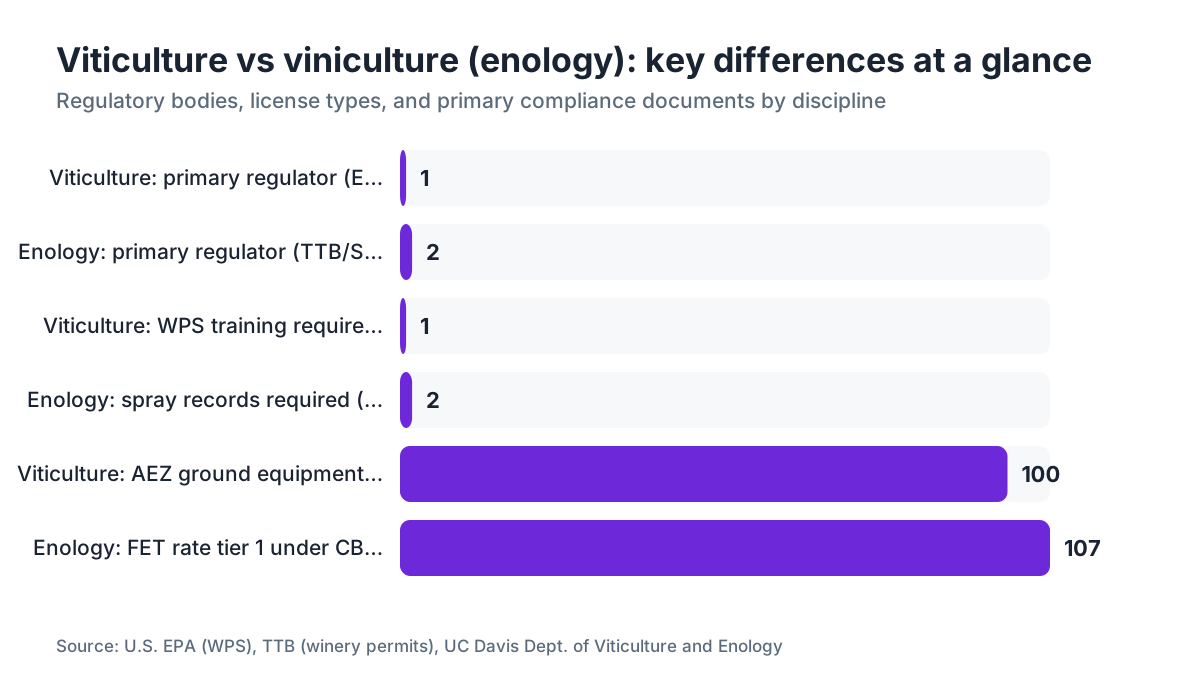
The cleanest way to see the difference is a direct comparison. The table below maps each term to its scope, regulatory category, and typical job titles.
| Dimension | Viticulture | Viniculture (Enology) |
|---|---|---|
| Definition | Growing grapes | Making wine |
| Latin root | vitis (grapevine) | vinum (wine) |
| Where it happens | Field / vineyard | Winery / cellar |
| Key decisions | Trellis, irrigation, spray timing, harvest | Fermentation, blending, filtration, aging |
| Regulatory category | Agriculture | Food/beverage processing |
| Primary license type | Pesticide applicator, water rights | Winery license, TTB permit |
| Academic home (U.S.) | Dept. of Viticulture & Enology (UC Davis, WSU, Cornell) | Same dept., enology track |
| Typical job title | Viticulturist, vineyard manager, grower | Winemaker, enologist, cellar master |
| Primary compliance doc | Spray records, WPS training logs | TTB production reports, cellar logs |
The overlap zone is real. At small estate wineries, one person often does both. At paso robles wineries or south coast winery operations, you might see a viticulture director whose role bleeds into crush-pad calls. But these are two separate bodies of knowledge, with two separate certification pathways.
Why do so many people confuse viticulture and viniculture?
The confusion makes sense. Both words sound alike, both point at wine, and popular writing swaps them freely. Wine tourism spots like gervasi vineyard or the allegretto vineyard resort sell the whole experience, vine rows and wine glass together, and never bother drawing a line between the two disciplines.
The search data backs this up. "Viticulture vs viniculture" and "difference between viticulture and viniculture" are real queries people type, which is exactly why this article exists.
There's a historical reason for the blur too. In the French and Italian tradition, the vigneron or vignaiolo grew the grapes and made the wine. Nobody split the roles institutionally until the late 19th century, when Pasteur-era science pushed universities to build dedicated programs. The University of Bordeaux launched formal enology coursework in the 1880s. UC Davis established its Department of Viticulture and Enology in 1935 [1].
In the U.S. today, marketing copy still uses the terms loosely. Any legal, regulatory, or academic context does not. There, they point to distinct activities.
Does the difference between viticulture and viniculture matter for compliance?
Yes, and this is where loose terminology costs you real time and money.
Grow grapes to sell to another winery and you're an agricultural producer. Your obligations include pesticide applicator licensing (usually through your state department of agriculture), EPA Worker Protection Standard training for anyone who handles pesticides or works treated fields, pesticide application records (most states want these kept two years minimum), and in many states a farm labor contractor license if you hire seasonal crews [3].
The EPA Worker Protection Standard, 40 CFR Part 170, applies to agricultural workers and pesticide handlers on farms, and vineyards land squarely inside that definition. The standard requires worker training, access to pesticide safety information, and decontamination supplies in the field [3].
Make wine and you answer to a different set of regulators. The Alcohol and Tobacco Tax and Trade Bureau (TTB) requires a Basic Permit or a Bonded Winery permit depending on your operation. You file production reports, pay federal excise tax, and follow labeling rules [4]. Your state ABC or liquor control board stacks another layer on top.
A grower who also makes wine, which describes a large share of small estate producers, carries both compliance stacks at once. That's where a tool like VitiScribe earns its keep: spray records, WPS training logs, and restricted-entry interval tracking in one place instead of scattered across half a dozen spreadsheets.
For the growing side, if you need a model spray record template or a WPS compliance checklist, UC Davis Cooperative Extension and WSU Extension both publish free resources [1][5].
What are the career and education differences between viticulture and viniculture?
Choosing a degree program? The V&E departments at UC Davis, Cornell, and WSU all offer tracks in both disciplines, but the coursework splits hard after the shared intro classes.
Viticulture coursework covers plant physiology, soil science, pest management, irrigation engineering, vine nutrition, and vineyard design. A viticulture student spends a lot of time outdoors. Cornell's curriculum includes vine physiology, integrated pest management for vineyards, and a supervised field internship [2].
Enology coursework covers fermentation microbiology, wine chemistry, sensory evaluation, cellar equipment, and regulatory compliance for alcohol production. Most programs require lab work in a working winery.
Now the job market. Vineyard manager roles in California typically pay $60,000 to $100,000 a year depending on operation size and experience, in line with compensation data reported by the American Society for Enology and Viticulture [6]. Winemaker salaries run wider, from around $50,000 at small operations to well over $150,000 at major producers, with the top end weighted toward established California, Oregon, and Washington labels.
One honest caveat. There's no single authoritative compensation study for vineyard managers that I know of with a stable, freely accessible URL. The figures above track what ASEV members report and Bureau of Labor Statistics data for farm and agricultural managers, but treat them as ranges, not promises [7].
Is 'viniculture' just a misspelling of 'viticulture'?
No. It's a different word with a real etymology. That said, plenty of people type "viniculture" when they mean "viticulture," and several style guides and universities have quietly retired "viniculture" in favor of "enology."
See "viniculture" in a job posting or an academic context? Assume it means winemaking unless the context says otherwise. See it in a casual blog post or a travel article? It might mean either, or both, or the writer never worried about the distinction.
For your own professional writing, pick the precise term. Viticulture for growing. Enology or winemaking for the cellar. It signals you know the field.
How do viticulture and viniculture connect in a wine region?
In a working wine region, the two disciplines are tied together even though they're distinct. What happens in the vineyard sets the ceiling for what's possible in the winery. A winemaker can refine, but can't conjure what the grower didn't grow. That's why most serious winemakers want to walk the rows at least weekly through the growing season, and why the best viticulturists want to taste through fermentation to see how their field decisions show up in the glass.
Regions like paso robles wineries built strong grower-producer cultures precisely because the range of soils, elevations, and microclimates rewards close talk between vineyard and cellar. The Paso Robles Wine Country Alliance and similar regional bodies run joint education sessions covering both disciplines.
City-based operations work differently. A city winery model sources fruit from established growers, sometimes across several AVAs, and does the winemaking in an urban facility. The viticulture decisions got made miles away, by someone else. Knowing both sides of the equation helps city winery teams ask sharper questions of their growers and write better contracts.
Running a multi-site operation? Keeping your vineyard records and production records in separate but linked systems pays off. VitiScribe handles the viticulture side, which is where the field compliance burden runs heaviest.
What does the EPA Worker Protection Standard require for vineyard workers specifically?
The EPA Worker Protection Standard (WPS), codified at 40 CFR Part 170, is the federal rule governing pesticide safety for agricultural workers. Vineyards are covered agricultural establishments [3].
The core requirements hit vineyard operations directly.
First, training. You must train all agricultural workers and pesticide handlers before they work in a treated area or handle pesticides. Workers hired for more than a short season get trained before entering treated areas; the current WPS requires training annually.
Second, posting. You must post application-specific information: product name, EPA registration number, active ingredient, restricted-entry interval (REI), and location of treated areas. That information stays posted for 30 days after the REI expires.
Third, decontamination. Water, soap, and towels must be available at the workplace and within one quarter mile of workers in treated fields.
Fourth, emergency access. You must provide emergency assistance and inform workers of their rights.
EPA revised the WPS in 2015, with most provisions taking effect in 2017 [3]. The revised rule added the Application Exclusion Zone: during a pesticide application, no one but the applicator may be within a set distance of the equipment. For ground-based equipment that distance is generally 100 feet.
Violations carry civil penalties. EPA has assessed penalties against vineyard operations under the WPS, so this is not theoretical paperwork.
What resources do UC Davis, Cornell, and WSU offer for learning both disciplines?
These three programs are the main credentialing and extension pathways for U.S. grape growers and winemakers.
UC Davis houses the Robert Mondavi Institute for Wine and Food Science and offers undergraduate and graduate degrees through its Department of Viticulture and Enology [1]. Its extension arm, UC Cooperative Extension, publishes free pest management guides, spray record templates, and irrigation resources that are more useful to working vineyard managers than to students [8].
Cornell runs a viticulture and enology program through the College of Agriculture and Life Sciences plus a Cornell Cooperative Extension viticulture program, which is especially strong for cold-climate grape growing in New York and the Northeast [2][9]. Its research on Vitis vinifera performance in short seasons and on hybrid varieties is the best freely available work on those topics.
WSU Extension runs a viticulture and enology program built around Washington State's wine industry, the second largest by volume in the U.S. [5]. The V&E program at WSU Tri-Cities and its extension publications cover irrigation scheduling, nutrient management, and pest management for the Columbia Valley AVA and nearby regions.
All three offer online short courses and webinars, useful if you're a working manager without time for a full degree. Individual short courses typically run $50 to $400 depending on the program. None of these institutions have a financial relationship with VitiScribe. I'm citing them because they're the best free and low-cost resources available.
How does the TTB regulate wine production, and where does viticulture fit in?
The Alcohol and Tobacco Tax and Trade Bureau regulates the production, labeling, and taxation of wine in the United States [4]. Its jurisdiction starts when grapes hit the crush pad, not before. Everything upstream, planting, growing, harvesting, hauling, is agricultural and sits outside TTB's reach.
To produce wine commercially, you need a Bonded Winery (BW) permit or a Bonded Wine Cellar (BWC) permit, depending on whether you make wine or just blend and store it. You apply through TTB's Permits Online system.
Once you're a bonded winery, you file operational reports and pay federal excise tax on wine removed from bond for sale. The federal excise tax rate for still wine at 16% alcohol or less starts at $1.07 per gallon, with a credit structure under the Craft Beverage Modernization Act that lowers the effective rate for smaller producers [4][10].
For a grower who sells fruit rather than making wine, TTB is essentially irrelevant. Your transaction with the winery is a commodity sale, not a regulated alcohol transaction. The compliance handoff happens at the crush pad.
For a vertically integrated estate, keeping viticulture records and production records organized separately is worth the effort. Spray records, REI logs, and harvest data aren't TTB documents, but a state ABC auditor may ask to see harvest logs to confirm that reported grape tonnage matches your permit conditions.
Frequently asked questions
Is viticulture the same as viniculture?
No. Viticulture is the growing of grapes; viniculture (more commonly called enology in the U.S.) is the making of wine. Both relate to wine production, but they cover different parts of the process and different regulatory environments. The confusion is common because the words sound similar and wine marketing often treats the vineyard and winery as one experience.
Which term is more commonly used in the U.S., viticulture or viniculture?
Viticulture is used far more often in U.S. academic, regulatory, and industry contexts. The winemaking side of the field is almost universally called enology in the United States. "Viniculture" appears in older texts and some contemporary writing but is not standard terminology in programs at UC Davis, Cornell, or WSU.
What does a viticulturist do day to day?
A viticulturist manages every field-level decision in the vineyard: scouting for pests and disease, timing spray applications, scheduling irrigation, adjusting the canopy, overseeing harvest logistics, and keeping pesticide records. At smaller operations, the viticulturist is usually the vineyard manager. The role is primarily outdoors, agricultural, and compliance-heavy relative to the cellar side.
What does an enologist (viniculturist) do?
An enologist manages fermentation, cellar sanitation, blending, filtration, aging, and the regulatory paperwork that comes with producing a licensed alcohol product. They track tank volumes, measure Brix and pH, manage yeast and nutrient additions, and file production reports with the TTB. At small wineries, the winemaker handles all of this. At larger operations, the enologist oversees a cellar crew.
Do I need separate licenses for viticulture and winemaking?
Yes, if you do both. The viticulture side typically requires a state pesticide applicator license and compliance with the EPA Worker Protection Standard. The winemaking side requires a TTB Bonded Winery permit and a state winery license. Growers who only sell fruit to other wineries generally need no alcohol license; the compliance burden is entirely agricultural.
What spray records are required for a vineyard in the U.S.?
Most states require pesticide application records kept for at least two years. Required fields typically include the date, product name, EPA registration number, rate, total amount applied, target pest, field location, and applicator name. Some states require daily records; others allow monthly summaries. California requires reporting for restricted materials within 7 days of application. Check your state department of agriculture for specifics.
Does the EPA Worker Protection Standard apply to small vineyards?
Yes. The WPS at 40 CFR Part 170 applies to all agricultural establishments where pesticides are used, regardless of size. Exemptions are narrow: farms where only the owner and their immediate family work are generally exempt. Any time you hire workers, even seasonal harvest crews, the WPS training, posting, and decontamination requirements apply.
Can one person be both a viticulturist and a winemaker?
Yes, and at most small estate wineries, one person does both. The disciplines require different knowledge bases, and being skilled at both is genuinely hard. Most estate winemakers who grew up in the vineyard will tell you they're stronger on one side than the other. Large operations typically hire separately for each role.
Where can I study viticulture online in the U.S.?
UC Davis, Cornell, and WSU all offer online courses and certificate programs in viticulture and enology. UC Davis offers a distance-learning certificate in winemaking and viticulture. WSU Tri-Cities hosts in-person and online V&E courses. Cornell Cooperative Extension runs regional workshops. Costs range roughly from $50 for a single webinar to several thousand dollars for a full certificate program.
What is the difference between enology and viniculture?
They mean the same thing. Enology (also spelled oenology) is the widely accepted academic and industry term for the science of winemaking. Viniculture is an older or less commonly used synonym for the same discipline. In U.S. university programs and regulatory documents, enology is almost always the preferred term.
How do Brix and harvest timing connect viticulture to winemaking?
Brix (sugar content measured in degrees) is the primary metric viticulturists track in the weeks before harvest. It directly predicts potential alcohol in the finished wine. A winemaker's target style drives the harvest Brix target, which the viticulturist works backward from when making canopy and irrigation decisions. The two disciplines intersect most intensely during the 30 days before harvest.
Is there a federal license for vineyard managers specifically?
There is no single federal vineyard manager license. Federal requirements come through the EPA Worker Protection Standard (for pesticide handling and worker safety) and, if you apply restricted-use pesticides, through state-level pesticide applicator certification. Some states, like California, have additional requirements for agricultural employers. The TTB only enters the picture when wine is produced.
What is the federal excise tax rate for small wineries?
Under Craft Beverage Modernization Act provisions, small domestic wineries get a tax credit that lowers the effective federal excise rate on their first tiers of production. The base rate for still wine at or under 16% alcohol is $1.07 per gallon. Because CBMA credits and thresholds have been adjusted over time, verify the current rate tables on the TTB website annually.
Does VitiScribe help with both viticulture and winemaking records?
VitiScribe focuses on the vineyard and field operations side: spray records, restricted-entry interval tracking, worker protection standard compliance logs, and harvest data. It is built for the viticulture compliance stack. TTB production reports and cellar records are separate documents with different regulatory homes; those typically live in winery-specific production software.
Sources
- Cornell University, College of Agriculture and Life Sciences: Cornell CALS runs a viticulture and enology program where viticulture is the field-side discipline and enology covers cellar science, with required coursework in vine physiology and integrated pest management.
- U.S. EPA, Agricultural Worker Protection Standard (40 CFR Part 170): The EPA Worker Protection Standard requires agricultural worker training, pesticide application posting, and decontamination supplies at all farms where pesticides are used; the 2015 revision added the Application Exclusion Zone requirement effective 2017.
- Alcohol and Tobacco Tax and Trade Bureau (TTB): TTB requires Bonded Winery permits and periodic operational reports; the federal excise tax rate for still wine at or under 16% alcohol starts at $1.07 per gallon, with CBMA credits reducing the effective rate for smaller producers.
- Washington State University, Viticulture and Enology Program: WSU separates viticulture (field operations) from enology (winery/cellar science) and publishes irrigation, nutrient management, and pest management resources for Columbia Valley growers.
- American Society for Enology and Viticulture (ASEV): ASEV member-reported compensation indicates vineyard manager roles in California typically pay $60,000 to $100,000 annually depending on operation size and experience.
- U.S. Bureau of Labor Statistics, Occupational Outlook Handbook: BLS occupational data for farmers, ranchers, and agricultural managers supports the salary range cited for vineyard management roles, with compensation varying widely by operation size.
- UC Statewide Integrated Pest Management Program (UC IPM): UC IPM publishes free pest management guidelines and record-keeping resources for California grape growers.
- Cornell Cooperative Extension: Cornell Cooperative Extension's viticulture program leads research on cold-climate grape growing and hybrid variety performance in the Northeast U.S.
- U.S. Alcohol and Tobacco Tax and Trade Bureau (TTB): The Craft Beverage Modernization Act reduced effective federal excise tax rates for small domestic wineries through a tiered credit structure applied to the first tiers of annual production.
Last updated 2026-07-09