Viticulture research news: what vineyard managers need to know in 2025
TL;DR
- Viticulture research in 2024 and 2025 is moving fast on three fronts.
- Climate adaptation covers heat stress thresholds and drought-tolerant rootstocks.
- Disease work is mapping downy and powdery mildew resistance genes.
- Water research from UC Davis and WSU is refining deficit irrigation.
- Most findings are 2 to 5 years from commercial release, but several already change your spray records and WPS compliance.
What are the biggest viticulture research breakthroughs in 2024-2025?
The headline finding from 2024 is the completion of the Vitis vinifera pangenome by an international consortium in Nature Genetics. That paper assembled reference sequences from 50 diverse accessions and identified structural variants tied to disease resistance and stress tolerance. It gives breeders a far more complete map than the single reference genome from 2007 [1]. It won't change what you spray this season. It does speed up the pipeline for varieties that need less fungicide.
On the practical side, UC Davis published updated regulated deficit irrigation (RDI) protocols in 2024. Holding pre-veraison water stress at a stem water potential of about -1.2 MPa reduced berry size and raised anthocyanins in Cabernet Sauvignon with no measurable yield loss in their trials. The researchers note their sites were in the Sacramento Valley, so results may differ at coastal sites with morning fog [2]. Write down -1.2 MPa and share it with your irrigation crew.
Washington State University's viticulture team kept up its multi-year work on grapevine trunk disease. A 2024 update showed that delayed pruning, done past bud swell, cut Eutypa lata infection rates by roughly 50 percent compared to dormant pruning in wet winters [3]. The mechanism was already known. What WSU added is field data across eight Yakima Valley blocks, which makes the practice easier to defend to an owner who balks at later pruning costs.
Mildew resistance is where the genetics get interesting. Cornell's Geneva station published a resistance screening update on 37 interspecific hybrid candidates, with several showing near-immunity to both downy and powdery mildew under New York field conditions. Commercial release is 5 to 7 years out for the most promising. A few are already in the USDA Vitis germplasm collection [12].
How is climate change affecting viticulture research priorities?
Heat stress now dominates every major viticulture conference, from the International Symposium on Grapevine Physiology and Biotechnology to the American Society for Enology and Viticulture annual meeting. The science is catching up to what growers in California, Australia, and southern France have handled operationally for a decade.
A 2023 meta-analysis in Global Change Biology reviewed 40 years of harvest date records across 11 wine regions. Average harvest dates advanced by roughly 6 to 7 days per decade since 1981, and the rate sped up after 2000 [5]. That number has teeth. If your block used to come in mid-October and now pushes into late September, your spray timing intervals, canopy management calendar, and compliance record cutoffs all shift with it.
Kaolin clay as a heat and sunburn tool has been building for years. A 2024 UC Cooperative Extension trial in Napa found that kaolin applied starting at berry set dropped berry temperature by 2 to 4 degrees C on peak heat days, which kept anthocyanin degradation measurably lower than untreated controls. The catch is timing and label compliance. Kaolin is registered as a physical pesticide with EPA, so applications go in your spray records with REI documentation like any other product [6].
Drought-tolerant rootstock work carries more urgency than it did five years ago. UC Davis Foundation Plant Services maintains over 30 rootstock selections under evaluation for water use efficiency, and WSU is comparing 1103 Paulsen, 140 Ruggeri, and 110 Richter under deficit irrigation in eastern Washington. None of it is a reason to pull out your existing rootstock. If you're planting new blocks in the next three years, read the trial results before you order [2].
For vineyard operations in warm inland regions like Paso Robles, heat stress research hits close to home. Some Paso Robles wineries already set harvest windows on temperature accumulation data instead of calendar timing.
What does current research say about powdery and downy mildew management?
Mildew is where research touches your spray records and input costs most directly. Powdery mildew (Erysiphe necator) control is the single largest fungicide cost for most wine grape growers in humid regions, and the science on resistance in fungicide programs is maturing fast.
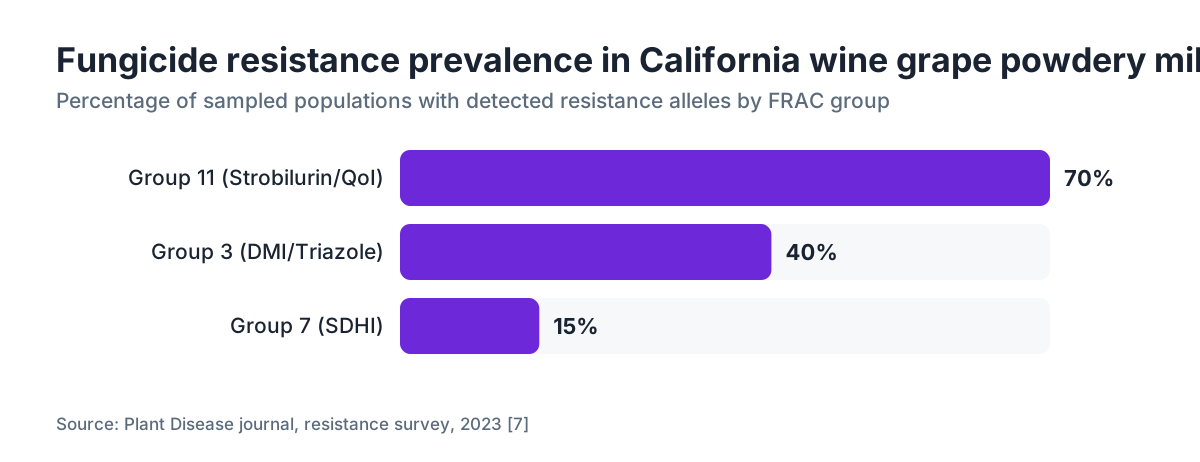
The FRAC (Fungicide Resistance Action Committee) groups that matter most for grape powdery mildew are Group 3 (DMI/triazoles), Group 7 (SDHI), and Group 11 (QoI/strobilurin). A 2023 survey across California wine regions in Plant Disease found Group 11 resistance alleles in over 70 percent of sampled populations, and Group 3 resistance in roughly 40 percent [7]. Those numbers are almost certainly higher now. If strobilurins are the backbone of your program, you may be paying for reduced efficacy without knowing it.
WSU Extension runs a mildew risk model called DVM (Disease and Vine Monitoring) that combines temperature, humidity, and leaf wetness to estimate infection pressure by growth stage [3]. It's free and validated across multiple Pacific Northwest seasons. It doesn't replace scouting. It does give you a defensible basis for adjusting spray intervals, which helps when you're writing spray record justifications.
For downy mildew (Plasmopara viticola), the 2024 focus is oospore germination timing and primary inoculum prediction. Cornell's IPM program updated its grape downy mildew guidelines in 2024, noting that primary infection risk correlates with soil temperature at 2-inch depth above 50 degrees F combined with rainfall over 0.1 inches in a 24-hour window [4]. If you tie weather station records to spray decisions, that's the threshold to document.
Botrytis work keeps pointing back to canopy architecture as the first defense. A 2024 UC Davis paper found that shoot positioning and fruit-zone leaf pulling before bloom cut Botrytis bunch rot incidence by 30 to 45 percent versus unpruned controls, independent of fungicide program [2]. That's a cultural practice for your field records, not your spray records.
What is the latest research on grapevine water use and irrigation?
Water drives more viticulture research investment right now than anything else. UC Cooperative Extension has been the most productive source of applied findings.
The 2024 UC Davis update on crop coefficients (Kc values) for wine grapes is worth pulling if you schedule irrigation off evapotranspiration. The old baseline Kc values dated to early-2000s studies and didn't reflect the lower-vigor canopy styles common today. Updated Kc values for a vertically shoot-positioned (VSP) canopy run roughly 10 to 15 percent lower than the old figures at mid-season [2]. On a 50-acre block with CIMIS-based scheduling, that gap moves real acre-feet.
Regulated deficit irrigation (RDI) is well-established by now, and the research is getting granular. A 2023 WSU study looked at RDI timing across three growth stages (pre-bloom, berry set to veraison, post-veraison) in Riesling. Post-veraison stress had the largest effect on titratable acidity without hurting yield, while pre-bloom stress increased cluster count variability more than any other timing [3]. Stage-specific management is where the field is going.
Soil moisture sensor placement research from UC Davis confirms a single probe at 12-inch depth is not enough for most wine grape blocks. Paired shallow (6-inch) and deep (24-inch) probes cut prediction error for stem water potential correlation by 40 percent versus single-depth monitoring in their Sacramento Valley trials [2]. A second probe per zone costs little, and the data is hard to argue with.
How does current EPA Worker Protection Standard research affect vineyard spray compliance?
The EPA's Agricultural Worker Protection Standard (WPS), revised in 2015 and in effect since January 2017, sets the federal floor for pesticide safety in vineyards. It covers restricted-entry intervals (REIs), personal protective equipment (PPE), pesticide safety training, and posting requirements for application and hazard information [6].
EPA enforcement reports show more inspection focus on vineyards using sulfur-based products, especially during high-temperature application windows. The WPS requires that handlers not apply any pesticide "in a manner that contacts, either directly or through drift, any worker or other person, other than an appropriately trained and equipped handler" and sets REI requirements that hold even for some minimum-risk formulations [6]. Elemental sulfur carries a 24-hour REI under its standard label, and multiple state extension documents flag high-temperature conditions (above 90 degrees F at application) as needing extra precautions.
Washington State's Department of Agriculture runs a state-level WPS overlay. California does too, through CDFA and the county agricultural commissioner system. Both states require pesticide use reports (PURs) that go beyond federal WPS minimums, and both can hand out fines well above federal baseline penalties [9].
Cornell Extension's WPS compliance guides, updated in 2023, are among the clearest plain-language reads of the federal rule for small and mid-size operations. They include sample training logs and REI posting templates [4]. Templates don't guarantee compliance. They do match the format state inspectors look for when reviewing records.
This is where record-keeping infrastructure pays off. VitiScribe, a vineyard compliance and field operations platform, structures spray logs to hold the REI, PPE requirements, and weather at application in one record, which is the format that satisfies federal WPS and state PUR requirements at the same time.
What are UC Davis, Cornell, and WSU publishing on grape disease resistance genetics?
The three land-grant programs most active in U.S. viticulture research have distinct but complementary focuses.
UC Davis, through its Department of Viticulture and Enology, is the leading producer of applied wine grape physiology research in the country. Current funded projects include heat stress genomics, canopy microclimate modeling, and the long-running Foundation Plant Services program that maintains clean certified planting material [2]. Their 2023 work on Pinot noir heat tolerance identified two quantitative trait loci (QTL) linked to heat-induced berry shriveling, which is the genetic base for marker-assisted breeding.
Cornell's Geneva Agricultural Experiment Station is the center of U.S. cold-hardy and disease-resistant variety development. The breeding program has released over 20 commercial varieties since the 1970s, including Marquette, La Crescent, and Aromella. Its current pipeline combines Rpv resistance loci (downy mildew resistance from wild Vitis species) with acceptable wine quality [4]. A 2024 Geneva update reported that its leading Rpv3.1 and Rpv12 stacked-resistance selections held field resistance through four straight high-pressure seasons in the Finger Lakes.
WSU Viticulture and Enology at Prosser works on Pacific Northwest problems: trunk disease management, Botrytis in high-humidity harvest conditions, and cold hardiness under freeze-thaw cycles that don't hit California [3]. Its 2024 cold hardiness monitoring, published through the Washington State Grape Society, showed the 2023 to 2024 winter caused acclimation breaks in mid-January that raised xylem damage risk by roughly 25 percent over the five-year average, and that tracked with reduced fruitfulness in several Yakima blocks the next season.
All three programs publish extension bulletins that are free and written for growers, not researchers. If peer-reviewed journal articles are your primary input, you're doing more work than you need to. The extension publications carry the same findings in usable form.
What does new research say about sustainable and organic viticulture practices?
Certified organic area in California wine grapes reached about 22,000 acres in the 2023 USDA organic survey, up from roughly 15,000 in 2015 [8]. Research is responding to that growth, though the honest read is that applied science for certified organic programs still trails conventional program optimization.
Copper is the unresolved tension in organic viticulture. Copper-based fungicides work against downy mildew, carry OMRI listing, and are allowed under NOP organic standards, but copper builds up in vineyard soils. The EU has moved to cap applications at 4 kg copper metal per hectare per year, averaged over 7 years. California has no equivalent state cap yet, though several county agricultural commissioners flag it as rising scrutiny [9].
A 2024 UC Cooperative Extension trial in Sonoma County found that kaolin clay plus reduced-rate copper (50 percent of standard label rate) held downy mildew control comparable to full-rate copper in two of three seasons. The third season, an unusually wet June, saw higher incidence. Promising, but a one-in-three failure is not a green light to cut copper without local trial data of your own.
Cover crop research is a bright spot. A 2023 UC Davis paper in the American Journal of Enology and Viticulture showed permanent legume-grass cover crop mixes raised soil organic matter by 0.3 to 0.5 percent over 8 years in Napa Valley blocks versus clean cultivation, with measurable gains in water infiltration [11]. That change is slow. It's also the kind of soil biology gain that cuts erosion risk on hillside blocks, which matters for stormwater compliance in both California and Washington.
Biological fungicides based on Bacillus amyloliquefaciens and Trichoderma strains are getting more rigorous field testing. Results are mixed. In high-pressure years, biological-only programs in humid climates keep showing lower efficacy than conventional programs. Where these products earn their keep is in rotation with conventional chemistries to cut FRAC resistance pressure, not as standalone replacements [7].
How is precision viticulture technology being validated by current research?
Precision viticulture, meaning variable-rate application, remote sensing, and sensor-based management, has been pushed hard by vendors for 15 years. The research on actual economic returns is more measured.
A 2023 review in Precision Agriculture looked at 22 studies on variable-rate irrigation in wine grapes. Seventeen showed statistically significant gains in water use efficiency, with a median water saving of about 18 percent versus uniform scheduling. Only 9 of the 22 reported full input cost accounting, and of those, 6 showed positive ROI with payback under 5 years at current water costs [10]. The technology works. The economics ride on water cost and block size.
NDVI mapping from satellite or UAV imagery for within-block variability is now cheap enough to be routine. PlanetScope imagery at 3-meter resolution runs under $10 per acre per season for most vineyard scales. The research question has shifted from "does this imagery reflect real vine variability" (it does) to "does acting on that variability through variable-rate management improve outcomes" (sometimes, depending on the action and the scale of variability).
Soil electrical conductivity (EC) mapping via EM38 or similar tools has strong research backing as a proxy for soil texture variability, which predicts water-holding capacity and vine vigor zones. A WSU study found EC maps in two Washington blocks predicted vine NDVI zones with correlation coefficients above 0.7 [3]. That's solid enough to base soil sampling zones on EC maps instead of uniform-grid sampling, which cuts sampling cost while improving how well the samples represent the block.
The gap in this research is longitudinal studies. Most trials run two to four years, not long enough to catch the multi-year payoff of soil health investments or the vintage-to-vintage swing in precision irrigation decisions. Nobody has good data on 10-year ROI for precision systems on small blocks under 20 acres.
What new grape varieties and rootstocks should vineyard managers be watching?
New variety development moves slowly, but several releases and near-releases deserve attention from anyone weighing a replant or a new block.
The USDA-ARS program in Geneva and UC Davis are both advancing disease-resistant varieties. On the red side, Geneva's NY95.0301.01 (likely to release under a commercial name in 2026 or 2027) has shown strong Rpv stacked resistance plus wine quality metrics that cleared an internal panel review. On the white side, Aromella, released in 2013, is still underplanted relative to its agronomic performance, mostly because winemaker adoption has been slow.
For rootstocks, UC Davis Foundation Plant Services added three new selections to its certified stock program in 2024, including a 1103 Paulsen by 110 Richter hybrid from a French INRAE program that showed better drought tolerance and nematode resistance in Spanish trials [2]. It's not yet widely available from California nurseries. Availability usually follows FPS certification by two to three nursery production cycles.
Grapevine red blotch disease (GRBD) has changed the conversation about rootstock and scion certification. Red blotch, caused by Grapevine red blotch virus (GRBV), was first formally described in 2012, and clean planting material is the only management tool. UC Davis FPS certification now includes red blotch screening as a standard test. Blocks planted before 2015 may have unknown status [2].
At estate-production models with high per-ton values, like Gervasi Vineyard or comparable operations, investing in disease-resistant or certified-clean material pays back faster than for commodity grape producers, because the effect on wine quality is direct and shows up in the glass.
| Variety or Rootstock | Origin | Key Trait | Stage |
|---|---|---|---|
| NY95.0301.01 (red, unnamed) | Cornell Geneva | Rpv stacked mildew resistance | Pre-commercial, est. 2026-2027 |
| Aromella (white) | Cornell Geneva | PM/DM resistance, cold hardy | Available, underplanted |
| 1103P x 110R hybrid | INRAE/UC Davis FPS | Drought tolerance + nematode resistance | FPS certified 2024, limited nursery stock |
| Marquette (red) | U of Minnesota | Extreme cold hardiness, hybrid | Commercially available |
| La Crescent (white) | U of Minnesota | Cold hardiness, aromatic | Commercially available |
How do I find and follow viticulture research news without reading journals every week?
Most growers don't have time to monitor peer-reviewed journals, and you probably shouldn't try. The translation layer, meaning extension publications, grower newsletters, and commodity board updates, is where the actionable signal lives.
The best free sources, in rough order of reliability and relevance for U.S. wine grape growers:
UC Cooperative Extension's viticulture and enology news (ucanr.edu) posts new findings within weeks, with practitioner-facing summaries. WSU Viticulture and Enology at Prosser sends a quarterly newsletter to registered growers, and back issues are publicly archived [3]. Cornell Cooperative Extension's grape program covers the Northeast and has the most detailed downy mildew and cold-hardiness content [4].
For California regulatory updates that intersect with research, watch CDFA's pesticide and fertilizing materials information and the county agricultural commissioner system [9]. Regulatory changes tend to follow research findings by two to four years, so what's published now tells you what compliance may look like in a few seasons.
VitiScribe's built-in compliance calendar tracks regulatory effective dates tied to published rulemaking, which helps when a research finding turns into a new label requirement or REI change and you need that reflected in your spray record templates without editing them by hand.
Conferences are worth the cost for the hallway conversations, not the formal talks. By the time something reaches the podium at ASEV or the Unified Wine and Grape Symposium, it's typically been in print for 12 to 18 months. The real value is learning which programs are running trials that match your conditions, so you can reach out to the extension advisors doing the work.
What viticulture research findings have direct compliance implications for spray records?
This is the question that separates interesting research from research you have to act on this season.
Three findings from 2023 to 2025 carry real compliance weight and belong in your records now.
First, EPA's updated guidance on sulfoxaflor (Transform WG, Closer SC) and grapevines, published in 2023, added pollinator and beneficial insect risk language to labels affecting bloom applications and pre-harvest intervals. If you used any sulfoxaflor product in the last two seasons, confirm your records carry the correct PHI and the bloom restriction notation [6].
Second, FRAC resistance management language on strobilurin (Group 11) labels has been strengthened with mandatory rotation wording since 2022. Some state extensions now advise that more than two consecutive Group 11 applications in a season counts as off-label use where registration conditions are appended to the federal label. California is the main example. Check your county ag commissioner's label supplement list [9].
Third, the 2024 update to EPA's bee protection language for several neonicotinoids, including imidacloprid (Admire Pro), tightened the ban on applications when bees are foraging and added a record-keeping recommendation for time and weather at application. It's not yet a hard requirement in every state. Recording application time and temperature is now standard practice under the WPS compliance framework [6].
The broader point: research findings turn into label updates on a lag of one to five years. Keep your spray records detailed enough to satisfy current WPS requirements, plus any California or Washington state overlay, and you can absorb new label language without rebuilding your recordkeeping.
Frequently asked questions
What is the most important viticulture research finding for 2024-2025?
The completion of the Vitis vinifera pangenome, published in Nature Genetics, gives breeders the most complete genetic map of grapevine diversity yet assembled. For near-term impact, the UC Davis update on regulated deficit irrigation thresholds (stem water potential of -1.2 MPa pre-veraison in Cabernet Sauvignon) and WSU's finding that delayed pruning cuts Eutypa infection by roughly 50 percent are more immediately actionable for growers.
How is climate change shifting harvest timing in wine regions?
A 2023 meta-analysis in Global Change Biology found that average harvest dates across 11 wine regions advanced by roughly 6 to 7 days per decade since 1981, with acceleration after 2000. For growers, that means spray timing intervals, canopy management calendars, and compliance record cutoffs need rechecking against actual seasonal progression rather than historical calendar anchors.
What does research say about fungicide resistance in grape powdery mildew?
A 2023 survey in Plant Disease found Group 11 (strobilurin) resistance alleles in over 70 percent of California powdery mildew populations sampled, and Group 3 (DMI/triazole) resistance in roughly 40 percent. If your program leans on strobilurin materials, efficacy may be substantially compromised without visible symptoms, which makes FRAC rotation documentation in your spray records both agronomically and potentially legally relevant.
What free tools exist for mildew risk modeling in vineyards?
WSU Extension's Disease and Vine Monitoring (DVM) model combines temperature, humidity, and leaf wetness to estimate powdery mildew infection pressure by growth stage. It's free through WSU's viticulture program. Cornell's IPM guidelines set the downy mildew primary infection threshold at soil temperature above 50 degrees F combined with rainfall over 0.1 inches in 24 hours, which you can track with any basic weather station.
Are disease-resistant grape varieties actually available to plant now?
Yes, though selection is limited. Marquette, La Crescent, and Aromella from the Cornell program are commercially available and suited to cold climates. Geneva's pipeline has more advanced selections, with one promising red (NY95.0301.01) expected around 2026 to 2027. UC Davis's FPS program added a drought-tolerant rootstock hybrid to certified stock in 2024, though nursery supply is currently limited.
Does precision viticulture technology actually show positive ROI in research?
A 2023 review in Precision Agriculture found 17 of 22 studies on variable-rate irrigation in wine grapes showed statistically significant water savings, with a median of about 18 percent. Of the 9 studies reporting full cost accounting, 6 showed positive ROI with payback under 5 years at current water costs. ROI depends heavily on water cost, block size, and the specific action taken on sensor data.
How do EPA Worker Protection Standard requirements apply to sulfur applications in vineyards?
Elemental sulfur carries a 24-hour REI under the federal WPS. EPA and several state extensions also flag high-temperature applications, above roughly 90 degrees F, as needing extra precautions beyond the standard label. California and Washington both have state-level pesticide use reporting requirements that apply on top of federal WPS minimums. All sulfur applications should appear in your spray records with REI, PPE notation, and weather at application time.
What is grapevine red blotch disease and how does current research affect planting decisions?
Grapevine red blotch disease, caused by Grapevine red blotch virus, was formally described in 2012. It reduces anthocyanin development and delays sugar accumulation, causing significant quality loss in red varieties. Clean certified planting material is the only management tool. UC Davis Foundation Plant Services now includes red blotch screening in standard certification testing. Blocks planted before 2015 may have unknown infection status and warrant testing before replanting.
What does research say about copper use in organic viticulture?
Copper is effective against downy mildew and permitted under NOP organic standards, but it accumulates in vineyard soils. The EU caps applications at 4 kg copper metal per hectare per year averaged over 7 years. A 2024 UC Cooperative Extension trial found that reduced-rate copper (50 percent of label rate) combined with kaolin clay held comparable mildew control in two of three seasons, though the third high-pressure season showed higher disease incidence.
How do I stay current on viticulture research news without reading academic journals?
UC Cooperative Extension (ucanr.edu), WSU's viticulture newsletter from Prosser, and Cornell Cooperative Extension's grape program translate peer-reviewed findings into grower-facing summaries, usually within weeks. For regulatory updates that intersect with research, track your county agricultural commissioner's label supplement list and CDFA's pesticide information. Conferences like the Unified Wine and Grape Symposium are useful mainly for networking with extension advisors running relevant local trials.
What are the biggest irrigation research updates for wine grape growers?
UC Davis updated crop coefficient (Kc) values for wine grapes in 2024, finding VSP-trained canopies need Kc values roughly 10 to 15 percent lower than older figures at mid-season, which affects ET-based scheduling. WSU's stage-specific RDI research in Riesling found post-veraison stress had the largest effect on titratable acidity. UC Davis also confirmed that paired shallow and deep soil moisture probes cut stem water potential prediction error by 40 percent versus single-depth monitoring.
What does delayed pruning research actually show about trunk disease?
WSU's 2024 field data from eight Yakima Valley blocks found that pruning after bud swell, rather than during dormancy in wet winters, cut Eutypa lata infection rates by roughly 50 percent. The study matters because it quantifies a practice that was already recommended on mechanistic reasoning. The tradeoff is higher labor cost and the logistics of pruning large acreage after bud swell, so the cost-benefit math varies by block size and region.
Are cover crops in vineyards supported by long-term research data?
A 2023 UC Davis paper in the American Journal of Enology and Viticulture found permanent legume-grass cover crops raised soil organic matter by 0.3 to 0.5 percent over 8 years in Napa Valley blocks versus clean cultivation, with improved water infiltration. That rate of change is slow, but it's a peer-reviewed finding over a multi-year window, which is rare in cover crop research. Hillside blocks also see measurable erosion reduction, relevant for stormwater compliance in California and Washington.
What compliance record changes should vineyard managers make based on 2023-2025 research and label updates?
Three priorities: confirm records for any sulfoxaflor applications include the bloom restriction notation from EPA's 2023 guidance update; check whether more than two consecutive Group 11 fungicide applications in a season triggers mandatory rotation language under your state's label supplements (California is the primary example); and start recording application time and ambient temperature for neonicotinoid applications following 2024 EPA bee protection guidance, even where it's not yet required.
Sources
- Nature Genetics, Vitis vinifera pangenome consortium, 2024: An international consortium assembled a pangenome from 50 Vitis vinifera accessions, identifying structural variants tied to disease resistance and abiotic stress tolerance.
- UC Davis Department of Viticulture and Enology / UC Cooperative Extension: Updated regulated deficit irrigation protocols, crop coefficient values, soil moisture probe placement research, Botrytis canopy management data, and Foundation Plant Services planting material program.
- Washington State University Viticulture and Enology, Prosser: Delayed pruning trunk disease data, stage-specific RDI research in Riesling, DVM mildew model, EC-to-NDVI zone correlation, and cold hardiness monitoring.
- Cornell Cooperative Extension and Cornell AgriTech (Geneva): Downy mildew primary infection thresholds, Rpv stacked-resistance breeding selections, disease-resistant variety releases, and WPS compliance guides.
- Global Change Biology, harvest date meta-analysis, 2023: Average harvest dates across 11 wine regions advanced by roughly 6 to 7 days per decade since 1981, with the rate accelerating after 2000.
- U.S. EPA Agricultural Worker Protection Standard: WPS sets REI requirements, PPE standards, pesticide safety training, posting requirements, and label restrictions including bloom-period and pollinator-protection language for sulfoxaflor and neonicotinoid products.
- Plant Disease journal, FRAC resistance survey, 2023: Group 11 (strobilurin) resistance alleles found in over 70 percent of California powdery mildew populations sampled; Group 3 (DMI) resistance in roughly 40 percent.
- USDA National Agricultural Statistics Service, Organic Survey 2023: Certified organic area in California wine grapes reached approximately 22,000 acres as of the 2023 USDA organic survey, up from about 15,000 in 2015.
- California Department of Food and Agriculture, Pesticides and Fertilizing Materials: California county agricultural commissioners maintain label supplement lists; some county supplements restrict consecutive Group 11 fungicide applications in vineyards, and PUR requirements exceed federal WPS minimums.
- Precision Agriculture journal, variable-rate irrigation review, 2023: Review of 22 studies on variable-rate irrigation in wine grapes found 17 showing statistically significant water savings with a median of about 18 percent, and 6 of 9 cost-reporting studies showing positive ROI with payback under 5 years.
- American Journal of Enology and Viticulture, cover crop study, 2023: Permanent legume-grass cover crops increased soil organic matter by 0.3 to 0.5 percent over 8 years in Napa Valley blocks versus clean cultivation controls, with improved water infiltration.
- USDA ARS National Plant Germplasm System, Vitis collection: Cornell disease-resistant variety candidates referenced in this article are accessible in the USDA Vitis germplasm collection.
Last updated 2026-07-09