Viticulture webinars: the best free and paid training in 2026
TL;DR
- Free and low-cost viticulture webinars run year-round through UC Davis, Cornell Cooperative Extension, Washington State University, and USDA-funded programs.
- Most cover disease management, canopy work, spray compliance, and water use.
- CEU credit depends on state approval.
- Find upcoming sessions through extension calendars, the American Society for Enology and Viticulture, and regional grape grower associations.
Where do vineyard managers find legitimate viticulture webinars?
Start with your land-grant university extension system. That's the shortest honest answer. UC Davis Cooperative Extension, Cornell Cooperative Extension, and Washington State University Extension each run ongoing webinar series that are free or very cheap, aimed at working vineyard managers rather than students. They publish calendars you can subscribe to, so you get notified instead of hunting.
UC Davis Viticulture and Enology posts its public programs and short course calendar on its extension page [1]. Cornell's viticulture and enology team, based in Geneva, NY, hosts periodic Zoom sessions tied to their research projects and partners regularly with the New York Wine Industry Workshop [2]. WSU Extension in Prosser runs the viticulture program for the Pacific Northwest and puts on webinars through its online event system, often free to Washington and Oregon growers [3].
Beyond land-grant schools, the American Society for Enology and Viticulture (ASEV) holds national symposia and smaller online sessions, some archived for members [4]. The Wine Institute, the National Grape and Wine Initiative, and state-level associations like the California Association of Winegrape Growers or Wine Growers of Oregon push webinars during the off-season too. The practical move is to join the email lists for two or three of those organizations and let them do the calendar work for you.
One underused source: the USDA Risk Management Agency runs free educational webinars for growers on crop insurance and climate risk, sometimes bundled with broader vineyard operations content [5]. They're dry. The information is solid, and attendance counts toward some professional development requirements.
What topics do viticulture webinars actually cover?
The range is wider than most people expect. At any point in the year you can find sessions on powdery mildew and botrytis forecasting models, cover crop establishment, irrigation scheduling, vineyard floor management, labor efficiency, and new pest pressures like spotted lanternfly or vine mealybug. Regulatory topics like EPA Worker Protection Standard (WPS) training and pesticide applicator recertification show up often because they drive compliance deadlines [6].
Canopy management gets heavy coverage in late winter and early spring. Disease management and spray programs dominate from bud break through veraison. Harvest planning and winemaking chemistry cluster in late summer. Winter brings the economics: vineyard financial benchmarking, insurance programs, replanting decisions.
A few specialized topics show up rarely but are worth hunting for. Smoke taint assessment, water rights compliance in drought years, and labor law updates for agricultural employers each tend to be one-off sessions rather than recurring series. When you see one, register right away, because they rarely get rescheduled.
For spray record compliance specifically, some states require documented training on restricted-use pesticides and WPS every year. Several extension programs now archive completed webinars so managers can log attendance later, though that usually does not count for CEU purposes.
Can you get CEU or pesticide recertification credit from online viticulture webinars?
Yes, in many cases. But the rules differ by state and by the type of credit, and nobody should assume a webinar counts without confirming first.
Pesticide applicator continuing education units (CEUs) are managed at the state level by departments of agriculture. A webinar has to be pre-approved by your state's lead agency to count. California's Department of Pesticide Regulation (CDPR) keeps a list of approved courses [7]. Washington State Department of Agriculture and Oregon Department of Agriculture run similar approval systems. If you're a licensed applicator in more than one state, you may need separate verification for each.
Some of the bigger series carry pre-approved CEU status. WSU Extension's spray school series and UC ANR's integrated pest management programs are two examples for their respective states. The event listing usually says so. If it doesn't say, ask the organizer before you register.
Certified crop advisers (CCAs) seeking continuing education through the American Society of Agronomy will find that many university extension webinars qualify as approved provider sessions. ASEV's national technical program carries CCA credits as well.
Documentation matters. Keep your registration confirmation, the attendance certificate or completion email, and any quiz results. If your state wants a sign-in sheet equivalent for online events, some platforms generate a timestamped attendance log you can download. Store those with your other compliance records. If you run a field operations platform like VitiScribe for spray records and compliance logs, attaching training certificates to the same system saves time at audit.
One practical note: EPA Worker Protection Standard training itself is not delivered through commercial webinars. It's a requirement for employers to train workers and handlers using EPA-approved materials [6]. That training can happen by video or in person, but it has to follow WPS curriculum requirements and be documented separately from general viticulture education.
How do the major university extension webinar programs compare?
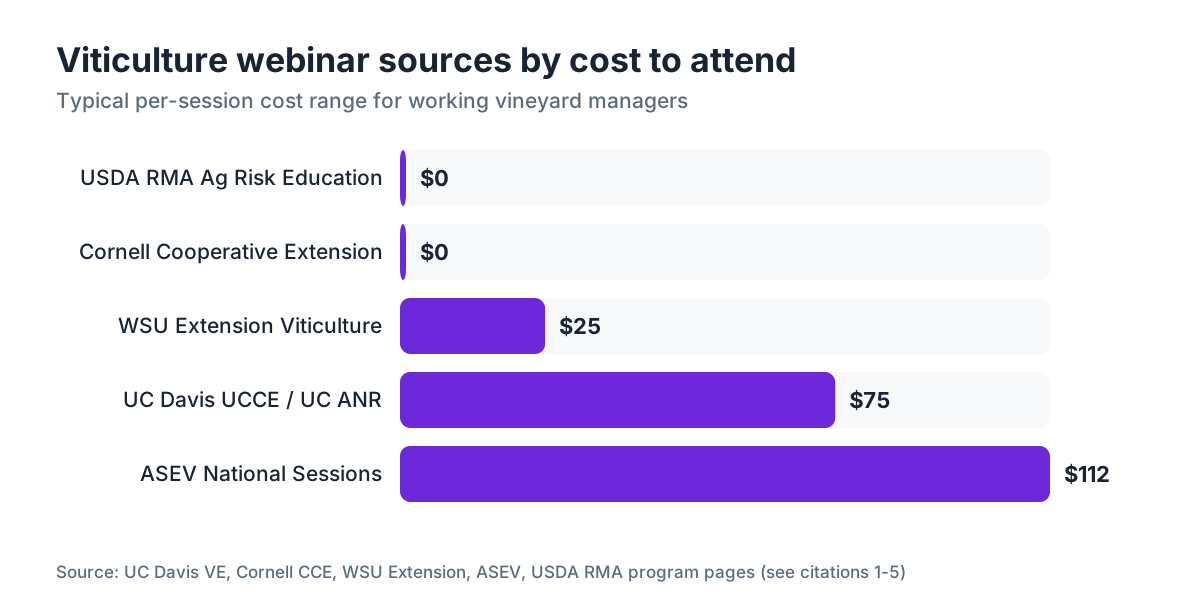
Here's a straight comparison of the three programs most growers in production regions will interact with.
| Program | Primary region served | Cost to attend | Archive access | CEU credit |
|---|---|---|---|---|
| UC Davis Viticulture & Enology Extension | California, Southwest | Free to low-cost ($0-$150) | Some sessions archived | CA DPR CEUs for select sessions |
| Cornell Cooperative Extension, Geneva | New York, Northeast | Mostly free | Partial archive via YouTube | NY DEC CEUs for select sessions |
| WSU Extension Viticulture | WA, OR, ID | Free to $50 | Yes, on WSU sites | WA and OR CEUs for select sessions |
| ASEV National | All US regions | Member rates $25-$200+ | Members only | CCA credits, select state CEUs |
| USDA RMA Ag Risk Education | All US regions | Free | Yes | None typically |
UC Davis runs the most polished production, which reflects its larger endowment and the economic scale of California wine. Cornell's content is often the most research-current, because the Geneva station is an active breeding and pathology site. WSU tends to be the most grower-practical, probably because its audiences are smaller and more hands-on in sessions.
None of them are perfect. UC Davis sometimes leans hard on California-specific spray materials and regulations that don't transfer to other states. Cornell's scheduling can be irregular. WSU's archive organization is inconsistent and things get buried. Worth knowing before you expect a tidy resource library.
What free viticulture webinar series are running right now?
An honest caveat first: webinar calendars change every season, and any list I give here goes stale within months. So I'm handing you the stable sources instead of a list that rots.
UC Cooperative Extension keeps regional advisors who announce upcoming events by listserv. Signing up for a UC ANR email list in your crop type (wine grapes, table grapes, raisins) is the most reliable way to hear about California sessions [11].
Cornell's viticulture and enology program posts upcoming events on its main site [2]. The New York Wine Industry Workshop, run by Cornell and NYSAES, is a major annual event with recorded sessions.
WSU Extension Viticulture runs a series called 'Viticulture Field Day' and associated webinars tied to its research calendar. The Viticulture and Enology team page lists upcoming events [3].
The California Association of Winegrape Growers (CAWG) and Wine Institute both push member-facing webinars, often on regulatory and legislative topics. Free for members, sometimes available afterward as recordings.
A newer source worth checking: the American Vineyard Foundation has funded research communication efforts that include webinar-style presentations from funded researchers. Less practical, more science-forward, but good if you're making varietal or rootstock decisions.
One thing worth doing once a year: search YouTube for your region's university extension plus viticulture plus the current year. Extension faculty post recordings inconsistently but freely, and you can learn a lot for zero cost and zero registration friction.
How do you evaluate whether a viticulture webinar is worth your time?
Two questions matter most. First, who is presenting and what is their actual work? A presenter who runs field trials in your climate zone is worth 90 minutes. A presenter whose bio reads 'industry consultant with 20 years of experience' but shows no research affiliation deserves more skepticism. Extension specialists and university researchers publish their work. You can look it up.
Second, what is the product relationship? Some webinars are educational. Others are sponsored by agrochemical companies or equipment makers and are mostly sales presentations with an educational wrapper. That's not inherently bad. You can learn real things from industry technical staff, but know what you're watching. Look for disclosure of sponsorships on the registration page.
For compliance-focused webinars, check that the content references current regulations. Pesticide rules in particular change. A 2021 webinar on WPS requirements may predate later revisions. Always cross-check against the current EPA WPS page [6] or your state ag department.
Runtime signals quality too. A serious technical webinar on powdery mildew forecasting runs 60 to 90 minutes with Q&A. A 20-minute webinar is usually a product pitch or a teaser for a paid course. Both can be useful. They're different things.
For vineyard managers at commercial operations, time is the real cost. Given the opportunity cost of your day, a 90-minute webinar earns its place if it changes a decision you'll make this season, whether about spray timing, a new rootstock, or a compliance requirement you didn't know was shifting.
What does the EPA Worker Protection Standard require for pesticide training in vineyards?
The EPA WPS requires agricultural employers to train all agricultural workers and pesticide handlers before they do any work in a vineyard where pesticides have been or will be applied [6]. Workers must be trained by an EPA-approved WPS trainer or through an EPA-approved video program. This is not a one-time certification. Workers must be retrained every year, within 12 months of their previous training.
The EPA revised WPS in 2015, with full compliance required by 2018. The current rule requires training to cover a set list of topics including pesticide safety information, labeling requirements, application restrictions, decontamination, and how to report suspected poisoning. Among the required topics, the rule directs employers to ensure training covers 'how to recognize and understand the meaning of the posted warning signs' for treated areas [6].
Webinars do not satisfy WPS training for workers unless the webinar uses EPA-approved materials and the employer can document that each worker actually received the training in a format the worker could understand, including language access. Many vineyard webinars covering spray safety are not WPS-approved training. They're supplemental education for managers and supervisors.
California has its own WPS-equivalent requirements under Title 3 of the California Code of Regulations and the Cal/EPA Department of Pesticide Regulation. California's rules are generally stricter than the federal minimums [7]. Oregon and Washington have adopted WPS with state-specific additions. Check your state's ag department for the current version.
The practical compliance step: keep a training log with worker names, dates, trainer name, and materials used. That log is the first thing an inspector asks for.
How do you build an annual viticulture continuing education plan using webinars?
Start with your hard compliance deadlines. If you hold a pesticide applicator license, find out your state's CEU renewal cycle and how many hours it wants. California requires 20 CEUs every two years for a Qualified Applicator License [7]. Washington requires 40 hours over a five-year period for commercial applicators. Map those requirements before you sign up for anything.
Once compliance is covered, think about the decision you most regret from last season. That regret usually points to a knowledge gap. If powdery mildew hit at a moment you thought you were covered, a disease modeling webinar earns priority. If labor efficiency felt low at pruning, find a canopy management or labor productivity session.
Plan for one to two webinars per month during the off-season (November through February) and one per month during the growing season. That's a realistic cadence without burning out or letting field work slip. More than that and retention drops, because you're watching without time to apply anything.
Keep a simple log: date, title, presenter, organization, runtime, CEUs if any, and one or two sentences about what you actually changed because of it. That last column is the accountability check. If the answer to 'what changed' is always blank, you're collecting information rather than using it.
Some of the most useful continuing education pairs a webinar with a farm visit. WSU Extension and many UCCE advisors do both. The webinar covers the concept, the farm walk shows you what it looks like in the field. When those two formats are available together, prioritize them.
Are there viticulture webinars specifically for small or diversified vineyards?
Yes, though they take some hunting. The USDA Sustainable Agriculture Research and Education (SARE) program funds outreach projects that often include webinars aimed at smaller and diversified operations, including organic and biodynamic practices [8]. SARE's website has a searchable database of funded projects with associated educational materials.
Practical Farmers of Iowa, though not wine-grape-focused, runs webinars on cover crops and soil health that transfer directly to vineyard floor management in cooler climates. eOrganic, a USDA-funded extension network, hosts archived organic viticulture webinars [9].
For small producers trying to understand both the farming and the business side, the Winegrowers of Dry Creek Valley and similar regional associations occasionally run webinars on direct-to-consumer compliance, tasting room operations, and wine club logistics. Those aren't viticulture in the strict agronomic sense, but they're real operational knowledge for small estate wineries.
Here's the honest reality for small vineyard owners: the major extension programs are built for commercial-scale growers with hundreds of acres and multiple spray rigs. The content still helps at 5 or 20 acres, but some recommendations won't scale down economically. The questions you'd bring to a webinar Q&A about small-parcel economics or hand-harvest logistics may not get the sharpest answers from a large-scale production researcher. Local grower associations and your county extension advisor will often serve you better for those.
How do you keep track of webinar attendance and training records for compliance audits?
The short version: treat webinar attendance records the way you treat spray application records. Make a file, physical or digital, and put every certificate, confirmation email, and quiz result in it. When an inspector or certification auditor asks for documentation, you want to hand over a folder, not dig through your inbox.
For CEU documentation specifically, most approved webinar providers generate a certificate after you finish the session and any required quiz. Download it immediately and save it in a dedicated folder by year. Some states allow online submission of CEU records to your pesticide applicator license account. When that's an option, upload as you go rather than in a batch before renewal.
For WPS training records, EPA and most state agencies require you to keep records for at least two years, and some states require longer. The record has to include the date of training, the trainer's name, the names of the workers trained, and the materials used. A webinar attendance certificate doesn't cover that for worker training. That's an internal record you create and maintain.
If you're managing spray records, field applications, and compliance documentation across multiple blocks or crews, a purpose-built tool helps. VitiScribe is built for vineyard compliance and field operations record-keeping, so training logs and spray records live in the same system. That matters at audit time, when an inspector wants a full compliance picture rather than piecemeal printouts.
For multi-property operations, or anyone with more than a handful of employees, run an internal audit of your training records in January or February, before the season starts. Pull every name, check that WPS training is current, verify applicator licenses haven't lapsed, and confirm any CEU deadlines coming up this year are on your calendar. It saves grief later.
What do viticulture researchers say about online learning effectiveness for growers?
The honest answer is that the research base here is thin. Most studies on agricultural extension effectiveness measure in-person programs. Nobody has great data specifically on viticulture webinar impact on grower decision-making. The closest relevant literature comes from broader agricultural extension research.
A 2019 study in the Journal of Extension found that online agricultural extension programs reached a broader geographic audience but scored lower on knowledge retention and behavior change than in-person workshops, measured 90 days after training [10]. The gap narrowed when online sessions included interactive Q&A and follow-up resources.
Extension specialists at land-grant universities have noted in published proceedings that webinar attendance spikes during disease pressure events, when growers are actively worried and seeking answers, and again during the winter off-season planning period. That seasonal pattern suggests growers use webinars most when they have an immediate decision to inform.
The practical takeaway: if you're attending just to collect CEU credits and have no current decision the content touches, retention will be low. That's not a character flaw. It's how adult learning works. Try to connect each webinar to something you'll do differently. Jotting one action item at the end of a session, even something small like 'check current WPS training dates for crew' or 'look at the block 4 canopy before the next morning scout', improves whether the learning sticks.
Frequently asked questions
Are UC Davis viticulture webinars free?
Many UC Davis Cooperative Extension viticulture events are free or low-cost, particularly those run by regional farm advisors through UC ANR. Some short courses and certificate programs through the UC Davis continuing education division carry fees of $50 to several hundred dollars. Check the UC ANR event calendar and the UC Davis Department of Viticulture and Enology continuing education page for current pricing.
Do viticulture webinars count for pesticide applicator license renewal?
Only if the webinar is pre-approved by your state's department of agriculture for continuing education units. Approval is state-specific. California, Washington, and Oregon each maintain lists of approved providers. The webinar registration page should state whether CEU credit is available and for which state. If it doesn't say, ask before registering. Keep your completion certificate in case your state requires documentation at renewal.
What is the EPA Worker Protection Standard and how does it affect vineyard training requirements?
The EPA Worker Protection Standard (40 CFR Part 170) requires vineyard employers to train all agricultural workers and pesticide handlers annually using EPA-approved materials. Workers must be retrained within 12 months of prior training. Most commercial viticulture webinars do not satisfy WPS training requirements; they're supplemental education for managers, not the required worker safety program that has to use approved curriculum.
Which university extension program has the best viticulture webinar archive?
WSU Extension Viticulture and Cornell Cooperative Extension both keep accessible archives. WSU has more recordings tied to Pacific Northwest spray programs and production practices. Cornell's Geneva station archives lean toward disease research and Northeast cultivar trials. UC Davis has strong materials but access to archived sessions varies by program. Searching YouTube for '[university name] viticulture extension' often surfaces free recordings that aren't formally indexed.
How many CEUs do I need to renew a California pesticide applicator license?
California requires 20 continuing education units every two years to renew a Qualified Applicator License or Certificate, administered by the California Department of Pesticide Regulation. At least two of those CEUs must be in laws and regulations. Some categories require additional specific-topic hours. Approved courses have to be completed before license expiration; there's no grace period for CEU shortfalls under CDPR rules.
Can I get viticulture webinar training for organic vineyard practices?
Yes. The eOrganic network, funded through USDA, archives webinars specifically covering organic crop production including viticulture. USDA SARE funds outreach that includes organic and sustainable small-farm content. UC Davis, WSU, and Cornell each carry organic and sustainable viticulture content within their broader programs, though dedicated organic webinar series run less often than conventional production topics.
Are there free viticulture webinars for small vineyard owners with fewer than 10 acres?
Extension webinars are open to growers of any size and most are free. Content skews toward commercial-scale production, so not every recommendation translates to small parcels. USDA SARE and eOrganic tend to have more small-farm-relevant material. Local grower association webinars, when available, are often better calibrated to smaller operations. Your county farm bureau or local winegrape association may run sessions specifically for small producers.
What's the difference between a viticulture webinar and a viticulture short course?
Webinars are typically a single session of 60 to 120 minutes covering one topic, usually free or very cheap, with live Q&A and sometimes archived afterward. Short courses run multiple sessions over days or weeks, carry a fee from a few hundred to several thousand dollars, often include assessments and formal certificates of completion, and are built for structured professional development rather than a single operational question.
How do I document webinar attendance for a compliance audit?
Save your registration confirmation and any attendance certificate or completion email the platform generates. For CEU purposes, also record the session title, presenter name, sponsoring organization, date, duration, and number of CEUs awarded. Store these in a dedicated folder by calendar year. If your state allows online CEU record submission to your applicator license account, upload as you go rather than in a batch before renewal.
Do viticulture webinars cover spray record keeping and compliance?
Some do. Pesticide recordkeeping requirements are a regular topic in extension webinar series because regulations change and compliance errors carry real penalties. California DPR, Washington WSDA, and Oregon ODA all require licensed applicators to keep application records; extension webinars periodically cover these. Spotted lanternfly, new pesticide registrations, and WPS recordkeeping updates have driven dedicated compliance-focused sessions in recent years.
Are ASEV webinars worth the membership cost for vineyard managers?
It depends on your role. ASEV content runs toward enology and viticulture research, peer-reviewed science, and national-level technical topics. If you're deciding on variety selection, rootstocks, or novel practices and want current research, ASEV membership is worth it. If your work is mostly field operations and spray compliance, the free extension webinars from UC Davis, Cornell, or WSU will serve you better for lower cost.
Where can I find viticulture webinars about spotted lanternfly or new pest threats?
Cornell Cooperative Extension has been the lead land-grant source for spotted lanternfly (SLF) viticulture guidance, given the pest's spread in the Northeast and mid-Atlantic. Penn State Extension has run dedicated SLF-viticulture webinars too. USDA APHIS posts management resources and has coordinated grower outreach sessions. For Western pests like vine mealybug or grape leafroll virus vectors, UC Davis ANR and WSU Extension are the go-to sources.
Can vineyard employees watch viticulture webinars on behalf of the operation?
For general education, yes. For CEU credit, the licensed pesticide applicator whose license is being renewed must personally attend and complete any required verification. A vineyard manager cannot transfer CEU credit to an absent employee. For WPS training, each worker has to receive the training; one employee watching a webinar while others are absent does not satisfy the requirement for the absent workers.
Sources
- UC Davis Department of Viticulture and Enology, Extension Programs: UC Davis Viticulture and Enology offers public extension programs and continuing education for vineyard professionals
- Cornell Cooperative Extension, Viticulture and Enology Program: Cornell Cooperative Extension runs viticulture and enology programming including the New York Wine Industry Workshop
- Washington State University Extension, Viticulture and Enology: WSU Extension hosts viticulture webinars for Pacific Northwest growers, often free to Washington and Oregon attendees
- American Society for Enology and Viticulture (ASEV): ASEV holds national symposia and online technical sessions with archived content for members
- USDA Risk Management Agency, Ag Risk Education: USDA RMA runs free educational webinars for growers on crop insurance and climate risk
- EPA Worker Protection Standard, 40 CFR Part 170: WPS requires annual training of agricultural workers and handlers covering required topic areas; workers must be retrained within 12 months of previous training
- California Department of Pesticide Regulation, Continuing Education: California requires 20 CEUs every two years to renew a Qualified Applicator License, with at least 2 CEUs in laws and regulations; CDPR maintains a list of approved courses
- USDA Sustainable Agriculture Research and Education (SARE): USDA SARE funds outreach projects including webinars for small and diversified operations covering organic and sustainable practices
- eOrganic, USDA-funded Extension Network: eOrganic archives webinars on organic crop production including viticulture topics
- Journal of Extension, Vol. 57 No. 2, 2019: Online agricultural extension programs reached broader audiences but scored lower on knowledge retention and behavior change vs. in-person workshops at 90-day follow-up; gap narrowed with interactive Q&A and follow-up resources
- UC Agriculture and Natural Resources (UC ANR), Events and Webinars: UC ANR publishes regional advisor event listings and email listservs for wine grape, table grape, and raisin growers in California
Last updated 2026-07-09