VSP trellis system: how it works and whether it fits your vineyard
TL;DR
- Vertical shoot positioning (VSP) trains grapevine shoots upward between pairs of foliage wires, making a narrow, well-exposed canopy wall.
- It's the default trellis in cool climates and the standard for Bordeaux varieties and Pinot Noir.
- Setup runs $4,000 to $8,000 per acre for materials and labor.
- VSP works best on moderate-vigor sites.
- On high-vigor ground it makes shading problems it can't solve on its own.
What is a VSP trellis system and how does it actually work?
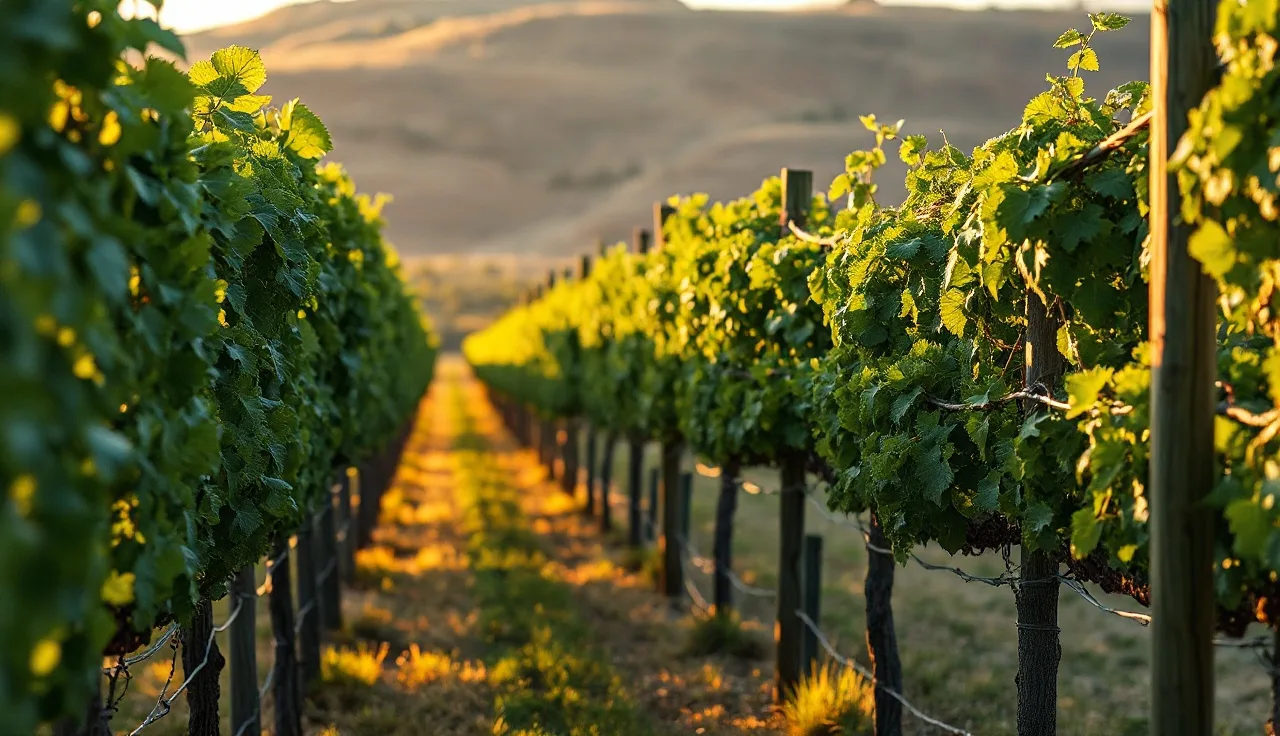
Vertical shoot positioning is a trellis and training method where the vine's shoots grow straight up and get held in place by pairs of movable foliage wires. The result is a narrow, flat canopy wall facing the sun. The fruiting zone sits on a cordon wire, usually 30 to 40 inches off the ground, and everything above it trains vertically to heights of 40 to 60 inches depending on row orientation and variety [1].
The mechanics are simple. Shoots get tucked between two pairs of catch wires (the first and second foliage wire sets), spaced 10 to 14 inches apart vertically. Once shoots are established, gravity and the wires do most of the work. The canopy that results is roughly 12 to 18 inches deep front to back. That's narrow enough for sunlight to reach the interior and for a standard airblast sprayer to actually get inside.
Most VSP vineyards are bilateral cordon trained. The cordon extends in both directions from the trunk along the fruiting wire, with spurs or canes spread along it. Cane-pruned VSP is common too, especially in cooler regions with heavier disease pressure, where growers want more control over bud count per vine.
The systematic description of VSP as a defined system came mostly out of research in Burgundy and Germany, where low-vigor, high-density planting demanded efficient light interception in short seasons [2]. UC Davis and Cornell extension both point to it as the default choice for cool to moderate climates and moderate-vigor varieties [3][4].
What are the main components of a VSP trellis and what does each part do?
A VSP trellis has seven or eight working parts. Get any one wrong and the problems compound over the whole life of the vineyard.
| Component | Typical spec | Function |
|---|---|---|
| End post (anchor) | 4-6" diameter, 8-10 ft treated wood or metal | Anchors row tension; takes most lateral load |
| Line post | 3-4" diameter, 7-8 ft | Supports wire intervals along row |
| Deadman anchor | buried log or plate, or screw anchor | Counteracts end-post pull |
| Fruiting wire | 9-12 gauge high-tensile | Supports cordon and fruit; lowest permanent wire |
| Foliage wires (pairs) | 12-14 gauge, 2 pair minimum | Capture and hold upright shoots |
| Staples or clips | galvanized or stainless | Attach wires to posts at correct height |
| Tensioners (in-line strainers) | galvanized or stainless turnbuckles | Maintain wire tension as wires expand and contract |
Post spacing runs 20 to 24 feet in most vineyards. Tighter spacing (16 to 18 ft) helps on hillside rows where soil creep is a concern. End-post bracing matters more than most growers expect. A poorly braced end post is the most common cause of trellis failure in the first few years after planting [5].
Foliage wire pairs are often movable, riding on wire clips or snap-on holders so you can drop them during dormant pruning and raise them as shoot growth advances in spring. Fixed foliage wires work, but they make early-season tucking harder when shoot length is uneven.
High-tensile wire (Class 3 galvanized, minimum) earns its slightly higher cost. It holds tension longer and resists corrosion better than standard wire. On coastal or high-humidity sites, stainless hardware at the end posts pays for itself.
How much does it cost to install a VSP trellis system per acre?
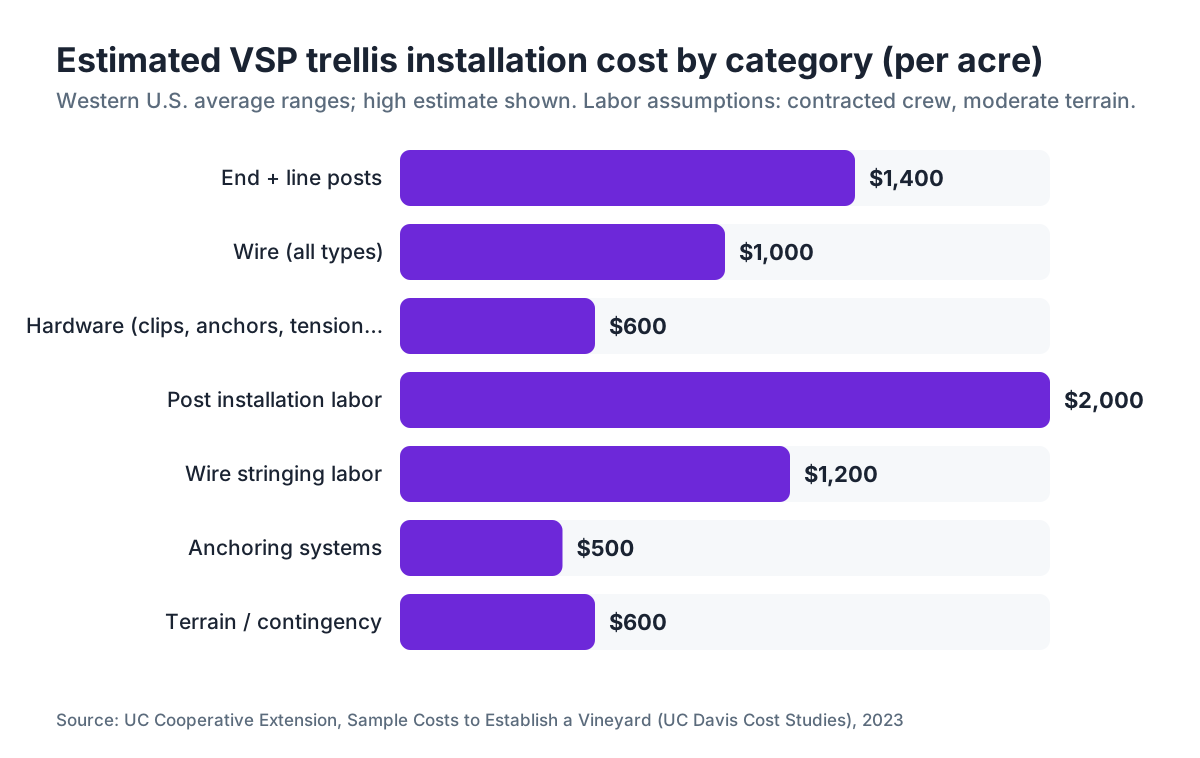
A complete VSP trellis in the western U.S. runs $4,000 to $8,000 per acre for materials and contracted labor combined [6]. Costs swing with region, terrain, and how much of the work you do yourself. Here's roughly how that breaks down:
| Cost category | Low estimate ($/acre) | High estimate ($/acre) |
|---|---|---|
| Posts (end + line) | 800 | 1,400 |
| Wire (all types) | 600 | 1,000 |
| Hardware (anchors, clips, tensioners) | 300 | 600 |
| Post driving and installation labor | 900 | 2,000 |
| Wire stringing and tensioning labor | 600 | 1,200 |
| Anchoring systems | 200 | 500 |
| Contingency / terrain surcharge | 200 | 600 |
Sloped ground adds 20 to 40% to labor. Rocky soils that need pneumatic or hydraulic post drivers add equipment rental on top. Organic vineyards sometimes pay a premium for untreated wooden posts when they're avoiding CCA (chromated copper arsenate) preservatives.
Those figures assume 10 to 12 foot rows and standard post spacing. High-density planting (closer rows, more posts) pushes materials cost up proportionally.
The budget line that catches people is ongoing trellis maintenance. Figure $150 to $400 per acre per year for wire re-tensioning, broken post replacement, clip replacement, and foliage wire adjustment [6]. It sounds like nothing. But a neglected trellis loses tension over three to five years and creates canopy problems that cost more to fix than the maintenance would have.
What are the real advantages of VSP over other trellis systems?
Spray penetration is VSP's biggest practical win. A narrow, vertical canopy wall presents its leaf surface evenly to an airblast sprayer running down the row, so timing, nozzle angle, and air volume dial in predictably. On a sprawl or Geneva Double Curtain system, you're guessing. On VSP you can measure canopy depth with a stick and know within a few inches whether your spray is reaching the interior.
Sunlight distribution is the second real win. Shoots trained upright and separated keep the fruiting zone below the dense upper canopy, so clusters get morning sun and afternoon shade. That matters for anthocyanin development in reds and acid retention in whites [3].
Mechanical work gets easier. Leaf removal, shoot thinning, hedging, and hand harvest all happen in a defined zone. Mechanical harvesters run well on VSP because the fruit zone sits at a predictable height. Canopy-management labor per acre usually runs lower on VSP than on sprawl, partly because nobody's hunting for clusters buried in a wall of leaves.
For record-keeping, the consistent canopy geometry makes spray records more defensible. When your pesticide application log needs to reflect actual canopy coverage and buffer-zone compliance, a VSP block gives you a stable baseline. Tools like VitiScribe are built around exactly this kind of block-by-block record structure, where canopy system is a field attribute tied to your spray program and worker protection records.
Last one: crews already know VSP. Training workers on tucking, shoot positioning, and hedging goes faster than teaching them Scott Henry or Smart-Dyson. In a tight labor market, that's real money.
What are the real disadvantages and when should you not use VSP?
VSP fails on high-vigor sites. Extension advisors say this constantly and growers still ignore it when they're in love with a variety that pushes four feet of shoot growth before June. With that much vigor, the canopy closes fast, the interior goes dark, shoots climbing above the top wire flop over and shade the fruit, and you get exactly the overcrowded canopy VSP was supposed to prevent. More leaf pulling and hedging doesn't fix it. It just triggers lateral growth that closes back up in two weeks [4].
On high-vigor ground, a divided canopy system (Smart-Dyson, Scott Henry, or Lyre, depending on row width and variety) is a better place to start. You can also work on vigor through rootstock choice, cover cropping to compete for water and nitrogen, or deficit irrigation, but those take years to dial in.
Hot, low-humidity climates where fruit needs afternoon shade to dodge sunburn are another weak spot. The west face of a VSP canopy can expose clusters to direct afternoon sun for three to five hours, depending on row orientation. East-west rows in the San Joaquin Valley are a common case where growers have backed away from VSP or hung shade netting on the west wire.
VSP also asks for more shoot-positioning labor than sprawl or GDC. In regions with chronic labor shortages and high wages, those extra passes add up. Washington State University extension reports canopy-management labor running 30 to 50% higher on VSP than on mechanically managed GDC on high-vigor sites [5].
Row spacing matters too. VSP canopies need about 4.5 to 5 feet of open air and light between adjacent canopy faces. In vineyards with rows tighter than 8 feet, VSP creates so much mutual shading between rows that a divided system serves you better.
How do you set up the wire heights for a VSP trellis?
Set wire heights relative to the cordon, not the ground. Ground elevation shifts along a sloping row, but the vine's physiology doesn't care about elevation. Here's the standard layout for most VSP configurations:
| Wire | Height above ground (typical) | Notes |
|---|---|---|
| Fruiting wire (cordon wire) | 30-40 inches | Lower on hot sites (35"), higher on frost-prone sites (40") |
| First foliage wire pair | 12-16 inches above fruiting wire | First catch point for emerging shoots |
| Second foliage wire pair | 10-14 inches above first pair | Holds mid-length shoots |
| Top wire (optional) | 8-12 inches above second pair | Used on tall trellis systems, max canopy height 60" total |
Many vineyards run two foliage wire pairs and a single top wire for a total trellis height of 60 to 65 inches from the ground. That gives you enough vertical room to manage 36 to 40 inches of shoot growth without the tips flopping.
Cordon height drives frost risk. Cornell research on cool-climate regions recommends setting the cordon no lower than 36 inches on sites with documented spring frost risk, because cold air pools near the ground and the first foot above the soil stays coldest. Going to 40 inches adds some protection. The tradeoff is that cluster height rises too, which changes harvest logistics on sloped rows.
The most common install mistake is setting foliage wire spacing too wide. When the gap between the fruiting wire and the first foliage pair runs past 18 inches, shoots have to grow through open space before anything supports them, so they blow around and cross over in wind and tangle. Twelve to fourteen inches between pairs is the practical sweet spot for most varieties with normal internode length.
How do you prune a VSP trellis: cane vs. spur?
Both cane and spur pruning work on VSP. The choice comes down to variety fit and disease management more than anything else.
Spur pruning is simpler mechanically and takes to mechanical pre-pruning. You leave two-bud spurs spaced 4 to 6 inches apart along the cordon. It's the dominant approach for Cabernet Sauvignon, Merlot, Syrah, and other varieties where primary buds are fruitful at positions 1 and 2. It's also easier to train crews to do consistently.
Cane pruning renews the fruiting zone every year. You replace the whole cane, taking a new one from a renewal spur near the head or cordon junction. For Pinot Noir, Grenache, and Riesling, where basal bud fruitfulness runs low and fruitfulness improves at nodes 3 through 8, cane pruning consistently outyields spur pruning in cool climates [3]. UC Davis trials on Pinot Noir in Carneros found 15 to 25% higher yields with cane pruning over matched spur-pruned vines, though the gap narrowed after vine age ten as the spur systems matured.
The trade-off is skilled labor. Cane pruning means selecting, tying, and positioning one or two long canes per vine, each laid along the fruiting wire and secured before shoots emerge. Machines exist (cane-tying rigs, pneumatic ties), but they're hard to justify on small acreage.
Match bud count per vine to your yield target and your site's average cluster weight, not some default number from a textbook. Work backward: target tons per acre, to clusters per vine, to buds per vine, adjusting for typical bud break percentage and crop per shoot. Most VSP vineyards in the 2 to 4 ton per acre range target 30 to 50 buds per vine. That range is wide enough to be nearly meaningless without site data.
How does VSP affect spray coverage and pesticide application records?
VSP's narrow, uniform canopy is one of its biggest practical advantages for spray management. An airblast sprayer dialed in for a VSP block delivers more consistent internal coverage than on sprawl or divided canopy systems, because the target geometry stays predictable row to row.
The EPA Worker Protection Standard requires pesticide application records to include the application site, the product applied, the restricted-entry interval (REI), and related information [7]. In VSP vineyards, documenting spray coverage by block is cleaner because canopy depth and height hold steady, so your records map straight to block boundaries without noting different canopy conditions inside a single block.
For fungicide programs, VSP's uniform canopy depth lets you calculate spray volume per acre with reasonable accuracy using the tree-row-volume (TRV) method, which accounts for canopy height and width. The UC IPM program documents this calculation and recommends it for calibrating sprayers in vertical canopy systems [8]. When your spray records reference a documented canopy geometry and a calibrated sprayer output, they hold up better under state agricultural department audits.
REIs matter for VSP because shoot tucking and foliage wire work put crews in close contact with the canopy over and over through the season. Any REI on a fungicide or insecticide applied to a VSP block applies to those activities, not only to harvest. Make sure crew supervisors know which REIs cover canopy contact. Cornell's pesticide safety education materials break down task-specific REI requirements clearly [9].
If you're tracking spray records across VSP blocks with different canopy heights (say, one block at 54 inches and another at 62), keep them as separate records, not an average. The canopy attribute changes your spray volume calculation and belongs as a field in your record-keeping system.
What row orientation works best for VSP?
North-south rows are the standard recommendation for VSP in most wine regions because they spread sunlight more evenly across both faces of the canopy through the day [2]. East-west rows leave the north face in near-permanent shade in the northern hemisphere. That's fine on very cool, high-latitude sites but creates fruit-quality problems across most of California, Oregon, and Washington.
The qualifier: terrain usually beats the ideal orientation. If your slope runs east-west, running rows up-and-down the slope for erosion control and equipment access will likely override north-south. Drainage and erosion are real agronomic constraints, not afterthoughts.
Wind direction matters too. Rows set perpendicular to prevailing winds see more shoot blow-over and wire damage than rows running with the wind. In coastal California and much of the Columbia Valley, where afternoon winds are strong and steady, orienting rows parallel to the wind cuts foliage-wire maintenance a lot.
On shoot-tip damage specifically: VSP canopies taller than 50 inches on windy sites get chronic tip damage and lateral proliferation from the beating, which adds canopy labor. If strong wind is a site reality, keep trellis height conservative (50 to 55 inches max) or plant wind breaks at the end rows.
How does VSP compare to other common trellis systems?
Trellis choice is one of the most consequential decisions in vineyard establishment, because switching systems after year three costs far more than getting it right at planting. Here's an honest comparison:
| System | Best for | Weakness | Relative setup cost |
|---|---|---|---|
| VSP | Moderate-vigor varieties, cool climates, mechanized harvest | Fails on high-vigor sites | Baseline (1x) |
| Geneva Double Curtain (GDC) | High-vigor sites, wide rows | Labor-heavy canopy management, weak for reds | 1.2-1.4x |
| Scott Henry | High-vigor, quality-focused, mid-wide rows | Complex training, demands skilled labor | 1.3-1.5x |
| Smart-Dyson | Very high vigor, California reds | Expensive, needs tall posts | 1.5-1.8x |
| Lyre (U-trellis) | High-vigor, warm climates | Very wide rows required, expensive | 1.6-2.0x |
| High bilateral cordon (sprawl) | Arid, water-limited sites | Poor spray penetration, irregular ripening | 0.7-0.9x |
VSP is the right default for most new plantings in the Pacific Northwest, California Coast, New York, and Virginia. It's not the flashiest option. But it has the deepest research behind it and the most widely trained workforce available to run it [3][4][5].
For growers in the vineyard establishment phase, the honest advice is to choose VSP unless you have a specific, documented reason not to. A vigor assessment showing NDVI or shoot growth beyond what VSP can handle counts. So does a climate and variety combination where research clearly favors something else. Swapping trellis systems after establishment is a multi-year, $2,000 to $5,000 per acre project.
What do you need to know about maintaining a VSP trellis long-term?
Most VSP trellises last 20 to 30 years if the end posts are sound, the wire is high-tensile, and tension gets maintained every year. The parts that fail first are the end-post anchors, the clip or staple connections on line posts, and the foliage wires, which stretch under mechanical hedgers and repeated tucking.
Annual inspection should check wire tension with a tensionometer or a simple deflection test (standard references call for under 1 inch of deflection per 5 feet of unsupported wire span). Retension fruiting wires before bud break each year. They lose tension over winter from contraction. Foliage wires need a look after each mechanical hedging pass, because the hedger puts lateral force on the wire-to-post connections.
Post rot is the other failure mode. Even treated posts rot at the soil line over 15 to 20 years in heavy soils with poor drainage. When you're replacing posts, go up a diameter if you can (4-inch to 5-inch) and think about switching to steel T-posts or round steel for line posts in the replacement row. Steel lasts effectively forever and the cost difference is small at replacement scale.
Logging your trellis install year, post type, wire gauge, and repair history by block isn't glamorous. It gets genuinely useful when you're budgeting capital repairs. VitiScribe's block record structure lets you keep trellis specs alongside your spray and harvest records, so the data is there when you need it instead of lost in a folder.
For vineyards in the paso robles wineries region or other warm, dry climates, UV degradation of plastic clips and foliage wire holders is a real problem. High-UV sites should run UV-stabilized or stainless hardware from the start. Replacing clips on a 20-acre vineyard mid-season is a miserable job.
Frequently asked questions
What does VSP stand for in viticulture?
VSP stands for vertical shoot positioning. It's a training and trellis system where grapevine shoots get guided upward between pairs of catch wires, making a narrow, vertical canopy wall. The term is standard across university extension literature and growers use it interchangeably in California, Oregon, Washington, New York, and most major U.S. wine regions.
How many foliage wires does a VSP trellis need?
A standard VSP trellis uses two pairs of foliage wires (four wires total) above the fruiting wire. Some tall-trellis setups add a fifth wire at the top to hold shoot tips. The pairs sit 10 to 14 inches apart vertically and work by sandwiching shoots between the two wires in each pair. Fewer than two pairs leaves too much shoot length unsupported.
Can you convert an existing sprawl vineyard to VSP?
Yes, but it takes three to five years and costs $1,500 to $3,500 per acre in labor and materials, depending on how much trellis infrastructure is already there. The bigger constraint is vine training. Cordons grown to sprawl need repositioning or replacement, which sets back vine age and delays full production. It's worth doing on high-value blocks, harder to justify on volume blocks.
What varieties are best suited to VSP?
VSP works well with moderate-vigor varieties where basal bud fruitfulness is reasonable: Cabernet Sauvignon, Merlot, Chardonnay, Sauvignon Blanc, Pinot Gris, Riesling, and Syrah are the most common. Naturally high-vigor varieties like Grenache, Zinfandel, or Sangiovese on rich soils can work on VSP with aggressive canopy management but often do better in divided systems. Rootstock affects vigor as much as variety does.
How does row spacing interact with VSP performance?
VSP canopies need roughly 4.5 to 5 feet of open air and light between adjacent canopy faces to avoid inter-row shading. Row spacings tighter than 8 feet tend to create shading in a standard VSP setup. For 7-foot rows, you'd hold trellis height to 48 to 50 inches or switch to a divided system. Most new VSP plantings target 9 to 10 foot rows in the western U.S. for equipment access and adequate light.
When should you start shoot tucking in a VSP trellis?
Start tucking when shoots reach 8 to 12 inches above the fruiting wire, usually when they can reach the first foliage wire pair. In most regions that lands around the 8 to 12 leaf stage. Earlier tucking is gentler on shoots and cuts wind damage, but it means more passes as growth continues. Most experienced VSP managers plan two to three tucking passes per season, with the first the most labor-heavy.
Does VSP work for organic vineyards?
Yes, and VSP's spray penetration is especially valuable in organic programs where contact fungicides like copper and sulfur need physical coverage to work. The narrow, open canopy cuts the number of spray passes needed for adequate coverage. One catch for certified organic operations: if you're avoiding CCA-treated wooden posts, source untreated or alternative-treated posts (borate-treated, for instance) and budget for their shorter lifespan.
What is the difference between VSP and high cordon training?
High cordon (or high bilateral cordon) sets the cordon wire at 5 to 6 feet and lets shoots hang down, the opposite of VSP. It suits high-vigor varieties in warm, arid regions where natural shoot drooping makes a curtain-style canopy. VSP trains shoots upward from a lower cordon. High cordon is simpler and cheaper to establish but ripens less evenly in most cool-to-moderate climates and is harder to spray well.
How does VSP affect frost risk?
VSP's cordon height, typically 30 to 40 inches off the ground, lifts the fruiting zone above the coldest air layer at ground level during radiation frost. Cornell extension recommends a minimum cordon height of 36 inches on frost-prone sites for this reason. A 40-inch setting offers modestly more protection. VSP doesn't prevent frost damage on its own. Overhead irrigation frost protection or wind machines are still needed on vulnerable sites.
What spray equipment calibration is needed for VSP blocks?
The tree-row-volume (TRV) or canopy volume method is the standard calibration approach for VSP. You measure canopy height and width, calculate volume per acre, and scale sprayer output to it. UC Cooperative Extension and the UC IPM program document this method. For a typical VSP canopy of 36 inches tall by 12 inches wide, TRV-based calibration usually lands at 50 to 100 gallons per acre applied volume, depending on pest pressure and label requirements.
Do you need a permit to install a VSP trellis?
In most U.S. jurisdictions, trellis installation needs no building or grading permit if posts stay under a certain height (usually 6 to 8 feet) and the structure is agricultural. Some counties in California, Oregon, and Washington may require a grading permit if installation moves significant soil or the vineyard sits in an erosion-hazard area. Check with your county agricultural commissioner and planning department before installing on slopes over 15%.
How does VSP interact with mechanical harvesting?
VSP is one of the best trellis systems for mechanical harvest because the fruit zone sits at a fixed height along the fruiting wire, making harvester head positioning predictable. Spur-pruned VSP with a well-established cordon harvests cleanly. The main headaches are excessive canopy density, which traps clusters, and loose foliage wires that snag the harvester head. Annual trellis maintenance directly affects mechanical harvest efficiency.
What is the typical lifespan of a VSP trellis system?
A well-installed VSP trellis using Class 3 galvanized high-tensile wire and pressure-treated or steel posts typically lasts 20 to 30 years before major structural replacement. Foliage wires and clips need replacement on a 7 to 12 year cycle. End post anchors and treated wooden posts at the soil line are the most common early failures, usually showing rot or anchor failure at 15 to 20 years in heavy soils or high-moisture climates.
Sources
- UC Davis Viticulture and Enology, Canopy Management Overview: VSP trains shoots vertically between foliage wire pairs, with fruiting wire at 30-40 inches and total canopy height to 60 inches
- Wine Business Monthly / Smart & Robinson, Sunlight into Wine (primary viticulture reference): VSP system origins in Burgundy and Germany research on light interception in low-vigor, high-density plantings
- UC Cooperative Extension, Vineyard Establishment and Trellis Design: UC Davis recommends VSP as default for cool to moderate climates with moderate-vigor varieties; Pinot Noir cane pruning trials showed 15-25% yield advantage
- Cornell Cooperative Extension, Viticulture Program, Trellis and Training Systems: Cornell recommends cordon height minimum 36 inches in frost-prone sites; VSP recommended for cool-climate varieties of moderate vigor
- Washington State University Extension, Trellis Systems for Pacific Northwest Vineyards: Labor costs for canopy management 30-50% higher in VSP than mechanically managed GDC on high-vigor sites; poor end-post bracing is most common early trellis failure
- UC Cooperative Extension, Sample Costs to Establish a Vineyard, Napa County: Complete VSP trellis installation costs range $4,000-$8,000 per acre; ongoing maintenance budget $150-$400 per acre per year
- EPA Worker Protection Standard for Agricultural Pesticides: WPS requires pesticide application records include application site, product applied, REI, and related information; REIs apply to canopy contact activities including shoot tucking
- UC IPM Program, Sprayer Calibration Using the Tree Row Volume Method: UC IPM documents tree-row-volume (TRV) calibration method for vertical canopy systems including VSP, recommending 50-100 gallons per acre applied volume for typical VSP canopies
- Cornell Pesticide Safety Education Program, Worker Protection Standard Training Materials: Cornell PSEP documents task-specific REI requirements including canopy contact activities like shoot tucking and foliage wire manipulation
- USDA National Agricultural Statistics Service, Grape Acreage Report: VSP is the dominant trellis system reported across wine grape acreage in California, Washington, and Oregon in USDA acreage surveys
Last updated 2026-07-09