Western grapeleaf skeletonizer outbreak documentation and response records
TL;DR
- Western grapeleaf skeletonizer (Harrisina brillians) can strip a block in days.
- A defensible outbreak file has dated scouting logs, a pest ID with a photo or specimen, spray records that meet EPA Worker Protection Standard rules, and a post-treatment efficacy note.
- California and Arizona counties may want notification.
- Keep records at least three years, five if you're certified organic.
What is western grapeleaf skeletonizer and why does it hit so fast?
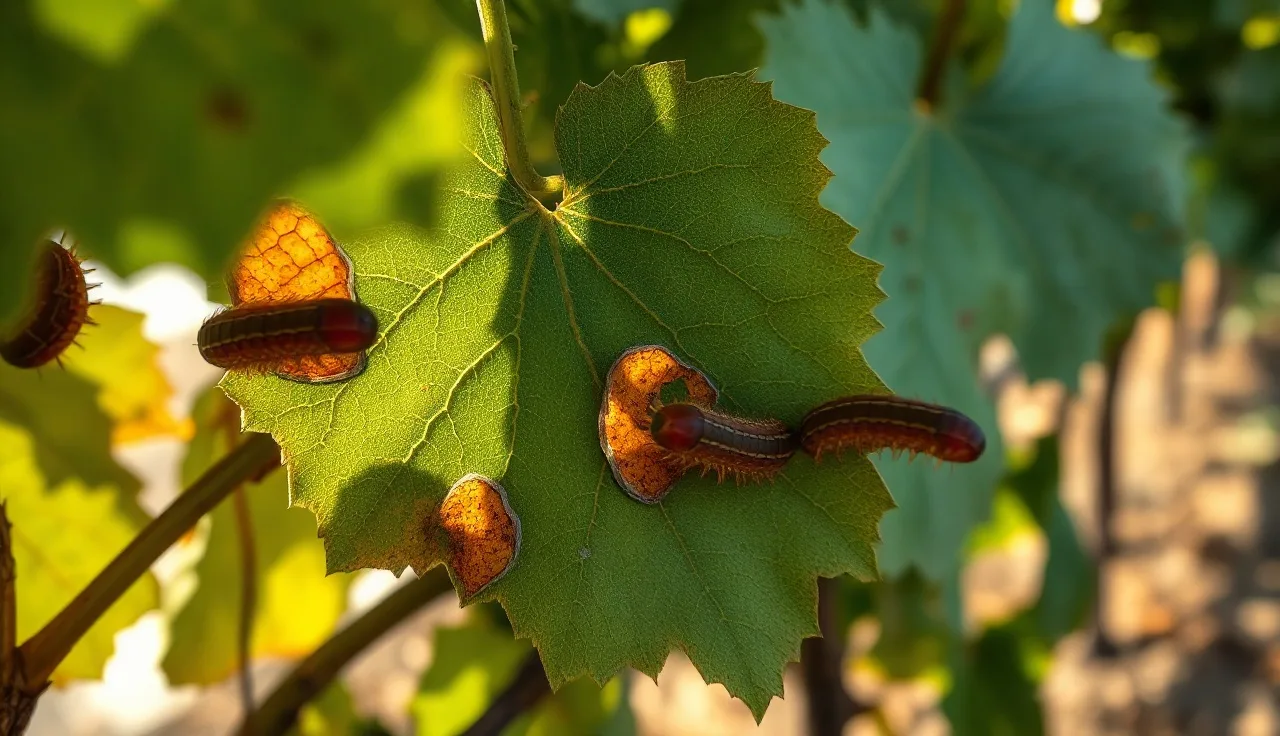
Western grapeleaf skeletonizer (Harrisina brillians) is a moth whose larvae feed shoulder to shoulder, scraping tissue from the underside of a leaf until only the papery upper epidermis is left. That translucent window is the tell. On a warm summer day a colony of late-instar larvae can strip nearly all the photosynthetic tissue off a shoot in 24 to 48 hours. [1]
The insect overwinters as a pupa in bark crevices and vineyard debris, and adults start flying in late spring. Two or three generations build through a season in California's interior valleys and Arizona's desert wine regions. The first generation slides by unnoticed because small early-instar larvae do less obvious damage and cluster deep in the canopy. By the time a manager spots the skeletonized patches that name the pest, the colony is usually third-instar or later and feeding rates have jumped.
The larvae carry urticating hairs that irritate skin on contact, which matters for your Worker Protection Standard records and your re-entry interval documentation. UC IPM notes the hairs can cause "a burning skin rash" in workers who handle infested foliage. [2]
For growers in southern California and the desert Southwest, this is no once-a-decade surprise. It's a routine scouting target from May through September.
What should a scouting log for grapeleaf skeletonizer actually contain?
Your scouting log is the first document anyone asks for. If an outbreak later sets off a worker comp claim, a neighbor complaint, or a county ag department inquiry, those dated entries are what prove you were watching, that you named the pest correctly, and that you acted inside a reasonable window.
Each entry should carry the date and time of scouting, the block identifier, the variety and row range covered, the name of the person scouting, the life stage observed (egg mass, first-instar cluster, late-instar, adult moths), an estimated percent of vines infested or damaged, and photo file names or attachment references.
For skeletonizer, note the generation. First-flight adults look almost identical to second-generation adults, but treatment timing and expected residual differ. If you're not sure on generation ID, a specimen sent to your county UC Cooperative Extension farm advisor or the CDFA plant pest diagnostics lab can get you a written confirmation that belongs in the file. [3]
Photograph everything. A smartphone shot geotagged to the block, timestamped, dropped into a cloud folder with the block name in the filename takes about 45 seconds. Regulators and courts treat a dated photo as near-primary evidence of field conditions.
Record your scouting frequency too. UC IPM guidelines for grapeleaf skeletonizer recommend starting scouting in May when adults first fly and checking weekly through peak flight. [1] A log that shows weekly walks and still caught the outbreak late is a defensible record. A log with a three-week gap in that block is a harder conversation.
How do you formally document the pest identification?
Pest ID is the step most managers skip, and it's the one that bites later. "I knew it was skeletonizer" is not a record.
For a clear outbreak the working standard is three parts: a written ID statement in your field log, a photo showing larval clusters with visible urticating hairs or the classic skeletonized leaf pattern, and, ideally, a retained or submitted specimen. The written statement names the pest to species (Harrisina brillians, not "moth larvae"), the life stage, and the basis for the ID.
If you're submitting to a diagnostic lab, UC Cooperative Extension takes specimens through the county network. Turnaround for a common pest like grapeleaf skeletonizer runs a few days to a week. Ask for a written confirmation email or report, not a phone call. That email goes in your file. [3]
Arizona growers can lean on University of Arizona Cooperative Extension for identification resources and a line to the Arizona Department of Agriculture's monitoring network for bigger outbreaks. [4]
One honest note. If a block had confirmed grapeleaf skeletonizer the prior season, most experienced farm advisors will accept a photographic ID from a trained manager without lab work, as long as the photos clearly show the cluster and feeding pattern. The bar rises the moment you're making a claim (insurance, crop loss, neighbor dispute) or the county asks to see records.
What spray application records does an outbreak response require?
This is where compliance scrutiny lands hardest. California requires licensed pest control operators and growers applying restricted-use pesticides to file a Pesticide Use Report (PUR) with the county agricultural commissioner within seven days of most applications. [5] Arizona runs parallel reporting rules through its Department of Agriculture. [6]
Even for a general-use pesticide you apply yourself, your internal spray record needs the date and time of application, the product name and EPA registration number, the target pest (Harrisina brillians or western grapeleaf skeletonizer), the application method and equipment, the rate per acre, the total acres treated, wind speed and direction at application, temperature, the applicator's name and license number if applicable, and the restricted-entry interval (REI) for that product.
The EPA Worker Protection Standard (40 CFR Part 170) governs agricultural pesticide applications and requires that re-entry interval information reach workers before application and again before they re-enter treated areas. [7] Keep the posted REI, the early-entry exceptions, and the record of worker notification.
Bt (Bacillus thuringiensis) products are the first-line tool for skeletonizer at the early-instar stage, and their REI is typically four hours. Confirm the label. Spinosad products such as Entrust SC (used in organic programs) also carry a four-hour REI, with a seven-day pre-harvest interval on grapes. Record which formulation and which label version you used, because labels change. [2]
Tools like VitiScribe let you log spray events from the field, with the REI and PHI pulled from the registered label, which trims the risk of a blank field on a PUR submission.
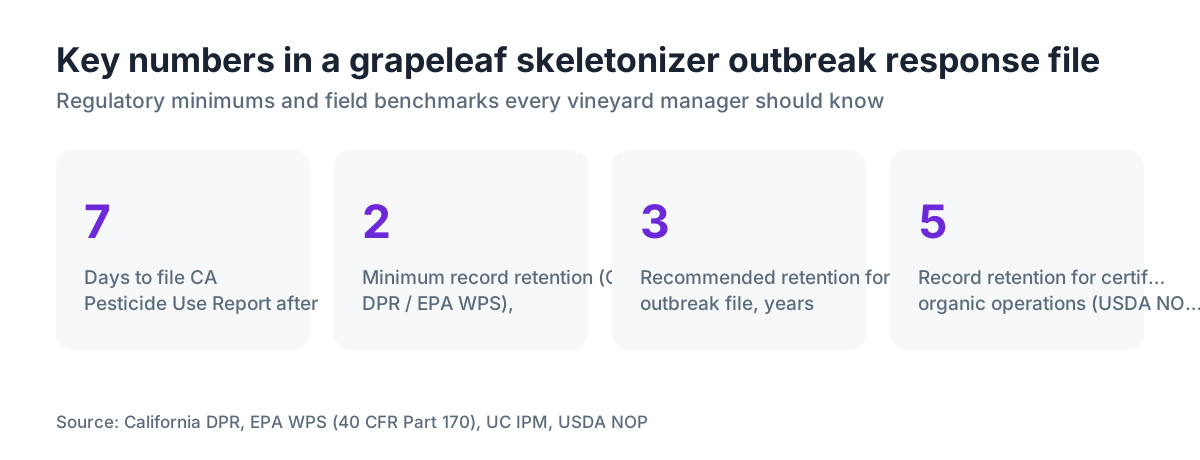
Keep spray records at least three years. California DPR requires two years from the date of application for most records, but three years covers the usual audit window and lines up with the retention advice in EPA WPS guidance. [5]
What re-entry interval and worker notification records do you need?
REI documentation is separate from the spray record, and it's one of the most commonly cited deficiencies in WPS inspections. You need three things in the file for every treated block.
First, a record that the central display or posting (the WPS safety information plus the application-specific information) was updated before workers entered. That means the product name, the location of the treated area, the REI end date and time, and the name and phone number of the treating establishment. [7]
Second, a record that any worker entering under an early-entry exception got the required training and wore the label-specified PPE. For skeletonizer this counts double, because the larvae's urticating hairs are a hazard on their own. A worker handling infested canes before or after a spray needs protection even with no chemical REI running.
Third, records that any worker or handler who reported symptoms of pesticide exposure or contact with the hairs got first aid information and was pointed to appropriate medical care. Under WPS the employer has to provide prompt transportation to an emergency medical facility if needed and keep records of any such incident. [7]
The urticating hair problem also means you should log the infestation itself in your worker safety records, not only your spray log. Crew pruning or doing canopy work in an infested block before treatment is an occupational hazard event, and it belongs in the file.
Does a grapeleaf skeletonizer outbreak require official notification in California or Arizona?
In most cases, no. Western grapeleaf skeletonizer isn't a quarantine pest under current California or Arizona rules, so an outbreak on your own property triggers no mandatory notification. The history is more layered, though.
Harrisina brillians was the target of a California-USDA biological control program starting in the 1940s and running through the late twentieth century, with the introduction of a parasitoid tachinid fly and other natural enemies. [8] Those agents are well established in coastal and central California. Some county agricultural commissioners keep informal monitoring networks for resurgences, and calling your county farm advisor when you see an odd outbreak is good practice even when the law doesn't require it.
Arizona growers should check with the Arizona Department of Agriculture, since the pest is historically less established in some desert wine districts and a large outbreak may draw more attention. [6]
If your vineyard is certified organic, your certifier likely wants notification of any significant pest event plus documentation of the IPM steps you took before reaching for approved pesticides. Check your organic system plan for the exact language.
On neighbors: California imposes no statutory duty to notify adjacent landowners of a pest outbreak on your own property, barring quarantine pests. Most farm advisors still recommend a phone call, both for good relations and because nearby vineyards under the same pressure benefit from the heads-up.
What does an IPM decision record look like for this pest?
An integrated pest management decision record documents the why behind your response, not only the what. For a skeletonizer outbreak it should capture the threshold you used to decide treatment was warranted, the alternatives you weighed and why you passed on them, and the product and timing you chose.
UC IPM guidance points to early detection at first- or second-instar as the moment when biological and least-toxic options work best. Bt applied when larvae are young can hit 80 to 90 percent control with little non-target impact. [1] Wait until third- or fourth-instar and you're probably reaching for a faster-acting organophosphate or pyrethroid, which carries different REI, PHI, and worker protection implications. Your IPM record should state the instar you were dealing with and why it drove the product choice.
The economic threshold for grapeleaf skeletonizer isn't spelled out numerically the way it is for leafhoppers or spider mites. UC IPM treats any actively feeding colony in a commercial vineyard as grounds for action, because the speed of defoliation makes waiting for a count risky for yield and vine stress. [1] That's the reasoning to put in the file: "Actively feeding late-instar colony confirmed across approximately 8% of vines in Block 4. Given the defoliation rate observed, immediate treatment indicated per UC IPM guidelines."
Document who made the call and their credentials. If you consulted a licensed pest control adviser (PCA) before treating, their written recommendation is a core document for the file and gives the grower liability cover.
How do you document post-treatment efficacy and block re-entry?
Post-treatment documentation closes the loop, and it's the piece most growers forget. Two to five days after treatment, walk a follow-up scouting pass and record it: what percent of larvae survived, whether egg masses or fresh adult activity signals a second flush, and whether the application looked effective.
If the treatment failed or efficacy came in below 70 to 80 percent, write down why. Common causes are late-instar timing, product choice, poor coverage in dense canopies, or a temperature spike after application that cooked the Bt. [2] A failed-treatment note protects you if a second spray is needed and someone questions why you sprayed twice.
Block re-entry records have to show the REI for the specific product elapsed before workers returned to normal hand labor. Have the first person back in after the REI sign a simple log: date, time, block, name. That's your evidence if an inspection asks. Under EPA WPS the requirement is that workers be informed the REI has ended, not that you privately believe it has. [7]
For organic programs, your certifier may want records that the post-treatment assessment confirmed control, to justify not jumping to a broader-spectrum product on a second pass.
How long do you keep outbreak and response records, and how should you organize them?
California DPR requires pesticide use records for two years from the date of application. [5] Federal WPS requires application records and REI information to be kept for two years. [7] Most agricultural attorneys and standard practice in certified operations push for three years, because civil litigation and USDA audit windows sometimes run past the two-year floor.
For organic operations, the USDA National Organic Program requires records for five years, available for inspection by your certifier or the USDA at any time. [9] That five-year standard should set the pace for your whole operation if any blocks are certified or transitioning.
Organize outbreak files by block and by season. A complete file for a single grapeleaf skeletonizer event holds these documents:
| Document | Purpose | Minimum retention |
|---|---|---|
| Scouting log entries with dates | Establishes monitoring and timing | 3 years |
| Pest ID record or lab confirmation | Confirms correct pest | 3 years |
| PCA written recommendation (if used) | Liability and compliance | 3 years |
| Spray application record / PUR | Regulatory requirement | 2 years (CA); 3 recommended |
| WPS central display update record | WPS compliance | 2 years |
| Worker REI notification log | WPS compliance | 2 years |
| Post-treatment efficacy scouting | Closes IPM loop | 3 years |
| Any worker exposure or injury reports | Legal protection | 5+ years |
Digital storage with automatic backup is fine as long as records stay legible and can be pulled within a reasonable time on request. Paper in a binder organized by block and year works just as well. What fails an audit is a logbook full of gaps, spray records missing the EPA registration number, or WPS posting records filed apart from the spray records so you can't match them.
Running multiple blocks across a larger operation? VitiScribe keeps these record types in one place so an inspector can pull a complete outbreak file for any block in minutes. That's the standard California DPR auditors are used to seeing from bigger operations.
What does a county or state inspector actually look for in your records?
California county agricultural commissioners run pesticide use inspections, and in a typical year they check hard on whether the PUR matches the actual product and rate applied, whether the REI was correctly recorded and enforced, and whether WPS posting requirements were met. [5]
For a grapeleaf skeletonizer event, an inspector following a complaint (a worker rash report is the most common trigger) wants the spray record, the WPS posting record showing when the notice went up and what it said, evidence that workers knew not to re-enter before the REI ended, and records of any first aid or medical referrals for hair exposure. The larvae's hairs are a separate occupational hazard from the pesticide, and inspectors sometimes find growers who documented the spray perfectly but have nothing on the pre-treatment worker hazard.
WSU Extension's wine grape pest resources note that western grapeleaf skeletonizer is mostly a California and Southwest pest, but Pacific Northwest growers watching for range expansion should hold to the same documentation standards, because WPS is federal and applies everywhere. [10]
Here's the honest picture. Most inspections triggered by a worker complaint do not end in major fines if the grower has complete records, even with a minor procedural gap. The ones that draw significant civil penalties tend to involve records that either don't exist or were altered. Good records, produced promptly, resolve most issues at the inspection stage.
What resources and extension contacts support outbreak documentation?
UC IPM Online (ipm.ucanr.edu) has the most detailed current pest management guidelines for western grapeleaf skeletonizer, with threshold guidance, treatment timing windows, and product recommendations for conventional and organic programs. [1] UC Cooperative Extension county offices can connect you with a farm advisor or licensed PCA who can write a recommendation, the single most useful document you can add to an outbreak file.
Cornell University's Viticulture and Enology program covers eastern grapeleaf skeletonizer (Harrisina americana), a related but different pest found mostly in the eastern US. Cornell's record-keeping and WPS material applies to any grape pest outbreak even when the species differs. [11]
WSU Extension's wine grape pest management guides run through the WSU extension publications catalog and help with the Pacific Northwest context, including the rare western grapeleaf skeletonizer sighting in warmer parts of Washington and Oregon. [10]
EPA's WPS resources, including the "Agricultural Worker Protection Standard" guide, live at epa.gov and are the primary reference for the re-entry interval, posting, and worker notification rules that govern your outbreak response records. [7]
For Arizona regulatory questions, the Arizona Department of Agriculture's Environmental Services Division handles pesticide use reporting and compliance. [6]
Need a specimen identified and confirmed? The UC Statewide IPM Program runs a pest identification service through county Cooperative Extension offices. For a pest as distinctive as grapeleaf skeletonizer larvae, experienced farm advisors can usually confirm by photo, but a formal lab ID carries more weight in a legal or regulatory proceeding.
Frequently asked questions
How quickly can western grapeleaf skeletonizer defoliate a vine?
A large colony of late-instar larvae can strip nearly all leaf tissue off a shoot within 24 to 48 hours in warm summer conditions. Earlier instars move slower, but colonies grow fast and feeding rates accelerate with each molt. By the time you see widespread skeletonized leaves, the colony is usually third-instar or beyond. Weekly scouting starting in May is the only reliable way to catch infestations before serious defoliation.
Do grapeleaf skeletonizer larvae cause a worker rash?
Yes. The larvae carry urticating (irritating) hairs that cause a burning skin rash on contact. This is a documented worker hazard separate from any pesticide application, and it belongs in your WPS records. Workers doing canopy work in an infested block need PPE (long sleeves, gloves) even before a spray event. Any worker who develops a rash after contact with infested foliage should be documented and directed to appropriate medical care per EPA WPS requirements.
What is the economic threshold for treating grapeleaf skeletonizer?
UC IPM does not publish a numeric leaf-count threshold the way it does for grape leafhopper. Any actively feeding colony in a commercial block is treated as a threshold event, because late-instar colonies can cause significant defoliation within days. Document the instar stage and estimated percent of vines infested when you made the treatment decision. That written justification, paired with the UC IPM guideline language, is your IPM decision record.
Can you control grapeleaf skeletonizer with Bt in an organic vineyard?
Yes. Bacillus thuringiensis (Bt) products are approved for organic use and work best against first- and second-instar larvae. Apply when egg hatch is happening and larvae are young. Coverage into the canopy interior matters because early instars feed on the lower leaf surface. Spinosad (Entrust SC) is another OMRI-listed option with a seven-day pre-harvest interval on grapes. Document the product's OMRI listing and the label REI (four hours for both Bt and spinosad formulations) in your spray record.
How many days before harvest can you spray for grapeleaf skeletonizer?
Pre-harvest intervals depend on the product. Spinosad (Entrust SC) has a seven-day PHI on grapes. Many pyrethroid products carry 7 to 14-day PHIs depending on the active ingredient. Organophosphates vary widely. Always record the exact PHI from the label version in use at the time of application. The label is the law, and a mismatch between your spray record and the actual PHI is one of the most common findings in pesticide use inspections.
What information must the WPS central display show after a grapeleaf skeletonizer spray treatment?
Under EPA WPS (40 CFR Part 170) the central display must show the product name, the treated location, and the date and time the restricted-entry interval ends. It must be posted before workers enter the treated area and stay posted until the REI has fully elapsed. Keep a written record of when you updated the display and what it contained, because that's what an inspector will ask for.
Is western grapeleaf skeletonizer a quarantine pest in California?
No, not currently. It was subject to historical biological control programs, but it's not listed as a California quarantine pest requiring mandatory grower reporting. Unusual outbreak intensity or new county detections may still draw attention from your county agricultural commissioner, and contacting your local UC Cooperative Extension farm advisor for significant events is good practice. Arizona growers should confirm status with the Arizona Department of Agriculture, since distribution can differ by region.
How do you identify western grapeleaf skeletonizer vs. grape leafroller or other caterpillars?
Grapeleaf skeletonizer larvae feed in clusters on the lower leaf surface and carry prominent banded black-and-yellow urticating hairs. Their feeding leaves a translucent window in the leaf rather than rolling or tying it. Adult moths are metallic blue-black with orange and yellow forewing spots. Grape leafrollers feed singly and roll or fold leaf tissue. If you're unsure, photograph the larvae and submit them to your county UC Cooperative Extension office for identification.
What records does an organic certifier expect for a grapeleaf skeletonizer outbreak?
Under the USDA National Organic Program (7 CFR Part 205), you must document the pest identification, the IPM steps taken before any approved material, the product used with its OMRI or NOP compliance status, application rate and date, and a post-treatment assessment. Records must be kept for five years and available to your certifier on request. Using a non-approved material, even once, risks your certification status for the affected parcels.
How do you file a California Pesticide Use Report (PUR) after a grapeleaf skeletonizer spray?
In California, pesticide use reports for restricted-use pesticides go to the county agricultural commissioner within seven days of application. General-use pesticide applications by licensed PCAs also require PUR filing. Growers applying their own general-use materials aren't always required to file directly, but many do to keep complete records. Check with your county ag commissioner's office for current county-specific rules, since some counties have requirements beyond the state minimum.
Can neighboring vineyards take legal action if your skeletonizer outbreak spreads?
There's no California statute specifically making a grower liable for grapeleaf skeletonizer spread to adjacent property, and the pest is not quarantine-listed. Liability in civil nuisance or negligence claims would turn on whether you failed to take reasonable action once the outbreak was identified. Complete scouting records, timely treatment, and documented IPM decisions are your best protection. A phone call to neighbors when you detect a significant outbreak is good practice and rarely a bad idea.
What is the difference between western and eastern grapeleaf skeletonizer?
Western grapeleaf skeletonizer (Harrisina brillians) is the primary concern for California and the desert Southwest. Eastern grapeleaf skeletonizer (Harrisina americana) is found mostly in the eastern United States and is covered in Cornell Extension resources. Both sit in the family Zygaenidae and cause similar leaf feeding damage, but their ranges, biological control options, and monitoring programs differ. Confirm the species in your region before applying treatment recommendations from out-of-region extension guides.
How often should you scout for grapeleaf skeletonizer and what does a scouting walk look like?
UC IPM recommends starting scouting in May when adults first emerge and checking weekly through September. A scouting walk focuses on the lower leaf surface, looking for egg masses (small, flat, pale yellow clusters) and early-instar larval clusters. Work the interior canopy as well as the perimeter, since outbreaks often start in warmer interior rows. Record the percent of vines infested and the dominant larval instar in each block visited.
Sources
- UC IPM Online, UC Statewide IPM Program - Western Grapeleaf Skeletonizer pest management guidelines: UC IPM guidelines on western grapeleaf skeletonizer biology, scouting timing, treatment thresholds, and Bt efficacy at early instars
- UC IPM Online - Grape Pest Management Guidelines: Urticating hairs cause burning skin rash in workers; REI and PHI guidance for spinosad and Bt products on grapes
- UC Agriculture and Natural Resources - Cooperative Extension pest identification and specimen submission: UC Cooperative Extension county offices provide pest identification and specimen submission services for vineyard pest confirmation
- University of Arizona Cooperative Extension - Viticulture and Pest Management: University of Arizona Cooperative Extension provides identification resources and pest monitoring support for Arizona grape growers
- California Department of Pesticide Regulation - Pesticide Use Reporting: California requires PUR filing within seven days of application for restricted-use pesticides and mandates retention of pesticide use records for two years
- Arizona Department of Agriculture - Environmental Services Division, Pesticide Compliance: Arizona Department of Agriculture Environmental Services Division administers pesticide use reporting and compliance requirements for agricultural applicators
- U.S. EPA - Agricultural Worker Protection Standard (40 CFR Part 170): EPA WPS requires REI posting, worker notification, retention of application records for two years, and prompt transportation to medical facilities for pesticide exposure incidents
- USDA Agricultural Research Service - Biological Control research: California-USDA biological control program for Harrisina brillians involving parasitoid introductions beginning in the 1940s
- USDA Agricultural Marketing Service - National Organic Program, 7 CFR Part 205 record-keeping: USDA NOP requires certified organic operations to maintain records for five years and make them available to certifiers on request
- Washington State University Extension - Wine Grape Pest Management: WSU Extension notes western grapeleaf skeletonizer is primarily a California and Southwest pest; WPS requirements apply federally regardless of region
- Cornell University Viticulture and Enology - Grape Pest Management: Cornell covers eastern grapeleaf skeletonizer (Harrisina americana) and provides WPS compliance guidance applicable across grape pest outbreak documentation
Last updated 2026-07-10