What counts as a spray record unit of measure for gallons per acre

TL;DR
- On a spray record, gallons per acre (GPA) is the total finished spray mix applied divided by acres treated.
- Regulators want your actual applied GPA, not the label's suggested rate.
- You get it from tank volume, real fill count, and measured acreage.
- Missing or guessed GPA is the most common audit finding in California, Washington, and New York vineyard records.
What does 'unit of measure' mean on a pesticide spray record?
The unit of measure on a spray record is the label attached to your application rate. For liquid vineyard sprays, that unit is almost always gallons per acre (GPA). It tells the inspector how much spray mix touched the crop. It does not tell them how much active ingredient you used (separate field) or how fast the tractor was moving.
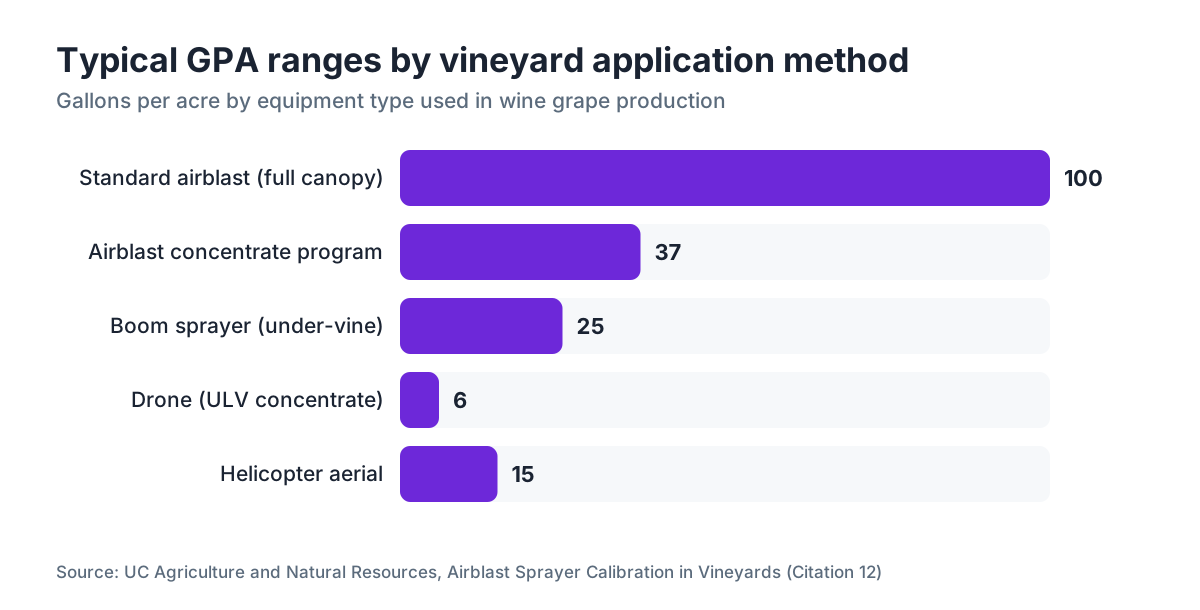
Think of the record as two measurements that have to live side by side. One is the product rate, usually in fluid ounces, pints, or pounds of formulated product per acre. The other is application volume, in GPA. Regulators need both. The product rate confirms you didn't over-apply a restricted material. The GPA tells them the carrier volume that delivered it. A 5-GPA application of a copper fungicide behaves very differently, agronomically and for drift risk, than a 100-GPA application of the same product, even when the copper rate per acre matches to the ounce.
California's Department of Pesticide Regulation (CDPR) lists GPA as a required field under the Pesticide Use Report (PUR) system, and county agricultural commissioners routinely cite missing or implausible GPA entries during compliance audits. [1]
How do you actually calculate gallons per acre for a spray record?
GPA is total gallons sprayed divided by total acres treated. The formula is easy. Getting the two inputs right in the field is where the errors hide.
Total gallons sprayed is your actual tank output, not your tank capacity. Fill a 200-gallon tank three times, pull 180 usable gallons from each fill, and you applied roughly 540 gallons. The leftover in the sump doesn't count. Total acres treated is the ground you actually covered, not the block's mapped size if terrain or headlands left strips untouched.
Here's the workflow most experienced vineyard managers use:
- Record tank capacity and actual fill volume each fill (fill to the same mark every time, or weigh it).
- Note the fill count.
- Multiply fill volume by fill count to get total gallons.
- Divide by GPS-confirmed or surveyed block acreage.
Got an in-cab flow meter? The meter's cumulative output is your total gallons figure, and it's the most defensible number you can put on a record. Washington State University Extension recommends calibrating flow meters at least once per season and after any pump wear, because even a 5% drift in the reading compounds across a full spray program. [2]
Example: 3 fills at 190 gallons each is 570 gallons total. Block size is 6.2 acres. GPA is 570 divided by 6.2, which is 91.9. You'd record 92 GPA. Round to the nearest whole gallon. No state PUR system I'm aware of asks for sub-gallon precision.
What GPA entry does a regulator actually want to see?
The actual applied GPA. Full stop. Not the label's recommended range. Not the sprayer's rated output at a given pressure. Not a number copied from last year's record for the same block.
The distinction matters because the label's GPA range is often something wide like "50 to 150 GPA." Writing "100 GPA" on every record no matter what happened is exactly the kind of entry that triggers a re-inspection in California. A county ag commissioner inspector pulling five years of records for one block will notice your GPA never moves, even across different sprayer setups or crew changes. That flat line reads as estimated, not measured.
The EPA's Worker Protection Standard (WPS) doesn't mandate a specific GPA format, but it does require application records accurate enough for emergency medical personnel to identify what a worker was exposed to. [3] A wrong GPA breaks that purpose, which is how a paperwork slip can escalate into a WPS violation.
In New York, Cornell Cooperative Extension guidance on pesticide recordkeeping says records must reflect the "actual conditions of application," which includes the measured application rate. [4] Washington's WSDA uses similar language. The practical standard across all three big wine states comes down to one thing: if you can't show how you got your GPA number, expect questions.
Does the GPA on a spray record have to match the product label?
No, but it has to land inside the label's stated range if the label gives one.
Many vineyard pesticide labels list a GPA range instead of a fixed rate. Some say "apply in sufficient water to ensure thorough coverage" and name no volume at all. There, any reasonable GPA holds up as long as you can show coverage was adequate. Where a label says "apply in 50 to 200 gallons of water per acre," your recorded GPA has to sit inside that window.
Applying outside the label's GPA range is a federal FIFRA violation, which is bigger than a recordkeeping problem. FIFRA Section 12(a)(2)(G) makes it illegal to use a pesticide in a manner inconsistent with its labeling. [5] The label is the law, as every licensed PCA will tell you. If your airblast rig is dialed in for ultra-low volume work at 20 GPA and the label requires 50 GPA minimum, a record showing 20 GPA is evidence of a violation, not proof of compliance.
Running a newer concentrate program at 30 to 50 GPA? Check that every product in the tank permits concentrate application. Plenty of fungicides and insecticides bury their concentrate language deep in the directions-for-use section.
What's the difference between GPA and product rate per acre on a spray record?
They answer different questions, and both have to appear on a compliant record. People mix them up constantly.
Product rate per acre is how much formulated pesticide you applied, say 8 fluid ounces of a fungicide per acre. GPA is the carrier volume, how many gallons of total spray mix (water plus product) went on each acre. A tank mix with three products has three separate product rates per acre and one GPA figure covering all of them.
The math that connects them: if your target is 8 fl oz product per acre and your GPA is 80, you mix 8 fl oz times the number of acres per tank into your 80-GPA spray volume. The product rate and the GPA have to agree with your tank mix recipe, or the record falls apart under scrutiny.
One quick sanity check. Take total product used from the record, divide by acres treated, and see if you get the recorded product rate. Then take total gallons, divide by acres, and confirm you get the recorded GPA. If either number is off, something got estimated instead of measured. This is the same cross-check a CDPR auditor runs. [1]
How do row spacing and canopy architecture affect your GPA calculation?
For a vineyard record, GPA is measured against land area, meaning actual ground acres. That's the standard. Canopy volume is a separate concept used more and more in modern spray calibration, especially in European-influenced programs, but it doesn't replace GPA on a regulatory record. It's a calibration tool, nothing more.
Here's where row spacing bites your records. Spray a 12-foot-row-spacing block, then move to an 8-foot-row-spacing block at the same tractor speed and pressure, and your GPA per land area changes even though you touched nothing on the sprayer. Blocks with different row spacings belong on separate records and will usually show different GPA values. Lumping them into a single GPA figure is an approximation that gets hard to defend.
UC Cooperative Extension advises calibrating airblast sprayers by block type, not by vineyard-wide averages, precisely because row spacing and trellis variation create real differences in actual application volume per acre. [6] Borrowing another winery's spray records as a model? Their GPA may reflect vineyard geometry nothing like yours.
Tall-wire VSP at 9-foot spacing, head-trained at 12-foot spacing, and bilateral GDC at 10-foot spacing will hand you three different GPA values from the same sprayer at the same settings. Record them separately.
What happens if you estimate GPA instead of measuring it?
Short version: you're exposed.
Estimated GPA isn't inherently illegal, but it isn't compliant in any state that requires records to reflect actual conditions. If you're audited and your method for the GPA was "I looked at the sprayer spec sheet," that's not a measurement. Sprayer specs give theoretical output at a given pressure. Actual output depends on nozzle wear, pump pressure swings, ground speed, and terrain. A worn nozzle can flow 20 to 30% over rated output. [2]
California's penalty schedule for PUR violations runs from warning letters up to $5,000 per violation per day for willful violations, per California Food and Agricultural Code Section 12999.5. [7] Estimated GPA that's demonstrably wrong (say you recorded 50 GPA but the math from your tank fills and block acreage shows 85 GPA) can move from a paperwork deficiency into a misrepresentation finding.
The risk scales with your operation. A 5-acre hobby block audited once in 20 years has almost no practical exposure. A 200-acre contracted vineyard with a large winery buyer faces annual grower audits, GAP audits, and state PUR review. At that scale, a documented calibration and measurement system is worth a few hours of your time.
Operations that want a structured way to capture tank fill volumes and auto-calculate GPA from GPS acreage can use field record software like VitiScribe to pull those fields into a PUR-ready format without manual math on every application.
How should you record GPA when you're using a drone or helicopter for pesticide application?
Aerial applications, drones included, still need a GPA figure on the record. Only the method for getting there changes.
For a drone applicator, GPA usually comes from the drone's onboard flow control system and its GPS-tracked coverage area. Most commercial ag drones flown in vineyards (DJI Agras series, Hylio, and similar platforms) log spray volume and area electronically. That log is your source data. The per-application summary from the drone's software gives total liters or gallons dispensed and total area covered, and GPA follows from dividing the two.
EPA guidance on drone pesticide applications says existing pesticide label requirements apply, including GPA ranges where the label specifies them. [8] Several older vineyard fungicide labels predate drone use and specify GPA ranges built for airblast or boom equipment. If the label minimum is 50 GPA and your drone runs 5 to 10 GPA (common for drone concentrate work), you may be off-label unless the label has been amended for aerial or UAV use. Check the current label through EPA's pesticide product system, not a copy you downloaded two years ago.
Helicopter work follows the same logic. The pilot's application record becomes your supporting documentation, and the GPA on your record should match what the pilot logged.
What records do you need to keep alongside the GPA entry?
GPA never stands alone. A complete, audit-ready spray record ties the GPA to source documents that let anyone reconstruct how you got the number.
At minimum, keep:
- Tank fill log (date, volume per fill, number of fills)
- Block acreage (GPS map or survey, not an estimate)
- Equipment ID (sprayer, nozzle type and size, boom or airblast configuration)
- Pressure setting at the manifold
- Ground speed during application
- Tractor or equipment operator
- Date and start/end time
- Weather conditions at application (wind speed and direction, temperature, humidity for pesticides that require it)
California requires all of the above under CCR Title 3, Section 6624, which sets the minimum content for pesticide use records. [9] Washington's requirements under WAC 16-228 are similar. New York's Part 325 regulations require records be kept at least two years and produced within 24 hours of an inspector's request. [4]
The tank fill log is your best defense if anyone ever questions your GPA. It lets you rebuild the actual gallons applied from raw data instead of asking an inspector to take your word for it.
How does GPA entry work in practice when you split a tank across two blocks?
Split tanks are the most common source of GPA record errors. You start the tank in block 12, run dry at the headland shared with block 14, and finish the residual on block 14. One tank, two blocks, and now you have an accounting problem.
The right move: estimate the volume applied to each block as accurately as you can, then record separate GPA figures for each. The strongest method is to note the spray level in the tank at the block boundary (a gauge glass or calibrated dip stick), calculate gallons applied to block 12 from the fill-level drop, then assign the remainder to block 14.
No tank gauge? Use tractor hours or GPS area covered per block as a proxy, then multiply by your calibrated GPA to back-calculate volume per block. It's an estimate, but a documented, reasoned estimate beats a single combined record that hides which block got how much.
Compliance software helps here. A good field record system lets you log partial tank applications to separate block records without forcing you to close and reopen the application. That kills the workaround of merging blocks into one entry just to simplify the math. VitiScribe's application record splits a tank across up to four blocks per entry, with proportional GPA calculated automatically from the volume assigned to each block.
Spray record GPA requirements by state: California, Washington, and New York compared
These three states account for roughly 90% of U.S. wine grape acreage, and each has spray record rules that touch GPA. Similar, but not identical.
| Requirement | California (CDPR/CAC) | Washington (WSDA) | New York (DEC/NYSDAM) |
|---|---|---|---|
| GPA required on record? | Yes (CCR Title 3 §6624) | Yes (WAC 16-228) | Yes (Part 325) |
| Record retention | 2 years | 2 years | 2 years |
| PUR filing required? | Yes, county commissioner | No statewide PUR | No statewide PUR |
| Inspection frequency | Annual for many operators | Complaint/random | Random |
| Acceptable GPA source | Measured or calibrated | Measured | Measured |
| Penalty range (paperwork) | Warning to $5,000/day | Warning to $10,000 | Warning to $2,000 |
California is the strictest in practice, largely because the Pesticide Use Report creates a big, searchable dataset that agricultural commissioners actively compare against label rates and a farm's own history. A GPA that's implausible for your equipment type (say, 200 GPA from a standard airblast) gets flagged in the CDPR database. [1]
Washington's WSDA has raised audit frequency in recent years for operations using organophosphates and certain fungicides, and GPA is part of those audits. [10] New York's DEC leans harder on restricted-use pesticide records than general-use, but PCA certification records tie back to GPA accuracy.
Grow in more than one state? Track which record format each one requires before spray season starts. A California PUR format carries more detail than New York needs, so filing California-compliant records everywhere gives you the cleanest paper trail.
Common mistakes vineyards make recording gallons per acre
A handful of patterns show up over and over in compliance reviews.
Copying last year's GPA without recalibrating. Nozzles wear. Pumps lose pressure. A number that was accurate in 2022 can be 15% off by 2025. WSU Extension data on nozzle wear suggest ceramic nozzles can exceed rated output by 10% after 40 hours of use and by 25% or more after 100 hours. [2] Recalibrate at least once per season, ideally right before the mildew program.
Recording tank capacity instead of applied volume. A 300-gallon tank filled three times did not deliver 900 gallons if each fill left 30 gallons of rinse water and settled solids behind. Record actual output.
Using mapped acreage that includes non-productive ground. If your 10-acre block holds 0.8 acres of roads, headlands, and equipment staging you didn't spray, your denominator is 9.2 acres, not 10. A slightly higher GPA from accurate acreage beats a lower GPA from inflated area every time.
Leaving GPA blank in concentrate programs. Some operators running 30 to 40 GPA concentrate leave the field empty because "the label says up to 150 GPA and we're obviously under." Blank is not compliant. Put the actual number in.
Lumping multiple passes into one record. Two passes through a block (fungicide one pass, insecticide the next, same day, different sprayer settings) are two records, not one.
Frequently asked questions
Is gallons per acre required on every pesticide spray record?
In California, Washington, and New York, yes. GPA is a required field under CCR Title 3 Section 6624 (California), WAC 16-228 (Washington), and Part 325 (New York). For restricted-use pesticides especially, a missing GPA is a recordkeeping violation. Even for general-use materials, most county ag commissioners treat GPA as mandatory on any record that includes a spray volume unit of measure.
Can I record the label's recommended GPA instead of my actual applied rate?
No. Regulators require the actual applied GPA, derived from measured tank volumes and real acreage. Recording the label's suggested range instead of your measured rate is the most common audit finding in California PUR reviews. If you're audited, an inspector cross-checks your recorded GPA against your tank fill logs and block acreage, and a label-rate estimate stands out fast.
What's a normal GPA range for vineyard airblast sprayer applications?
Standard airblast applications in vineyards typically run 50 to 150 GPA depending on canopy density, row spacing, and program type. Concentrate programs run 25 to 50 GPA. Ultra-low volume drone applications often run 2 to 10 GPA. None of these ranges is inherently more or less compliant. What matters is that your recorded GPA reflects what actually came out of the sprayer and sits within the product label's specified range.
How do I document GPA when using a flow meter?
Read the meter's cumulative output at the start and end of each block application. The difference is your total gallons for that block. Divide by the block's acreage to get GPA. Keep the meter's paper tape or digital log as supporting documentation. WSU Extension recommends calibrating flow meters at least once per season against a physical volume check (fill a known container and compare) to catch drift from pump wear.
Do I need a separate GPA entry for each product in a tank mix?
No. GPA is a property of the whole tank mix, not of individual products. One GPA figure covers all products applied in that application. Each product gets its own product rate (ounces or pounds per acre) in a separate field. The single GPA entry reflects the carrier volume for all of them combined. Make sure your tank mix recipe is internally consistent with both the GPA and each product rate you've recorded.
How long do spray records with GPA data need to be kept?
California, Washington, and New York all require a minimum of two years of pesticide application record retention. California's county agricultural commissioners can request records within 24 hours. Some winery contracts and third-party sustainability audits (like CCOF organic certification or Certified California Sustainable Winegrowing) require three to five years of records. Keep your records at least as long as your longest certification requirement.
What if my GPS acreage differs from my assessor's parcel acreage?
Use GPS-measured or surveyed acreage for your spray records, not parcel acreage. Assessor parcels include easements, roads, and non-productive land. For spray records, the relevant acreage is the area actually treated. If your GPS shows a block at 4.3 acres but your assessor parcel is 5.1 acres, using 4.3 gives you a more accurate GPA and a more defensible record. Note the source of your acreage figure in your block data.
Does the EPA Worker Protection Standard require GPA on spray records?
The WPS requires that application records be accurate enough for emergency medical responders to identify pesticide exposures. While it doesn't name GPA as a specific required field, it does require the application rate and volume. An accurate GPA satisfies that requirement. WPS records must be available within 30 days of a request by a worker's healthcare provider, per 40 CFR Part 170.
How do weather conditions affect my recorded GPA?
Weather doesn't change the GPA calculation itself, but some product labels require specific conditions (wind speed under 10 mph, temperature below a threshold) for application. Your record should note the actual weather at application time. If you applied in conditions that drove evaporation from your tank or forced you to slow down, those factors can affect your actual output versus your sprayer spec. Measure what came out. Don't assume it matched the setup.
What's the difference between gallons per acre and liters per hectare on spray records?
These are equivalent units in different measurement systems. One GPA equals approximately 9.35 liters per hectare. U.S. state spray records use GPA as the standard unit. If you're referencing imported label recommendations from Canadian or European sources, convert to GPA before recording. Some university extension spray rate calculators (UC Davis, WSU) include unit conversion tools built for vineyard applications.
Can I use a calibration chart to estimate GPA instead of measuring it per application?
A calibration chart is a legitimate starting point, not a substitute for measurement. You use the chart to set up your sprayer, then verify actual output with a timed collection test or flow meter reading. Once calibrated, you can use the chart's predicted GPA for records as long as you re-verify calibration at the start of each spray season and after any nozzle changes, pressure changes, or pump repairs. Document when you calibrated and against what method.
Do organic vineyard spray records need GPA the same way conventional records do?
Yes. Organic certification doesn't change state pesticide recordkeeping requirements. Copper, sulfur, and OMRI-listed materials are still pesticides under FIFRA and California Food and Agricultural Code, and their application records require GPA. CCOF and other certifiers also review spray records during annual audits and will flag missing GPA fields. Organic operations face the same state recordkeeping rules as conventional operations for any registered pesticide application.
What's the easiest way to catch GPA recording errors before an audit?
Run the basic math cross-check after every spray record entry: divide total gallons by total acres and confirm you get the recorded GPA. Then check that the implied product per acre (total product used divided by acres) matches the recorded product rate. If either number is off, find the error before you submit or file. This two-minute check catches the majority of recording mistakes before they become compliance issues.
Sources
- California Department of Pesticide Regulation, Pesticide Use Reporting: California PUR system requires GPA as a mandatory field; county agricultural commissioners audit for missing or implausible GPA entries
- Washington State University Extension, Sprayer Calibration for Vineyards: WSU Extension recommends calibrating flow meters at least once per season; ceramic nozzles can exceed rated output by 10% after 40 hours and 25% or more after 100 hours of use
- U.S. EPA, Agricultural Worker Protection Standard (40 CFR Part 170): EPA WPS requires application records be accurate enough for emergency medical personnel to identify pesticide exposures; records available within 30 days of healthcare provider request
- Cornell Cooperative Extension, Pesticide Safety Education Program: Cornell guidance specifies that application records must reflect actual conditions of application, including measured application rate; New York Part 325 requires records kept at least two years, available within 24 hours
- U.S. EPA, Summary of the Federal Insecticide, Fungicide, and Rodenticide Act (FIFRA) Section 12: FIFRA Section 12(a)(2)(G) makes it a federal violation to use a pesticide in a manner inconsistent with its labeling, including GPA ranges specified on the label
- UC Agriculture and Natural Resources, Vineyard Pest Management and Spray Calibration: UC Cooperative Extension advises calibrating airblast sprayers by block type rather than vineyard-wide averages because row spacing and trellis system variation creates real differences in actual application volume per acre
- California Food and Agricultural Code Section 12999.5: California penalty schedule for PUR violations ranges from warning letters up to $5,000 per violation per day for willful violations
- U.S. EPA, Pesticides: EPA guidance states existing pesticide label requirements apply to drone applications, including GPA ranges where specified on the label
- California Code of Regulations Title 3, Section 6624, Pesticide Use Records: CCR Title 3 Section 6624 specifies minimum content for California pesticide use records, including application volume in GPA, equipment ID, operator, date, time, and weather conditions
- Washington State Department of Agriculture, Pesticide Recordkeeping (WAC 16-228): Washington WSDA requires GPA on pesticide records under WAC 16-228 and has increased audit frequency for operations using organophosphates and certain fungicides
- U.S. EPA, Pesticide Registration: Current pesticide labels including GPA range specifications are available through EPA's pesticide product registry; operators should use current labels rather than downloaded copies
- UC Agriculture and Natural Resources, Airblast Sprayer Calibration in Vineyards: Standard airblast applications in vineyards typically run 50 to 150 GPA depending on canopy density and row spacing; concentrate programs run 25 to 50 GPA
Last updated 2026-07-11