What does powdery mildew look like on grapes?
TL;DR
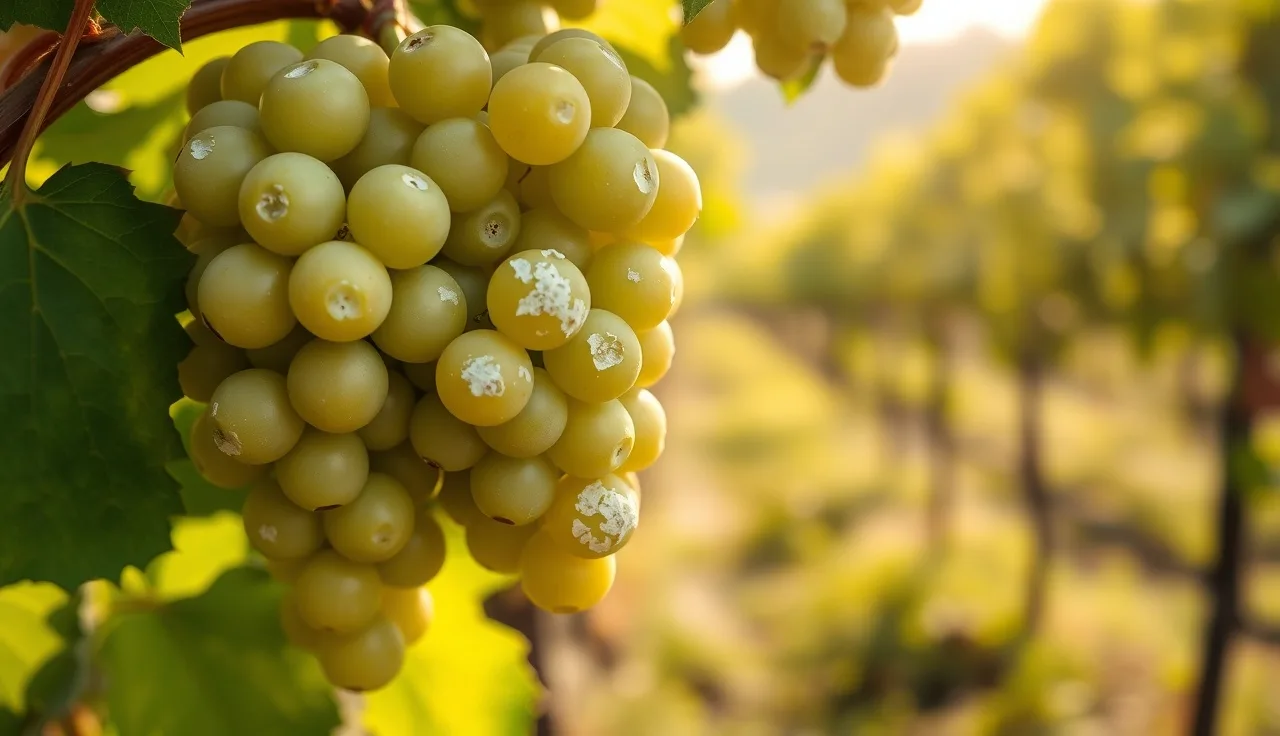
- Powdery mildew on grapes shows up as white or grayish powdery patches on leaves, shoots, and berries.
- Infected berries crack, develop a musty "cat-pee" off-odor in wine, and can drop early.
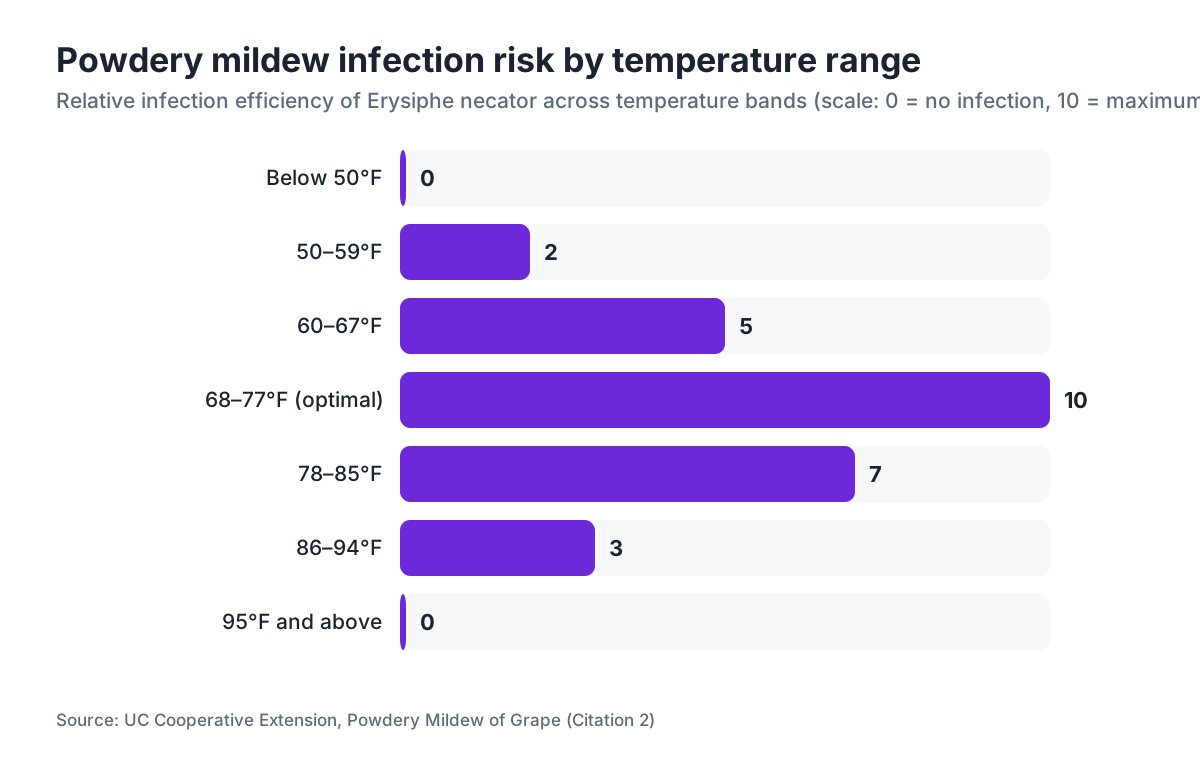
- The fungus Erysiphe necator thrives in warm, dry weather with cool nights, and spreads fastest between 70 and 85°F.
- Catch it early: symptoms on young tissue are subtle and easy to miss.
What does powdery mildew actually look like on grape leaves?
The classic sign is a white to pale gray powdery coating on the upper surface of leaves, made up of fungal mycelium and spore chains (conidia). It looks almost dusty, like someone dragged a finger through flour and left a smear. Early infections are small, circular colonies maybe a centimeter across. As they spread, they can cover most of the leaf surface.
Flip the leaf over and you'll sometimes see corresponding discoloration on the lower surface, but the white fuzz is almost always most visible on top. Young leaves show symptoms differently than mature ones: on very young tissue the infection can cause the leaf to curl, pucker, or look slightly distorted before the white coating becomes obvious [1].
Under a hand lens you can see the upright conidiophores, which look like tiny chains of barrel-shaped beads. That's the defining structure of Erysiphe necator. If you're ever unsure whether you're looking at mildew or residue from a previous spray, breathe on the patch and look again. Spray residue won't grow. Mildew will.
Not every whitish patch is powdery mildew. Spray residue, dust, and nutrient deposits can look similar from a distance. The difference: mildew wipes off and leaves a darker, watersoaked-looking stain underneath. Spray residue usually doesn't have that zone of discolored tissue beneath it.
How does powdery mildew show up on shoots and tendrils?
Shoots infected early in the season take on a distinctive rusty brown or dark reddish-brown webbing pattern as they harden off, sometimes called "netting" or "dark netting." This is the overwintering signature of the disease: the white fuzz is long gone by harvest, but that rusty, web-like discoloration on canes is a clear record of where the infection was active earlier in the year [1].
Tendrils are some of the most sensitive tissue in the canopy. They get colonized quickly, curl and die, and then persist as a visual marker. Rachises (the berry cluster stems) infected while clusters are young develop the same powdery coating, and that early-season colonization sets up the berry infections that cost you fruit quality later.
If you're scouting in late spring and you see that rusty netting on green shoots before clusters are even fully formed, you're already behind. The flag-shoot symptom, where a single shoot emerges from an infected overwintering bud with white fuzz on every surface before other shoots even show it, means the fungus survived inside the bud over winter [2]. One flag shoot in a block is a serious signal to start your spray program immediately.
What does powdery mildew look like on grape berries?
Berry infections are where yield loss and quality damage get real. On small berries before bloom, you'll see the same white powdery coating. But the more damaging scenario is infection during the three to four weeks right after bloom, when berries are tiny and the skin cells are still dividing rapidly [3].
Once berries reach about 8 Brix (roughly veraison), they become largely resistant to new infections. But berries infected before that point show dramatic symptoms as they grow: the skin, which was colonized when cells were young, can no longer expand normally. The result is cracking, russeting, and full splitting in the worst cases. Split berries invite Botrytis and other secondary rots in immediately [3].
Late-season powdery mildew, where visible sporulation appears on nearly ripe berries, is less common but does happen. More often what winemakers notice at the crusher is the musty, earthy, sometimes described as "cat urine" or "barnyard" off-odor in juice from heavily infected fruit. That comes from the fungal metabolite 1-octen-3-ol and related compounds. Even low levels of infected fruit in a lot can taint the finished wine [4].
Colored varieties like Cabernet Sauvignon and Merlot can look deceptively clean at harvest because the berry skin color masks the visual symptoms. Weigh that against the smell test and your spray records.
What conditions cause powdery mildew to spread fastest?
Erysiphe necator is unusual among fungal pathogens because it does not need free water to germinate and infect. Rain actually reduces spore viability on the surface for a short period. What it needs is moderate temperatures and high humidity at the leaf surface, not wet leaves [1].
Spore germination and infection happen fastest between 68 and 77°F (20 to 25°C), though the fungus can infect from around 50°F up to about 95°F [2]. At 95°F and above, hot dry conditions slow it down considerably, which is why inland valley vineyards in California sometimes escape mid-summer pressure even when coastal sites are hammered. The worst scenario is mild daytime temperatures paired with a shaded canopy interior and dew or fog at night.
The 3-hour-in-10 rule used in some disease models: if temperatures stay between 50 and 95°F for six consecutive hours, with the leaf surface humid but not wet, you have an infection event. UC Davis and other researchers have built degree-day models to time spray decisions around these conditions [2]. Programs like the UC IPM risk model run on this logic.
Overwinter, the fungus survives two ways: as cleistothecia (sexual fruiting bodies) on bark and leaf debris, and as mycelium inside dormant buds. The bud infections produce those flag shoots early in spring and are the source of the earliest season inoculum [1].
Which grape varieties are most susceptible to powdery mildew?
All Vitis vinifera varieties are susceptible to some degree. Zero exceptions. But susceptibility varies enough to change your spray interval significantly.
Chardonnay, Merlot, Cabernet Franc, Pinot Noir, and Syrah are generally considered highly susceptible. Muscat varieties tend to be very susceptible as well. Cabernet Sauvignon and Sauvignon Blanc sit in a middle range, still needing good coverage but with a slightly longer spray window in moderate-pressure years [5].
American species (Vitis labrusca, V. riparia) and most hybrid varieties have natural resistance to E. necator because they co-evolved with it. This is why hybrid varieties like Marquette, Frontenac, or Chambourcin require far fewer fungicide applications than a Pinot Noir block, which matters enormously for organic programs or operations trying to reduce inputs [5].
Here's a rough susceptibility ranking based on University of Minnesota and Cornell work [5][6]:
| Susceptibility Level | Example Varieties |
|---|---|
| Very High | Chardonnay, Muscat, Pinot Noir, Cabernet Franc |
| High | Merlot, Syrah, Riesling |
| Moderate | Cabernet Sauvignon, Sauvignon Blanc, Zinfandel |
| Low (Hybrids) | Marquette, La Crescent, Frontenac |
| Very Low (American) | Concord, Niagara |
Site selection matters too. A Chardonnay block in a low-lying, foggy spot needs tighter spray intervals than the same variety on an exposed, well-drained slope with morning sun and afternoon wind.
How does powdery mildew compare to downy mildew on grapes?
These two diseases get confused constantly, and the confusion costs money when growers treat for the wrong one. They look different, come from different organisms, and respond to different fungicide chemistries.
Powdery mildew (Erysiphe necator) is a true fungus. Its white growth appears primarily on the upper leaf surface. It does not need rain or wet leaves to infect. Downy mildew (Plasmopara viticola) is an oomycete, closer to a water mold. Its yellowish oily "oil spots" appear on the upper surface, and the white sporulation appears on the lower leaf surface (look underneath the yellow spots). Downy mildew absolutely requires free water and rain events to sporulate and infect [6].
Fungicide programs targeting the two diseases are different. Sulfur and DMI (sterol inhibitor) fungicides work well against powdery mildew but have no activity on downy mildew. Phosphonate fungicides (like potassium phosphite) target downy mildew but are not reliable against powdery mildew. Many growers in humid regions run programs targeting both at once, which is where tank-mixes earn their cost [6].
If you're confused in the field, look at where the sporulation is. White fuzz on top of the leaf: suspect powdery mildew. White fuzz on the underside, with yellow or brown spots on top: suspect downy mildew. Both can occur at the same time in the same vineyard.
When in the season should you scout for powdery mildew?
Start scouting at budbreak. Seriously. The flag-shoot symptom appears right as the first green tissue emerges from infected overwintering buds, and catching it then tells you whether you have an inoculum problem in that block before you've made your first spray decision [1].
The highest-risk window for berry infections is the three to four weeks bracketing bloom: roughly one week before through three weeks after full bloom. UC Davis extension puts this as the most critical protection window, and it's when most season-long losses are determined [3]. If you drop the ball during bloom, you can't fix the berry cracking problem later, no matter what you spray in August.
After clusters reach about 8 Brix at veraison, new berry infections are rare, but leaf infections can still build inoculum and set up a worse problem in the following season. Post-veraison sprays make sense in high-pressure years or on highly susceptible varieties.
For practical scouting, walk transects through the block and check every fifth to tenth vine. Sample young shoot tips (the top 6 inches of shoot growth), cluster stems around bloom, and check the undersides of shaded interior leaves later in summer. Log what you find with location notes. If you're tracking multiple blocks, that written record becomes essential for building a spray history and justifying chemical choices to a compliance inspector. This is exactly the kind of field-level documentation that VitiScribe is built for, tying your scout observations to your spray records in one place.
What fungicides actually control powdery mildew on grapes?
Sulfur is still the workhorse. It's cheap and effective, and it has no resistance concerns because it's a multi-site protectant. The big caveats: don't apply when temperatures will exceed 90°F within 24 to 48 hours after application (phytotoxicity risk), and don't apply within two weeks of an oil application. Standard spray intervals for sulfur run 7 to 14 days depending on disease pressure [7].
DMI (demethylation inhibitor, FRAC Group 3) fungicides include myclobutanil and tebuconazole. They're systemic, meaning they move into plant tissue and provide some kickback activity (2 to 4 days post-infection). They work well, but resistance is a documented issue. UC IPM recommends rotating FRAC groups to slow resistance development [7].
QoI (strobilurin) fungicides (FRAC Group 11, e.g., azoxystrobin, trifloxystrobin) are potent but carry high resistance risk in E. necator populations. Many California populations have documented resistance to QoIs. Don't rely on them as primary tools, and always tank-mix with a different mode of action [7].
Some options approved for organic production: potassium bicarbonate (Kaligreen, Milstop), micronized sulfur, and neem oil-based products. These are shorter in residual activity and need tighter spray intervals, but they work well as part of a managed program.
EPA worker protection standard requirements apply to all of these. Restricted-entry intervals (REIs) for sulfur are typically 24 hours. For systemic fungicides they range from 12 to 24 hours or more depending on the product. Post your WPS information and record application dates, rates, and REIs for every application [8].
Pre-harvest intervals (PHIs) matter too. Myclobutanil, for example, has a PHI of 7 days on grapes in California. Tebuconazole runs longer. Check the label every time. It's the legal document.
How do you build a powdery mildew spray program that works?
Timing, coverage, rotation. Those three principles separate effective programs from expensive failures.
Timing means starting early. A common mistake is waiting until you see symptoms to spray. By the time white colonies are visible, you're looking at established infections that already happened 7 to 14 days ago (the incubation period). The goal is to prevent establishment, not respond to it. In most vinifera programs, the spray schedule starts at budbreak and runs through veraison without gaps during the high-risk window [2].
Coverage is where application equipment separates good programs from bad ones. Powdery mildew lives on plant surfaces, and fungicide has to reach those surfaces. Dense canopies are the enemy. Canopy management, shoot thinning, and leaf pulling around clusters all improve spray penetration while cutting humidity. A perfect fungicide applied poorly covers maybe 60% of the target surface. An imperfect fungicide applied with a well-set-up sprayer and an open canopy covers 90%.
Rotation means switching FRAC groups. WSU extension recommends no more than two consecutive applications of any single mode of action before rotating to a product from a different group [9]. Build a season calendar that maps out which product goes in at which growth stage. Post it. Follow it.
Tracking every application, including the product name, EPA registration number, rate, water volume, REI, PHI, and operator name, is both a compliance requirement and a practical management tool. Spray records are what you look at next season to understand why one block got away from you.
What does powdery mildew do to fruit quality and how much does it cost?
Yield losses vary enormously by timing and severity. Infections established around bloom, the most critical window, can cause complete cluster loss in severe years. More typically, a poorly managed block in a high-pressure year loses 10 to 30% of yield to berry cracking, shrivel, and secondary Botrytis [3].
The quality damage in wine is harder to quantify but arguably worse than the yield loss. The compound 1-octen-3-ol, produced by E. necator, has a sensory threshold in wine somewhere around 40 to 100 parts per billion depending on wine matrix. Even a small percentage of infected fruit in a lot can push levels above threshold and produce a musty, moldy character that no winemaking intervention reliably removes [4]. You cannot barrel-age or fine your way out of heavily infected fruit.
For a 10-acre Chardonnay block averaging 4 tons per acre at $1,500 per ton, a 20% yield loss from powdery mildew costs $12,000 in lost fruit revenue, before you account for quality downgrades. A full fungicide program for that same block, depending on your product mix and spray intervals, might cost $800 to $1,500 per acre per season in materials alone, based on UC Cooperative Extension cost-of-production studies for North Coast California [10]. The math almost always favors prevention.
Nobody has good nationally consistent data on average per-acre powdery mildew losses because it varies so much by region, variety, and year. The closest published estimates come from UC Cooperative Extension and WSU budgets, which treat full fungicide programs as essentially standard operating cost for vinifera in most regions.
How do you tell powdery mildew from other grape diseases or disorders?
This is worth spending time on because misidentification changes what you spray.
Leaf roll virus causes red or bronze discoloration with the leaf margins curling downward on red varieties. No white powdery coating, no fuzzy spores. Sometimes first-time observers confuse late-season leaf curl from other causes with powdery mildew stress.
Botrytis bunch rot produces gray, fuzzy, wet sporulation on berries, usually starting after veraison in humid weather. The gray color and wet appearance look completely different from the dry white powder of E. necator. Botrytis follows powdery mildew sometimes, entering through cracks the mildew caused, so both can be present.
Spray residue, as mentioned earlier, can look like mildew at a distance. Wettable sulfur, kaolin clay (Surround), and potassium bicarbonate all leave white deposits. The rule of thumb: if the white deposit sits on plant surfaces in a uniform, predictable pattern consistent with how the sprayer hits the canopy, it's probably spray residue. If it's localized, slightly raised, and comes off leaving a discolored mark beneath, it's mildew.
Mealybug honeydew and sooty mold are black and sticky, a completely different look. Esca and other grapevine trunk diseases produce interior wood symptoms and leaf scorch patterns with no surface powdery coating.
When in doubt, send samples to a diagnostic lab. UC Davis Plant Pathology and Cornell's Plant Disease Diagnostic Clinic both accept samples for a modest fee and can confirm the pathogen [1][6]. Getting a real ID is worth more than guessing.
How do you record and document powdery mildew spray applications for compliance?
Federal and California law (and most other state regulations) require records for every pesticide application. The minimum required data points under the California DPR system and EPA Worker Protection Standard include: date and time of application, product name and EPA registration number, pest target, application site, acreage treated, application method, total product applied, applicator name and license number, and REI [8][11].
For IPM documentation, you also want to capture pre-application disease scouting observations, growth stage at application, weather conditions (temperature, wind speed, and direction), and resistance management notes (which FRAC group you're using, how many consecutive applications).
Those records serve three functions at once. They're legal compliance documents. They're the data you use to evaluate your program's effectiveness at the end of the season. And they're what you hand over in a worker protection inspection, a crop insurance claim, or a buyer audit. Wine buyers, particularly those with sustainability certifications or organic market commitments, increasingly ask for spray records as part of their sourcing due diligence.
Paper logbooks work. Spreadsheets work. Purpose-built software like VitiScribe ties the scouting record, the spray event, the product label details, and the block map together so you're not cross-referencing three separate documents at 6 PM in August. Whatever system you use, the records need to be complete and legible, and kept for at least two years (some states require three) [11].
Frequently asked questions
Can powdery mildew on grapes spread from vine to vine by contact?
Not by physical vine-to-vine contact. The fungus spreads by airborne conidia (asexual spores) that detach from infected tissue and drift on air currents to new hosts. Wind movement within the canopy and between rows is the primary dispersal mechanism. That's why canopy management that increases airflow genuinely reduces disease pressure, not only by cutting humidity but by disrupting the micro-environment spores need to land and germinate.
Is powdery mildew on grapes the same fungus as powdery mildew on other plants?
No. Erysiphe necator, which infects grapevines, is host-specific to the genus Vitis. The powdery mildew you see on squash (Podosphaera xanthii), roses (Podosphaera pannosa), or wheat (Blumeria graminis) are different species with their own host ranges. You cannot get grapevine powdery mildew from a cucumber plant in the garden next door, and the reverse is also true.
What does grape powdery mildew smell like?
On infected clusters at harvest, E. necator produces a distinctive musty, sometimes described as earthy or "cat urine" odor. The main compound responsible is 1-octen-3-ol. It's detectable even at very low levels in finished wine, where it can produce what winemakers call a "moldy" or "musty" character. Sniffing clusters at harvest is a fast practical check for mildew-tainted fruit before it enters the winery.
Does rain wash off powdery mildew on grapes?
Rain does not reliably control or remove established powdery mildew. It can temporarily reduce conidial germination on wet surfaces, but E. necator doesn't need free water to infect and resumes sporulation once the tissue dries. Heavy rain may physically dislodge some surface spores, but it's not a treatment. Fungicides need to be applied before infection events, rain or no rain, during the susceptible growth window.
Can you eat grapes with powdery mildew on them?
Mildly infected table grapes are not toxic, but the musty flavor and texture of cracked, infected berries make them unpleasant. Heavily infected berries with visible mold and secondary rot should be discarded. For wine grapes, the concern is quality in the finished product rather than safety. At very high infection levels, secondary Botrytis following berry cracking creates additional problems, including potential mycotoxin issues in some contexts.
How do you get rid of powdery mildew on grapes organically?
OMRI-listed options include wettable sulfur (by far the most effective organic tool), potassium bicarbonate products like Kaligreen or Milstop, and neem oil-based fungicides. Sulfur has the longest track record and broadest efficacy, but temperature restrictions apply (don't spray above 90°F). Organic programs typically need tighter spray intervals, every 7 to 10 days at peak risk, because these products have shorter residual activity than synthetic DMIs.
What time of year does powdery mildew first appear on grapevines?
The first symptoms appear at budbreak in spring. Flag shoots, whole shoots emerging already coated in white mycelium from an infected overwintering bud, are the earliest sign. Cleistothecia on bark and debris release ascospores with spring rains and warming temperatures. In California, this typically starts in March to April depending on location and season warmth. In eastern regions, April to May is more typical.
Does powdery mildew overwinter in vineyards?
Yes, it survives winter two ways. As cleistothecia, the sexual fruiting bodies visible as tiny black dots on infected leaves and bark in fall, which release spores the following spring. And as dormant mycelium inside infected buds, which produces flag shoots the next season. Both inoculum sources are present in any vineyard that had powdery mildew the previous year, which is why programs need to start at budbreak every season.
How do I know if my fungicide program is actually working against powdery mildew?
Scouting is the only honest answer. Walk the block every 7 to 14 days during the growing season and record the percentage of shoots, leaves, or clusters showing symptoms. If incidence is below 5% of clusters at bloom and below 10% of shoots at any point, most programs consider that adequate control. Rising incidence after what should be a protected spray interval signals coverage problems, product resistance, or timing gaps.
Can powdery mildew kill a grapevine?
Rarely, and only in extreme cases where total defoliation and severe shoot damage occur over multiple seasons without any control. In practical terms, even heavily infected vines survive, but chronic severe infection weakens the vine over time by reducing photosynthetic capacity and forcing it to regrow damaged tissue. The real damage is to fruit quality and yield, and to vine longevity in cases of multi-year neglect. One bad season rarely kills a mature vine.
What growth stage is grape powdery mildew hardest to control?
The period from early bloom through three weeks post-bloom is both the hardest to control and the most consequential if you fail. Berry skin cells are dividing rapidly, susceptibility is at its peak, and weather during this window is often the mild, damp-canopy conditions the fungus prefers. Missing a spray interval during this window can result in berry cracking that no later application can reverse. This window gets the most attention in every university extension spray guide.
What FRAC groups should I rotate between for powdery mildew on grapes?
The main groups used for grape powdery mildew are FRAC Group 3 (DMIs: myclobutanil, tebuconazole), Group 11 (QoIs: azoxystrobin, trifloxystrobin), Group 13 (quinoxyfen), Group 50 (cyflufenamid), and the multi-site protectants sulfur (Group M2) and copper. WSU and UC IPM both recommend alternating single-site chemistries and including multi-site protectants to reduce resistance selection pressure.
Does powdery mildew affect grape seeds or roots?
No. E. necator is an obligate biotroph that lives only on the surface of green plant tissue. It colonizes leaves, shoots, rachises, and berry skin but does not penetrate into berry flesh, seeds, or woody root tissue. The berry interior and seeds are not directly infected. The visible damage to seeds comes secondarily from the skin splitting and drying around them when the infected berry skin cracks.
Sources
- UC Davis IPM Program, Grape Powdery Mildew: Flag shoots emerge from infected buds at budbreak; dark netting on canes is a late-season symptom of earlier infection; E. necator overwinters as cleistothecia and bud-infecting mycelium.
- UC Cooperative Extension, Powdery Mildew of Grape: Optimal infection temperature range is 68 to 77°F; infection possible from 50 to 95°F; degree-day models used to time spray decisions.
- UC Davis Plant Pathology, Grape Powdery Mildew Management: Three to four weeks around bloom is the critical protection window; berries become resistant around 8 Brix at veraison; early infections cause berry cracking.
- American Journal of Enology and Viticulture, 1-octen-3-ol and Powdery Mildew Off-odor in Wine: 1-octen-3-ol produced by E. necator creates musty off-odors in wine; sensory threshold approximately 40 to 100 ppb depending on wine matrix.
- University of Minnesota Extension, Grape Variety Disease Resistance: Vitis vinifera varieties are all susceptible to E. necator; hybrid varieties like Marquette and Frontenac have significant natural resistance.
- Cornell University, Grape Disease Management (Cornell Cooperative Extension): Downy mildew (Plasmopara viticola) is an oomycete requiring free water; sporulates on lower leaf surface with oil spots on top; distinct from powdery mildew in symptoms and control.
- UC IPM, Grape Pesticide Guidelines: Powdery Mildew: Sulfur is multi-site, no resistance risk; DMIs carry resistance risk; QoI resistance documented in California E. necator populations; FRAC group rotation recommended.
- EPA Worker Protection Standard (40 CFR Part 170): Worker protection standard requires posting REI information; restricted-entry intervals for common fungicides range from 12 to 24 hours or more depending on product.
- Washington State University Extension, Grape Disease Management: WSU recommends no more than two consecutive applications of any single FRAC group before rotating to a different mode of action.
- UC Cooperative Extension, Sample Cost to Establish a Vineyard and Produce Winegrapes: Fungicide program materials for vinifera in North Coast California estimated at $800 to $1,500 per acre per season in UC cost-of-production studies.
- California Department of Pesticide Regulation, Pesticide Use Reporting: California requires spray records including product name, EPA registration number, application site, acreage, rate, applicator license, and date; records kept minimum two years.
Last updated 2026-07-10