Winery residue testing documentation and grower record correlation

TL;DR
- Wineries and growers must match pesticide spray logs against residue lab results to prove compliance, protect the brand, and satisfy buyer contracts.
- The chain runs from field spray records through the lab certificate of analysis to winery intake paperwork.
- Gaps in that chain trigger batch holds, TTB inquiries, and export rejections.
- Keep the correlation files for five years.
Why does winery residue testing need to connect to grower spray records?
The short answer is traceability. A residue result with no matching spray record is nearly impossible to defend to a regulator, a buyer, or a certification auditor. A spray record with no residue result leaves you unable to prove the chemistry broke down before harvest. You need both halves.
The U.S. has no single federal law requiring wineries to run routine residue tests on incoming fruit. That gap gets filled from several directions at once. Export markets fill it hard. The EU, UK, Canada, and Japan all set maximum residue limits (MRLs) that are often far stricter than the EPA tolerances on the same compound [1]. A domestic wine sold to a European importer has to meet the importing country's MRL, which is usually lower than the U.S. number. The importer or the foreign competent authority may ask for lab documentation tracing back to the vineyard.
Domestic pressure comes from two other places. Large retail buyers and restaurant groups now write residue testing into supplier contracts, and they want grower records attached to the results. And TTB labeling rules require wine to be made from "sound" grapes. A crop carrying residues over EPA tolerances arguably fails that standard, though TTB enforcement on this point is rare and fact-specific [2].
Here's the practical result. Any winery serious about export or premium retail needs a documented system that ties the grower's spray log to the certificate of analysis (COA) from the residue lab. That system is what this article walks through.
What records does a grower need to keep for pesticide applications?
Under the EPA Worker Protection Standard (WPS) and most state right-to-know rules, growers have to keep written pesticide application records for at least two years from the date of application [3]. California, Washington, and Oregon go further. California's County Agricultural Commissioner system requires pesticide use reports (PURs) filed on a short timeline, and those records are public [4].
A compliant spray record captures, at minimum:
- Date and time of application
- Product name and EPA registration number
- Active ingredient(s)
- Application rate (amount per acre or per unit of water)
- Total area treated (acres)
- Applicator name and, where required, license number
- Pre-harvest interval (PHI) as stated on the label
- Restricted-entry interval (REI) as stated on the label
- Target pest or disease
The PHI is the field that matters most to the winery side of the correlation. Say the spray record shows myclobutanil applied August 2 with a 7-day PHI, and the fruit hit the crush pad August 8. Now you have a compliance question. Whether it becomes a compliance problem depends on the rate, the residue level, and the tolerance that applies.
WSU Extension publishes grower recordkeeping guides with field-ready templates that cover every required field [12]. UC Davis Cooperative Extension runs parallel training for California growers on PUR compliance and label reading [5]. If you source from growers in more than one state, the required fields differ a little, but the core list above covers nearly every jurisdiction.
One detail is easy to miss. The record has to name the product and the EPA registration number, not only the active ingredient. Two products with the same AI can carry different label rates and different MRLs, because formulation changes how the residue behaves in the field.
How does a winery lab residue test actually work?
Residue testing for wine grapes runs on one of two analytical methods: GC/MS (gas chromatography/mass spectrometry) or LC-MS/MS (liquid chromatography tandem mass spectrometry). LC-MS/MS is now the workhorse for multi-residue screening because it handles more polar compounds at lower detection limits, which matters when you're chasing systemic fungicides and insecticides in one run [6].
A standard multi-residue panel from a commercial ag lab covers 200 to 400 compounds, depending on the lab and the tier. Prices as of early 2025 run roughly $150 to $400 per sample for a standard panel, and $400 to $900 for an extended panel that adds compounds like chlorate, perchlorate, and metabolites the basic panels skip. Those ranges come from publicly posted price lists at major agricultural testing labs and vary by region and volume.
The lab reports results on a certificate of analysis (COA) listing each compound tested, the detected concentration in mg/kg (ppm), the method limit of quantification (LOQ), and whether the detected level sits above or below the applicable tolerance or MRL. Some labs flag EU MRL violations separately if you name your export markets.
Sample collection matters more than most winery managers think. A composite sample pulled from several gondola loads gives a better read on the whole lot than a single-bin grab. Lab guides recommend 2 to 3 kg of fruit from at least 10 random points across the load, mixed, then subsampled. If you test post-fermentation wine instead of fruit, the conversion from fresh fruit concentration to wine concentration is not 1:1. Concentration factors depend on the compound and the winemaking process, and some fungicide residues actually rise in concentration during fermentation because water gets driven off [7].
The COA is the document that files alongside the grower spray records. The correlation is simple in concept. The grower record tells you what was sprayed and when. The COA tells you what was found and at what level. Find chlorpyrifos at 0.02 ppm on the COA, with a grower record showing chlorpyrifos applied 45 days before harvest at a label-compliant rate, and you have a story that holds together. Find a compound that appears nowhere in the spray record, and you have a very different problem.
What does an MRL actually mean and how do U.S. tolerances compare to EU limits?
An MRL (maximum residue limit) and a U.S. tolerance are the same concept: the legal ceiling on a pesticide residue in or on a food or beverage at the point of sale. The EPA sets tolerances for the U.S. market under FIFRA and FFDCA [1]. The EU sets MRLs under Regulation (EC) No 396/2005. The numbers often differ by a lot for the same compound.
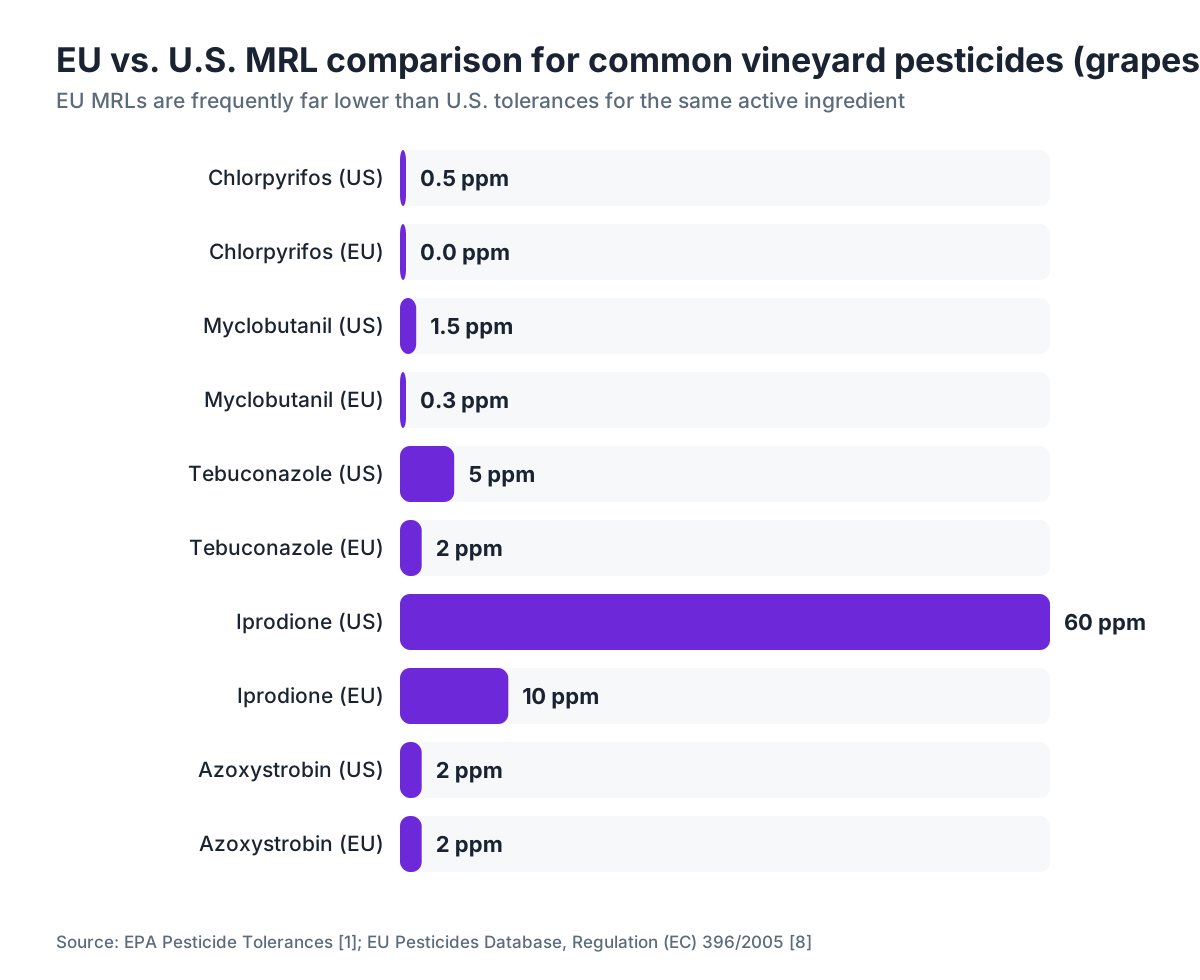
The table below shows a sample comparison for compounds common in vineyards. These values come from the EU pesticide MRL database and the EPA tolerance database, both publicly searchable [1][8].
| Compound | Crop | EPA Tolerance (ppm) | EU MRL (ppm) | Notes |
|---|---|---|---|---|
| Myclobutanil | Grapes | 1.5 | 0.3 | Common for powdery mildew |
| Iprodione | Grapes | 60 | 10 | Botrytis control |
| Chlorpyrifos | Grapes | 0.5 | 0.01 | EU near-zero MRL |
| Azoxystrobin | Grapes | 2.0 | 2.0 | Matches in this case |
| Tebuconazole | Grapes | 5.0 | 2.0 | Common DMI fungicide |
| Fenhexamid | Grapes | 3.0 | 15 | EU actually higher |
Chlorpyrifos is the one that catches growers off guard. A U.S. tolerance of 0.5 ppm against an EU MRL of 0.01 ppm means a load that clears U.S. inspection can fail EU import at 50 times the allowed level. If your winery sells into Europe, your grower agreements need to name the compounds that are legal here and effectively banned there.
Canada and Japan run their own MRL systems. Japan's positive list system, introduced in 2006, sets a default MRL of 0.01 ppm for any compound not explicitly listed. That's a near-zero tolerance for residues from any pesticide not registered in Japan. Wineries shipping to Japan need to know which compounds are registered there and which land in the default bucket.
How do you build the documentation chain from field to COA?
The chain has four links. Each one has a responsible party and a deadline. Break any single link and the traceability that auditors and buyers want falls apart.
Link 1 is the grower's spray log, filled in at the time of application by the applicator. This is the source record. Changing it after the fact is illegal and obvious to any experienced compliance auditor.
Link 2 is the pre-harvest declaration. The grower signs it at or before delivery. It summarizes every application made during the season, confirms all PHIs were observed, and attests that nothing was sprayed after the final spray date listed. Some wineries use a one-page form. Others fold it into the tonnage contract. Cornell's viticulture extension program publishes grower declaration templates you can adapt [9].
Link 3 is intake sampling and the COA. The winery, or a third-party lab, pulls a fruit sample at the crush pad, logs the grower ID, block ID, and lot number on the chain of custody, and ships it out. The COA comes back carrying those lot numbers, tying the result to the specific delivery.
Link 4 is the correlation file, and this is where the system earns its keep. For each grower and each lot, the file holds the signed pre-harvest declaration, copies of the relevant spray log entries, the lab COA, and a summary note from whoever reviewed them. That note states whether the residues found match the chemistry applied, whether any detected level clears the applicable tolerance or MRL for your target markets, and what action followed if something got flagged.
A spreadsheet handles this fine for a small operation with two or three growers. Push it to 15 growers across 40 blocks with separate export requirements, and the manual cross-reference starts generating real errors. VitiScribe was built to map spray records to lab results by block and lot, flag PHI issues, and generate the correlation summary automatically.
Keep these files for at least five years. The FDA's FSMA produce safety rule uses a two-year standard for farm records, but TTB can audit wine production records back multiple years, and export certifications sometimes want documentation reaching back to the vintage year [2].
What happens when a COA result doesn't match the grower's spray records?
This happens more often than the industry admits publicly. Three scenarios come up most.
A compound shows up on the COA that isn't in the spray log. Sometimes that's drift from a neighboring property. Sometimes a grower applied something and didn't record it, or used a different product name that the correlator never mapped back to the active ingredient. Sometimes it's a lab false positive, though modern LC-MS/MS confirmation makes those rare.
A compound shows up higher than the spray record would predict. Usually that means the rate ran higher than logged, the PHI wasn't actually observed, or the sample came from a hot section of the load.
A compound shows up that isn't registered for use on grapes at all. This is the serious one. Off-label use is a federal violation under FIFRA [1]. A winery taking fruit with illegal residues carries liability exposure, and the grower faces enforcement risk.
When there's a discrepancy, first request the original spray log, not the pre-harvest declaration summary. Compare the application dates and rates against what it would take to produce the residue level found, given typical field half-lives for that compound. UC Davis and WSU Extension publish residue persistence data for compounds common in western viticulture [5].
If you can't reconcile it, you decide whether to accept or reject the lot. Put that decision in writing, sign it, and file it with the correlation documentation. Accept a lot with a residue over an applicable tolerance and you've made a product you legally can't sell in the jurisdiction where that tolerance applies. If you take it anyway, document exactly why (for example, the market for that batch has no applicable MRL for that compound) and keep the analysis in the file.
What are the specific TTB and state-level documentation requirements for wineries?
TTB has no specific pesticide residue testing regulation for domestic wine production. What it does require, under 27 CFR Part 24, is that wineries keep production records good enough to show wine was made from acceptable material [2]. A batch with illegal residues isn't legally sound fruit, so the indirect hook exists.
The more direct federal angle is FDA. Under FSMA, large wineries (more than $1M in annual sales) that receive raw agricultural commodities have to build food safety plans addressing chemical hazards, which covers pesticide residues. The FDA preventive controls rule (21 CFR Part 117) requires a hazard analysis that at least acknowledges residues as a potential hazard, even if the control is supplier verification rather than in-house testing [10].
California is the most demanding state. The California Department of Food and Agriculture (CDFA) runs its own residue monitoring program and periodically tests wine grapes and wine at market. CDFA's monitoring reports are public and show which compounds and commodities get flagged most [4]. Getting caught in a CDFA sweep with a documented residue over tolerance is a far worse outcome than catching it yourself.
Oregon and Washington have wine-specific rules under their state agriculture departments, but neither mandates routine residue testing for in-state sales right now. Both track pesticide use and hold enforcement authority for illegal residues. Any winery in an appellation that uses sustainability certification (LIVE in the Pacific Northwest, Lodi Rules in California) picks up extra documentation requirements baked into the certification standard, and those programs do include residue testing components [11].
How should grower contracts address residue testing and documentation sharing?
The grower contract is where a winery's residue policy gets teeth. A handshake deal that growers will follow all label requirements won't do if you want to enforce documentation sharing or shield yourself from liability.
A well-drafted grower agreement should include at least:
- A requirement that the grower keep complete spray records in the format the winery specifies, and provide copies on request within a set number of days.
- A pre-harvest declaration requirement with a deadline tied to the anticipated harvest date, more than delivery.
- A statement naming which market's MRLs the fruit must meet (for example, "European Union MRLs as published in Regulation (EC) No 396/2005").
- A right to test incoming fruit and reject or renegotiate price if residues clear specified limits.
- Indemnification language covering the winery's costs if a residue violation from the grower's practices causes a recall, export rejection, or certification loss.
- A requirement that the grower notify the winery within 24 hours of any application made after the agreed final spray date.
Most growers won't fight reasonable documentation terms if you explain them clearly. The ones who push back hardest on sharing records are sometimes the ones whose records have holes. That's a signal worth reading before you sign tonnage.
For growers you've worked with for years and trust, an annual records review plus a spot-test program (one block per grower per season) is a fair minimum. For new growers, or anyone supplying premium fruit bound for export, test every delivery for the first two or three seasons and keep the correlation files tight.
How often should a winery test incoming fruit, and which compounds should the panel cover?
There's no single right answer, and anyone who says there is probably has a lab contract to sell you. The honest framework: test frequency and panel scope should match your risk exposure.
What pushes you toward more frequent, broader testing:
- You source from multiple growers with uneven record quality
- You sell, or plan to sell, in export markets
- You hold organic or sustainability certifications
- You source from high-disease-pressure regions where fungicide use runs heavy
- Your growers farm multiple crops with equipment shared across non-grape applications
A winery sourcing from a few trusted estate or long-term growers with solid records and purely domestic sales can defend annual lot-level testing with a standard multi-residue panel ($150 to $250 per sample) for each grower block.
Export-focused production calls for quarterly or per-vintage lot testing with an extended panel that includes EU-flagged compounds. Some export wineries run a rapid pre-crush screen, then a full panel on the same lot, using the quick screen to catch obvious issues before the fruit hits the tank.
Which compounds to prioritize depends on what actually gets applied in your region. In California, systemic fungicides (azoxystrobin, myclobutanil, tebuconazole) and botryticides (fenhexamid, iprodione) dominate vineyard use [4]. In the Pacific Northwest, mancozeb and copper-based products show up more often alongside the systemics. Read the CDFA annual residue monitoring reports and the USDA Pesticide Data Program (PDP) reports to see which compounds get detected most in grapes nationally [14].
The USDA Pesticide Data Program reported in its most recent grape testing cycle that among samples with detectable residues, the most frequently detected compounds were azoxystrobin, boscalid, fludioxonil, and tebuconazole. None are unusual, all have established tolerances, but knowing what's common tells you where to spend panel coverage.
What does an audit-ready residue documentation file look like?
Picture a buyer's food safety auditor sitting down with your files for one vintage lot. Here's what an audit-ready file holds, piece by piece, and why each one earns its place.
First, the grower identification page: name, farm address, block IDs in the lot, acreage, and the signed grower agreement or annual update. This nails down who's responsible for the source material.
Second, the spray record summary. That's either a copy of the grower's actual spray log entries or a grower-completed summary form the winery's intake team verified against the original log. Every application from bud break through harvest should be there, with dates, products, EPA registration numbers, rates, and applicator signatures.
Third, the pre-harvest declaration, signed by the grower inside a defined window before harvest, confirming the spray log is complete and accurate and all PHIs were observed.
Fourth, the intake record, showing delivery date, lot or gondola ID, and that a sample was collected at intake. Chain of custody from winery to lab should be attached or referenced.
Fifth, the COA from the lab, carrying the lot ID, the panel run, results for every compound tested, LOQ for each, and the tolerance or MRL comparison if the lab provides it.
Sixth, the correlation review note. One page is plenty. Whoever reviewed the COA against the spray records writes it. It states whether every detected residue is explained by the spray log, whether any level approaches or clears a tolerance for the intended market, and what the disposition decision was (accept, reject, hold for further review).
With those six pieces in order, you can answer almost any auditor question. Miss any one of them and you've left a gap experienced auditors will find. VitiScribe's templates are built around this six-piece model, so the correlation review generates automatically once the grower records and COA are both loaded against the same lot.
Keep the files digital where you can, with version control and backup. Paper works as a backup, but search and retrieval speed matter when an auditor is parked in your conference room.
How do organic and sustainability certifications change the residue testing requirements?
USDA certified organic wine grapes are grown without synthetic pesticides. But certification doesn't guarantee zero residues, because of drift, soil persistence from earlier conventional use, and contamination during processing. The National Organic Program (NOP) under USDA AMS requires certifying agents to run residue tests on organic products when there's reason to suspect a prohibited substance [13]. Routine annual testing isn't mandated, but agents can and do pull samples.
For organic growers, the documentation runs the opposite direction from conventional. Instead of showing that only approved pesticides were applied, you're showing that only allowed substances appear in the records, and that any detected residue sits below a threshold suggesting intentional use (generally under 5% of the EPA tolerance for the substance, per NOP guidance).
Sustainability programs come in tiers. Lodi Rules for Sustainable Winegrowing requires growers to track all pesticide applications and includes specific guidance on which compounds are restricted or prohibited under the program's scoring system [11]. LIVE certification in the Pacific Northwest requires growers to document spray records and make them available to verifiers. Neither program mandates third-party residue testing for every enrolled grower, but both can request testing when records come up short or a compliance question surfaces.
Some international sustainability schemes that European buyers increasingly demand, especially for bulk wine exports, do require annual third-party residue testing as a condition of certification. GLOBALG.A.P. certification, widely recognized in European retail supply chains, includes residue testing requirements that go beyond what most U.S. domestic programs ask for.
Frequently asked questions
Do wineries legally have to test incoming grapes for pesticide residues?
In the U.S., no federal law explicitly requires wineries to test every incoming lot for pesticide residues. But FDA's FSMA preventive controls rule (21 CFR Part 117) requires large wineries to analyze chemical hazards including pesticide residues and document supplier verification. Export markets impose hard MRL requirements that effectively mandate testing if you want to sell internationally and stay out of compliance trouble.
How long do wineries and growers need to keep pesticide application records?
EPA and state Worker Protection Standard rules require growers to keep pesticide application records for at least two years from the date of application. TTB can audit wine production records back multiple years, and export certifications may reference vintage year documentation. Keeping grower spray records and winery COA files for five years is a safer standard that covers most regulatory and commercial audit scenarios you're likely to face.
What is a pre-harvest declaration and why does the winery need it?
A pre-harvest declaration is a signed document from the grower confirming the spray log is complete, all applications are recorded, and all pre-harvest intervals were observed before delivery. Wineries need it because it establishes contractual accountability before the fruit arrives. If a residue problem surfaces later, the declaration is part of the chain of evidence showing the grower attested to compliance, which matters in any dispute or audit.
How much does a pesticide residue test cost for wine grapes?
Standard multi-residue panels covering 200 to 400 compounds run roughly $150 to $400 per sample from major agricultural testing labs. Extended panels that add metabolites, chlorate, or perchlorate can run $400 to $900 per sample. Prices vary by lab, region, and volume. Get quotes from at least two labs and ask specifically which compounds and MRL comparisons are included in each tier before comparing prices.
What should a winery do if a COA shows a residue that isn't in the grower's spray records?
Start by requesting the original spray log and comparing it to the COA result. Consider drift from adjacent properties, shared application equipment, or a product applied under a different trade name with the same active ingredient. If you can't explain the residue, contact the lab to confirm the result wasn't a false positive. Document your investigation in writing. If the residue exceeds an applicable tolerance, reject the lot or hold it pending further testing and legal review.
Which pesticides have EU MRLs much lower than U.S. tolerances for wine grapes?
Chlorpyrifos is the clearest example: the U.S. tolerance is 0.5 ppm on grapes but the EU MRL is 0.01 ppm. Iprodione runs 60 ppm in the U.S. versus 10 ppm in the EU. Myclobutanil is 1.5 ppm in the U.S. and 0.3 ppm in the EU. These gaps mean a U.S.-compliant crop can fail EU import requirements. Any winery selling to Europe needs to verify which compounds their growers use against the EU MRL database before the season starts.
Can a winery be held liable for pesticide residues that came from the grower's application?
Yes. Once fruit enters the winery, the resulting wine is the winery's product and the winery bears regulatory and commercial responsibility for it. If the wine contains illegal residues, the liability for recalls, export rejections, or regulatory action falls on the winery as the food manufacturer, even if the source was the grower's application. Good grower contracts with indemnification language help allocate that risk, but they don't eliminate the winery's exposure.
What sample size and collection method should be used for residue testing at crush intake?
Standard practice is a composite sample of approximately 2 to 3 kilograms of fruit taken from at least 10 random points across the lot or gondola load, mixed, then subsampled and packaged for the lab. A single-bin grab sample isn't representative of the whole lot. Submit the sample with a chain-of-custody form that includes the grower ID, block ID, delivery date, and lot number. Those fields tie the COA back to the specific delivery in your correlation files.
What information must a grower's spray record include to satisfy state and federal requirements?
At minimum: application date, product name, EPA registration number, active ingredient, application rate, total acres treated, target pest, applicator name and license number if required, and both the pre-harvest interval and restricted-entry interval from the product label. California also requires filing pesticide use reports (PURs) with the County Agricultural Commissioner. Records must be kept for at least two years under EPA WPS, with some state rules requiring longer retention.
How does FSMA affect winery pesticide residue documentation?
Under FSMA's preventive controls rule (21 CFR Part 117), wineries with more than $1 million in annual sales that receive raw agricultural commodities must conduct a hazard analysis identifying reasonably foreseeable chemical hazards, which includes pesticide residues. The rule requires documented preventive controls and supplier verification activities. Testing incoming fruit or reviewing grower spray records qualifies as supplier verification. The records from those activities must be kept for two years.
Should wineries test fruit at intake or test the finished wine for residues?
Testing at fruit intake gives you the earliest possible decision point, before the fruit goes in the tank and you've added labor and processing costs to a potentially problematic lot. Finished wine testing is useful for export documentation and certification purposes but some compounds change in concentration during fermentation. Testing both, or sequencing a rapid fruit screen followed by a finished wine panel for export lots, gives you the most complete picture. Testing only finished wine leaves you exposed after significant production investment.
How does Japan's positive list system affect wine export documentation?
Japan's positive list system, in effect since 2006, sets a default MRL of 0.01 ppm for any pesticide not explicitly listed in Japan's residue database. For wine grapes, many compounds commonly used in U.S. vineyards have no Japan-specific listing, meaning any detectable residue of those compounds could trigger a rejection at 0.01 ppm. Wineries exporting to Japan should check each active ingredient their growers use against Japan's Ministry of Health database, and build that into grower agreements before the season.
What do organic certification auditors look for in pesticide residue documentation?
USDA NOP certifying agents look for complete records of all substances applied in the field, confirmation those substances are on the National Organic Program's allowed materials list, and plausible explanations for any detected residues. NOP guidance suggests a detected synthetic pesticide residue below 5% of its EPA tolerance may be consistent with drift or environmental contamination rather than intentional use. Documentation that shows no prohibited substances were in the spray log supports that case. Any gap in the records creates doubt.
Sources
- EPA, Pesticide Tolerances (FFDCA Section 408): EPA sets U.S. tolerances for pesticide residues in food under FIFRA and FFDCA; tolerances often differ substantially from EU MRLs for the same compound on grapes
- EPA, Worker Protection Standard for Agricultural Pesticides: EPA WPS requires growers to maintain written pesticide application records for a minimum of two years from the date of application
- California Department of Food and Agriculture, Pesticides: California requires growers to file pesticide use reports (PURs) with County Agricultural Commissioners; CDFA publishes annual residue monitoring reports showing detection rates by commodity
- UC Agriculture and Natural Resources (UC Davis Cooperative Extension): UC Cooperative Extension publishes grower training resources on pesticide label compliance, PUR requirements, and residue persistence data for wine grape production
- European Food Safety Authority, Pesticides: LC-MS/MS is the dominant method for multi-residue pesticide screening in food because it covers a broad range of polar compounds at lower detection limits than GC/MS alone
- USDA Pesticide Data Program: Some fungicide residues can increase in concentration during fermentation as water is driven off; conversion from fruit to wine concentration is not 1:1
- European Commission, EU Pesticides Database (MRL Regulation 396/2005): EU MRLs for grapes are publicly searchable and differ substantially from U.S. tolerances for compounds such as chlorpyrifos (EU 0.01 ppm vs. U.S. 0.5 ppm) and iprodione (EU 10 ppm vs. U.S. 60 ppm)
- Cornell Cooperative Extension: Cornell Extension has published grower declaration templates and spray record guidance applicable to wine grape compliance documentation
- FDA, FSMA Preventive Controls for Human Food (21 CFR Part 117): FDA's preventive controls rule requires large wineries to conduct a hazard analysis addressing chemical hazards including pesticide residues, with supplier verification records kept two years
- Lodi Rules for Sustainable Winegrowing: Lodi Rules requires growers to track all pesticide applications and includes guidance on restricted or prohibited compounds under its scoring system; sustainability programs include residue testing components
- Washington State University Extension: WSU Extension publishes vineyard pesticide recordkeeping guides with field-ready templates and residue persistence data for compounds common in Pacific Northwest viticulture
- USDA AMS, National Organic Program: NOP requires certifying agents to conduct residue testing on organic products when a prohibited substance is suspected; a residue below 5% of the EPA tolerance may indicate drift rather than intentional use
- USDA Pesticide Data Program, Annual Summary: The USDA PDP grape testing cycle reported azoxystrobin, boscalid, fludioxonil, and tebuconazole among the most frequently detected residues, all with established tolerances
Last updated 2026-07-11