Zinc phosphide application records in vineyards and required notifications

TL;DR
- Zinc phosphide is a Restricted Use Pesticide (RUP) used in vineyards mainly for pocket gopher and vole control.
- Federal law requires written application records kept at least two years, a 24-hour re-entry interval, and pre-application notifications to workers under the EPA Worker Protection Standard.
- Most states add more: a licensed Pest Control Adviser recommendation, county ag commissioner notification, and posting at field entry points.
What is zinc phosphide and why do vineyards use it?
Zinc phosphide kills burrowing rodents, mostly pocket gophers and meadow voles, by converting to phosphine gas inside the animal's gut once it hits moisture and stomach acid. Gopher damage to roots and drip lines is a real production problem, and zinc phosphide baits are one of the few options that stay cheap across a lot of acres.
The active ingredient has been registered in the U.S. since the 1940s. It comes as a grain bait (usually corn or oats coated at around 2% zinc phosphide), applied into burrow systems with a hand probe or a tractor-mounted burrow builder. Some formulations go as pelleted bait in bait stations. The product smells like garlic and rotting fish, which matters when you think about worker exposure.
Because it generates toxic phosphine on contact with moisture, including moisture in soil, lungs, or eyes, the EPA classifies zinc phosphide as a Restricted Use Pesticide. That is not a technicality. Only a certified applicator, or someone working under the direct supervision of one, can buy or apply it [1].
If you have not already done it, get your private applicator certification through your state department of agriculture before you ever open a container. That is step one.
For how rodenticide programs fit into the bigger picture, the vineyard section covers cover crop and habitat practices that lower gopher pressure over time.
What federal records does zinc phosphide require?
Federal recordkeeping for Restricted Use Pesticides comes from FIFRA Section 8(a) [2] and the rules at 40 CFR Part 171. Any certified applicator who uses or supervises the use of an RUP has to keep records at least two years from the date of application. That is the floor, not the target.
Those records have to include:
- The brand name and EPA registration number of the product
- The amount of product applied
- The location of the application (legal description or other identifier)
- The crop or site treated
- The date of application
- The name and certification number of the certified applicator responsible
Federal inspectors and state lead agencies can review your RUP records without prior notice. Worth knowing before you decide how loose to keep your notes. Handwritten logs stuffed in a filing cabinet technically meet federal minimums. In practice, any state or county inspection finds the gaps fast.
Federal and state records rules are separate things. Most states want more than FIFRA does, often daily logs with weather, equipment, and the supervising applicator's license number. Check your state ag department's current rules. California's are run by county agricultural commissioners under California Food and Agriculture Code Section 12981 [11].
What notifications are required before applying zinc phosphide near workers?
The EPA Worker Protection Standard (WPS) at 40 CFR Part 170 is the federal framework for worker notification on farms [4]. A zinc phosphide application in a vineyard that employs workers or handlers triggers several obligations at once.
Start with central posting. Under the 2015 revised WPS, you must post a pesticide application safety bulletin at a central location workers can reach at all times. It has to name the pesticide, describe and locate the treated area, state the restricted-entry interval, and give the date and time the REI expires. For zinc phosphide, the REI is 24 hours [4].
Next, oral warnings. Before workers enter any area under an REI, you warn them, either by posting at all entry points to the treated area or orally in a language they understand. The 2015 revision tightened this: if you apply while workers are elsewhere on the establishment, you notify those workers before they could reach the treated spot.
Third, application-specific notification. If a worker or handler may be next to where you are applying, more steps kick in. Phosphine drifts. The WPS sets no buffer for zinc phosphide baited into burrows, but the label is the law. Most registered zinc phosphide bait labels say bystanders and non-essential people stay out of the application area during treatment. Under FIFRA, that instruction carries the force of law [1].
Fourth, the 2015 revision added designated representatives. A worker can name a representative who can request application details from you, including the EPA registration number, the active ingredient, and the safety data sheet.
WSU Extension has a readable summary of the 2015 WPS changes aimed at tree fruit and vineyard operations [5]. UC Cooperative Extension publishes worker safety guidance for rodenticide programs in California [6].
What is the re-entry interval for zinc phosphide in vineyards?
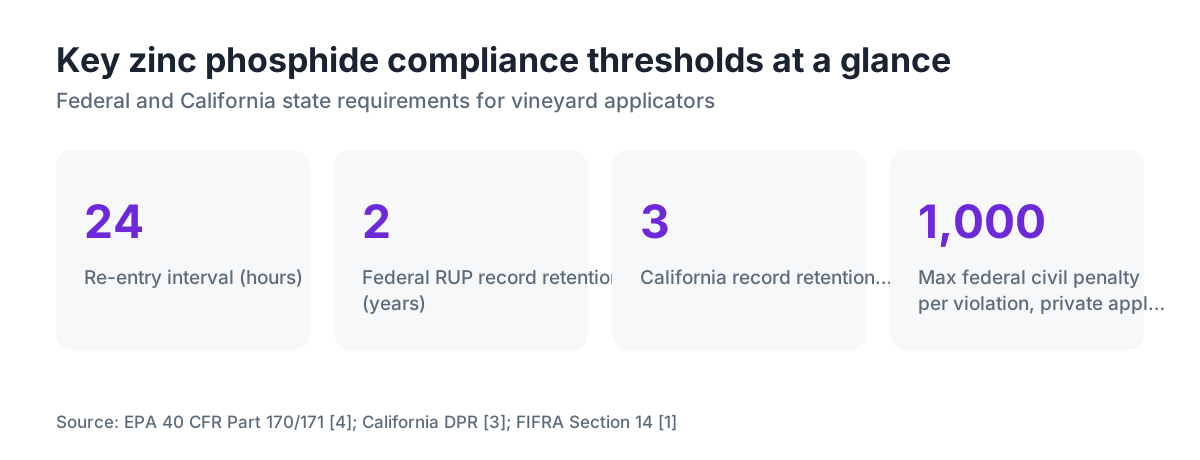
The label re-entry interval (REI) for zinc phosphide is 24 hours [4]. Workers and handlers cannot enter the treated area, including driving through it, until 24 hours have passed from the end of the application. This is not negotiable. The label is the law under FIFRA Section 2(ee), and applying a product against its labeling is a federal violation.
The 24-hour clock matters because zinc phosphide keeps reacting with soil moisture and giving off trace phosphine for a while after it goes into the burrows. The REI lets that off-gassing die down before anyone walks the block.
So don't start a zinc phosphide application on a morning when you have irrigation crews or trellising work planned for the same block that afternoon. End applications at day's end when you can, so the clock runs overnight. Some California county advisers suggest applying late afternoon so the REI expires the next afternoon instead of during peak morning work. Sensible, but not federally required.
PPE during the application itself is on the label and usually means chemical-resistant gloves, long sleeves, long pants, and for some formulations a dust/mist filtering respirator. Read the current label for your product, because PPE differs by formulation.
Do you need to notify the county before using zinc phosphide in a California vineyard?
Yes, and California asks more than the federal baseline. The state requires that any use of a Restricted Material, a separate and stricter state category that includes zinc phosphide, be authorized by the county agricultural commissioner (CAC) for the county where you apply [11].
Here is what that means in practice:
- You need a written recommendation from a licensed Pest Control Adviser (PCA) before you buy or apply a Restricted Material. The PCA visits the site, confirms the pest problem, and writes a recommendation naming the pest, the product, the rate, and the method [3].
- You then file a Notice of Intent (NOI) with the county agricultural commissioner before application. Timing varies by county, but 24 hours' notice is common. The CAC can add restrictions or conditions.
- After application, you file a Pesticide Use Report (PUR) with the county. The PUR is due monthly for every month with any application [3]. That data feeds the California Department of Pesticide Regulation's statewide database, which anyone can search.
California's PUR program is one of the most thorough pesticide tracking systems in the country. The DPR publishes annual summaries [7]. Missing a PUR deadline is a citable violation even when the application itself was clean.
Other wine states differ. Washington requires restricted applicators to keep records under WAC 16-228, and Oregon runs its own reporting through the Oregon Department of Agriculture. Check your state department for current rules.
What goes in a zinc phosphide application record?
A compliant zinc phosphide record has to satisfy federal RUP rules and your state's extra rules at the same time. Here is a field-by-field breakdown:
| Field | Federal RUP requirement | California additional requirement |
|---|---|---|
| Product name and EPA reg. number | Required | Required in PUR |
| Application date | Required | Required in PUR |
| Location (block, parcel, GPS) | Required | Required (APN or legal description) |
| Crop and commodity | Required | Required |
| Area treated (acres) | Required | Required |
| Amount of product applied | Required | Required (lbs active ingredient) |
| Certified applicator name and license # | Required | Required |
| PCA recommendation number | Not required | Required |
| Weather at time of application | Not required | Not required but strongly advised |
| Equipment used | Not required | Not required but good practice |
| REI posted/workers notified | Not required by records rule | Not required but WPS documentation |
The weather row earns emphasis even though it is not federally required. Don't apply zinc phosphide bait when rain is coming, because surface moisture can trigger off-gassing before the bait is eaten. If you ever face a liability claim, a record showing wind speed, humidity, and temperature at application time is worth far more than one without.
Retention is two years federally, but California and some states want three for certain categories. Keep everything three years as your default.
Running records across many blocks or several employees doing supervised applications gets messy on paper. A digital system beats a binder for auditability. VitiScribe is built for exactly this: structured records that pre-populate from product databases, flag missing fields, and timestamp worker notifications.
What are the secondary poisoning and environmental risks that affect where and how you apply?
Zinc phosphide carries a secondary poisoning risk to raptors, owls, and scavenging mammals that eat poisoned rodents. The EPA's ecological risk assessment for zinc phosphide has flagged this concern more than once [8]. Some states impose nesting-season restrictions, and if you have listed species (San Joaquin kit fox, burrowing owls, California tiger salamander in some vineyard regions), Section 7 or Section 10 consultation under the Endangered Species Act could technically apply.
For recordkeeping, the practical piece is water. If you apply near a water source, the label usually bans application within a set buffer, because phosphine dissolved in water is toxic to fish. Record the distance to the nearest water feature at application time. If a water quality complaint ever lands, that note carries weight.
The label also bars application into flooded or wet burrows. That is both a safety issue (phosphine generated underground in wet conditions can hurt the applicator) and an efficacy issue. Note burrow conditions in your record: dry, damp, or wet. Skipping wet-burrow sections is more than label compliance. It's what good applicators actually do.
Cornell Cooperative Extension publishes IPM guidance on vole and rodent management in perennial crops that covers both application timing and habitat modification alongside chemical control [9].
How do posting and field-boundary notification work during a zinc phosphide application?
Under the WPS, you post warning signs at every point where workers could enter a treated area during the REI [4]. With zinc phosphide's 24-hour REI, that means every road, path, or access point into the block stays posted for the full 24 hours after the application ends.
The WPS sets minimum sign dimensions: at least 8.5 x 11 inches, the word WARNING in letters at least one inch high, plus the pesticide name, the REI, and the date and time the REI expires. The sign has to be legible from 25 feet. Farm supply retailers sell pre-printed WPS signs.
Some zinc phosphide label language goes past the WPS minimum, requiring that the area be monitored or that bystanders stay clear during the application itself, more than just afterward. Read your product label for this.
Pulling or covering signs before the REI expires is a WPS violation. Multi-day applications across several blocks mean signs posted in several places at once, and tracking which blocks are in REI on which day takes either a very good memory or a written log. A simple block-by-block log with start times, end times, and REI expirations solves it.
At any real scale, tracking applications across dozens of blocks is exactly the kind of overhead that produces compliance failures. A record system, paper or digital, is not optional there.
What are the penalties for missing records or skipping notification?
Federal FIFRA penalties for RUP recordkeeping failures can reach $1,000 per violation for private applicators under FIFRA Section 14 [1]. That cap sounds small, but each missing or falsified record can count as a separate violation, and state penalties stack on top.
California county agricultural commissioners can fine you and, worse, revoke your ability to buy or use Restricted Materials in that county. Repeat violations can get referred to the Department of Pesticide Regulation for license suspension. A suspended applicator license shuts down any operation that runs on RUPs.
WPS violations run through the EPA, which delegates enforcement to state agencies. The 2015 revision pushed inspection activity up. Civil penalties under FIFRA for WPS violations can reach $10,000 per violation for employers [4]. Worker deaths or serious injuries tied to a WPS violation have produced six-figure settlements in California and Florida agricultural cases, though I'm not quoting specific amounts because the public record on those is inconsistent.
The fines are not the real thing you are protecting against. You are protecting against the worker injury, and you are protecting your license to operate.
How long do you have to keep zinc phosphide application records?
Federal law sets a two-year minimum for RUP application records [2]. California wants PUR source records kept three years [3]. Washington and Oregon also require records, with Washington's rule at WAC 16-228 generally requiring two years, though dealer records run longer. Farm in multiple states and you apply the longest period across the board. Three years is a safe default anywhere.
The physical form does not matter federally. Paper, spreadsheet, or purpose-built software all satisfy the rule. What matters is that the record is legible, complete, and producible on request. An inspector can ask for your RUP records on the spot during an inspection. You don't get to go fetch them later. They should be at the operation and reachable.
Plenty of vineyard managers keep application records in the same binder as their SDS sheets. That's fine for a small operation. If you have several employees doing supervised applications, a central log with supervisor sign-off on each entry adds accountability worth the extra 30 seconds per entry.
Where can I get training on zinc phosphide safety and application certification?
Private applicator certification, which you need to buy and apply RUPs including zinc phosphide, is run at the state level. Each state's department of agriculture sets its own exam and continuing education. The National Pesticide Information Center at Oregon State University links to every state program [10].
UC Cooperative Extension runs in-person and online pesticide safety training, including Spanish-language worker safety training, that counts toward continuing education hours for California applicators [6]. If your vineyard employs workers who will be in or near treated areas, FIFRA requires you to give those workers and handlers pesticide safety training at least annually [4]. UC Cooperative Extension materials meet that requirement.
WSU Extension's Viticulture and Enology program publishes annual pesticide use guides for Washington wine grapes, rodenticide sections included, and those materials track current Washington labels and registration status [5].
Cornell's New York State IPM Program covers eastern vineyard pest management and has vole control guidance for Concord, hybrid, and vinifera vineyards in the Northeast [9].
For California specifics on the NOI process and PCA rules, your county agricultural commissioner's office is the authoritative source. They don't bite, and most will walk you through it if you call before your first application.
What does a compliant zinc phosphide notification workflow look like step by step?
Here is the sequence for a California vineyard, which has the toughest requirements. Other states run similar but shorter.
Step 1: PCA site visit and written recommendation. Before you buy zinc phosphide, a licensed PCA visits, confirms pocket gopher damage, and writes a recommendation. It has to name the block, the pest, the product, the rate, and the method. File it before you buy the product.
Step 2: Submit Notice of Intent to the county agricultural commissioner. File at least 24 hours ahead (confirm your county's window). The CAC may add conditions. Some counties make you wait for written approval.
Step 3: Inform workers of the upcoming application. Under WPS, workers on the establishment get notified before they could reach the treated area. Oral warning in a language they understand is required.
Step 4: Conduct the application. Record the start time, end time, product lot number, quantity used, equipment, weather, and the applicator's name and license number.
Step 5: Post WPS warning signs. Post a compliant sign at every entry point to the treated block right after application ends. Record what you posted and where.
Step 6: Record the REI expiration time. 24 hours from the end of application. No worker enters before then.
Step 7: Inspect and remove signs after the REI expires. Note the date and time of sign removal in your log.
Step 8: File the Pesticide Use Report with the county. Due by the end of the month following the month of application. In California this is a legal obligation, not optional paperwork.
Step 9: Retain all records at least three years.
Tools like VitiScribe walk you through this block by block and auto-generate the PUR fields from your application log, which cuts reporting time hard when you're applying across many blocks per season.
Frequently asked questions
Can a vineyard worker who is not a certified applicator apply zinc phosphide?
Yes, but only under the direct supervision of a certified applicator. FIFRA defines direct supervision as the certified applicator being available by phone or radio and having given specific instructions for the application. The certified applicator is legally responsible for the worker's compliance. The certified applicator's name and license number must appear in the application record even when someone else does the physical work.
Does zinc phosphide applied into burrows still require WPS posting?
Yes. The application method, broadcast or into burrows, does not change WPS notification obligations. The 24-hour REI and worker notification apply whenever the product is used on an agricultural establishment with workers or handlers. What sometimes confuses people is that burrow application lowers drift risk but does not remove the off-gassing period that drives the REI.
How often do California county ag commissioners actually inspect spray records?
California's county agricultural commissioners run routine compliance inspections and also investigate complaints. Pesticide Use Reports get cross-checked by the Department of Pesticide Regulation against licensed PCA recommendations and purchase records. Gaps between purchase volume and reported use often trigger a follow-up inspection. Nobody publishes a precise inspection frequency, but the DPR annual enforcement report shows thousands of investigations statewide each year.
What is the difference between a Restricted Use Pesticide and a California Restricted Material?
A Restricted Use Pesticide (RUP) is a federal EPA designation requiring certified applicator purchase and use. A California Restricted Material is a state designation that adds county agricultural commissioner authorization on top of the federal RUP requirement. Zinc phosphide is both, which is why California requires the PCA recommendation and the Notice of Intent to the county commissioner before any application.
Can I use zinc phosphide in a certified organic vineyard?
No. Zinc phosphide is not on the National Organic Program's National List of Allowed and Prohibited Substances for organic crop production. Using it in a certified organic block would jeopardize that parcel's certification. Organic vineyards managing gopher pressure typically rely on underground barriers, gopher gassing machines approved under NOP, or raptor habitat. Check with your certifier before using any rodenticide.
Is there a buffer zone required between a zinc phosphide application and a neighboring vineyard or residence?
Buffer distances are on the product label, not in a universal federal rule, so they vary by formulation. Most zinc phosphide grain bait labels set no property-line buffer for burrow applications, because the bait goes underground and drift potential is low. Some labels do restrict use within a set distance of occupied structures. Always read your specific product's current label for buffer requirements.
What happens to excess or unused zinc phosphide after a vineyard application?
Unused bait exposed to moisture should not go back into the original container. Most labels require disposal as hazardous waste through an approved facility or by label-specific instructions. Zinc phosphide bait is ignitable and can generate phosphine gas if stored or disposed of improperly. Contact your county hazardous waste facility or the California Department of Toxic Substances Control for proper disposal options in your area.
Do I need to notify my neighbors or adjacent landowners before applying zinc phosphide?
Federal law and most state laws do not require notifying adjacent landowners for zinc phosphide bait applied into burrows. Some county ordinances, especially in California's more urban-adjacent AVAs, may require neighbor notification for Restricted Material applications. If your vineyard borders a school, a residence, or a public right-of-way, check with your county agricultural commissioner. Voluntary notification is good neighbor practice.
What training do workers need before they can re-enter a zinc phosphide-treated block?
Workers must get WPS pesticide safety training before they can be in any area on an agricultural establishment where pesticides are used. This training runs annually and covers the pesticide safety information specified in the WPS. For re-entry after a zinc phosphide application, workers must be told the REI, the treated block location, and not to enter until the REI has expired and signs are removed.
How does the Pesticide Use Report in California get filed, and what does it cost?
California's PUR is filed with the county agricultural commissioner's office for the county where the application occurred. Most counties take submission through an online portal or by paper form. There is no direct per-report fee paid by the grower, but commissioner services are funded through assessments that vary by county. Late filing is a violation and can bring penalties. The DPR website has county contact information and current PUR forms.
Can I apply zinc phosphide myself if I buy it, or do I need to hire a licensed pest control operator?
If you hold a state private pesticide applicator certification, you can buy and apply zinc phosphide yourself on land you own or lease for agricultural production. You do not need to hire a licensed pest control company. If you are not certified, you either become certified or hire a licensed commercial applicator. Some large vineyard operations keep at least one certified applicator on staff for exactly this reason.
What is the typical application rate of zinc phosphide in a vineyard, and how do I record it?
Rates vary by formulation and target pest. A common grain bait at 2% zinc phosphide might go at roughly 0.5 to 1.5 pounds of bait per burrow system, but always follow the product label rate, not a rule of thumb. In your record, log the total pounds of product applied and calculate pounds of active ingredient (product weight times the label percentage). California's PUR specifically requires the active ingredient quantity.
Sources
- EPA, Federal Insecticide, Fungicide, and Rodenticide Act (FIFRA) overview: Zinc phosphide is classified as a Restricted Use Pesticide; only certified applicators or those under their direct supervision may purchase or apply it; using a pesticide inconsistent with its label is a federal violation under FIFRA Section 2(ee)
- EPA, Recordkeeping requirements for certified applicators and restricted use pesticides: FIFRA Section 8(a) and 40 CFR Part 171 require certified applicators to keep RUP application records for at least two years from the date of application
- California Department of Pesticide Regulation, Pesticide Use Reporting: California requires a licensed PCA recommendation before Restricted Material use, Notice of Intent to county agricultural commissioner, and monthly Pesticide Use Report filing; records must be retained for three years
- EPA, Worker Protection Standard, 40 CFR Part 170: The 2015 WPS requires central posting, oral worker notification, warning signs at field entry points, 24-hour REI for zinc phosphide, and WPS pesticide safety training for workers annually; civil penalties for WPS violations can reach $10,000 per violation
- Washington State University Extension, Viticulture and Enology and WPS guidance: WSU Extension publishes summaries of the 2015 WPS revisions and annual pesticide use guides for Washington wine grapes including rodenticide sections
- University of California Agriculture and Natural Resources / UC Cooperative Extension: UC Cooperative Extension publishes worker safety guidance for rodenticide programs and offers pesticide safety training, including Spanish-language worker safety training, that counts toward California continuing education hours
- California Department of Pesticide Regulation, Annual Pesticide Use Report Summaries: The California DPR publishes annual statewide pesticide use summaries from county PUR data, which is publicly searchable and used for compliance cross-checking
- EPA, Pesticide ecological risk assessment: The EPA's ecological risk assessment for zinc phosphide has flagged secondary poisoning risk to raptors, owls, and scavenging mammals
- Cornell Cooperative Extension, New York State IPM Program: Cornell's IPM program covers integrated vole and rodent management in vineyards including application timing guidance, habitat modification, and chemical control options
- National Pesticide Information Center, Oregon State University, Applicator Certification: State private applicator certification for RUP purchase and use is administered by each state's department of agriculture; NPIC links to all state programs
- California Food and Agriculture Code Section 12981, Restricted Materials Permits: California Food and Agriculture Code Section 12981 establishes the county agricultural commissioner permitting system for Restricted Materials including zinc phosphide
- EPA, Pesticide Registration: Label Requirements: Under FIFRA, the pesticide label is a legal document; applying a product inconsistent with label instructions is a federal violation; REI and PPE requirements on the label are enforceable
Last updated 2026-07-11