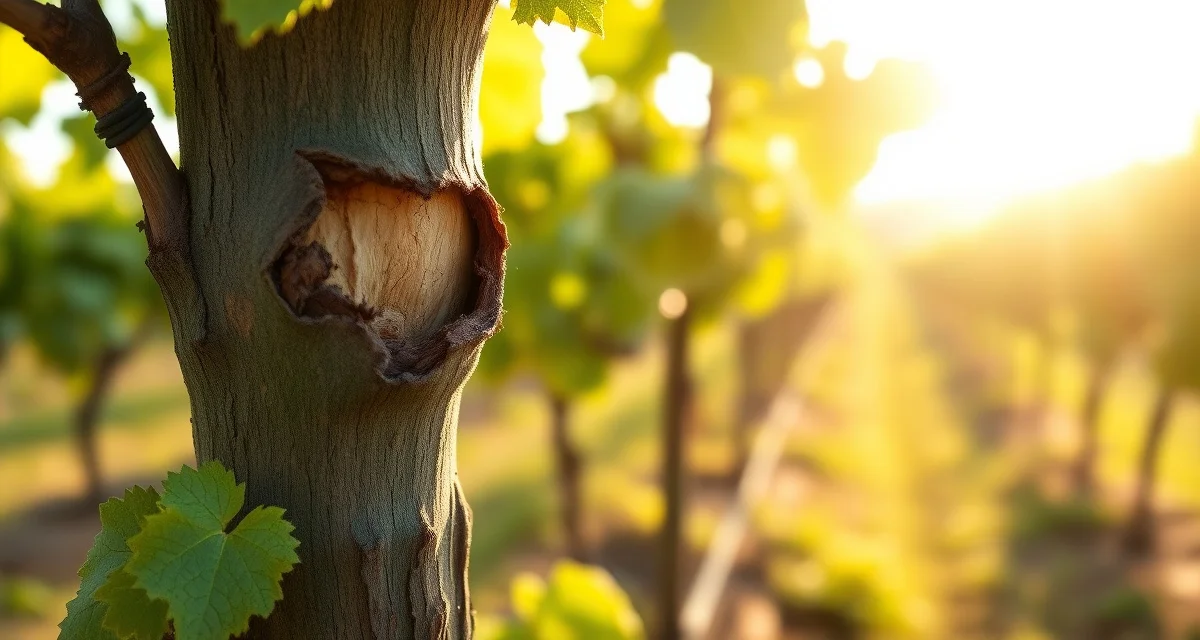
Eutypa Dieback in Vineyards: Complete Management Guide
Eutypa dieback can kill arms and cordons within 3-5 years of infection -- that's the timeline that makes this trunk disease one of the most economically damaging long-term threats in a vineyard operation. Unlike powdery mildew or botrytis, which you manage season to season, Eutypa infections establish in pruning wounds and kill vine structure progressively over years. By the time you see characteristic wedge-shaped wood discoloration or stunted spring shoot growth, the fungus has been advancing through arm and trunk tissue for years.
TL;DR
- Eutypa lata infects fresh pruning wounds within 24-48 hours -- wound protection must be applied within 24 hours of each pruning cut, not as a single end-of-season application after all pruning is complete
- For large operations where pruning takes weeks, protection must be applied progressively as you move through blocks; early-pruned cuts left unprotected for 3 weeks are exposed to rain events and spore release throughout that window
- Eutypa spores are released during rainfall at temperatures above 40°F throughout the California dormant pruning season (December through April) -- if rain is forecast within 6-12 hours of pruning, apply wound protectant immediately
- Visible symptoms (stunted distorted shoot growth, V-shaped wood discoloration) appear 3-5 years after infection -- by the time symptoms are present, the fungus has been advancing for years
- Once Eutypa is established in wood, there is no cure -- management options are cordon removal, whole-vine removal, or slowing spread through consistent wound protection in adjacent vines
- VitiScribe's pruning wound protection records track the gap between pruning completion date and wound protection date by block -- the metric that tells you which blocks were adequately protected and which had unprotected exposure windows
Pruning wound protection records in VitiScribe track Eutypa preventive spray history by block, creating the documentation trail that tells you which blocks received protection, when protection was applied relative to pruning, and where program gaps may have left vine tissue vulnerable.
Biology and Disease Cycle
Eutypa lata is an ascomycete fungus that infects pruning wounds and other wound sites. The fungus produces ascospores that are released during and after rainfall events during the dormant pruning season. These spores are wind-dispersed and land on freshly cut pruning wounds, where they germinate and colonize the wood.
Infection occurs through fresh wounds. The pathogen can infect through wounds up to several weeks old, but wounds cut within the past 24-48 hours are at highest risk. Once established in wound tissue, the fungus grows internally through woody tissue at a rate of approximately 1-2 cm per year. This slow growth means that visible symptoms -- stunted, distorted shoot growth from infected cordon arms -- typically appear 3-5 years after the original infection event.
Spore release conditions: Eutypa lata releases ascospores during rainfall events when temperatures are above 40°F (5°C). In California's North Coast, this means spore release occurs throughout the dormant pruning season (December through April) whenever it rains. In eastern wine regions with cold winters, the infection window is compressed into warmer pre-spring rain events. Spore release can continue well into spring through the early bloom period.
Critical window for protection: The 24-48 hours after pruning cuts are made is when protection is most valuable. Applications made days after pruning have reduced efficacy. For large operations that take weeks to complete pruning, this means protection must be applied progressively as you move through blocks -- not as a single end-of-pruning application.
Identification
Early symptoms (3-5 years post-infection):
- Stunted, distorted shoot growth from infected cordon arms -- shoots may be shorter, have compressed internodes, and appear "witches' broom" or bundled
- Small, chlorotic leaves on affected shoots
- Sparse, poorly developed flower clusters
Advanced symptoms:
- Dead cordon arms: when the fungus has killed the vascular tissue completely, cordon arms fail to break dormancy and appear dead in spring
- V-shaped or wedge-shaped wood discoloration visible in cross-section of affected arms -- the stained tissue corresponds to the advancing fungal colony
- Internal wood cavity (esca-associated) in some infections
Distinguishing from other trunk diseases:
- Botryosphaeria dieback produces similar wood discoloration but different spore-release timing (summer infection possible)
- Esca (Phaeomoniella, Phaeoacremonium) creates a distinct "tiger stripe" or "brown stripe" wood pattern in cross-section
- Crown gall creates external galls at wound sites and graft unions
If you're uncertain which trunk disease you're dealing with, send a sample to your state plant pathology laboratory for identification. Different trunk diseases require different management approaches, and the records you keep should reflect which disease you're managing.
Spray Timing for Wound Protection
The correct timing is within 24 hours of each pruning cut. For large vineyards where pruning takes weeks, this means following behind the pruning crew progressively. A single post-pruning application at the end of a 3-week pruning operation leaves early-pruned cuts unprotected for up to 3 weeks -- exactly the window when Eutypa lata spores are infecting.
Application methods:
- Paint-on application: Apply wound protectant by brush or roller directly to individual pruning cuts. Labor-intensive but ensures coverage. Best for high-value blocks where Eutypa history is notable.
- Hydraulic spray to pruning wounds: Applying wound protectant by tractor-mounted sprayer to pruning cuts immediately after the pruning crew. Practical for large-scale operations.
- Pruning crew follow-up: Some operations train pruning crews to apply wound protectant by brush or aerosol can immediately after making each cut. Most consistent coverage but requires crew training and compliance.
Application timing relative to rain: If rainfall is forecast within 6-12 hours of pruning, apply wound protectant immediately -- don't wait for the rain to pass. Rain creates spore release events that infect the wound before your protectant can be applied. Prioritize the blocks at highest risk for early infection.
Registered Materials for Pruning Wound Protection
Thiophanate-methyl (Topsin-M): The most widely used material for Eutypa wound protection. Effective against Eutypa lata and several other trunk disease pathogens. Available as a paint-on formulation (Topsin M 70% WP) or liquid. Must be applied promptly after pruning for maximum efficacy. PHI varies -- check label for specific formulation and use timing.
Myclobutanil (Rally 40W): DMI fungicide with good efficacy against Eutypa lata. Also registered for powdery mildew management in-season, so it's already in most spray programs. Can be applied as a wound paint in concentrated form.
Biological options:
- Trichoderma atroviride (Vintec, Trichopel): biological wound protectant with good efficacy against trunk disease pathogens in research trials. OMRI-listed formulations available for organic programs.
- Bacillus subtilis (Serenade): some suppressive activity against trunk disease pathogens but generally considered secondary to chemical wound protectants.
Bordeaux mixture: Traditional wound protectant combining copper sulfate and lime. Effective for trunk disease protection. OMRI-listed formulations available for organic vineyard use. High-viscosity application is appropriate for large pruning cuts on established vines.
Record Keeping in VitiScribe
Trunk disease management records serve a different function than seasonal spray records. Rather than tracking applications every 7-14 days during the growing season, your Eutypa records document a specific annual event -- pruning wound protection -- and create a historical record that helps you correlate protection coverage with disease incidence over time.
In VitiScribe, log your Eutypa wound protection applications with:
- Block identifier and vine count or acreage treated
- Pruning completion date for that block (for timing verification)
- Wound protection application date (should be within 24-48 hours of pruning)
- Product applied, formulation, rate
- Application method (spray, paint, brush)
- Weather conditions at application
- Any noted gaps in coverage or problem areas
The gap between your pruning date and your wound protection date is a key metric. If you're completing pruning in block 3 on January 15 and applying wound protectant on January 22, you have a 7-day gap where wounds were unprotected through rain events. That's documented in your records and worth addressing in your operational planning for the following season.
See how VitiScribe connects pruning records to spray decisions for trunk disease management.
Managing Eutypa in Established Blocks
Once Eutypa is established in a block, you can't cure infected wood. Your management options are:
Cordon removal: Cut back infected cordons to below the advancing fungal front (identified by the wedge-shaped wood discoloration in cross-section). This requires notable vine restructuring and production loss during retraining, but removes the infected tissue.
Spur removal: If infection is confined to individual spurs or short spur sections, remove and destroy infected wood. Apply wound protectant immediately to cut surfaces.
Whole-vine removal and replanting: When infection has reached the trunk and primary cordons are extensively affected, replanting is often the only economically viable option.
Prevention in adjacent vines: The removal of infected wood reduces the spore load from diseased vines acting as inoculum sources within the vineyard. Apply wound protectant consistently in all surrounding blocks to slow spread.
Document disease incidence observations by block in VitiScribe's scouting records. Recording the percentage of affected vines per block annually creates a time-series record that shows whether disease is spreading, stable, or being contained. That data is valuable for replanting decisions and for documenting the ROI of wound protection programs in blocks where incidence is declining. See block mapping for vineyard management decisions.
Frequently Asked Questions
How do I identify Eutypa dieback in my vineyard?
Look for two key symptoms. In spring, infected cordon arms produce stunted, distorted shoots with small, cupped, or chlorotic leaves -- often called "dead arm" by growers who see it annually. In cross-section, cut through a suspected arm and look for V-shaped or wedge-shaped dark discoloration in the wood -- this pattern is characteristic of Eutypa's columnar advance through vascular tissue. Advanced infections show dead cordon arms that fail to break dormancy entirely. Confirm with laboratory diagnosis if uncertain, particularly in blocks where multiple trunk diseases may be present simultaneously.
When is the critical window for Eutypa pruning wound protection sprays?
The critical window is within 24 hours of each pruning cut. Protection efficacy declines substantially after 24-48 hours as the wound tissue begins to dry and as any rainfall events after pruning introduce spore inoculum. For large operations, this means applying wound protectant progressively as you move through blocks rather than as a single end-of-season application. If rainfall is forecast within 6-12 hours of pruning, apply wound protection immediately -- before the rain event rather than after.
What fungicides are registered for Eutypa pruning wound protection?
Registered wound protectants for Eutypa management include thiophanate-methyl (Topsin-M), available as liquid spray or paint formulations; myclobutanil (Rally 40W), which can be applied in concentrated form to wound surfaces; and biological options including Trichoderma atroviride (Vintec) for operations seeking OMRI-listed alternatives. Bordeaux mixture provides effective protection and is appropriate for organic programs. Apply all materials directly to cut wound surfaces at the rates specified on the label. For large pruning cuts on mature vines, paint-on application ensures more consistent coverage than hydraulic spray.
Should Eutypa disease incidence data be tracked annually even in blocks not showing symptoms?
Yes. Baseline incidence data from blocks not yet showing symptoms is valuable in two ways: it confirms that symptom-free blocks are genuinely disease-free (rather than early-infected blocks where symptoms haven't yet appeared), and it establishes a reference point for detecting the first year of symptom appearance, which occurs 3-5 years post-infection. Annual incidence surveys in all blocks -- not just blocks with visible disease -- let you see early warning signs in previously clean blocks and correlate those emerging symptoms with past wound protection gaps in your records. VitiScribe's block scouting records support this annual survey tracking with timestamped incidence data by block going back multiple seasons.
How does Eutypa pruning wound protection differ for organic vineyards?
Organic options for Eutypa wound protection include Trichoderma atroviride (Vintec, Trichopel) -- biological materials with OMRI listing and good efficacy data in research trials -- and Bordeaux mixture (copper sulfate plus lime) which has a long history as a wound protectant and is compatible with organic certification. The conventional benchmark is thiophanate-methyl (Topsin-M), which isn't OMRI-listed and can't be used in certified organic programs. Organic operations should document the product used, its OMRI listing status, and the application date relative to pruning completion for each block -- the same timing-gap metric that matters for conventional programs. The timing standard (within 24 hours of pruning) is the same for organic and conventional wound protection programs.
What is Eutypa Dieback in Vineyards: Complete Management Guide?
[FAQ_ANSWER_PLACEHOLDER: This answer needs to be generated by AI with specific data, examples, and actionable advice relevant to Eutypa Dieback in Vineyards: Complete Management Guide. Target 50-150 words.]
How much does Eutypa Dieback in Vineyards: Complete Management Guide cost?
[FAQ_ANSWER_PLACEHOLDER: This answer needs to be generated by AI with specific data, examples, and actionable advice relevant to Eutypa Dieback in Vineyards: Complete Management Guide. Target 50-150 words.]
How does Eutypa Dieback in Vineyards: Complete Management Guide work?
[FAQ_ANSWER_PLACEHOLDER: This answer needs to be generated by AI with specific data, examples, and actionable advice relevant to Eutypa Dieback in Vineyards: Complete Management Guide. Target 50-150 words.]
What are the benefits of Eutypa Dieback in Vineyards: Complete Management Guide?
[FAQ_ANSWER_PLACEHOLDER: This answer needs to be generated by AI with specific data, examples, and actionable advice relevant to Eutypa Dieback in Vineyards: Complete Management Guide. Target 50-150 words.]
Who needs Eutypa Dieback in Vineyards: Complete Management Guide?
[FAQ_ANSWER_PLACEHOLDER: This answer needs to be generated by AI with specific data, examples, and actionable advice relevant to Eutypa Dieback in Vineyards: Complete Management Guide. Target 50-150 words.]
How long does Eutypa Dieback in Vineyards: Complete Management Guide take?
[FAQ_ANSWER_PLACEHOLDER: This answer needs to be generated by AI with specific data, examples, and actionable advice relevant to Eutypa Dieback in Vineyards: Complete Management Guide. Target 50-150 words.]
Related Articles
- California DPR Reporting for Vineyards: Complete Guide to Pesticide Use Reporting
- Grape Berry Moth IPM for Vineyards: Complete Guide
Sources
- UC Cooperative Extension Viticulture
- American Vineyard Foundation
- American Society for Enology and Viticulture (ASEV)
- Wine Institute
- California Department of Pesticide Regulation (CDPR)
Get Started with VitiScribe
Eutypa management is a multi-year documentation challenge: wound protection records from this pruning season determine which blocks are at risk for disease expression 3-5 years from now, and incidence surveys today reflect wound protection decisions made years in the past. VitiScribe's pruning wound protection records track the timing gap between pruning completion and protection application by block -- the metric that tells you where your program was effective and where unprotected exposure windows existed. Try VitiScribe free and log your first Eutypa wound protection application alongside your pruning records today.