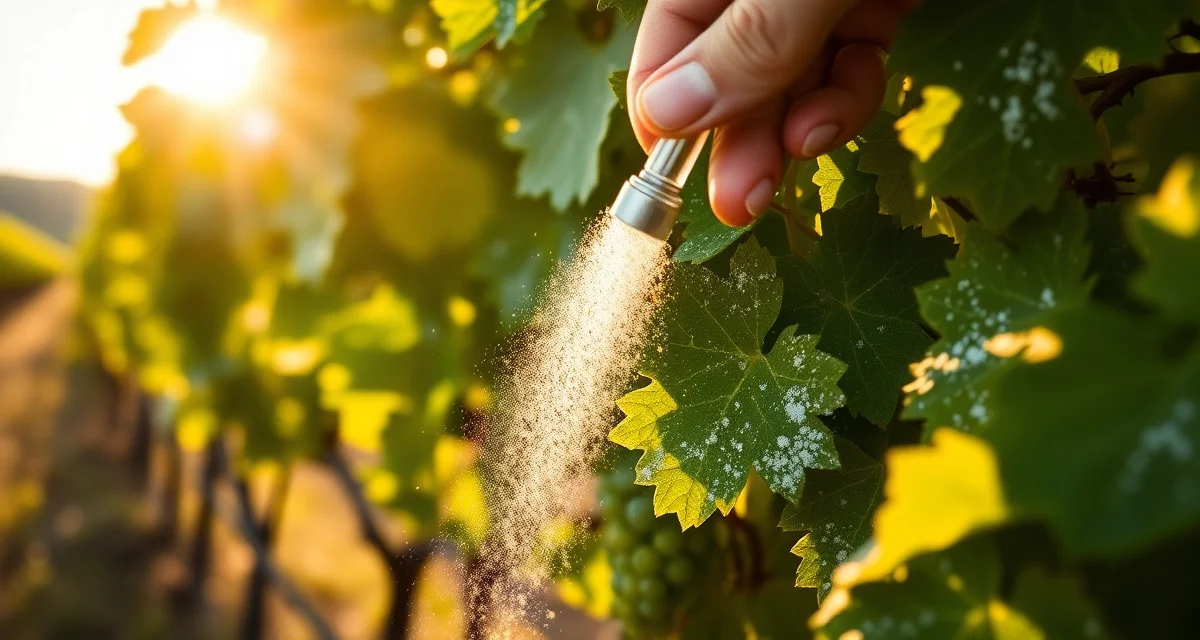
Organic Powdery Mildew Control for Vineyards
Organic powdery mildew control in vineyards is achievable. It requires tighter spray intervals, better canopy management, and a program built around materials that actually work -- not just whatever's in the organic section of the ag supply catalog.
The growers who succeed with organic powdery mildew control understand the biology, know their materials, and don't skip spray windows because they think organic products are "gentler." Some of them will burn your vines if you apply them wrong.
TL;DR
- Wettable sulfur at 3-4 lbs/acre is the backbone of every organic powdery mildew program -- no resistance has developed in centuries of use, and no other OMRI-listed material matches it for cost-efficiency
- Sulfur phytotoxicity risk is real: applications within 24-48 hours before temperatures above 90°F cause leaf and berry burning -- a critical limitation in inland California, Paso Robles, and warm Washington AVAs during summer
- Potassium bicarbonate (Kaligreen, Armicarb, MilStop) provides both preventive and some curative activity and is the primary rotation partner with sulfur -- useful when heat prevents sulfur use
- Copper has limited direct efficacy against powdery mildew and shouldn't be counted toward your powdery mildew program -- copper is more effective against downy mildew and bacterial diseases
- Stylet oil and neem shouldn't be tank-mixed with sulfur: both combinations create phytotoxicity risk, and oil products need a minimum 2-week gap before sulfur applications
- Organic programs have no curative synthetic chemistry to fall back on when spray windows are missed -- a missed bloom-window application in an organic program is harder to recover from than in a conventional program
Materials That Work for Organic Powdery Mildew Control
Sulfur (FRAC M2)
The backbone of every organic powdery mildew program. Sulfur has been used on grapes for centuries, no resistance has developed, and it's inexpensive.
What works: Wettable sulfur at 3-4 lbs/acre, micronized sulfur, sulfur dust (not preferred in most operations due to worker exposure and drift)
What doesn't work: Applying sulfur incorrectly
The heat problem: Elemental sulfur applied within 24-48 hours before temperatures above 90°F causes phytotoxicity -- burning of leaf and berry tissue. In inland California, Paso Robles, and parts of Washington, heat events during summer require adjusting your sulfur timing. Apply sulfur in the morning when evening temperatures won't spike, or switch to non-sulfur materials during sustained heat periods.
PHI: Most sulfur formulations list 0 days PHI, though some list 2 days. Confirm your specific product label.
REI: 24 hours for most sulfur products -- longer than many growers expect. Don't send workers into a sulfur-treated block three hours after spraying.
Potassium Bicarbonate (FRAC BM01)
Products: Kaligreen, Armicarb, MilStop
Potassium bicarbonate raises surface pH, disrupting the fungal cell wall. It has both preventive and some curative activity.
Best use: Early-season primary infection management, alternated with sulfur
Rate: Follow label -- typically 2.5-3.5 lbs/acre
Limitations: Shorter residual than sulfur; more expensive per application
PHI: 0 days
Neem Oil (FRAC U12-like activity as a multi-site)
OMRI-listed neem products (Trilogy, others) have fungistatic activity.
Best use: Early-season rotation partner with sulfur
Limitations: Moderate efficacy; requires thorough coverage; can cause phytotoxicity in some conditions
PHI: Check specific product label
Stylet Oil / JMS Stylet Oil
Paraffinic or mineral oils have physical mode of action -- they smother spores and disrupt the waxy surface on which mildew develops.
Best use: Early season, especially around budbreak and primary infection period
Limitations: Don't mix with sulfur (phytotoxicity risk); moderate efficacy
Copper
Copper has limited activity against powdery mildew specifically. It's more effective against downy mildew and bacteria. Copper is an organic program staple but for downy mildew or bacterial diseases, not powdery mildew.
Don't count copper toward your powdery mildew program.
Bacillus subtilis (Serenade, Rhapsody)
Biological fungicide with OMRI listing. Preventive activity; limited curative.
Best use: Tank-mix partner to enhance coverage and add biological activity; not effective as a standalone program
PHI: 0 days
For the FRAC group context on organic materials and how they fit within multi-site classification, see the fungicide FRAC groups guide.
Building an Organic Powdery Mildew Spray Program
The key difference between organic and conventional programs: no curative synthetic chemistry to fall back on. An organic program has to be preventive. When you miss a spray window in a conventional program, Rally or Fontelis can provide some kickback activity. When you miss a window in an organic program, you're behind and catching up is hard.
Interval: 7-10 days during bloom and fruit set, 10-14 days in lower-pressure periods
No exceptions during bloom: Organic Cabernet Sauvignon and Chardonnay during bloom need 7-day intervals in California conditions.
Sample organic rotation for California:
- Budbreak: Stylet Oil
- 3-inch shoot: Sulfur 3 lbs/acre
- Pre-bloom: Kaligreen 2.5 lbs/acre
- Bloom: Sulfur 4 lbs/acre
- Post-bloom: Sulfur 4 lbs/acre
- Fruit set: Kaligreen + Serenade tank mix
- Mid-season: Sulfur 3 lbs/acre (adjust for heat)
- Pre-veraison: Kaligreen
- Veraison+: Sulfur (low rate)
For organic programs in coastal Sonoma where fog creates extended overnight infection windows, see the Chardonnay powdery mildew management guide for Sonoma.
Canopy Management as IPM Tool
Canopy management is your most powerful organic disease management tool besides sprays.
Shoot positioning: VSP (vertical shoot positioning) with properly spaced shoots creates air circulation that reduces the humidity microclimate where powdery mildew develops. Positioned shoots dry faster after dew or fog.
Leaf removal: Strategic leaf removal in the cluster zone at fruit set improves spray penetration and air circulation. This is particularly important for Pinot Noir and Chardonnay in cool-climate regions where cluster moisture drives both powdery mildew and botrytis.
Canopy density: Overcrowded canopies trap humidity. If your VSP is so dense that you can't see through it, you're creating a mildew incubator.
The spray program and canopy management work together. Don't expect your organic fungicide program to compensate for a poorly managed canopy.
Documentation for Organic Operations
Every organic input application needs to be documented with OMRI listing status. VitisScribe flags OMRI-listed products and tracks your organic input applications separately from any conventional applications on other blocks.
Sulfur application rates matter for CCOF compliance -- track your cumulative sulfur applications per block per season, especially if you're near the limits some certifiers set.
Related Articles
- Identifying Powdery Mildew in Vineyards: Field Guide
- Identifying Downy Mildew in Vineyards: Field Guide
FAQ
Can I control powdery mildew organically in California vineyards?
Yes, but it requires tight spray intervals -- 7-10 days during bloom and fruit set -- and a program built primarily around sulfur with rotation partners like potassium bicarbonate and stylet oil. Organic powdery mildew control is harder than conventional control in high-pressure years. In extreme pressure seasons, expect some leaf symptoms but focus protection on clusters.
What is the best organic fungicide for vineyard powdery mildew?
Sulfur is the most effective and cost-efficient organic material for powdery mildew. Wettable sulfur at 3-4 lbs/acre on a 7-14 day interval is the backbone of every successful organic powdery mildew program. Potassium bicarbonate products (Kaligreen, MilStop) are effective rotation partners. Stylet Oil has value early in the season. Biologicals like Serenade are better as supplements than standalone materials.
Does sulfur have any PHI restrictions for organic grape production?
Most sulfur formulations list 0 days PHI, but some formulations specify 2 days. Always check the label of the specific sulfur product you're using -- different formulations can have different PHI values even for the same active ingredient. The more important restriction is the REI: most sulfur products require a 24-hour re-entry interval. Workers should not enter sulfur-treated blocks for 24 hours after application.
How does an organic grower document a spray window missed due to heat events that prevented sulfur application?
The documentation should capture the weather conditions that prevented the application: the forecasted and actual high temperatures during the intended spray window, the decision to delay rather than risk phytotoxicity, and the alternative material used (if any) when conditions allowed. If no application was possible during the window -- high temperatures prevented sulfur and you don't carry potassium bicarbonate as an alternative -- document the weather and scouting observation that assessed disease status after the delay. That record shows the decision was conditions-based, not a skipped spray. VitiScribe's weather station integration auto-captures the temperature data alongside spray entries, so the heat event that prevented the application appears in the record with the application that followed.
What CCOF documentation is required for every OMRI-listed material application in an organic Chardonnay program?
CCOF requires documentation of OMRI listing status for every organic input used. That means the application record for each sulfur, potassium bicarbonate, or biological product application should include the specific product name and formulation (not just "sulfur"), the OMRI listing number or notation that it is OMRI-listed, and the date applied. CCOF can request verification that the specific formulation used was OMRI-listed at the time of application -- OMRI listings are updated periodically, so a product that was OMRI-listed last season may have changed status. VitiScribe's organic program tracking flags OMRI-listed products and records OMRI status at the time of application entry.
What is Organic Powdery Mildew Control for Vineyards?
[FAQ_ANSWER_PLACEHOLDER: This answer needs to be generated by AI with specific data, examples, and actionable advice relevant to Organic Powdery Mildew Control for Vineyards. Target 50-150 words.]
How much does Organic Powdery Mildew Control for Vineyards cost?
[FAQ_ANSWER_PLACEHOLDER: This answer needs to be generated by AI with specific data, examples, and actionable advice relevant to Organic Powdery Mildew Control for Vineyards. Target 50-150 words.]
How does Organic Powdery Mildew Control for Vineyards work?
[FAQ_ANSWER_PLACEHOLDER: This answer needs to be generated by AI with specific data, examples, and actionable advice relevant to Organic Powdery Mildew Control for Vineyards. Target 50-150 words.]
Sources
- USDA National Organic Program
- CCOF (California Certified Organic Farmers)
- OMRI (Organic Materials Review Institute)
- UC Cooperative Extension Viticulture
- Oregon Tilth (OTCO)
Get Started with VitiScribe
Organic powdery mildew programs require OMRI listing documentation for every input, sulfur phytotoxicity monitoring during heat events, block-level cumulative sulfur tracking for certifier compliance, and 7-10 day interval management through bloom -- documentation requirements that generic spray logs don't connect to organic certification records. VitiScribe flags OMRI-listed products, tracks organic input applications separately from conventional blocks, records OMRI status at application entry, and generates certifier-ready organic input documentation. Try VitiScribe free and build your first organic powdery mildew program documentation today.