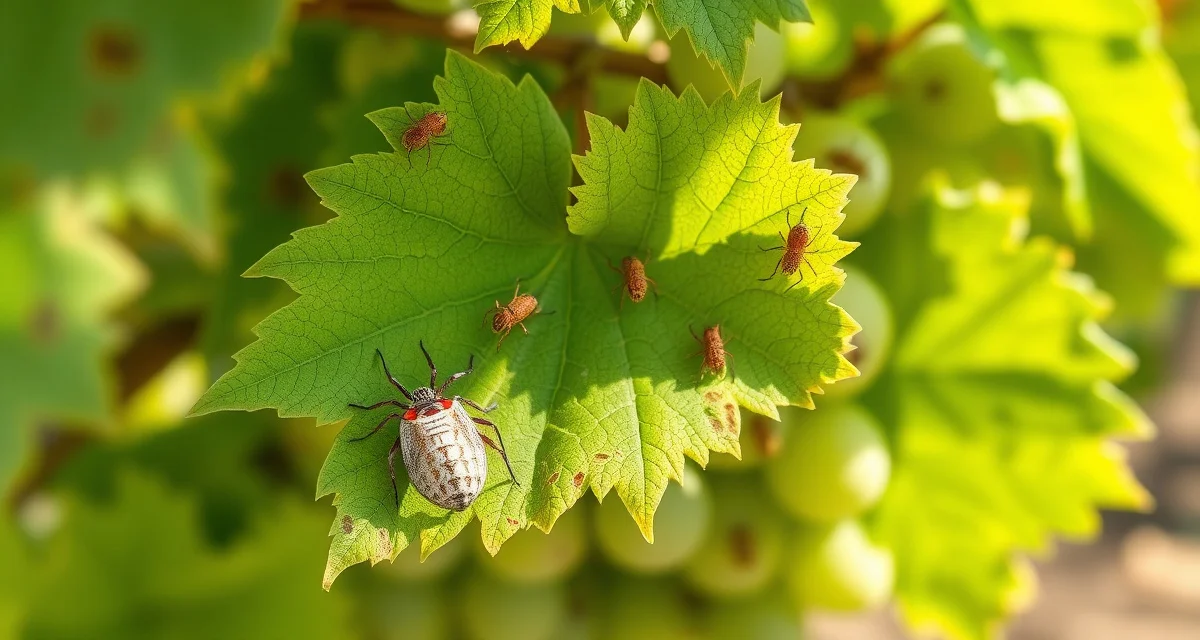
Spider Mite IPM for Vineyards: Complete Control Guide
Spider mites flare in hot, dry weather and after pyrethroid applications. If you've had a summer heat wave in Paso Robles or the San Joaquin Valley and wondered why your Zinfandel leaves started bronzing in July, spider mites were likely involved.
The primary species in California vineyards are Pacific spider mite (Tetranychus pacificus) and Willamette mite (Eotetranychus willamettei). Pacific mite is the major problem in inland, hot regions; Willamette mite causes issues in cooler coastal regions. Their biology and management are similar enough that the IPM approach is consistent.
TL;DR
- Spider mite populations can go from near-zero to economic threshold in 1-3 weeks during a heat wave above 90°F -- monitoring every 7-10 days during hot periods in July-August is the minimum frequency that allows a timely response
- Pyrethroid applications for leafhopper or other pests kill predatory mites (Metaseiulus occidentalis and Typhlodromus pyri) that suppress spider mite populations; the classic pesticide-induced flare follows 2-3 weeks later as mites recover faster than their predators
- Always count predatory mites alongside spider mite counts -- a ratio of 1 predator per 3-5 spider mites may support biological control without chemical intervention even above the general threshold count
- Agri-Mek (abamectin, IRAC Group 6) has a 28-day PHI on wine grapes -- a mid-August application must clear before a mid-September harvest; Acramite (bifenazate, 7-day PHI) and Portal (fenpyroximate, 7-day PHI) are the practical late-season alternatives
- Savey (hexythiazox, IRAC Group 10B) has a 60-day PHI, making it appropriate for early-season preventive use only; it cannot be used after approximately late July for most California harvest timing
- IRAC group rotation is essential -- resistance to abamectin has been documented in California spider mite populations; applying the same group more than once per season per block accelerates resistance development
Spider Mite Biology
Spider mites overwinter as adult females in leaf litter and under bark. They become active in spring, colonizing lower leaves first and moving up the canopy as populations build.
Population dynamics: Spider mite populations can increase extremely rapidly under hot, dry conditions. A single female can produce hundreds of offspring in a season. From near-zero levels to economic threshold can happen in 1-3 weeks during a heat wave.
Heat flares: Temperatures above 90°F accelerate mite development and reproduction. Extended heat periods in inland California wine regions can cause explosive population growth in July-August.
Pesticide-induced flares: Pyrethroid insecticide applications kill predatory mites (Metaseiulus occidentalis and other phytoseiids) that suppress spider mite populations. The mites recover faster than their predators, leading to the classic "pesticide-induced flare" that occurs 2-3 weeks after a pyrethroid application.
Economic Thresholds and Monitoring
Monitoring Method
Count mites per leaf on 10 leaves from the mid-canopy position (4th to 6th leaf from the shoot tip) on 10 vines across the block. Use a 10x hand lens.
For quick estimates: check the underside of leaves for the characteristic fine webbing and tiny (0.5mm) red or yellow-green mites. Bronzing or stippling of the upper leaf surface indicates feeding activity.
Economic Thresholds
UC IPM thresholds for California wine grapes:
- Pre-bloom: 5+ mites per leaf with evidence of increasing population (particularly if natural enemies are low)
- Post-bloom through veraison: 10-20 mites per leaf, depending on canopy size, vine water stress, and presence of predators
- Pre-harvest: Lower threshold -- vine stress and defoliation at this point affect ripening
Always consider predatory mite populations alongside spider mite counts. If predatory mites are present at a ratio of 1 predator per 3-5 spider mites, biological control may suppress the population without chemical intervention.
For documentation of threshold-based spray decisions that satisfies sustainable certification audit review, see the powdery mildew threshold spray decisions guide for the documentation framework that applies equivalently to spider mite threshold decisions.
Management Options
Biological Control
Metaseiulus occidentalis (western predatory mite) and Typhlodromus pyri are the primary predatory mite species in California vineyards. They can suppress spider mite populations effectively when not disrupted by pesticide applications.
Do not apply pyrethroids or organophosphates if predatory mites are present and at favorable ratios. These materials devastate predator populations.
If you've eliminated predators through pesticide use, you can purchase and release predatory mites. Releases work best when spider mite populations are not already at high levels.
Chemical Miticides
IRAC Group 10A (Clofentezine -- Apollo): Ovicidal/larvicidal activity. Excellent for preventive and early-season use before populations build. PHI: 7 days.
IRAC Group 10B (Hexythiazox -- Savey): Ovicidal activity. Apply before populations peak. PHI: 60 days -- significant for harvest timing.
IRAC Group 6 (Abamectin -- Agri-Mek): Very effective, residual activity, systemic. Must be applied with a penetrant oil. PHI: 28 days. Resistance can develop with heavy use.
IRAC Group 25 (Bifenazate -- Acramite): Effective contact miticide. Lower resistance risk. PHI: 7 days.
IRAC Group 21 (Fenpyroximate -- Fujimite/Portal): Rapid knockdown of motile stages. PHI: 7 days.
Petroleum/horticultural oils: Effective physical control. Apply when temperatures are below 90°F (phytotoxicity risk). PHI: 0 days.
Sulfur: Has some miticide activity. Already in your fungicide program? It's providing incidental mite suppression.
Resistance Management for Spider Mites
Spider mites have tremendous capacity for resistance development. Resistance to abamectin and to some carbamate miticides has been documented in California populations.
Rotate IRAC groups between applications. Don't apply abamectin more than once per season per block. If you're seeing reduced efficacy from a previously effective miticide, you may have a resistant population -- contact your UC Farm Advisor.
Interaction With Fungicide and Insecticide Programs
The mite program doesn't exist in isolation:
- Sulfur applications in your powdery mildew program provide incidental mite suppression
- Pyrethroid applications for leafhopper or other insects disrupt predatory mites
- Oil applications in your fungicide program can provide physical mite control
Build your spray programs with mite-predator conservation in mind. Choose insecticides with lower predator impact when alternatives are available.
For the complete insecticide REI and PHI reference covering the products most likely to intersect with spider mite management decisions, see the REI insecticides vineyard reference.
Related Articles
- Eutypa Dieback in Vineyards: Complete Management Guide
- Leafhopper Management in Vineyards: IPM Guide
FAQ
How do I know if I need to spray for spider mites in my vineyard?
Monitor by counting mites per leaf (use a 10x hand lens on the underside of mid-canopy leaves) and evaluate the ratio of spider mites to predatory mites. UC IPM guidelines suggest action thresholds of 10-20 mites per leaf in most post-bloom situations, but adjust based on predator populations, vine water stress, and proximity to critical growth stages. A population of 20 mites per leaf with 5 predatory mites per leaf may not warrant treatment; the same mite population with zero predators warrants action.
Why did my spider mite population explode after I applied insecticides?
This is the classic pesticide-induced mite flare. Broad-spectrum insecticides -- especially pyrethroids -- kill predatory mites that were suppressing the spider mite population. Spider mites recover and reproduce faster than predatory mites after a disruptive application. The result is explosive mite population growth 2-3 weeks after the insecticide application. Avoid pyrethroids when mite pressure is present or when predatory mite populations are established.
What is the PHI for Agri-Mek (abamectin) on wine grapes?
Agri-Mek has a 28-day PHI on wine grapes in California. This is a significant harvest timing consideration -- an Agri-Mek application in mid-August must clear before harvest in mid-September. If you're managing a late September harvest, Agri-Mek applied before September 1st clears PHI. Use Acramite (bifenazate, 7-day PHI) or Portal (fenpyroximate, 7-day PHI) for late-season mite control when PHI is a concern.
How should scouting records document both spider mite counts and predatory mite counts to satisfy a SIP Certified audit review of natural enemy conservation practices?
SIP Certified requires documentation of natural enemy conservation practices, and spider mite scouting records that include predatory mite counts alongside pest mite counts are the primary documentation for this standard. Each scouting entry should record: the date, block, number of leaves sampled, count of pest mites per leaf (average), count of predatory mites per leaf (average), the pest-to-predator ratio, and the management decision. If the decision was no-spray because predatory mite ratios were at a suppressive level, the no-spray decision and ratio rationale should be noted explicitly. If the decision was to spray but with a selective miticide to preserve predators, the product selection rationale belongs in the record. VitiScribe's scouting module captures both pest and predator counts in a single observation entry linked to the subsequent spray record or documented no-spray decision.
For a California operation where abamectin resistance is suspected based on reduced efficacy after application, what records should accompany a product switch and a consultation with a UC Farm Advisor?
The records supporting a resistance investigation should include the application records showing the abamectin application(s) (date, rate, block), post-application scouting records showing mite counts that indicate inadequate control (scouted 5-7 days after application at which point efficacy should be visible), and the Farm Advisor consultation note documenting the reported failure and the recommendation to switch products and/or submit a population for resistance testing. The product switch record should note the IRAC group of the replacement product and reference the abamectin efficacy failure as the rationale for the switch. This documentation sequence converts what might look like a rotation gap into a documented resistance response -- a distinction that matters in a DPR inspection or sustainable certification audit.
What is Spider Mite IPM for Vineyards: Complete Control Guide?
[FAQ_ANSWER_PLACEHOLDER: This answer needs to be generated by AI with specific data, examples, and actionable advice relevant to Spider Mite IPM for Vineyards: Complete Control Guide. Target 50-150 words.]
How much does Spider Mite IPM for Vineyards: Complete Control Guide cost?
[FAQ_ANSWER_PLACEHOLDER: This answer needs to be generated by AI with specific data, examples, and actionable advice relevant to Spider Mite IPM for Vineyards: Complete Control Guide. Target 50-150 words.]
How does Spider Mite IPM for Vineyards: Complete Control Guide work?
[FAQ_ANSWER_PLACEHOLDER: This answer needs to be generated by AI with specific data, examples, and actionable advice relevant to Spider Mite IPM for Vineyards: Complete Control Guide. Target 50-150 words.]
Sources
- UC IPM Program
- UC Cooperative Extension Viticulture
- IRAC (Insecticide Resistance Action Committee)
- California Department of Pesticide Regulation (CDPR)
- American Vineyard Foundation
Get Started with VitiScribe
Spider mite IPM requires monitoring records that track both pest and predatory mite populations, IRAC group rotation across applications, and PHI management against harvest timing for late-season miticide applications -- documentation that a paper log captures poorly when counts, ratios, and group rotation all need to be cross-referenced against block spray history. VitiScribe's scouting module captures pest and predator counts simultaneously, tracks IRAC group rotation by block, and flags PHI conflicts for any miticide application scheduled near the block's anticipated harvest date. Try VitiScribe free and log your first spider mite scouting observation today.